• 검색 결과가 없습니다.

Factors Related to Efforts to Enhance Health Behavior Among Patients With Metabolic Disease

N/A
N/A
Protected

Academic year: 2021

Share "Factors Related to Efforts to Enhance Health Behavior Among Patients With Metabolic Disease"

Copied!
10
0
0

로드 중.... (전체 텍스트 보기)

전체 글

(1)

1. Introduction

Due to changing lifestyles entailing lack of

exercise and overeating, metabolic syndrome has been a growing concern in Korea[1,2]. Of men over 30 years old, 31.9%, of women, 25.6%, and

Factors Related to Efforts to Enhance Health Behavior Among Patients With Metabolic Disease

Sun Kyung Kim 1 , Sun Ae Kim 2* , Yu Mi Kim 3

1

Professor, Department of Nursing, Mokpo National University

2

Professor, Department of Nursing, Korea National University of Transportation

3

Doctoral Course, Department of Nursing, Chungnam National University

대사성 질환자의 건강행위증진 노력관련 융합연구

김선경 1 , 김선애 2* , 김유미 3

1

목포대학교 간호학과 교수,

2

한국교통대학교 간호학과 교수,

3

충남대학교 간호대학 박사과정

Abstract The purpose of this study was to investigate the convergence factors affecting disease management efforts of the middle-aged population who have comorbidities of all three metabolic diseases: type 2 diabetes, hypertension, and dyslipidemia. This study used raw data from the 2015 community health survey(CHS). A multiple hierarchical regression analysis was performed that the included variables explained 20.1% of the variance in weight-loss efforts, 6.8% of exercise efforts and 5.3% diet efforts respectively. This study revealed associations among gender, socioeconomic status, and behavioral habits of smoking and drinking with disease-management efforts. It is important to design a health service or supportive intervention with consideration of multiple factors for patients with multiple metabolic disease.

Key Words : Convergence, Metabolic disease, Exercise, Diet effort, Weight loss

요 약 본 연구의 목적은 제 2 형 당뇨병, 고혈압 및 이상지질혈증을 복합적으로 가지고 있는 중년 대상자의 체중조절, 운동, 식이조절을 통한 질환관리 노력에 영향을 미치는 융합적 요인을 확인하고자 시행되었다. 본 연구는 2015 년 지역 사회 건강 조사 (CHS)의 원시 데이터를 사용했다. 2015년 지역사회건강조사의 총 228,558명 중 연구대상 선정기준에 부합되어 분석에 이용된 대상자는 2,990명의 데이터를 활용하였다. 다중 회귀 분석이 수행되었고 체중조절노력, 운동노 력, 식이조절노력 변수의 설명력은 각각 20.1%, 6.8 %, 5.3 %였다. 본 연구의 결과는 대사성 질환이 복합적으로 있는 대상자의 성별, 사회 경제적 상태 및 흡연과 음주의 행동 습관과 체중감소, 운동, 식이조절의 질병 관리 노력의 관계를 보여 주었다. 향후 대사질환을 복합적으로 가지고 있는 환자를 위한 서비스나 중재 프로그램 개발에 요소들을 복합적으 로 고려할 것을 제언한다.

주제어 : 융합, 대사성 질환, 운동, 식이노력, 체중감소

*Corresponding Author : Sun Ae Kim([email protected]) Received August 19, 2019

Accepted October 20, 2019

Revised October 2, 2019

Published October 28, 2019

(2)

of men and women combined, 28.8% have metabolic-syndrome prevalence.

Hypertension, type 2 diabetes, and hyperlipidemia are the most prevalent metabolic diseases affecting the productive population aged 30 to 60[2]. Hypertension disease prevalence is estimated to be 26.9% in the adult population[3]

and the majority of this population have comorbidities of other metabolic diseases: type 2 diabetes or dyslipidemia[4].

People with metabolic disease have a great risk of developing complications. Previous studies indicated cardiovascular disease is one of the major complications of metabolic disease and results in disease with high mortality such as heart attack and stroke[5,6]. These are the leading causes of death among the middle-aged adult population in Korea[7]. The treatment of metabolic disease is costly, comprising more than one third of the total domestic medical expenses in Korea. Moreover, the cost of treatment for cardiovascular diseases is continuously increasing[8-10]. Thus, considering the high prevalence of metabolic diseases in elders, management of the disease in the younger population is very important to prevent catastrophic outcomes.

Type 2 diabetes, hypertension, and dyslipidemia are closely related metabolic diseases that often develop as a result of excessive calorie intake and little physical inactivity[1,2]. In Korea, concerns have been raised regarding health behavior in middle aged adults with metabolic disease such as excessive intake of carbohydrates and sodium, and sedentary lifestyles[11-13]. In addition, among middle-aged women, menopause aligns with risk of overweight and obesity and developing metabolic disease[14].

Guidelines for metabolic-disease management indicate that timely interventions with proper lifestyle modification include improved health behaviors with proper weight loss, essential to preventing the development of further

complications[15-17]. In addition, a meta-analysis of 13 randomized experimental studies showed that a combination of nutrition and exercise interventions are more effective in reducing metabolic-related factors such as abdominal obesity and systolic blood pressure than are nutrition and exercise interventions alone[18].

Metabolic diseases are chronic; modification in one’s daily lifestyle occurs not only through medication, but also through exercise and proper diet[19]. Despite evidence suggesting continuous efforts in lifestyle modification, people in this age group are often less interested in improving their health as they age, rending it more difficult to modify their behavior patterns. The first step in interventions for lifestyle modification for patients with metabolic disease is education.

However, it is unknown if education is effective at influencing sustainable disease management over time[20,21].

A comprehensive understanding of factors affecting efforts to manage disease is essential;

thus the provision of baseline information on the middle-aged population with metabolic disease could promote healthier lifestyles in this population. Several contextual factors have been identified as determinants of metabolic disease including socio-demographic characteristics and health behavior related factors in middle aged adults[12,13,22,23]. But, previous studies only partially examined the influencing factors in small groups. Using big data and examining diverse variables could reveal a more comprehensive understanding of factors that enable health providers to develop and implement practical interventions for patients with metabolic disease.

To achieve the research objective through the

analysis of big data, this study used raw data

from the Community Health Survey (CHS),

conducted in 2015. CHS has launched to provide

population-based estimates of health indicators

since 2008. The purpose of this study was to

investigate the factors affecting the disease-

(3)

management efforts of the middle-aged population who have comorbidities of all three metabolic diseases: type 2 diabetes, hypertension, and dyslipidemia.

2. Method

A retrospective secondary analysis was conducted using data from 2015 CHS, national-wide survey.

2.1 Sample

The data for this study accrued from the 2015 CHS run by the Korean Center for Disease Control and Prevention with 253 community health centers and 36 universities. Trained interviewers conducted 1:1 protocols and computer-assisted personal interviews. The CHS is nationwide survey that targets the adult population, aged 19 and older, and has been conducted annually for 3 months since 2008. The survey questionnaire consists of 11 fields including factors related to demographics, behavior, comorbidities, and quality of life. The quality of survey data is ensured by the Ministry of Health and Welfare, which readministers the survey to a random 10% of participants and retrains interviewers. Of the 228,558 adults who took part in the CHS in 2015, 2,990 adults had all three metabolic diseases: type 2 diabetes, hypertension, and dyslipidemia.

2.2 Independent variables

Independent variables included demographic factors, physical and psychological factors, health-habit factors, and education factors.

Demographic factors included age (40s, 50s, and 60s), gender (male/female), education level (less than elementary school, middle school graduate, high school graduate, and college graduate and above), having a spouse (yes/no), income level (less than 1 million, 1~3million and 4 million won

and above) and economic activity in the past week (yes/no). Physical and psychological factors included EQ-5D from -1 to 1, perceived level of health status (poor, moderate, or good), perceived level of stress status (very high, high, low, or very low) and perceived body image (very thin, thin, normal, fat, or very fat). Health-habit factors include drinking alcohol (yes, not in the last year, or never drank alcohol) and smoking (yes, not in the last year, or never smoked).

Education factors include previous experiences of education regarding disease management for hypertension (none ~ 3 times) and previous experience of education regarding disease management of type 2 diabetes (none ~ 3 times).

2.3 Dependent variables

The dependent variables were disease management efforts including weight loss, exercise, and low-salt diet. Efforts related to weight loss indicated when a person attempted no weight loss, maintained their weight, or worked to lose weight. The scores range from 0 to 2, with higher scores indicating more active efforts at losing weight. Exercise effort is a sum of the number of days in a week of flexibility exercises and the number of days of strength exercises. Score range from 0 to 10 with higher scores indicating more exercise activity. Efforts to eat a low-salt diet are the sum of three items including usual salt-intake levels, the amount of salt added when eating, and the amount of soy sauce intake when eating fried foods. Scores range from 3 to 12 with higher scores indicating a lower salt diet.

2.4 Statistical analysis

We used SPSS version 24.0 to perform data

analysis; statistical significance was p < .05. A

complex sample plan file was used that was

developed to ensure representativeness of

sampling in this study. We used an ANOVA or

(4)

t-test to identify group differences for scores of individual dependent variables. Finally, we performed a multiple hierarchical regression analysis, entering independent variables in four blocks.

3. Results

We used data from 2,990 individuals with multiple metabolic diseases: type 2 diabetes, hypertension, and dyslipidemia.

3.1 General characteristics

Table 1 presents scores of the three efforts of weight loss, exercise, and diet, by sociodemographic,

Category Efforts 1 Weight loss Efforts 2 Exercise Efforts 3 Diet

N % M SD t/F (p) M SD t/F (p) M SD t/F (p)

Age

40s 288 9.6 1.42 0.839

26.03 (<.001)

2.02 2.593 1.45 (.234)

8.84 1.465 2.52 (.081)

50s 1033 34.5 1.17 0.91 2.34 2.986 8.99 1.538

60s 1669 55.8 1.03 0.922 2.34 3.102 9.05 1.513

Gender Male 1474 49.3 1.05 0.915 -3.94

(<.001)

2.67 3.356 6.52 (<.001)

8.76 1.624 -9.16 (<.001)

Female 1516 50.7 1.18 0.915 1.96 2.598 9.26 1.362

Education level

6< 1055 35.3 0.99 0.942

13.65 (<.001)

1.78 2.662 27.77 (<.001)

9.04 1.501 1.31 (.268)

6~12 640 21.4 1.11 0.918 2.11 2.93 9.08 1.476

12~15 845 28.3 1.18 0.896 2.67 3.19 8.98 1.524

15> 450 15.1 1.29 0.857 3.14 3.311 8.91 1.601

Having spouse Yes 2292 76.7 1.12 0.914 0.82

(.411)

2.41 3.065 3.36 (<.001)

8.99 1.522 -1.10 (.273)

No 698 23.3 1.09 0.929 1.99 2.831 9.07 1.504

Economic activity Yes 1713 57.3 1.08 0.924 2.04

(.042)

2.26 2.98 0.99 (.322)

8.95 1.518 2.59 (.010)

No 1277 42.7 1.15 0.908 2.37 3.065 9.09 1.514

Household income (10,000won/month)

< 100 847 28.3 1.01 0.936

13.38 (<.001)

1.96 2.857 19.88 (<.001)

9.04 1.568 0.30 (.743)

100~399 1650 55.2 1.11 0.913 2.28 3.001 9.00 1.499

400 > 493 16.5 1.28 0.876 3.02 3.215 8.98 1.496

Smoking

Everyday 504 16.9 0.89 0.911

14.18 (<.001)

2.21 3.077 12.38 (<.001)

8.54 1.659 32.94 (<.001)

Sometimes 40 1.3 0.88 0.939 2.58 2.925 8.55 1.782

Not in last 1 yr 828 27.7 1.12 0.914 2.83 3.449 8.87 1.614

Never smoked 1618 54.1 1.18 0.91 2.06 2.716 9.24 1.362

Drinking alcohol

Yes 1843 61.6 1.13 0.912

3.74 (.024)

2.52 3.139 18.06 (<.001)

8.84 1.562 31.23 (<.001)

Not in last 1 yr 596 19.9 1.15 0.92 2.25 3.022 9.29 1.381

Never 551 18.4 1.02 0.93 1.65 2.445 9.28 1.424

EQ-5D < 0.678 261 8.7 1.06 0.953 -0.98

(.329)

1.53 2.735 -4.78 (<.001)

9.11 1.672 1.16 (.246)

>= 0.678 2729 91.3 1.12 0.914 2.38 3.032 9.00 1.502

Perceived level of health status

Bad 1643 54.9 1.09 0.924

1.77 (.170)

1.95 2.851 30.65 (<.001)

9.04 1.554 0.84 (.432)

Moderate 1054 35.3 1.15 0.904 2.6 3.047 8.96 1.477

Good 293 9.8 1.08 0.926 3.23 3.479 9.04 1.453

Perceived level of stress status

Very high 138 4.6 1.01 0.924

1.27 (.284)

1.68 2.75 6.83 (<.001)

8.91 1.729 2.74 (.042)

High 761 25.5 1.12 0.935 1.99 2.77 8.89 1.584

Low 1421 47.5 1.14 0.906 2.46 3.057 9.04 1.471

Very low 670 22.4 1.08 0.919 2.49 3.206 9.1 1.487

BMI

< 18.5 9 0.3 0.67 0.866

129.64 (<.001)

2.00 3.500 0.33 (.806)

9.33 1.732 3.83 (.009)

18.5~22.99 563 18.8 0.57 0.764 2.42 3.097 9.16 1.527

23.0~24.99 810 27.1 0.97 0.906 2.29 3.027 9.07 1.485

>= 25.0 1608 53.8 1.37 0.874 2.28 2.982 8.93 1.526

Perceived physical fitness of self

Very thin 34 1.1 0.15 0.359

156.07 (<.001)

0.62 1.393 7.41 (<.001)

9.18 1.623 4.14 (.002)

Thin 178 6 0.34 0.6 1.97 3.075 8.99 1.669

Normal 985 32.9 0.75 0.831 2.61 3.221 9.17 1.495

Fat 1393 46.6 1.37 0.878 2.3 2.974 8.93 1.484

Very fat 400 13.4 1.55 0.809 1.91 2.591 8.92 1.586

HTN management education

None 2252 75.3 1.08 0.923

4.82 (.002)

2.18 2.966 6.03 (<.001)

9.01 1.497 0.32 (.814)

1 683 22.8 1.21 0.894 2.72 3.151 9.02 1.59

2 49 1.6 1.33 0.899 2.22 2.733 8.9 1.489

3 6 0.2 1 0.632 3.5 4.722 9.5 1.378

DM management education

None 2105 70.4 1.07 0.926

7.17 (<.001)

2.15 2.951 7.81 (<.001)

8.97 1.506 1.72 (.160)

1 829 27.7 1.21 0.893 2.69 3.151 9.11 1.538

2 50 1.7 1.44 0.837 2.4 2.556 8.92 1.55

3 6 0.2 1.5 0.548 4.67 5.164 9.33 2.251

Table 1. Descriptive of general characteristics of study participants

(5)

physical, psychological, health-habit, and education-related factors of individuals with metabolic diseases. More than half of study participants (55.8%) were in their 60s and the proportion of men was slightly higher than women. Most participants were not involved in economic activity (57.3%) and the majority had income between 1,000,000 and 3,990,000 won.

Nine of ten study participants (90.2%) reported health status of moderate to poor. At present, 19.9% were drinking alcohol and 16.9% were smoking. About two thirds reported being fat or very fat (60.0%) and a large proportion of study participants reported experiencing no education on managing hypertension or type 2 diabetes (75.3% and 70.4%, respectively).

3.2 Correlation analysis

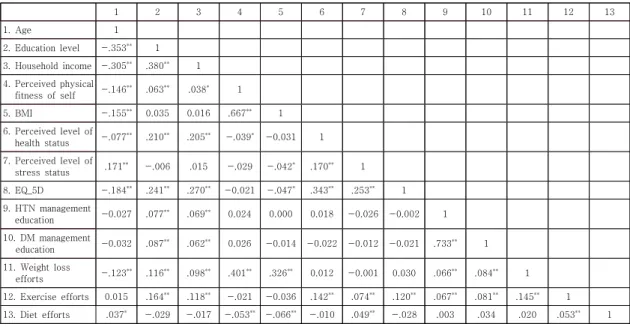
The correlation analysis among continuous variables appears in Table 2; all correlations were weak. Statistically significant correlations emerged between weight loss and exercise (r = .145, p < .001), and exercise and diet (r = .053, p

< .001).

3.3 Hierarchical regression analysis

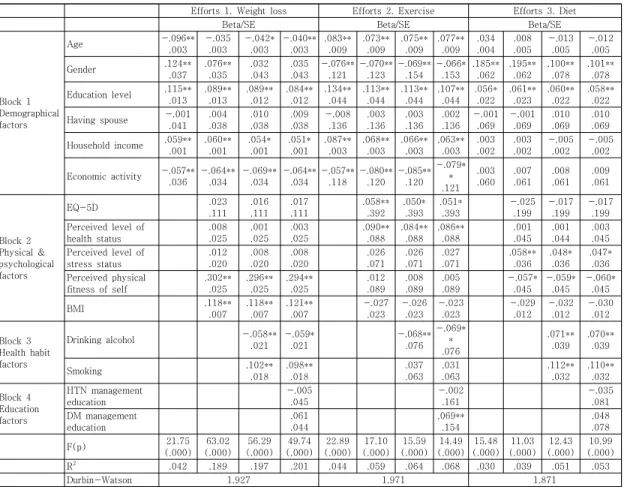
We entered study variables into a four-block model grouping sociodemographic factors in Block 1, physical and psychological factors in Block 2, health-habit factors in Block 3, and education factors in Block 4 (Table 3). The multi-collinearity was examined using variance of the inflation factor (VIF). A VIF greater than 10 indicate serious multi-collinearity problem. Figures ranged between 1.143 and 2.193. The results of Durbin-Watson test indicate no residual correlation of models with 1.927, 1.971 and 1.871 respectfully.

The variables included explained 20.1% of the variance on weight-loss effort. The explanatory power for exercise and diet efforts were 6.8%

and 5.3%, respectively. Of the four blocks entered, the largest contributor to weight-loss efforts were the physical and psychological factors in Block 2 (F = 32.022, p = .000) and for exercise, demographical factors in Block 1 (F = 22.891, p = .000). Examining the beta scores for individual variables, self-perceived physical fitness was the greatest contributor to the variance for weight-loss effort (β = .294, SE =

1 2 3 4 5 6 7 8 9 10 11 12 13

1. Age 1

2. Education level -.353

**

1 3. Household income -.305

**

.380

**

1 4. Perceived physical

fitness of self -.146

**

.063

**

.038

*

1

5. BMI -.155

**

0.035 0.016 .667

**

1

6. Perceived level of

health status -.077

**

.210

**

.205

**

-.039

*

-0.031 1 7. Perceived level of

stress status .171

**

-.006 .015 -.029 -.042

*

.170

**

1 8. EQ_5D -.184

**

.241

**

.270

**

-0.021 -.047

*

.343

**

.253

**

1 9. HTN management

education -0.027 .077

**

.069

**

0.024 0.000 0.018 -0.026 -0.002 1 10. DM management

education -0.032 .087

**

.062

**

0.026 -0.014 -0.022 -0.012 -0.021 .733

**

1 11. Weight loss

efforts -.123

**

.116

**

.098

**

.401

**

.326

**

0.012 -0.001 0.030 .066

**

.084

**

1 12. Exercise efforts 0.015 .164

**

.118

**

-.021 -0.036 .142

**

.074

**

.120

**

.067

**

.081

**

.145

**

1 13. Diet efforts .037

*

-.029 -.017 -.053

**

-.066

**

-.010 .049

**

-.028 .003 .034 .020 .053

**

1

∗p < 0.05, ∗∗p < 0.01

Table 2 Pearson’s correlation analysis

(6)

.025), followed by BMI (β = .121, SE = .007) and smoking (β = .098, SE = .018). Education level was the biggest contributor to exercise (β = .107, SE

= .044) as was smoking for diet effort (β = .110, SE = .032).

4. Discussion

Middle-aged adults with metabolic disease have a tremendous risk for complications leading to high mortality; thus, continuous health care as well as self-management promise a healthier old age. Little is known about the factors affecting efforts for disease management. Accordingly, the current study examined multidimensional factors

using big data from CHS that may influence the three disease-management efforts of weight loss, exercise, and diet among the middle-aged population with all three metabolic diseases of type 2 diabetes, hypertension, and dyslipidemia in Korea.

Study findings indicates a few common factors influencing the three efforts of weight loss, exercise, and diet. Gender and alcohol consumption were variables showing statistically significant differences in all three efforts. This pattern also emerged in the correlation analysis, showing weak and no statistically significant correlation among scores of the three efforts.

Although these three efforts are essential for disease management, high barriers exist to

Efforts 1. Weight loss Efforts 2. Exercise Efforts 3. Diet

Beta/SE Beta/SE Beta/SE

Block 1 Demographical factors

Age -.096**

.003 -.035

.003 -.042*

.003 -.040**

.003 .083**

.009 .073**

.009 .075**

.009 .077**

.009 .034 .004

.008 .005

-.013 .005

-.012 .005

Gender .124**

.037 .076**

.035 .032 .043

.035 .043

-.076**

.121 -.070**

.123 -.069**

.154 -.066*

.153 .185**

.062 .195**

.062 .100**

.078 .101**

.078 Education level .115**

.013 .089**

.013 .089**

.012 .084**

.012 .134**

.044 .113**

.044 .113**

.044 .107**

.044 .056*

.022 .061**

.023 .060**

.022 .058**

.022 Having spouse -.001

.041 .004 .038

.010 .038

.009 .038

-.008 .136

.003 .136

.003 .136

.002 .136

-.001 .069

-.001 .069

.010 .069

.010 .069 Household income .059**

.001 .060**

.001 .054*

.001 .051*

.001 .087**

.003 .068**

.003 .066**

.003 .063**

.003 .003 .002

.003 .002

-.005 .002

-.005 .002

Economic activity -.057**

.036 -.064**

.034 -.069**

.034 -.064**

.034 -.057**

.118 -.080**

.120 -.085**

.120 -.079*

* .121

.003 .060

.007 .061

.008 .061

.009 .061

Block 2 Physical &

psychological factors

EQ-5D .023

.111 .016 .111

.017 .111

.058**

.392 .050*

.393 .051*

.393

-.025 .199

-.017 .199

-.017 .199 Perceived level of

health status

.008 .025

.001 .025

.003 .025

.090**

.088 .084**

.088 .086**

.088

.001 .045

.001 .044

.003 .045 Perceived level of

stress status

.012 .020

.008 .020

.008 .020

.026 .071

.026 .071

.027 .071

.058**

.036 .048*

.036 .047*

.036 Perceived physical

fitness of self

.302**

.025 .296**

.025 .294**

.025

.012 .089

.008 .089

.005 .089

-.057*

.045 -.059*

.045 -.060*

.045

BMI .118**

.007 .118**

.007 .121**

.007

-.027 .023

-.026 .023

-.023 .023

-.029 .012

-.032 .012

-.030 .012

Block 3 Health habit factors

Drinking alcohol -.058**

.021 -.059*

.021

-.068**

.076 -.069*

* .076

.071**

.039 .070**

.039

Smoking .102**

.018 .098**

.018

.037 .063

.031 .063

.112**

.032 .110**

.032 Block 4

Education factors

HTN management education

-.005 .045

-.002 .161

-.035 .081 DM management

education

.061 .044

.069**

.154

.048 .078

F(p) 21.75

(.000) 63.02 (.000)

56.29 (.000)

49.74 (.000)

22.89 (.000)

17.10 (.000)

15.59 (.000)

14.49 (.000)

15.48 (.000)

11.03 (.000)

12.43 (.000)

10.99 (.000)

R

2

.042 .189 .197 .201 .044 .059 .064 .068 .030 .039 .051 .053

Durbin-Watson 1.927 1.971 1.871

∗p < 0.05, ∗∗p < 0.01

Table 3 Hierarchical regression analysis of factors determining disease management efforts

(7)

maintaining all three efforts in people’s daily lives.

Researchers in a previous review concluded that it was more effective to promote single interventions targeting exercise or diet as a behavior change[24]. In addition, it is unlikely these three metabolic diseases occur at the same time; thus, people may focus on the most concerning disease. Future researchers should to use multiple-health-behavior-change interventions for patients from the onset of metabolic disease[25].

These multiple-health-behavior-change interventions are designed to intervene in physical activity and diet and would eventually reduce the risk of developing complications.

Regression analysis showed that education for disease management was not a powerful predictor of patients making effort to manage their diseases. Some degree of influence of type 2 diabetes education was identified for weight control and exercise, but not for diet. This finding implies that educational interventions are ineffective for patients with metabolic diseases.

Clearly, self-management education is a critical element; however, incorporating personal needs and targeting personal preferences is essential and has been emphasized[26]. In Korea, most public health care centers provide education on disease management at a very low cost[27] as a nationwide health-promotion strategy. However, most educational programs are uniform, which could hinder the effectiveness of an intervention.

The most significant predictor of weight-loss effort was perceived self-body image. Clearly, recognition of one’s own body plays an important role in determining a person’s weight control as a motivator. However, compared to young people, middle-aged adults rarely accurately identify their body as overweight or obese[28-30]. This study identified that perceived physical fitness was a stronger predictor of weight-loss effort than body-mass index, implying an underrecognition or lack of interest in self-perceptions of body

image. A recent review suggested application of

behavior-change-techniques and

persuasive-system-design principles to stimulate motivation[31]. Knowing the significant influence of motivation on efforts to manage disease, future interventions should consider using these strategies.

Examining with EQ-5D, the finding of this study identified that quality of life (QoL) was only statistically significant variables for exercise efforts. It can be explained the attribute of concept QoL. The contents of EQ-5D tool were mainly regarding individuals capability to lead daily life without assistant from others. Regular exercise is an important components of disease management in metabolic disease which has close relationship with quality of life[32]. In other words, when exercise is integrated into health habits with adequate physical function, the quality of life of the subject could be improved.

Interestingly, metabolic patients with previous and current experiences of smoking and drinking alcohol showed better effort for weight loss and exercise. Moreover, smoking was a statistically significant factor affecting weight loss and diet effort and drinking alcohol influenced all three efforts. Diet, in particular, those health-habit variables, were of secondary significance in that metabolic-disease patients who have never experienced drinking alcohol and smoking were more likely to work to eat a healthy diet. These findings indicate an association between disease- management behavior and the poor health habits of smoking and drinking alcohol.

In addition, previous research identified relationships of smoking and alcohol to deterioration of metabolic disease, increasing the risk of developing cardiovascular complications[33,34].

Therefore, metabolic-disease patients with poor

behavioral habits of drinking and smoking should

be classified as a group urgently in need of

intervention. Education was the most significant

factor influencing exercise effort, followed by

(8)

perceived level of physical health and current economic activity. This outcome aligns with findings from a previous study in Chine that showed that those with low socioeconomic status had poor disease control and were more likely to develop complications among diabetes patients[35].

Possible explanations are that one’s level of interest in a healthy life and accessibility to health care services focused on health and healthy behaviors increased as the level of socioeconomic status increased[30].

People engaged in current economic activity would have a greater chance to be exposed to information regarding the importance of physical activity while participating in social activities. In addition to public health education, a disease- management program based on socioeconomic status is encouraged.

Hierarchical regression analysis indicated that gender was the second strongest factor affecting diet effort. One possible explanation is the culture surrounding gender roles in Korea.

Middle-aged men mostly depend on women to prepare meals[36]. Hence, it is less likely for men to consider healthy diet as something they can modify. The provision of simple recipes for low-salt meals could induce their interest.

Further studies are needed to develop special strategies to encourage men to make efforts to modify their diet habits.

Unlike other efforts, income level and economic activities were not significant predictors for diet efforts. It may reflect the stronger motivation required for diet efforts for individuals with metabolic disease. Previous studies, on the other hand, have reported that subjects with low level of socio-economic status poor economic would have poor eating habits with cheap and restricted choice of foods which lead to unhealthy diet[37]. Thus, further research will be needed to confirm these different results.

5. Conclusion

This study was conducted to provide comprehensive understanding of factors affecting disease management efforts in patients with multiple metabolic diseases. Using data from national-wide survey, evidences for future implication for metabolic disease were produced.

The findings of this study revealed relations of gender, socio-economic status and behavioral habits of smoking and drinking to disease management efforts in patients with multiple metabolic diseases. Future intervention needs to consider these components in its implication.

This study aimed at identifying determinants affecting the three most important efforts for disease prevention and management in middle aged adults. Middle age is the period of transition to old age, and it is judged to be more accessible and effective group than old age, which is more difficult to improve lifestyle.

Therefore, it is meaningful to provide fundamental and comprehensive information as various interventions should design to provide individualized and to target multiple life style behaviors for patients with metabolic diseases.

REFERENCES

[1] J. Lim et al. (2018). An association between Diet Quality Index for Koreans (DQI-K) and total mortality in Health Examinees Gem (HEXA-G) study. Nutrition Research and Practice, 12(3) , 258–264.

[2] S. E. Lee et al. (2018). Trends in the prevalence of metabolic syndrome and its components in South Korea: findings from the Korean National Health Insurance Service Database (2009-2013). PLoS One, 13(3) , e0194490.

DOI: 10.1371/journal.pone.0194490

[3] Korea Centers for Disease Control and Prevention.

(2019). Korea Health Statistics 2017: Korea National Health and Nutrition Examination Survey (KNHANES

Ⅶ-2). Osong: KCDC.

[4] S. E. Kjeldsen, L. Naditch-Brule, S. Perlini, W. Zidek &

C. Farsang. (2008). Increased prevalence of metabolic

syndrome in uncontrolled hypertension across

(9)

europe: The global cardiometabolic risk profile in patients with hypertension disease survey. Journal of Hypertension, 26(10) , 2064-2070.

[5] A. K. Grupa, B. Dahlof, P. S. Server & N. R. Poulter.

(2010). Metabolic syndrome, independent of its components, is a risk factor for stroke and death but not for coronary heart disease among hypertensive patients in the ASCOT-BPLA. Diabetes Care, 33(7) , 1647-1651.

DOI: 10.2337/dc09-2208. Epub 2010 Apr 22.

[6] Y. M. Lee, Y. J. Son & B. J. Lee. (2012). Health literacy, disease-related knowledge, self-efficacy and self-care behavior in patients with diabetes mellitus. Journal of The Korean Data Analysis Society, 14(6) , 3087–3101.

[7] Korea national statistical office. (2018). The statistic results of birth and Mortality. http://www.nso.go.kr/

[8] Health Insurance Review and Assessment Service.

(2016). Health Insurance Review and Assessment Service. Distribution of medical resources.

https://www.hira.or.kr/eng/

[9] Internal Diabetes Federation. (2015). International Diabetes Federation annual report 2015. Brussels:

Internaitonal Diabetes Federation.

[10] Internal Diabetes Federation. (2016). International Diabetes Federation annual report 2016. Brussels:

Internaitonal Diabetes Federation.

[11] D. W. Na, E. Jeong, E. K. Noh, J. S. Chung, C. H. Choi

& J. Par. (2010). Dietry factors and metabolic syndrome in middle-aged man. Journal of agricultural medicine and community health, 35(4), 383-394.

[12] H. Ko, S. Byeon, B. Kang, M. Doo, S. Lee & Y. Kim.

(2017). Stress Level Related to Dietary Intake and Metabolic Syndrome in Middle Aged Women in Urban Area. The FASEB Journal, 31(1_supplement), lb371-lb371.

[13] S. Lee, Y. Shin, & Y. Kim. (2018). Risk of Metabolic Syndrome among Middle-Aged Koreans from Rural and Urban Areas. Nutrients, 10(7), 859.

DOI: 10.3390/nu10070859

[14] R. Lima, M. Wofford & J. F. Reckelhoff. (2012).

Hypertension in postmenopausal women. Current hypertension reports. 14(3), 254-260.

DOI : 10.1007/s11906-012-0260-0

[15] D. W. Lam & D. LeRoith. (2015). Metabolic syndrome.

eds. : MDText.com, Inc.

[16] P. Perez-Martinez et al. (2017). Lifestyle recommendations for the prevention and management of metabolic syndrome: an international panel recommendation.

Nutrition Reviews, 75(5), 307–326.

DOI: 10.1093/nutrit/nux014.

[17] L. Lee, S. W. Hwang, H. J. Shin, B. H. Oh, Y. S. Chang

& B. L. Cho. (2003). Prevalence and Risk Factors of the Metabolic Syndrome as Defined by NCEP-ATP III.

Journal of the Korean Academy of Family Medicine, 24, 135-143.

[18] G. Lee, H. Y. Choi & S. J. Yang. (2015). Effects of dietry and physical activity interventions on metabolic syndrome : A meta analysis. Journal of the Korean Academy of Nursing, 45(4), 483-494.

DOI: 10.4040/jkan.2015.45.4.483

[19] Y. S. Chung, M. Moon g C. H. Lee. (2013). The effect of Smart Care ubiquitous health service on hypertension management, Journal of the Korea Academia-Industrial cooperation Society, 14(3), 1213-1220.

[20] L. Chen, J. H. Pei, J. Kuang, H. M. Chen, Z. Chen, Z.

W. Li & H. Z. Yang. (2015). Effect of lifestyle intervention in patients with type 2 diabetes: a meta-analysis. Metabolism, 64(2), 338-347.

[21] H. C. Gay, S. G. Rao, V. Vaccarino & M. K. Ali. (2016).

Effects of different dietary interventions on blood pressure: systematic review and meta-analysis of randomized controlled trials. Hypertension, 67(4), 733-739.

DOI: 10.1161/HYPERTENSIONAHA.115.06853 [22] C. H. Lin, S. L. Chiang, M. M. Heitkemper, Y. J. Hung,

M. S. Lee, W. C. Tzeng & L. C. Chiang. (2016). Effects of telephone-based motivational interviewing in lifestyle modification program on reducing metabolic risks in middle-aged and older women with metabolic syndrome: A randomized controlled trial.

International Journal of Nursing Studies, 60, 12-23.

DOI: 10.1016/j.ijnurstu.2016.03.003

[23] Y. Ohno et al. (2015). Lifestyle modifications supported by regional health nurses lowered insulin resistance, oxidative stress and central blood pressure in subjects with metabolic syndrome. Obesity Research & Clinical Practice, 9(6), 584-591.

DOI: 10.1016/j.orcp.2015.03.003

[24] G. B. Samdal, G. E. Eode, T. Barth, G. Williams & E.

Meland. (2017). Effective behaviour change techniques for physical activity and healthy eating in overweight and obese adults; systematic review and meta-regression analyses. International Journal of Behavioral Nutrition and Physical Activity, 14(1), 42.

DOI : 10.1186/s12966-017-0494-y

[25] J. J. Prochaska, & J. O. Prochaska. (2011). A review of multiple health behavior change interventions for primary prevention. American journal of lifestyle medicine, 5(3), 208-221.

[26] J. Beck,, D. A. Greenwood, L. Blanton, S. T. Bollinger, M. K. Butcher, J. B. Condon & L. B. Kolb. (2018). 2017 National standards for diabetes self-management education and support. The Diabetes Educator, 44(1), 35-50.

[27] K. Kim. (2015). Medical Insurance Coverage for Diabetes Education. Journal of Korean Diabetes, 16, 276-280.

[28] J. H. Seo, H. S. Ma, S. H. Kim, J. Y. Kim, M. S. Shin &

Y. J. Yang. (2016). Effects of the difference between

actual body condition and body image perception on

(10)

nutrient intake, weight control and mental health in Korean adults - Based on the 5th Korea National Health and Nutrition Examination Survey. Journal of Nutrition and Health, 49(3), 153-164.

DOI: 10.4163/jnh.2016.49.3.153

[29] M. Fan, Y. Jin & J. Khubchandani. (2014). Overweight misperception among adolescents in the United States. Journal of Pediatric Nursing, 29(6), 536-546.

DOI: 10.1016/j.pedn.2014.07.009

[30] G. B. Lim, S. Y. Kang, Y. K. Kim, H. W. Kim , T. J.

Park, J. S. Kim & K. Y. Lee. (2017). Secular Trends for Body-shape Perception, Weight-loss Efforts, and Weight-loss Behaviors in Korean Adults Using the Korea National Health and Nutrition Examination Survey from 2001 to 2014. Korean Journal of Health Promotion, 17(1) , 31-37.

DOI: 10.15384/kjhp.2017.17.1.31.

[31] R. A. Asbjorsen et al. (2019). Persuasive System Design Principles and Behavior Change Techniques to Stimulate Motivation and Adherence in Electronic Health Interventions to Support Weight Loss Maintenance: Scoping Review. Journal of Medical Internet Research, 21(6), e14265

[32] T. K. Çolak et al. (2015). Association between the physical activity level and the quality of life of patients with type 2 diabetes mellitus. diabetes mellitus. Journal of physical therapy science, 28(1), 142–147.

DOI: 10.1589/jpts.28.142

[33] H. M. Kelli, L. Kassas & O. M. Lattouf. (2015). Cardio metabolic syndrome: a global epidemic. Journal of Diabetes and Metabolism, 6(513), 2.

DOI: 10.4172/2155-6156.1000513

[34] J. H. Huang, R. H. Li, S. L. Huang, H. K. Sia, Y. L.

Chen & F. C. Tang. (2015). Lifestyle factors and metabolic syndrome among workers: The role of interactions between smoking and alcohol to nutrition and exercise. International journal of environmental research and public health, 12(12), 15967-15978.

DOI: 10.3390/ijerph121215035.

[35] X. Tao et al. (2016). Association between socioeconomic status and metabolic control and diabetes complications: a cross-sectional nationwide study in Chinese adults with type 2 diabetes mellitus.

Cardiovascular diabetology, 15(1), 61.

DOI: 10.1186/s12933-016-0376

[36] K. A. Lee. (2018). The Gender Culture and Division of Household Labor in Taiwan. The Journal of Chinese Studies, 85, 297-336.

[37] T. Psaltopoulou, G. Hatzis, N. Papageorgiou, E.

Androulakis, A. Briasoulis & D. Tousoulis. (2017).

Socioeconomic status and risk factors for cardiovascular disease: Impact of dietary mediators.

Hellenic Journal of Cardiology, 58(1), 32-42.

DOI: 10.1016/j.hjc.2017.01.022

김 선 경(Sun Kyung Kim) [정회원]

․ 2016년 2월 : 충남대학교 간호대학 간호학과 (간호학 박사)

․ 2017년 2월 ~ 현재 : 국립목포대학교 간호학과 조교수

․ 관심분야 : 간호정보, 빅데이터 분석, 메타분석

․ E-Mail : [email protected]

김 선 애(Sun Ae Kim) [정회원]

․ 2000년 8월 : 충남대학교 간호학과 (간호학석사)

․ 2007년 2월 : 충남대학교 간호학과(간 호학박사)

․ 2018년 2월 ~ 현재 : 한국교통대학교 간호학과 교수

․ 관심분야 : 간호중재, 여성, 노인

․ E-Mail : [email protected]

김 유 미(Yu Mi Kim) [정회원]

․ 2017년 2월 : 충남대학교 간호학과 (간호학 박사수료)

․ 2017년 6월 ∼ 2018년 12월 : 충남 대학교 의학연구소 전임연구원

․ 2019년 9월 ~ 현재 : 충남대학교 간 호학과 박사과정 수료후연구생

․ 관심분야 : 기본간호, 노인, 빅데이터 분석

․ E-Mail : [email protected]

수치

Table  1  presents  scores  of  the  three  efforts  of  weight  loss,  exercise,  and  diet,  by  sociodemographic,
Table  2  Pearson’s  correlation  analysis
Table  3  Hierarchical  regression  analysis  of  factors  determining  disease  management  efforts

참조

관련 문서

In the health-related fitness of middle-aged women who participated in the Zumba fitness exercise, muscle strength, muscular endurance, cardiopulmonary

Objective: This study was conducted to identify the association between vitamin D and osteosarcopenia among all adults in Korea using data from the Korea National Health

The purpose of this study was to identify the frequency and related factors of advanced airway management for patients with cardiac arrest by the

Objective: This study was conducted to identify the association between vitamin D and Sarcopenia among all adults in Korea using data from the National Health and

Serum uric acid levels and risk for vascular disease in patients with metabolic syndrome... Prevalence if the metabolic syndrome in a Turkish

This study was conducted to analyze the effects of obesity on the core stability and metabolic syndrome risk factors of middle - aged women.. The effect

Among the various pulmonary manifestations, interstitial lung disease (ILD) is known to be associated with substantial morbidity and mortality rates in RA patients.. As RA-ILD

The purpose of the present study was to examine the effect of age-based social identity and aging anxiety on ageism among Korean young and middle aged adults. Results