• 검색 결과가 없습니다.

First record of Diplazium mettenianum (Miq.) C. Chr. var. metteniamum (Athyriaceae) from Korea

N/A
N/A
Protected

Academic year: 2021

Share "First record of Diplazium mettenianum (Miq.) C. Chr. var. metteniamum (Athyriaceae) from Korea"

Copied!
5
0
0

로드 중.... (전체 텍스트 보기)

전체 글

(1)

First record of Diplazium mettenianum (Miq.) C. Chr. var. metteniamum (Athyriaceae) from Korea

Chang Shook Lee*, Kanghyup Lee

1

and Sun Yeul Ko

2

Dept. of Science Education, Ewha Womans University, Seoul 120-750, Korea

1

Korea National Arboretum, Pocheon 487-821, Gyeonggi-do, Korea

2

Dept. of Agriculture, Graduate school, Jeju University, Jeju 690-756, Korea (Received 4 November 2014; Accepted 28 November 2014)

한반도 미기록 식물: 깃주름고사리(개고사리과)

이창숙*·이강협1·고순열2

이화여자대학교 사범대학 과학교육과,

1

국립수목원,

2

제주대학교 대학원 농학과

ABSTRACT: The newly recorded species, Diplazium mettenianum (Miq.) C. Chr. var. mettenianum (Athyri- aceae) was collected from a forest in Min-oreum, Jeju-do. D. mettenianum var. mettenianum (vernacular name:

‘Kit-ju-reum-go-sa-ri’) is distinguished from other Korean congeners of the genus Diplazium by having pinnae shallowly or halfway lobed, lower pinnae stalked, lanceolate, pinna segments serrate margin and obtuse apex. A new Korean name, ‘Kit-ju-reum-go-sa-ri’, was given based on the shape of pinna halfway lobed. Descriptions and illustrations of this taxon and its photograph in the habitat are provided along with a key to the species of Diplazium from Korea.

Keywords: Diplazium mettenianum var. mettenianum, Athyriaceae, first report

적 요: 개고사리과 미기록 분류군 깃주름고사리(Diplazium mettenianum var. mettenianum)가 제주도 민오름 에서 발견되었다. 깃주름고사리는 주름고사리속의 다른 분류군들에 비해서 우편이 얕게 갈라지고 맨 아래 우편은 자루가 있으며 피침형이고, 우편의 열편은 가장자리가 찢어졌고, 끝이 뭉뚝한 점이 다른 종과 뚜렷이 구별된다. 새로운 국명은 우편이 갈라진다는 의미로 깃주름고사리로 하였고, 주요형질에 대한 종기재 및 해 부도와 서식지 식물사진 및 한국산 주름고사리속 식물에 대한 검색표를 제시하였다.

주요어: 깃주름고사리, 개고사리과, 미기록

The Athyriaceae family, known as the lady fern family, consists of 600 species distributed in mostly tropical and subtropical regions, in addition to a few species found in temperate regions (Kato, 1977; Wang et al., 2004; Tryon and Tryon, 1982; Wu and Ching, 1991). Athyriaceae includes the majority of genera placed in Woodsiaceae (Lellinger, 1985;

Iwatsuki, 1992; Iwatsuki et al., 1995; Lee, 2006; Smith et

al., 2006). As Woodsiaceae is paraphyletic, molecular phylogenetic studies provided new insights into the systematic relationships within Athyriaceae (Lehtonen, 2011;

Christenhusz et al., 2011). Athyriaceae is defined by five genera (Anisocampium, Athyrium, Cornopteris, Deparia, Diplazium) based on Kato (1977), Wang et al. (2004), and Lehtonen (2011). The family Athyriaceae in Korea consists of four genera without Anisocampium.

The genus Diplazium Sw., s.l., known as a twinsorus fern includes about 400 species that are mostly distributed in the old world tropics up to subtropical regions (Kramer and Kato, 1990). This genus is characterized by rhizomes creeping to

*Author for correspondence: [email protected] http://www.pltaxa.or.kr

Copyright © 2014 the Korean Society of Plant Taxonomists

(2)

erect, and scaly, stipes green, deeply grooved adaxially, either scaly or glabrous, lamina either singular or in sets of two and entirely pinnate, mostly broadly ovate, oblong, or oblong- lanceolate to deltoid, and herbaceous to papery, basal sori linear, single or double paired back-to-back on the same vein, indusia linear, persistent, chromosome number, x = 41 (Kramer and Kato, 1990; Kato, 1995). This genus is split into several genera or sections (Allantodia, Callipteris, Diplaziopsis, Momomelangium, and Diplazium, s. s.) and this scheme has been adopted by some Asian scholars (Ching, 1964; Kato, 1977; Chu and He, 1999). Most taxa of the genus Diplazium were moved to Allantodia R. Br. by Ching (1964) based on discontinuous groove of rachis and costa, and sori linear and spread from midrib to margin. However this genus Diplazium in its broadest sense is followed by Sano et al.

(2000), Wang et al. (2003), and Ebihara (2011) based on molecular phylogenetic studies. It was reported as a distinct monophyletic group corresponding to the traditional genus Allantodia R. Br., Callipteris Bory, and Monomelangium Hayata which were arranged by Ching (1964) and Chu and He (1999). Diplaziopsis was recently segregated as the Diplaziopsidaceae family (Lehtonen, 2011; Maarten et al, 2011). Recently Wei et al. (2013) suggested that the genus Diplazium can be proposed as a single genus and divided into four subgenera (Pseudallantoidia, Diplazium, Sibirica, and Callipteris) based on morphology and molecular phylogeny.

Among these taxa, Diplazium subsinuatum has been changed to other genera, Athyrium, Neotriblemma, and Triblemma. Recently, Sano et al. (2000) proposed it should be moved from Diplazium to Deparia according to molecular, morphological and cytological studies.

The genus Diplazium in Korea has been reported to contain five to ten species as a simple species description (Park, 1975;

Lee, 1980; Lee, 2006; Korea National Arboretum, 2008). Lee (2005) performed cladistic analysis to determine the interspecific relationships of nine taxa with D. subsiniatum, which it was treated as Deparia lacera by Sano et al. (2000) as Korean Diplazium (Woodsiaceae) based on 17 morph- ological characters. Diplazium nipponicum, was recently reported from Jeju Island, and is most closely related to D.

chinense by having acuminate apex of pinnule segment and fascicled fronds (Lee, 2005).

Among these taxa, Park (1961, 1975) recorded Diplazium taquetii distributed in Jeju Island, but it has not been observed in Korea since it was a misidentification of D. nipponicum.

Diplazium okudairae was recorded in Korea by Park (1975) and Lee (2006), but it also has not still observed in Korea according to misidentification of other taxon or undiscovered thing.

We found an additional species, Diplazium mettenianum (Miq.) C. Chr. var. mettenianum, with about 10 individuals per 5 m

2

. It is reported as a newly recorded taxon from Korea, and it was collected from a forest in Min-oreum, Ora-dong, Jeju-si, Jeju-do. The local name was designated as ‘Kkit-ju- reum-go-sa-ri’ based on its habitat. We compared and analyzed morphological characters between D. mettenianum var. mettenianum and similar infraspecific taxa of Diplazium in order to elucidate their taxonomic relationship.

Morphological characters and illustrations of D. mettenianum var. mettenianum, along with photographs of the habitat, are newly reported with a taxonomic key to the species of Diplazium from Korea.

Taxonomic Treatment

Diplazium mettenianum (Miq.) C. Chr. var. mettenianum, Index Filic. 236 (1905). (Figs. 1, 2)

Asplenium mettenianum Miq., Ann. Mus. Bot. Lugd.-Bat.

3: 174 (1867).

Allantodia metteniana (Miq.) Ching, Acta Phytotax. Sin.

9 (1): 51 (1964).

Fig. 1. Illustrations of Diplazium mettenianum (Miq.) C. Chr. var.

mettenianum. A. Habit; B. Stels in stipe; C. Pinna with sori and

involucre; D. Hairs in rhizome and stipe.

(3)

Korean name: Kit-ju-reum-go-sa-ri 깃주름고사리

Winter green herb, terrestrial, height 50-75 cm. Rhizomes long creeping, about 4 mm diameter, scaly, leaves remote.

Scales linear lanceolate, some toothed margin, 5-6 mm length, ca. 1 mm width, dark brown, margin with projection. Stipes 25-45 cm length, greenish brown or stramineous, rarely scaled at base. Laminae 1 pinnate deeply, lanceolate- triangular or ovate lanceolate, gradually narrowing toward long acute apex, hard herbaceous, 30-40 cm length, about 30 cm width, groovy on upper side of rachis. Pinnae 10- 13 pairs, alternately or somewhat opposite, linear lanceolate, upper parts somewhat curved to upward, 8-16 cm length, 1.5- 3 cm width, basal pinnae with short stalked or no. Segments apex round or obtuse, margins serrated; leaf veins free, simple. Sori long linear toward midveins of segments on lateral veins to near margin. Indusia almost entire or somewhat serrated to margin.

Habitat: In lowland of mountain forests.

Distribution: Korea, Japan, South of China, Taiwan, Philippines, Vietnam.

Specimens examined: Min-oreum, Ora-dong, Jeju-si, Korea, 7 Sept. 2012 C.S. Lee & K. Lee 121001-3 (EWH); 4 Mar. 2013 C.S. Lee & K. Lee 1303100-3 (KB)

Notes: The new reported taxon in Korea, Diplazium mettenianum var. mettenianum, has been classified as a taxon of Asplenium (Miquell, 1867) and Allantodia (Ching, 1964).

However, this taxon belongs to the subgenus Callipteris,

corresponding to Wie et al. (2013) based on the margin of rhizome and stipe toothed, color of scales concolorous, sori flattened, and dissection of leaf imparipinnate as morphological characters.

The new local name ‘Kit-ju-reum-go-sa-ri’ was given based on the shape of pinna halfway lobed. It was found in Korea with Hedera rhombea, Camellia japonica, Machilus japonica, Sasa borealis, Fatsia japonica, Thelypteris japonica, Achyranthes japonica, Pinus densiflora, Quercus myrsinaefolia, and Prunus yedoensis, in a forest in Min-oreum, Jeju-do.

This taxon was distinguished from other Korean congeners of the genus Diplazium by having pinnae shallowly or halfway lobed, lower pinnae stalked, lanceolate, pinna segments serrate margin and obtuse apex (Figs. 1, 2).

Diplazium mettenianum var. mettenianum is distributed in Japan, Taiwan, South China, Vietnam, and Thailand. Due to its polymorphic characters, this species has been described from infraspecific taxa, var. mettenianum, var. fauriei (H.

Christ) Tagawa, var. isobasis (H. Christ) Tagawa, and var.

teniufolium Sa Kurata. Some pteridologists have identified two to four varieties (Nakaike, 1992; Iwatsuki et al., 1995).

Ohta and Takamiya (1999) re-examined about four varieties of D. mettenianum complex in Japan based on morphology, cytology and taxonomy. According to a previous study, D.

mettenianum in Korea is more typically similar to D.

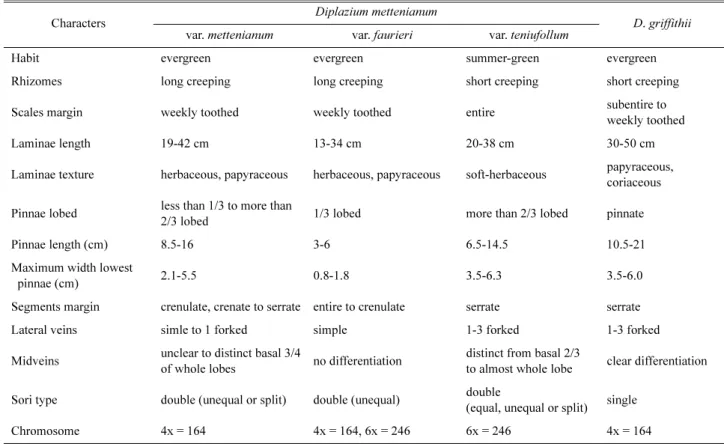
mettenianum var. mettenianum than other varieties based on having laminae margins crenulate, midveins crenate to serrate and unclear to distinct basal acroscopic vienlets (Table 1).

Key to the known allied taxa of Diplazium mettenianum var. mettenianum in Korea

1. Laminae 1 pinnate

2. Pinnae margins serrated, distinctly auriculed in base;

sori attached toward the midrib of pinna

··· D. wichurae 주름고사리 2. Pinnae margins deeply torn to a little or the middle, no auriculed; sori attached toward the midrib of segments

···· D. mettenianum var. mettenianum 깃주름고사리 1. Lamina 2 pinnatifid or 3-4 pinnated

3. Sori usually broad oblong or ovate or short cylindrical;

indusia arch-liked, easily fallen

··· D. virescens 검정비늘고사리 3. Sori short or long linear; indusia flat, opened to upward

after mature, permanent

4. Pinnules oblong, apex blunt or slightly pointed 5. Stipes length more than 30 cm, rate of the rate of

width/length less than 1/3, pinnules mostly no Fig. 2. Photographs of Diplazium mettenianum (Miq.) C. Chr. var.

mettenianum, taken in a forest at Min-oreum, Jeju-do, Korea, 7

Sept. 2012. A. Pinna with involucre and sori; B. Habit.

(4)

overlapped ··· D. squamigerum 내장고사리 5. Stipes length less than 30 cm, rate of the rate of width/length from 1/3 to 1/2, pinnules mostly overlapped

6. Hairs glandular hairs present on rachis of pinnae or pinnules

··· D. sibiricum var. sibiricum 두메고사리 6. Hairs glandular hairs absent on rachis of pinnae or

pinnules

··· D. sibiricum var. glabrum 민두메고사리 4. Pinnules usually lanceolate, acute apex

7. Sori and indusia attached alternately face to face to midrib ··· D. mesosorum 큰개고사리 7. Sori and indusia attached parallel to middle or

nearby of segment margin and midrib 8. Scales and indusial margins serrated

··· D. nipponicum 큰섬잔고사리 8. Scales and indusial margin almost entire

9. Laminae 2 pinnatifid, scales brown; segment margins round; sori short linear

··· D. hachizoense 섬잔고사리 9. Laminae 3-4 pinnate, scales dark brown; segments deeply torn; sori linear ···· D. chinense 암고사리

Acknowledgment

This search was supported by grants from “ The Survey of new and unrecorded taxa in vascular plants (NIBR No. 2013- 02-001) ” founded by the Ministry of Environment of the Korean Government.

Literature Cited

Ching, R. C. 1964. On some confused genera of the family Athy- riaceae. Acta Phytotaxonomica Sinica 9: 41-84.

Christenhusz, M. J. M., X.-C. Zhang and H. Scnneider. 2011. A linear sequence of extant families and genera of lycophytes and ferns. Phytotaxa 19: 7-54.

Chu, W.-M. and Z.-R. He. 1999. Monomelangium Hayata, Allan- todia R. Br., Callipteris Bory, Diplazium Sw. In Flora Reipub- licae Popularis Sinicae. Vol. 3(2). Chu, W.-M. (ed.), Science Press, Beijing. Pp. 346-349, 365-499.

Ebihara, A. 2011. RbcL Phylogeny of Japanese Pteridophyte Flora and Implications on Infrafamilial Systematics. Bulletin of the National Museum of Nature and Science, Ser. B, 37(2): 63-74 Iwatsuki, K. 1992. Ferns and Fern Allies of Japan. Heibonsha Ltd.,

Tokyo. (in Japanese)

Table 1. Comparative morphological characters between Diplazium mettenianum (Miq.) C. Chr. var. mettenianum, and related infraspecific taxa distributed in Japan of Diplazium [Tagawa, 1959; Iwatsuki, 1992; Kato, 1995; mainly referred Ohta and Takamiya (1999)].

Characters Diplazium mettenianum

D. griffithii var. mettenianum var. faurieri var. teniufollum

Habit evergreen evergreen summer-green evergreen

Rhizomes long creeping long creeping short creeping short creeping

Scales margin weekly toothed weekly toothed entire subentire to

weekly toothed

Laminae length 19-42 cm 13-34 cm 20-38 cm 30-50 cm

Laminae texture herbaceous, papyraceous herbaceous, papyraceous soft-herbaceous papyraceous, coriaceous

Pinnae lobed less than 1/3 to more than

2/3 lobed 1/3 lobed more than 2/3 lobed pinnate

Pinnae length (cm) 8.5-16 3-6 6.5-14.5 10.5-21

Maximum width lowest

pinnae (cm) 2.1-5.5 0.8-1.8 3.5-6.3 3.5-6.0

Segments margin crenulate, crenate to serrate entire to crenulate serrate serrate

Lateral veins simle to 1 forked simple 1-3 forked 1-3 forked

Midveins unclear to distinct basal 3/4

of whole lobes no differentiation distinct from basal 2/3

to almost whole lobe clear differentiation

Sori type double (unequal or split) double (unequal) double

(equal, unequal or split) single

Chromosome 4x = 164 4x = 164, 6x = 246 6x = 246 4x = 164

(5)

Johnson, D. M. 1986. Trophopods in North American species of Athyrium (Aspleniaceae). Systematic Botany 11: 26-31.

Kato, M. 1977. Classification of Athyrium and allied genera of Japan. Botanical Magazine (Tokyo) 90: 23-40.

Kato, M. 1995. Diplazium. In Flora of Japan I. Iwatsuki, K., T.

Yamazaki, D. E. Boufford and H. Ohba (eds.), Kodansha Ltd., Tokyo.

Korean Fern Society. 2005. Ferns and Fern Allies of Korea. Geo- book, Seoul. (in Korean)

Korea National Arboretum. 2008. Illustrated Pteridophytes of Korea. Korea National Arboretum, Pocheon. (in Korean) Kramer, K. U. and M. Kato. 1990. Dryopteridaceae, subfamily

Athyrioideae. In The Families and Genera of Vascular Plants.

I. Pteridophytes and Gymnosperms. Kramer, K. U. and P. S.

Green (eds.), Springer-Verlag. Berlin.

Lee, C. S. 2005. Taxonomic study of the genus Diplazium (Wood- siaceae) in Korea. Korean Journal of Plant Taxonomy 35: 175- 186.

Lee, T. B. 1980. Aspidiaceae. In Illustrated Flora of Korea. Hyang Mun-sa, Seoul. (in Korean)

Lee, Y. N. 2006. New Flora of Korea. Kyohaksa Publ. Co., Seoul.

(in Korean)

Lehtonen, S. 2011. Towards resolving the complete fern tree of life. PloS ONE 6: e24851.

Lellinger, D. B. 1985. A Field Manual of the Ferns and Fern-allies of the United States & Canada. Washington, D.C.: Smithso- nian Institution Press.

Maarten, J., M. Christenhusz, X.-C. Zhang and H. Schneider.

2011. A linear sequence of extant families and genera of lyco- phytes and ferns. Phytotaxa 19: 7-54.

Ohta, N. and M. Takamiya. 1999. Taxonomic Studies of the Dipla- zium mettenianum Complex (Woodsiaceae; Pteridophyta) in Japan: Morphology, Cytology and Taxonomy of Plants with Normal Shaped Spores. Journal of Plant Research 112: 67-86.

Park, M. K. 1975. Illustrated Encyclopedia of Fauna and Flora of Korea. Vol. 16. Pteridophyta. Ministry of Education, Seoul. (in Korean)

Sano, R., M. Takamiya, S. Kurita, M. Ito and M. Hasebe. 2000.

Diplazium subsinuatum and Di. omitaroanum should be moved to Deparia according to molecular, morphological, and cytological characters. Journal of Plant Research 113: 157–

163.

Smith, A. R., K. M. Pryer, E. Schuettpelz, P. Korall, H. Schneider and P. Wolf. 2006. A classification for extant ferns. Taxon 55:

705-731.

Wang, M.-L., Y.-T. Hsieh and G.-F. Zhao. 2004. A revised subdi- vision of the Athyriaceae. Acta Phytotaxonomica Sinica 42:

524-527.

Wei, R., H. Schneider and X.-C. Zhang. 2013. Toward a new cir- cumscription of the twinsorus-fern genus Diplazium (Athyri- aceae): A molecular phylogeny with morphological implication and infrageneric taxonomy. Taxon 62(3): 441-457.

Wu, S.-H. and R.-C. Ching. 1991. Fern Families and Genera of

China. Science Press, Beijing.

수치

Fig. 1. Illustrations of Diplazium mettenianum (Miq.) C. Chr. var.
Table 1. Comparative morphological characters between Diplazium mettenianum (Miq.) C. Chr

참조

관련 문서

Students in Group C thought that the biology content of learning from outdoor activities was limited, and said the findings from outdoor activities

“This program was supported by korea Foundation for the Advancement of Science and Creativity(KOFAC)grant funded by the

- "This work was supported by the Korea Foundation for the Advancement of Science and Creativity(KOFAC) grant funded by

Korean Studies major is designed for students from other nations who would like to prepare for a career as liaisons between the businesses of Korea and

Korean Studies major is designed for students from other nations who would like to prepare for a career as liaisons between the businesses of Korea and their nation,

Coloured columns show Member States’ performance in 2018, using the most recent data for the indicators in this dimension, relative to that of the EU in 2011.. The horizontal

- Click the Icon of Record Log Data from Equipment Selection Menu (Log Data Record mode ON – shall be identified Log Data saved or not during on moment of escape

1 John Owen, Justification by Faith Alone, in The Works of John Owen, ed. John Bolt, trans. Scott Clark, "Do This and Live: Christ's Active Obedience as the