Corresponding Author: Jeoungnam Yang
Social work department, Dongshin University Daehodong Naju-city Junman Korea
Tel: 011-771-1926, Fax: +82-61-330-3690, E-mail: [email protected] Article submitted 26 November 2009, Revised 10 December 2009, Approved 12 December 2009
Knowledge and Attitudes about HIV/AIDS among Health Care Officers in S. Korea
Eunjeung Choi*, Whason Kim**, Sunbok Jung***, Insook Whang****, Jeoungnam Yang†
* Dongshin University
** Catholic University
*** Dongshin University
**** Dongshin University
Ⅰ. Introduction
The HIV/AIDS (Acquired Immune Deficiency Syndrome) epidemic has become one of the most serious public health problems worldwide. Recent epidemiological data indicates that an estimated 34-36 million individuals are living with human immunodeficiency virus (UNAIDS/WHO, 2003).
Already 30 million people have died from HIV/
AIDS, within the year 2003 alone (UNAIDS/WHO, 2004). Four million children have been infected since the virus first appeared. It was reported that 430 thousand new cases were infected in 2006 worldwide, and the number of new cases continued to increase(UNAIDS, 2008). There is concern that the next epidemic of HIV/AIDS infection will occur in Asia (Kodandapani and Alpert, 2007).
As the prevalence of HIV/AIDS infection rises, health care professionals worldwide can expect greater demand to care for infected patients and their families. In view of the increasing number of reported case the demand for treatment presents a significant challenge to health care providers.
Since the beginning of the 1990s, a considerable amount of information about HIV/AIDS has appeared in a variety of sources. Much research have been undertaken which show that health care professionals have negative attitudes towards HIV/AIDS(Campell et al., 1991; Bell et al., 1993;
Jemmott et al., 1992). As HIV/AIDS-related issues usually evoke strong emotional reactions including anxiety and withdrawal, health care workers attitudes to such issues may indicate their level of preparedness in caring for people living with HIV/AIDS.
In Korea a total of 6,680 people with HIV/AIDS were reported in December 2009, which is relatively low compared to other countries. However, in Korea new infected HIV/AIDS cases are increasing every year by 10%(Ministry for Health, Welfare and Family Affairs and Korea Center for Disease Control and Prevention. Press release, November 30, 2009).
From 1980 researchers and health care professionals in developed countries have been interested to find out factors including stigma and
discrimination towards HIV/AIDS patients. In Korea research is mainly done on general knowledge, contagious, prevention methods and people's attitude towards HIV/AIDS(Jang, 1994;
Jeyn, Kim and Jin, 1999; Oh, 1999; Um, 2000;
Kwon, Lee and Byeon, 2002; Kim et al., 2002; Lee, 2002; Greenlee and Ridley, 1993; Kulwicki and Cass, 1994; Maswanya et al., 2000; Her et al., 2007;
Park et al., 2002; Moon, 2003). The research undertaken was mainly a simply descriptive method.
These research subjects were middle school, high school, nursing students, soldiers, and shipping crews. There is very little research carried out on health care professional who work in the public sector with HIV/AIDS in Korea. According to Herek et al. (2002), the HIV/AIDS prevention education program was successful in enhancing knowledge of the general public, but some people still had a lot of doubts, so more substantial training is required in health education. He also argued that the public health policy makers should be aware that stigma on HIV/AIDS is still present in the USA.
Given that health care workers are expected to provide care and accurate information on HIV/AIDS to patients and their relatives, as well as to the general public, it is necessary that there is an education program to accomodate this need in Korea. This is important for optimal health care delivery because several studies have shown that health care workers knowledge about HIV/AIDS are frequently inaccurate and that their attitudes are often negative (Ayranci, 2005; Moatti et al., 1998).
In Korea, many studies(Yoon, 2009; Seo, 2006;
Jeon, 2006; Lee, 2002; Bae, 2006) suggest that education was effective in enhancing public officer‘s attitude towards their clients, even though these studies were not directly related to knowledge about HIV/AIDS. This reflects the value of
appropriate training. However, very little study has examined health care worker's knowledge and attitude towards people suffering from HIV/AIDS.
Therefore, it is evident that further research is needed to assess public health care officers attitudes and their knowledge on HIV/AIDS, as it is policy in Korea that people diagnosed with HIV/AIDS are obliged to be on a general register.
This study seeks to explore the level of knowledge and attitude towards HIV/AIDS and the relationship between knowledge and attitude among social workers and nurses who work in the public sector in Korea.
Ⅱ. Methods
Data for the this analysis was obtained from a purposive sampling of nurses and social workers who work in the public sector in G. S. Korea to determine their knowledge and attitude towards HIV/AIDS. The sample was composed of 245 participants. Of these, 121 were nurses and 124 were social workers who work in city offices, district offices and dong offices in G. city. The study relied on a self-administered questionnaire. The data was collected between December 2008 and January 2009.
1. Study Questions
The study was designed to answer the following questions;
First, how the level of subject's knowledge and attitude differ on HIV/AIDS.
Second, how nurses and social workers differ in their knowledge and attitude towards HIV/AIDS.
Third, how the subjects characteristics differ in
their knowledge and attitude towards HIV/AIDS.
Forth, what influences the subjects attitude towards HIV/AIDS.
2. Measures
The measures of HIV/AIDS includes mainly knowledge, awareness, misconception, discrimination, stigma and attitude, which consists of 20 to 50 questions(Herek, 2002; Carey and Schroder, 2002).
Recently an International AIDS questionnaire was developed in order to compare with different countries. The International AIDS questionnaire was translated into English and Chinese which is a standardized and validated to be used by researchers (Davis et al., 1999; Davis et al., 2007).
The measures used in the study refereed to Herek(2002; 2007) and Carey and Schroder(2002), Korea Center for Disease Control and Prevention and Seoul National University Hospital(KCDC and SNUH, 2007). To ensure reliability two professors in nursing and two professors in social work as well as nurses and social workers who work with HIV/AIDS directly were consulted in the review.
1) The measures of knowledge on HIV/AIDS
The questionnaire about knowledge on HIV/
AIDS was used by Herek(2002) in his stigma survey items(26 questions) and Carey and Schroder (2002, HIV-KQ-45), KCDC and SNUH(2007). In this study a total of 8 questions included casual contact(4 questions) symbolic contact(1 question), appearance(1 question), back to normal life(1 question), duration(1 question).
2) The measures of attitudes towards HIV/AIDS The questionnaire about attitudes towards HIV/
AIDS was used by Herek's(2002) stigma survey items(26questions) and Carey and Schroder(2002, HIV-KQ-45), KCDC and SNUH(2007). In this study a total of 11 questions included ① HIV/AIDS patients cause fear among people. ② People who have HIV/AIDS are dirty. ③ Most HIV/AIDS patients are homosexual, ④ HIV/AIDS patients are responsible for their illness, ⑤ Most HIV/AIDS patients don't care if they infect people with the virus, ⑥ People with HIV/AIDS should be legally separated from others to protect the public, ⑦ Most people with HIV/AIDS have a social responsibility for their illness, ⑧ There should be a public register of people with HIV/AIDS, ⑨ People with HIV/AIDS should not be allowed to work, ⑩Caring for my family who have HIV/AIDS, ⑪ People do not want to be friends with someone who has HIV/AIDS. In this study one additional attitude question was added “would you look after your family member if they suffer from HIV/AIDS” in order to consider cultural differences. The measures were used to assess the subject's attitudes towards HIV/AIDS reliability was considerably high which was .826(Cronbach's α= .826).
3. Data analysis
All data were analyzed using SPSS WIN version 12.0 for technical statistics.
First, the measures were used to assess the subject's attitudes towards HIV/AIDS, reliability analysis was used. Second, the data analysis used measures of central tendency, mean, median and mode, and also standard deviations to describe the characteristics of the study sample. Third, in order to analyze knowledge on HIV/AIDS patients (infected persons) of the subjects, a t-Test with one-way analysis of variance (ANOVA) with
contrasts and Scheeffé was conducted. Fourth, to describe the feelings and views of the respondents on care of HIV/AIDS patients, a factor analysis was conducted in the initial data analysis together with Pearson‘s correlation. Finally, in order to analyze factors influencing the attitude towards HIV/AIDS patients(infected persons) of the subjects, a multi-regression analysis by enter method was conducted according to general characteristics i.e gender, age, academic background, career, religion, professions, HIV/AIDS education experience, contact experience, and HIV/AIDS related degree of knowledge.
Ⅲ. Results
1. Participants' general characteristics
The sample was composed of 245 participants.
Of these, 121 were nurses and 124 were social workers. The age groups were split into four different age categories: group1 = people in their twenties(16.3%), group2 = people in their thirties (41.2%), group3 = people in their forties(30.2), and group4= people in their fifties(21.2%). The greatest number of respondents was in the 30-40 age group.
Of the participants 44(18%) were male and 201(82%) were female.
The level of education of the participants were split into four different categories: high school and below 4(1.6%), junior collage 65(26.5%) university graduates 151(61.6%) and subjects with higher degrees were 25(10.2%). The greatest number of respondents were highly educated. Most participants were married and had a religion. The duration of
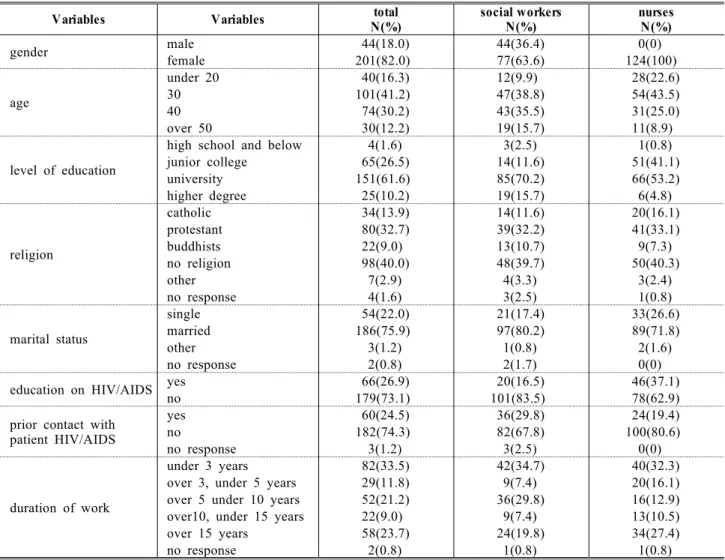
their work was less than 3 years(33%) more than 3 years(33.5%) more than 15 years(15.7%) 5 to 10 years(21.2%). 71.3% participants who had no education about HIV/AIDS. 74.3% of participants had no contact with HIV/AIDS patients and their families(See Table 1). This result reflects that social workers delivered a services to patients and their families, without an educated knowledge of HIV/AIDS. The result also showed that even though nurses had more educated knowledge on HIV/AIDS than social workers they had less contact with patients and their families. This result suggests that health care professionals need further education about HIV/AIDS in order to provide a more professional services.
2. Knowledge level on HIV/AIDS
It was found that the mean percentage of correct answers on 8 questions of knowledge scale of subjects related to HIV/AIDS was 85.9%. From the questions, it was found that the percentage of correct answer on No.2 question was the highest, 98.4%
and that No.5 question showed the second highest percentage, 91.0%. On the other hand, No.7 question showed the lowest percentage of correct answer, 57.6%. Dividing and investigating the knowledge level on HIV/AIDS by subjects' profession, it was found that the total level of knowledge of the nurse(M= .922) was statistically significantly higher than that of the social workers(M= .795) on p<.001 was of a significance level (See Table 2). It was suggested that the difference shown in the level of knowledge on HIV/AIDS of the subjects originated from the difference in curriculum of schools.
Variables Variables total
N(%) social workers
N(%) nurses
N(%)
gender male 44(18.0) 44(36.4) 0(0)
female 201(82.0) 77(63.6) 124(100)
age
under 20 40(16.3) 12(9.9) 28(22.6)
30 101(41.2) 47(38.8) 54(43.5)
40 74(30.2) 43(35.5) 31(25.0)
over 50 30(12.2) 19(15.7) 11(8.9)
level of education
high school and below 4(1.6) 3(2.5) 1(0.8)
junior college 65(26.5) 14(11.6) 51(41.1)
university 151(61.6) 85(70.2) 66(53.2)
higher degree 25(10.2) 19(15.7) 6(4.8)
religion
catholic 34(13.9) 14(11.6) 20(16.1)
protestant 80(32.7) 39(32.2) 41(33.1)
buddhists 22(9.0) 13(10.7) 9(7.3)
no religion 98(40.0) 48(39.7) 50(40.3)
other 7(2.9) 4(3.3) 3(2.4)
no response 4(1.6) 3(2.5) 1(0.8)
marital status
single 54(22.0) 21(17.4) 33(26.6)
married 186(75.9) 97(80.2) 89(71.8)
other 3(1.2) 1(0.8) 2(1.6)
no response 2(0.8) 2(1.7) 0(0)
education on HIV/AIDS yes 66(26.9) 20(16.5) 46(37.1)
no 179(73.1) 101(83.5) 78(62.9)
prior contact with patient HIV/AIDS
yes 60(24.5) 36(29.8) 24(19.4)
no 182(74.3) 82(67.8) 100(80.6)
no response 3(1.2) 3(2.5) 0(0)
duration of work
under 3 years 82(33.5) 42(34.7) 40(32.3)
over 3, under 5 years 29(11.8) 9(7.4) 20(16.1)
over 5 under 10 years 52(21.2) 36(29.8) 16(12.9)
over10, under 15 years 22(9.0) 9(7.4) 13(10.5)
over 15 years 58(23.7) 24(19.8) 34(27.4)
no response 2(0.8) 1(0.8) 1(0.8)
Table 1. participants' general characteristics
(N=245)
Question Average correct answer (%)
total social workers nurses
1 HIV/AIDS is contagious by coughing, sneezing 87.8 79.3 96.0
2 HIV/AIDS is contagious by kissing or hugging 98.4 96.7 100.0
3 HIV/AIDS is contagious by using the same glass 83.7 74.4 92.7
4 HIV/AIDS is contagious by eating from the same plate 86.9 79.3 94.4
5 HIV/AIDS is contagious by using the same bath 91.0 86.8 95.2
6 HIV/AIDS patients can be known by looking at them 96.3 92.6 100.0
7 There is a cure for HIV/AIDS and people can have a
normal life 57.6 49.6 65.3
8 HIV/AIDS patients show signs of the illness quickly. 84.9 76.0 93.5
Total average correct answer 85.9 79.5 92.2
t -5.884***
***p< .001
Table 2. Knowledge on HIV/AIDS by professions
(N=245)
3. Attitudes toward HIV/AIDS patients by professions
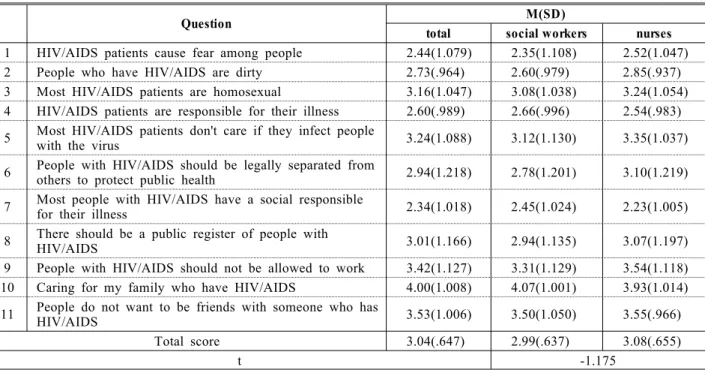
In relation to the attitude towards HIV/AIDS, it is evident that the higher the score the more positive attitudes become. This result showed that the attitude of subjects scored 3.04 points out of 5. In reviewing the questions, it was found that No.10 question showed the most positive attitude and that No.11 question had the second highest score. On a further review of the questions, it was shown that
the subjects had a more positive attitude towards their family member or friend who had HIV/AIDS.
On the contrary, it was found that No.7 and No.1 question had 2.34 and 2.44 points respectively and showed relatively negative attitudes(See Table 3).
Table 3 shows the result of study which compared the differences of attitude on HIV/AIDS patients of the subjects by professions. Although it was found that attitude of the nurse was more positive than that of social workers but it was not significant statistically.
Question M(SD)
total social workers nurses 1 HIV/AIDS patients cause fear among people 2.44(1.079) 2.35(1.108) 2.52(1.047)
2 People who have HIV/AIDS are dirty 2.73(.964) 2.60(.979) 2.85(.937)
3 Most HIV/AIDS patients are homosexual 3.16(1.047) 3.08(1.038) 3.24(1.054) 4 HIV/AIDS patients are responsible for their illness 2.60(.989) 2.66(.996) 2.54(.983) 5 Most HIV/AIDS patients don't care if they infect people
with the virus 3.24(1.088) 3.12(1.130) 3.35(1.037)
6 People with HIV/AIDS should be legally separated from
others to protect public health 2.94(1.218) 2.78(1.201) 3.10(1.219)
7 Most people with HIV/AIDS have a social responsible
for their illness 2.34(1.018) 2.45(1.024) 2.23(1.005)
8 There should be a public register of people with
HIV/AIDS 3.01(1.166) 2.94(1.135) 3.07(1.197)
9 People with HIV/AIDS should not be allowed to work 3.42(1.127) 3.31(1.129) 3.54(1.118) 10 Caring for my family who have HIV/AIDS 4.00(1.008) 4.07(1.001) 3.93(1.014) 11 People do not want to be friends with someone who has
HIV/AIDS 3.53(1.006) 3.50(1.050) 3.55(.966)
Total score 3.04(.647) 2.99(.637) 3.08(.655)
t -1.175
Table 3. A attitudes towards HIV/AIDS by professions
(N=245)
4. Attitudes toward HIV/AIDS patients by general characteristics of the participants
The result of analysis on difference of attitude on HIV/AIDS patient according to general characteristics of the subjects, it was found that there was no significant difference of attitude by gender, age, and marital state. Furthermore, with
regard to attitude according to their education experience, it was found that the attitude of subjects with previous education on HIV/AIDS(M=3.23) was more positive than that of subjects without previous education(M=2.97) and this result was statistically significant p<.01 of significance level. The difference of their attitude by contact experience with HIV/AIDS patients(infected persons) showed
that the attitude of the subjects compared to contact experience(M=3.26) was more positive, which was statistically significantly compared to that of the
subjects without contact experience(M=2.96) (See Table 4).
Education Contact
Yes No Yes No
M(SD) M(SD) M(SD) M(SD)
Attitude total 3.23(.681) 2.97(.621) 3.26(.522) 2.96(.670)
t 2.823** 3.666***
**p< .01, ***p< .001
Table 4. Attitude towards HIV/AIDS by education and prior contact with HIV/AIDS
(N=245)
With regard to the difference of attitude according to religion of the subjects, it was found that the subjects who had a religion(M=3.08) had more positive attitudes than that of the subjects who had no religion(M=2.98), but it was not statistically significant.
Viewing by question, No.4 and No.7 question in the attitude section showed a significant difference by the subjects' academic background. According to Post-Hoc test, it was suggested that the difference on No.4 originated from the difference between university graduates(M=2.75) and college graduates (M=2.32) and that No.7 question on attitude also showed some difference originating from the difference between university graduates(M=2.48) and college graduates(M=2.00). Other questions showed no difference in academic background. With regard to the difference of attitude by career, it was found that subjects with a career over 15 years(M=3.23) had a more positive attitude than other groups, but it was not statistically significant.
The significant difference on No.11 question originated from the difference between subjects with a career over 15 years(M=3.83) compared to the subjects with a career from 10 years to 15
years(M=3.00).
5. Factors influencing the attitude towards HIV/AIDS patients
In order to analyze factors influencing the attitude towards HIV/AIDS patients (infected persons) of the subjects, a multi-regression analysis by enter method was conducted according to general characteristics ie. gender, age, academic background, career, religion, professions, HIV/AIDS education experience, contact experience, and HIV/AIDS related degree of knowledge. In the study these variables were used as independent variables. In order to assess multi-collinearity problem before conducting the regression analysis, correlation analysis among the independent variables was undertaken to estimate their correlation. The result found that Person's correlation coefficient between the professions and gender was the highest, 0.474.
It was suggested that the correlation was low overall.
The multi- collinearity was assessed through Variance Inflation Factor (VIF) and tolerance among the statistic values presented in the multi-regression analysis. The result showed that the possibility of multi- collinearity existence was low and its
Model
Attitude towards HIV/AIDS Total
(N=245) Social workers
(N=121) Nurses
(N=124)
β t β t β t
CH AR AC TE RI ST CI S
Gender .047 .604 .081 .748 - -
Age -.049 -.618 -.106 -.933 .026 .214
Education .058 .917 .063 .687 .021 .233
Work Experiences .136 1.872 .149 1.467 .088 .751
Marital status .086 1.194 .028 .257 .135 1.348
Religion .081 1.305 .064 .696 .100 1.151
Profession -.010 -.129 - - - -
Education on
HIV/AIDS .089 1.302 .088 .860 .090 .963
Contact .153 2.396* .146 1.515 .112 1.233
Knowledge .243 3.617*** .221 2.357* .292 3.202**
F 4.019*** 1.980* 2.986**
R² .149 .143 .173
*p< .05, **p< .01, ***p< .001
Table 5. Factors influencing the attitude towards HIV/AIDS
regression assumption was satisfied.
Analysis on the factors influencing attitude of the subjects showed that the model was significant (F=4.019, p<.001) and its explanatory power was 14.9%. It was found that among the independent variables, the HIV/AIDS related knowledge was the highest influencing factor and contact experience (β
= .153) was the second most significant factor. It was suggested that the factors influencing the attitude on HIV/AIDS patients were the subjects' HIV/AIDS related knowledge and their contact experience. By analyzing the factors influencing their attitude by profession, the result showed that the model was significant both in the social workers(F=1.980, p<.05) and the nurses (F=2.986, p<.01). It was also identified that the HIV/AIDS related knowledge was an influencing factor from β
= .221 of the social workers and β= .292 of the nurses. On the other hand, the contact experience and the professions were also influencing factor, but they were not significant statistically(See Table 5). In
the case of nurses, all of the subjects were women, so the gender was excluded in the analysis. Based on these results, it was suggested that the HIV/AIDS related knowledge was an important determining factor for the subject's attitude towards HIV/AIDS.
This results showed that the general characteristics ie. gender, age, academic background, were not influencing factors. This result reflects that most participant had similarities as they were married women, who were university graduates.
This result also showed that previous education experiences and contact experience on HIV/AIDS were not influencing factors. According to Armstrong-Easther and Hewitt(1990) a quarter of participants had education on HIV/AIDS which mainly entailed lectures. This type of training may have had an influencing factor on the participants fears towards HIV/AIDS. An other study suggest a lack of clinical experience is an influencing factor towards HIV/AIDS which showed participant' negative attitude(Ficarrotto et al., 1989). The
outcome of this study is supported by these findings.
Ⅳ. Discussion
Government intervention on HIV/AIDS was only started in 1990 in Korea. This reflects that Korea was 10 to 15 years slower in tackling the problem of HIV/AIDS compared to other developed countries. However, the number of HIV/AIDS infected people is increasing continuously and it is estimated that the number of infected persons in Korea is about 3.7 times more than the actually reported number(UNAIDS, 2008; Choi et al., 2007) Therefore, more active and effective health care interventions are urgently needed(Kim et al., 2008).
This study was designed to investigate the level of knowledge and attitudes towards HIV/AIDS and influencing factors of social workers and nurses who deliver healthcare intervention services to HIV/AIDS patients and their families directly.
The result of this study is as follows:
First, the percentage of correct answers for 8 questions to assess the knowledge on HIV/AIDS of the subject's in this study was 85.9%. Comparing this with the results of other previous studies, it was found that general demographic factors(gender, academic background, marriage state, religion, etc.) showed no significant effects regarding the subject's knowledge on HIV/AIDS. However, the result showed that the level of knowledge of nurses was significantly higher than that of social workers. In addition the nurse had more education on HIV/AIDS than social workers. But social workers had more contact experience with HIV/AIDS patient and their families than nurses.
As it was found in previous studies that the awareness level on transmission by blood infusion
was relatively high(Son et al., 2007; Lee, 1994; Oh, 1999; Kim et al., 2002; Korean Federation for HIV/AIDS Prevention, 2003; Song et al., 2000; Lee, 1997; Yum et al., 2001; KCDC and SNUH, 2005;
KCDC and SNUH, 2007; Im-em et al., 2002;
Merakou et al., 2002; Huang et al., 2005). The questionnaire for this study included 5 questions in relation to casual contacts i.e (cough, hug, common use of cup or glass, eating or bathing), distinguishable by appearances from normal people (1 item), possibility of normal life after treatment(1 item), symptomatic presentation within 1 year(1 item). This result found that the mean percentage of correct answers was relatively high, 85.9%, but the question ‘is it possible to recover to normal life after treatment’ showed the lowest percentage (57.6%), this proved that at least 40% of the subjects who provide therapeutic care for HIV/AIDS patients and their families had negative views in this area. The previous study showed a similar result(KCDC and SNUH, 2007), for example ‘HIV/AIDS is capable of at least 20 year survival’ resulted in relatively low percentage of correct answer(68.7%).
This research found that ‘infection by cough’
was 87.8%, ‘common use of cup or glass’ was 83.7%, and ‘eating food together may cause infection’ was 86.9%. Comparing the correct answer percentage of other countries on similar questions (KCDC and SNUH, 2007), it was found that ‘kiss may cause infection’ was 82.9% in US (Herek, 2002), 94.0% in UK(National AIDS Trust, 2006), 45.7% in Hongkong(Lau and Tsui, 2000), and 67.0% in Korea(KCDC and SNUH, 2007). The correct answer percentages on ‘HIV/AIDS infection is possible from common use of toilet seats’ were 66.0% in US(Herek, 2002), 98.0% in UK(National AIDS Trust, 2006), 76.4% in Hongkong(Lau and Tsui, 2000), and 73.7% in Korea(KCDC and SNUH,
2007). This reflects that Korea needs an education system for HIV/AIDS prevention because the general knowledge level was relatively lower than those of other countries.
Second, in relation to attitudes towards HIV/
AIDS, the questions on attitudes towards HIV/AIDS patients(infected persons) (11 questions), including negative emotion, fear of HIV/AIDS or criticism of sexual promiscuity, preconception of homosexual, responsibility for the disease, responsibility for infection, isolation, social responsibility, care for HIV/AIDS infected family members, continuance of friendship with an HIV/AIDS infected friend were selected from HIV/AIDS Stigma inquiry questions (26 questions) by Herek(2002).
In this research the level of attitude about HIV/AIDS showed that nurses had a more positive attitude than social workers, but there was no significant difference. Although there was no difference in general characteristics i.e gender, age, marital state, this outcome show a different result compare to the previous study by the Korea Center for Disease Control and Prevention(2007), which showed a higher age group, lower academic career, lower income, agricultural workers, fishing industry, and housewives had more negative views (p<0.01), knowledge and awareness about HIV/AIDS.
Third, this result showed a significant difference of attitude according to education and contact experience on HIV/AIDS. The importance of education on HIV/AIDS has been indicated in several pervious studies(Lee, 2000; Jeong-A Oh, 1999; Kim et al., 2002, Kwon et al., 2001; Ayranci et al., 2005) as well as contact experiences(Kim, 2006; Choi, 2002; Cha, 2003; Olivier et al., 2003).
Fourth, the result showed that knowledge on HIV/AIDS had the highest positive correlation among the various factors influencing the attitude of
social workers and nurses. This outcome is supported by other results obtained from several previous studies even though the subjects were different(Kim et al., 2002; Oh, 1999; Lee, 2000; Son et al., 2007; Kim et al., 2008).
Ⅴ. Conclusion
This result suggests that social workers and nurses who work in the public sector are required to have practical and scientific knowledge and attitude about HIV/AIDS as a public officers in Korea. As they have responsibility to reduce the drop-out rate from treatment by providing healthcare services to HIV/AIDS infected people and their families within the government monitoring system.
In addition they are responsible for planning, executing, and assessing its prevention and education program for the general public. Therefore an education program on HIV/AIDS is required for social workers as well as nurses. However, according to Korean policy on 「HIV/AIDS Control Guide in 2009」, reinforcement of education for medical care workers was clearly stated, but there is no program for social workers who work in welfare centers and in the community(KCDC, 2009). Given the importances of the role of public officers as practitioners and policy makers on HIV/AIDS, the education program should not only focus on lectures but also include a sharing of practical experience and knowledge.
The limitations of this study are that subjects mainly consisted of social workers and nurses in a limited area of Korea. The correlation of knowledge and attitude towards HIV/AIDS is not fully verified and needs to be evaluated. Further studies are needed to find influencing factors and a path
analysis study of health care public officials in a nationwide probability sampling.
References
Armstrong-Easther, C., and Hewitt, W. 1989.
Knowledge and Perception of AIDS among Canadian Nurses, J Adv Nurs 14:923-938.
Ayranci, U. 2005. AIDS knowledge and attitudes in a Turkish population: an epidemiological study.
BMC public health 5:95.
_______. 2007. 2007 HIV/AIDS Knowledge, Attitudes, Belief and Behaviors Survey Report. Seoul:
Korea.
Bae, H.S. 2006. A Study on the attitudes of social Workers' toward the poverty Affected Quality of Social Welfare Services in Public Assistance.
Master. dissertation, Graduate School of Pusan Public Administration, Pusan National University.
Bell, P., Williams, A., Ross. M., Boswarva, P., and Strunin, L. 1993. HIV/AIDS : Knowledge and Attitudes of Accident and Emergency Healthcare Professional. Journal of the Association of Nurses in AIDS care 4(4):7-14.
Campbell, S., Maki, M., Willenbring, K., and Henry, K. 1991. AIDS related Knowledge. Attitudes, and Behaviors among 629 Registered Nurses at a Minnesota Hospital: A Descriptive Study, Journal of the Association of Nurses in AIDS Care 2:15-23.
Carey, M.D., and Schroder, K.E. 2002. Development and psychometric evaluation of the brief HIV knowledge questionnaire. AIDS Education and Prevention 14(2):172- 182.
Cha, Y.J. 2003. Prevention of Human Immunodeficiency Virus Infection in Healthcare Workers. The Chung-Ang journal of medicine 28(1):1-6.
Choi, S.M., Lee, J.Y., Oh, H.S., Park, E.S., et al., 2002. Survey of HIV Exposure and Post- exposure Prophylaxis among Health Care Workers in Korea. Korean Journal of Nosocomial Infection Control 7(1):65-73.
Choi, Y.J., Park, U.S., Byun, S.Y. & Lee, H.J. 2007.
Project evaluation and monitoring of national HIV/AIDS. Korea Center for Disease Control and Prevention & Hallym University. Seoul:
Korea.
Davis, C., Sloan, M., MacMaster, S., and Kilbourne, B. 2007. HIV/AIDS Knowledge and Sexual Activity: An Examination of Racial Differences in a College Sample. Health & Social Work 32(3);211.
Davis, C., Tang, C.S., Chan, S.F., and Noel, B. 1999.
The development and validation of the International AIDS Questionnaire-Chinese Version (IAQ-C). Educational and Psychological Measurement 59:481-491.
Ficarrotto, T.J., Grade, M., Bartnof, H., Koenig, B., Bliwise, N., and Irish, T. 1989. Factors predictive of AIDS-HIV knowledge and attitudes among nursing and medical students.
International Conference on AIDS. 1989 Jun 4-9;5:907 (abstract no. E.629).
Greenlee, S.P., and Ridley, D.R. 1993. AIDS and college students: a survey of knowledge, attitudes and beliefs. Psychological Reports 73:490.
Her, S.H., Kim, J.E., Kim, S.M., Kim, S.H., Kim, D.G., Kim, S.Y., Hong, M.H., and Choi, Y.S.
2007. Medical Students' Knowledge about AIDS/STDs: Comparing with Non-medical Students. Korean Journal of Hospice and Palliative Care 10(2):85-90.
Herek, G.M. 2007. Confronting sexual stigma and prejudice: Theory and practice. Journal of Social Issues 63:905-925.
Herek, G.M., Capitanio, J.P., and Widaman, K.F.
2002. HIV-related stigma knowledge in the United States: Prevalence and trends, 1991- 1999. American Journal of Public Health 92(3):371-377.
Huang, J., Bova, C., Fennie, K.P., Rogers, A. and Williamset, A.B. 2005. Knowledge, Attitudes, Behaviors, and Perceptions of Risk Related to HIV/AIDS among Chinese University Students in Hunan, China. AIDS Patient Care and STDs 19(11):769-777.
Im-em, W., VanLandingham, M., Knodel, J., and
Saengtienchai, C. 2002. HIV/AIDS-related Knowledge and Attitudes: A Comparison of Older Persons and Young Adults in Thailand.
AIDS Education and Prevention 14:3, 246-262.
Jang, S.B. 1994. HIV/AIDS Related Knowledge and Attitude of Korean Childbearing Women.
Journal of The Korean nurse 33(5):46-62.
Jemmott, L.S., Jemmott Ⅲ, J.B., and Cruz-Collins, M.
1992. Predicting AIDS Patients Care Intentions among Nursing Students. Nursing Research 41(3):172-177.
Jeon. J.W. 2006. A Study on attitude of the Social Welfare Officials about Child Abuse. Master.
dissertation, Graduate School of Public Administration, Pusan National University.
Jeyn, M.K., Kim, C.K., and Jin, K.N. 1999. AIDS- related Knowledge, Attitudes and AIDS-Education Needs of Male Workers in Seoul and Kyungki areas. Journal of Korean Society for Health Education and Promotion 16(2):1-17.
Kim, B.Y. 2007. Knowledge, Prevention Infection Control Behavior and Perceived Vulnerability to AIDS of Nurse. Master. dissertation, Department of Nursing, The Graduate School of Ewha Womans University.
Kim, N.C., Oh, J.A., Han, H.J., Kim, M.H., Kim, J.K., Lee, H.J., and Kim, M.J. 2002. Sexual Orientation, Knowledge and Attitudes toward AIDS among Military Personnel in Korea.
Journal of Korea community health nursing academic society 16(2):225-238.
Kim, S.Y., Lee, J.S., Park, S.K. & Kim, Y.I. 2008.
Knowledge and Attitudes Towards AIDS in a General Population. Journal of Korean Society for Health Education and Promotion 25(4):13-28.
Kodandapani, K. & Alpert, P. 2007. AIDS in India:
When Denial Kills. Home Health Care Management & Practice 20(1):21-26.
Korea Center for Disease Control and Prevention and Seoul National University Hospital. 2005. 2005 HIV/AIDS Knowledge, Attitudes, Belief and Behaviors Survey Report. Seoul: Korea.
Korea Center for Disease Control and Prevention.
2009. 2009 Guidelines for Managing HIV/AIDS.
Seoul: Korea.
Korean Federation for HIV/AIDS Prevention. 2003.
2003 National Research of Sexual Behaviors and HIV/AIDS Perceptions. Seoul: Korea.
Kulwicki, A.D., and Cass, P.S. 1994. An assessment of Arab-American knowledge, attitudes and beliefs about AIDS. Journal of Nursing Scholarship 26(1):13-17.
Kwon, K.W., Lee, K.M., and Byeon, J.O., 2002. A Study on Discrimination of People Living with HIV/AIDS(PLWHAs) in Korea. Health and social science 12:199-218.
Lau, JTF., and Tsui, HY. 2002. Surveillance of HIV/AIDS-related attitudes and perceptions among the general public in Hong Kong from 1994 to 2000. AIDS Educ Prev Oct;14(5):
419-31.
Lee, C.S. 2002. Knowledge, Attitudes of College Students to AIDS. Master, dissertation.
Department of Medicine, Inje University.
Lee, J.E. 1994. A Study on the AIDS Knowledge, Attitude and Risk Behaviors among High School Students in Seoul. Master, dissertation.
The Graduate School of Ewha Womans University.
Lee, J.K. 2000. The Effect of an AIDS Education Program of Nursing Students on Knowledge, Attitudes, Fear of Contagion and Nursing Intention about AIDS. The Journal of Korean Academic Society of Adult Nursing 14(1):5-14.
Lee, Y.J. 1997. Survey of knowledge and Attitudes of Junior College Students about AIDS. NURSING SCIENCE. Research Institute of Nursing Science, Ewha Womans University. pp. 93-106.
Maswanya, E., Mojik, Aoyagi, K., Yahata, K., Izumi, T., and Takemoto, Y. 2000. Knowledge and Attitudes toward AIDS among female college students in Nagasaki. Journal of Health Education Res 15:5-11.
Merakou, K., Costopoulos, C., Marcopoulou, J. &
Kourea-Kremastinou, J. 2002. Knowledge, attitudes and behavior after 15 years of HIV/AIDS prevention in schools. European Journal of Public Health 12:90-93.
Ministry for Health, Welfare and Family Affairs.
Press release, November 30, 2009, No. 7334.
Moatti, J.P., Manesse, L., Le, Gales. C., Pages, J.P., and Fagnani, F. 1998. Social perception of AIDS in the general public: a French study.
Health Policy 1998;9:1-8.
Moon, E.S., Jung, H.S., Choi, E.S., 2004. A Study on Soldiers' Knowledge, Attitude and Health Belief about AIDS. Journal of Community Health Nursing 15(2):298-307.
National AIDS Trust. 2006. Public attitudes toward HIV. UK.
Oh, J.A. 1999. The knowledge and attitudes about AIDS in middle and high school students.
Journal of Korea community health nursing academic society 13(1):63-76.
Olivier, C., and Dykeman, M. 2003. Challenges for HIV service provision: the challenges for nurses and social worker. AIDS Care 15(5): 649-663.
Park, S.H., Im, D.O., Lee, B.G., and Han, J.H. 2002.
Original Articles: Study on the Attitudes Toward Condoms and STDs/AIDS in Male College Students. Journal of Reproductive Medicine and Population 15:46-55.
Seo, S.R. 2006. Knowledge, Attitude and Practical Skill of Health Center Worker's about Hypertension and Diabetes. Master. dissertation, Graduate School of Public Health in Inje University.
Sohn, A.R., Moon, J.S., Park, J.E., Chun, S.S. & Ko, S.D. 2007. HIV/AIDS Knowledge and Discriminatory
Attitudes and Identifying Factors Which Impact the Discriminatory Attitudes towards Persons With HIV/AIDS among Adolescents in Seoul, Korea. Health and social science 21:25-49.
Song, K.B., Song, K.H., Lee, H.S. 2000. Prevalence of infection control and knowledge about AIDS among dental hygienists in the private dental clinics in Taegu, Korea. The Journal of the Korean academy of dental health 24(3):217-226.
Um, J.W. 2000. A Study on Knowledge, Belief, About AIDS and the Use of Condoms Among Adolescents. Master, dissertation. Graduate School of Public Health, Seoul National University.
UNAIDS. 2008. Annex 1: HIV and AIDS estimates and data, 2007 and 2001.
UNAIDS/WHO, 2004. Improving estimates. Report on the Global HIV/AIDS epedemic.
UNAIDS/WHO. 2003. Report on Global HIV/AIDS Epidemic.
Yoon, S.K. 2009. A Study on the Attitudes of the Public Officials toward the Long-Term Care Insurance in Korea. Ph.D. dissertation, Graduate School of Kunyang University.
Yum, C.H., Choi, T.S., Jo, K.H. 2001. The Comparison of Knowledge and Attitude of AIDS between the Sex Group with a Prostitute and the Non-sex Group in Unmarried Young Men. Korean Journal of Hospice and Palliative Care 4(2):122-129.
ABSTRACT
Objective: This study explores the level of knowledge and attitude towards HIV/AIDS and the relationship between knowledge and attitude among social workers and nurses working in the public sector in Gwangju, S. Korea.
Methods: The sample was composed of 121 nurse and 124 social workers. For the purpose of this research participants completed a questionnaire designed to assess their knowledge and attitudes about HIV/AIDS. The data was collected between December 2008 and January 2009. All data was analyzed using SPSS WIN version 12.0 for technical statistics. t-Test, ANOVA and multiple regression analysis was employed.
Results: First, the result of this research showed that the level of participants knowledge on HIV/AIDS was 85.9%. The nurses score was significantly higher than social workers on knowledge. Second, the outcome also showed that nurses generally had a more positive attitude about HIV/AIDS patients than social workers but it was not significant. Third, participant's attitudes towards HIV/AIDS was significantly influenced by the level of knowledge and previous education about HIV/AIDS. Fourth, the results also showed that knowledge on HIV/AIDS is the most important influencing factor towards the participants attitude.
Conclusion: This result has important implications for future education programs designed for health care professionals including nurses and social workers. Given the importances of the role of public officers as practitioners and policy makers on HIV/AIDS, the education program should not only focus on lectures but also include a sharing of practical experience and knowledge.
Key Words: Attitudes; Health care officers; HIV/AIDS; Knowledge
<국문초록>
보건복지 공무원의 에이즈에 대한 지식과 태도에 대한 연구
목적: 대상자의 에이즈에 대한 지식수준과 태도를 파악하고, 에이즈감염자에 대한 태도에 영향을 미치는 요인을 규명하기 위함이다.
방법: 본 연구는 G광역시내 보건복지 분야에 종사하고 있는 사회복지직과 간호직 공무원을 대상으로 편의
표집 하였다. 자료 수집은 대상자에게 연구목적을 직접 설명한 후 동의를 거쳐 구조화된 설문지에 각자 기입하도록
하였다. 수집된 총 252부의 질문지 중 불성실한 답변을 제외한 245부(사회복지직 124부, 간호직 121부)를 최종분석 에 사용하였다. 자료수집은 2008년 12월부터 2009년 1월 사이에 이루어졌다. 측정도구인 에이즈 지식 및 HIV/AIDS 환자(감염인)에 대한 태도 문항은 많은 선행연구에서 인용되고 있는 Herek(2002, 2007)과 Carey & Schroder(2002), 국내 연구 중에는 질병관리본부(2007)의 조사 문항들을 토대로 구성하였다.
결과: 첫째, 대상자의 지식정도의 정답률은 85.9%로 나타났으며 사회복지직 공무원의 지식정도가 간호직보다 낮게 나타났다. 둘째, 통계적으로 유의미 하지 않지만 간호직 공무원의 태도가 사회복지직 보다 에이즈환자에 대해 긍정적 태도를 보여주었다. 셋째, 대상자의 에이즈에 대한 태도는 지식의 정도와 에이즈에 대한 교육경험 유무에 따라 하위영역별로 유의미한 차이가 나타났다. 넷째, 에이즈에 대한 대상자의 태도에 영향을 미치는 요인을 분석한 결과, 대상자의 에이즈에 대한 지식이 가장 큰 영향 요인으로 나타났다.
결론: 에이즈에 대한 임상실천가이면서 정책에 영향을 미치는 사회복지직과 간호직 공무원의 에이즈에 대한 지식을 증진시키고 편견을 감소시키기 위한 실천적 교육 프로그램 개발이 필요하다.
주제어: HIV/AIDS, 태도, 지식, 보건 간호직, 사회복지직 공무원