인삼 재배지의 토양 화학성에 따른 생리장해 유형 분석
현동윤*†·연병열*·이성우*·강승원*·현근수*·김영철*·이광원**·김성민***
*국립원예특작과학원 인삼특작부, **농촌진흥청 기술경영과, ***공주대학교 산업과학대학
Analysis of Occurrence Type of Physiological Disorder to Soil Chemical Components in Ginseng Cultivated Field
Dong Yun Hyun
*†, Byeong Yeol Yeon
*, Seong Woo Lee
*, Seung Weon Kang
*, Geun Soo Hyeon
*, Young Cheol Kim
*, Kwang Won Lee
**, and Seong Min Kim
****
Department of Herbal Crop Research, NIHHIS, RDA, Eumseong 369-873, Korea.
**
Technology Management Division, RDA, Suwon 441-707, Korea.
***
College of Industrial Sciences, Kongju National Univ., Yesan 340-800, Korea.
ABSTRACT : This study was to set the guidelines of soil chemical components in order to assure the safety and quality of the panax ginseng from physiological disorder. The disorder symptoms appeared on the leaf with yellow spot, atrophy, yel- low-brown spot, also showed red skin and rough skin of the root. Occurrence type of physiological disorder in cultivated field divided into two types : type I ‘such as, yellow spot’ consist of single disorder symptom; type II ‘such as, yellow spot and yellow-brown spot’ consist of two or more different disorder symptoms. The individual contribution of soil properties to the occurrence type was as follows ; The yellow spot was affected by Na > NO
3-N > salinity (EC) in soil. The same results was observed in red skin. Atrophy was affected by NO
3-N > salinity (EC) > Ca > Mg. Rough skin was affected by P
2O
5>pH >
Organic material > K. It showed positive associated to P
2O
5, pH and K, but negative associated to organic matter. Simulta- neous occurrence of two different disorder, including cases which yellow spot and yellow-brown spot, those were affected by NO
3-N > salinity (EC) > Na > Mg. In the case of atrophy plus yellow-brown spot, those also were affected by in the order : NO
3-N > salinity (EC) > Ca > Mg > Na. Red-rough skin was affected in the order : salinity (EC) > NO
3-N > K > Na. Soil chemical components appear to be related to occurrence of physiological disorder, particularly in salinity (EC) and NO
3-N.
The salinity (EC) and NO
3-N were negative related to plant growth. In addition, exchangeable cation capacity play critical roles in attributing to complex occurrence of physiological disorder.
Key Words : Panax ginseng , Physiological Disorder, Soil Chemical Property, Leaf Discoloration, Red Skin, Rough Skin
서 언
우리나라에서 재배되고 있는 고려인삼 ( Panax ginseng C.
A. Meyer) 은 오가피과 (Araliaceae), 인삼속 ( Panax ) 에 속하는
다년생 숙근초로 북위 30
o~48
o의 한반도와 중국의 북동부 장
백산맥을 중심으로 길림성 , 요녕성 , 흑룡강성 , 그리고 러시아 의 연해주 일부 지역에 자생하는 반음지성 약용식물이다 .
인삼 재배면적은 1980~1990 년에는 일정 수준으로 유지
(11,000~12,000 ㏊ ) 되어 오다가 1991 년에 11,694 ㏊이었던 것이
1996 년에는 8,940 ㏊까지 감소되었다 . 그러나 1996 년 이후 재 배면적이 증가하기 시작하여 2000 년 12,445 ㏊ , 2008 년 19,408 ㏊로 매년 재배면적이 현저하게 증가하는 추세이다 . 최
근 인삼 신규재배면적이 증가함에 따라 전남 , 전북 , 강원도 , 경 기도 민통선 지역 등 신규 재배지가 늘어나고 있으나 부적지 에서의 재배로 인한 생리장해 발생율이 증가하는 추세에 있다 .
인삼의 생리장해에 대한 연구는 주로 재배 관리 측면에서 이루어졌고 (Kim, 2002), 토양 화학성과 관련된 연구는 한 가
지 유형의 생리장해에 대하여 단편적으로 이루어져 있을 뿐이 다 (Kang et al., 2007)
인삼의 생리장해로서는 잎에서 발생하는 황증과 뿌리에 발 생하는 적변 및 은피가 대표적인 것으로 보고되고 있다 . 황증 은 건조기에 수분부족과 염류과다로 인하여 발생하며 , 적변은 우기시 과습과 미부숙 축분의 시용에 의하여 , 은피는 야산개
간지에서 발생하는 것으로 보고되고 있으나 (Park , 1982; Park
†
Corresponding author: (Phone) +82-43-871-5543 (E-mail) [email protected]
Received 2009 November 2 / 1st Revised 2009 December 7 / Accepted 2009 December 9
et al., 1982) 두 가지 유형의 생리장해가 복합적으로 발생하는
농가의 토양 화학성에 대한 구체적인 조사는 미흡하여 본 시 험에서는 농가포장에서 발생하는 생리장해 유형을 조사 , 토양 화학성분이 생리장해에 미치는 영향을 알아보기 위하여 실시 하였다 .
재료 및 방법
1. 인삼 재배지 생리장해 조사
인삼 재배지 생리장해 조사는 2004 년부터 2006 년에 걸쳐 강원도 15 개소 , 경기도 57 개소 , 충청북도 47 개소 , 충청남도 30
개소 , 전라북도 21 개소 , 경상북도 31 개소 , 총 6 개 도 17 개 시·군 재배농가의 4 년근 포지 201 개소를 대상으로 7 월 상순 에서 8 월 하순 기간동안 토양의 화학성과 생리장해 및 수량을 조사하였다 . 인삼 생리장해 발생정도 조사는 농촌진흥청의 농
업과학기술 연구 조사 분석 기준에 준하였는데 (NIAST,
2003), 엽에 발생하는 황증과 뿌리에 발생하는 적변 및 은피
를 대상으로 하였고 , 황증은 황색반점 , 황갈색반점 , 엽연 ( 오 갈 ) 으로 구분하여 조사하였다 .
생리장해 발생율은 33 ㎡당 출현된 개체 중 증상이 나타나 는 개체수의 비율로 환산하여 3 반복으로 조사하였다 . 조기낙 엽율은 33 ㎡당 출현된 개체 중 지상부가 고사되는 개체수의
비율로 환산하여 3 반복으로 조사하였다 . 생육조사는 초장 , 경 태를 대상으로 10 개체를 3 반복으로 조사하였다 . 토양 화학성 이 인삼생리장해에 미치는 영향을 구명하기 위하여 SAS enterprise 3.0 을 이용하여 상관계수 및 선형회귀분석 등을 계 산하였다 .
2. 토양화학성 분석
토양화학성 분석은 농업과학기술원 토양 및 식물체 분석법
(Frederick , 1960; NIAST , 1992; NIAST , 2000) 에 준하여 실 시하였으며 , pH, EC, NO
3-N, 유기물 , 유효인산 , 치환성양이온
K, Ca, Mg 등을 분석하였다 .
토양 pH 는 풍건토양 5 g 을 50 ㎖ 비이커에 취하고 증류수 25 ㎖를 가한 뒤 때때로 유리봉으로 저어 주면서 1 시간 방치 한 후 60 초 이내에 pH meter (Orion 720A, 미국 ) 로 측정하 였다 . 토양 염류농도 (EC) 는 풍건토양 10 g 을 100 ㎖ 비이커 에 취하고 증류수 50 ㎖ 를 가하여 20 분간 진탕한 후 EC meter (Orion 150A, 미국 ) 로 측정하였다 . 토양의 NO
3−-N 분 석은 풍건토양 10 g 을 100 ㎖ 삼각플라스크에 취하고 2 M KC1 50 ㎖를 가하여 30 분간 진탕한 후 N
O. 2 여과지로 여과
한 후 원소자동분석기 (Bran + Luebbe, AA3, 미국 ) 로 자동비 색 정량하였다 . 토양 유기물 분석은 Tyurin 법으로 토양시료
0.3 g (200 mesh 통과 시료 ) 을 250 ㎖ 삼각플라스크에 취하고
10 ㎖의 0.4 N 중크롬산칼리황산 혼합용액을 가한 다음 200 ㎖ 의 전열판에서 5 분간 끓인 후 증류수 약 150 ㎖ 를 넣고
0.2 N 황산제 1 철 암모늄 용액으로 적정하였다 . 유효인산은 Lancaster 법으로 토양 5 g 에 침출액 20 ㎖를 넣고 10 분간 진
탕한 후 No. 2 여과지로 여과한 시료액 3 ㎖를 시험관에 넣 고 조작액을 6 ㎖ 씩 넣은 다음 0.4 ㎖의 1, 2, 4 용액을 가 하여 30 ℃에서 30 분간 항온한 후 분광광도계 (Cintra 40, GBC, 호주 ) 로 720 ㎚에서 비색 측정하였다 . 치환성 양이온
(K, Ca, Mg) 은 토양 5 g 에 1N-NH
4OAc (pH 7.0) 완충용액
50 ㎖ 을 넣고 30 분간 진탕한 후 침출 , 여과하여 유도결합플
라스마 발광광도계 (ICP, Integra XMP, GBC, 호주 ) 로 측정 하였다 .
결과 및 고찰
1. 생리장해 발생 유형과 생육양상
엽에서 발생하는 생리장해 증상은 황색 반점형 (Ys), 엽연
형 (A), 황색 반점과 황갈색 반점이 복합적으로 발생하는 형
(YYbsc), 엽연과 황색 반점에 황갈색 반점이 함께 발생하는
형 (AYYbsc) 으로 나타났다 . 뿌리에서 발생하는 생리장해로는
Table 1.The occurrence rate(%) of physiological disorders in individual survey tilth.
Physiological
disorder Survey tilth
Gangwon Gyeonggi Chungbuk Chungnam Jeonbuk Gyeongbuk Mean (Total)
Ys
−26.5±3.1(8) 20.7±4.1(9) 22.5±2.8(8) 26.5±2.3(8)
−24.1±3.1(33)
A 30.5±2.9(7) 22.5±3.7(7) 29.3±3.1(6)
−21.5±2.9(6) 25.9±3.2(26)
YYbsc 24.3±4.9(7) 38.0±4.1(7) 34.0±3.8(3)
−23.3±2.1(7)
−29.9±3.7(24)
AYYbsc 35.0±3.5(7) 19.1±2.9(10) 32.3±4.1(7)
−18.3±2.2(7) 26.2±3.1(31)
Rs
−26.1±3.9(11) 18.5±3.1(4)
−18.7±2.8(6)
−21.1±3.3(21)
Ros
−19.0±2.9(9) 23.1±3.7(6) 27.0±2.1(5)
−20.7±2.9(9) 22.5±2.9(29)
RRos 20.3±2.7(8) 26.0±3.9(8) 18.4±2.9(8) 27.5±3.3(4)
−14.5±2.1(9) 21.3±3.0(37)
※
Ys, Yellow spot; A, Atrophy; YYbsc, Yellow-Yellow brown spot complex; AYYbsc, Atrophy plus Yellow-Yellow brown spot complex; Rs, Red skin;
Ros, Rough skin; RRosc, Red-Rough skin complex.
Parentheses are the number of survey tilth
적변 (Rs), 은피 (Ros) 그리고 적변과 은피가 함께 발생하는 형 (RRos) 으로 구분되었다 (Fig. 1).
인삼 재배지역의 생리장해 유형에 따른 개소별 발생율을 보 면 (Table 1), 황색 반점은 조사지역 33 개소에서 평균 24.1%,
엽연은 26 개소에서 25.9%, 황색 반점과 황갈색 반점이 함께
발생하는 경우는 24 개소에서 29.9%, 엽연과 황색 및 황갈색
반점이 함께 발생하는 경우는 31 개소에서 26.2%, 적변은 21
개소에서 21.1%, 은피는 29 개소에서 22.5% 그리고 적변과 은 피가 함께 발생하는 형은 37 개소에서 21.3% 로 조사 되었다 .
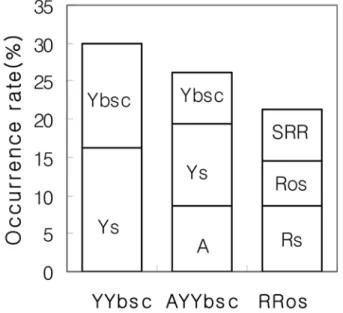
또한 생리장해가 복합적으로 발생하는 경우 , 생리장해 발생
비율은 Fig. 2 와 같다 . 황색 반점에 황갈색 반점이 함께 발생 하는 형태는 황색반점 16.2%, 황갈색 반점 13.7% 으로 나타났 으며 , 엽연과 황색 반점에 황갈색 반점이 함께 발생하는 형태 는 엽연 8.6%, 황색반점 10.8% 및 황갈색 반점 6.8% 으로 나 타났고 , 적변과 은피가 함께 발생하는 형은 적변 8.7%, 은피
5.9%, 그리고 적변과 은피 동시 발생은 6.7% 로 나타났다 .
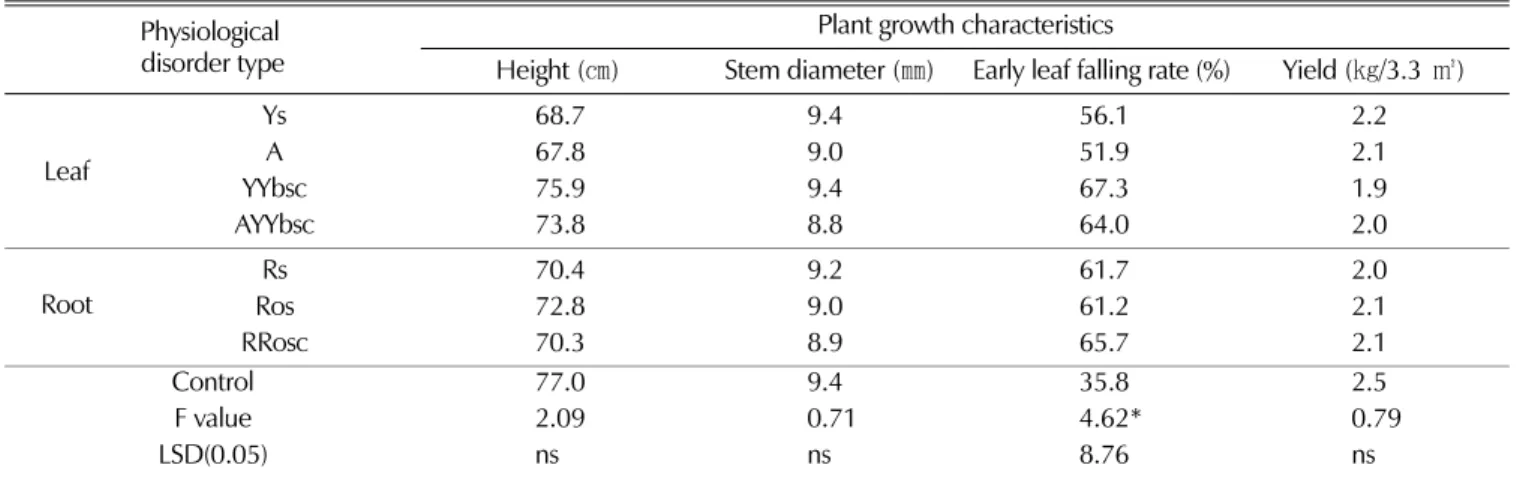
인삼 재배지에서 발생한 생리장해 유형별 생육특성은 Table 2 와 같다 . 전체적으로 생리장해 증상을 나타내는 재배지는 무 발생 재배포지 보다 초장 , 경태 및 수량이 다소 낮아지는 경 향을 보였으나 조기낙엽율은 높게 나타났다 . 특히 황색과 황 갈색 반점이 복합적으로 발생하는 재배포지에서는 조기낙엽율 이 가장 높았다 . 뿌리에서도 적변 , 은피 그리고 적변과 은피가 복합적으로 발생하는 포지에서도 초장 및 경태가 작아지면서 수량이 다소 적어지는 경향을 보였으나 조기낙엽율은 높게 나 타났다 .
생리장해 발생이 한 가지 유형으로 나타나는 경우보다 두 가지 이상의 유형이 복합적으로 나타나는 재배포지에서 대체 적으로 조기낙엽율이 높은데 이는 생리장해 발생정도가 심하 면 조기낙엽이 증가하고 수량이 감소된다는 보고 (Lee et al.,
1980; Lee et al., 1984; Lee et al., 1989; Lee et al., 1991) 와 일치한다 .
2. 토양화학 성분이 생리장해 발생 유형에 미치는 영향 잎과 뿌리에 나타나는 인삼 생리장해 발생 유형과 토양 화 학성분 함량과의 관계는 Table 3 과 같다 . 황색 반점형 발생 포장은 생리장해 무 발생에 비해 염류농도 1.7 배 , 질산태 질소
2.0 배 , 유효인산 2.2 배 그리고 나트륨은 1.5 배 높게 나타났다 .
엽연 ( 오갈 ) 형 황증 발생 포장은 염류농도 1.6 배 , 질산태 질소
1.8 배 , 유효인산 1.7 배 그리고 칼슘은 1.2 배 높게 나타났다 . 황 색·황갈색 반점이 복합적으로 발생하는 포장은 염류농도 1.6
Fig. 1.
Type of physiological disorder with symptoms appear in the leaf and root. A, yellow spot; B, Atrophy; C, Yellow-Yellow brown spot complex; D, Atrophy plus Yellow-Yellow brown spot complex; E, Red skin; F, Rough skin; G, Red-Rough skin complex.
Fig. 2.
Composed rate of single physiological disorder associated with complex physiological disorder type.
※
Ys, Yellow spot; Ybsc, Yellow brown spot; A, Atrophy;
Rs, Red skin; Ros, Rough skin; SRR, Simultaneously occurred Ros and Rs.
YYbsc, Yellow-Yellow brown spot complex type; AYYbsc, Atrophy plus Yellow-Yellow brown spot complex type;
RRosc, Red-Rough skin complex type.
배 , 질산태 질소 1.8 배 , 유효인산 1.4 배 그리고 칼슘과 마그네 슘은 각각 1.3 배와 1.1 배 높았다 . 오갈·황색·황갈색 반점
복합형 황증 발생 포장은 염류농도 1.8 배 , 질산태 질소 1.8 배 ,
유효인산 2.3 배 , 칼슘 1.12 배 , 마그네슘 1.35 배 그리고 나트륨 은 1.3 배 높았다 .
뿌리에서 나타나는 적변 발생 포장은 염류농도 2.0 배 , 질산 태 질소 2.3 배 유효인산 1.2 배 그리고 양이온은 마그네슘 1.5
배와 나트륨 1.3 배 높은 경향을 보였으며 , 은피 발생 포장은 산도 (pH) 가 6.2 로 유효인산은 1.8 배 칼륨은 1.64 배 높게 나
타났으나 유기물 함량은 낮은 경향을 보였다 . 적변과 은피가
복합적으로 발생하는 포장은 염류농도 1.3 배 , 질산태 질소
1.5 배 그리고 양이온은 칼륨 1.6 배 , 나트륨 1.12 배 높은 수준 이었다 .
토양 화학성분이 잎에서 나타나는 황증 발생율에 미치는 영 향은 Table 4 와 같다 . 황색 반점형은 나트륨 , 질산태 질소 그
리고 염류농도 순으로 , 엽연 ( 오갈 ) 형은 질산태 질소와 염류농
도 그 다음으로 칼슘과 마그네슘 순으로 발생율에 기여하는 것으로 나타났다 . 황색·황갈색 반점 복합형 황증 발생은 염 류농도와 질산태 질소 그 다음으로 마그네슘과 나트륨 , 유효 인산으로 나타났다 . 오갈·황색·황갈색 반점 복합형 황증 발 생은 질산태 질소와 염류농도 그 다음으로 칼슘 , 마그네슘과 나트륨 순으로 나타났다 .
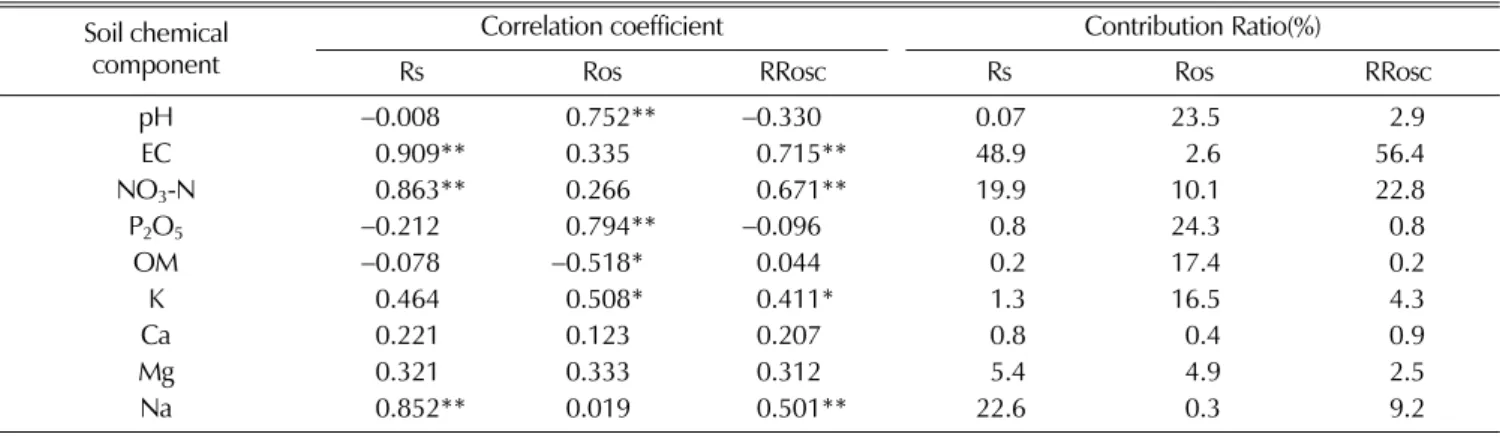
토양 화학성분이 뿌리에서 발생되는 생리장해에 미치는 영 향은 Table 5 와 같다 . 적변 발생율에 영향을 미치는 성분은 염류농도 , 질산태 질소 , 나트륨 순으로 기여하는 것으로 나타 났다 . 은피 발생율에 기여하는 성분은 유효인산 , 토양산도 , 칼
Table 2.Plant growth characteristics of individual physiological disorder type.
Physiological
disorder type Plant growth characteristics
Height (
㎝) Stem diameter (
㎜) Early leaf falling rate (%) Yield (
㎏/3.3
㎡) Leaf
Ys 68.7 9.4 56.1 2.2
A 67.8 9.0 51.9 2.1
YYbsc 75.9 9.4 67.3 1.9
AYYbsc 73.8 8.8 64.0 2.0
Root Rs 70.4 9.2 61.7 2.0
Ros 72.8 9.0 61.2 2.1
RRosc 70.3 8.9 65.7 2.1
Control 77.0 9.4 35.8 2.5
F value 2.09 0.71 4.62* 0.79
LSD(0.05) ns ns 8.76 ns
※
Ys, Yellow spot; A, Atrophy; YYbsc, Yellow-Yellow brown spot complex; AYYbsc, Atrophy plus Yellow-Yellow brown spot complex; Rs, Red skin;
Ros, Rough skin; RRosc, Red-Rough skin complex.
* : Significant at the 5% level.
Table 3.
Soil chemical properties associated with occurrence of physiological disorder.
Physiological disorder type Soil chemical components
pH EC
ds m
−1NO
3-N
㎎㎏−1
P
2O
5㎎㎏−1
OM
g
㎏−1K Ca Mg Na
Ex. c
㏖+㎏−1leaf
Ys 5.4 2.0 206.7 440.9 11.4 0.54 4.48 1.51 0.247
A 5.3 1.9 210.8 343.2 14.8 0.52 5.40 2.83 0.168
YYbsc 4.9 1.9 194.9 276.9 18.8 0.59 4.43 1.84 0.181
AYYbsc 5.0 1.9 189.5 476.5 12.9 0.56 4.99 1.91 0.215
root Rs 5.0 2.3 245.3 227.6 14.6 0.61 4.84 2.14 0.211
Ros 6.2 1.1 116.7 364.2 10.7 0.82 4.54 1.47 0.155
RRosc 5.0 1.5 159.4 270.1 12.9 0.78 4.63 1.61 0.186
Control (non-occurrence) 5.4 1.2 105.8 203.2 13.7 0.50 4.44 1.41 0.165
F value 1.55 2.29* 3.31* 3.29* 1.79* 0.68* 2.42* 1.33 2.45*
LSD(0.05) ns 0.64 77.8 89.7 3.12 0.19 0.78 ns 0.061
※
Ys, Yellow spot; A, Atrophy; YYbsc, Yellow-Yellow brown spot complex; AYYbsc, Atrophy plus Yellow-Yellow brown spot complex; Rs, Red skin;
Ros, Rough skin; RRosc, Red-Rough skin complex.
* : Significant at the 5% level.
륨 순으로 나타났으며 , 유기물 함량은 부의 상관으로 관여하 는 것으로 나타났다 . 적변과 은피 복합형은 염류농도 , 질산태 질소 , 나트륨과 칼륨 순으로 나타났다 .
농가 포지에서 발생하는 생리장해는 황색 반점형 생리장해 와 같이 한가지 유형으로 발생하는 경우와 황색 반점형에 황 갈색 반점형이 함께 발생하는 생리장해로 구분 할 수 있다 .
또한 모든 생리장해 발생 유형에 공통적으로 관여하는 토양화 학성분은 염류농도 , 질산태 질소이며 양이온들은 생리장해 유 형별로 관여하는 종류와 농도가 달랐다 . 특히 , 두 가지 또는 세 가지 유형이 복합적으로 발생할 경우 관여하는 양이온의 종류와 농도가 증가 된다는 사실을 확인 할 수 있었다 . 또한 엽에서 황색 반점 발생과 뿌리에서 적변 발생에 관여하는 토 양화학성분의 종류 및 기여하는 정도가 같게 나타나 엽에서 나타나는 증상으로 뿌리의 적변진행 정도를 예측 할 수 있을 것으로 판단된다 .
엽에서 나타나는 생리장해는 토양내 질산태 질소 및 마그네 슘 성분 과다가 미량원소인 철 , 구리 또는 아연의 흡수를 저
해한다고 하였으나 (Lee et al., 1989; Lee et al., 1995;
Mork et al., 1981) 구체적으로 이들 무기성분간의 상호작용에 대한 역할은 아직까지 확립된 것이 없는 실정이다 . 본 연구에 서 나트륨 이온이 황색 반점형 황증 및 적변 발생에 질산태 질소와 유효인산 보다 더 크게 영향을 주는 것으로 나타났다 . Lee et al. (1980) 은 은피 상습 발생지는 적황색의 야산 개 간지로 척박한 재배지에서 관찰되어 진다는 보고와 비교할 때 , 본 연구에서도 은피발생은 유기물 함량이 낮으면 은피 발 생율이 높아진다는 것과 상호 관련성이 있는 것으로 보인다 .
결론적으로 생리장해는 토양 성분 절대량이 부족하여 발생하 는 생리장해보다는 토양내 특정성분이 과다로 인한 상호간의 양분 흡수 불균형에서 오는 생리장해가 더 많다 (Chung et al.,
2003; Chung et al., 1985). 특히 나트륨 함량이 높으면 뿌리가
적변 증상을 보이면서 동시에 지상부에서 황색 반점 생리장해 가 나타났으며 , 나트륨 , 칼슘과 마그네슘 세 종류의 성분이 높 은 재배지는 생리장해가 복합적으로 나타나는 현상을 보여 이 들 성분은 생육과 밀접한 관계가 있는 것으로 나타났다 .
Table 4.
Contribution of soil chemical components affecting physiological disorders with symptom appeared on the leaf surface.
Soil chemical
component Correlation coefficient Contribution Ratio (%)
Ys A YYbsc AYYbsc Ys A YYbsc AYYbsc
pH
−0.332 − 0.114 − 0.417 − 0.342 6.4 1.6 3.3 6.2
EC − 0.740** − 0.676** − 0.633** − 0.607** 13.4 20.1 53.8 20.4
NO
3-N − 0.754** − 0.714** − 0.624** − 0.589* 18.6 47.3 12.0 39.1
P
2O
5− 0.151 − 0.293 − 0.555*
−0.062 1.8 4.5 11.4 0.06
OM
−0.148
−0.427
−0.108 − 0.368 2.4 0.9 0.2 3.1
K − 0.069 − 0.002 − 0.266 − 0.172 0.03 0.02 0.6 2.6
Ca − 0.376 − 0.574* − 0.390 − 0.569* 10.2 14.3 0.9 13.1
Mg − 0.325 − 0.562* − 0.506* − 0.640** 5.5 9.5 7.4 8.8
Na − 0.808** − 0.397 − 0.538* − 0.502* 41.7 1.8 10.4 6.7
※
Ys, Yellow spot; A, Atrophy; YYbsc, Yellow-Yellow brown spot complex; AYYbsc, Atrophy plus Yellow-Yellow brown spot complex
*,** : Significant at the 5% and 1% levels, respectively.
Table 5.
Contribution of soil chemical components affecting physiological disorders with symptom appeared on the root.
Soil chemical
component Correlation coefficient Contribution Ratio(%)
Rs Ros RRosc Rs Ros RRosc
pH
−0.008 − 0.752**
−0.330 0.07 23.5 2.9
EC − 0.909** − 0.335 − 0.715** 48.9 2.6 56.4
NO
3-N − 0.863** − 0.266 − 0.671** 19.9 10.1 22.8
P
2O
5 −0.212 − 0.794**
−0.096 0.8 24.3 0.8
OM
−0.078
−0.518* − 0.044 0.2 17.4 0.2
K − 0.464 − 0.508* − 0.411* 1.3 16.5 4.3
Ca − 0.221 − 0.123 − 0.207 0.8 0.4 0.9
Mg − 0.321 − 0.333 − 0.312 5.4 4.9 2.5
Na − 0.852** − 0.019 − 0.501** 22.6 0.3 9.2
※