마우스에서 삼색제비꽃 추출물의 진통 효과와 매커니즘
박수현*,**,#·심윤범*,**,#·서홍원*,**·김진규**·이진구**·임순성**,***†
*한림대학교 의과대학 약리학교실, **한림대학교 천연의약연구소, ***한림대학교 식품영양학과3
Antinociception Effect and Mechanisms of Viola tricolor L. Extract in Mouse
Soo Hyun Park
*,**,#, Yun Beom Sim
*,**,#, Hong Won Suh
*,**, Jin Kyu Kim
**, Jin Koo Lee
**and Soon Sung Lim
**,***†*
Department of Pharmacology, College of Medicine, Chuncheon 200-702, Korea.
**
Institute of Natural Medicine, Chuncheon 200-702, Korea.
***
Department of Food Science and Nutrition, Hallym University, Chuncheon 200-702, Korea.
ABSTRACT: In the present study, the antinociceptive profiles of Viola tricolor L . (V. tricolor L. ) extract were examined in ICR mice. V. tricolor L. extract administered orally (200 ㎎ / ㎏ ) showed an antinociceptive effect as measured by the tail-flick and hot-plate tests. In addition, V. tricolor L. extract attenuated the writhing numbers in the acetic acid-induced writhing test. Furthermore, the cumulative nociceptive response time for intrathecal (i.t.) injection of substance P (0.7 ㎍ ) was dimin- ished by V. tricolor L. extract. Intraperitoneal (i.p.) pretreatment with yohimbine ( α
2-adrenergic receptor antagonist) attenu- ated antinociceptive effect induced by V. tricolor L. extract in the writhing test. However, naloxone (opioid receptor antagonist) or methysergide (5-HT serotonergic receptor antagonist) did not affect antinociception induced by V. tricolor L.
extract in the writhing test. Our results suggest that V. tricolor L. extract shows an antinociceptive property in various pain models. Furthermore, this antinociceptive effect of V. tricolor L. extract may be mediated by α
2-adrenergic receptor, but not opioidergic and serotonergic receptors.
Key Words : Viola tricolor L . , Anti-Nociception, Inflammatory Pain, α
2-adrenoceptor
INTRODUCTION
Heartsease, also known as wild Viola tricolor L. (pansy, Violaceae), has a long history in phytomedicine. The therapeutic activity of V. tricolor L. has been identified in treating various skin conditions, such as eczema, seborrhea, impetigo, acne, catarrh of the respiratory tract, and whooping cough. It is also helpful in cases of cradlecap in babies. The herb is employed in treating frequent and painful urination in conditions such as cystitis. Due to the high concentration of rutin in the herb, it may be employed to prevent bruising and broken capillaries, to check the build up of fluid in the tissues and to help to reduce blood pressure (Bakoyte et al , 1973; Bisset and Wichtl, 2001). It can gently alter the functioning of nerves, and the immune system. It is helpful in cases of nightmares,
insomnia, and distressed sleep with frequent night awa- kenings. The herb of wild pansy may be very successfully used after surgery to prevent reoccurring tumors (McGuffin et al ., 1997).
However, the effect of this herb on pain is unclear.
Therefore, in this study, we attempted to characterize antinociceptive profiles and mechanisms of V. tricolor L.
extract in various pain models.
MATERIALS AND METHODS
These experiments were approved by the University of Hallym Animal Care and Use Committee (Registration Number: Hallym 2009-05-01). All procedures were conducted in accordance with the ‘Guide for Care and Use of Laboratory Animals’ published by the National Institutes of
#
Soo Hyun Park and Yun Beom Sim are equally contributed to this study.
†
Corresponding author: (Phone) +82-33-248-2133 (E-mail) [email protected]
Received 2010 June 30 / 1st Revised 2010 July 13 / 2nd Revised 2010 August 2 / 3rd Revised 2010 August 3 / Accepted 2010 August 5
Health and the ethical guidelines of the International Association for the Study of Pain.
1. Experimental animals
Male ICR mice (MJ Co., Seoul, Korea) weighing 20-25 g were used for all the experiments. Animals were housed 5 per cage in a room maintained at 22 ± 0.5 ℃ with an alternating 12 hr light-dark cycle. Food and water were available adlibitum . The animals were allowed to adapt to the laboratory for atleast 2 hr before testing and were only used once. Experiments were performed during the light phase of the cycle (10:00-17:00).
2. Oral administration, and intraperitoneal (i.p.) and intrathecal (i.t.) injections
Oral administration was performed with gage in a volume of 500 ㎕ /25 g body weight. I.p. injection was conducted to unanesthesized mice with volume of 250 ㎕ . The i.t.
administration was performed following the method of Hylden and Wilcox (Hylden and Wilcox, 1980; 1981) using a 30-gauge needle connected to a 25 ㎕ Hamilton syringe with polyethylene tubing. The i.t. injection volume was 5 ㎕ and the injection site was verified by injecting a similar volume of 1% methylene blue solution and determining the distribution of the injected dye in the spinal cord. The dye injected i.t. was distributed both rostrally and caudally but with short distance (about 0.5 ㎝ from the injection site) and no dye was found visually in the brain. The success rate for the injections was consistently found to be over 95%, before the experiments were done.
3. Assessment of antinociception and experimental protocols All assessments for measuring antinociceptive properties of V. tricolor L. extract were carried out by blinded observers.
4. Tail-flick and hot-plate tests
Antinociception was determined by the tail-flick (D’Amour and Smith, 1941) and the hot-plate paw-licking tests (Eddy and Leimbach, 1953). For the measurement of the tail-flick latency, mice were gently held with one hand with the tail positioned in the apparatus (EMDIE Instrument Co., Maidens, VA, USA, Model TF6) and the tail-flick response was elicited by applying radiant heat to the dorsal surface of the tail. The intensity of radiant heat was adjusted so that the animal flicked its tail within 3 to 5 sec. For the hot-plate
test, mice were individually placed on the 55 ℃ hot-plate apparatus (Itic Life Science, Woodland Hills, CA, USA, Model 39 Hot Plate) and then, the reaction time starting from the placement of the mouse on the hotplate to the time of licking the front paw was measured. Basal latency for the hot-plate test was approximately 9 sec. Animals were pretreated orally once with vehicle (control) or V. tricolor L.
extract at 200 ㎎ / ㎏ doses 30 min prior to performing the tail-flick or hot-plate tests.
5. Acetic acid-induced writhing test
For the writhing test (Koster et al ., 1959), 1% acetic acid was injection i.p. and then, the animals were immediately placed in an acrylic observation chamber (20 ㎝ high, 20 ㎝
diameter). The number of writhes was counted during 30 min after the injection of acetic acid. A writhe was defined as a contraction of the abdominal muscles accompanied by an extension of the forelimbs and elongation of the body.
Animals were pretreated orally once with vehicle (control) or V. tricolor L. extract at 200 ㎎ / ㎏ doses 30 min prior to performing the acetic acid-induced writhing test.
6. Substance P-induced nociceptive behavioral test Vehicle (control) or 200 ㎎ / ㎏ of V. tricolor L. extract was pretreated orally 30 min prior to performing i.t. injection of substance P (0.7 ㎍ /5 ㎕ ). Immediately after i.t. injection with substance P, the mice were placed in an observation chamber (20 ㎝ high, 20 ㎝ diameter) and their nociceptive behavioral responses were recorded during 30 min. The cumulative response time of licking, scratching and biting episodes directed toward the lumbar and caudal region of spinal cord were measured with a stop-watch timer (Hylden and Wilcox, 1981).
7. Pretreatment of antagonists
At first, mice were pretreated i.p. with either saline, naloxone (5 ㎎ / ㎏ ), methysergide (5 ㎎ / ㎏ ), or yohimbine (5
㎎ / ㎏ ), 10 min before oral administration of vehicle as a control or a fixed dose of V. tricolor L. extract (200 ㎎ / ㎏ ).
And then, the writhing response was tested 30 min after the treatment with either vehicle or V. tricolor L. extract (Choi et al ., 2003; Park et al ., 2009; Suh et al ., 1996; 1996; 1999).
8. Drugs
Acetic acid, substance P, naloxone, methysergide and
yohimbine were purchased from Sigma Chemical Co. (St.
Louis, MO, USA). V. tricolor L. (300 g) was dissolved in 80% ethanol (1,500 ㎖ ) and extracted as refluxing for 3 hours, and then the extract was filtered for obtaining A.
This process was repeated again once to obtain B from residue. A and B were mixed. This mixture was decom- pressed and dried for using as V. tricolor L. extract. V.
tricolor L. extract, naloxone, methysergide and yohimbine were dissolved in saline. All drugs were prepared just before use.
9. Statistical analysis
Data were presented as the mean ± SEM. The statistical significance of differences between groups was assessed with one-way ANOVA with Bonferroni’s post-hoc test using GraphPad Prism version 4.0 for Windows Vista (GraphPad Software, San Diego, CA, USA); P < 0.05 was considered significant.
Results
1. Effect of Viola tricolor L. extract on the tail-flick and hot-plate paw-licking responses
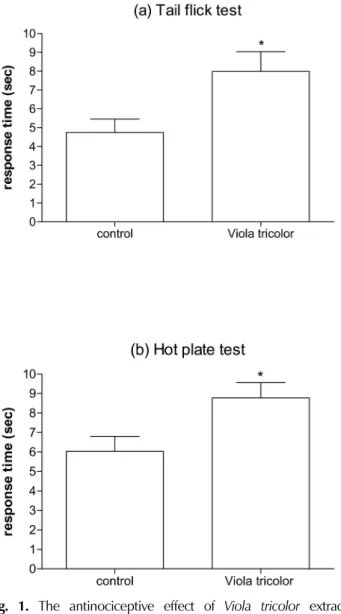
As revealed in Fig. 1a and b, oral treatment of V.
tricolor L. extract at the dose of 200 ㎎ / ㎏ led to 62.5%
and 46.6% increased latencies of the tail-flick and hot-plate paw-licking responses compare to the control group of mice.
The sedative effect was manifested, when the mice were treated with V. tricolor L. extract orally at the dose of 200
㎎ / ㎏ . However, there were no paralysis and motor changes.
2. Effect of Viola tricolor L. extract on the nociceptive behavior induced by acetic acid and substance P
V. tricolor L. extract attenuated the acetic acid-induced writhing numbers (Fig. 2a). Treatment with V. tricolor L.
extract at the dose of 200 ㎎ / ㎏ led to 54% decrease in the acetic acid-induced writhing response compare to the control group of mice. In vehicle-treated control mice, i.t.
injection of substance P (0.7 ㎍ ) caused acute, immediate behavioral responses, i.e., licking, scratching and biting the lumbar or caudal region, which lasted about 30 min. As shown in Figs. 2b, cumulative nociceptive response times for i.t. administration of substance P was significantly diminished by 61 %.
3. Effect of opioidergic, serotonergic and adrenergic system on the inhibition of writhing response induced by Viola tricolor L. extract
We examined the possible involvement of opioidergic, serotonergic and adrenergic system in the V. tricolor L.
extract-induced antinociception. The pretreatment with naloxone (opioid receptor antagonist, Fig. 3a) or methysergide (sero- tonergic receptor antagonist, Fig. 3b) did not affect V.
tricolor L. extract-induced antinociception. However, the
Fig. 1.
The antinociceptive effect of
Viola tricolorextract administered orally in the tail-flick and hot-plate tests.
Mice were administered orally with either vehicle or 200
㎎/
㎏of
Viola tricolorextract and the tail-flick (a) or hot-plate (b) response was measured at 30 min after treatment. The vertical bars denote the standard error of the mean. The number of animal used for each group was 8 / 1 time for 3 times (*P < 0.05, **P <
0.01 compared to the vehicle-treated control group of
mice).
blockade of α
2-adrenergic receptor with systemic pre-admini- stration of yohimbine abolished the V. tricolor L. extract- induced inhibition of the writhing response (Fig. 3c). The treatment of naloxone, methysergide or yohimbine itself did not affect the writhing response (Fig. 3).
Discussion
In the present study, we found that V. tricolor L. extract
Fig. 2.
Effect of
Viola tricolorextract on the nociceptive response induced by various pain models.
Viola tricolorextract (200
㎎/
㎏) was administered orally and then, 0.25
㎖of 1% acetic acid solution was injected intraperitoneally 30 min after treatment. The number of writhing was counted for 30 min following acetic acid injection (a).
Viola tricolorextract (200
㎎/
㎏) was administered orally for 30 min prior to the substance P (0.7
㎍per 5
㎕) injection intrathecally (b). The cumulative response time of licking, scratching and biting episodes was measured for 30 min.
The vertical bars indicate the standard error of the mean.
The number of animal used for each group was 8 / 1 time for 3 times (***p < 0.001, compared with control group).
Fig. 3.