복분자 에탄올 추출물의 생리활성 탐색
권지웅*·이희권*·박희전*·권태오**·최혜란***·송지영*†
*(재)고창복분자연구소, **원광대학교 생명자원과학대학, ***고창군농업기술센터
Screening of Biological Activities to Different Ethanol Extracts of Rubus coreanus Miq.
Ji Wung Kwon*, Hee Kwon Lee*, Hee Jeon Park*, Tae Oh Kwon**, Heh Ran Choi***and Ji Young Song*†
*Gochang Black Raspberry Research Institute, Gochang 585-943, Korea.
**College of Life Science and Natural Resources, Wonkwang University, Iksan 570-749, Korea.
***Gochang Development Technology Center, Gochang 585-807, Korea.
ABSTRACT : This study was carried out to evaluate biological activities to different ethanol extracts from unripened and ripened fruit (Rubus coreanus Miq.). 25% to 75% ethanol extracts of unripened and ripened fruits were similar to extract yield respectively. Yield of ethanol extract of ripened fruit were approximately 3 times higher than that of unripened fruit.
75% ethanol extract of unripened fruit showed the highest contents of total polyphenol (180.04± 0.41 ㎎/g) and total fla- vonoid (50.43± 0.81 ㎎/g). Contents of total polyphenol and total flavonoid of unripened fruit were about 2 times higher than those of ripened fruit. IC50 values of DPPH radical scavenging activity and linoleic acid peroxidation inhibition activity of BHA and α-tocopherol showed 13.19 ± 0.21 and 18.16 ± 0.23 ㎍/㎖, 4.25 ± 0.04 ㎍/㎖ and 5.56 ± 0.10 ㎍/㎖ respectively, but 75% ethanol extract of unripened fruit showed the lowest 23.85± 0.10 ㎍/㎖ and 7.34 ± 0.07 ㎍/㎖ among other all extracts. IC50 values of LDL (low density lipoprotein) oxidation inhibition activity and α-glucosidase inhibitory activity of 75% ethanol extract of unripened fruit showed the lowest 1.04± 0.04 ㎍/㎖ and 7.21 ± 0.13 ㎍/㎖ among other all extracts respectively. Specifically, 75% ethanol extract of unripened fruit has relatively better biological activities than other ethanol extracts, it could be potentially used as bioactive source for health functional foods.
Key Words : Rubus coreanus Miq., DPPH, Linoleic Acid Peroxidation, Low Density Lipoprotein, α-Glucosidase
서 언
복분자 (Rubus coreanus Miquel)는 우리나라 중부 이남의 산기슭 양지에 자라는 장미과 (Rosaceae)에 속하는 낙엽관목 으로 높이가 2~3 m 정도이며, 줄기는 흰 분이 덮여 있고 갈 고리 모양의 가시가 있는 것이 특징이다. 열매는 핵과가 모여 서 반달모양의 검은 복과를 형성하고 5~6월에 꽃이 피며 7~8 월에 열매가 성숙되어 둥글고 붉은색으로 익다가 나중에는 흑 색으로 완숙된다 (Bae, 2000; Lee, 1989, 1998). 복분자는 식 용 및 약용 등으로 사용되고 있으며, 가공에 대한 연구로는 복분자를 이용한 발효주 (Choi et al., 2006), 유산발효 (Park and Chang, 2003), 착즙액 첨가 식빵제조 (Kwon et al., 2004), 분말첨가 건면제조 (Lee et al., 2000) 등으로 식품산 업에 이용되고 있다.
복분자의 주요성분으로는 coreanoside F1, suavissimoside,
nigaichigoside F1, F2 등이 있는 것으로 보고되고 있다 (Ohtiani et al., 1990; Lee and Kang, 1993). 복분자의 잎으 로부터 flavonoid인 kaempferol, quercetin, quercetin 3-O-β- D-glucuronide의 sodium salt 및 ellagitannin인 ellagic acid, sanguiin H-5 등을 분리·동정하였고, 줄기로부터 2종의 flavan-3-ol, 1종의 proanthocyanidin과 1종의 ellagitanin을 분 리하였다 (Lee, 1995; Kim et al., 1997). 복분자의 미숙과를 이용한 연구로는 Pang 등 (1996)이 gallic acid, 2,3-(s)- HHDP-D-glucopyranose, sanguiin H-4, sanguiin H-6의 4종 의 가수분해성 탄닌을 확인·동정하였고, 항산화 (Yoon et al., 2002), 면역 활성 증가 (Lee et al., 2003; Park et al., 2004), B형 간염바이러스 (HBV) 억제 (Kim et al., 1999), 항암활성 (Kim et al., 2005), 항암 및 항스트레스 효과 (Kim et al., 2006)에 관한 연구 등이 보고되었다. 한편, 복분 자의 완숙과에서 Helicobacter pylori urease 저해물질을 분리
†Corresponding author: (Phone) +82-63-561-6768 (E-mail) [email protected]
Received 2011 September 2 / 1st Revised 2011 September 20 / 2nd Revised 2011 September 28 / Accepted 2011 October 4
하고 내열성 단백질인 이 물질이 위내 단백분해효소인 pepsin 에도 가수분해 저항성이 있음이 밝혀졌고, 복분자술이 수컷 흰 쥐에서 testosterone의 증가를 유도하는 식물 호르몬 작용이 있 음을 보고하였다 (Yang et al., 2004; Whang, 2005). 완숙복 분자는 미숙과에 비하여 면역활성과 항산화활성이 다소 떨어 지는 경향은 있으나 과실이 성숙함에 따라 비타민 C, 당과 유 리당의 함량은 증가하고 탄닌과 산의 함량은 감소하여 맛이 증가한다 (Cha et al., 2007; Ohtani, 1990). 복분자와 관련한 연구가 기능성식품으로 방향이 전환되어, 그 효능에 대한 관 심이 높아진 2003년 이후로는 재배면적의 증대 및 보급의 확 대와 함께 완숙복분자를 이용하여 주류, 음료 등 식품을 중심 으로 하는 연구가 많이 이루어졌으며, 또한 화장품 소재 및 착즙액을 이용 안토시아닌 색소를 추출하여 천연염색에 이용 하기도 하였다 (Bai, 2006).
따라서 본 연구에서는 복분자 미숙과와 완숙과의 에탄올 농 도를 달리한 추출물의 생리활성을 탐색하고 향후 그 활용방안 을 모색하고자 연구를 수행하였다.
재료 및 방법
1. 실험재료
본 실험에 사용된 복분자는 전북 고창군에서 재배된 것으로 2010년 6월부터 과실의 색이 녹색인 것을 미숙과, 검붉은 색 을 완숙과로 구분하여 수확한 것을 −20℃ 냉동 보관하여 사 용하였다.
2. 추출물 제조
복분자 생과를 믹서기로 마쇄한 후 생과 400 g당 에탄올 0%, 25%, 50%, 75%, 100% 농도별로 넣고 환류냉각장치를 부착한 히팅 맨틀을 이용 2시간 동안 가열 추출하였고, 이것 을 2회 반복 하였다. 추출물은 여과지 (ADVANTEC No.2)를 이용 여과하여 감압농축 후 동결 건조 하였다.
3. 총 폴리페놀 및 총 플라보노이드 함량
총 폴리페놀 함량은 Folin-Denis 법 (Amerine and Ough, 1980)을 응용하여 측정하였다. 즉 미숙과와 완숙과를 에탄올 농도별 (0, 25, 50, 75, 100%)로 추출 후 농축한 시료 1 ㎎ 을 용매 1 ㎖에 용해시켜 Folin-Ciocalteau 시약 2 ㎖를 가하 여 혼합하고 3분 후 10% Na2CO3 용액 (w/v) 2 ㎖를 넣어 진탕하고 1시간 실온에서 방치한 후 700 ㎚에서 비색정량 하 였다. Gallic acid를 표준물질로 사용하여 검량곡선을 작성하 고 이로부터 총 폴리페놀 함량을 구하였다.
총 플라보노이드 함량은 Davis 방법 (Chang et al., 2002) 을 이용하여 측정하였는데, 시료 1 ㎎을 용매 1 ㎖에 용해시 키고 diethylene glycol 2 ㎖, 1 N-NaOH 0.02 ㎖ 를 가한 다
음 37℃ 항온수조에서 1시간 동안 방치한 후 420 ㎚에서 흡 광도를 측정하였다. Rutin을 이용하여 표준곡선을 구하여 총 플라보노이드 함량을 구하였다.
4. DPPH radical 소거능 측정
에탄올 농도별로 복분자 미숙과, 완숙과의 항산화 활성을 조 사하기 위하여 자유라디칼인 DPPH를 사용한 항산화활성 측 정법 (Choi et al., 1993)을 이용하였다. 각 시료를 농도별로 용매 1.0 ㎖에 용해하여 사용하였다. 농도별로 조제한 시료 1.0㎖에 EtOH 3.0 ㎖을 넣고 2 × 10⁻⁴ M DPPH용액 1.0 ㎖ 을 가한 후 vortex mixer로 교반하였고, 실온에서 30분간 반 응시키고 517 ㎚ 에서 흡광도를 측정하여 추출물의 DPPH radical 소거능 (%)을 측정하였고, 대조구는 시료 대신에 EtOH 을 첨가하여 실험 하였으며, positive control은 BHA, α- tocopherol을 사용하여 활성을 비교하였고, 각 실험은 3회 반 복하여 실시하였다.
5. 지질과산화 억제활성 측정
에탄올 농도별로 복분자 미숙과, 완숙과의 linoleic acid의 지질과산화에 대한 억제활성 검정은 Inatani (Inatani et al., 1983) 등의 방법에 따라 실시하였다. 각 시료 농도별로 용매 1.0㎖ 에 용해하여 사용하였다. 시료 (1 ㎖), EtOH에 녹인 2.51% linoleic acid (2.05㎖), 0.05 M phosphate buffer (pH 7.0, 4.0㎖), 증류수 (1.95 ㎖), EtOH (1.0 ㎖)을 첨가하여 40
℃의 암소에 5일간 방치하였다. 이 반응액을 0.1 ㎖을 취해 75% EtOH (4.7㎖), 30% ammonium thiocyanate (0.1 ㎖), 3.5% HCl에 녹인 0.02 M ferrous chloride (0.1 ㎖)와 혼합하 여 3분이 지난 후에 500 ㎚에서 흡광도를 측정하여 산화양상 을 관찰하였다. 대조구는 시료대신 EtOH를 첨가하였으며, positive control은 BHA, α-tocopherol을 사용하여 활성을 비 교하였고, 각 실험은 3회 반복하여 실시하였다.
6. LDL (low density lipoprotein) 산화 저해능 측정 복분자 추출물을 농도별로 DMSO에 녹여 20 ㎕ 를 취하고 100㎍ protein을 함유하는 LDL 50 ㎕, 10 mM PBS (phos- phate-buffered saline) 90㎕ 를 혼합한 후 0.25 mM CuSO4
40㎕ 를 가해 37℃에서 4시간 동안 반응시키고 냉각한 후 20% TCA 1㎖ 를 가해 반응을 중단시켰다. 이 반응액을 vortex 한 후 0.05 N NaOH에 녹인 0.67% TBA (thiobar- bituric acid) 1.0㎖을 가해 혼합하여 95℃에서 15분간 가열하
DPPH radical scavenging activity
(%) = (1 − 시료의흡광도 ) × 100 대조구의 흡광도
Linoleic acid peroxidation
inhibition (%) = (1 − 시료의흡광도 ) × 100 대조구의 흡광도
고 냉각한 후 3,000 rpm에서 15분간 원심분리 하여 분리된 상등액 1 ㎖을 semi-micro cuvette에 분주하여 540 ㎚에서 생 성된 MDA (malondialdehyde)의 흡광도를 측정하였다 (Miller et al., 1996).
7. α-Glucosidase 활성 억제 효과 측정
복분자 추출물을 농도별로 희석하여 50 ㎕ 를 넣고, 0.75 unit/㎖ 의 α-glucosidase 효소액 25 ㎕ 를 50 mM potassium phosphate buffer (pH 7.0) 200㎕에 넣고 혼합한 후 2 mM p-nitrophenyl-α-D-glucopyranoside (PNPG) 225 ㎕ 를 가하여 37℃에서 30분간 반응시킨 후 0.5 M Na2CO3 용액 500 ㎕ 가하여 반응을 정지시킨 후 405 ㎚에서 흡광도를 측정하여 효 소 반응으로 생성된 nitrophenyl의 함량을 정량하여 각 추출물 을 처리하지 않은 대조구와 비교하여 효소활성을 계산하였다 (Kim et al., 1991). 양성대조구로는 acarbose를 사용하였다.
8. 통계처리
실험결과는 3회 반복실험 한 값을 SAS Package (release 9.1.3)를 이용하여 평균 ± 표준편차로 표시하였고, 평균값의 p
< 0.05의 수준에서 Duncan's multiple range test에 의하여 검 정하였다.
결과 및 고찰
1. 총 폴리페놀 및 총 플라보노이드 함량
페놀화합물은 식물계에 널리 분포하는 2차 대사물질로 수산 기를 가지는 방향성 화합물을 총칭하는 것으로 대부분의 폴리 페놀 화합물은 세포벽 다당류, 리그닌 등과 에스테르 결합을 이루고 있거나 중합체로 존재하며, 수산기를 통한 수소공여와 페놀 고리구조의 공명 안정화에 의하여 항산화능을 나타낸다.
즉 폴리페놀류는 체내의 항산화 체계와 함께 자유기로부터 조 직을 보호해 주는 역할을 한다 (Hyon et al., 2010; Choi et al., 2008). 특히 항산화작용과 관련하여 최근 생체내에서의 산 소 free radical 반응이 생체조직의 노화와 질병에 관련이 있 고, 페놀성 물질의 hydroxyl기는 유지의 유리기 수용체로서 유 지 산패의 초기단계에 생성된 유리기들이 안정된 화합물을 형 성하도록 하여 산화 억제작용을 하는 것으로 알려져 있다 (Lee et al., 2005).
또한 플라보노이드는 주로 anthocyanidins, flavonols, flavones, cathechins 및 flavanones 등으로 구성되어 있으며, 식물에 다량 존재하는 플라보노이드는 항산화작용, 순환기 질 환 예방, 항염, 항알러지, 항균, 항바이러스, 면역증강 등 다양 한 기능성 생리활성 효과를 보인다고 보고하였다 (Kwaguchi et al., 1997; Middleton and Kandaswami, 1994; Nakagawa and Amano, 1974).
복분자 미숙과와 완숙과의 생과 400 g당 추출 용매 1 L를 가한 후 추출 용매별 수율, 총 폴리페놀 함량, 총 플라보노이 드 함량을 분석한 결과는 Table 1과 같다. 추출 수율은 미숙 과, 완숙과 모두 25%~75% 에탄올 추출물까지는 비슷한 수율 을 나타냈으나, 25% 에탄올 추출물 수율이 각각 6.96 ± 0.35%, 20.62± 0.89%로 높았고, 에탄올 농도가 높을수록 수율 은 감소되었으며 100% 에탄올 추출물의 수율은 4.50 ± 0.81%, 17.33± 0.84%로 0% 에탄올 추출보다도 수율이 오히려 낮았 다. 미숙과와 완숙과를 비교하면 당 함량의 증가 등으로 완숙 과의 수율이 3배 정도 더 높게 나타난 것으로 생각된다.
총 폴리페놀 함량은 미숙과의 경우 75% 에탄올 추출물이 180.04± 0.41 ㎎/g으로 가장 많이 함유되어 있었으며, 50% 에 탄올 추출물은 167.56 ± 0.09 ㎎/g, 100% 에탄올 추출물이 126.48± 0.37 ㎎/g로 가장 함량이 낮게 나타났다. 완숙과의 경 우는 에탄올 농도가 증가할수록 총 폴리페놀 함량이 증가하였 Table 1. Yield, total polyphenol and total flavonoid contents of different ethanol extracts from unripened and ripened fruit of Rubus
coreanus Miq.
Material Extraction Yield (%) Total phenolic contents (㎎GA/g)* Total flavonoid contents (㎎RE/g)**
Unripened fruit
0% Ethanol 5.10±0.44de 130.34±0.13d 34.34±0.25e,***
25% Ethanol 6.96±0.35c 145.29±0.21c 38.51±0.11c
50% Ethanol 6.35±0.71cd 167.56±0.09b 45.43±0.67b
75% Ethanol 6.30±0.55cd 180.04±0.41a 50.43±0.81a
100% Ethanol 4.50±0.81e 126.48±0.37e 37.28±0.41d
Ripened fruit
0% Ethanol 18.00±0.73b 48.75±0.28j 18.31±0.42i
25% Ethanol 20.62±0.89a 60.40±0.36i 22.08±0.22g
50% Ethanol 20.23±0.96a 64.79±0.24h 22.69±0.41g
75% Ethanol 20.05±0.77a 65.71±0.37g 23.92±0.38f
100% Ethanol 17.33±0.84b 67.07±0.43f 19.47±0.64h
*Gallic acid(GA) was used as a standard for measuring of the total phenolics content. **Rutin(RE) was used as a standard for measuring of the total flavonoid content. ***Each value represents the mean ± SD (n = 3). Different alphabets in each values show statistically difference at p < 0.05 by Duncan's multiple range test.
는데 100% 에탄올 추출물이 67.07 ± 0.43 ㎎/g으로 가장 함량 이 높았으며, 0% 에탄올 추출물이 48.75 ± 0.28 ㎎/g으로 가장 함량이 낮았다. 미숙과와 완숙과의 총 폴리페놀 함량을 비교 하면 미숙과가 완숙과 보다 2배 이상 함량이 높게 나타났다.
Lee와 Do (2000)에 의하면 복분자 미숙과에서 폴리페놀 함 량은 물 추출물 보다 60% ethanol 추출물에서 더 높게 나타 났는데, 본 연구에서도 물 추출물 보다는 75% ethanol 추출물 에서 함량이 가장 많아 유사한 결과를 보였다.
총 플라보노이드 함량은 미숙과나 완숙과에서 75% 에탄올 추출물 까지는 함량이 증가되었으나 100% 에탄올 추출물에서 는 오히려 함량이 감소되었다. 미숙과의 경우 75% 에탄올 추 출물이 50.43 ± 0.81 ㎎/g으로 가장 많이 함유되어 있었으며, 0, 25, 50, 100% 에탄올 추출물의 함량은 각각 34.34 ± 0.25, 38.51± 0.11, 45.43 ± 0.67, 37.28 ± 0.41 ㎎/g이었다. 완숙과의 경우도 75% 에탄올 추출물이 23.92 ± 0.38 ㎎/g으로 가장 많 이 함유되어 있었으며, 0, 25, 50, 100% 에탄올 추출물의 함 량은 각각 18.31 ± 0.42, 22.08 ± 0.22, 22.69 ± 0.41, 19.47 ± 0.64㎎/g이었다. 미숙과와 완숙과를 비교하면 총 폴리페놀과 같이 미숙과에서 총 플라보노이드 함량이 높았다 (Table 1).
Park 등 (2007)은 블랙 라스베리의 성숙 단계에 따른 총 페놀 함량을 분석한 결과 과실이 형성된 지 5일 지난 열매에서 총 페놀 함량이 가장 높았고, 성숙함에 따라 점차 총 페놀 함량 이 줄어 완숙과에서 총 페놀 함량이 가장 적게 함유되어 있었 다고 보고하였다. 일반적으로 과실이 성숙함에 따라 총 페놀 함량이 감소하는 이유는 과실 내에 존재하는 폴리페놀들이 다 른 물질과 반응하여 다른 형태의 화합물을 형성하고 이것이 과실 내에 축적되기 때문이다 (Kim, 1975).
2. DPPH free radical 소거활성
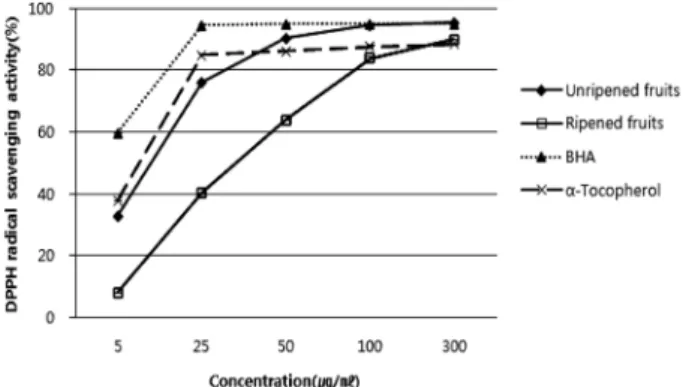
DPPH는 아스코르빈산 및 토코페롤, polyhydroxy 방향족 화 합물, 방향족 아민류에 의해 전자나 수소를 받아 불가역적으 로 안정한 분자를 형성하여 환원되어짐에 따라 짙은 자색이 탈색되어지는 원리를 이용하여 다양한 천연소재로부터 항산화 물질을 탐색하기 위해 많이 이용되고 있다 (Jeong et al., 2009). DPPH 소거활성을 측정하기 위하여 미숙과와 완숙과 75% 에탄올 추출물을 5, 25, 50, 100, 300 ㎍/㎖ 농도로 처 리한 결과는 Fig. 1과 같다. 미숙과와 완숙과의 에탄올 추출물 의 DPPH free radical 소거활성은 모두 농도 의존적으로 활 성이 높아지는 경향을 나타냈다. 특히 미숙과 75% 에탄올 추 출물의 활성이 가장 좋았는데, 5, 25, 50, 100, 300 ㎍/㎖ 농 도별로 각각 15.67 ± 0.14, 44.47 ± 0.19, 72.12 ± 0.15, 81.57 ± 0.37, 91.24± 0.12%를 나타내었다. 미숙과의 경우는 50 ㎍/㎖
이상, 완숙과의 경우는 300 ㎍/㎖ 이상의 농도에서 72.12 ± 0.15% 이상으로 BHA 71.20 ± 0.30%, α-tocopherol 78.34 ± 0.10%와 비슷한 활성을 보였다. 미숙과와 완숙과의 에탄올 농
도별 추출물에 대한 IC50 값을측정한 결과는 Table 2와 같다.
미숙과와 완숙과 모두 75% 에탄올 추출물에서 IC50 값이 가장 낮았으며, 미숙과 75% 에탄올 추출물이 23.85 ± 0.10 ㎍/㎖로 BHA, α-tocopherol의 IC50값 13.19 ± 0.21, 18.16 ± 0.23 ㎍/㎖
보다는 높았지만 추출물 중에서는 가장 낮은 값을 보였다. 미 숙과 추출물의 IC50 값이 23.85 ± 0.10~38.21 ± 0.37 ㎍/㎖으로 완숙과 104.4 ± 0.52~154.7 ± 0.73 ㎍/㎖보다 낮은 값을 나타내 었다. 이와 같은 결과는 추출용매나 복분자의 수확시기의 차이 에 따른 것으로 생각되며, Choi 등 (2009)도 자원식물의 생육 시기별로 항산화 물질의 함량과 항산화 활성에 차이가 있다고 보고하였다. 따라서 약용식물로부터 항산화물질을 추출하기 위 해서는 부위별 최적 생육 시기를 파악할 필요가 있을 것으로 판단된다. Park과 Oh (2003)는 거봉포도 에탄올 추출물의 전 Fig. 1. DPPH radical scavenging activity according to concen- tration of 75% ethanol extracts from unripened and ripened fruits of Rubus coreanus Miq. Each value represents the mean ± SD (n = 3).
Table 2. Comparison of IC50 values of DPPH radical scavenging activity of different ethanol extracts from unripened and ripened fruit of Rubus coreanus Miq.
Material Extraction IC50 (㎍/㎖)
Unripened fruit
0% Ethanol 535.39±0.25f, * 25% Ethanol 527.42±0.22g 50% Ethanol 524.98±0.23h 75% Ethanol 523.85±0.10i 100% Ethanol 538.21±0.37e
Ripened fruit
0% Ethanol 154.70±0.73a 25% Ethanol 116.30±0.53c 50% Ethanol 115.90±0.49c 75% Ethanol 104.40±0.52d 100% Ethanol 119.40±0.34b
BHA 513.19±0.21j
α-tocopherol 518.16±0.23k
*Each value represents the mean ± SD (n = 3). Different alphabets in each values show statistically difference at p < 0.05 by Duncan's multiple range test.
자공여 작용을 측정한 결과 종자와 과피의 IC50 값이 각각 136.7, 694.7㎍/㎖를 보였다고 보고하였는데, 복분자 미숙과와 완숙과 모두 거봉포도와 비슷하거나 우수한 결과를 보여 천연 항산화제 소재로 개발할 수 있을 것으로 생각된다.
3. 지질과산화 억제 활성
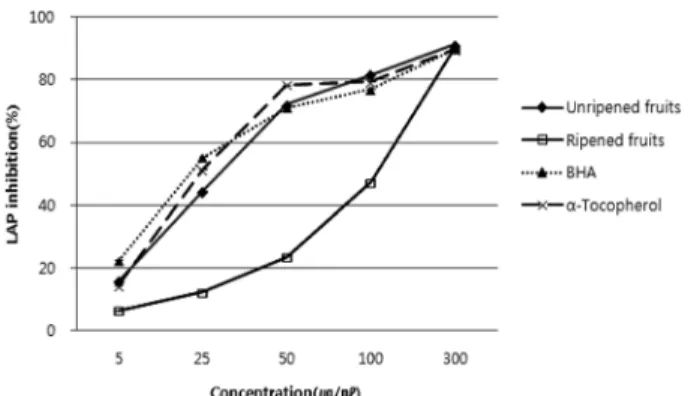
생체막 구성 지방산의 일종으로, 다양한 자연식품에 함유되 어 있는 linoleic acid는 산소에 의하여 쉽게 산화되어 세포 손상을 유도하며 (Seo et al., 2008), 식품에 첨가된 linoleic acid의 과산화는 영양소 파괴, 관능저하 및 변질을 유발하므로 (Lee et al., 2008) linoleic acid의 과산화억제는 다양한 분야 에 적용될 수 있는 중요한 생리활성이다. 미숙과와 완숙과의 75% 에탄올 추출물의 지질과산화 억제 활성을 농도별로 측정 한 결과는 Fig. 2와 같다. 미숙과와 완숙과 모두 농도 의존적 으로 지질과산화 억제 활성이 높아지는 경향을 나타내었다. 특 히 75% 에탄올 추출물의 지질과산화 억제 활성이 높았는데, 50㎍/㎖ 이상의 농도에서는 90.48 ± 0.32~95.45 ± 0.35%의 억 제 활성을 보여 α-tocopherol 86.24 ± 0.31~88.56 ± 0.25%보다 억제 활성이 더 좋았다. 에탄올 농도별 추출물에 대한 IC50 값 은 Table 3과 같은데 미숙과의 경우 75% 에탄올 추출물의 IC50 값이 7.34 ± 0.07 ㎍/㎖로 가장 낮은 값을 보였으며, 0, 25, 50, 100% 에탄올 추출물의 IC50 값은 각각 12.61 ± 0.31, 9.70± 0.30, 7.45 ± 0.14, 11.60 ± 0.25 ㎍/㎖ 으로 0% 에탄올 추출물에서 75% 에탄올 추출물 까지는 IC50값이 감소되다가 100% 에탄올 추출물에서는 증가되는 경향을 나타내었다. 또 한 에탄올 추출물 IC50 값에 비하여 BHA, α-tocopherol의 IC50 값은 4.25 ± 0.04, 5.56 ± 0.10 ㎍/㎖로 낮았으나 에탄올 추 출물도 분리·정제 과정을 거치면 더 좋은 활성을 나타낼 것 으로 생각된다. 또한 Woo 등 (2009)은 등골나무의 지질과산 화 억제활성이 4일차에 90.1% 정도를 나타내었다고 보고 하 였으며, Kim 등 (2010)은 칠피의 추출용매에 따른 지질과산화
억제 활성을 0.1 ㎎/㎖ 농도로 측정한 결과 80% 메탄올 추출 물 61.7%, 80% 에탄올 추출물 45.5%, 물 추출물 49.0%의 활성을 보여 추출용매에 따라 차이가 있다고 보고하였다. 복 분자의 경우도 추출용매에 따른 차이를 보였으며, 등골나무와 비슷한 억제 활성을 보여 지질과산화를 억제하기 위한 식물소 재로도 활용 가치가 높다고 생각된다.
4. LDL (low density lipoprotein) 산화 억제 활성
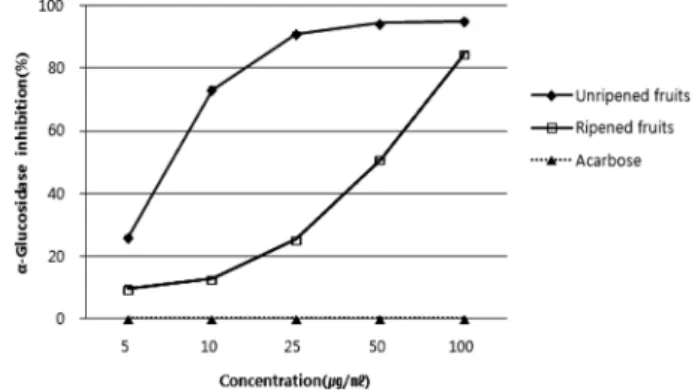
LDL (low density lipoprotein)은 죽상동맥경화의 병리적 측 면에서 중요한 유발인자로 쉽게 산화되어 동맥혈관이 좁아지 는 역할을 하나 vitamin C, vitamin E, carotenoid (Jialal et al., 1991), probucol (Thomas et al., 1987) 등의 항산화제가 첨가되면 산화가 억제된다. 본 실험에서는 복분자 미숙과와 완 숙과 75% 에탄올 추출물이 LDL 산화에 미치는 영향을 알아 보고자 최종 농도를 0.5, 1, 2, 4, 8 ㎍/㎖ 농도로 처리한 결 과는 Fig. 3과 같다. 미숙과와 완숙과의 에탄올 추출물은 모두 농도 의존적으로 LDL 산화 억제 효과가 높아지는 경향을 나 타냈다. LDL 산화 억제 효과 역시 미숙과 75% 에탄올 추출 물의 LDL 산화 억제 효과가 가장 좋았는데, 0.5, 1, 2, 4, 8
㎍/㎖ 농도별로 각각 11.14 ± 1.44%, 65.17 ± 1.22%, 73.78 ± 0.90%, 76.97± 0.74%, 84.55 ± 1.01%를 나타내었다. 완숙과 75% 에탄올 추출물의 경우 농도별로 각각 9.78 ± 1.06%, 34.50± 1.15%, 36.25 ± 1.39%, 55.79 ± 0.83%, 63.22 ± 1.24%
를 보여 미숙과의 추출물이 완숙과의 추출물보다 억제활성이 컸다. 에탄올 농도별 추출물에 대한 IC50 값을측정한 결과는 Table 4와 같다. 미숙과 75% 에탄올 추출물의 IC50 값이 1.04± 0.04 ㎍/㎖ 로 가장 낮은 값을 보였으며, 미숙과 0%, Fig. 2. Linoleic acid peroxidation(LAP) inhibition activity accor-
ding to concentration of 75% ethanol extracts from unripened and ripened fruits of Rubus coreanus Miq.
Each value represents the mean ± SD (n = 3).
Table 3. Comparison of IC50 values of linoleic acid peroxidation inhibition activity of different ethanol extracts from unripened and ripened fruit of Rubus coreanus Miq.
Material Extraction IC50 (㎍/㎖)
Unripened fruit
0% Ethanol 12.61±0.31f, * 25% Ethanol 59.70±0.30h 50% Ethanol 57.45±0.14i 75% Ethanol 57.34±0.07i 100% Ethanol 11.60±0.25g
Ripened fruit
0% Ethanol 98.68±0.49a 25% Ethanol 55.22±0.53b 50% Ethanol 45.72±0.41c 75% Ethanol 29.62±0.29e 100% Ethanol 41.19±0.26d
BHA 54.25±0.04k
α-tocopherol 55.56±0.10j
*Each value represents the mean ± SD (n = 3). Different alphabets in each values show statistically difference at p < 0.05 by Duncan's multiple range test.
25%, 50%, 100% 에탄올 추출물은 각각 1.31 ± 0.02, 1.20 ± 0.03, 1.10± 0.03, 1.34 ± 0.03 ㎍/㎖의 IC50 값을 보여 0% 에 탄올 추출물에서 75% 에탄올 추출물 까지는 IC50 값이 감소 되다가 100% 에탄올 추출물에서는 증가되는 경향을 나타내었 다. 완숙과 0%, 25%, 50%, 75%, 100% 에탄올 추출물의 IC50 값은 각각 4.19 ± 0.08, 3.86 ± 0.11, 3.82 ± 0.13, 3.50 ± 0.11, 4.18± 0.02 ㎍/㎖로 미숙과와 같은 경향이나 활성억제는 떨어지는 경향이었다. Lee 등 (2004)은 땅콩의 품종간 항산화 활성 비교에서 땅콩의 LDL 산화 억제 효과가 85.3~91.0%로 우수하다고 보고하였는데, 복분자의 경우도 땅콩보다는 억제 효과가 조금은 낮았지만 LDL 산화를 억제하므로 동맥경화를 예방할 수 있는 소재로 생각된다.
5. α-Glucosidase 억제 활성
최근 당뇨병이나 비만 등의 치료를 위해 탄수화물의 소화를
지연시키거나 억제시킴으로써 소장에서의 흡수를 억제하고자 하는 연구들이 활발히 이루어지고 있다. 그 중에 α-glucosidase 는 소장의 융모막 (brush-border membrane)에 존재하는 소화 효소이다. 이들은 이당류나 다당류가 탄수화물이 소화 흡수되 기 위한 상태인 단당류로 가수분해하는 역할을 한다. 소장 내 α-glucosidase들에 의한 탄수화물의 흡수는 대개 소장 상부에 서 신속하게 이루어지게 되어 식후 혈당치의 급격한 상승을 초래한다. 정상인의 경우 소장 내에 maltase나 sucrase 같은 α-glucosidase들을 적절히 억제함으로써 식후에 급격한 혈당상 승을 억제하는 것으로 알려져 있다 (Kim et al., 2005). 따라 서 α-glucosidase 저해제는 제 2형 당뇨와 같은 당질 관련 질 병을 위한 치료제 개발에 유용하다 (Cho et al., 2010).
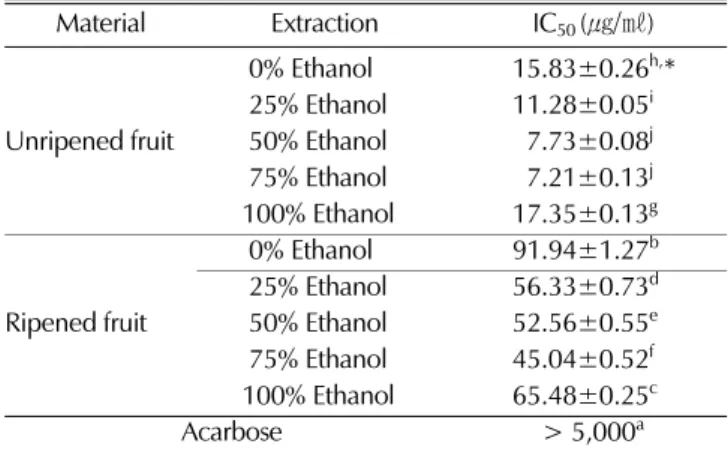
미숙과와 완숙과 75% 에탄올 추출물의 α-glucosidase 억제 활성 효과를 농도별로 측정한 결과는 Fig. 4와 같다. 미숙과와 완숙과 모두 농도 의존적으로 α-glucosidase 억제 활성 효과가 높아지는 경향을 나타내었다. 미숙과 75% 에탄올 추출물의 α- glucosidase 억제 활성 효과가 높았는데, 25 ㎍/㎖ 이상의 농 도에서 70.0% 이상의 억제 활성 효과를 보인 반면 완숙과 추 출물의 경우는 100 ㎍/㎖에서 50.0% 이상의 억제 활성 효과 를 나타내었다. 양성대조구로 사용한 acarbose는 5 ㎎/㎖에서 40.0% 정도의 억제 활성을 보였다 (data not shown). 에탄올 농도별 추출물에 대한 IC50 값은 Table 5와 같이 미숙과의 경 우 75% 에탄올 추출물의 값이 7.21 ± 0.13 ㎍/㎖로 가장 낮은 값을 보였으며, 0%, 25%, 50%, 100% 에탄올 추출물의 값은 각각 15.83 ± 0.26, 11.28 ± 0.05, 7.73 ± 0.08, 17.35 ± 0.13
㎍/㎖ 값으로 0%에서 75% 에탄올 추출물 까지는 낮아졌으나 100% 에탄올 추출물에서 높아지는 경향이었다. 완숙과의 경 우도 IC50 값이 45.04 ± 0.52~91.94 ± 1.27 ㎍/㎖ 로 75% 에탄 올 추출물에서 가장 낮았으나 미숙과보다 상당히 높았다. 양 성대조구로 사용한 acarbose의 IC50 값을 5 ㎎/㎖로 본다면 이 들 추출물은 acarbose 보다 상당히 낮은 값으로 향후 기존 당 Fig. 3. LDL(low density lipoprotein) oxidation inhibition activity
according to concentration of 75% ethanol extracts from unripened and ripened fruits of Rubus coreanus Miq. Each value represents the mean ± SD (n = 3).
Table 4. Comparison of IC50 values of LDL oxidation inhibition activity of different ethanol extracts from unripened and ripened fruit of Rubus coreanus Miq.
Material Extraction IC50 (㎍/㎖)
Unripened fruit
0% Ethanol 1.31±0.02de,* 25% Ethanol 1.20±0.03ef 50% Ethanol 1.10±0.03fg 75% Ethanol 1.04±0.04g 100% Ethanol 1.34±0.03d
Ripened fruit
0% Ethanol 4.19±0.08a 25% Ethanol 3.86±0.11b 50% Ethanol 3.82±0.13b 75% Ethanol 3.50±0.11c 100% Ethanol 4.18±0.02a
*Each value represents the mean ± SD (n = 3). Different alphabets in each values show statistically difference at p < 0.05 by Duncan's multiple range test.
Fig. 4. α-Glucosidase inhibition activity according to concentra- tion of 75% ethanol extracts from unripened and ripened fruits of Rubus coreanus Miq. Each value represents the mean ± SD (n = 3).
뇨병 치료제를 대체할 수 있는 천연물 제제로의 개발 가능성 이 높다고 본다. 시판되고 있는 acarbose와 같은 α-glucosidase 저해제는 장기간 복용할 경우 일부 환자에 있어서 복부팽만 감, 구토, 설사 등 부작용을 나타낼 수 있어 그 사용이 제한 될 수 있다. 이에 부작용이 적은 천연물로부터 혈당강하제를 찾으려는 연구가 활발히 진행되고 있으며, 황금 (Nishioka et al., 1998), 메밀 (Kim et al., 2009) 등의 추출물이 α- glucosidase 저해활성이 높았다고 보고하였다. 본 연구에서도 복분자 추출물이 α-glucosidase 저해 활성을 보여 어떤 화합물 이 저해 활성을 나타내었는지 추후 연구가 필요할 것으로 생 각된다.
감사의 글
본 연구는 전북 고창군에서 시행한 2010년 지역농식품 선 도클러스터육성사업 중 건강기능식품 개별인정등록사업비의 일부로 수행한 연구 결과로 이에 감사드립니다.
LITERATURE CITED
Amerine MA and Ough CS. (1980). Methods for analysis of musts and win. John Wiley and Sons. New York, USA. p.176- 180.
Bae GH. (2000). The Medicinal Plants of Korea. Kyohak Publishing Co., Ltd. Seoul, Korea. p.231.
Bai SK. (2006). Natural dyeing of silk fabric dyed with Rubus coreanus Miquel extract. Journal of the Korean Society of Clothing Industry. 8:476-480.
Cha HS, Youn AR, Park PJ, Choi HR and Kim BS. (2007).
Physicochemical characteristics of Rubus coreanus Miquel
during maturation. Korean Society of Food Science and Technology. 39:476-479.
Chang CC, Yang MH, Wen HM and Chen JC. (2002).
Estimation of total flavonoid content in propolis by two complementary colorimetirc methods. Journal of Food and Drug Analysis. 10:178-182.
Cho HE, Choi YJ and Cho EK. (2010). Antioxidant and nitrite scavenging activity and α-glucosidase inhibitory effect of water extract from Schizandra chinensis Baillon. Journal of the Korean Society of Food Science and Nutrition. 39:481-486.
Choi HS, Kim MK, Park HS, Kim YS and Shin DH. (2006).
Alcoholic fermentation of Bokbunja(Rubus coreanus Miq) wine.
Korean Society of Food Science and Technology. 38:543-547.
Choi, JS, Park JH, Kim HG, Young HS and Mun SI. (1993).
Screening for antioxidant activity of plants and marine algae and its active principles from Prunus daviana. Korean Journal of Pharmacognosy. 24:299-303.
Choi SR, You DH, Kim JY, Park CB, Kim DH and Ryu J.
(2009). Antioxidant activity of ethanol extracts from Cudrania tricuspidata Bureau according to harvesting parts and time.
Korean Journal of Medicinal Crop Science. 17:115-120.
Choi SR, You DH, Kim JY, Park CB, Ryu J, Kim DH and Eun JS. (2008). Antioxidant and antimicrobial activities of Artemisia capillaris Thunberg. Korean Journal of Medicinal Crop Science. 16:112-117.
Hyon JS, Kang SM, Senevirathne M, Koh WJ, Yang TS, Oh MC, Oh CK, Jeon YJ and Kim SH. (2010). Antioxidative activities of extracts from dried Citrus sunki and C. unshiu Peels. Journal of the Korean Society of Food Science and Nutrition. 39:1-7.
Inatani, R, Nakatani N and Fuwa H. (1983). Antioxidative effect of the constituents of rosemary(Rosmarinus offcinalis L.) and their derivatives. Agricultural and Biological Chemistry. 47:521- 528.
Jeong HS, Han JG, Ha JH, Kim Y, Oh SH, Kim SS, Jeong MH, Choi GP, Park UY and Lee HY. (2009). Antioxidant activities and skin-whitening effects of nano-encapsuled water extract from Rubus coreanus Miquel. Korean Journal of Medicinal Crop Science. 17:83-89.
Jialal I. Norkus EP and Grundy SM. (1991). β-Carotene inhibits the oxidative modification of low-density lipoprotein. Biochimica et Biophysica Acta. 1086:134-138.
Kawaguchi, K., Mizuno T, Aida K and Uchino K. (1997).
Hesperidin as an inhibitor of lipases from porcine pancreas and pseudomonas. Bioscience, Biotechnology and Biochemistry.
61:102-104
Kim BN, Park HK, Kwon TB and Maeng YS. (1991). Analysis of rutin centents in buckwheat noodles. Journal of Korean Food Science and Nutrition. 7:61-66.
Kim EJ, Lee YJ, Shin HK and Park JH. (2005). Induction of apoptosis by the aqueous extract of Rubus coreanum in HT-29 human colon cancer cells. Nutrition. 21:1141-1148.
Kim JE, Joo SI, Seo JH and Lee SP. (2009). Antioxidant and α- glucosidase inhibitory effect of tartary buckwheat extract obtained by the treatment of different solvents and enzymes.
Journal of the Korean Society of Food Science and Nutrition.
38:989-995.
Table 5. Comparison of IC50 values of α-glucosidase inhibition activity of different ethanol extracts from unripened and ripened fruit of Rubus coreanus Miq.
Material Extraction IC50 (㎍/㎖)
Unripened fruit
0% Ethanol 15.83±0.26h,* 25% Ethanol 11.28±0.05i 50% Ethanol 57.73±0.08j 75% Ethanol 57.21±0.13j 100% Ethanol 17.35±0.13g
Ripened fruit
0% Ethanol 91.94±1.27b 25% Ethanol 56.33±0.73d 50% Ethanol 52.56±0.55e 75% Ethanol 45.04±0.52f 100% Ethanol 65.48±0.25c
Acarbose > 5,000a
*Each value represents the mean ± SD (n = 3). Different alphabets in each values show statistically difference at p < 0.05 by Duncan's multiple range test.
Kim JH. (1975). Studies on the causal factors of skin browning during storage and its control method in Imamura-aki pear (Pyrus serotina Rehder). Journal of the Korean Society Horticultural Science. 16:1-25.
Kim JH, Kim CH, Kim HS, Kwon MC, Song YK, Seong NS, Lee SE, Yi JS, Kwon OS and Lee HY. (2006). Effect of aqueous extracts from Rubus coreanus Miquel and Angelica gigas Nakai on anti-tumor and anti-stress activities in mice.
Korean Journal of Medicinal Crop Science. 14:206-211.
Kim MJ, Kwon YS and Yu CY. (2005). Anti-oxidative compounds in extracts of Eleutherococcus senticosus Max.
plantlets. Korean Journal of Medicinal Crop Science. 13:194- 198.
Kim MO, Kim JS, Sa YJ, Jeong HJ, Chun WJ, Kwon YS, Kim TY, Choi HS, Yu CY and Kim MJ. (2010). Screening of extraction solvent condition of fermented Rhus verniciflua stem bark by antioxidant activities. Korean Journal of Medicinal Crop Science. 18:217-223.
Kim MS, Pang GC and Lee MW. (1997). Flavonoids from the leaves of Rubus coreanum. Yakhak Hoeji. 41:1-6.
Kim TG, Park MS, Han HM, Kang SY, Jung KK, Rheu HM and Kim SH. (1999). Inhibitory effects of Terminalia chebula, Sanguisorba officinalis, Rubus coreanus and Rheum palmatum on Hepatitis B virus replication in HepG2 2.2.15 cells. Yakhak Hoeji. 43:458-463.
Kwon KS, Kim YS, Song GS and Hong SP. (2004). Quality characteristics of bread with Rubi fructus(Rubus coreanus Miquel) juice. The Korean Journal of Food and Nutrition.
17:272-277.
Lee CB. (1989). Illustrated Flora of Korea. Hyangmoon Publishing Co., Ltd. Seoul, Korea. p.441.
Lee JW and Do JH. (2000). Determination of total phenolic compounds from the fruit of Rubus coreanum and antioxidative activity. Journal of the Korean Society of Food Science and Nutrition. 29:943-947.
Lee MK, Lee HS, Choi GP, Oh DH, Kim JD, Yu CY and Lee HY. (2003). Screening of biological activities of the extracts from Rubus coreanus Miq. Korean Journal of Medicinal Crop Science. 11:5-12.
Lee MW. (1995). Phenolic compounds from the leaves of Rubus coreanum. Yakhak Hoeji. 39:200-204.
Lee SE, Park CH, Bang JK, Seong NS and Chung TY. (2004).
Comparison on antioxidant potential of several peanut varieties.
Journal of the Korean Society of Food Science and Nutrition.
33:941-945.
Lee SE, Sung JS, Jang IB, Kim GS, Ahn TJ, Han HS, Kim JE, Kim YO, Park CB, Cha SW, Ahn YS, Park HK, Bang JK and Seong NS. (2008). Investigation on antioxidant activity in plant resources. Korean Journal of Medicinal Crop Science.
16:356-370.
Lee SO, Lee HJ, Yu MH, Im HG and Lee IS. (2005). Total polyphenol contents and antioxidant activities of methanol extracts from vegetables produced in Ullung island. Korean Journal of Food Science and Technology. 37:233-240.
Lee YA and Kang SS. (1993). Triterpenoids from Rubus fructus (Bogbunja). Archives of Pharmacal Research. 16:109-113.
Lee YN. (1998). Flora of Korea. Kyohak Publishing Co., Ltd.
Seoul, Korea. p.323.
Lee YN, Kim YS and Song GS. (2000). Quality of dry noodle prepared with wheat flour and immature Rubus coreanus (Bog bunja) powder compoites. Journal of the Korean Society of Agricultural Chemistry and Biotechnology. 43:271-276.
Middleton E and Kandaswami C. (1994). Potential health- promoting properties of citrus flavonoids. Food Technology.
48:115-119.
Miller CP, Jirkovsky I, Hayhurst DA and Adelman SJ. (1996).
In vitro antioxidant effects of estrogens with a hindered 3-OH function on the copper-induced oxidation of low density lipoprotein. Steroids. 61:305-308.
Nakagawa M and Amano I. (1974). Evaluation method of green tea grade by nitrogen analysis. Journal of Japanese Food Science and Technology. 21:57-63.
Nishioka T, Kawabata J and Aoyama Y. (1998). Baicalein, an alpha-glucosidase inhibitor from Scutellaria baicalensis. Journal of Natural Products. 61:1413-1415.
Ohtani K. (1990). A dimeric triterpene-glycoside from Rubus coreanum. Chemical & Pharmaceutical Bulletin. 29:327-580.
Ohtani. K, Miyajima C, Takhasi T, Kasai R, Tanaka O and Hahn DR. (1990). A dimeric triterpene-glycoside from Rubus coreanus. Phytochemistry. 29:3275-3280.
Pang KC, Kim MS and Lee MW. (1996). Hydrolyzable tannins from the fruits of Rubus coreanum. Korean Journal of Pharmacognosy. 27:366-370.
Park JH, Lee HS, Mun HC, Kim DH, Seong NS, Jung JK, Bang JK and Lee HY. (2004). Effect of ultrasonification process on enhancement of immuno-stimulatory activity of Ephedera sinica Stapf and Rubus coreanus Miq. Korean Journal of Biotechnology and Bioengineering. 19:113-117.
Park SJ and Oh DH. (2003). Free radical scavenging effect of seed and skin extracts of black olympia grape(Vitis labruscana L.). Korean Journal of Food Science and Technology. 35:121- 124.
Park YK, Choi SH, Kim SH, Han JG and Chung HG. (2007).
Changes in antioxidant activity, total phenolics and vitamin C content during fruit ripening in Rubus occidentalis. Korean Journal of Plant Resources. 20:461-465.
Park YS and Chang HG. (2003). Lactic acid fermentation and biological activities of Rubus coreanus Miq. Journal of the Korean Society of Agricultural Chemistry and Biotechnology.
46:367-375.
Seo JS, Choi YM, Lee SM, Kong SH and Lee JS. (2008).
Antioxidant activities and antioxdant compounds of some specialty rices. Journal of the Korean Society of Food Science and Nutrition. 37:129-135.
Thomas EC, Dawn CS and Daniel S. (1987). Antiatherogenic effect of probucol unrelated to its hypocholesterolemic effect:
Evidence that antioxidants in vivo can selectively inhibit low density lipoprotein degradation in macrophage-rich fatty streaks and slow the progression of atherosclerosis in the Watanabe heritable hyperlipidemic rabbit. Proceedings of the National Academy of Sciences of the United State of America. 84:7725- 7729.
Whang IS. (2005). Effects of black raspberry wine in the male sprague-dawley rat. Ph.D Dissertation. Chonbuk Natural
University. Jeonju, Korea.
Woo JH, Shin SL, Chang YD and Lee CH. (2009). Screening for antioxidant effects of aerial part extracts obtained from sixteen compositae species. Flower Research Journal. 17:271- 278.
Yang SW, Ho JN, Lee YH, Shin DH, Hong BS and Cho HY.
(2004). Isolation and characterization of Helicobacter pylori
urease inhibitor from Rubus coreanus Miquel. Journal of the Korean Society of Food Science and Nutrition. 33:769-777.
Yoon I, Cho JY, Kuk JH, Wee JH, Jang MY, Ahn TH and Park KH. (2002). Identification and activity of antioxidative compounds from Rubus coreanum fruit. Korean Journal of Food Science and Technology. 34:898-904.