ⓒ2010 The Korean Society of Dyers and Finishers 1229-0033/2010-09/181-186
한국염색가공학회지 제22권 제3호 2010년 Textile Coloration and Finishing Vol. 22, No. 3, 2010
〈Research Paper〉
Abstract― A thermoresponsive poly(NIPAM-co-dye) labeled with benzopyran-based D-π-A type dye was prepared by typical radical copolymerization. It can be also constructed a acid/base-induced molecular switch by modulation of intramolecular charge transfer with protonation/deprotonation. The lower critical solution temperature behavior was investigated by means of UV-vis spectroscopy which allows the measurement of the phase transition from 25°C to 45°C in aqueous DMSO solution. The morphology of the internal microstructure of the poly(NIPAM-co-dye) hydrogel was observed by scanning electron microscopy. The reversible switch could be obtained by thermal and acid/base stimuli.
Keywords: D-π-A dye, pyran-based dye, poly(N-isopropylacrylamide), switch, lower critical solution temperature(LCST)
Thermo- and Acid/base-induced Spectral Switching of a Poly(N-isopropylacrylamide) Copolymer Containing Benzopyran-based D-π-A type Dye Units
Eun-Mi Lee, Seon-Yeong Gwon, Byung-Chul Ji and Sung-Hoon Kim†
Department of Advanced Organic Materials Science and Engineering, Kyungpook National University, Daegu, 702-701 Republic of Korea
(Received: August 23, 2010/Revised: September 10, 2010/Accepted: September 13, 2010)
The effect of the lower critical solution tem- perature (LCST) in solutions of polymer gel is increasingly of interest to numerous academic and industrial applications such as drug delivery, fluorescent thermometer and separation systems1-4). One of the most intensively studied polymers in this field is poly(N-isopropylacrylamide) (PNIPAM) which exhibits a LCST transition from 30 to 45°C5,6). The polymer is hydrophilic and soluble in water below the LCST, but becomes hydrophobic and forms a macroscopic coacervate phase above that temperature due to the fluctuation of hydro- phobic interactions and hydrogen bonding7). In previous papers8,9), we have reported thermores- ponsive behavior and photoregulated optical switching in PNIPAM copolymers with electron donor-π -conjugate-electron acceptor (D-π-A) type fluorophore.
Also reported has been the acid/base-induced optical switching of the D-π-A type dyes10-14). Herein we present a novel multi stimuli-res- ponsive polymer hydrogel containing both N-isopro- pylacrylamide and acid/base-switchable D-π-A type benzopyrane-based dye units containing indole moiety as the thermosensitive and acid/base sensitive com- ponents, respectively.
The cyano-benzopyran dye is the typical D-π-A
†Corresponding author. Tel.: +82-53-950-5641; Fax.: +82-53-950-6617; e-mail: [email protected]
charge transfer compounds, which showed interesting photochemical and photophysical properties due to their intrinsic intramolecular charge transfer (ICT) character15). The synthetic route of a D-π-A type dye monomer 5 is depicted in Scheme 1.
In our design and synthetic strategy, we have aimed to take the following points into con- sideration: at first, poly(N-isopropylacrylamide) is thermosensitive polymer hydrogel and shows a LCST due to the presence of both hydrophilic amide groups and hydrophobic isopropyl groups in its side chains. Second, incorporation of the D-π-A type dye containing indole moiety in the polymer system could lead to a acid/base-induced spectral switching unit. 2-Methyl-chromene-4-one 1 was prepared by the literature procedure16).
The compound 3, containing a polymerizable functional allyl group, was successfully obtained by condensing 2-methyl-chromene-4-one 1 and allyl cyanoacetate 2 in acetic anhydride solution refluxed for 24 h. D-π-A type dye monomer 5 was obtained by condensation reaction with com- pound 3 and indole-3-carboxaldehyde 4 using piperidine as catalyst9). In the next step, this dye- functionalized monomer 5 was copolymerized with N-isopropylacrylamide 6 by conventional radical
Scheme 1. Synthesis of a D-π-A type dye monomer 5 and poly(NIPAM-co-dye)
polymerization8). Reaction of a monomer 5 and N-isopropylacrylamide 6 in THF affords a pink- coloured powder of poly(NIPAM-co-dye).
For the interpretation of the ICT process of dye monomer 5, the quantum chemical DMol3 approach was used. All the theoretical calculations were performed by DMol3 program in the Materials Studio 4.4 package17,18) which is the quantum mechanical code using density functional theory.
Perdew-Burke-Ernzerhof (PBE) function of generalized gradient approximation (GGA) level19) with double numeric polarization basis set was used to calculate the energy level of the frontier molecular orbital. Fig. 1 shows the electron distribution of the HOMO and LUMO energy level of dye monomer 5. Comparison of the electron distribution in the frontier MOs reveals the HOMO-LUMO excitation moves the electron distribution from indole moiety to the acceptor, which showed a strong migration of ICT character of dye monomer 5.
The interaction of the dye monomer 5 with base(NaOH)/ acid(HCl) was investigated in DMSO solution through spectrophotometric titration experi- ments. Fig. 2 showed the UV-vis absorption spectral
switching changes of monomer 5 in DMSO with deprotonation/protonation. Upon addition of OH-, the broad band at around 600 nm progressively decreases, while a new band with a peak at 640 and 825 nm appeared. The colour changed from blue to dark green. Upon addition of acid, the green colored solution became rapidly recovered to initial state. We propose that these spectral changes are due to the interaction of the OH- and the NH proton of indole moiety. This would suggest that a negatively charged amino nitrogen moiety was formed, which causes a significant increase in the charge density on the amino nitrogen, with associated increasing in the push- pull effect of the ICT transition.
In Fig. 3, we show the absorption spectra of aqueous DMSO poly(NIPAM-co-dye) solution (H2O/
DMSO=9/1, v/v) at different temperature. As solution is heated, it becomes turbid; these temperature- responsive changes are entirely reversible. This kind of gelation behavior induced by temperature is well-known as a LCST, resulting from a balance between hydrogen-bond formation with water and intramolecular hydrophobic forces20).
The values of transmittance (A500) of aqueous
Thermo- and Acid/base-induced Spectral Switching of a Poly(N-isopropylacrylamide) Copolymer Containing Benzopyran-based D-π-A type Dye UnitsⅠ183Ⅰ
Fig. 1. Electron distribution of the HOMO and LUMO energy levels of dye monomer 3.
Fig. 2. The UV-vis absorption spectra switching changes of dye monomer 5 in DMSO (5 x 10⁻³ molL-1) solution with deprotonation/protonation.
Fig. 3. Absorption spectra and images of poly (NIPAM-co-dye) in aqueous DMSO (H2O/DMSO= 9/1, v/v) solution(0.001 g/ml) at various temperatures.
DMSO solution containing poly(NIPAM-co-dye) are plotted against the temperature of the solution in Fig. 5; an obvious transmittance decreases at
>25°C: LCST=25-45°C.
The effect of acid/base on the absorption spectra of a 0.001 g/ml solution of poly(NIPAM-co-dye) in 9:1 H2O/DMSO was investigated by the addition of 1μl/ml of 5M NaOH solution at room temperature (Fig. 5). Upon addition of OH-, the band at 385 and 490 nm progressively decreased whilst a new band with a peak at 615 nm formed resulting in a dark green coloured solution. The addition of H+ by using a micropipette gradually turned the original orange colored solution.
As orange colored poly(NIPAM-co-dye) solution is heated to LCST, it becomes clouded to orange-
Fig. 4. Transmittance of a solution of Poly(NIPAAm -co-dye) in aqueous DMSO (H2O/DMSO=9/1, v/v) solution(0.001 g/ml) at various temperatures. ●, heating;
○, cooling.
Fig. 5. Absorption spectra changing of poly (NIPAM-co-dye) in aqueous DMSO (H2O/DMSO=9/1, v/v) solution(0.001 g/ml)) after adding 5M NaOH solution (1 μl/ml).
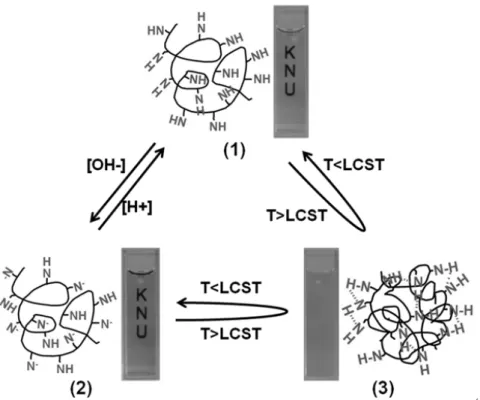
Fig. 6. Schematic representation of the multiple switching process of poly (NIPAM-co-dye) associated with the three states of (1), (2), and (3).
colored gel state, indicative of the occurrence of interpolymer aggregation with –NH fragments in indole moiety, resulting between hydrogen bond formation of –NH fragments (Fig. 6). The tem- perature and acid/base as the inputs may be exploited to modulate the multiple switches between the species (1), (2), and (3) in solution and hydrogel states (Fig. 6).
Fig. 7 shows a SEM image of the poly (NIPAM- co-dye) microspheres which has relatively regular size and smooth surface.
In conclusion, we synthesized a thermal, and acid/base-responsive poly(NIPAM-co-dye) composed of poly(N-isopropylacrylamide) partly modified with benzopyran-based D-π-A type dye. The phase transition temperature for poly(NIPAM-co-dye) was determined by UV-vis spectroscopic method.
Color switching of poly(NIPAM-co-dye) was also demonstrated by modulation of deprotonation/
protonation.
Therefore, the temperature and acid/base as the inputs may be exploited to modulate the multi- pleswitches between the species (1), (2), and (3) in solution and hydrogel states (Fig. 6).
Fig. 7. SEM micrograph of poly(NIPAM-co-dye).
The concept presented here, which controls the phase separation and colour switching by inputs such as temperature and acid/base, may contribute to the development of switching molecules with multiple switching.
Acknowledgements
This work was supported by Basic Science Research Program through the National Research Foundation (NRF) grant funded by the Korea government (MEST) (No. 2010-0001885). This research
Thermo- and Acid/base-induced Spectral Switching of a Poly(N-isopropylacrylamide) Copolymer Containing Benzopyran-based D-π-A type Dye UnitsⅠ185Ⅰ
was supported by a grant from the Fundamental R&D Program for Core Technology of Materials funded by the Ministry of Knowledge Economy, Republic of Korea (2010).
References
1. D. Umeno, M. Kawasaki, and M. Maeda, Water-soluble Conjugate of Double-stranded DNA and Poly(N-isopropylacrylamide) for One- pot Affinity Precipitation Separation of DNA- binding Proteins, Bioconjugate Chemistry, 9, 719-724(1998).
2. H. Hayashi, K. Kono, and T. Takagishi, Temperature Sensitization of Liposomes Using Copolymers of N-isopropylacrylamide, Bioconjugate Chemistry, 10, 412-418(1999).
3. S. Uchiyama, Y. Matsumura, A. P. de Silva, and K. Iwai, Modulation of the Sensitive Temperature Range of Fluorescent Molecular Thermometers Based on Thermoresponsive Polymers, Analytical Chemistry, 76, 1793-1798 (2004).
4. K. Iwai, Y. Matsumura, S. Uchiyama, and A.
P. de Silva, Development of Fluorescent Microgel Thermometers Based on Thermoresponsive Polymers and Their Modulation of Sensitivity Range, Journal of Materials Chemistry, 15, 2896-2800(2005).
5. C. Wu and S. Zhou, Thermodynamically Stable Globule State of a Single Poly(N-isopropyla- crylamide) Chain in Water, Macromolecules, 28, 5388-5390(1995).
6. K. Akiyoshi, E. C. Kang, S. Kurumada, J.
Sunamoto, T. Principi, and F. M. Winnik, Controlled Association of Amphiphilic Polymers in Water: Thermosensitive Nanoparticles Formed by Self-Assembly of Hydrophobically Modified Pullulans and Poly(N-isopropylacrylamides), Macromolecules, 33, 3244-3249(2000).
7. Z. Guo, W. Zhu, and H. Tian, Hydrophilic Copolymer Bearing Dicyanomethylene-4H-pyran Moiety as Fluorescent Film Sensor for Cu2+
and Pyrophosphate Anion, Macromolecules, 43, 739-744(2010).
8. S. H. Kim, I. J. Hwang, S. Y. Gwon, and Y.
A. Son, Photoregulated Optical Switching of Poly(N-isopropylacrylamide) Hydrogel in Aqueous Solution with Covalently Attached Spirona- phthoxazine and D-π-A type Pyran-Based Fluorescent Dye, Dyes and Pigments, 87, 158- 163(2010).
9. S. H. Kim, I. J. Hwang, S. Y. Gwon, and Y.
A. Son, Thermoresponsive Behavior of Poly (N-isopropylacrylamide) Hydrogel with D-π-A Type Pyran-Based Fluorescent Dye, Dyes and Pigments, 87, 84-88(2010).
10. S. Wang and S. H. Kim, Proton-Induced Fluorescent Switching of a New 2D-π-A Type Vinylcyan- oacetate-Pyran Dye, Spectrochimica Acta Part A, 72, 677-681(2009).
11. S. Wang and S. H. Kim, Photophysical and Electrochemical Properties of D-π-A Type Solvatofluorchromic Isophorone Dye for pH Molecular Switch, Current Applied Physics, 9, 783-787(2009).
12. S. H. Kim, S. Y. Lee, S. Y. Gwon, Y. A.
Son, and J. S. Bae, D-π-A Solvatochromic Charge Transfer Dyes Containing a 2-cyano- methylene-3-cyano-4,5,5-trimethyl-2,5-dihydrofu ran Acceptor, Dyes and Pigments, 84, 169- 175(2010).
13. Y. A. Son, S. Y. Gwon, S. Y. Lee, and S.
H. Kim, Synthesis and Property of Solvato- chromic Fluorophore Based on D-π-A Mole- cular System: 2-{[3-cyano-4-(N-ethyl-N-(2-hydro- xyethyl)amino)styryl]-5,5-dimethylfuran-2(5H)- ylidene}malononitrile Dye, Spectrochimica Acta Part A, 75, 225-229(2010).
14. S. H. Kim, S. Y. Gwon, S. M. Burkinshaw, and Y. A. Son, The Photo- and Electrophysical Properties of Curcumin in Aqueous Solution, Spectrochimica Acta Part A, 76, 293-296(2010).
15. Z. Guo, W. Zhu, L. Shen, and H. Tian, Fluorophore Capable of Crossword Puzzles and Logic Memory, Angewandte Chemie International Edition, 46, 5549-5553(2007).
16. X. Huang, Z. Guo, W. Zhu, Y. Xie, and H.
Tian, A Colorimetric and Fluorescent Turn-on
Sensor for Pyrophosphate Anion Based on Dicyanomethylene-4H-chromene Framework, Chemical Communications, 5143-5145(2008).
17. B. Delley, An All-Electron Numerical Method for Solving the Local Density Functional for Polyatomic Molecules, Journal of Chemical Physics, 92, 508-517(1990).
18. B. Delley, From Molecules to Solids with the DMol3 Approach, Journal of Chemical Physics, 113, 7756-7764(2000).
19. A. D. Boese, and N. C. Handy, A New Para- meterization of Exchange-Correlation Gen- eralized Gradient Approximation Functional, Journal of Chemical Physics, 114, 5497-5503 (2001).
20. A. Garcia, M. Marquez, T. Cai, R. Rosario, H. Zhibing, D. Gust, M. Hayes, S. A. Vail, and C. D. Park, Photo-, Thermally, and pH- Responsive Microgels, Langmuir, 23, 224-229 (2007).