Spray Characteristics of Hydrotreated Biodiesel Blended Fuels
Duckhan Kim
†, Sehun Oh
*, Seonghwan Kim
*and Soo-Young No
**Key Words: BD, HBD, SMD, Spray angle, Spray tip penetration
Abstract
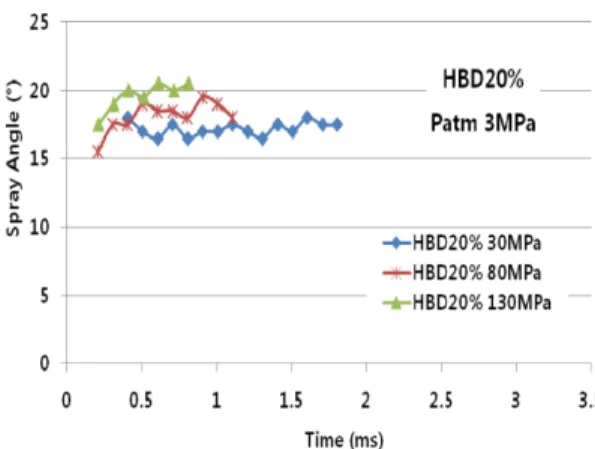
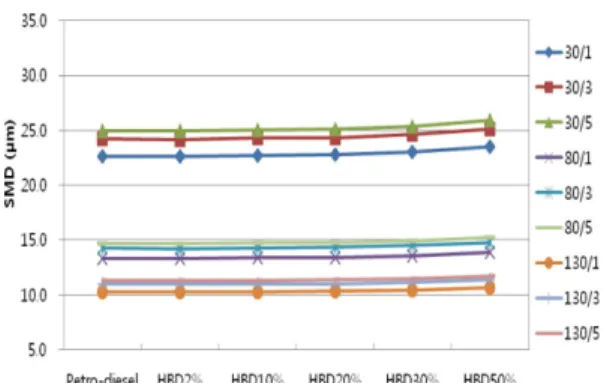
Hydrotreated biodiesel (HBD) would be one of the promising alternative fuels instead of current biodiesel. In this study, spray characteristics in terms of spray penetration and spray angle were conducted experimentally including calculated SMDs as well. The ambient pressures of 1, 3, and 5 MPa and injection pressures of 30, 80, and 130 MPa were intro- duced and the fuels employed were petro-diesel, and 2, 10, 20, 30, and 50% for hydrotreated biodiesel, respectively. The result of this study found that the more HBD blended diesels have the slightly shorter spray tip penetration lengths espe- cially on the lowest injection pressure and at the highest ambient pressure, but have the larger spray angles and SMDs than petro-diesel. Consequently, this study found that HBD has a little bit merits and demerits of macro- and micro- spray patterns compared to petro-diesel.
1. Introduction
Hydrotreated biodiesel is already a well-known advanced biodiesel, especially in Europe. HVO (Hydrotreated Vegetable Oil; one of another name of HBD made by Neste Oil) has been already selling in Europe during many years. HBD has better proper- ties than BD as one of the alternative diesel fuels.
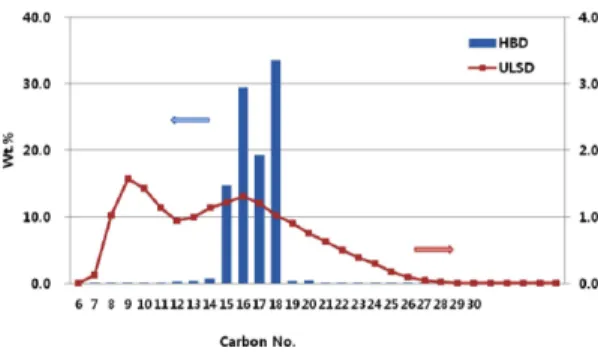
The reason is that HBD has better cold flow proper- ties such as lower CFPP (Cold Filter Plugging Point) and PP (Pour Point) than biodiesel and/or petro-die- sel. The merits of HBD are not only similar chemical structures with petro-diesel but also better cold flow properties. On the contrary, demerit of HBD is not found yet for CI engines. The better cold flow prop- erties, lower density, and sulfur free are typical better
properties of HBD than BD and petro-diesel.
There are many kinds of previous studies and liter- atures comparing biodiesels with petro-diesel. Wang studied the effects of spray characteristics between biodiesel and diesel at the ultra-high injection pres- sure
(1). No investigated the effects of various vegeta- ble oil derived biodiesels for spray characteristics in CI engines
(2). Ing performed spray characteristics of palm biofuel blends
(3). Mancaruso analyzed the first and second generation biodiesels spray characteris- tics in a diesel engine
(4), and so on.
However, it is rare that literatures compared HBD and petro-diesel, especially various blending ratios of HBDs in petro-diesel. Hulkkonen reported that spray characteristics between HVO and crude oil based EN (European Fuel Standards) 590 diesel
(5). Sugiyama studied that comparison of HVO and petro-diesel spray characteristics using spray analyzer
(6). Gong analyzed that a computational investigation of HVO sprays using simulation models
(7).
These previous studies did not compare various mixtures of them, but investigated only between hydrotreated biodiesel and petro-diesel. Therefore, the aim of this study is to widen current knowledge
(2013 년 9월 23일 접수 ~ 2013년 11월 19일 심사완료, 2013년 12 월 7일 게재확정)
*
Energy R&D Center, SK Innovation
**
Dept. of Biosystems Engineering, Chungbuk National Uni- versity
†