1. 서 론
1)우리의 생활과 산업활동으로 인하여 유역으로부터
Received 3 August 2016, revised 27 September 2016, accepted 30 October 2016
*
Corresponding author: Hyen-Mi Chung (E-mail: [email protected])
발생되는 각종 수질오염물질을 분뇨처리시설, 매립지 침출수 처리시설, 폐수처리시설, 하수처리시설 등에서 처리하여 공공수역으로 배출되고 있다. 이들 처리시 설 중에서도 공공하수처리시설은 지방자치단체가 주 체가 되어 운영되는 시설로서 주로 하수관로를 통하
공공하수처리시설에서 수질오염물질 유입 및 배출 특성 고찰
- 산업폐수 및 매립지 침출수 연계처리 시설을 중심으로 -
A study on characteristics of influent and effluent pollutants in
public sewage treatment works combined with industrial wastewater and landfill leachate
정동환・조양석・안경희・김은석・김창수・정현미*
Dong-Hwan Jeong・Yangseok Cho・Kyung-Hee Ahn・Eunseok Kim・Changsoo Kim・Hyen-Mi Chung
*국립환경과학원 상하수도연구과
National Institute of Environmental Research
ABSTRACT
In this study, we investigated influent and effluent water pollutants in 53 Public Sewage Treatment Works (PSTWs) where industrial wastewater or landfill leachate is combined four times for two years from 2014 to 2015. Also, we analyzed the characteristics of heavy metals and volatile organic carbons at influent and effluent of these PSTWs caused by sewage treatment combined with industrial wastewater or landfill leachate. As a result, six heavy metals such as barium, copper, iron, manganese, nickel and zinc, and four volatile organic carbons (VOCs) including phenols, di(2-)ethylhexyl phthalate (DEHP), formaldehyde and toluene were observed above detection limits in most of PSTWs. Also, it was revealed that six heavy metals such as hexavalent chromium, mercury, cadmium, chromium, nickel and selenium, and four VOCs including 1,1-dichloroethylene, vinyl chloride, naphthalene, and epichlorohydrin were observed more frequently according to precipitation. As a result of reviewing the monitoring data on “Water Quality Monitoring Networks” in lower watersheds of PSTWs, both heavy metals and VOCs were below detection limits, indicating that the effluent water had little influence on the watershed. Nevertheless for the better management of influent and effluent pollutants in PSTWs, it is necessary to establish the advanced management plans for water pollutants in PSTWs, which include a list of priority substances management, monitoring plans, and guidelines for industrial wastewater and landfill leachate combined in PSTWs.
Key words: Heavy metal, Industrial wastewater, Public sewage treatment works, VOCs, Water pollutants
주제어: 공공하수처리시설, 산업폐수, 수질오염물질, 중금속, 휘발성 유기물질
여 유입되는 하수를 처리하여 하천 또는 공유수면으 로 배출하는 역할을 하며 분뇨 및 정화조의 슬러지, 각종 폐수 등과 다른 처리시설에서 1차적으로 처리된 물을 연계하여 처리하기도 한다. 산업폐수 및 매립지 침출수와 같이 중금속 및 휘발성 유기물질을 함유할 가능성이 높은 배출수를 연계 처리할 때에는 공공하 수처리시설 입장에서 각별한 주의가 필요하며, 이를 위해 환경부에서도 산업폐수의 공공하수처리시설 연 계처리 지침과 공공하수처리시설 운영・관리 지침을 마련하고 있다(MOE 2011, MOE 2014a). 이 지침에 따 르면 공공하수처리시설에 연계되는 산업폐수는 배출 허용기준의 “나” 지역기준 수질로 처리하도록 하고 있으며, 각종 중금속 및 특정수질유해물질이 포함된 폐수는 연계하지 못하도록 하고 있다. 그러나 현실적 으로 하수도를 통하여 유입되는 각종 폐수 특히, 산업 폐수를 포함하고 있는 하수를 적절하게 관리하는 것 은 상당히 어려우며, 그 출처를 파악하여 관리하기도 쉽지 않아 방류수역의 수질 및 수생태 안전성에 대한 위협이 높아질 수 있다. 이러한 관점에서 볼 때, 하수 처리시설에서의 수질오염물질 적정 관리체계를 구축 하기 위해서는 소규모 산업계 배출시설로부터 하수도 를 통하여 공공하수처리시설로 유입되는 하수 중의 수질오염물질 분포실태를 파악할 필요가 있다.
본 연구에서는 2014년부터 2015년까지 하수 처리용 량이 하루 500 m
3이상인 전국의 공공하수처리시설 중 산업폐수가 연계되는 처리장을 중심으로 수질오염 물질 유입 및 배출 실태 조사를 실시하고, 이를 바탕 으로 공공하수처리시설에서 수질오염물질에 대한 유 입 및 배출 특성을 고찰하고자 한다.
2. 연구방법
공공하수처리시설의 수질오염물질 조사는 2014년 부터 2015년까지 4회에 걸쳐 전국 53개 시설(5개소 중 복)에 대하여 실시하였다(Table 1). 이들 공공하수처리 시설에 대한 유입・배출 실태 조사와 더불어, 국내 주
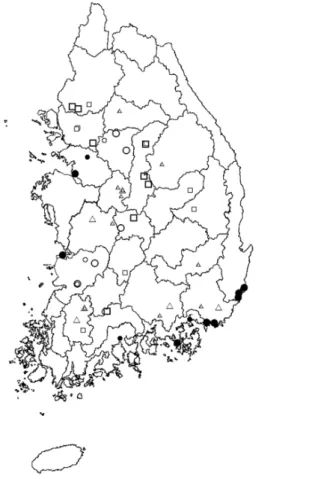
요 공법을 도입한 공공하수처리시설에 대한 수질오염 물질 특성을 파악하기 위해 하수처리 공법별 특성 조 사를 실시하였다. 수질오염물질 유입・배출 특성에 대 한 조사대상 공공하수처리시설은 매립지 침출수나 산 업폐수가 연계 처리되고 있는 시설을 중심으로 방류수 수질기준 적용지역별로 배분하였으며, 비교대상 하수 처리시설을 지역별로 배분하여 선정하였다(Fig. 1).
2014년부터 2015년까지 조사대상 공공하수처리시설 은 총 53개소로 산업폐수를 연계 처리하는 공공하수
Fig. 1. Distribution map of investigation PSTWs above 500 m
3/day facility capacity according to effluent limit region grade (Small type : 2014, Large type : 2015).
※ ○:Ⅰ region PSTWs, △: Ⅱ region PSTWs, □:
Ⅲ region PSTWs, ●: Ⅳ region PSTWs
Table 1. Summary of investigation PSTWs and substances
Classification 2014 2015
Number of PSTWs Influent and effluent of 25 PSTWs Influent and effluent of 28 PSTWs Analytical substances 24 substances include heavy metals of AEL 48 substances
(except for 24 substances include VOCs) AEL 48 substances, EC 2 substances
※ AEL : Allowable emission limitation, EC : Environmental criteria for river
처리시설 40개소와 매립지 침출수를 연계 처리하는 공 공하수처리시설 4개소를 지역별로 배분하여 선정하고, 유입수 및 방류수 중 수질오염물질 검출 실태를 비교하 기 위하여 산업폐수를 연계 처리하지 않는 9개 공공하수 처리시설을 추가로 선정하였다(Table 2). 수질오염물질 조사항목은 배출허용기준 48개 항목과 방류수역에 대한 영향을 고려하여 하천환경기준 2개 항목(안티몬, 헥사클 로로벤젠)을 추가하여 총 50개 항목을 측정․분석하였다.
3. 결과 및 고찰
3.1 국내외 하수처리시설 수질오염물질 관리
3.1.1 하수처리시설 수질오염물질 관리체계
미국에서는 하수처리시설로 산업폐수를 연계 처리하 는 경우, 국가전처리프로그램(NPP, National Pretreatment Program)에 의한 전처리를 요구하고 있으며 국가 오염물 질 배출 삭감시스템(NPDES, National Pollutant Discharge Elimination System)에서는 산업폐수를 연계 처리하는 허가절차와 조건을 명시하고 있다(US EPA 2010). 프 랑스의 경우 산업폐수를 공공하수도로 유입시키기 전 에 pH 등 11개 항목에 대한 전처리 및 유입 가능 여 부를 결정하여 승인하고, 철 등 28개 항목에 대하여 공공하수도로 유입시켜 연계 처리하는 것을 제한하고 있으며, 산업폐수를 연계 처리하는 경우, 방류 유량에 대한 하천 유량의 희석 비율을 기준으로 pH 등 10개 규제 항목을 두어 전처리 기준을 적용하고 있다. 독일 의 경우 물관리위원회의 조례에 따라 배출업종 항목 별 최소 요구사항을 이행하도록 하고 있고 연계 처리 하는 산업폐수의 성상과 업종에 따라 총 57개의 부록 에 다양한 별도 배출기준 및 저감 대책을 준수하도록 하고 있다(RSD 2012, FMENCN 2004, NIER 2011).
우리나라의 경우, 산업폐수의 공공하수처리시설 연계 처리 지침은 공공하수처리장에 산업폐수 연계처리 시
사전검토 사항 , 절차 및 방법 등을 정하기 위하여 2011넌 7월 당시 수생태보전과에서 마련한 지침으로 수질 및 수생태 보전에 관한 법률 제32조 제8항과 하수도법 제27 조 배수설비의 설치 등에 근거를 두고 있다. 지침의 적용 범위는 분류식 하수처리구역 내 배수설비를 갖춘 폐수배 출시설 설치・운영하는 사업자를 대상으로 한다. 이들 사 업자 중에서 특정수질유해물질 및 중금속을 배출하는 사업자는 대상에서 제외하며 , 음식료품 제조업 등 공공하 수처리시설의 적정 운영에 지장을 초래하지 않는 업종으 로 1일 폐수배출량이 50 m
3미만인 5종 사업장을 우선 선정하도록 하고 있다. 산업폐수 연계처리 절차는 Fig.
2에서 보는 바와 같이 산업폐수 연계처리를 위한 사전검 토를 거쳐 별도 배출허용기준 고시 , 폐수배출시설 설치허 가(신고), 배수설비 설치 순으로 진행하도록 하고 있다.
사전검토 사항으로는 유입 하수량 및 폐수량 산정 , 공공하 수처리시설 처리능력 검토 , 별도 배출허용기준 도입 검토 및 설정 , 하수도요금 차등화 산정 등이 있다. 또한 연계처 리 과정에서 사업자가 배출하는 폐수로 인하여 공공하수 처리시설의 적정 처리에 지장을 초래할 경우를 감안하여
“사업시행자 또는 운영자가 요청할 경우 해당 사업자와의 연계처리를 제한하거나 전처리시설을 설치하게 할 수 있음 ”을 허가조건으로 부여하도록 하고 있다(MOE 2011).
Fig. 2. Procedure of combined sewage and wastewater treatment in Korea.
Table 2. Status of investigation PSTWs
Classification Total PSTWs combined industrial wastewater PSTWs combined Landfill leachate None
Total 53 25 19 9
Ⅰ Region 8 4 2 2
Ⅱ Region 17 6 8 3
Ⅲ Region 15 6 7 2
Ⅳ Region 13 9 2 2
※ 5 PSTWs were investigated duplicately in 2014 and 2015.
3.1.2 우선관리대상 수질오염물질 선정
미국의 우선관리대상 수질오염물질은 총 126개 물질 이며 그 중 우리나라의 산업폐수 배출허용기준에 등록된 항목은 27개 항목으로 조사되었다(US EPA 2010). 또한
유럽은 우선관리대상 수질오염물질로 33개 항목을 선정 하여 관리하고 있으며 , 그 중 우리나라의 배출허용기준 에 등록된 항목은 10개 항목으로 조사되었다(EC 2003, MOE 2016). 그리고 유럽에서는 우선관리대상 수질오염
[EU, 45 Priority substances)]
Alachor, Atrazine, Chlorofenvinphos, Chlorpyrifos, Diuron,
Fluoranthene(PAH), Isoproturon, Octylphenols, Pentachlorophenol, Simazine, Trichlorobenzenes, Trifluralin, Brominated diphenylether, Anthracene, C10-13-chloroalkanes, Endosulfan, Hexachlorobenzene, Hexachlorobutadiene,
Hexachlorocyclohexane(HCH), Nonylphenols, entachlorobenzene, Polyaromatic hydrocarbons(PAH), Tributyltin compounds
(After 2018, Aclonifen, Bifenox, Cybutryne, Cypermetryne, Dechlorvos, Terbutryn, Dicofol, PFOS*,
Quinoxyfen, Dioxin and dioxin-like compounds, HBCDD**)
[Korea, 49 Discharge allowable substances)]
BOD, COD, SS, pH, N-Hexane(Mineral oil), N-Hexane(Fauna and flora oil), Phenols, Iron, Orgnic phosphorus compounds, Chromium(6+) ion(Hexavalent chromium), Manganese, Total coliform, Color, Temperature, Nitrogen, Phosphorus, Detergents(ABS), Biological toxicity, Barium, 1,4-Dioxane,
Formaldehyde(Formalin), Epichlorohydrin, Xylene(Dimethyl benzene)
[USA, 126 Priority substances)]
Heptachlor, Heptachlor epoxide (BHC-hexachlorocyclohexane) (After 2018 in EU)
Benzene, 1,2-Dichloroethane,
Dichloromethane, Lead and compounds, Napthalene, Nickel and compounds, Trichloromethane (chloroform), Di(2-ethylhexyl)phthalate(DEHP), Cadmium and compounds, Mercury and compounds
Cyanide, Chromium, Zinc, Copper, Arsenic, Fluoride, Polychlorinated biphenyls(PCBs, PCB 1242),
Trichloroethylene, Tetrachloroethylene, Selenium, Carbon tetrachloride, 1,1-Dichloroethylene, Vinyl chloride, Acrylonitril,
Bromoform(Tribromomethane), Toluene Di-N-Butyl Phthalate, Acenaphthene,
Acrolein, Benzidine, Chlorobenzene, 1,2,4-trichlorobenzene,
Hexachlorobenzene, 1,1,1-trichloreothane, Hexachloroethane, 1,1-dichloroethane, 1,1,2-trichloroethane,
1,1,2,2-tetrachloroethane, Chloroethane, Bis(2-chloroethyl) ether,
2-chloroethyl vinyl ether (mixed), 2-chloronaphthalene, 2,4,
6-trichlorophenol, Parachlorometa cresol, 2-chlorophenol, 1,2-dichlorobenzene, 1,3-dichlorobenzene, 1,4-dichlorobenzene, 3,3-dichlorobenzidine,
1,2-trans-dichloroethylene,
2,4-dichlorophenol, 1,2-dichloropropane, 1,2-dichloropropylene (1,3-dichloropropene), 2,4-dimethylphenol, 2,4-dinitrotoluene, 2,6-dinitrotoluene, 1,2-diphenylhydrazine, Ethylbenzene, Fluoranthene,
4-chlorophenyl phenyl ether, 4-bromophenyl phenyl ether,
Bis(2-chloroisopropyl) ether, Bis(2-chloroethoxy) methane, Methyl chloride (dichloromethane), Methyl bromide (bromomethane), Dichlorobromomethane,
Chlorodibromomethane, Hexachlorobutadiene,
Hexachloromyclopentadiene, Isophorone, Nitrobenzene, 2-nitrophenol, 4-nitrophenol, 2,4-dinitrophenol, 4,6-dinitro-o-cresol, N-nitrosodimethylamine,
N-nitrosodiphenylamine, N-nitrosodi-n-propylamin,
Pentachlorophenol, Butyl benzyl phthalate, Di-n-octyl phthalate, Diethyl Phthalate, Dimethyl phthalate,
1,2-benzanthracene (benzo(a) anthracene), Benzo(a)pyrene (3,4-benzo-pyrene), 3,4-Benzofluoranthene (benzo(b) fluoranthene), 11,12-benzofluoranthene (benzo(b) fluoranthene), Chrysene, Acenaphthylene, Anthracene, 1,12-benzoperylene (benzo(ghi) perylene),
Phenanthrene, 1,2,5,6-dibenzanthracene (dibenzo(,h) anthracene),
Indeno (,1,2,3-cd)
pyrene (2,3-o-pheynylene pyrene), Pyrene, Aldrin, Dieldrin, Chlordane (technical mixture and metabolites), 4,4-DDT, 4,4-DDE(p,p-DDX), 4,4-DDD(p,p-TDE), Alpha-endosulfan, Beta-endosulfan, Endosulfan sulfate, Endrin, Endrin aldehyde, Alpha-BHC, Beta-BHC, Gamma-BHC (lindane), Delta-BHC (PCB-polychlorinated biphenyls), PCB-1254 (Arochlor 1254), PCB-1221 (Arochlor 1221), PCB-1232 (Arochlor 1232), PCB-1248 (Arochlor 1248), PCB-1260 (Arochlor 1260), PCB-1016 (Arochlor 1016), Toxaphene, Antimony, Asbestos, Beryllium, Silver, Thallium, 2,3,7,8-tetrachloro-dibenzo-p-dioxin (TCDD)
* PFOS : Perfluorooctane sulfonic acid and its derivatives, ** HBCDD : Hexabromocyclododecanes Fig. 3. Comparison of priority substances of EU and USA, and discharge allowable substances of Korea ※ Priority substances of EU (45) Priority substances of USA
(126) Discharge allowable substances
of Korea (49)
※Duplication of priority substances between EU and USA
Duplication among priority substances of EU and USA, discharge allowable substances of Korea
Duplication between priority
substances of USA and
discharge allowable substances
of Korea
물질에 2013년 8월 12개 물질을 추가로 지정하여 2018년 부터 45개 물질을 관리하도록 개정하였다. 우선관리대상 오염물질에 대한 검토기간을 당초 4년 주기에서 6년 주기 로 연장하였다(EU 2013)(Fig. 3).
우리나라 공공하수처리시설에서 배출허용기준(나 지역 기준)을 준수하는 산업폐수를 연계 처리할 수 있 도록 하고 있으며 수질 및 수생태계 보전에 관한 법 률에서 정한 수질오염물질 중 49개 항목에 대해 배출 허용기준을 설정하고 있다. 공공하수처리시설에서 처 리하기 어려운 이들 물질에 대해 유입 단계에서 우선 관리대상물질을 선정하여 관리하는 것이 필요하다.
3.2 국내 공공하수처리시설의 산업폐수 연계처리 현황
500 m
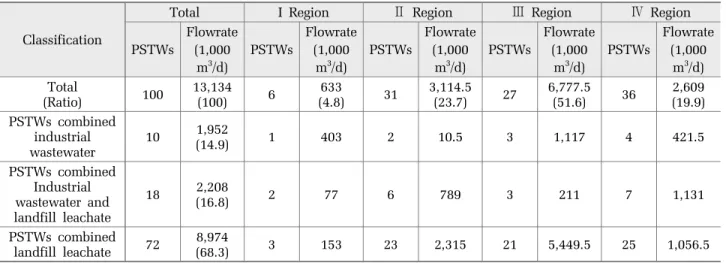
3/일 이상의 공공하수처리시설 중 산업폐수 및 매립지 침출수를 연계 처리하는 시설은 2013년 기 준으로 총 100개소이며, 시설용량은 총 13,134,000 m
3/ 일로 조사되었다(MOE, 2014b). 이 중 매립지 침출수 를 연계 처리하는 공공하수처시설의 시설용량은 가장 많아 8,974 m
3/일로 68%를 차지하고, 산업폐수를 연계 처리하는 공공하수처리시설의 시설용량은 약 15%, 산
업폐수 및 매립지 침출수를 함께 처리하는 시설의 시 설용량은 약 17%를 차지하고 있다.
공공하수처리시설에서 실재 이들 배출수를 연계 처 리하는 량은 일부분에 해당하며, 산업폐수를 연계 처 리하는 량은 99,103 m
3/일로 하수처리 시설용량 대비 5.1% 정도이고, 산업폐수와 매립지 침출수를 연계 처 리하는 양은 210,108 m
3/일로 9.5% 정도이며, 매립지 침출수를 연계 처리하는 양은 7,785 m
3/일로 0.1% 수 준이다(MOE, 2014b).
3.3 공공하수처리시설의 수질오염물질 유입 및 배출 특성
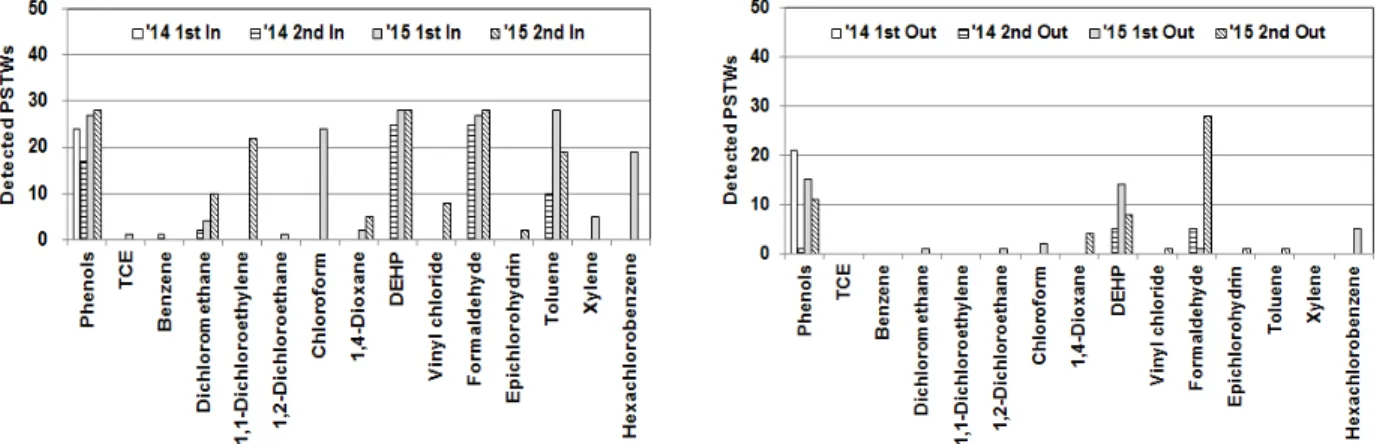
공공하수처리시설에서 수질오염물질 검출현황은 Fig. 4에 나타낸 바와 같이 2014년부터 2015년까지 중 금속 검출항목은 2년간 크게 변하지 않았으나, 2015년 휘발성 유기물질의 검출항목은 2014년보다 증가한 것 으로 나타났다. 2015년 공공하수처리시설 유입수와 방류수에서 중금속 및 휘발성 유기물질이 검출되는 처리시설 수가 유사한 것은 유입된 중금속 및 휘발성 유기물질이 공공하수처리시설 공정을 거치는 동안 처 Table 3. Number of combined sewage and wastewater treatment works (above 500 m
3/d PSTWs in 2013)
Classification
Total I Region Ⅱ Region Ⅲ Region Ⅳ Region
PSTWs
Flowrate (1,000
m
3/d)
PSTWs
Flowrate (1,000
m
3/d)
PSTWs
Flowrate (1,000
m
3/d)
PSTWs
Flowrate (1,000
m
3/d)
PSTWs
Flowrate (1,000
m
3/d) Total
(Ratio) 100 13,134
(100) 6 633
(4.8) 31 3,114.5
(23.7) 27 6,777.5
(51.6) 36 2,609
(19.9) PSTWs combined
industrial
wastewater 10 1,952
(14.9) 1 403 2 10.5 3 1,117 4 421.5
PSTWs combined Industrial wastewater and landfill leachate
18 2,208
(16.8) 2 77 6 789 3 211 7 1,131
PSTWs combined
landfill leachate 72 8,974
(68.3) 3 153 23 2,315 21 5,449.5 25 1,056.5
Table 4. Influent flowrate and proportion of combined wastewater in PSTWs
Classification Total PSTWs combined
industrial wastewater
PSTWs combined Industrial wastewater and landfill leachate
PSTWs combined landfill leachate Total (Ratio) 316,995.9 (2.4%) 99,103.2 (5.1%) 210,107.9 (9.5%) 7,784.8 (0.1%)
I Region 57,833.9 47,063.6 10,628.3 142.0
II Region 15,996.4 28.4 12,825.5 3,142.5
III Region 5,776.2 271.7 2,749.6 2,754.8
IV Region 237,389.5 51,739.5 183,904.5 1,745.5
리되기 어렵다는 것을 나타낸다. 따라서 산업폐수 및 매립지 침출수를 통해 공공하수처리시설로 유입되는 중금속 및 휘발성 유기물질에 대한 관리가 필요하다.
2015년 조사에서 유입수 중 중금속류는 8~11종이 검 출된 것으로 나타났는데, 전년도 조사 보다 검출항목이 늘어난 것은 조사대상 중 산업폐수를 연계 처리하는 하수처리시설이 늘어났기 때문으로 판단된다. 중금속 중
Fig. 4. PSTWs of water pollutants detection (‘14~’15)
바륨 구리, 철, 망간, 니켈, 망간, 아연 등 6개 항목은 거의 모든 처리장 유입수에서 정량한계 이상 검출되었으 나, 배출허용기준(나 지역)을 초과한 곳은 없는 것으로 조사되었으며 비소 , 납 등 2개 항목은 조사기간 중 검출되 지 않았다 . 검출된 중금속 중 셀레늄은 24개소 하수처리 시설의 유입수와 방류수에서 검출되었지만 모두 정량한 계 미만이었다 (Fig. 5). ”수질 및 수생태계 보전에 관한 법률” 시행규칙의 배출허용기준과 기준항목에 대한 정 량한계는 부록에 수록하였다(APPENDIX 1).
페놀류, 디에틸헥실프탈레이트, 포름알데히드, 톨루 엔 등 4개 항목은 거의 모든 처리장 유입수에서 정량 한계 이상 검출되었으나 , 중금속과 마찬가지로 배출 허용기준(나 지역)을 초과한 곳은 없는 것으로 조사되 었다 . 폴리클로리네이티드비페닐, 테트라클로로에틸렌, 사염화탄소, 아크릴로니트릴, 브로모포름, 나프탈렌 등 6개 항목은 조사 기간 중 검출되지 않았다(Fig. 6).
특정수질유해물질 항목에 해당하는 구리 , 페놀, 디에 틸헥실프탈레이트(DEHP), 폼알데하이드 등 4개 항목은 전지역 처리장의 유입수에서 모두 정량한계 이상 검출되
Fig. 5. Detection of heavy metals at influent and effluent of PSTWs (‘14~’15)
Fig. 6. Detection of volatile organic carbons at influent and effluent of PSTWs (‘14~’15)
었으며, 방류수에서는 페놀류와 디에틸헥실프탈레이트, 포름알데히드의 검출빈도가 비교적 높게 나타났다 (Fig. 7).
연계처리 유형별 검출 항목수는 2014년 매립지 침출 수를 연계 처리하는 하수처리시설에서 높게 나타났으 나, 2015년에는 산업폐수를 연계 처리하는 하수처리시
설에서 높게 나타났다 . 그러나 매립지 침출수를 연계 처리하는 하수처리시설과 연계 처리하지 않는 하수처 리시설에서는 뚜렷한 차이가 나타나지 않았다(Fig. 8).
이번 4회 조사기간 동안 강우에 따른 중금속 검출결 과를 살펴보면, Cr
+6, Hg, Cd, Cr, Ni, Sb 등 6개 항목은
Fig. 7. Specific hazardous substances detection at influent and effluent of PSTWs (‘14~’15)
Fig. 8. The number of PSTWs detected water pollutants according to combined wastewater type
Fig. 9. Difference in number of detection by water pollutants between fine day and rainy day
강우시 검출빈도가 더 높았으며, Zn의 경우는 강우시 검출빈도가 낮아지는 것으로 조사되었다. 휘발성 유기 물질은 1,1-디클로로에틸렌, 염화비닐, 나프탈렌, 에피 클로로히드린 등 4개 항목이 강우시 검출빈도가 높았 고, 페놀류, 트리클로로에틸렌, 1,2-디클로로에탄, 클로 로포름, 자일렌, 헥사클로로벤젠 등 6개 항목은 강우시 검출빈도가 낮아지는 것으로 조사되었다(Fig. 9).
3.4 공공하수처리시설 수질오염물질에 의한 수계 영 향 고찰