Corresponding Author: Shin Kim, M.D., Department of Immunology, Keimyung University School of Medicine 1095 Dalgubeol-daero, Dalseo-gu, Daegu 704-701, Korea
Tel : +82-53-580-3884 E-mail : [email protected]
Introduction
Thyroid cancer is the most prevalent type of e n d o c r i n e m a l i g n a n c y, a c c o u n t i n g f o r approximately 1% of all cancers [1,2]. Although the mechanism in the development of PTC is
unclear, environmental and genetic factors have been implicated as a risk factor for PTC [3-5].
In recent years, gradually accumulating evidences have demonstrated that a wide range of biological processes, such as cellular development, dif ferentiation, proliferation, cell death,
Abstract
Although various research papers have revealed that alterations of microRNAs (miRNAs) expression profiles in thyroid cancer, there have been few studies on the miRNA machinery itself. Altered expression of microRNA (miRNA) machinery components may play an important role in progression of thyroid cancer. The purposes of this study were to evaluate the mRNA expression levels of important miRNA machinery components in papillary thyroid cancer (PTC) and to investigate the correlations between each component. By using quantitative real-time PCR, the mRNA expressions of the four miRNA machinery components were examined in 40 PTC tissues and their adjacent non-neoplastic tissues. In the present study, decreased mRNA expression level of Drosha was observed in PTC. The altered mRNA expression levels of Dicer and AGO2; DGCR8 and Drosha; AGO2 and DGCR8 were positively correlated with each other. This study revealed for the first time that altered expression of Drosha is present in PTC tissue and could be potentially responsible for altered miRNAs profiles observed in this malignancy.
Key Words :
AGO2, DGCR8, Drosha, MicroRNA biogenesis, Papillary thyroid cancerDepartment of Immunology & Institute for Cancer Research, Keimyung University School of Medicine, Daegu, Korea
Shin Kim, M.D.
The Dysregulation of MicroRNA Machinery Components in Papillary
Thyroid Cancer
metabolism, and carcinogenesis, are associated with a group of endogenous, small (17-21 nucleotides) and noncoding RNAs called microRNAs (miRNAs) [6-8]. The biogenesis of miRNA occurs in a well-organized process, referred to as the “miRNA machinery” [9]. A number of interesting reports have provided proof that human disorders, including malignant tumors, are frequently associated with global alterations in the miRNA machinery components, comprising irregular expression and function of the key factors Drosha, the DiGeorge syndrome critical region gene 8 (DGCR8), Dicer, and Argonaute (AGO) [10]. Drosha, an RNAse III endonuclease, is a part of a multiprotein complex, the microprocessor, which cleaves primary miRNAs (pri-miRNAs;
consisting of a hairpin stem, a terminal loop, and 5’
and 3’ single-stranded RNA extensions) into precursor miRNAs (pre-miRNAs; approximately 60-70 nucleotide stem-loop structure) in nucleus [11]. DGCR8 is also a part of the microprocessor complex and has been shown to be essential for miRNAs maturation [12]. Within the cytoplasm, the p r e-m i R N A s a r e f u r t h e r p r o c e s s e d b y a multidomain Dicer, which also belongs to the class of RNAse III endonucleases, into short double- stranded molecules, mature miRNAs [13]. The effect in which miRNAs regulates gene expression are accomplished by the RNA-induced silencing complex (RISC), multiprotein effector complex with endonuclease activity, which integrates mature miRNA strands [14]. The RISC is the main element of the RNA silencing process and consist of several different proteins that comprise a multiprotein complex, including AGO1, AGO2, and the dsRNA-binding protein PACT [15].
T h e r e g u l a t i o n o f m i R N A m a c h i n e r y components could directly influence expression patterns of various genes by regulating mRNA expression. If any miRNA machinery component is
dysregulated, miRNA may be incompletely matured. Recently, the dysregulated miRNA machinery components have been reported in various human diseases, including malignancies [15,16].
Therefore, in the present study, the mRNA e x p r e s s i o n l e v e l s o f m i R N A m a c h i n e r y components were compared and analyzed in thyroid cancer tissues and corresponding adjacent non-neoplastic tissues from patients with PTC.
Moreover, the correlations between the mRNA expression levels of inter-individual miRNA machinery components were investigated in PTC.
Materials and Methods
Patients and tissues
Altogether, forty female patients diagnosed with PTC were included in the study. Papillary thyroid carcinomas and adjacent non-neoplastic tissues were obtained from the patients undergoing surgery in Dongsan Medical Center (Daegu, Korea) between July 2008 and December 2011. Tissue samples were immediately frozen in liquid nitrogen and stored at –80℃ until RNA isolation.
Tissue samples were provided from Keimyung Human Bio-resource Bank, Korea. All patients were explained the purpose of study and informed consents were obtained from each study participant. The protocols were approved by the Institutional Review Board of Keimyung University Dongsan Medical Center (approval #12-41).
Isolation of RNA and quantitative real-time PCR
Total cellular RNA was extracted from tissues using the TRIzol reagent (Molecular Research
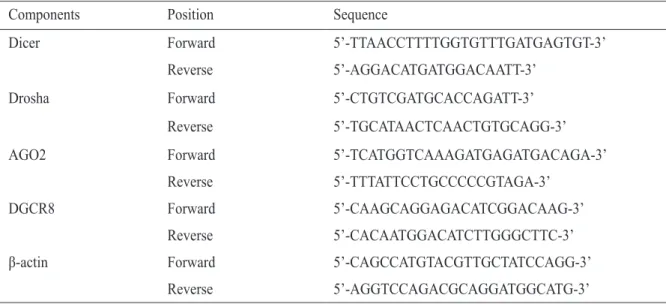
Center, Inc., Cincinnati, OH, USA). RNA was quantified using Nanodrop 1000 (Thermo Scientific, Wilmington, Denmark). Each cDNA was synthesized form 2 μg of total RNA using M-MLV reverse transcriptase (Promega, Madison, WI, USA) according to the manufacturer’s protocol. By using the specific primer pairs described in Table 1 and S Y B R G R E E N P r e m i x (T O Y O B O, J a p a n), quantitative real-time PCR (qPCR) was performed on the LightCyclerⓇ 480 real-time PCR system (Roche Diagnostics, Mannheim, Germany). β-actin w a s u s e d a s a h o u s e k e e p i n g g e n e f o r normalization, and a no template sample was used as a negative control.
Statistical analysis
Statistical analysis was performed with SPSS 18.0 (SPSS Inc., Chicago, IL, USA). Differences between the groups were analyzed statistically by using Student’s t test. Correlations between relative mRNA expressions of inter-individual miRNA machinery components were analyzed by the Pearson’s correlation coefficient analysis.
Generally, p value of less than 0.05 was established to denote significance in all statistical analyses performed in the study.
Results
Expression levels of miRNAs machinery components in PTC
The mRNA expression levels of miRNAs machinery components were quantified by qPCR in paired samples of cancer tissues and adjacent non-cancer tissues from 40 patients with PTC. Each mRNA level of components was normalized to the level of β-actin mRNA. As shown in Fig. 1, the mean value of Drosha mRNA expression level in PTC tissues was significantly lower than in non- neoplastic thyroid tissues (p < 0.001).
Relationship between mRNA expression levels o f i n t e r-i n d i v i d u a l m i R N A m a c h i n e r y components in patients with PTC.
Table 1. Primer sequences of miRNA machinery components used in quantitative PCR
Components Position Sequence
Dicer Forward 5’-TTAACCTTTTGGTGTTTGATGAGTGT-3’
Reverse 5’-AGGACATGATGGACAATT-3’
Drosha Forward 5’-CTGTCGATGCACCAGATT-3’
Reverse 5’-TGCATAACTCAACTGTGCAGG-3’
AGO2 Forward 5’-TCATGGTCAAAGATGAGATGACAGA-3’
Reverse 5’-TTTATTCCTGCCCCCGTAGA-3’
DGCR8 Forward 5’-CAAGCAGGAGACATCGGACAAG-3’
Reverse 5’-CACAATGGACATCTTGGGCTTC-3’
β-actin Forward 5’-CAGCCATGTACGTTGCTATCCAGG-3’
Reverse 5’-AGGTCCAGACGCAGGATGGCATG-3’
Prior to statistical analysis, raw qPCR data of Dicer, Drosha, DGCR8, and AGO2 mRNA expression were normalized to reference gene, β-actin. Then, the qPCR data were analyzed by the 2
-ΔΔct
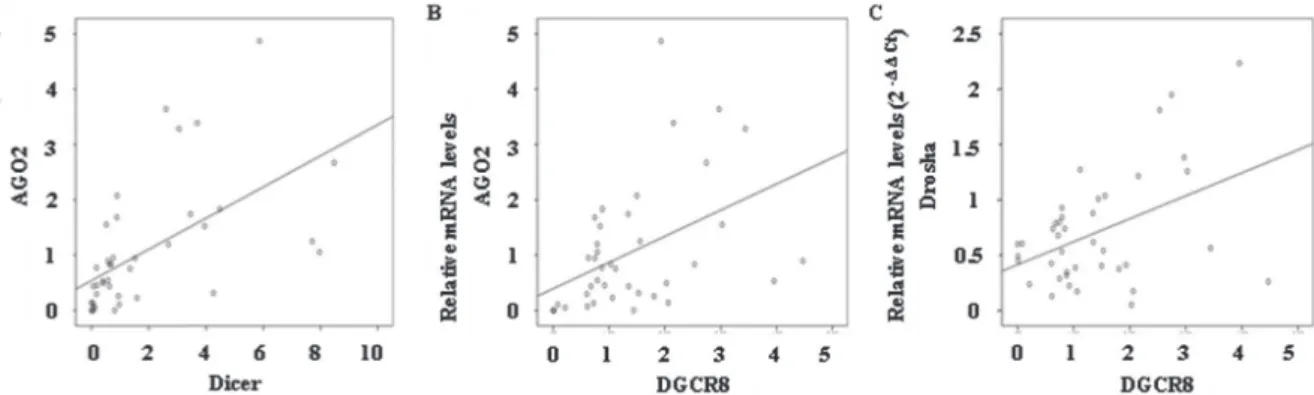
method [17]. To investigate the significant correlation between mRNA levels of inter- individual miRNA machinery components in PTC, the correlations of the four selected miRNAmachinery components were evaluated. As shown in (Fig. 2) there were significant associations between Dicer and AGO2; DGCR8 and AGO2;
DGCR8 and Drosha with Pearson correlation coefficient value of 0.574, 0.446 and 0.445 in thyroid cancer (p < 0.001, p = 0.004 and p = 0.004), respectively.
Fig. 1. The relative mRNA expression levels of Dicer, Drosha, DGCR8, and AGO2 in PTC group and non-neoplastic group.
Fig. 2. Correlation between mRNA expressions of inter-individual components in PTC. (A) Dicer and AGO2. *p <
0.001. (B) DGCR8 and AGO2. **p = 0.004. (C) DGCR8 and Drosha,***p = 0.004.
Discussion
MiRNAs are a new class of highly conserved, small noncoding RNAs that regulate gene expression on the post-transcriptional level by translational repression or cleavage of the target mRNA [14]. Dysregulation of the miRNAs machinery components have previously been linked to a variety of various cancers [18].
The aims of this study were to elucidate the expression patterns of four selected miRNA machinery components by RT-qPCR method in pair-matched thyroid specimens and analyze their correlation with each other components.
Therefore, the mRNA expression levels of the miRNA machinery components were investigated in PTC tissue compared with adjacent non- neoplastic thyroid tissue using RT-qPCR in a total number of 40 thyroid cancer patients. Notably, in the present study, compared with adjacent non- neoplastic thyroid tissue, Drosha mRNA expression level was down-regulated in PTC. Previous studies also have demonstrated that Drosha mRNA expression level is down-regulated in breast cancer [19], and nasopharyngeal cancer [20]. On the other hand, up-regulated mRNA expression level of Drosha has been revealed in ovarian cancer [21], cervical cancer [22], salivary gland tumor [23], and skin cancer [24]. In the esophageal squamous cell carcinoma, aberrantly increased Drosha expression was observed and correlated with tumorigenesis [25]. In the last work, strong Drosha (RNASEN) staining was observed in the tumor periphery [25], suggesting that Drosha up-regulation might be involved in tumor invasion to surrounding tissues.
Although, it would be needed to assess the m e c h a n i s m i n w h i c h D r o s h a r e g u l a t e s invasiveness-related miRNA in PTC, it has been shown that Drosha is regulated diversely in various cancers [19-25].
Although mRNA expression levels of Dicer, Drosha, and AGO2 were strongly and positively correlated to each other in colorectal carcinoma [9], there were few studies to compare inter-individual miRNA machinery components in strictly pair- matched samples of thyroid cancerous and adjacent non-neoplastic tissues. So, in the present study, the correlation between expression levels of inter-individual miRNA machinery components in thyroid cancer was evaluated by using the Pearson’s correlation coefficient analysis. It appeared that mRNA expression levels of Dicer and AGO2; AGO2 and DGCR8; DGCR8 and Drosha are positively correlated with each other (Fig. 2).
DGCR8 is a cofactor for Drosha, an RNAse III e n d o n u c l e a s e , a n d a l s o a p a r t o f t h e microprocessor complex and has been found to be essential for miRNAs maturation [12]. Drosha and DGCR8 have evolved to regulate each other via a complicated double-negative feedback circuit in which DGCR8 stabilizes Drosha through a direct interaction [10]. On the other hand, there have been few studies on the correlations between Dicer and AGO2; AGO2 and DGCR8 [26]. So, it would be needed to investigate the correlations between Dicer and AGO2; AGO2 and DGCR8 mRNA expression levels in PTC cases.
In this study, the expression patterns of four selected miRNA machinery components and their inter-relation were investigated for the first time in PTC. Down-regulated Drosha mRNA expression was identified, suggesting that reduced expression of Drosha may play an important role in PTC in comparison with non-neoplastic thyroid tissues and the positively correlated miRNA machinery components may share partially common regulating mechanisms in PTC.
Acknowledgements
This work was supported by Dong-Il Culture and Scholarship Foundation of Korea, 2012. The biospecimens for this study were provided by the Keimyung Human Bio-Resource Bank, a member of the National Biobank of Korea, which is supported by the Ministry of Health and Welfare.
All samples derived from the National Biobank of Korea were obtained with informed consent under institutional review board-approved protocols.
Especially, I thank Sun Hee Kang, M.D. for providing specimens and Sun Young Kwon, M.D., Ph.D. for professional advisement about papillary thyroid cancer histopathologically.
References
1. Hundahl SA, Fleming ID, Fremgen AM, Menck HR. A National Cancer Data Base report on 53,856 cases of thyroid carcinoma treated in the U.S., 1985-1995 [see commetns]. Cancer 1998;83:2638-48.
2. Espey DK, Wu XC, Swan J, Wiggins C, Jim MA, Ward E, et al. Annual report to the nation on the status of cancer, 1975-2004, featuring cancer in American Indians and Alaska Natives. Cancer 2007;110:2119-52.
3. Kondo T, Ezzat S, Asa SL. Pathogenetic mechanisms in thyroid follicular-cell neoplasia. Nat Rev Cancer 2006;6:292-306.
4. Grubbs EG, Rich TA, Li G, Sturgis EM, Younes MN, Myers JN, et al. Recent advances in thyroid cancer.
Curr Probl Surg 2008;45:156-250.
5. Sturgis EM, Li G. Molecular epidemiology of papillary thyroid cancer: in search of common genetic associations. Thyroid 2009;19:1031-4.
6. Li PY, He FC, Zhou GQ. [Association of human microRNA related genetic variations with cancer]. Yi Chuan 2011;33:870-8.
7. Schmittgen TD. Regulation of microRNA processing in
development, differentiation and cancer. J Cell Mol Med 2008;12:1811-9.
8. Shen J, Stass SA, Jiang F. MicroRNAs as potential biomarkers in human solid tumors. Cancer Lett 2013;329:125-36.
9. Papachristou DJ, Korpetinou A, Giannopoulou E, Antonacopoulou AG, Papadaki H, Grivas P, et al.
Expression of the ribonucleases Drosha, Dicer, and Ago2 in colorectal carcinomas. Virchows Arch 2011;459:431-40.
10. Mockenhaupt S, Schurmann N, Grimm D. When cellular networks run out of control: global dysregulation of the RNAi machinery in human pathology and therapy. Prog Mol Biol Transl Sci 2011;102:165-242.
11. Lee Y, Han J, Yeom KH, Jin H, Kim VN. Drosha in primary microRNA processing. Cold Spring Harb Symp Quant Biol 2006;71:51-7.
12. Gregory RI, Yan KP, Amuthan G, Chendrimada T, Doratotaj B, Cooch N, et al. The Microprocessor complex mediates the genesis of microRNAs. Nature 2004;432:235-40.
13. Tijsterman M, Plasterk RH. Dicers at RISC; the mechanism of RNAi. Cell 2004;117:1-3.
14. Bartel DP. MicroRNAs: genomics, biogenesis, mechanism, and function. Cell 2004;116:281-97.
15. Sand M, Skrygan M, Georgas D, Arenz C, Gambichler T, Sand D, et al. Expression levels of the microRNA maturing microprocessor complex component DGCR8 and the RNA-induced silencing complex (RISC) components argonaute-1, argonaute-2, PACT, TARBP1, and TARBP2 in epithelial skin cancer. Mol Carcinog 2012;51:916-22.
16. Merritt WM, Lin YG, Han LY, Kamat AA, Spannuth WA, Schmandt R, et al. Dicer, Drosha, and outcomes in patients with ovarian cancer. N Engl J Med 2008;359:2641-50.
17. Schmittgen TD, Livak KJ. Analyzing real-time PCR data by the comparative C(T) method. Nat Protoc 2008;3:1101-8.
18. Gartel AL, Kandel ES. RNA interference in cancer.
Biomol Eng 2006;23:17-34.
19. Yan M, Huang HY, Wang T, Wan Y, Cui SD, Liu ZZ, et al. Dysregulated expression of dicer and drosha in breast cancer. Pathol Oncol Res 2012;18:343-8.
20. Guo X, Liao Q, Chen P, Li X, Xiong W, Ma J, et al.
The microRNA-processing enzymes: Drosha and Dicer can predict prognosis of nasopharyngeal carcinoma. J Cancer Res Clin Oncol 2012;138:49-56.
21. Vaksman O, Hetland TE, Trope CG, Reich R, Davidson B. Argonaute, Dicer, and Drosha are up-regulated along tumor progression in serous ovarian carcinoma. Hum Pathol 2012;43:2062-9.
22. Muralidhar B, Winder D, Murray M, Palmer R, Barbosa-Morais N, Saini H, et al. Functional evidence that Drosha overexpression in cervical squamous cell carcinoma affects cell phenotype and microRNA profiles. J Pathol 2011;224:496-507.
23. Zhang X, Cairns M, Rose B, O'Brien C, Shannon K, Clark J, et al. Alterations in miRNA processing and expression in pleomorphic adenomas of the salivary gland. Int J Cancer 2009;124:2855-63.
24. Sand M, Gambichler T, Skrygan M, Sand D, Scola N, Altmeyer P, et al. Expression levels of the microRNA processing enzymes Drosha and dicer in epithelial skin cancer. Cancer Invest 2010;28:649-53.
25. Sugito N, Ishiguro H, Kuwabara Y, Kimura M, Mitsui A, Kurehara H, et al. RNASEN regulates cell proliferation and affects survival in esophageal cancer patients. Clin Cancer Res 2006;12:7322-8.
26. Sand M, Skrygan M, Georgas D, Sand D, Gambichler T, Altmeyer P, et al. The miRNA machinery in primary cutaneous malignant melanoma, cutaneous malignant melanoma metastases and benign melanocytic nevi.
Cell Tissue Res 2012;350:119-26.