유동층 반응기를 이용한 Medium-Density Fiberboard의 급속 열분해
박영권*,**⋅박경선**⋅박성훈***,†
* 서울시립대학교 환경공학부, **서울시립대학교 대학원 에너지환경시스템 공학과, ***순천대학교 환경공학과 (2013년 9월 9일 접수, 2013년 9월 26일 심사, 2013년 9월 27일 채택)
Fast pyrolysis of Medium-Density Fiberboard Using a Fluidized Bed Reactor
Young-Kwon Park
*,**, Kyung-Seon Park
**, and Sung Hoon Park
***,†*
School of Environmental Engineering, University of Seoul, Seoul 130-743, Korea
**
Graduate School of Energy and Environmental System Engineering, University of Seoul, Seoul 130-743, Korea
***
Department of Environmental Engineering, Sunchon National University, Jeonnam 540-950, Korea (Received September 9, 2013; Revised September 26, 2013; Accepted September 27, 2013)
Medium-density fiberboard의 최적 열분해 조건을 찾기 위해 유동층 반응기를 이용하여 다양한 실험조건에서 급속열 분해 실험을 수행하였다. 열분해 온도를 425 ℃와 575 ℃ 사이에서 변화시켰을 때, 525 ℃에서 최대 바이오오일 수율
52 wt% 를 얻을 수 있었다. 열분해 온도가 높을수록 생성되는 바이오오일의 품질이 좋은 것으로 나타났다. 높은 온도
에서 열분해 반응을 수행할 경우, 상당한 양의 oxygenates 및 acids 물질들이 분해되고, 대신 aromatics와 phenolics 같은
고부가가치 물질들이 생성되었다. 기체상 생성물의 대부분은 CO와 CO
2였다. 열분해 온도가 높을수록 CO와 C
1-C
4탄화
수소 생성량이 많았다.
Fast pyrolysis of medium-density fiberboard was carried out using a fluidized-bed reactor under various conditions to find an optimum pyrolysis condition. When the pyrolysis temperature was varied between 425 ℃ and 575 ℃, the maximum bio-oil yield of 52 wt% was obtained at 525 ℃. The quality of the bio-oil product increased with increasing pyrolysis temperature.
Pyrolysis at a high temperature removed significant amounts of oxygenates and acids, producing more valuable species such as aromatics and phenolics. The main gaseous products were CO and CO
2. The yields of CO and C
1-C
4hydrocarbons in- creased with increasing the pyrolysis temperature.
Keywords: fast pyrolysis, medium-density fiberboard, fluidized-bed reactor, pyrolysis temperature, bio-oil
1. Introduction
1)
Fossil fuels are the energy source used most widely in modernized countries. Its limited reserves and uneven distribution are expected to bring about another energy crisis in the near future. In this regard, efforts are being made over the world to find alternative energy resources that can replace fossil fuels. Air pollution and global warming caused by the combustion of fossil fuels are another problems that stimulate the development of cleaner and renewable energy production technologies.
Biomass is a generic term referring to materials derived from living organisms, such as plant, plant-derived materials, dead animals, organic waste, etc. Biomass is regarded as a renewable energy resource because
† Corresponding Author: Sunchon National University Department of Environmental Engineering 255 Jungangno, Suncheon, Jeonnam 540-950, Korea Tel: +82-61-750-3816 e-mail: [email protected]
pISSN: 1225-0112 @ 2013 The Korean Society of Industrial and Engineering Chemistry.
All rights reserved.
it is carbon-neutral; the carbon that it contains stems from the photosynthesis of plants (assimilation of carbon dioxide in air). Among other renewable energy resources, biomass has received particularly significant attention because it can be used not only for producing energy but also for producing solid, liquid and gaseous fuels[1-13]. In addition, biomass can be used even for producing chemical feedstock materials for the petrochemical industry, which cannot be achieved from any other renewable energy sources. One of the most widely used methods for converting biomass to fuels or chemical feedstock materials is pyrolysis[8-13].
Municipal waste often contains various woody biomass materials.
Recycling of woody biomass is difficult in terms of sorting, collection, transport and storage in South Korea. Most recycling practice of woody biomass in Korea is using physical processing, which can be applied only to limited situations. Pyrolysis of woody biomass can be a way for promoting the recycling of woody biomass.
Fast pyrolysis using a fluidized-bed reactor is known to be the best
way for obtaining high bio-oil yield from biomass [14]. The fluidized-bed
reactor is easy to build, operate, separate char after reaction, and scale
유동층 반응기를 이용한 Medium-Density Fiberboard의 급속 열분해 673
Appl. Chem. Eng., Vol. 24, No. 6, 2013 Table 1. Results of Proximate and Ultimate Analyses
Proximate analysis (wt%) Ultimate analysis (wt%)
Moisture 2.1 C 53.9
Volatile matter 77.9 H 4.4
Fixed carbon 17.2 O 39.8
Ash 2.8 N 1.9
S -
Oil Char Gas
Product Yield(wt%)
0 10 20 30 40 50 60
425oc 475oc 525oc 575oc
Figure 1. Comparison of bio-oil, char and gas yields obtained at different pyrolysis temperatures.
up. Uniform temperature in the reactor is another important merit of the fluidized-bed reactor.
Various woody biomass materials have been used for pyrolysis.
Medium-density fiberboard (MDF), one of the most frequently found woody waste materials in Korea, has also been applied to the pyrolysis experiments[15,16]. However, batch reactors or pyrolyzers were used for those experiments; the fluidized-bed reactor has never been employed for the pyrolysis of MDF.
In this study, the fast pyrolysis of MDF was carried out using a fluidized-bed reactor. Experiments were conducted under various conditions to find an optimum pyrolysis condition. The effects of the pyrolysis conditions on the composition of product bio-oil were also investigated.
2. Experimental
2.1. Preparation of Biomass Samples
MDF was pulverized and sieved into uniform size of 0.6∼1 mm before being used for the experiments. The composition of all MDF particles was assumed to be identical. The particle samples were dried for 24 h in an oven maintained at 110 ℃ before experiment to minimize the moisture content in the product oil.
Proximate and ultimate analyses were performed for MDF in our previous study[15]. The results are briefly summarized in Table 1. The ash content was shown to be higher than that of typical woody biomass.
2.2. Pyrolysis Experiment
The experimental system, including a lab-scale fluidized-bed reactor, used in the study of Kim[14] was used in the present study. One can refer to Kim[14] for the detailed description of the system. 1.5 kg of white alumina particles (NANKO ABEASIVES, Japan) with an average size of 250 mm was used as the fluid sand. The MDF sample is fed from a silo into the reactor. High-temperature nitrogen gas flow was used to fluidize the fluid sand.
The product vapor is condensed into oil when it passes through two condensers connected in series. The liquid droplets that are not collected in the condensers are deposited in an electrostatic precipitator. Most solid product, char, remains in the bottom of the reactor, while suspended char particles are removed by a cyclone. The gaseous products that were not condensed in the condensers were collected in a Teflon bag.
The Teflon bag was replaced with a new one every 20 min.
2.3. Product Analysis
The bio-oil yield was obtained by weighing the mass of bio-oil collected in the condensers. The char yield was calculated from the difference between the fluid sand mass values measured before and after the reaction. The gas yield was determined by subtracting the yields of bio-oil and char from unity.
Composition analysis was performed for the product bio-oil using gas chromatography (GC; HP 6890N)/mass spectrometry (MS; HP 5973 inert Mass Spectral Detector). An HP-5MS (30 m × 0.25 mm × 0.25 µm) column was used for the analysis. The mass spectra were interpreted based on an automatic library (NIST05a). Prior to the composition analysis, the bio-oil was stirred sufficiently using a stirrer to obtain a homogeneous sample for the analysis. The sample was extracted using a syringe after the stirring process. One can refer to Kim et al.[14] for the detailed procedure of the GC/MS analysis.
The gaseous products collected in the Teflon bags were analyzed quantitatively using GC (ACME 6000, Young Lin Instrument Co., Ltd).
CO, CO
2, H
2and CH
4were analyzed using a thermal conductivity detector equipped with a Carboxen 1000 column, whereas hydrocarbons were analyzed using a flame ionization detector equipped with an HP-plot Al
2O
3/KCl column. The response factor required for the analysis program was calculated using the Kaiser formula.
3. Results and Discussion
Figure 1 shows the yields of gas, oil and char obtained at different pyrolysis temperatures. The gas yield increased, while the char yield decreased, with increasing pyrolysis temperature as was expected. This trend is almost universally observed in the pyrolysis of biomass because a supply of more thermal energy can promote the breakage of carbon bonds.
The oil yield increased with increasing temperature until the pyrolysis
temperature reached 525 ℃. According to Lin et al.[17], high heat
transfer rate is desirable to suppress the formation of coke, which
implies that high temperature is advantageous for the production of oil
species. This is believed to be the reason why the oil yield increased
Temperature (oC)
425℃ 475℃ 525℃ 575℃
Gas Yield (wt%)
0 5 10 15 20
CO CO2
C1~C4
Figure 2. Comparison of product gas yields obtained at different pyrolysis temperatures.
Temperature (oC)
425℃ 475℃ 525℃ 575℃
Water Content (%)
0 10 20 30 40 50 60
Figure 3. Comparison of water contents in bio-oil obtained at different pyrolysis temperatures.
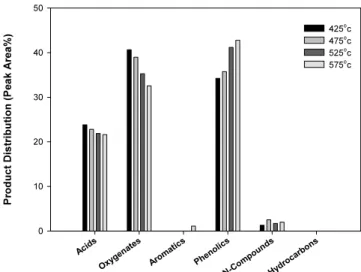
Acids Oxygenates
Aromatics Phenolics
N-Compounds Hydrocarbons
Product Distribution (Peak Area%)
0 10 20 30 40 50
425oc 475oc 525oc 575oc