• 검색 결과가 없습니다.

A Case of Double-unit Cord Blood Transplantation in Primary Refractory Acute Myeloid Leukemia

N/A
N/A
Protected

Academic year: 2021

Share "A Case of Double-unit Cord Blood Transplantation in Primary Refractory Acute Myeloid Leukemia"

Copied!
6
0
0

로드 중.... (전체 텍스트 보기)

전체 글

(1)

Introduction

The first successful umbilical cord blood transplantation (UCBT) was performed to treat a patient with Fanconi anemia in 1989 [1]. Umbilical cord blood has been an alternative source of allogeneic hematopoietic stem cell transplantation for recipients who don't have matched related or

unrelated bone marrow or peripheral blood stem cell donor [2]. UCBT has advantages such as easy availability, low risk of severe acute graft versus host disease (GVHD) and transmitting infections, tolerance for Human Leukocyte Antigen (HLA) mismatches and no harm for donors [3,4]. The disadvantages of UCBT are the higher rate of graft failure, delayed hematopoietic recovery, the risk

Abstract

Umbilical cord blood is an attractive source of hematopoietic stem cells in allogeneic hematopoietic stem cell transplantation. Umbilical cord blood transplantation has merits of rapid availability and low risk of severe acute graft versus host disease. Umbilical cord blood should be an important source of stem cell transplantation for patients who have no suitable human leukocyte antigen-matched bone marrow, or peripheral stem cell donor.

Transplantation of umbilical cord blood is limited by insufficient cell doses. This had led to the alternative concept of attempting to increase the number of cell doses using two cord blood units from different donor. We report a case of double-unit cord blood transplantation for 55-year-old male with primary refractory acute myeloid leukemia.

Key Words : Acute myeloid leukemia, Cord blood transplantation, Double units

Corresponding Author: Young Rok Do, M.D., Department of Internal Medicine, Keimyung University School of Medicine 56 Dalseong-ro, Jung-gu, Daegu 700-712, Korea

Tel : +82-53-250-7719 E-mail : [email protected]
Division of Hematology/Oncology, Department of Internal Medicine, Keimyung University School of Medicine, Daegu, Korea

Mi Hwa Heo, M.D., Won Young Jang, M.D., Myung Soon Park, M.D., Eu Gene Han, M.D., Jin Young Kim, M.D., Keon Uk Park, M.D., Young Rok Do, M.D.

A Case of Double-unit Cord Blood Transplantation in Primary

Refractory Acute Myeloid Leukemia

(2)

of transmitting genetic disorders, and the inability to further obtaining of stem cells or donor lymphocyte infusion [3-5].

Results of adult UCBT have shown worse outcomes compared with pediatric UCBT [5-10].

The cell doses using in these studies have been s i g n i f i c a n t l y l o w e r t h a n o t h e r m e a n s o f transplantation performed in adults. Cornetta et al.

analyzed the outcomes after adult UCBT, the median number of infused total nucleated cells were 1.6 × 10

7

/kg, the median time to neutrophil and platelet engraftment were 27 and 99 days, graft failure occurred in 10% of patients, and grade II–IV acute GVHD rate were 60% [8]. Other adult UCBT studies had also observed a higher rate of graft failure and delayed engraftment compared to bone marrow or peripheral blood grafts, that were principally attributed to the lower progenitor cell count of umbilical cord blood grafts [7-10]. This had led to the alternative concept of attempting to increase the number of cord blood cell doses to u s e o f t w o d i f f e r e n t c o r d b l o o d u n i t s simultaneously. We report a case of double-unit umbilical cord blood transplantation for 55-year- old man with primary refractory acute myeloid leukemia.

Case Report

A 55-year-old male visited hospital because of fatigue and dizziness for a month. He had no specific medical history except hemorrhoid operation 4 years ago. Physical examination revealed features of pale conjunctiva, peripheral cyanosis and no hepatosplenomegaly. His presenting peripheral blood cell count were revealed hemoglobin 9.2 g/L, white cell count 85

×10

6

/L (neutrophil 27%), and platelets 65 × 10

9

/L.

A review of the peripheral blood film showed

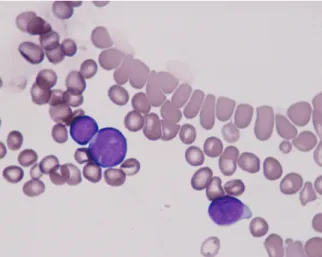
pancytopenia and a few blast-like immature cells (<1%). Bone marrow aspirate examination showed slightly hypocellular marrow particles for his age with proliferation of blasts. The blasts were 36% of all nucleated cells (ANC) and these cells had fine chromatin pattern, high nuclear-cytoplasmic ratio and relatively prominent nucleoli (Fig. 1). Flow cytometry of these blast cells demonstrated expression of CD45, HLA-DR, CD34, CD13, and C D 1 1 7 . B o n e m a r r o w b i o p s y s h o w e d normocellular marrow (cellularity 40%) with atypical hematopoietic cell infiltration. He was diagnosed as acute myeloid leukemia (AML), M2 by the WHO classification, cytogenetic study were done by karyotyping & FISH, which proved no abnormal cytogenetic abnormality.

Chemotherapy was started with standard idarubicin (12 mg/m

2

/per day for 3 days) and cytarabine (100 mg/m

2

/per day for 7 days) on the 15th July 2011. After induction treatment, follow up bone marrow aspiration revealed 52.3% of blast were still remained (Fig. 2). Salvage treatment with

Fig. 1. Bone marrow aspiration before treatment.

The blasts are 36% of all nucleated cells and these

cells have fine chromatin pattern, high N/C ratio

and relatively prominent nucleoli, ×1000.

(3)

fludarabine (25 mg/m

2

/per day for 5 days) and high dose cytarabine (2 g/m

2

/per day for 4days) was done on the August 2, 2011. He achieved hematologic complete remission proved by in the bone marrow examination on the August 16, 2011 (Fig. 3).

In anticipation of poor prognosis at refractory AML, we searched for donors of transplantation.

However there was no matched donor either in his family or in stem cell bank including bone marrow and peripheral blood registry. We started searching for donor in cord blood bank, and two umbilical cord blood with enough total nucleated cells (TNC) dose with two antigen mismatching were found.

The number of TNC were 1.5 × 10

7

/Kg and 2.9 × 10

7

/Kg.

He received high dose cytarabine (1 g/m

2

twice daily for 4 days) consolidation treatment in the September 9, 2011. After that, he also received the 'Tokyo university conditioning protocol' that was made up myeloablative setting with total body

irradiation (TBI) followed by cyclophosphamide based regimens. He received total 12 Gy dose of TBI with cytarabine (3 g/m

2

/per day, on days -5 to -4) and cyclophosphamide (60 mg/kg/per day, on days -3 to -2) before transplantation with double- unit umbilical cord (dUCBT). Two units of umbilical cord blood were infused in December 6, 2011. For prevention of acute GVHD, cyclosporin prophylaxis was given (3 mg/kg/per day) from day -1.

G r a d e I I s k i n G V H D a n d g r a d e I I gastrointestinal GVHD were occurred after transplantation. On the day 12, multiple maculopapular eruptions on his both forearm and back were developed, and treated with systemic corticosteroid and topical steroid agent. Also he complained symptoms of nausea and diarrhea for 7 days on day 20, that symptoms were slowly recovered without treatment.

The time to neutrophil and platelet engraftment was after transplantation 20 and 34 days respectively. On day 40, complete chimerism with Fig. 2. Follow up bone marrow aspiration, after

induction treatment. The smeared film show few hematopoietic cells scattered around marrow particles and some blasts still exist. The blasts are 52.3% of nucleated cells and had fine chromatin pattern, high N/C ratio and prominent nucleoli.

×400.

Fig. 3. Bone marrow aspiration after salvage

chemotherapy. The smeared film shows that

myeloid series are slightly decreased in number

without abnormal form. Erythroid series are

increased in number without abnormal form. Other

cell lines are unremarkable. ×1000.

(4)

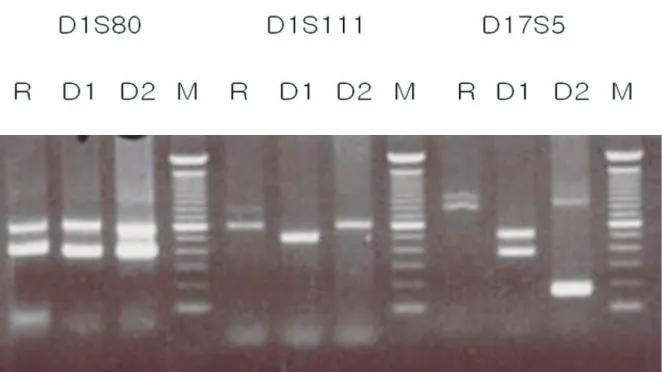
Fig. 4a. Pre- BMT DNA Test. Used primer: D1S80, D1S111, D17S5, R: recipient, D1: donor cord 1, D2: donor cord 2, M: marker.

Fig. 4b. Post-BMT DNA Test. Complete agreement at D1S111, D17S5, complete chimerism (donor cord 1).

(5)

donor cord 1 was achived (Fig. 4a, 4b). That represented successful engraftment of cord blood.

Repeat bone marrow examination presented no recurrence of AML and DNA test showed complete chimerism with donor cord 1. He died seven months after dUCBT due to severe atypical pneumonia, there was no evidence of leukemia relapse for seven months.

Discussion

A lots of adult UCBT studies showed worse outcomes compared with pediatric patients most of them were retrospective [5-10]. These studies also reported that adults receiving single, mismatched umbilical cord blood grafts had higher early mortality but similar overall survival when compared to recipients of unrelated donor bone marrow or peripheral blood stem cell [8-12]. The rate of primary graft failure were also higher in single UCBT than using of peripheral blood or bone marrow grafts [9]. These studies supported that the impaired engraftment in UCBT was associated with the degree of HLA matching, the dosage of CD34 cells and TNCs [10,13,14]. Double- unit cord blood transplantation had been proposed as a strategy to increase cell doses and to improve outcomes [7,11,12,14].

Recently, Rocha et al. compared 230 dUCBT with 377 single UCBT from the Eurocord Registry, and confirmed that lower relapse and improved leukemia-free survival rates after dUCBT than with single UCBT for patients transplanted in complete remission [15]. Brunstein et al. reported similar leukemia-free survival after dUCBT when they were compared with allogeneic HSCT from HLA- matched related or unrelated donors [16]. Similarly, Ponce et al. showed earlier treatment related mortality (TRM) after dUCBT was increased

compared to allogeneic transplantations from related and unrelated donors but with a lower long term TRM and less relapse [14].

Studies of UCBT in adult patient were seldom in Korea. In 2012, only 31 case of UCBT were performed and data of double-unit umbilical cord blood had not been reported. Moreover, only a few patients had an opportunity to find matched allogeneic stem cell donor due to small size of stem cell bank. Recently, there were some changes in this country. First, ministry of Health and Welfare made a regulation about the cord blood bank. So cord blood bank should be qualified for the stem cell dose and using a standard procedure for harvest. Second, the cost of double-unit cord procurement discounted almost 25% compared to previous cost. Third, Korean Adult Stem Cell Transplant Society made an protocol for adult cord blood transplantation and tried to apply to adult transplantation. We experienced a case of dUCBT with successful engraftment and tolerable GVHD for patient who had no available donor for allogeneic stem cell.

In conclusion, dUCBT is an available modality of transplant in patients who has no suitable allogeneic stem cell donor. More case reports and studies about dUCBT could be helpful for centers and doctors considering UCBT for those patients.

Reference

1. Gluckman E, Broxmeyer HA, Auerbach AD, Friedman HS, Douglas GW, Devergie A, et al. Hematopoietic reconstitution in a patient with Fanconi's anemia by means of umbilical-cord blood from an HLA-identical sibling. N Engl J Med 1989;321:1174-8.

2. Barker JN, Byam CE, Kernan NA, Lee SS, Hawke

RM, Doshi KA, et al. Availability of cord blood

extends allogeneic hematopoietic stem cell transplant

(6)

access to racial and ethnic minorities. Biol Blood Marrow Transplant 2010;16:1541-8.

3. Gluckman E. Ten years of cord blood transplantation:

from bench to bedside. Br J Haematol 2009;147:192-9.

4. Hwang WY, Ong SY. Allogeneic haematopoietic stem cell transplantation without a matched sibling donor:

current options and future potential. Ann Acad Med Singapore 2009;38:340-6.

5. Kurtzberg J, Prasad VK, Carter SL, Wagner JE, Baxter- Lowe LA, Wall D, et al. Results of the Cord Blood Transplantation Study (COBLT): clinical outcomes of unrelated donor umbilical cord blood transplantation in pediatric patients with hematologic malignancies.

Blood 2008;112:4318-27.

6. Barker JN, Davies SM, DeFor T, Ramsay NK, Weisdorf DJ, Wagner JE. Survival after transplantation of unrelated donor umbilical cord blood is comparable to that of human leukocyte antigen-matched unrelated donor bone marrow: results of a matched-pair analysis.

Blood 2001;97:2957-61.

7. Sanz GF, Saavedra S, Planelles D, Senent L, Cervera J, Barragan E, et al. Standardized, unrelated donor cord blood transplantation in adults with hematologic malignancies. Blood 2001;98:2332-8.

8. Cornetta K, Laughlin M, Carter S, Wall D, Weinthal J, Delaney C, et al. Umbilical cord blood transplantation in adults: results of the prospective Cord Blood Transplantation (COBLT). Biol Blood Marrow Transplant 2005;11:149-60.

9. Takahashi S, Iseki T, Ooi J, Tomonari A, Takasugi K, Shimohakamada Y, et al. Single-institute comparative analysis of unrelated bone marrow transplantation and cord blood transplantation for adult patients with hematologic malignancies. Blood 2004;104:3813-20.

10. Ballen KK, Spitzer TR, Yeap BY, McAfee S, Dey BR, Attar E, et al. Double unrelated reduced-intensity umbilical cord blood transplantation in adults. Biol

Blood Marrow Transplant 2007;13:82-9.

11. Brunstein CG, Fuchs EJ, Carter SL, Karanes C, Costa LJ, Wu J, et al. Alternative donor transplantation after reduced intensity conditioning: results of parallel phase 2 trials using partially HLA-mismatched related bone marrow or unrelated double umbilical cord blood grafts. Blood 2011;118:282-8.

12. Laughlin MJ, Barker J, Bambach B, Koc ON, Rizzieri DA, Wagner JE, et al. Hematopoietic engraftment and survival in adult recipients of umbilical-cord blood from unrelated donors. N Engl J Med 2001;344:1815- 22.

13. Wagner JE, Barker JN, DeFor TE, Baker KS, Blazar BR, Eide C, et al. Transplantation of unrelated donor umbilical cord blood in 102 patients with malignant and nonmalignant diseases: influence of CD34 cell dose and HLA disparity on treatment-related mortality and survival. Blood 2002;100:1611-8.

14. Ponce DM, Zheng J, Gonzales AM, Lubin M, Heller G, Castro-Malaspina H, et al. Reduced late mortality risk contributes to similar survival after double-unit cord blood transplantation compared with related and unrelated donor hematopoietic stem cell transplantation. Biol Blood Marrow Transplant 2011;17:1316-26.

15. Rocha V, Labopin M, Mohty M, Sanz GF, Rio B, Furst S, et al. Outcomes after double unit unrelated cord blood transplantation (UCBT) compared with single UCBT in adults with acute leukemia in remission. An Eurocord and ALWP collaboration study[Abstract]. Blood 2010;116:910.

16. Brunstein CG, Gutman JA, Weisdorf DJ, Woolfrey

AE, Defor TE, Gooley TA, et al. Allogeneic

hematopoietic cell transplantation for hematologic

malignancy: relative risks and benefits of double

umbilical cord blood. Blood 2010;116:4693-9.

수치

Fig. 1. Bone marrow aspiration before treatment.
Fig. 3. Bone marrow aspiration after salvage  chemotherapy. The smeared film shows that  myeloid series are slightly decreased in number  without abnormal form
Fig. 4a.  Pre- BMT DNA Test. Used primer: D1S80, D1S111, D17S5, R: recipient, D1: donor cord 1, D2: donor  cord 2, M: marker.

참조

관련 문서

This study evaluated the feasibility of the cultured human umbilical cord blood (hUCB)-derived CD34 + cells for cell expansion, in