Introduction
Nutrient input by rainfall is a major contributor of nutrients to forest ecosystems (Rodrigo et al., 2003), and varies according to ecosystem-specific characteristics (Amezaga et al., 1997). The forest canopy intercepted rainfall by throughfall and stemflow. Throughfall and stemflow are intercepted by the forest canopy before reaching the land surface. Interception can alter not only the volume of rainfall but also the chemistry composition of rainfall by several processes that occur at tree leaf and stem surfaces (Cronan and Reiners, 1983; Gaber and Hutchinson, 1988; Wang et al., 2004).
Characteristics of the forest structure such as species or density also affect nutrient inputs by rainfall. Forest management activities such as thinning or cutting alter this structure thereby resulting in changes in nutrient deposition. For example, thinning leads to the reduction in canopy density, which affects the timing of runoff and the volume of rainwater reaching the forest floor (Aboal et al., 2000).
Litter dynamics also constitute an important aspect of nutrient cycling and energy transfer in forest ecosystems.
Litterfall is related to growth rates and productivity of forests and is a principal pathway for the return of nutrients to the soil (Maguire, 1994; Kavvadias et al., 2001; Sonia et al., 2005).
It is therefore essential to understand the effects of sustainable forest management on nutrient cycling in
Received : September 30. 2007 Accepted : December 2. 2007*Corresponding author: Phone : +8237026774, E-mail : [email protected]
Effects of Thinning on Nutrient Input by Rainfall and Litterfall in Natural Hardwood Forest at Mt. Joongwang, Gangwon-do
Mun-Ho Jung
1,
*Don-Koo Lee
2, Tae-Won Um
3, Young-Soo Kim
4, Ki-Cheol Kwon
2, and Kang-Ho Jung
51
Rock Engineering Team, Technology Research Center Mine Reclamation Corporation, Coal Center, 30 Chungjin-dong Street (Susong-dong), Jongno-gu, Seoul
2
Department of Forest Sciences, College of Agriculture and Life Sciences, Seoul National University San 56-1, Shillim-9dong, Gwanak-gu, Seoul
3
Department of Forest Sciences, College of Life Science & Natural Resources, Sangji University 660 Usandong Wonjusi Gangwon-do
4
Forest Practice Research Center, Korea Forest Research Institute 51, Chikdong-ri, Sohul-up, Pocheon-si, Gyonggi-do
5
Soil Management Divison, Department of Agricultural Environment National Institute of Agricultural Science & Technology Rural Development Administration Suin-ro 150th, Gwonsun-gu, Suwon, Geonggi-do
The objectives of this study were to compare nutrient natural input between thinned and unthinned natural hardwood stands at Mt. Joongwang, Pyongchang-gun, Gangwon-do. Throughfall, stemflow, A- layer and B-layer soil water as well as litterfall were sampled at two-week intervals during the period of June to October from 2002 to 2004. The amount of rainfall interception in thinned and unthinned natural hardwood stands was as 12% and 18%, respectively. The results indicated that there was no difference in annual nutrient input by rainfall between thinned and unthinned stands. Na
+, Cl
-and SO
42-concentrations of A-layer soil water in the unthinned stand were higher than those in the thinned stand. In the B-layer soil water, Ca
2+, Cl
-, NO
3-and SO
42-concentrations in the unthinned stand were higher than those in thinned stand. Mean annual litterfall input was 2,706 kg ha
-1in unthinned stand and 2,589 kg ha
-1in thinned stand.
Total-N input from litterfall was 50.28 kg ha
-1yr
-1in the unthinned stand and 36.81 kg ha
-1yr
-1in the thinned stand, while there was no difference in exchangeable cation input from litterfall between thinned and unthinned stands. Thus, the difference in nutrient inputs except for N by throughfall, stemflow and litterfall between the two stands was not influenced by thinning.
Key words : Thinning, Nutrient Input, Throughfall;, Stemflow, Soil water, Litterfall
forested ecosystems. A long-term record on the effects of forest management activities on nutrient cycling is available for forested ecosystems in Europe and North America (Lindverg et al., 1989; Likens and Bormann, 1994; Moller et al., 1991; Roig et al, 2005). However, research in this area for Korean forests is short-term (1 to 2 years) and focuses only on undisturbed forest stands (Park, et al., 1999; Kim, et al., 2001; Joo, et al., 2003).
Integrated research on various factors such as thinning and artificial plantation in natural mixed-forest stands in Korea have not yet to be conducted. The objectives of this study were to compare nutrient natural inputs between unthinned and thinned natural hardwood stands at Mt. Joongwang, Pyongchang-gun, Gangwon-do, Korea.
Materials and Methods
Study area The study area is located in Jinbu-myun and Daehwa-myun, Pyungchang-gun, Gangwon-do, between 1,000~1,200m elevation (Figure 1, Table 1). To measure temperature and relative moisture in study site, two weather stations (CR10X, Campbell Scientific, Inc.) were conducted around study site. The data was collected last week of every November during study period. The range in annual mean temperature is -8.1~19.4℃, while annual mean relative moisture is 52.8~91.9% (Figure 2).
Climate is temperate in the middle and northern area.
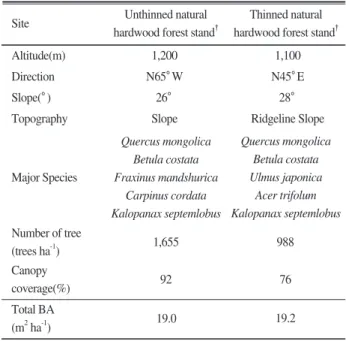
Vegetation in the study area is vertically distributed from the foot of the mountain to the sub-alpine belt between the altitude of 600~1500m. In April 2000, two 30m × 30m plots were set in each of the thinned and unthinned
¨
Fig. 1. Location of study sites at Mt. Joongwang, Gangwon-do.
natural deciduous stands. The intensity of the thinned stand was 30% and thinning was conducted in 1997. The thinned stand was allowed to grow back naturally after thinning.
Sampling method Samples of precipitation, throughfall, stemflow and soil water were collected twice each month during June and October from 2002 to 2004.
Samples were brought to laboratory prior to storing in a freezer. Precipitation was measured and samples were collected from sampling vessels attached with funnels 217 mm in diameter at 5 open areas. The same kind of vessels was used to collect throughfall samples. To collect stemflow, six trees with average stand DBH (Diameter of Basal Height) were selected. Their barks were smoothed and then plastered with silicon sealant.
After the sealant had dried, a spiral tin strip 12cm wide was attached to the stem of each tree at 1.2~1.5m from the tree base. Gaps that occurred between the stem and
thin strip were sealed with silicon sealant. A plastic tube was then attached to the bottom of the tin strip and was connected to a large vessel (250L volume). To collect soil water, we installed 3 Tension Lysimeters (Soil Solution Access Tubes, IRROMETER) in A and B layer respectively. The tension was adjusted according to the actual soil water tension whenever samples were collected. Five 1m × 1m (1 m
2) litter traps were randomly installed 1m above the ground in 2002.
Littefall samples were collected monthly and oven-dried to constant weight at 85℃ for 48 hours.
Sample analysis Precipitation samples were filtered with 0.2 μ m membrane filter and litterfall samples were dried for 48 hours in the outdoor shade and subsequently oven-dried for 48hours at 85℃ before weighing. After filtering each water sample, concentrations of 4 exchangeable cations (Na
+, K
+, Mg
2+, C
2+) were measured by Inductively Coupled Plasma Spectrometer (ICPS 100-IV, Shimazu, Japan,), while inorganic anions (Cl
-, NO
3-and SO
42-) were measured by Ion Chromatography (DX-500, DIONEX, USA). Total nitrogen content of litterfall samples was measured by automatic decomposition/titration (Kjeltec, Tecator, USA) after wet-digested in a sulfuric acid-hydrogen peroxide mixture using a block digester. Also, 4 exchangeable cations (Na
+, K
+, Mg
2+, Ca
2+) of litterfall
Unthinned natural hardwood forest stand"
Thinned natural hardwood forest stand"
Site
Altitude(m) 1,200 1,100
Direction N65°W N45°E
Slope(°) 26° 28°
Topography Slope Ridgeline Slope
Major Species
Number of tree
(trees ha-1) 1,655 988
92 76
Canopy coverage(%) Total BA (m2ha-1)
"
Unthinned natural hardwood forest stand as unthinned, while thinned natural hardwood forest as thinned.
19.0 19.2
Quercus mongolica Betula costata Fraxinus mandshurica
Carpinus cordata Kalopanax septemlobus
Quercus mongolica Betula costata Ulmus japonica
Acer trifolum Kalopanax septemlobus Table 1. Characteristics of unthinned and thinned natural hardwood mixed forest stands.
Fig. 2. Climate diagram of study site.
Site
Moisture (%) 34.5 34.2 43.3 43.4
pH (H2O) 4.8 5.3 5.4 5.3
pH (CaCl2) 4.0 4.4 4.2 4.4
Total-N (%) 0.3 0.2 0.5 0.4
Organic matter (%) 11.2 8.0 9.9 5.3
B-layer A-layer
B-layer A-layer
Unthinned Thinned
Table 2. Soil properties of study sites.
samples were measured by Inductively Coupled Plasma Spectrometer (ICPS 100-IV, Shimazu, Japan,)
Statistical analysis Duncan's multiple test was conducted to compare the differences of mean annual concentrations of exchangeable cations and inorganic anions in throughfall, stemflow and precipitation.
ANOVA was conducted to compare the differences of:
1) mean annual concentrations of exchangeable cations and inorganic anions in A-layer and B-layer soil water and 2) annual concentrations of exchangeable cations and total-N input by litterfall.
Results and Discussion
Rainfall Interception Mean annual rainfall was 1,355 mm and 1,463 mm in unthinned and thinned stands, respectively (Figure 3). Rainfall interception loss for the unthinned stand was 22% of precipitation and 12% for the thinned stand (Figure 4). Rainfall interception loss decreased as a result of a decrease in canopy area caused mainly by the reduction in number of trees following thinning (Asdak et al., 1998). This result is similar to
other studies. Interception was reported to 18.5%
(Veracio and Lopez, 1976) or 30.2% (Aussenac et al., 1982) after the removal of 50% of basal area. Baumler and Zech (1997) reported that removal of 40% of the stem volume caused a 39% reduction in interception.
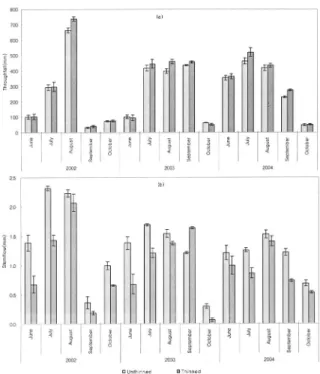
Throughfall and stemflow Figure 5 shows seasonal changes of throughfall and stemflow. Annual throughfall during the study period was more than 98% in both of thinned and unthinned stands. Annual throughfall of 1,391 mm in the thinned stand was greater than that of the unthinned stand (1,290 mm). The changes in throughfall are inversely proportional to tree density and crown coverage, which were reduced after thinning (Aboal et al., 2000).
Annual stemflow was 6.7 mm in the unthinned stand and 4.9 mm in the thinned stand. The difference in stemflow results from the direct relationship between the amount of stemflow and tree density. Fewer trees remained in the thinned stand after thinning, thus changing the amount of annual stemflow (Asdak et al., 1998).
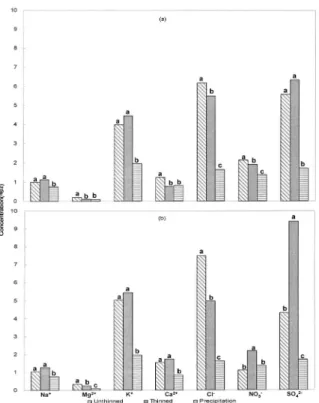
Nutrient input by rainfall Figure 6 shows the mean annual concentrations of exchangeable cations and inorganic anions in throughfall, stemflow and precipitation. In throughfall, Mg
2+, Ca
2+, Cl
-and NO
3-Fig. 3. Seasonal changes in total rainfall within forest (throughfall + stemflow) and precipitation.
Fig. 4. Relationship between total rainfall within forest (throughfall + stemflow) and precipitation.
Fig. 5. Seasonal changes of throughfall (a) and stemflow (b).
¨
′ ′
concentrations in the unthinned stand were higher than those in the thinned stand. In general, ion concentrations in throughfall decreased after thinning. This resulted from 1) the dilution of throughfall due to the decrease of interception in thinned stand, and 2) the reduction of dry deposition via the canopy (Baumler and Zech, 1997).
Changes of canopy characteristics may affect processes like ion exchange and leaching or dry deposition (Sollins and McCorison, 1981).
Figure 7 shows the mean annual input of exchangeable cations and inorganic anions by throughfall and stemflow. Nutrient input by throughfall was more than 98% in both the unthinned and thinned stands. There were no significant differences in nutrient input by rainfall between the unthinned and thinned stands, with exception of Cl
-and SO
42-. Although rainfall was higher in the thinned versus the unthinned stand, ion concentrations were higher in the unthinned as a result of concentration dilution. Because of this, we conclude that thinning has no effect on nutrient input despite the increased amount of rainfall in study site.
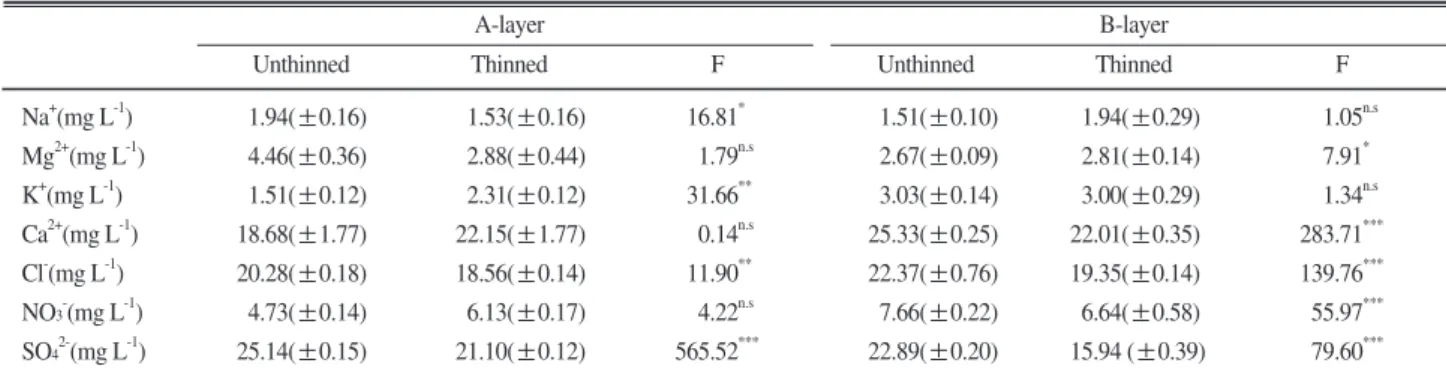
Soil water Despite similar soil characteristics and parent material at study sites, there were significant differences in ion concentrations of A-layer and B-layer soil water between unthinned and thinned stands (Table 3). Na
+, Cl
-and SO
42-concentrations of A-layer soil water in the unthinned stand were higher than those in the thinned stand. In the B-layer soil water, Ca
2+, Cl
-, NO
3-and SO
42concentrations in the unthinned stand were higher than those in thinned stand. Thinning causes changes in soil and soil water chemistry. High rainfall after thinning dilutes concentrations of soil solutes, and nutrient uptake by the roots is reduced after thinning.
Moreover, plants with a high N-supply start to grow in the lower shrub and ground layer after thinning, and their high demand for nutrients may result in reduction of ion concentrations in the soil solution (Fashey et al., 1991;
Baeumler and Zech, 1998; Robertson, 2000).
Nutrient input by litterfall Mean annual litterfall in the unthinned stand was 2,706 kg ha
-1, while 2,589 kg ha
-1in thinned stand (Figure 8). This corroborates with similar studies focusing on litterfall in unthinned stands versus thinned stands (Harrington and Edwards, 1999; Roig et al., 2005). This is due to the reduction of tree density, canopy coverage or stocking levels after thinning.
Huebschmann et al (1999) found that litterfall weights were significantly and positively correlated with tree density or stocking levels in Pinus echinata stands.
Concentration of total-N was higher in the unthinned stand, while exchangeable cations were higher in the thinned stand(Table 4). Although studies about the effects of thinning on litterfall nutrient exist, the results are quite different. Moller et al. (1991) found slight differences in foliar N, P and K concentrations between thinned and
¨
Fig. 6. Mean annual exchangeable cations and inorganic anions concentrations of throughfall (a) and stemflow (b).
Different letters(a, b and c) indicate significant difference at 5% by Duncan's multiple range test.
Fig. 7. Mean annual input of exchangeable cations and inorganic anions by rainfall (throughfall + stemflow).
Different letters(a, b and c) indicate significant difference at 5% by Duncan's multiple range test.
¨
unthinned stands. In that study, Moller et al. (1991) reported that N, P and K concentrations became higher after thinning because trees needed more nutrient in their stem and leaves by effect of thinning. But Wollum and Schubert (1975) reported no changes in foliar nutrient concentrations in ponderosa pine after thinning. In this study, except for total-N, results were same with the study of Moller et al. (1991).
However, we did not find significant differences in nutrient input by litterfall between unthinned and thinned stand, with the exception of total-N (Table 4). Although litterfall was higher in the unthinned stand, concentrations of exchangeable cations were higher in the thinned stand. Through these results, we conclude that the reduction in litterfall as a result of thinning only has no effect on exchangeable cations while effect on N input to the forest ecosystem in study site.
Acknowledgements
This research was supported financially by Korea Forest Service.
References
Aboal, J.R., M.S. Jimenez, D. Morales and P. Gil. 2000. Effects of thinning on throughfall in Canary Islands pine forest-the role of
¨
¨
*Represent P<0.05.
**Represent P<0.01.
***Represent P<0.001.
n.sNot significant at the 5% level
Na+(mg L-1) 1.94(±0.16) 1.53(±0.16) 16.81* 1.51(±0.10) 1.94(±0.29) 1.05n.s
Mg2+(mg L-1) 4.46(±0.36) 2.88(±0.44) 1.79n.s 2.67(±0.09) 2.81(±0.14) 7.91*
K+(mg L-1) 1.51(±0.12) 2.31(±0.12) 31.66** 3.03(±0.14) 3.00(±0.29) 1.34n.s
Ca2+(mg L-1) 18.68(±1.77) 22.15(±1.77) 0.14n.s 25.33(±0.25) 22.01(±0.35) 283.71***
Cl-(mg L-1) 20.28(±0.18) 18.56(±0.14) 11.90** 22.37(±0.76) 19.35(±0.14) 139.76***
NO3-
(mg L-1) 4.73(±0.14) 6.13(±0.17) 4.22n.s 7.66(±0.22) 6.64(±0.58) 55.97***
SO42-(mg L-1) 25.14(±0.15) 21.10(±0.12) 565.52*** 22.89(±0.20) 15.94 (±0.39) 79.60***
F Thinned
Unthinned F
Thinned Unthinned
A-layer B-layer
Table 3. Mean (±±standard error) annual concentrations of exchangeable cations and inorganic anions in A-layer and B-layer soil water.
Fig. 8. Seasonal changes in litterfall.
Concentration (mg kg-1)
Nutrient Inputs (kg ha-1)
**Represent P<0.01.
***Represent P<0.001.
n.sNot significant at the 5% level
Na+ 4.5(±0.02) 5.5(±0.03) 140.31***
Mg2+ 13.9(±0.20) 21.3(±0.12) 607.30***
K+ 55.9(±1.06) 66.7(±0.51) 77.19***
Ca2+ 101.2(±2.86) 123.9(±1.27) 50.39***
total-N(%) 1.5(±0.01) 1.1(±0.03) 110.80***
Na+ 1.6(±0.04) 1.3(±0.05) 1.20n.s
Mg2+ 4.8(±0.13) 7.2(±0.15) 0.90n.s
K+ 19.6(±0.65) 21.0(±0.57) 0.07n.s
Ca2+ 36.0(±0.94) 42.8(±1.23) 0.19n.s
total-N 50.2(±1.12) 36.8(±1.05) 32.67***
F Thinned
Unthinned
Table 4. Annual (±±standard error) exchangeable cations and total-N input by litterfall.
′
fog. J Hydrol. 238:218-230.
Amezaga, I., A.G. Areas, M.Domingo, A. Echeandia and M.
Onaindia. 1997. Atmospheric deposition and canopy interactions for conifer and deciduous forests in northern Spain. Water Air Soil Poll. 97:303-313.
Asdak, C., Jarvis, P.G. Gardingen and P.A. Fraser. 1998. Rainfall interception loss in unlogged and logged forest areas of Central Kalimantan, Indonesia. J Hydrol. 206:237-244.
Aussenac, G., A. Granier and R. Naud. 1982. Influence of thinning on growth and water balance. Can J Forest Res. 12(2):222-231.
Baumler, R. W. and Zech. 1997. Atmospheric deposition and impact of forest thinning on the throughfall of mountain forest ecosystems in the Bavarian Alps. Forest Ecol Manag. 95:243-251.
Baeumler, R. W. and Zech. 1998. Soil solution chemistry and impact of forest thinning in mountain forests in the Bavarian Alps.
Forest Ecol Manag. 108:231-238.
Cronan, C.S. and W.A. Reiners. 1983. Canopy processing of acidic precipitation by coniferous and hardwood forests in New England.
Oecologia (Berlin). 59:216-223.
Fashey, T.J., P.A. Stevens, M. Hornung and P. Rowland. 1991.
Decomposition and nutrient release from logging residue following conventional harvesting of Sitka Spruce in North Wales.
Forestry. 64:271-288.
Gaber, B.A. and T.C. Hutchison. 1988. Chemical changes in simulated rain drops following contact with leaves of four boreal forest species. Can J Bull. 66:2445-2451.
Harrington, T.B. and M.B. Edwards. 1999. Understory vegetation, resource availability and litter fall responses to pine thinning and woody vegetation control in longleaf pine plantations. Can J Forest Res. 29:1055-1064.
Huebschmann, M.M., T.B. Lynch and R.F. Wittwer. 1999. Needle litterfall prediction models for even-aged natural shortleaf pine (Pinus echinata Mill.) stands. Forest Ecol Manag. 117:179-186.
Joo, Y.T., H.R. Kim and S.D. Lee. 2003. Changes the pH and Chemical Composition of the Precipitation inside the Pinus densiflora and Pinus rigida Stnads. Journal of KSAFM. 5(1):24- 29.
Kavvadias, V.A., D. Alifragis, A. Tsiontsis, G. Brofas and G.
Stamatelos. 2001. Litterfall, litter accumulation and litter decomposition rates in four forest ecosystems in northern Greece.
Forest Ecol Manag. 144:113-127.
Kim, H.R., Y.T. Joo and H.O. Jin. 2001. Chemical Composition of the Sequentially Sampled Precipitation in the Different Forest
Stands. Journal of KSAFM. 3(2):88-95.
Likens, G.E. and F.H. Bormann. 1994. Biogeochemistry of a Forested Ecosystem. Springer, Verlag, 31-94.
Lindverg, S.E., R.C. Harriss, W.A.,Jr. Hoffman, G.H. Lovett and R.R. Turner, 1989. Atmospheric chemistry, deposition and canopy interactions. In: D. W. and R. I. Van Hook (eds) Analysis of Biogeochemical Cycling Processes in Walker Branch Watershed, Springer, Verlag. pp 96-163.
Maguire, D.A. 1994. Branch mortality and potential litterfall from Douglas-fir trees in stands of varying density. Forest Ecol Manag.
70:41-53.
Moller, G., B. Tveite, H.G. Gustavsen and F. Petterson. 1991. Time adjustment of forest fertilization relative to that of thinning preliminary results from a nine year old Scandinavian cooperative study. Report of the Institute for Forest Improvement 23pp.
Park, Y.D., D.K. Lee and D.Y. Kim, 1999. Nutrient Dynamics in the Throughfall, Stemflow and Soil Solution of Korean Pine, Japanese Larch and Hardwood Stands at Kwangju-Gun, Kyonggi- Do. Jour. Korean For. Soc. 88(4):541-554.
Rodrigo, A., A. Avila and F. Roda. 2003. The chemistry of precipitation, throughfall and stemflow in two holm oak (Quercus ilex L.) forests under a contrasted pollution environment in NE Spain. Sci Total Environ. 305:195-205.
Robertson, S.M.C. 2000. Water chemistry of throughfall and soil water under four tree species at Gisburn, Northwest England, before and after felling. Forest Ecol Manag. 129:102-117.
Roig. S., R. C. Miren, Isabel and M. Grenorio. 2005. Litter fall in Mediterranean Pinus pinaster Ait. stands under different regimes.
Forest Ecol Manag. 206:179-190.
Sollins, P. and F.M. McCorison. 1981. Nitrogen and carbon solution chemistry of an old growth coniferous forest watershed before and after cutting. Water Resour Res. 17:1409-1418.
Sonia, R., R. Miren, C. Isabel and M. Gregorio. 2005. Litter fall in Mediterranean Pinus pinaster Ait. stands under different thinning regimes. Forest Ecol Manag. 206, 179-190.
Veracio, V.P. and A.C.B. Lopez. 1976. Rainfall interception in a thinned Benguet pine forest stand. Sylvatrop. 1(2):128-134.
Wang, M.C., C.P. Liu and B.H. Sheu. 2004. Characterization of organic matter in rainfall, throufall, stemflow, and streamwater from three subtropical forest ecosystems. J Hydrol. 289:275-285 Wollum, A.G. and G.H. Schubert. 1975. Effects of thinning on the
foliage and forest floor properties of ponderosa pine stands. Soil Sci Soc Am J. 39(5):968-972.
¨
¨
′ ′
′ ′
본 연구의 목적은 강원도 평창군에 위치한 중왕산 지역에서 천연활엽수림 내 간벌작업지와 비작업지에서 양분 유입의 차이를 비교하는 것이었다. 임내강우와 임외강우, 낙엽낙지에 의한 양분 유입량과 토양수 내 양분 농도 를 조사하기 위하여2002년부터 2004년까지 임내강우와 임외강우, 토양수는 매년 6월부터 10월 사이에 격주간 채취하였고, 낙엽낙지는 매년 9월과 10월에 채취하였다. 조사 기간동안 강우 차단율은 간벌작업지에서 12%, 비 작업지에서 18%였다. 수관통과우와 수간류에 의한 양분 유입량은 간벌작업지와 비작업지에서 차이를 보이지 않았다. 토양수 내 이온 농도는 A층에서는 Na+, Cl-, SO42- 이온이, B층에서는 Ca2+, Cl- NO3-, SO42- 이온이 비 작업지에서 다소 높았다. 연간 낙엽낙지량은 간벌작업지에서 2,589 kg ha-1로, 비작업지의 2,706 kg ha-1보다 적 은 유입량을 보였다. 낙엽낙지에 의한 양분 유입량은 N의 경우, 간벌작업지에서 36.81 kg ha-1 yr-1, 비작업지에 서 50.28 kg ha-1 yr-1였으나, 양이온의 유입량은 차이가 없었다. 이를 종합해 볼 때, 본 연구에서 수관통과우와 수간류 및 낙엽낙지에 의한 양분유입량의 간벌에 의한 영향은 질소를 제외한 다른 양분에서는 없었던 것으로 나타났다.
강원도 중왕산 지역 천연활엽수림에서 간벌작업이 강우와 낙엽에 의한 양분 유입에 미치는 영향
정문호1,*·이돈구2·엄태원3·김영수4·권기철2·정강호5
1광해방지사업단 기술연구센터 암반공학연구팀, 2서울대학교, 농업생명과학대학
3상지대학교 생명자원과학대학, 4국립산림과학원, 산림생산기술 연구소
5농촌진흥청, 농업과학기술원