ORIGINAL ARTICLE
Evaluation of Photosynthetic Ability in Two Representative Evergreen Broad-leaved Tree Species in Korea
Dong-Hak Kim, Yong Mok Park
*Department of Life Science, Cheongju University, Cheongju 28503, Korea
Abstract
To maintain a rich biological diversity is important to develop for biomaterial resources such as Korean evergreen broad-leaved tree species, the distribution of which is restricted to the southern part of Korean peninsula. We assessed photosynthetic characteristics of Quercus acuta and Castanopsis sieboldii, the representative evergreen broad-leaved trees in Korea, in order to establish a basis for conservation strategy related to distributional change in evergreen broad-leaved tree species according to climate change. Photosynthetic characteristics were evaluated in the sun and shade leaves of the two species. Sun leaves in both species revealed higher light compensation point and maximum photosynthetic rate compared to the shade leaves.
In addition, photosynthetic rate was higher in Q. acuta than C. sieboldii, which was supported by a higher leaf nitrogen content and leaf mass per area. Water use efficiency was also higher in Q. acuta as compared to that in C. sieboldii. Similar photosynthetic rate, however, was shown in photosynthetic response to CO2 concentration in the intercellular space. These results suggest that both species could respond differently to the changing environmental factors including climate change, suggesting the possibility of distributional changes resulting from a differential growth rate.
Key words : Evergreen broad-leaved tree, Leaf mass per area, Leaf nitrogen content, Photosynthesis
1. Introduction
1)Climate change affects productive process and performance of plants. In particular, increasing CO
2concentration and air temperature lead to change of photosynthesis and plant water use traits and, in turn, result in matter production change of plants. In natural forest, global warming can accelerate difference in death rate and recruitment success between species (Ibanez et al., 2008; Peltier and Ines, 2015), resulting in distributional change of tree species.
Vegetation in Korea is roughly classified into three representative types (Kim, 1992). In northern part of
Korean peninsula coniferous tree species such as Picea jezoensis and Abies hollophylla makes up subalpine coniferous forest. In the middle part region broad-leaved deciduous forest composed of Quercus mongolica, Rhododendron schlippenbachii and Lindera obtusiloba is distributed over a wide area, forming representative cool temperate forest. On the other hand, warm temperate forest that is mainly composed of evergreen broad-leaved tree species is distributed with a narrow area in southern part of Korean peninsula due to the cold of winter. Besides, its distribution is scattered in many islands far away from main land of Korea. Thus, evergreen broad-leaved
Received 3 October 2017; Revised 18 October, 2017;
Accepted 19 October, 2017
*Corresponding author: Yong Mok Park, Department of Life Science, Cheongju University, Cheongju 28503, Korea
Phone: +82-43-229-8531 E-mail: [email protected]
ⓒ The Korean Environmental Sciences Society. All rights reserved.
This is an Open-Access article distributed under the terms of the Creative Commons Attribution Non-Commercial License (http://
creativecommons.org/licenses/by-nc/3.0) which permits unrestricted non-commercial use, distribution, and reproduction in any medium, provided the original work is properly cited.
tree species is very important in terms of conservation of biological diversity in Korea. In recent, the extension of distribution in some evergreen broad-leaved tree species into northern region of the peninsula has been reported (Park et al., 2010). Considering isolated population of a species is easy to extinct accumulation of information on ecophysiological characteristics for evergreen broad-leaved tree species is essentially needed to establish a basis for conservation plan in Korea.
We assessed photosynthetic traits in the two representative evergreen broad-leaved tree species to find a clue to predict their distributional change under climate conditions.
2. Materials and Methods
2.1. Study site and species
The study was conducted in Wando-arboretum located at Wando Island, Jeollanam-do province, Korea (N34°21’25”, E126°40’31”). Wando-arboretum is located at hillside of Mt. Baegunbong with 600 m above sea level in peak. An average annual precipitation in Wando area is about 1,600 mm (Korea Meteorological Administration, 2015). Mean annual temperature is above 15 , and it remains over 0 even in January. As a result, vegetation in this area shows the representative warm temperate forest characteristics, occupied by evergreen broad-leaved tree species such as Camellia japonica, Quercus acuta (Q. acuta) and Castanopsis sieboldii. (C.
sieboldii). Among tree species we selected two species as plant materials because these species were remained in a state of nature with high integrity without any extensive disturbance like artificial thinning for management. We categorized plant materials into two groups; sun leaf is a group of leaves exposed to full sunlight by facing outward of canopy. Shade leaf is a group of leaves exposed to shaded light condition inside canopy. Three branches
from each of three individuals were randomly sampled per species. Branches about 1 m long with leaves were cut and then immediately recut the base of them under air-removed water in a bucket to protect disconnection of sap in branch. Branches were capped with dark-colored plastic bag and then transported to laboratory for measurements of photosynthesis. All measurement was performed within three days after sampling
2.2. Gas exchange measurement and leaf characteristics
Leaf gas exchange rate was measured with potable photosynthesis apparatus (Li-6400, Li-Cor, Lincoln, NE). Phtosynthetic light responses to Photosynthetic Photon Flux (PPF) were measured by increasing PPF in seven steps from 0 to 2,000 μmol/m
2/s under 400 ppm in CO
2concentration in the chamber. The photosynthetic response curve to intercellular CO
2concentration (Ci) was also constructed in eight steps by increasing CO
2concentration with CO
2injector (LI 6401-01) under 1,000 μmol/m
2/s PPF conditions.
LED (LI 6400-2B, Li-Cor, Lincoln, NE) light was used for measurements. During all measurements of temperature and relative humidity in the chamber were maintained 25 and above 50%, respectively.
From sampled branches five leaves per species were selected for chlorophyll measurement. Another five leaves were sampled for measurements of Leaf Mass per Area (LMA) and Leaf Nitrogen Content (LNC).
Chlorophyll content was determined with absorbance
at 663.8 and 646.8 nm using spectrophotometer
according to Porra et al. (1989) after chlorophyll
extraction with dimethylformamide (DMF) for 2 days
in the refrigerator. For the measurement of LMA and
LNC leaf area was determined using area meter
(AAM-8, Hayashi Denkou, Tokyo, Japan) and then
leaf dry mass was determined after drying at 80 for
48 hrs. LNC was determined with semi-microkjeldahl
system (VA-SA-1, MRK. Tokyo, Japan). Statistical
Fig. 1. Light response curves in sun and shade leaves of Q.
acuta and C. sieboldii. Bars indicate standard errors (n=5).
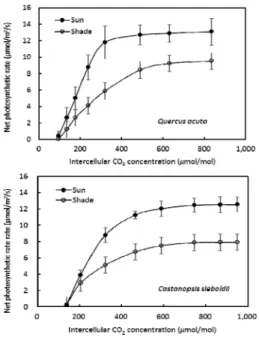
Fig. 2. Photosynthetic rate to CO2 concentration at intercellular space (A-Ci) in sun and shade leaves of Q. acuta and C. sieboldii. Bars indicate standard errors (n=5).
analyses were performed with the SPSS software package (SPSS 24.0 2017) for Windows.
3. Results and Discussion
3.1. Photosynthetic traits
Light is one of the critical environmental factors in plants because matter production affects survival, growth, reproduction and distribution of plants. As a result, light environment in habitat leads to the differentiation of sun and shade plants and has brought development of sun and shade leaves in even an individual tree (Givnish, 1988). Photosynthetic rates of Q. acuta and C. sieboldii to PPF were shown in Fig. 1. Sun leaves in Q. acuta tree species showed higher photosynthetic rates than those in shade leaves.
C. sieboldii also showed higher photosynthetic rates in sun leaves than shade leaves though the difference between them was not strikingly apparent compared to Q. acuta (Fig. 1). These results indicate that there
is a leaf differentiation according to light environments inside and outside of canopy in both tree species.
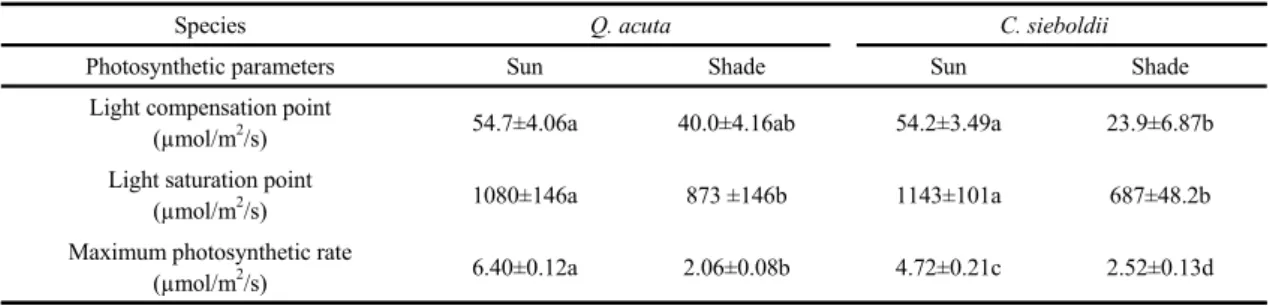
Pmax of Q. acuta in sun leaves was 6.40 µmol/m
2/s, whereas Pmax of C. sieboldii only reached about 73% of that of Q. acuta (Fig. 1). Light Compensation Point (LCP), light saturation point and P
maxare shown in Table 1. In LCP, similar values were observed in both species (Table 1). On the other hand, Pmax of shade leaves in C. sieboldii showed higher than that in Q. acuta (Table 1). Photosynthetic characteristics shows strong correlation with PPF irrespective of leaf position, indicating the plasticity of leaf characteristics (Gonz et al., 2001; Iio et al., 2005). Thus, different photosynthetic response between sun and shade leaves and the difference between tree species must be related to the plasticity of leaf characteristics of species. Fig. 2 shows photosynthetic responses to intercellular CO
2concentration in the leaf. The carboxylation rates are also higher in Q.
acuta than in C. sieboldii irrespective of sun and
Fig. 3. Leaf Nitrogen Content (LNC) in sun and shade leaves of Q. acuta and C. sieboldii. Bars indicate standard errors (n=5). A Different letter indicates significant difference at p ≤0.05.
Fig. 4. Leaf Mass per Area (LMA) in sun and shade leaves of Q. acuta and C. sieboldii. Bars indicate standard errors (n=5). A Different letter indicates significant difference at p ≤0.05.
Species Q. acuta C. sieboldii
Photosynthetic parameters Sun Shade Sun Shade
Light compensation point
(µmol/m2/s) 54.7±4.06a 40.0±4.16ab 54.2±3.49a 23.9±6.87b
Light saturation point
(µmol/m2/s) 1080±146a 873 ±146b 1143±101a 687±48.2b
Maximum photosynthetic rate
(µmol/m2/s) 6.40±0.12a 2.06±0.08b 4.72±0.21c 2.52±0.13d
Table 1. Photosynthetic characteristics of Quercus acuta and Castanopsis sieboldii trees. Values are means ± se (n=5).
Different letters indicate significant difference at P 0.05
shade leaves (Fig. 2). Leaf photosynthesis rate under full sunlight strongly depends on CO
2concentration (Pfanz et al., 2007). However, at CO
2level of 300-400 ppm photosynthesis is restricted by CO
2concentrations, whereas RuBP concentration in stroma limits photosynthetic rate at over 400 ppm of CO
2concentrations ( Von Caemmerer and Farquhar, 1981) . Thus, A-Ci curve like Fig. 2 can give an information related to the effect of stomatal conductance (Farquar and Sharkey, 1985), relationship between maximum photosynthetic rate and environmental condition, rubisco activity, and RuBP reduction ability (Fischer et al., 1997). Photosynthesis is very complicated process acting together with several factors. The first
process of photosynthesis begin from light absorption
in chlorophyll of a leaf. Both species showed higher
chlorophyll contents in sun leaves than in shade
leaves (Table 2). Thick leaf, high chlorophyll a/b
ratio, and high nitrogen contents per area in sun leaf
is favorable characteristics functionally and structurally
for strong light use (Evans and Seemann, 1989). On
the other hand, shade leaf is characterized by big
chloroplast, many thylakoids per granum, and high
specific leaf area, which are developed to adapt to
weak light conditions (Fahl et al., 2015). The
combination of these characteristics in sun and shade
leaves is the results of adaptation of leaf to light
environment (Ashton, 1992). Contrary to the results of
Species Type Chl a (g/m2) Chl b (g/m2) Chl a+b (g/m2) Chl a/b (g/m2)
Q. acuta Sun 13.9±0.92a 5.57±0.21a 19.5±1.13a 2.48±0.07a
Shade 10.8±0.88b 5.02±0.26a 15.8±1.14a 2.13±0.06b
C. sieboldii Sun 28.0±2.42b 12.1±0.73b 40.2±3.13b 2.29±0.08b
Shade 18.2±1.35a 8.70±0.58c 26.9±1.91c 2.09±0.05b
Table 2. Chlorophyll contents of Quercus acuta and Castanopsis sieboldii. Values are means ± se (n=5). Different letters indicate significant difference at P 0.05
photosynthetic rate C. sieboldii showed higher chlorophyll contents compared to those in Q. acuta (Table 2). In chlorophyll a/b ratio, however, Q. acuta maintained high values in both sun and shade leaves.
This discrepancy must be resulted from the complexity of interactions involved in biochemical process of photosynthesis (Kenzo et al., 2004; Iio et al., 2005; Yasumura et al., 2006). Besides, various environmental factors such as leaf thickness (Koike, 1988, 1989), leaf nitrogen content (Reich et al., 1999) and mesophyll structure (Kenzo et al., 2004) also affect maximum photosynthetic rate. In particular, it is well known that leaf nitrogen content affects photosynthetic capacity, and strong correlation between leaf nitrogen content and light availability (Hikosaka, 2004). Fig. 3 shows LNC in sun and shade leaves of the two species. Considering that Pmax is correlated with leaf nitrogen (Yasumura et al., 2006), and changes of rubisco and chlorophyll contents were strongly correlated to leaf nitrogen, the difference of Pmax in sun leaves between the two species may be due to low leaf nitrogen content in C.
sieboldii (Figs. 1, 3). Light availability inside and outside canopy has brought the difference in LMA between sun and shade leaves (Fig. 4). LMAs of sun leaves in both species indicated significantly higher than those in shade leaves. LMA indicating leaf thickness is linked to efficient light use under high light conditions (Atwell et al., 1999). In addition, sun leaves in Q. acuta showed higher LMA compared to C. sieboldii. This is strongly supported by the fact that LMA and canopy leaf characteristics contribute
to increase of Pmax (Kenzo et al., 2004; Takashima et al., 2004; Iio et al., 2005). Sun leaves in Q. acuta indicated higher WUEs than those in C. sieboldii (Fig. 5). This must result from the difference in LNC and LMA (Figs. 3, 4).
Fig. 5. Water Use Efficiency (WUE) in sun and shade leaves of Q. acuta and C. sieboldii. Bars indicate standard errors (n=5). A Different letter indicates significant difference at p ≤0.05.