194 Korean J. Pl. Taxon. (2011)
Vol. 41 No. 3, pp.194-201
Preliminary search of intraspecific chloroplast DNA variation of nine evergreen broad leaved plants in East Asia
Jung-Hyun Lee, Byoung-Yoon Lee
1and Byoung-Hee Choi*
Department of Biological Sciences, Inha University, Incheon 402-751, Korea
1Department of Biological Resources, National Institute of Biological Resources,Incheon 404-708, Korea (Received 18 August 2011; Revised 05 September 2011; Accepted 11 September 2011)
ABSTRACT:
In order to acquire information on chloroplast DNA markers to evaluate the genetic diversity of evergreen broad leaved plants, we investigated the intraspecific variation of cpDNA in eight non-coding regions of nine species commonly distributed in East Asia. Although no variations were detected in psbA-trnH, rpoB-trnC, rpl16 and atpB-rbcL regions, a relatively large amount of intraspecific variations was detected in the psbC-trnS, rps16 and trnL-F regions. These results suggested that these three cpDNA markers are suitable to assess genetic diversity of the species investigated in this study. In contrast, intraspecific variations were detected in seven taxa except Hedera rhombea and Neolitsea aciculata. Neolitsea sericea and the taxa of Quercus had many poly- morphic sites.
Keywords:
Chloroplast DNA, East Asia, evergreen broad leaved plants, intraspecific variation
Global climatic oscillations during the Quaternary have had a strong influence on species distributions and evolution, and thus the present distribution patterns of plant and animal species are the results of migration and extinction due to climatic changes (Hewitt, 2000, 2003). Recently, our understanding of processes that have influenced the current distributions of populations and species has been greatly enhanced by phylogeography, which can be utilized to infer historical scenarios and account for the spatial arrangements (Avise, 2000). Variations in chloroplast DNA may enable us to trace seed migration and may provide an insight into the historical biogeography and phylogeography of a plant species (Soltis et al., 1997; Soltis and Soltis, 1998). Thus, intraspecific variations of cpDNA have been frequently used in phylogeographic studies (Petit et al., 2002; Rendell and Ennos, 2003; Aoki et al., 2004, 2006; Heuertz et al., 2004; Sugahara et al., 2011).
The phylogeographical structure for the temperate plant taxa distributed in East Asia have been shown to be formed due to the expansion and contraction of distribution through several land-bridges, as lowered sea-levels exposed wide stretches of the continental shelf of the East China Sea during the Pleistocene (Li et al., 2008; Qiu et al., 2009a,b; Bai et al., 2010). However, historical migrations of warm-temperate evergreen tree species in this region are still poorly understood.
There have only been a few phylogeographical studies on these
species in East Asia, and most population genetic studies on these species have focused only on localized regions, such as China, Korea, Japan or Taiwan (Chung et al., 2000; Cheng et al., 2005; Wang et al., 2005; Aoki et al., 2006).
Therefore, before evaluating the genetic diversity of East Asian evergreen broad leaved plants, we first need to accumulate information on cpDNA markers of these species.
In the present study, we investigated the intraspecific variation of cpDNA in eight non-coding regions of nine evergreen broad leaved plants that are commonly distributed in East Asian warm-temperate regions.
Materials and Methods
Sampling
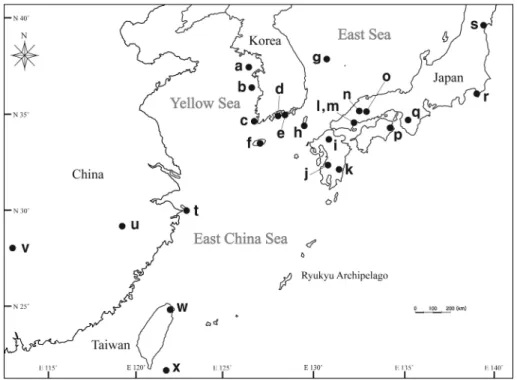
We sampled 98 individuals from 24 populations; seven from Korea, 12 from Japan, three from China, and two from Taiwan.
This dataset included the following nine species of East Asian evergreen broad leaved plants: Quercus acuta Thunb., Quercus salicina Blume, Quercus gilva Blume, Quercus myrsinifolia Blume (Fagaceae); Neolitsea sericea (Blume) Koidz., Neolitsea aciculata (Blume) Koidz., Machilus thunbergii Siebold & Zucc. (Lauraceae); Hedera rhombea (Miq.) Bean (Araliaceae); Trachelospermum asiaticum (Siebold & Zucc.) Nakai (Apocynaceae) (Appendix 1). Voucher specimens for this study were deposited in herbarium at Inha University (IUI).
*Author for correspondence: [email protected]
Korean J. Pl. Taxon, Vol. 41, No. 3 Preliminary search of intraspecific chloroplast DNA variation of nine evergreen broad leaved plants in East Asia 195
DNA extraction and PCR amplification
Genomic DNA was extracted from fresh or silica-gel dried leaves using a G-spin
TMIIp Kit for plant (Intron). Eight cpDNA non-coding regions were amplified by polymerase chain reaction (PCR). Universal primers were used to amplify the trnL-F, which included the trnL intron and trnL-trnF intergenic spacer (Taberlet et al., 1991), rps16 intron (Nishizawa and Watano 2000, Shaw et al., 2005), rpl16 intron (Nishizawa and Watano 2000), psbA-trnH intergenic spacer (Sang et al., 1997), psbC-trnS intergenic spacer (Nishizawa and Watano 2000), rpoB-trnC intergenic spacer (Shaw et al., 2005), atpB-rpcL intergenic spacer (Chiang et al., 1998) and petD-rpoA intergenic spacer (Nishizawa and Watano, 2000).
Polymerase chain reactions (PCR) were conducted using a GeneAmp
®PCR System 2700 Thermal Cycler (Applied Biosystems). Each reaction mixture contained 200 µM dNTPs (GeneCraft), 1x PCR buffer with 1.5 mM MgCl
2, 1 U of Taq DNA polymerase (TaKaRa), 10 ng of DNA, and an appropriate concentration of primers in a total volume of 50 µL. The PCR conditions included an initial denaturation at 94
oC for 2 min;
followed by 35 cycles at 94
oC for 30s, 52
oC for 45s, and 72
oC for 1 min; with a final extension at 72
oC for 10 min. PCR products were visualized on 2% agarose gels, purified using PCRquick-spin
TM(Intron) and sequenced with an ABI 3100 Genetic Analyzer using the ABI BigDye
TMTerminator Cycle Sequencing Ready Reaction Kit (Applied Biosystems). All
sequences were aligned manually using the program Clustal X ver. 1.83 (Thompson et al., 1997).
Results and Discussion
The following intraspacific cpDNA variations were detected in four non-coding regions: psbC-trnS, rps16, trnL-F, petD- rpoA regions. The psbC-trnS region was the most variable (11 polymorphisms detected in five taxa), followed by the rps16 region containing eight polymorphisms in five taxa, trnL-F region containing six polymorphisms in four taxa, and then petD-rpoA region containing one polymorphism in one taxon.
These regions contained indels, which included length polymorphisms (1 to 5 bp), nucleotide substitutions and inversions. The proportion of mutational events (including indel characters) of each region varied depending on the taxa (Table 1). Details of the intraspecific variation of eight non- coding regions examined are represented in Table 1.
In the psbC-trnS region, the sequence length varied from 239 bp (H. rhombea) to 293 bp (Quercus sp.), and the proportion of mutational events varied from 0% (N. aciculata, M. thunbergii, H. rhombea, T. asiaticum) to 1.02% (Q. acuta, Q. salicina). In the rps16 region, complete sequence data on N. sericea, N. aciculata and M. thunbergii of Lauraceae could not be obtained when Shaw et al. (2005)'s primer pair were used, because the sequence includes a long poly T or A. On
Fig. 1. Locations of 24 populations of warm temperate evergreen broad leaved plants sampled. The symbols of each population are corresponding to those of Table 2.
Korean J. Pl. Taxon, Vol. 41, No. 3 196Jung-Hyun Lee, Byoung-Yoon Lee and Byoung-Hee Choi Table 1. Intraspecific variation of chloroplast DNA for nine East Asian evergreen broad leaved plants.
Species
cpDNA regions
A total number of polymorphic sites
trnL-F rps16/1 rps16/2 rps16 rpl16 psbA-trnH psbC-trnS rpoB-trnC atpB-rbcL petD-rpoA
Quercus acuta O
(961bp) 2NS, 1SSRs
(0.33%, 916bp) O
(329bp) ! 1NI, 2NS
(1.02%, 293bp) ! — — 6
Quercus salicina O
(961bp) O
(910bp)
O
(329bp) ! 1NI, 2NS
(1.02%, 293bp) ! — — 3
Quercus gilva 1SSRs
(0.1%, 961bp) 1NS
(0.11%, 910bp) O
(329bp) ! 2NS
(0.68%, 293bp) ! — — 4
Quercus myrsinifolia 1Indel, 1SSRs
(0.21%, 961bp) 1NS
(0.11%, 910bp) O
(329bp) ! 1NI, 1NS
(0.68%, 293bp) ! — — 5
Neolitsea sericea 2Indel
(0.22%, 925bp) ! 1SSRs, 1NS
(0.75%, 265bp) ! O
(236bp) ! 1NS
(0.41%, 241bp) ! O
(861bp)
1NS
(0.32%, 314) 6
Neolitsea aciculata O
(920bp) ! O (263bp) ! O
(236bp) ! O
(241bp)
O (1143bp)
O (861bp)
O
(314bp) 0
Machilus thunbergii 1NS
(0.11%, 920bp) ! ! ! O
(232bp) ! O
(241bp)
O (1141bp)
O (854bp)
O
(314bp) 1
Hedera rhombea O
(968bp) O
(899bp)
O
(208bp) ! O
(239bp)
O (1316bp)
O (886bp)
O
(292bp) 0
Trachelospermum asiaticum O
(937bp) 1NS
(0.12%, 839bp) ! O
(363bp)
O (284bp)
O (1308bp)
O
(844bp) ! 1
A total number of
polymorphic sites 6 8 0 0 11 0 0 1
The number of variable site was compared with nine species; NI, Nucleotide inversion; NS, Nucleotide substitution; !, Insufficient data; O, No variation; —, No or poor amplification; SSRs, Simple sequence repeats; ID, Insertion/Deletion.
The proportion of observed mutational events and length of aligned sequence were represented in blankets.
Korean J. Pl. Taxon, Vol. 41, No. 3 Preliminary search of intraspecific chloroplast DNA variation of nine evergreen broad leaved plants in East Asia197 Table 2. Distribution and frequencies of cpDNA haplotypes for nine East Asian evergreen broad leaved species.
Populations Korea Japan China Taiwan
Number of haplotypes
Number of populations
Number of samples
Species a b c d e f g h i j k l m n o p q r s t u v w x
Quercus acuta 1(A) 4(B) 1(C) 2(B) 3(B) 3(B) 1(A) 1(B) 3 8 16
Quercus salicina 1(A) 1(C) 4(C) 2(C) 2(C) 2(C) 2(C) 1(C) 1(C) 2 9 16
Quercus gilva 2(D) 1(E) 3(E) 1(A) 3 4 7
Quercus myrsinifolia 2(F) 1(G) 1(C) 1(F) 1(G) 3 5 6
Neolitsea sericea 1(A) 1(E) 2(A, D) 2(B) 1(A) 2(C, F) 2(I) 1(G) 1(A) 8 9 13
Neolitsea aciculata 1(A) 2(A) 2(A) 1 3 5
Machilus thumbergii 1(A) 1(A) 1(A) 1(A) 1(A) 1(A) 1(A) 1(B) 1(B) 1(A) 2 10 10
Hedera rhombea 1(A) 1(A) 2(A) .1(A) 1(A) 1(A) 1 6 7
Trachelospermum asiaticum 1(A) 1(A) 2(A) 4(A) 2(A) 2(A) 2(A) 3(B) 1(A) 2 9 18
a. Incheon, Deokjeok Archipelago; b. Chungcheongnam-do, Isl. Oeyeon; c. Jeollanam-do, Mt. Cheomchal; d. Jeollanam-do, Isl. Geumo; e. Gyeongsangnam-do, Mijo-ri; f. Jeju-do; g. Gyeongsangbuk-do, Isl.
Ulleung; h. Nagasaki Pref., Isl. Tsushima; i. Fukuoka Pref., Mt. Koshoyama; j. Kumamoto Pref., Mt. Siroiwayama; k. Miyazaki Pref., Aya-cho; l. Hiroshima Pref., Isl. Itsukushima; m. Hiroshima Pref., around Temp. Gokurakuji; n. Hiroshima Pref., Miyoshi-shi; o, Hiroshima Pref., Shobara-shi; p. Tokushima Pref., Mt. Bizan; q. Wakayama Pref., Mt. Koya; r. Chiba Pref., Mt. Nokogiri; s. Miyagi Pref., Mt.
Aobayama; t. Zhejiang Prov., Isl. Putuo. u. Anhui Prov., Qian kou min zhai; v. Hunan Prov., Nanyue Dist. Mt. Hengshan; w. Shiding-shiang, Tianwang peak; x. Taitung, Isl. Lanyu.
The symbols in blanket are haplotypes.
Korean J. Pl. Taxon, Vol. 41, No. 3
198 Jung-Hyun Lee, Byoung-Yoon Lee and Byoung-Hee Choi
the other hand, Aoki et al. (2003) found that Japanese evergreen broad leaved plants showed the largest amount of intraspecific variation in the rps16 region. Thus, we used Nishizawa and Watano (2000)'s primer pair in order to obtain partial sequence data from the rps16 region in Lauraceous species. The sequence length of the rps16 region varied from 839bp (T.
asiaticum) to 916bp (Q. acuta), and the proportion of mutational events varied from 0% (Q. salicina, N. aciculata, H. rhombea) to 0.75% (N. sericea). In the trnL-F region, the sequence length varied from 920bp (N. aciculata, M.
thunbergii) to 968bp (H. rhombea), and the proportion of mutational events varied from 0% (Q. acuta, Q. salicina, Q.
gilva, N. aciculata, H. rhombea, T. asiaticum) to 0.22% (N.
sericea). The petD-rpoA region had only one informative character in N. sericea.
Among the four variable regions, the psbC-trnS intergenic spacer, rps16 intron and trnL-F (trnL intron and trnL-trnF intergenic spacer) regions, showed polymorphisms in many species (4 to 5). These three regions have been frequently used to infer the evolutionary history or the past migration of plants in species level (Aoki et al., 2004, 2006; Wu et al., 2006;
Ramos et al., 2007; Schonswetter et al., 2007; Li et al., 2008;
Qiu et al., 2009b). The remaining four regions (psbA-trnH, atpB-rbcL, rpoB-trnC and rpl16) did not contain intraspecific cpDNA variations in the all species examined. In addition, the rpl16 intron region has often been used to detect genetic variations among populations (Aoki et al., 2004, 2006, Shaw and Small, 2005). In this study, no intraspecific variation was detected in the rpl16 region. However, complete sequences were obtained for all species except T. asiaticum.
Therefore, we suggest that the above three cpDNA markers (psbC-trnS, rps16 and trnL-F) are suitable to assess the genetic diversity of East Asian evergreen broad leaved plants investigated in this study.
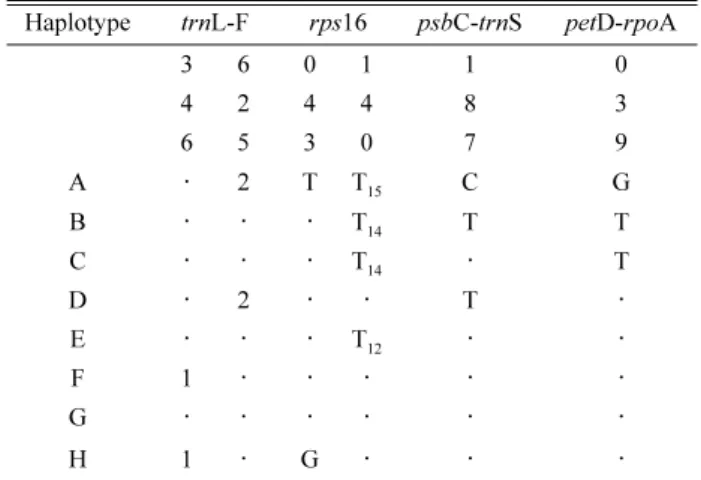
Based on the polymorphisms found in the present study, the cpDNA haplotypes for each species were determined (Table 3, 4, 5 and 6). The distribution and frequencies of haplotypes among the 24 sampled populations are shown in Table 2. N.
sericea had the most abundant haplotypes with six polymorphisms among the nine species examined. The regional specific haplotypes of N. sericea were found in Korea and Japan, respectively but individuals of East China did not contain any unique haplotypes. In the taxa of Quercus, the examined species had two to three haplotypes with three to six polymorphisms. Regional specific haplotypes of Q. acuta and Q. salicina were found in Korea, and those of Q.
myrsinifolia were found in Japan. However, all of haplotypes found in Q. gilva were regional specific and the haplotypes
Table 3. Polymorphic sites and haplotypes of N. sericea.
Haplotype trnL-F rps16 psbC-trnS petD-rpoA
3 6 0 1 1 0
4 2 4 4 8 3
6 5 3 0 7 9
A · 2 T T15 C G
B · · · T14 T T
C · · · T14 · T
D · 2 · · T ·
E · · · T12 · ·
F 1 · · · · ·
G · · · ·
H 1 · G · · ·
Notes :
1. Deletion = AAGGAAGAATCGAATATTCAGTGATCAAATCA- TTCACTCCTCGGATAGATCT;
2. Duplication = TCTTT
Table 4. Polymorphic sites and haplotypes of Quercus species.
Haplotype trnL-F rps16 psbC-trnS
6 6 0 2 5 6 7 1 2 2
4 6 7 9 5 9 1 8 5 5
6 2 7 1 6 3 4 3 2 4
A · T11 A C C A · · T T
B · · · T · T 2 · A ·
C · · · 3 A A
D · T10 · · · A ·
E · T10 C · · · A ·
F · · · A ·
G 1 T12 · · T · · · A ·
Notes:
1. Deletion = TTACAAAT; 2. Duplication = TAA2; 3. Inversion = GGGGGA
Table 5. Polymorphic sites and haplotypes of M. thumbergii.
Haplotype trnL-F
4 7 7
A · · · G · · · ·
B · · · T · · · ·
Table 6. Polymorphic sites and haplotypes of T. asiaticum.
Haplotype rps16
6 3 9
A · · · G · · · ·
B · · · T · · · ·
Korean J. Pl. Taxon, Vol. 41, No. 3 Preliminary search of intraspecific chloroplast DNA variation of nine evergreen broad leaved plants in East Asia 199
were not shared among the regions. M. thunbergii and T.
asiaticum contained two haplotypes with one polymorphism in the trnL-F and rps16 regions, respectively. The rare haplotype of M. thunbergii was found in China and Taiwan.
The regional specific haplotype of T. asiaticum was found in Japan (Table 2). On the other hand, several haplotypes of Quercus species were found to be shared between these species.
This may be due to introgression, which has been reported for several evergreen Quercus species of Japan (Aoki et al., 2003).
Although the results presented in this study are preliminary, it appears that the geographic distribution patterns of haplotypes of Quercus species are specific in species level.
Acknowledgements
We are grateful to Jong-Soo Park for providing material of T. asiaticum and for other assistance. This work was supported by National Research Foundation of Korea Grant funded by the Korean Government (KRF-313-2008-2-C00821).
Literature Cited
Aoki, K., T. Suzuki and N. Murakami. 2003. Intraspecific sequence variation of chloroplast DNA among the component species of evergreen broad-leaved forests in Japan. J. Pl. Res.
116: 337-344.
Aoki, K., T. Suzuki, T. W. Hsu and N. Murakami. 2004. Phylo- geography of the component species of broad-leaved ever- green forests in Japan, based on chloroplast DNA variation. J.
Pl. Res. 117: 77-94.
Aoki, K., T. Matsumura, T. Hattori and N. Murakami. 2006. Chlo- roplast DNA phylogeography of Photinia glabra (Rosaceae) in Japan. Am. J. Bot. 93: 1852-1858.
Avise, J. C. 2000. Phylogeography: the History and Formation of Species. Harvard University Press, Cambridge.
Bai, W. N., W. J. Liao and D. Y. Zhang. 2010. Nuclear and chlo- roplast DNA phylogeography reveal two refuge areas with asymmetrical gene flow in a temperate walnut tree from East Asia. New Phytol. 188: 892-901.
Cheng, Y. P., S. Y. Hwang and T. P. Lin. 2005. Potential refugia in Taiwan revealed by the phylogeographical study of Castanop- sis carlesii Hayata (Fagaceae). Mol. Ecol. 14: 2075-2085.
Chiang, T. Y., B. A. Schaal and C. I. Peng. 1998. Universal prim- ers for amplification and sequencing a noncoding spacer between atpB and rbcL genes of chloroplast DNA. Bot. Bull.
Acad. Sin. 39: 245-250.
Chung, M. G., M. Y. Chung, G. S. Oh and B. Epperson. 2000. Spa- tial genetic structure in a Neolitsea sericea population (Lau-
raceae). Heredity 85: 490-497.
Heuertz, M., S. Fineschi, M. Anzidei, R. Pastorelli, D. Salvini, L.
Paule, N. Frascaria-Lacoste, O. Hardy, X. Vekemans and G.
Vendramin. 2004. Chloroplast DNA variation and postglacial recolonization of common ash (Fraxinus excelsior L.) in Europe. Mol. Ecol. 13: 3437-3452.
Hewitt, G. M. 2000. The genetic legacy of the Quaternary ice ages.
Nature 405: 907-913.
Hewitt, G. M. 2003. Ice ages: their impact on species distributions and evolution. In Evolution on planet Earth. Rothschild, L. J.
and A. M. Lister (eds.), Academic Press, New York, Pp. 339- 361.
Li, E. X., S. Yi, Y. X. Qiu, J. T. Guo, H. P. Comes and C. X. Fu.
2008. Phylogeography of two East Asian species in Croomia (Stemonaceae) inferred from chloroplast DNA and ISSR fin- gerprinting variation. Molec. Phylogen. Evol. 49: 702-714.
Nishizawa, T. and Y. Watano. 2000. Primer pairs suitable for PCR- SSCP analysis of chloroplast DNA in angiosperms. J. Phyto- geogr. Taxon 48: 63-66.
Petit, R. J., S. Brewer, S. Bordács, K. Burg, R. Cheddadi, E. Coart, J. Cottrell, U. M. Csaikl, B. van Dam, J. D. Deans, S. Espinel, S. Fineschi, R. Finkeldey, I. Glaz, P. G. Goicoechea, J. S.
Jensen, A. O. König, A. J. Lowe, S. F. Madsen, G. Mátyás, R.
C. Munro, F. Popescu, D. Slade, H. Tabbener, S. G. M. de Vries, B. Ziegenhagen, J. L. de Beaulieu and A. Kremer. 2002.
Identification of refugia and post-glacial colonization routes of European white oaks based on chloroplast DNA and fossil pollen evidence. For. Ecol. Manage. 156: 49-74.
Qiu, Y. X., X. S. Qi, X. F. Jin, X. Y. Tao, C. X. Fu, A. Naiki and H.
P. Comes. 2009a. Population genetic structure, phylogeogra- phy and demographic history of Platycrater arguta (Hydrangeaceae) endemic to East China and South Japan, inferred from chloroplast DNA sequence variation. Taxon 58:
1226-1241.
Qiu, Y. X., Y. Sun, X. P. Zhang, J. Lee, C. X. Fu and H. P. Comes.
2009b. Molecular phylogeography of East Asian Kirenge- shoma (Hydrangeaceae) in relation to Quaternary climate change and landbridge configurations. New Phytol. 183: 480- 495.
Ramos, A. C. S., J. P. Lemos-Filho, R. A. Ribeiro, F. R. Santos and M. B. Lovato. 2007. Phylogeography of the tree Hymenaea stigonocarpa (Fabaceae: Caesalpinioideae) and the influence of Quaternary climate changes in the Brazilian Cerrado. Ann.
Bot. 100: 1219-1228.
Rendell, S. and R. Ennos. 2003. Chloroplast DNA diversity of the dioecious European tree Ilex aquifolium L. (English holly).
Mol. Ecol. 12: 2681-2688.
Sang, T., D. J. Crawford and T. F. Stuessy. 1997. Chloroplast DNA
Korean J. Pl. Taxon, Vol. 41, No. 3
200 Jung-Hyun Lee, Byoung-Yoon Lee and Byoung-Hee Choi
phylogeny, reticulate evolution and biogeography of Paeonia (Paeoniaceae). Am. J. Bot. 84: 1120-1136.
Schonswetter, P., J. Suda, M. Popp, H. Weiss-Schneeweiss and C.
Brochmann. 2007. Circumpolar phylogeography of Juncus biglumis (Juncaceae) inferred from AFLP fingerprints, cpDNA sequences, nuclear DNA content and chromosome numbers. Molec. Phylogen. Evol. 42: 92-103.
Shaw, J. and R. L. Small. 2005. Chloroplast DNA phylogeny and phylogeography of the North Amican plums (Prunus subgenus Prunus, section Prunocerasus, Rosaceae). Am. J. Bot. 92:
2011-2030.
Shaw, J., E. Lickey, J. T. Beck, S. B. Farmer, W. Liu, J. Miller, K.
C. Siripun, C. T. Winder, E. E. Schilling and R. L. Small.
2005. The tortoise and the hare II: relative utility of 21 non- coding chloroplast DNA sequences for phylogenetic analysis.
Am. J. Bot. 92: 142-166.
Soltis, D. E., M. A. Gistzendanner, D. D. Strenge and P. S. Soltis.
1997. Chloroplast DNA intraspecific phylogeography of plants from the Pacific Northwest of North Amica. Pl. Syst.
Evol. 206: 353-373.
Soltis, D. E. and P. S. Soltis. 1998. Choosing an approach and an appropriate gene for phylogenetic analysis. In Molecular Sys- tematics of Plant II DNA Sequencing. Soltis, D. E., P. S. Sol- tis and J. J. Doyle (eds.), Kluwer, Massachusetts, Pp. 1-42.
Sugahara, K., Y. Kaneko, S. Ito, K. Yamanaka, H. Sakio, K.
Hoshizaki, W. Suzuki, N. Yamanaka and H. Setoguchi. 2011.
Phylogeography of Japanese horse chestnut (Aesculus turbi- nata) in the Japanese Archipelago based on chloroplast DNA haplotypes. J. Pl. Res. 124: 75-83.
Taberlet, P., L. Gielly, G. Patou and J. Bouvet. 1991. Universal primers for amplification of three noncoding regions of chlo- roplast DNA. Pl. Mol. Biol. 17: 1105-1109.
Thompson, J. D., T. J. Gibson, F. Plewniak, F. Jeanmougin and D.
G. Higguns. 1997. The CLUSTAL X windows interface: flex- ible strategies for multiple sequence alignment aided by qual- ity analysis tools. Nucleic Acids Res. 24: 4876-4882.
Wang, Z. S., S. Q. An, H. Liu, X. Leng, J. W. Zheng and Y. H. Liu.
2005. Genetic structure of the endangered plant Neolitsea seri- cea (Lauraceae) from the Zhoushan Archipelago using RAPD markers. Ann. Bot. 95: 305-313.
Wu, S. H., C. Y. Hwang, T. P. Lin, J. D. Chung, Y. P. Cheng and S.
Y. Hwang. 2006. Contrasting phylogeographical patterns of two closely related species, Machilus thunbergii and Machilus kusanoi (Lauraceae), in Taiwan. J. Biogeogr. 33: 936-947.
Appendix 1. Voucher specimens for nine East Asian evergreen broad leaved species used in this study.
Quercus acuta Thunb., Korea: Isl. Nap, Deokjeok-myeon, Ongjin-gun, Incheon, 12 Aug. 2007, B. H. Choi & J. H. Lee 68075 (IUI); Mt. Sioreum, Seogwipo-si, Jeju-do, 13 Aug. 2009, B. H. Choi et al. 98102, 98138, 98154, 98158 (IUI); Seo- myeon, Ulleung-gun, Gyeongsangbuk-do, 16 Oct. 2010, J. H.
Lee & J. S. Park 1010037 (IUI); Japan: Mt. Koshoyama, Asakura-shi, Fukuoka Pref., 21 Jun. 2010, J. H. Lee & J. S.
Park K1-1, K1-5 (IUI); Aya-cho, Higashimorokata-gun, Miyazaki Pref., 23 Jun. 2010, J. H. Lee & J. S. Park K4-1, K4-3, K4-5 (IUI); Around Temp. Gokurakuji, Hiroshima Pref., 31 Mar. 2010, J. H. Lee 103525, 103527, 103533 (IUI); Mt.
Nokogiri, Futtsu-shi, Chiba Pref., 14 Jul. 2010, D. H. Lee 10714 (IUI); Mt. Aobayama, Sendai-shi, Miyagi Pref., 27 Sep.
2010, B. H. Choi 10901 (IUI).
Quercus salicina Blume, Korea: Mt. Cheomchal, Jindo- gun, Jeollanam-do, 9 Jun. 2010, J. H. Lee & J. S. Park 16068 (IUI); Isl. Geumo, Nam-myeon, Yeosu-si, Jeollanam-do, 28 Oct. 2009, J. H. Lee 910337 (IUI); Around 3 Sallokgyo, Seogwipo-si, Jeju-do, 12 Dec. 2009, J. H. Lee 912557, 912551 (IUI); Around 5 Sallokgyo, Seogwipo-si, Jeju-do, 12 Dec.
2009, J. H. Lee 912544, 912533 (IUI); Seo-myeon, Ulleung- gun, Gyeongsangbuk-do, 16 Oct. 2010, J. H. Lee & J. S. Park 1010027, 1010028 (IUI); Japan: Mt. Koshoyama, Asakura- shi, Fukuoka Pref., 21 Jun. 2010, J. H. Lee & J. S. Park K1- 37, K1-39 (IUI); Aya-cho, Higashimorokata-gun, Miyazaki Pref., 23 Jun. 2010, J. H. Lee & J. S. Park K4-19, K4-21 (IUI);
Around Temp. Gokurakuji, Hiroshima Pref., 31 Mar. 2010, J.
H. Lee 103516, 103513 (IUI); Mt. Aobayama, Sendai-shi, Miyagi Pref., 27 Sep. 2010, B. H. Choi 10908 (IUI); Taiwan:
Huangdi temple, Shiding-shiang, New Taipei, 8 Oct. 2010, B.
H. Choi & J. H. Lee 10872 (IUI).
Quercus gilva Blume, Korea: Around Osulloc Tea Museum, Seogwipo-si, Jeju-do, 10 Dec. 2009, J. H. Lee & J.
S. Park 912044, 912047 (IUI); Japan: Mt. Siroiwayama, Nishiusuki-gun, Kumamoto Pref., 22 Jun. 2010, J. H. Lee &
J. S. Park K2-31 (IUI); Aya-cho, Higashimorokata-gun, Miyazaki Pref., 23 Jun. 2010, J. H. Lee & J. S. Park K4-53, K4-54, K4-55 (IUI); China: Mt. Hengshan, Nanyue Dist., Hengyang-shi, Hunan Prov., 7 Jun. 2002, Z. H. Hu 275 (PE).
Quercus myrsinifolia Blume, Korea: Mt. Cheomchal, Gogun-myeon, Jindo-gun, Jeollanam-do, 9 Jun. 2010, J. H.
Lee & J. S. Park 16057, 16054 (IUI); Japan: Mt. Siroiwayama, Nishiusuki-gun, Kumamoto Pref., 23 Jun. 2010, J. H. Lee &
J. S. Park K3-23 (IUI); Aya-cho, Higashimorokata-gun,
Miyazaki Pref., 23 Jun. 2010, J. H. Lee & J. S. Park K4-65
Korean J. Pl. Taxon, Vol. 41, No. 3 Preliminary search of intraspecific chloroplast DNA variation of nine evergreen broad leaved plants in East Asia 201