Abstract
BACKGROUND: Most lakes have increased concerns about water pollution due to the inflow of non-point sources caused by human activities. Therefore, the lake water quality survey was conducted in order to propose effective plans for water quality management by analyzing the characteristics of lakes and the change of water quality.
METHODS AND RESULTS: In order to investigate the physicochemical water quality in Daedong lake, water quality analysis was undertaken from July 2018 to June 2019. Water temperature was ranged from 7.8 to 34.3 ℃ and pH varied from 6.9 to 10.2. The concentration of Dissolved oxygen, Suspended solid, Biochemical Oxygen Demand (BOD), and Chemical Oxygen Demand (COD) were 5.6 ~ 17.2 mg/L, 2.4 ~ 35.3 mg/L, and 4.5 ~ 15.1 mg/L, and 0.9 ~ 2.8 mg/L, respectively. The Total Nitrogen (T-N) concen- tration ranged from 0.974 ~ 2.126 mg/L, and Total Phos- phorus (T-P) concentration ranged from 0.014 ~ 0.057 mg/L. The Chlorophyll-a (Chl-a) ranged from 2.7 ~ 37.9 mg/m
3. Through Carlson TSIm assessment using T-P and Chl-a results, evaluating trophic state, Daedong lake was
evaluated as mesotrophic.
CONCLUSION: Water pollution management plan needs such as nutrient removal technology and nonpoint source management for prevention of eutrophication in Daedong lake.
Key words: Daedong lake, Eutrophication, Trend analysis, Trophic level, Water pollution characteristics
서 론
국토의 약 70%가 산지로 이루어진 우리나라는 강수량의 계절적 변화가 크고, 여름철에 집중되어 있어 일시에 바다로 유출되기 때문에 수자원으로의 이용은 제한적이다. 따라서 생 활용수, 공업용수 및 농업용수 등 수자원 확보와 용수의 이용 을 높이기 위해 하천에 대형 댐을 건설하여 정체된 수계인 대 형 인공호수를 조성하고 있다[1, 2]. 국내 대부분의 인공 호수 는 농업이나 수자원 공급에 사용되고 있으나, 최근 인간 활동 으로 야기되는 다양한 비점오염원의 유입으로 인하여 호소 내 수질오염 가능성은 점점 증가되고 있는 실정이다[3, 4]. 특 히, 호수는 폐쇄성 또는 준 폐쇄성 수역이라는 구조적 특성 때문에 소량의 오염물질에 의해서도 불균형이 초래되고, 오염 이 시작되면 오염원이 차단된다 할지라도 계속하여 오염도가 증가한다[5]. 또한 자체 정화 능력이 약하기 때문에 조류의
*Corresponding author: Ju-Sik Cho
Phone: +82-61-750-3297; Fax: +82-61-750-8011;
E-mail: [email protected]
Korean J Environ Agric. 2020;39(3):197-203. Korean Online ISSN: 2233-4173
Published online 2020 August 14. https://doi.org/10.5338/KJEA.2020.39.3.23 Print ISSN: 1225-3537
대동호의 시기별 및 계절별 수질변화 평가
윤진주
1, 강세원
1, 박종환
2, 서동철
2, 김현우
3, 조주식
1*1
순천대학교 생명산업과학대학 생물환경학과,
2경상대학교 응용생명과학부(BK 21플러스) & 농업생명과학원,
3
순천대학교 환경교육과
Assessment of Seasonal Variation in Water Quality in Daedong Lake
Jin-Ju Yun1, Se-Won Kang1, Jong-Hwan Park2, Dong-Cheol Seo2, Hyun-Woo Kim3 and Ju-Sik Cho1* (1Department of Bioenvironmental Science, College of Life Science and Natural Resources, Sunchon National University, Suncheon 57922, Korea, 2Division of Applied Life Science (BK21 Plus) & Institute of Agriculture and Life Science, Gyeongsang National University, Jinju 52828, Korea, 3Department of Environmental Education, Sunchon National University, Suncheon 57922, Korea)
Received: 25 June 2020/ Revised: 23 July 2020/ Accepted: 31 July 2020 Copyright ⓒ 2020 The Korean Society of Environmental Agriculture
This is an Open-Access article distributed under the terms of the Creative Commons Attribution Non-Commercial License (http://creativecommons.org/licenses/by-nc/3.0) which permits unrestricted non-commercial use, distribution, and reproduction in any medium, provided the original work is properly cited.
ORCID Ju-Sik Cho
https://orcid.org/0000-0001-6748-7886
197
Research Article Open Access
Yun et al.
198
증식과 세균 오염 등으로 인해 수질악화 현상이 나타나고, 영 양염류가 축적되어 부영양화 상태가 된다[6].
부영양화란 호소나 저수지에서 식물플랑크톤 같은 수중생 물의 번식에 사용되는 영양물질이 과도하게 유입됨에 따라 일 어나는 대표적인 수질오염의 현상들이며, 이 현상은 수생태계 및 수질 변화에 악영향을 미치게 된다[7, 8]. 특히, 부영양화는 호소 내 일차 생산 증가에 의해 호소의 유기물 함량을 증가시 키고, 수중 산소 고갈과 그에 따른 생태계 파괴 및 악취발생, 염소 소독 시 염소화합물의 독성농도 증가, 남조류 발생에 의 한 수돗물의 냄새 발생 등의 피해를 유발한다[9, 10].
지리적, 지형적 특성에 의해 전통적으로 생계형 농업 또는 집약적 농업이 주로 이루어진 호남지역은 20세기 후반부터의 급속한 도시화와 산업의 발달로 인해 오염물질 발생량과 비 료사용량이 증가됨에 따라 부영양화 현상이 나타나고, 하천과 호소의 수질오염이 심화되어 생태계의 기능이 많이 훼손되었 다[11, 12]. 특히, 영산강과 섬진강 수계의 주요 호소인 대동 호는 전남 지역의 중요한 수자원으로 이용되는 것에 비해 영 양상태 및 수질조사 등의 조사가 부족하고, 호소 전반에 대한 체계적인 관리가 미흡하여 호소별 특성에 맞는 적절한 수질 관리에 어려움이 많다.
이에 따라, 본 연구에서는 대동호의 시기별 및 계절별 호소 의 수질 특성을 조사하고, 부영양화정도를 평가하여 호소수질 보존대책 수립 및 관리를 위한 기초자료로 활용하고자 한다.
재료 및 방법
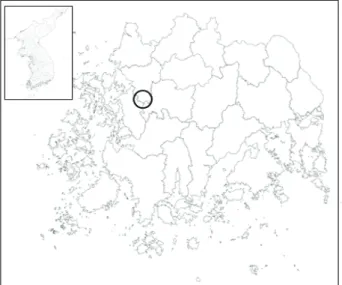
조사대상 호소대동호는 전라남도 함평군 대동면에 위치한 인공 호소로 유역 면적은 24.5 km2이며, 저수 용량 920만 m3으로 1981년 조성되었다. 대동천으로 유출되는 주요하천으로 한국농어촌 공사에서 수면 관리를 하고 있다. 조사대상 호소의 위치는 Fig. 1과 같다.
Fig. 1. Geographical description of Daedong lake.
조사시기 및 방법
대동호의 수질 특성을 조사하기 위해 2018년 7월부터 2019 년 6월까지 호소 환경 조사 지침에 근거하여 매 월 1회 현장 조사 및 수질시료채취를 실시하였다. 수질시료는 오전 9시-10시 사이 호소 앞 지점에 대하여 표층(수면 1 m 아래)에서 채취하 였으며, 조사 및 분석항목으로는 수질오염도와 영양상태를 평 가할 수 있는 수소이온농도(pH), 수온(Water temperature), 용존 산소(Dissolved Oxygen, DO), 부유물질(Suspended Solid, SS), 화학적산소요구량(Chemical Oxygen Demand, COD), 생물학적산소요구량(Biochemical Oxygen Demand, BOD), 총질소(Total Nitrogen, T-N), 총인(Total Phosphorus, T-P), 클로로필-a (Chlorophyll-a, Chl-a) 등 을 조사하였으며, 모든 항목은 수질오염공정시험기준에 준하 여 분석하였다. 분석한 수질 자료는 봄(3월~5월), 여름(6월~8 월), 가을(9월~11월), 겨울(12월~2월)로 분리하여 계절적 영 향을 검토하였다.
영양단계 평가
영양단계를 평가하기 위하여 수정 Carlson 지수(TSIm) [13]
의 평가 기준에 따라 T-P, Chl-a를 이용하여 TSIm 지수를 산정하였고, 산정된 지수들의 평균값으로 지수가 40미만이면 빈영양호, 40~50이면 중영양호, 50을 초과하면 부영양호로 평가하였다.
결과 및 고찰
수질의 이화학적 분석1) 수소이온농도(pH)
조사기간 동안 대동호의 pH는 6.9~10.2 범위로 평균 8.1 로 나타났다(Fig. 2A). 2월에 가장 낮은 값을 나타내고 있으 며, 수온이 상승하고 조류가 성장하는 6월에 급격히 높아져 8 월에 정점을 나타낸 후 점차 낮아졌다. [14]의 연구결과에서, 서낙동강의 계절별 pH 변화는 하절기에 급격히 증가한다고 보고하였으며, 이는 본 연구 결과와 유사하였다. 특히, 여름철 수중 pH의 급격한 증가는 기온 및 수온의 상승으로 과도하 게 증식된 식물플랑크톤의 광합성 작용으로 인하여 용존 HCO3-의 소비량이 급격히 증가하기 때문이다[15]. 대부분의 수계의 pH는 생명 활동에 적합한 6~8정도의 범위를 나타내 지만 부영양화가 발생하면 9.5이상으로 상승하는 경우도 있 다고 알려져 있다[16]. 이에 안정적인 수계의 pH를 위해서는 식물플랑크톤의 성장을 유도하는 영양염류의 관리가 필요할 것으로 판단된다.
2) 수온(Water temperature)
조사기간 동안 대동호의 수온은 7.8~34.3℃ 범위로 8월에 34.3℃로 가장 높았으며, 가을철 이후 점점 감소하였는데, 이 는 국내의 일반적인 호소와 유사한 경향이었다[17, 18]. 특히 호소 내 수온은 용존 산소의 농도, 유기물질의 분해와 수중생
Fig. 2. pH (A) and Water temperature (B) characteristics of Daedong lake (WT: Water temperature).
물의 활동을 지배하는 주요환경인자들 중의 하나로서 모든 물리, 화학, 생물학적 작용이 수온의 영향을 크게 받고 수온 변화에 따른 물의 밀도 차에 의해 호소에서는 성층 현상과 전 도 현상이 일어나게 된다[19]. 또한, 기온이 높은 하절기에 성 층화 현상이 빈번하게 발생되며, 이는 수중의 산소 이동이나 영양염류의 순환이 제한된다고 보고하였다.
3) 용존산소량(DO)
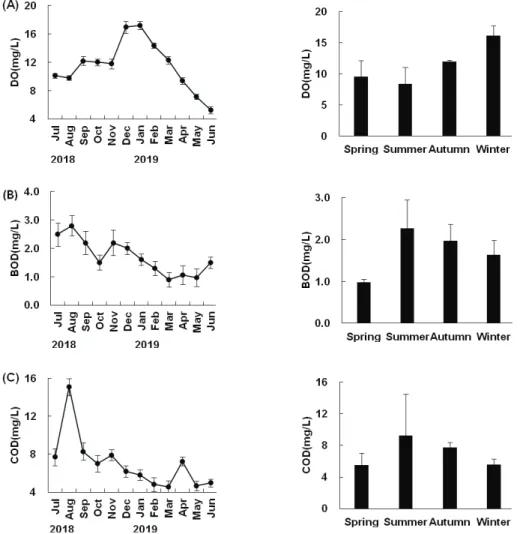
조사기간 동안 대동호의 DO는 5.26~17.20 mg/L범위로 평균 12.12 mg/L였다(Fig. 3A). 계절적 영향을 많이 받는 DO는 수온이 비교적 높은 여름과 초겨울에 다소 낮은 값을 나타내고 수온이 가장 낮은 기간(1~3월)에 높은 DO를 유지 하였다. 수온에 따른 산소 포화도는 역상관관계로 수온이 낮 은 겨울철에 높고, 수온이 증가하는 여름철에 낮아지는 특성 을 가진다. 본 조사에서 7월에 상대적으로 높은 DO농도를 보였는데, 이는 조류 성장에 따른 산소의 방출에 기인하여 증 가한 것으로 판단된다[20].
4) 생물학적산소요구량(BOD)
조사기간 동안 BOD는 0.9~2.8 mg/L 범위로 평균 1.7 mg/L로 나타났으며(Fig. 3C), 겨울에서 여름으로 갈수록 감소하는 경향을 나타내다가 여름철(8~10월)에 가장 높게 나타났는데, 이와 같이 여름철 대동호 내에 BOD가 높은 것 은 우리나라 기후 특성상 여름철의 강수량이 연간 강수량의 60%를 차지하는 계절적 편중현상이 나타나기 때문으로 판단 된다. 특히 집중 강우시 주변 비점오염원들이 호소로 유입되 게 되고, 퇴적이 많은 정체된 수역은 집중 강우에 의해 교란 요인이 유발되면 유기물의 재 부유나 유입에 의해 일시적인 BOD증가가 나타나기도 하는데[21], 대동호도 이러한 경우 로 판단된다.
5) 화학적산소요구량(COD)
조사기간 동안 COD의 범위는 4.5~15.1 mg/L로 나타났 으며(Fig. 3B), 여름 > 가을 > 겨울, 봄 순으로 봄에서 여름으 로 갈수록 증가하는 경향을 나타냈다. 집중 강우가 있는 여름 철을 중심으로 변화가 뚜렷하게 나타나는데, 이는 수온상승과 더불어 유기물을 함유하는 물질이 빗물에 쓸려서 하천으로 유입되기 때문으로 판단된다[22]. Jeong 등[14]은 여름철 호 소내 COD의 상승은 집중강우로 인한 지표상 퇴적오염물, 대 기 강하물 및 하수관 월류수 등과 밀접한 연관이 있다고 보고 하였으며, 이를 예방하기 위해서는 강우유출수가 집적 호소 내로 유입되는 경로를 차단하기 위한 방안이 필요하다고 보 고하였다. 유기물량의 간접적인 지표인 COD는 Chl-a, T-N 및 T-P와 유사한 경향을 나타내었다.
6) 부유 물질(SS)
시기별 대동호 내 부유물질량은 부유물질 범위는 2.4~35.3 mg/L로 8월에 가장 높았고 5월에 가장 낮았다. 또한 계절별 로 대동호 내의 부유물질량을 비교하였을 때, 여름철이 다른 계절에 비해 가장 높은 부유물질량을 보였다(Fig. 4A). 일반 적으로 부유 물질의 농도가 증가하는 경우는 수심이 얕을 경 우 바람의 영향으로 상하층 간의 물이 혼합되면서 나타나거나, 조류의 다량 범식으로 인하여 나타나는 경우가 있다[15]. 특 히, 대동호의 경우 여름철에 가장 높은 부유물질량을 보였는 데, 이는 여름철 집중 강우로 인하여 다량의 유기물이 함유된 유량이 증가할 뿐만 아니라 고온으로 인한 식물플랑크톤의 급 격한 성장으로 인하여 여름철에 부유물질량이 급격히 증가한 것으로 판단된다. 이와 같이 대동호 내에 부유물질 함량을 안 정적으로 관리하기 위해서는 여름철 집중 강우로부터 야기되는 토사 및 유기물이 호소 내로 유입되는 경로를 차단하거나 이들 을 저감 시킬 수 있는 관리방안이 필요할 것으로 판단된다.
Yun et al.
200
Fig. 3. DO (A), BOD (B) and COD (C) characteristics of Daedong lake.
7) 총질소(T-N)
조사기간 동안 T-N은 평균 1.58 mg/L로 우리나라 호소 생활환경기준 매우 나쁨(Ⅵ)에 해당되며, 6월 0.974 mg/L로 가장 낮고, 9월 2.126 mg/L로 가장 높게 나타났다(Fig. 4B).
[17]은 시기별 운문호의 T-N 농도변화를 관찰하였으며, 그 결과는 대동호의 시기별 T-N 농도변화와 유사하였다. 일반적 으로 호소내로 질소화합물의 유입은 경종농가에서 사용한 퇴 비, 농약 및 비료와 같은 비점오염원에 지배적인 영향을 받으 며, 그들의 유입경로는 강우 유출수에 호소로 유입되고 무강 우시에는 지하로 침투된 후 유출수와 함께 호소로 유입되는 것으로 보고되어졌다[23].
8) 총인(T-P)
조사기간동안 T-P는 0.014~0.057 mg/L의 범위로 평균 0.03 mg/L로 나타났으며(Fig. 4C), 여름≥가을>겨울>봄 순 으로 높았다. 특히 T-P는 식물플랑크톤의 증식을 결정하는 제한영양소로서, 여름 및 가을철 인 제한성이 강하게 나타났 다[24]. 호소와 같은 정체구역에 인의 유입은 주변 환경으로 부터 발생되는 비점오염원(농약, 비료 및 퇴비)에 의한 영향 이 대부분이다. 일반적으로 강우량이 낮은 봄과 겨울에는 대
부분의 인이 토양에 흡착되어 이동성이 제한적이기 때문에 호소 내 인의 농도는 낮게 유지되나 비교적 강우량이 높은 여 름과 가을철에는 강우에 의해 비점오염원들이 유입되고 봄과 겨울에 인이 흡착된 토양들이 호소로 유입됨에 따라 인의 농 도는 높아지게 된다.
9) 클로로필-a(Chl-a)
조사기간 동안 Chl-a는 2.7~37.9 mg/m3 범위로 평균 19.54 mg/m3로 나타났다(Fig. 5). Chl-a 농도는 봄철에 낮고 늦여 름과 가을철에 높아지는 경향을 보여주었는데, 빗물과 함께 유입된 다량의 영양염류의 영향으로 부영양화가 발생하고, 물 순환의 정체로 조류의 성장이 활발하여 Chl-a 농도가 높게 나타난 것으로 생각되어진다.
영양 단계 평가
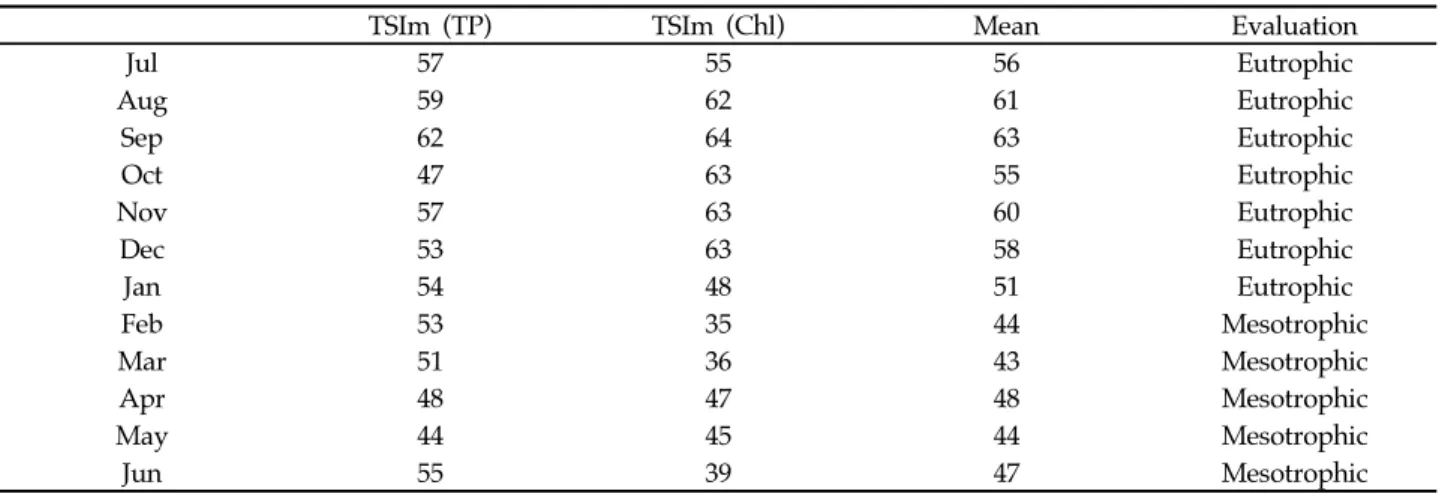
대동호의 부영양화도를 수정된 Carlson 지수에 따라 평가 한 결과는 43~63의 범위(평균 53)로 연평균 부영양상태로 평가 되었다. 2~6월까지는 중영양상태, 그 외 기간에는 부영양상태 로 평가되었고(Table 1), 이는 영산강⋅섬진강 수계 대부분의 호소가 부영양 단계로 나타난다는 연구결과와 일치하였다[25].
Fig. 4. SS (A), T-N (B) and T-P (C) characteristics of Daedong lake.
Fig. 5. Chl-a characteristics of Daedong lake.
TSIm (TP) TSIm (Chl) Mean Evaluation
Jul 57 55 56 Eutrophic
Aug 59 62 61 Eutrophic
Sep 62 64 63 Eutrophic
Oct 47 63 55 Eutrophic
Nov 57 63 60 Eutrophic
Dec 53 63 58 Eutrophic
Jan 54 48 51 Eutrophic
Feb 53 35 44 Mesotrophic
Mar 51 36 43 Mesotrophic
Apr 48 47 48 Mesotrophic
May 44 45 44 Mesotrophic
Jun 55 39 47 Mesotrophic
Table 1. The indices of eutrophication in Daedong Lake
Yun et al.
202
Note
The authors declare no conflict of interest.
References
1. Hwang SJ, Kwun SK, Yoon CG (2003) Water quality and limnology of Korean reservoirs. Paddy and Water Environment, 1(1), 43-52.
https://doi.org/10.1007/s10333-003-0010-7.
2. Chen J, Shi H, Sivakumar B, Peart MR (2016) Population, water, food, energy and dams. Renewable and Sustainable Energy Reviews, 56, 18-28.
https://doi.org/10.1016/j.rser.2015.11.043.
3. Yang SQ, Liu PW (2010) Strategy of water pollution prevention in Taihu Lake and its effects analysis. Journal of Great Lakes Research, 36, 150-158.
https://doi.org/10.1016/j.jglr.2009.12.010.
4. Yuan F, Wei YD, Gao J, Chen W (2019) Water crisis, environmental regulations and location dynamics of pollution-intensive industries in China: A study of the Taihu Lake watershed. Journal of Cleaner Production, 216, 311-322.
https://doi.org/10.1016/j.jclepro.2019.01.177.
5. Garnier M, Recanatesi F, Ripa MN, Leone A (2010) Agricultural nitrate monitoring in a lake basin in Central Italy: a further step ahead towards an integrated nutrient management aimed at controlling water pollution.
Environmental Monitoring and Assessment, 170(1-4), 273-286. https://doi.org/10.1007/s10661-009-1231-z.
6. Jiang JG, Shen YF (2006) Estimation of the natural purification rate of a eutrophic lake after pollutant removal. Ecological Engineering, 28(2), 166-173.
https://doi.org/10.1016/j.ecoleng.2006.06.002.
7. Deng J, Paerl HW, Qin B, Zhang Y, Zhu G, Jeppesen E, Cai Y, Xu H (2018) Climatically-modulated decline in wind speed may strongly affect eutrophication in shallow lakes. Science of The Total Environment, 645, 1361-1370.
https://doi.org/10.1016/j.scitotenv.2018.07.208.
8. Jiang X, Pan B, Sun Z, Cao L, Lu Y (2020) Application of taxonomic distinctness indices of fish assemblages for assessing effects of river-lake disconnection and eutrophication in floodplain lakes. Ecological Indicators, 110, 105955.
https://doi.org/10.1016/j.ecolind.2019.105955.
9. Legrand B, Miras Y, Beauger A, Dussauze M, Latour D (2019) Akinetes and ancient DNA reveal toxic cyanobacterial recurrences and their potential for
resurrection in a 6700-year-old core from a eutrophic lake. Science of The Total Environment, 687, 1369-1380.
https://doi.org/10.1016/j.scitotenv.2019.07.100.
10. Newell SE, Davis TW, Johengen TH, Gossiaux D, Burtner A, Palladino D, McCarthy MJ (2019) Reduced forms of nitrogen are a driver of non-nitrogen-fixing harmful cyanobacterial blooms and toxicity in Lake Erie. Harmful Algae, 81, 86-93.
https://doi.org/10.1016/j.hal.2018.11.003.
11. Kim HS, Park JH (2003) Development of eutrophication control technology for a pumped storage power plant dam: b. evaluation of the trophic level of a pumped storage power olant reservoir. International Journal of Research Institute of Industrial Science and Technology, 17(2), 51-57.
12. Park HK, Cheon SU, Park SI, Lee MH, Ryu JK (1992) Seasonal successtion of phytoplankton in some artificial lakes of Korea. Journal of Korean Society on Water Environment, 8, 150-158.
13. Aizaki M (1981) Application of modified Carlson’s trophic state index to Japanese and its relationships to other parameter related to trophic stage. Research Report on National Institute Environmental Studies, 23, 13-31.
14. Jeong JW, Jo JG (2003) Study on seasonal population structure and character of Phytoplankton at the Seonakdong River. Report of Busan Institute of Health
& Environment, 13, 69-89.
15. Unrein F, O’Farrell I, Izaguirre I, Sinistro R, dos Santos Afonso M, Tell G (2010) Phytoplankton response to pH rise in a N-limited floodplain lake: relevance of N2-fixing heterocystous cyanobacteria. Aquatic Science, 72(2), 179-190.
https://doi.org/10.1007/s00027-009-0115-1.
16. Sutherland DL, Howard-Williams C, Turnbull MH, Broady PA, Craggs RJ (2015) Enhancing microalgal photosynthesis and productivity in wastewater treatment high rate algal ponds for biofuel production. Bioresource Technology, 184, 222-229.
https://doi.org/10.1016/j.biortech.2014.10.074.
17. Seo JK, Yu JJ, Lee JJ, Yang SY, Chung IK (2003) Phytoplankton community dynamics and evaluation of trophic state in the Lake Unmoon. Algae, 18(2), 135-143. https://doi.org/10.4490/ALGAE.2003.18.2.135.
18. Lee SH, Sin YS, Chang NI, Kim JM, Kim HK, Cho YG, Jeong J (2006) Trophic state and Water quality in Major Lakes of the Sumjin and Youngsan river systems.
Korean Journal of Ecology and Environment, 39(3), 296-309.
19. Kirillin G, Shatwell T (2016) Generalized scaling of seasonal thermal stratification in lakes. Earth-Science Reviews, 161, 179-180.
https://doi.org/10.1016/j.earscirev.2016.08.008.
20. Gerardo-Nieto O, Astorga-España MS, Mansilla A, Thalasso F (2017) Initial report on methane and carbon dioxide emission dynamics from sub-Antartic freshwater ecosystems: A seasonal study of a lake and a reservoir. Science of the Total Environment, 593, 144-154.
https://doi.org/10.1016/j.scitotenv.2017.02.144.
21. Han M, Son J, Ryu J, Ahn K, Kim Y (2014) The effects of pollutants into sub-basin on the water quality and loading of receiving streams. Journal of Korean Society of Environmental Engineers, 36(9), 648-658. https://doi.org/10.4491/KSEE.2014.36.9.648.
22. Kim MS, Lee YJ, An KG, Kim BH, Hwang SJ, Shin KH (2014) Allochthonous organic matter contribution
to foodweb in Shingu Agricultural Reservoir after rainfall period. Korean Journal of Ecology and Environment, 47(1), 53-61.
https://doi.org/10.11614/KSL.2014.47.1.053.
23. Yang HK (2006) Runoff characteristics of non-point source pollutants in storm event-case study on the upstream and downstream of Kokseong river. Journal of the Korean Geographical Society, 41(4), 418-434.
24. Kim BC, Park JH, Hwang GS, Choi KS (1997) Eutrophication of Large Freshwater Ecosystems in Korea. Korean Society of Limnology, 30, 512-517.
25. Kim SJ, Song HJ, Park TJ, Hwang MY, Cho HS (2015) Survey on lake envirnoments in the Yeongsan and Seomjin river basins based on 10 lakes such as Hadong and Sangsa. Journal of Korean Society on Water Environment, 31(6), 665-679.
https://doi.org/10.15681/KSWE.2015.31.6.665.