INTRODUCTION
The individuals of epilithic diatom can be accu- rately counted due to their shorter life cycle and more distinct individuality than other algae or benthic insects. Also diatoms show the highest confidence when relative frequency of appearance in a community is calculated. Diatoms inhabit in water with wide ranges of organic pollution. The epilithic diatom assemblage has been used as an excellent biological indicator to assess water qua- lity (Watanabe et al., 1986, 1988, 1990) since it dis- plays the accumulative value of average changes of water quality over a certain period of time.
In Korea, there has been only a few reports about the diatoms in the water system of Ulle- ung Island. The first report (Kang, 1973) descri- bed several diatom species and later Chung (1981) reported approximately 30 species of dia- toms found in Ulleung Island. In this paper, we report the investigation of the variation of epili-
thic diatom community and the assessment of water quality of the water system of Ulleung Is- land.
MATERIALS AND METHODS
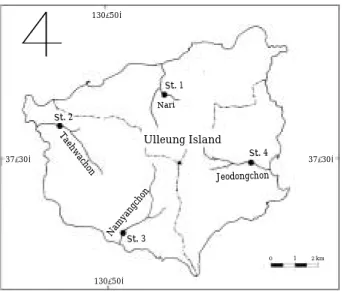
For the diatom analyses, samplings were made at four different stations of Ulleung Island in April, May, July, August, October, and November of 2003, and January and February of 2004 (Fig.
1). Samples were collected from the surface of stones located approximately 10 to 30 cm under water. Samples were cleaned by the Perman- ganat method (Hendey, 1974) and mounted in Pleurax. Slides were examined using a Nikon Apophoto microscope and the relative abundan- ces of diatom taxa occurred in each station were obtained by counting the number of individuals in randomly selected view fields. At least 500 in- dividuals were counted in each analysis.
Diatom taxa were identified based on the des-
─
─ 378 ──
Seasonal Variation of Epilithic Diatom Community and an Assessment of Water Quality by DAIpo
in the Water System of Ulleung Island
Choi, Jae Sin, Jung Won Park, Kyung Lak Lee, Myoung Sook Yang1and Han Soon Kim*
(Department of Biology, Kyungpook National University, Daegu 702-701, Korea
1Middle school of Ulleung, Ulleung Island, Korea)
We investigated the variations of epilithic diatom community and assessed water quality of the water system of Ulleung Island by DAIpo in April, May, July, August, October, and November of 2003, and January and February of 2004. Samples were collected from four sampling stations. Total 95 taxa were identified from this study and dominant species were Nitzschia inconspicua, Achnanthes minutissima, Gom- phonema angustum and Cocconeis placentula var. lineata. The variation of DAIpo values was ranged from 51.14 to 77.77 and the water quality by DAIpo was estimated between αα--oligosaprobic and ββ--oligosaprobic states.
Key words : epilithic diatom, water quality, DAIpo
* Corresponding Author: Tel: 053-950-5344, Fax: 053-953-3066, E-mail: [email protected]
cription of Krammer and Lange-Bertalot (1986, 1988, 1991a, b), and classified by the diatom system of Simonsen (1979). According to the tole- rance level to organic pollution, all the occurring diatom taxa were classified into the three ecolo- gical groups : saprophilous taxa, indifferent taxa and saproxenous taxa. The water quality was ass- essed by diatom assemblage index to organic water pollution (DAIpo). The relationship of DAIpo, BOD5 and conventional saprobic levels is given below for reference (Table 1).
RESULTS AND DISCUSSION
Physicochemical factors
The physicochemical factors of the water sys- tem are shown in Table 2.
At some stations, sampling or measurement was not possible due to mechanical troubles or unfavor- able situations. The highest water temperature
was recorded as 21.5�C at station 3 on August 2003, and the lowest was 5.0�C at station 2 and 4 on January 2004. Average water temperature of all stations except station 1 showed the seasonal variation such as 11.5�C in spring, 15.7�C in sum- mer, 12.6�C in autumn and 6.4�C in winter. pH was ranged between 7.0 and 8.6.
Epilithic diatom community
Total 95 taxa were identified in this study and classified into 84 species and 11 varieties belong- ing to 28 genera, 9 families, 3 suborders and 2 orders (Table 3).
The species numbers at each station are shown in Table 4. The highest number of taxa (44) appear- ed at station 2 in May, and the lowest number of taxa (14) was at station 4 in October 2003.
The diversity index of station 1 was between 0.69
Table 1. Relationship among DAIpo, BOD5and saprobic degrees (from Watanabe and Asai, 1990).
DAIpo BOD5 Saprobic level
0-15 ¤-10.0 polysaprobic
15-30 10.0-5.00 α-mesosaprobic
30-50 5.00-2.50 β-mesosaprobic
50-70 2.50-1.25 α-oligosaprobic
70-85 1.25-0.625 β-oligosaprobic
85-100 0.625-⁄ xenosaprobic
Table 2. Physicochemical factors at each sampling sta- tion in the water system of Ulleung Island duri- ng the survey period.
Sta- Factor 2003 2004
tion Apr. May Jul. Aug. Oct. Nov. Jan. Feb.
1 WT - 10.0 10.0 11.3 10.0 9.0 - -
pH 8.2 - 8.3 7.5 8.5 8.6 - -
2 WT 8.5 11.5 15.0 19.1 13.0 12.5 5.0 7.0 pH 7.8 - 8.1 8.0 8.6 8.3 8.6 8.6 3 WT 10.0 14.0 16.0 21.5 15.0 12.0 5.1 9.0 pH 8.0 - 7.0 7.4 8.2 8.3 8.5 8.4 4 WT 10.0 15.0 15.0 18.1 13.0 10.0 5.0 7.0 pH 7.8 - 8.3 7.7 8.2 8.0 8.4 8.2
Table 3. Summary of epilithic diatoms in the water sys- tem of Ulleung Island.
Order Subord. Fam. Gen. Sp. Var. Total
Centrales 1 1 2 4 7 7
Pennales 1 2 7 24 77 11 88
Total 2 3 9 28 84 11 95
Table 4. Species number of the diatom community at each station in the water system of Ulleung Island.
Station 2003 2004
Apr. May Jul. Aug. Oct. Nov. Jan. Feb.
1 36 19 33 19 24 - - -
2 28 44 40 29 35 27 42 21
3 24 27 25 36 38 42 32 36
4 34 30 34 27 14 - 32 33
Fig. 1. Sampling stations in Ulleung Island.
130�50′
130�50′
37�30′ 37�30′
Ulleung Island
Taehwachon
Jeodongchon
Namyangchon St. 1 Nari
St. 4
St. 3 St. 2
0 1 2 km
and 2.11. The dominance index was high values to 1.76 in August at station 1 because Achnanthes minutissima appeared hyper dominant (87.61%).
At station 2, the diversity index was between 0.79 and 2.28 showing the lowest in April(0.79).
However the dominance index in April was high (1.65) due to the 84.69% dominance of Nitzschia inconspicua. The diversity index was ranged 1.12
and 2.28 at station 3, and between 1.27 and 2.40 at station 4. We did not find correlative regula- rity between the indices of species diversity and dominance at stations and seasons (Table 5).
Nitzschia inconspicua was the only taxon that appeared at all stations and seasons. Following 18 taxa appeared only once : Aulacoseria ambigua, Cyclotella comta, Cyclotella stelligera, Cycloste-
Table 5. Diversity and dominance index of the epilithic diatom communities at each sampling station in the water system of Ulleung Island.
Month 2003 2004
Station Index Apr. May Jul. Aug. Oct. Nov. Jan. Feb.
1 Diversity 1.56 1.23 2.11 0.69 1.91 - - -
Dominance 1.04 1.04 0.45 1.76 0.47 - - -
2 Diversity 0.79 2.20 2.09 1.82 1.70 1.74 2.28 2.23
Dominance 1.65 0.60 0.71 0.80 0.88 0.73 0.50 0.40
3 Diversity 1.62 1.12 1.22 1.82 2.00 1.81 1.95 2.28
Dominance 0.71 1.35 1.29 0.72 0.56 0.83 0.59 0.38
4 Diversity 1.56 1.90 2.37 1.56 1.27 - 1.74 2.40
Dominance 1.00 0.66 0.50 0.97 1.07 - 0.82 0.36
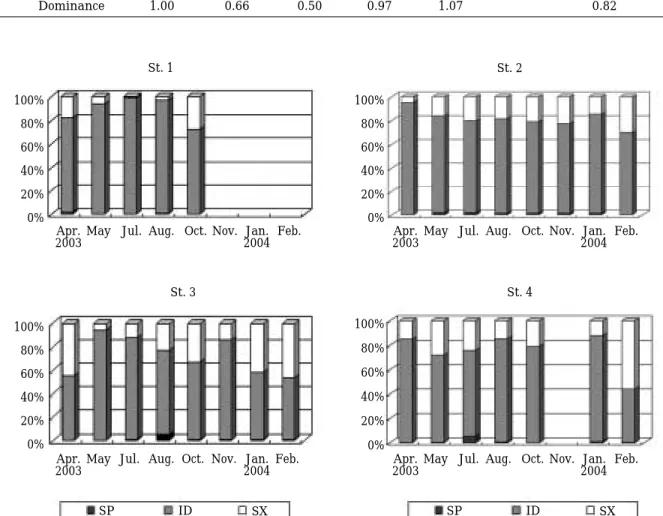
Fig. 2. Comparison with three taxa based on pollution tolerance at each station during the surveyed period (SP:
Saprophilous taxa, ID : Indifferent Taxa, SX : Saproxenous taxa).
St. 1 100%
80%
60%
40%
20%
0%
100%
80%
60%
40%
20%
0%
100%
80%
60%
40%
20%
0%
100%
80%
60%
40%
20%
0%
St. 3
SP ID SX SP ID SX
St. 2
St. 4 Apr. May Jul. Aug. Oct. Nov. Jan. Feb.
2003 2004
Apr. May Jul. Aug. Oct. Nov. Jan. Feb.
2003 2004
Apr. May Jul. Aug. Oct. Nov. Jan. Feb.
2003 2004
Apr. May Jul. Aug. Oct. Nov. Jan. Feb.
2003 2004
phanos dubius, Achnanthes montana, Diploneis subovalis, Diploneis elliptica, Frustulia rhom- boides var. viridula, Gomphonema augur, Navi- cula confervacea, Navicula decussis, Navicula mi- nuscula, Navicula charlatii, Navicula menisculus, Stauroneis anceps var. siberica, Nitzschia debilis, Nitzschia levidenssis var. victoriae, Surirella tenera.
Dominant species were Nitzschia inconspicua, Achnanthes minutissima, Gomphonema angustum, Cocconeis placentula var. lineata, and Navicula sp.
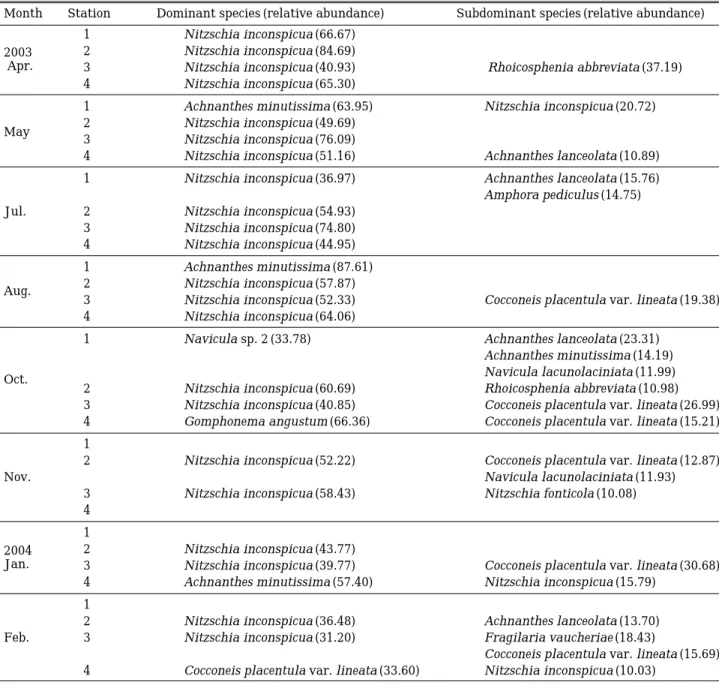
2. Nitzschia inconspicua was dominated at most
stations and seasons. Notably, Nitzschia incon- spicua was dominated the whole seasons at sta- tion 2 and 3. At station 1, the dominant species was Achnanthes minutissima in May and August, Navicula sp. 2 in October. These dominant species were different from station 2 and 3. At station 4, the dominant species was Nitzschia inconspicua in April, May, July and August, Gomphonema angustum in October, Achnanthes minutissima in January, and Cocconeis placentula var. lineata in February. Following 6 taxa appeared more than 10% of relative abundance : Rhoicosphenia
Table 6. Dominant species of epilithic diatom at each sampling station in the water system of Ulleung Island.
Month Station Dominant species (relative abundance) Subdominant species (relative abundance) 1 Nitzschia inconspicua (66.67)
2003 2 Nitzschia inconspicua (84.69)
Apr. 3 Nitzschia inconspicua (40.93) Rhoicosphenia abbreviata (37.19)
4 Nitzschia inconspicua (65.30)
1 Achnanthes minutissima (63.95) Nitzschia inconspicua (20.72)
May 2 Nitzschia inconspicua (49.69)
3 Nitzschia inconspicua (76.09)
4 Nitzschia inconspicua (51.16) Achnanthes lanceolata (10.89)
1 Nitzschia inconspicua (36.97) Achnanthes lanceolata (15.76)
Amphora pediculus (14.75)
Jul. 2 Nitzschia inconspicua (54.93)
3 Nitzschia inconspicua (74.80) 4 Nitzschia inconspicua (44.95) 1 Achnanthes minutissima (87.61)
Aug. 2 Nitzschia inconspicua (57.87)
3 Nitzschia inconspicua (52.33) Cocconeis placentula var. lineata (19.38) 4 Nitzschia inconspicua (64.06)
1 Navicula sp. 2 (33.78) Achnanthes lanceolata (23.31)
Achnanthes minutissima (14.19)
Oct. Navicula lacunolaciniata (11.99)
2 Nitzschia inconspicua (60.69) Rhoicosphenia abbreviata (10.98)
3 Nitzschia inconspicua (40.85) Cocconeis placentula var. lineata (26.99) 4 Gomphonema angustum (66.36) Cocconeis placentula var. lineata (15.21)
1 -
2 Nitzschia inconspicua (52.22) Cocconeis placentula var. lineata (12.87)
Nov. Navicula lacunolaciniata (11.93)
3 Nitzschia inconspicua (58.43) Nitzschia fonticola (10.08)
4 -
1 -
2004 2 Nitzschia inconspicua (43.77)
Jan. 3 Nitzschia inconspicua (39.77) Cocconeis placentula var. lineata (30.68)
4 Achnanthes minutissima (57.40) Nitzschia inconspicua (15.79)
1 -
2 Nitzschia inconspicua (36.48) Achnanthes lanceolata (13.70)
Feb. 3 Nitzschia inconspicua (31.20) Fragilaria vaucheriae (18.43)
Cocconeis placentula var. lineata (15.69) 4 Cocconeis placentula var. lineata (33.60) Nitzschia inconspicua (10.03)
abbreviata, Achnanthes lanceolata, Amphora pediculus, Navicula sp. 1, Nitzschia fonticola, Fragilaria vaucheriae. Achnanthes minutissima was dominated and subdominated mostly at station 1. Rhoicosphenia abbreviata and Cocconeis placentula var. lineata were subdominated at sta- tion 2 and 3 which were dominated mostly by Nitzschia inconspicua. At station 1 in October, dominant species was Navicula sp. 2 (Table 6).
Assessment of water quality by DAIpo
According to the degree of tolerance to organic water pollution (Asai and Watanabe, 1995), the 95 species were divided into 8 saprophilous taxa, 67 indifferent taxa and 20 saproxenous taxa. Sa- proxenous taxa were appeared more than sapro- philous taxa. Saprophilous taxa were Navicula pupula, Navicula seminulum, Navicula submin- uscula, Pinnularia microstaurion and Nitzschia palea. Saproxenous taxa were Achnanthes lance- olata, Diatoma mesodon, Fragilaria vaucheriae and Rhoicosphenia abbreviata.
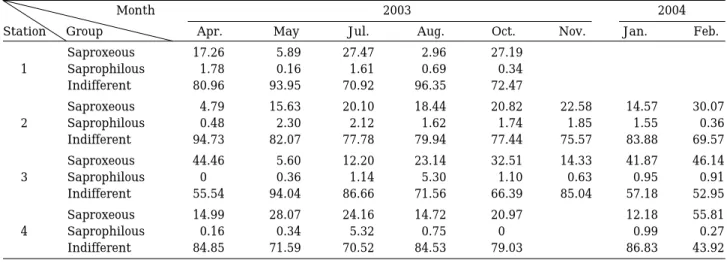
The component ratio of three ecological taxa were shown in Table 7. The ratio of saproxenous taxa was between 5.89 and 27.47% at station 1, 4.79 and 30.07% at station 2, 5.6 and 46.14% at station 3, and 12.18 and 55.81% at station 4. The ratio of saprophilous taxa was between 0.16 and 1.78% at station 1, 0.36 and 2.30% at station 2, 0 and 5.30% at station 3, and 0 and 5.32% at sta- tion 4. The component ratio of saprophilous taxa was lower than that of saproxenous taxa. The ratio of indifferent taxa was between 70.92 and
96.35% at station 1, 69.57 and 94.73% at station 2, 55.54 and 94.04% at station 3, and 43.92 and 86.83% at station 4. The component ratio of indi- fferent taxa was mostly higher in the whole sampling seasons and stations (Fig. 2).
DAIpo was the highest at station 4 as 77.77 in February 2004, and the lowest at station 1 as 51.14 in August 2003. DAIpo values were bet- ween 51.14 and 62.93 at station 1, 52.17 and 64.86 at station 2, 52.62 and 72.62 at station 3, 55.60 and 77.77 at station 4. Average DAIpo values were 57.62 at station 1, 58.44 at station 2, 63.15 at station 3 and 61.65 at station 4 (Fig. 3).
There were no distinguishable variations in the whole sampling seasons and stations. However the water quality was slightly improved in Fe- bruary 2004. The saprobic levels were estimated in the whole stations and seasons as α-oligosa-
Table 7. Percentage of ecological diatom groups divided by degress of pollution tolerance in epilithic diatom communities at each sampling station in the water system of Ulleung Island.
Month 2003 2004
Station Group Apr. May Jul. Aug. Oct. Nov. Jan. Feb.
Saproxeous 17.26 5.89 27.47 2.96 27.19 - - -
1 Saprophilous 1.78 0.16 1.61 0.69 0.34 - - -
Indifferent 80.96 93.95 70.92 96.35 72.47 - - -
Saproxeous 4.79 15.63 20.10 18.44 20.82 22.58 14.57 30.07
2 Saprophilous 0.48 2.30 2.12 1.62 1.74 1.85 1.55 0.36
Indifferent 94.73 82.07 77.78 79.94 77.44 75.57 83.88 69.57
Saproxeous 44.46 5.60 12.20 23.14 32.51 14.33 41.87 46.14
3 Saprophilous 0 0.36 1.14 5.30 1.10 0.63 0.95 0.91
Indifferent 55.54 94.04 86.66 71.56 66.39 85.04 57.18 52.95
Saproxeous 14.99 28.07 24.16 14.72 20.97 - 12.18 55.81
4 Saprophilous 0.16 0.34 5.32 0.75 0 - 0.99 0.27
Indifferent 84.85 71.59 70.52 84.53 79.03 - 86.83 43.92
Fig. 3. Variations of DAIpo at each station in the Ulleung island.
Apr. May Jul. Aug. Oct. Nov. Jan. Feb.
2003 2004
Month
DAIpo
100 80 60 40 20 0
St. 1 St. 2 St. 3 St. 4
probic except station 3 in January, February and April, and station 4 in February which were β- oligosaprobic. There were a few reports that assessed the water quality by DAIpo in Korea : Kumho river (Chung et al., 1993), Pochun stre- am (Kim, 1999), Shinchon stream (Kim, 2001) and Nakdong river (Park et al., 2004). The water quality of Ulleung Island by DAIpo was oligosaprobic, between 51.14-77.77, and it was similar to that of upper stream of the Kumho river.
REFERENCES
Asai, K. and T. Watanabe. 1995. Statistic classification of epilithic diatom species into three ecological groups relating to organic water pollution (2) Sapro- philous and saproxenous taxa. Diatom. 10: 35-47.
Chung, J., J.S. Choi and J.H. Lee. 1993. Assessment for water quality of the Kumho river using epili- thic diatom assemblage index to organic water pollution (DAIpo). Kor. J. Environ. Biol. 11: 43-58.
Chung, Y.H. 1981. On the phytoplanktons of Ulreung and Dogdo Islands. Nature conservation 19: 221- 228.
Hendey, N.I. 1974. The permanganate method for cleaning freshly gathered diatom. Microscopy. 32:
423-426.
Kang, S.W. 1973. A check list of the planktons of the rice paddy field at Jeou-Dong in Island Wooleo- ung-Do. Kor. J. Limnol. 6: 47-51.
Kim, Y.S. 1999. An assessment of water quality by attached diatoms assemblage in the Pochun stre- am. Kor. J. Limnol. 32: 135-140.
Kim, Y.S. 2001. An assessment of organic pollution using attached diatom assemblages in the Shin- chon stream. Kor. J. Limnol. 34: 199-205.
Krammer, K. and H. Lange-Bertalot. 1986. Süβwas- serflora von Mitteleuropa. Band 2/1. Bacillario- phyceae 1. Teil: Naviculaceae (H. Ettl, J. Gerloff, H.
Heynig and D. Mollenhauer, eds.). Gustav Fischer Verlag. Stuttgart.
Krammer, K. and H. Lange-Bertalot. 1988. Süβwas- serflora von Mitteleuropa. Band 2/2. Bacillario- phyceae 2. Teil: Bacillariaceae, Epithemiaceae, Surorellaceae (H. Ettl, J. Gerloff, H. Heynig and D. Mollenhauer, eds.). Gustav Fischer Verlag.
Stuttgart.
Krammer, K. and H. Lange-Bertalot. 1991a. Süβwa- sserflora von Mitteleuropa. Band 2/3. Bacillario- phyceae 3. Teil: Centrales, Fragilariaceae, Euno- tiaceae (H. Ettl, J. Gerloff, H. Heynig and D.
Mollenhauer, eds.). Gustav Fischer Verlag. Stu- ttgart.
Krammer, K. and H. Lange-Bertalot. 1991b. Süβwa- sserflora von Mitteleuropa. Band 2/4. Bacillario- phyceae 4. Teil: Achnanthaceae. Kritische Erg¨an- zungen zu Navicula (Lineolatae) und Gompho- nema (H. Ettl, J. Gerloff, H. Heynig and D. Mol- lenhauer, eds.). Gustav Fischer Verlag. Stuttgart.
Park, J.W., J.S. Choi and M.K. Kim. 2004. Variations of Epilithic Diatom Community and an Assess- ment of Water Quality by DAIpo in the Middle Reaches of the Nakdong River. Kor. J. Limnol. 37:
70-77.
Simonsen, R. 1979. The diatom system: Ideas on phylogeny. Bacillaria 2: 9-71.
Watanabe, T. and K. Asai. 1990. Numerical simul- ation using diatom assemblage of organic pol- lution in stream and lakes. Rev. Inq. and Res. 52:
99-139.
Watanabe, T., K. Asai, A. Houki, S. Tanaka and T.
Hizuka, 1986. Saprophilous and Eurysaprobic Di- atom Taxa to Organic Water Pollution and Dia- tom Assemblage Index (DAIpo). Diatom 2: 23-73.
Watanabe, T., K. Asai and A. Houki. 1988. Biological Information Closely Related to the Numerical Index DAIpo (Diatom Assemblage Index to Orga- nic Water Pollution). Diatom 4: 49-58.
(Manuscript received 10 September 2004, Revision accepted 30 November 2004)
⁄ ¤
울릉도 수계의 부착규조군집의 계절적 변이와 DAIpo 에 의한 수질평가
최재신∙박정원∙이경락∙양명숙1∙김한순*
(경북대학교 자연과학대학 생물학과, 1울릉중학교)
울릉도 수계의 부착규조군집의 계절적 변이와DAIpo에 의한 수질평가를 조사하였다. 채집은2003 년4월, 5월, 7월, 8월, 10월과 11월 그리고2004년 1월과 2월에 4개의 정점에서 채집하였다. 총95 분류군이 동정되었으며 우점종들은 Nitzschia inconspicua, Achnanthes minutissima, Gomphonema angustum과 Cocconeis placentula var. lineata였다. DAIpo는 51.15에서 77.77의 범위였고 울릉도 수계의 수질은α-빈부수성에서 β-빈부수성이었다.