Deterioration of water quality in a newly made reclaimed estuarine lake is of prime concerns because both that lake water will be finally stag- nant and there will be seawater dilution no longer by the time when the lake is completely isolate from the seawater. Korea (South) belongs over 10 reclaimed estuarine lakes in the western part of
the Korean peninsula. According to earlier cases of water quality changes in those lakes, reclaimed lakes have been experienced intense eutrophica- tion although the degree of changes varied among them. One of the worst cases of water quality deterioration and ecosystem destruction was shown in Lake Shihwa (Shin et al., 2000; Shin et
─
─ 455 ──
Water Quality and Chlorophyll-a at the Birth Stage of a Large Reclaimed Estuarine Lake in Korea (Lake Hwaong)
Hwang, Soon-Jin*, Ho-Sub Kim, Mi-Hee Chung and Chung-Il Choi1 (Department of Biological Systems Engineering, Konkuk University, Seoul 143-701, Korea
1Department of Earth and Marine Sciences, Hanyang University, Ansan 426-791, Korea)
This study evaluated the change of water quality and chlorophyll-a at the birth stage of a large reclaimed estuarine lake (Lake Hwaong) of which the dike was final- ly constructed in March, 2002. Physico-chemical parameters and chlorophyll-a were investigated along a longitudinal transect, including 3 in-lake sites and 1 out- lake site from June to November, 2002. Salinity at all in-lake sites was over 21 psu during the study period, indicating that lake is still in the seawater phase. Salinity was periodically diluted at times when precipitation was high, especially in August.
Chemocline was established in July near the dam site, and correspondingly vertical profile of dissolved oxygen was very clear during that period. Total nitrogen and phosphorus concentrations at all lake sites were in the eutrophic range, and they were especially high at the stream inlet site. Nutrients concentration was not much varied vertically but significantly varied temporally, and correlated significantly with precipitation and chlorophyll-a concentration, indicating that inflowing water from the watershed seemed not to improve lake water by dilution but cause eutroph- ication of the lake, and thereby stimulate phytoplankton development. Based on the analyses of nutrient ratio (N/P) and trophic state deviation, both phosphorus and nitrogen appeared to limit phytoplankton growth in the lake. Phosphorus limitation appeared to be probable at all in-lake sites with being most severe at the stream inlet site. Nitrogen limitation seemed to occur at both in-lake and out-lake sites.
These results indicate that in Lake Hwaong experiencing the very early stage of a reclaiming lake, water quality and phytoplankton development appear to be affect- ed largely by salinity and hydrology and nutrients from the inflowing water. Lake biogeochemistry is still very unstable, and thus further long-term study is necessary to understand the effects of seawater to freshwater conversion on lake biology and water chemistry.
Key words : reclaimed esturine lake, Lake Hwaong, water quality, chlorophyll-a, salinity, eutrophication
* Corresponding Author: Tel: 02) 450-3748, Fax: 02) 456-5062, E-mail: [email protected]
al., 2003).
Lake Hwaong is a large impounding lake, con- structed by the tidal reclamation project for the development of the coastal region of the Nam- yang Estuary, nearshore the Yellow Sea, Korea.
The dike of the lake has been finally constructed in March 2002. However, the lake is yet to be completely isolated from the seawater due to the water quality management plan directed by the government, so that seawater is incoming and lake water is discharging at daily intervals thro- ugh the water gate. This situation will be kept until 2007 by the operation of water gate by the Korean government agency. Thus lake water now appears to experience a certain stage between open estuary and impounding lake in terms of morphometry, hydrology, water chemistry, and lake biology.
The information on the water quality and the biology both in the coastal region and Lake Hwa- ong is very limited. Furthermore, there are no data on the nutrients dynamics, biological com- munity composition and variation, and energy flow, which are important to evaluate the effect of external nutrient inputs, the change of lake trophic status and the prediction of how the lake will be staying as a healthy ecosystem. Eutro- phication of lakes results in the biomass increase of aquatic organisms, e.g., algal blooms. The composition and biomass changes of the different components of the food web reflect the condition of the lake in terms of both water quality and fishery resource potential. An understanding of the factors controlling the composition and turn- over rates of the different trophic components is important for the effective lake management, and for the promotion of the development of a healthy and desirable ecosystem.
In the case of the tidal reclamation with the dam construction in an estuary connected with a river, impounded seawater in the lake will be experienced desalinization, and be freshwater
finally. It is well known that freshwater organi- sms get stressed physiologically by salt, and the change of salt concentration during the desal- inization will be expected to affect the ecology of freshwater organisms, and vice versa (Kinne, 1964; Williamson, et al., 1984; Rhoades, 1997).
Occurrence of the salt gradient in the freshwater ecosystem is a very uncommon phenomenon, and accordingly, there are few studies about the salt effect, as a stress factor, on the plankton trophic dynamics. In this regard, Lake Hwaong provides an excellent condition, which permits to study an ecological effect of desalnization.
We believe that this newly made Lake Hwaong provides a unique opportunity for a long-term study to provide information of variation of water quality and biological parameters through the progression of desalinization. Here, we report
Table 1. Water quality of incoming streams and inside region of the dam (May, 1999: before dike construction).
Parameters Chemical oxygen Biological oxygen Total nitrogen Total phosphorus Chl-a
Sampling site demand (mg/L) demand (mg/L) (mg/L) (mg/L) (µg/L)
Esturine area
1.3 0.03 4.2
(inside dam)
Incoming Namyang stream 8.4 17.7 1.27 18.9
streams Jaan stream 5.2 3.9 0.05 13.9
Aeun stream 3.9 4.5 0.54 8.5
Fig. 1. Map showing the study area (CA: costal area, LHL:
Lake Hwang lower part, LHM: Lake Hwang mid- dle part, LHU: Lake Hwang upper part).
Lake Hwaong
Namyang stream
Jaan stream
Aeun stream Watergate
LHM LHU
LHL
CA
127�50′′ E
37�05′ E
0 2.5 5.0 km N
that the change of water quality and chlorophyll -a at the birth stage of Lake Hwaong.
Lake Hwaong is a man-made estuarine lake, located in 126�40′-127�00′ E, 37�15′ N. Embank- ment of the lake was finally constructed in March, 2002. Three streams (Namyang stream, Jaan stream, Aeun stream) flow in the lake, and incom- ing streams contain a large amount of nutrients (Table 1). Watershed of the lake covers areas of downtown and agricultural region, and thus includes various sources of pollutants such as
sewage, livestock waste, industrial waste, and agricultural non-point effluent (Kyunggido, 2002).
Sampling was accomplished at four stations at monthly intervals from June to November 2002;
three stations in the lake part, and one station (CA) out the lake. In the lake, St. 1 is located in upper area of the lake (LHU) at the mouth of Namyang stream; St. 2 is located in middle area of the lake (LHM); and St. 3 is located in the lower area of the lake (LHL) (Fig. 1).
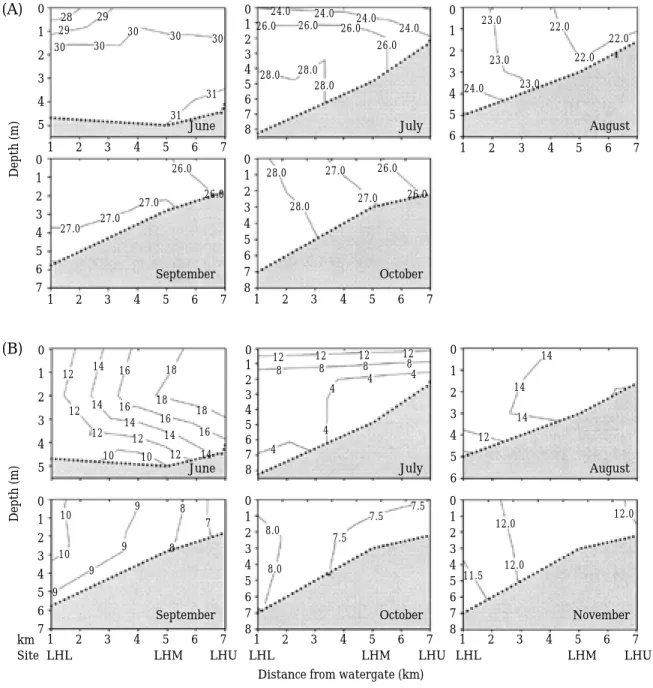
Fig. 2. Vertical and monthly variation of (A) salinity (Unit: psu) and (B) DO concentration (Unit: mgO2/L) in Lake Hwaong from June to November, 2002.
0 1 2 3 4 5
(A)
(B)
0 1 2 3 4 50 1 2 3 4 5 6 7 8
0 1 2 3 4 5 6 7 8
1 2 3 4 5 6 7
1 2 3 4 5 6 7 1 2 3 4 5 6 7
June July August
June July August
September October November
September October
1 2 3 4 5 6 7
28 29
29
30 30
30 30 30
31 31
24.0 24.0 24.0 26.0 26.0 26.0 24.0
26.0 28.0 28.0
28.0
23.0
23.0 24.0 23.0
22.0 22.0
22.0
27.0 27.0 27.0
26.0 26.0
28.0
28.0 27.0
27.0 26.0
26.0
12
12
12 12
10 10 12 14
14 14
14 14 16
16 16
16 18
18 18
12 12 12 12
8 8 8 8
4
4
4 4 4
14
14 14 12
10
10
9 9
9
9 8
8
7 8.0
8.0
7.5
7.5 7.5
12.0
11.5 12.0
12.0
km
Site LHL LHM LHU LHL LHM LHU LHL LHM LHU
Distance from watergate (km)
Depth (m)Depth (m)
1 2 3 4 5 6 7 1 2 3 4 5 6 7
0 1 2 3 4 5 6 7
0 1 2 3 4 5 6 7
0 1 2 3 4 5 6 7 8
0 1 2 3 4 5 6 7 8
0 1 2 3 4 5 6 7 8 0 1 2 3 4 5 6
0 1 2 3 4 5 6
1 2 3 4 5 6 7
Table 2. Water quality at out-lake station (CA) of Lake Hwaong from June to November, 2002.
sampling months
Parameters June July August September October November
Salinity psu 29.1 29.5 26.8 29.4 30.2 30.2
DO mgO2/L 10.2 13.0 9.8 8.0 8.2 11.3
Chl-a µg/L 13.3±0.3 8.9±0.2 18.4±0.6 5.5±0.3 3.3±0.2 1.6±0.3
DTP µgP/L 3.5±1.1 36.2±1.1 23.4±1.8 32.0±2.2 28.0±1.0 33.5±1.2
TP µgP/L 39.1±2.2 70.8±1.1 79.4±1.8 48.1±1.1 56.8±2.1 52.3±3.1
DIN mgN/L 29.7 332.1 326.3 113.3 143.1 225.4
TN mgN/L 0.8±0.04 1.1±0.1 1.0±0.1 0.7±0.0 0.4±0.0 0.6±0.0
Fig. 3. Vertical and monthly variation of chlorophyll-a concentration (µg/L) in Lake Hwaong from June to November, 2002 (Shade area is boundary layer between water column and sediment from LHL to LHU).
Fig. 4. The relationships between nutrients (TP, DOP, and BOD) and Chl. a in Lake Hwaong.
1 2 3 4 5 6 7 1 2 3 4 5 6 7 1 2 3 4 5 6 7
km
Site LHL LHM LHU LHL LHM LHU LHL LHM LHU
Distance from watergate (km)
120 100 80 60 40 20 0 -20 -40
Chl. a = 0.49×TP-13.4 r2 = 0.44
n = 53 p⁄0.001
Chl. a = e0.20×DOP r2 = 0.48 n = 55 p⁄0.001
Chl. a = 6.0×BOD-4.9 r2 = 0.55
n = 56 p⁄0.001
Chl. a
20 40 60 80 100 120 140 0 5 10 15 20 25
TP DOP BOD
0 1 2 3 4 5
0 1 2 3 4 5 6 7 8
0 1 2 3 4 5 6 7
0 1 2 3 4 5 6 7 8
0 1 2 3 4 5 6 7 8 0 1 2 3 4 5 6
Depth (m)
8.0 8.0
8.0
8.0 8.0 8.0 4.0 4.0 4.0
12.0
12.0 16.0
16.0
40 40 40 40
30 30 30 30
20 20 20 20
10
60
60 50
50 50 3040
40
40 40
40 50607080
6
6 6 8
8 10
10 12
12 14
16 1820
4
4 6
6 8
8 10
12
6
6 6
8
8 10
10 12
June July August
September October November
0 2 4 6 8 10 12 14 16
Salinity was measured in situ with CTD (Con- ductivity-Temperature-Depth Instrument, Sea Bird Electronic Inc.). Water transparency was determined by a black-white (20 cm diameter) Secchi disk. Dissolved oxygen (DO) and bioche- mical oxygen demand (BOD) concentration were analyzed by the azide modification method (APHA
et al., 1995). For the Chl. a measurement, sampl-ed water was filtered with GF/F, and extraction of Chl. a and analysis were followed Maker (1972) and Maker et al. (1980). Soluble reactive phosph- orus (SRP), ammonia, nitrite, and nitrate were determined with ascorbic acid method, phenate method, colorimetric method, and cadmium re- duction method (APHA et al., 1995), respective- ly. Total phosphorus (TP) and total nitrogen (TN) concentrations were determined by the ascorbic
acid method and cadmium reduction method, respectively, after decomposed with alkalate pur- sulfate (APHA et al., 1995). Trophic state of Lake Hwaong was analyzed with Trophic State Index (TSI) of Carlson (1977), and TN trophic state analysis was followed Kratzer and Brezonik (1981). The potential limiting nutrient on phyto- plankton growth was evaluated using TSI devia- tion analysis and stoichiometry.
We used one-way ANOVA for water quality comparison among the stations and Pearson’s correlation analysis for relationships among physico-chemical factors (SPSS 8.0).
Salinity was over 21.8 psu at all stations dur- ing the study period (Fig. 2A, Table 2), indicating that the lake was still largely influenced by the seawater intrusion. The lowest salinity observed in the lake area appeared during August when the largest amount of preceding precipitation.
Salinity chemocline was observed only in July at lower part of the lake (site LHL). These results suggest that lake salinity and its dilution were affected largely by the storm events in the water- shed because seawater comes into the lake by the water gate operation.
Dissolved oxygen (DO) concentration ranged 2.4~18.2 mgO
2/L (Fig. 2B, Table 2). Among lake sites, DO increased towards the lake upstream and surface DO concentration was higher than hypolimnetic DO, reflecting a large input of nutri- ents from the inflowing streams and resultant algal development. The difference of DO concen- trations with depth was observed with lower value in the hypolimnion during June and July when water was not disturbed by the storm event.
Fig. 5. Trophic status in Lake Hwaong according to the TSI (Trophic State Index)
Fig. 6. Monthly variation of N/P ratio (by mass) in Lake Hwaong from June to November, 2002 (Error bar is the standard deviation of measured N/P ratio value from epilimnion to hypolimnion).
100
80
60
40
20
TSI
LHU LHL LHM CA
Stations
53-60 Eutrophic state (Kratzer and Brezonik, 1981)
SD TN TP Chl. a
Jun. Jul. Aug. Sep. Oct. Nov. Dec. Jun. Jul. Aug. Sep. Oct. Nov. Dec.
Month Month
30
20
10
0
-10
DIN/DTP ration (by mass) TN/TP ration (by mass)
100 80 60 40 20 0
LHL LHM LHU CA NP = 10
However, there was no surface DO difference among sites during the study period (ANOVA, P¤0.05, n = 24) (Fig. 2B).
Chlorophyll-a (Chl. a) concentration ranged
2.6~91.8
µg/L, increased from June to August,and decreased in September. When chemocline was occurred, Chl. a concentration differed with depth. Chl. a concentration in the bottom layer of
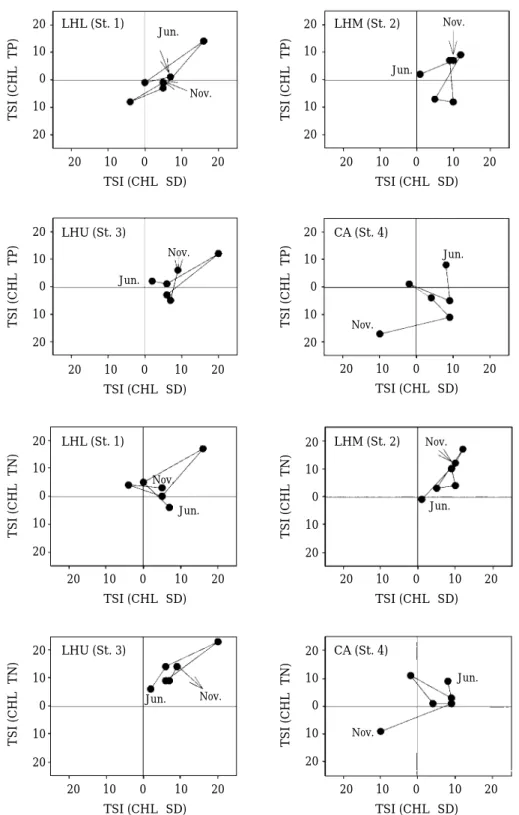
Fig. 7. Trophic status analogy based on TSI deviation analysis in Lake Hwaong from June to November, 2002.
20 10 0 -10 -20
20 10 0 -10 -20
20 10 0 -10 -20
20 10 0 -10 -20
20 10 0 -10 -20
20 10 0 -10 -20
20 10 0 -10 -20
20 10 0 -10 -20
TSI (CHL-TP)TSI (CHL-TP)TSI (CHL-TN)TSI (CHL-TN) TSI (CHL-TP)TSI (CHL-TP)TSI (CHL-TN)TSI (CHL-TN)
-20 -10 0 10 20
TSI (CHL-SD) LHL (St. 1)
LHU (St. 3)
LHL (St. 1)
LHU (St. 3)
Jun.
Jun.
Jun.
Jun.
Jun.
Jun.
Jun.
Jun.
Nov.
Nov.
Nov.
Nov.
Nov.
Nov.
Nov.
LHM (St. 2) Nov.
CA (St. 4)
LHM (St. 2)
CA (St. 4)
-20 -10 0 10 20
TSI (CHL-SD)
-20 -10 0 10 20
TSI (CHL-SD)
-20 -10 0 10 20
TSI (CHL-SD)
-20 -10 0 10 20
TSI (CHL-SD)
-20 -10 0 10 20
TSI (CHL-SD)
-20 -10 0 10 20
TSI (CHL-SD)
-20 -10 0 10 20
TSI (CHL-SD)
LHL station was very low compared with those of other layers in August. Surface Chl. a concen- tration was decreased toward downstream of the lake, and especially, CA station showed the low- est value (Fig. 3, Table 2). This result indicates that phytoplankton development in Lake Hwa- ong appeared to be affected by the continuous nutrients supply from the incoming streams. In addition, the variation of Chl. a concentrations was significantly correlated with nutrients con- centration (TP, DOP, and BOD) (Fig. 4) and rain- fall (r
2= 0.89, P⁄0.001, n = 24) (data not shown), indicating that inflowing water from streams likely affect lake water quality and algal growth, rather than diluting intruded seawater.
Trophic State Index (TSI) was calculated with Chl. a, TN, TP, and transparency. TSI value was over 53 at all stations, and this value indicates that Lake Hwaong was eutrophic state (Carlson, 1977). Especially, LHU where Namyang stream flows into the lake was highly eutrophic (Fig. 5).
Similarly, Lake Shihwa, another reclaimed lake in Korea, became eutrophic state in one year after the dike construction. The reason of eutrophica- tion at Lake Shihwa was excessive nutrients su- pply from the streams (Choi et al., 1997).
During the study period, total nitrogen and total phosphorus ratio was 17±10 (by mass) (Fig.
6), suggesting that both nitrogen and phosphorus were able to be limiting nutrients in Lake Hwa- ong. According to TSI deviation analysis (Havens, 2000), algal growth was affected most seriously by phosphorus limitation at LHU, reflecting the effect of incoming stream water. P limitation also was observed at stations of LHM and LHL, but it was not observed at station CA (Fig. 7). Interest- ingly, nitrogen limitation was observed at all stations and, strong N limiting on phytoplankton growth was estimated in August when a high Chlorophyll-a concentration was recorded during this study period. Commonly observed N limita- tion at all stations during the study period indi- cate that Lake Hwaong water is still dominated by seawater. A difference between TSI (CHL) and TSI (SD) was positive in most cases. It pro- vides evidence that non-algal sestons or large algae (e.g. visible aggregates of cyanobacteria) than small size algae were contributing to the light attenuation (Havens, 2000; Edmondson, 1980).
In conclusion, the results of this study indicate that in Lake Hwaong experiencing the birth
stage of a reclaiming lake, water quality and phy- toplankton (as Chl. a) development appear to be affected largely by salinity and hydrology toge- ther with nutrients from the inflowing water.
Lake biogeochemistry is still very unstable, and thus further long-term study is necessary to understand the effects of seawater to freshwater conversion on lake biology and water chemistry.
ACKNOWLEDGEMENT
This study was supported by the Ansan Envi- ronment Technology Development Center (Pro- ject #. 02-2-30-31).
REFERENCES
APHA, AWWA and WEF. 1995. Standard methods for the examination of water and wastewater, 19th ed., APHA-AWWA-WEF, Washington, D. C., USA.
Carlson, R.E. 1977. A trophic state index for lakes.
Limnol. Oceanogr. 22: 361-369.
Choi, J.K., E.H. Lee, J.H. Noh and S.H. Huh. 1997.
The study on the phytoplankton bloom and pri- mary productivity in Lake Shihwa and adjacent coasta areas. The Sea 2: 78-86 (in Korean).
Edmondson, W.T. 1980. Secchi disk and chlorophyll.
Limnol. Oceanogr. 25: 378-379.
Havens, K.E. 2000. Using Trophic state index (TSI) values to drow inferences regrading phytoplank- ton limiting factors and seston composition from routine water quality monitoring data. Korean J.
Limnol. 33: 187-196.
Kinne, O. 1964. The effects of temperature and salin- ity on marine and brackish water animals. Ocean- ogr. Mar. Biol. Ann. Rev. 2: 281-339.
Kratzer, C.R. and P.L. Brezonik. 1981. A calson-type trophic state index for nitrogen in Florida lakes.
Wat. Res. Bulletin. 17: 713-717.
Kyunggido, 2002. A comprehensive countermeasure of water quality improvement in Lake Hwaong.
Maker, A.F.H. 1972. The use of acetone and methanol in the estimation of chlorophyll in the presence of phaeophytin. Freshwat. Biol. 2: 361-385.
Maker, A.F.H., E.A. Nusch, I. Rai and B. Riemann.
1980. The measurement of photosynthetic pig- ments in freshwters and standardization of meth- ods: Conclusions and recommendations. Arch.
Hydrobiol. Beih. 14: 91-106.
Rhoades, J.D. 1997. Sustainability of Irrigation: An overview of salinity problems and control strate- gies. p. 1-40. Annual conference of Canadian Water Resources Association.
Shin, J. K., D. S. Kim and K.J. Cho. 2000. Dynamics of inorganic nutrients and phytoplankton in Shi- hwa Reservoir. Korean J. Limnol. 33: 109-118 (in Korean).
Shin, J.K., S.J. Hwang, D.S. Kim and C.K. Kang.
2003. Comparison of fertility of stream waters depending on the drainage systems. Korean J.
Limnol. 36: 381-388 (in Korean).
Williamson, D.R., R.A. Stokes and J.K. Ruprecht.
1984. Response of input of water and chloride to clearing for agriculture. J. Hydrology. 94: 1-28.
(Manuscript received 5 November 2003, Revision accepted 10 December 2003)
⁄ ¤
간척하구호(화옹호) 태동기의 수질과 엽록소- a 변화
황순진*∙김호섭∙정미희∙최청일1
(건국대학교 지역건설환경공학과, 1한양대학교 지구해양과학과)
본 연구는 최근에 조성된 간척 하구담수호인 화옹호의 태동초기의 수질변화를 평가할 목적으로 수 행되었다. 물리∙화학적 요인들과 엽록소 a농도의 시공간적 변화를 2002년 6~11월간 화옹호 호 내의 3지점과 호외의1지점을 대상으로 모니터링하였다. 조사기간 동안 호수 내 모든 지점에서 염 분도는21 psu로 여전히 해수성향이 강하게 나타났다. 염분도는 강우량이 높았던 시기, 특히 8월에 희석에 따른 농도감소가 주기적으로 관찰되었다. 화학성층은 방조제 앞 부근에서 7월에 형성되면 서 수심에 따른 용존산소의 감소가 나타났다. 호수 내 모든 지점에서 총질소와 총인 농도는 부영양 상태를 유지하였고, 하천 유입구 지점에서 가장 높은 농도를 보였다. 호수 내 영양염 농도의 수직 적 변화는 거의 없었으나, 지점에 따라 큰 차이가 나타났으며 강우량과 엽록소a농도와 밀접한 관 련이 있었다. 이러한 결과는, 호수의 수질이 유입수의 희석에 의해 개선되기 보다는 호수의 영양상 태를 증가시키고 그로 인해 식물플랑크톤의 성장이 촉진 된다는 것을 의미한다. N/P 비와 영양상 태 편차분석에 따르면, 인과 질소 모두 호수에서 식물플랑크톤의 성장을 제한하는 것으로 나타났 다. 화옹호에서의 식물플랑크톤 성장은 호수 내 전 지점에서 인에 의해 제한되는 것으로 나타났으 며, 특히 하천 유입구 부분에서 가장 뚜렷하게 나타났다. 질소 제한은 조사된 호수내외 모든 지점 에서 나타났다. 이러한 결과는 담수화 초기의 화옹호에서 수질과 식물플랑크톤 성장이 염분도와 수리∙수문적 요인 그리고 유입수로부터 유입되는 영양염에 의해 크게 영향을 받음을 의미한다. 화옹호의 생지화학적인 요인들은 여전히 매우 불안정하기 때문에 담수화 전환과정의 생물학적인 측면과 수질에 대한 해수의 영향을 이해하기 위해서는 장기간에 걸친 연구가 필요하다.