1. Introduction
Nursing fulfills the needs of people who have health problems in physical, mental, spiritual,
and societal realms. And also It involves providing care with good intentions and a positive attitude towards life. Nursing practice involves ethical judgments about what is best for
Factors Influencing Respect for Life and Will of Korean Nursing Students
Younghee Park
Assistant Professor, Department of Nursing, Dongguk University
간호대학생의 생명존중의지에 영향을 미치는 요인
박영희
동국대학교 간호학과 조교수
Abstract The purpose of this study is to investigate the factors influencing the willingness of nursing college students to have respect for life and to use them as basic principle to help develop an effective bioethics education program for nursing students. A descriptive study was used with 442 nursing students. Data were collected with a structured questionnaire and analyzed using descriptive analysis, t-test, ANOVA, Pearson correlation coefficients, and Multiple regression. The result showed that factors affecting respect for life and will were meanings of death, death anxiety, death concern and these three variables explained about 43.6% of respect for life and will. It is necessary for nursing students to understand the meaning of death and to reduce death anxiety by improving understanding of meanings of death. It also suggests the need to develop an educational program that can improve the respect for life and will by establishing their own views on death and improving the involvement of death in nursing a dying patient and family.
Key Words : Convergence, Death, Respect for life, Bioethics, Nursing, Students
요 약 이 연구의 목적은 간호대학생의 생명존중의지에 영향을 미치는 요인을 조사하고 간호대학생을 위한 효과적인 생명윤리 교육프로그램을 개발하는 데 도움이 되는 기초 자료로 활용하고자 하는 것이다. 442 명의 간호대학생을 대상 으로 조사연구를 시행하였으며, 분석방법은 t-test, ANOVA, Pearson correlation coefficients, and Multiple regression을 이용하였다. 결과는 생명존중의지에 영향을 미치는 요소들이 죽음의 의미, 죽음의 불안, 죽음의 관여도 라는 것을 보여 주었고, 이 세 요인의 생명존중의지에 대한 설명은 43.6%였다. 따라서 간호대학생들은 죽음의 의미에 대한 이해를 향상시켜 죽음의 의미를 이해하고, 죽음의 불안을 줄여야한다. 또한 긍정적 죽음의미 형성을 통해 간호학 생의 생명존중의지 향상을 기대할 수 있을 것이며, 궁극적으로 죽음을 맞이하는 환자에게 진정한 도움을 줄 수 있는 간호사로 성장할 것이라고 사료된다.
주제어 : 융합, 죽음, 생명존중, 생명윤리, 간호, 학생
*Corresponding Author : Younghee Park([email protected])
Received October 1, 2019 Revised October 25, 2019 Accepted November 20, 2019 Published November 28, 2019
the person receiving care and ultimately aims to provide quality care. In addition, since nursing is a science that offers care for health problems at all stages of the human life all the care activities of nursing are closely related to respect for life and ethics [1].
Today, however, we face many problems related to human life. In addition to science and technology, the development of medical technology has saved millions of lives that could not have been saved in the past. Biotechnology, which is deeply embedded in human daily life, has generated other ethical problems related to human life. The development of these sciences has created a number of biomedical problems associated with nurses’ career activities that are closely linked to human life. In other words, abortion, euthanasia, cessation of treatment, and brain death judgment have emerged as issues, and it becomes difficult to make ethical judgements and engage in ethical behavior when human dignity and values are involved [2].
In particular, respect for life and will the establishment of a firm sense of ethics with end-of-life nursing patients have become more necessary than ever [3]. However, while nursing end-of-life patients, nurses experience ethical conflicts between respecting patient autonomy and the responsibility for maintaining life [4].
The attitude of an individual towards accepting death differs according to the meaning of death for the individual. One of the important roles of a nurse is to help the patient to seek and accept the meaning of death actively rather than to die with anxiety and fear [5]. If the nurse does not understand the meaning of death and is anxious about death, the meaningfulness of respecting life reduces [6]. Therefore, it is important to study the effects of meaning of death, death anxiety, and death concern on respect for life and will, as such a study is pertinent to the basic vocation of nursing and offers a solution to nursing ethics. The impact of nurses' attitudes toward life and death will have
a significant impact on patients perceived health care services [7].
In this context, nursing college students who are training to become future nurses are more likely to encounter patients who are about to die in clinical practice or during major studies, and they experience stress just like nurses do when they participate in such nursing practices as part of their clinical training. This experience is reflected in their attitudes toward death and interpretations of death according to life-related perceptions [8].
In addition, nursing students are placed in a variety of ethical conflict situations when they encounter nursing patients awaiting impending death at a clinical practice site [3]. Therefore, it is important to understand the numerous problems of biomedical care and the factors affecting the will to respect life from the point of view of not only nurses but also nursing students so that they can rethink the dignity of human life and make accurate and valuable judgments.
Respect for life and will refer to fetus and that of other people to value life and not to end life in any difficult situation. It is also an attitude related to bioethics that can determine the intent to donate one’s organs when others face life-threatening situations. This respect for life and will are thought to be influenced by various aspects of attitude toward death [9].
Until now, no studies have investigated the factors affecting respect for life and will in nursing college students. Most of the existing studies have a single-variable level of influence on death and bioethical awareness [5, 10, 11], or the difference in perception or attitude toward death and bioethics of health students and non-health students [1]. Therefore, this study aims to identify the effects of meaning of death, death anxiety, and death concern on nursing students’ respect for life and will, and to utilize them as basic data to develop and operate an effective bioethics education program for nursing students.
2. Methods
2.1 Study design
This is a cross-sectional descriptive study designed to identify the meaning of death, death anxiety, and death concern; respect for life and will;
and factors influencing respect for life and will.
2.2 Sampling design and Data collection
We used a simple random sampling strategy for college students at four universities in Seoul, Pusan, and Gyeongbuk provinces. The data for this study were collected through a survey from June 18, 2018 to August 24, 2018 after receiving consent from the research participants. Participants completed a self- report questionnaire on general traits, meanings of death, death anxiety, death concern and respect for life and will. The researchers directly distributed questionnaires to 450 participants who responded to the questionnaires. A total of 442 participants were analyzed in the final study, and 8 participants who had insufficient responses were excluded from the results analysis.
2.3 Sample size Measures
The number of participants in this study was calculated using the G * Power 3.1.9 program. The significance level was .05, the effect size was .04, the power was .95 [12], the number if predictors was 5, and the minimum sample size obtained was 327. Due to the sensitivity of this research topic, high dropout rate was a concern. Finally, 450 people expressed willingness, and the minimum sample size of 442 was achieved.
2.4 Variable measurements 2.4.1 Meanings of death
We used the Meanings of death Scale, developed by Inumiya [13] a measure of participants’ positive meaning of death(19 items) and negative meaning of death(1 items). 35-item tool is rated on a 7-point
Likert scale. High score means that the level of meaning of death is high. At the time of development, Cronbach's α = .77 and .72 for positive meaning and negative meaning. In this study, Cronbach's α = .91 and .88 for positive meaning of death negative meaning of death.
Cronbach’s α were .90 in the present study.
2.4.2 Death anxiety
We used the Scale, developed by Inumiya [13], as a measure of participants’ negative psychological process for death. This 10-item tool is rated on a 7-point Likert scale. Higher scores indicate the higher level of death anxiety. Cronbach’s α were .87 and .90 in the original and present studies, respectively.
2.4.3 Death concern
We used the Scale, developed by Inumiya [13], as a measure of participants’ extent to which an individual is interested in the subject of death and actually thinks or imagines. This 10-item tool is rated on a 7-point Likert scale. Higher scores indicate the higher level of individual’s death concern. Cronbach’s α were .84 and .87 in the original and present studies, respectively.
2.4.4 Respect for life and will
We used the Scale, developed by Inumiya [13].
This 12-item tool is rated on a 7-point Likert scale.
Higher scores indicate the higher level of respect for life and will. Cronbach’s α were .77 and .86 in the original and present studies, respectively.
2.5 Data analysis
We used SPSS / Win 23.0 software to analyze the data. The general characteristics were determined by frequency and percentage, and differences in respect for life and will according to general characteristics were analyzed using mean, standard deviation, dependent t-test, and one-way ANOVA.
The relationship between meaning of death, death anxiety, and death concern on the one hand and
respect for life and will on the other was determined using Pearson's correlation coefficient.
Multiple regression analysis was used to identify factors influencing respect for life and will.
2.6 Ethical considerations
Ethical approval was obtained from Dongguk University Institutional Review Board (IRB NO: DGU IRB 20180006-01). We explained the objectives, requirements, expectations, and implications of this study to the potential participants. The participants then decided whether to participate in the study.
The participants then provided written consent and were informed that they were free to withdraw it.
3. Results
3.1 Respect for life and will according to general characteristics
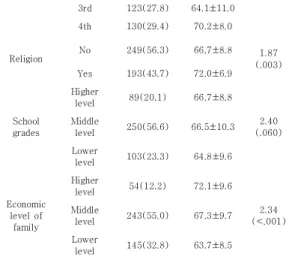
The respect for life and will among nursing students showed a statistically significant difference according to the grade, religion, and economic level of family (see Table 1). Significantly higher respect for life and will was noted among those who had a higher grade (F=2.00, p<.001), had a religion (t=1.87, p=.003), and had higher family economic level (F=2.34, p<.001).
3.2 Descriptive statistics and correlations of research variables
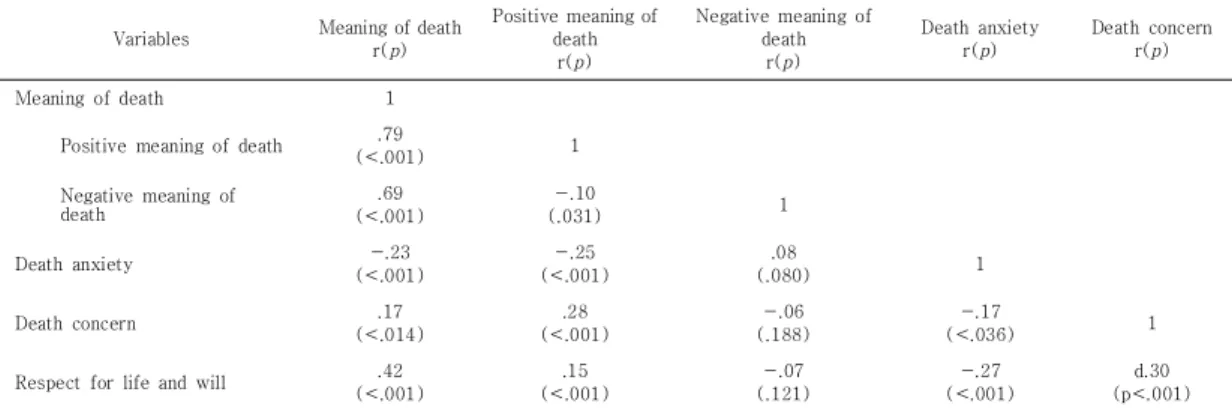
The means and standard deviations of the variables in the study are presented in Table 2, and the results of the analysis of correlations between the variables in this study are presented in Table 3.
There was a statistically significant positive correlation between meaning of death and negative meaning of death (r =. 69, p < .001), meaning of death and death of concern (r = .17, p = .014), and meaning of death and respect for life and will (r =.
42, p < .001). On the other hand, meaning of death was negatively correlated with death anxiety (r = -.23, p < .001). Among the sub-categories of death meanings, positive death of meaning was positively correlated with death of concern (r = .28, p < .001) and with respect for life and will (r = .15, p < .001).
Variables Min. Max. M±SD Ranges
Meanings of death 97 207 155.59±20.2
8 35~245
Positive meaning of
death 40 115 80.15±14.76 19~133
Negative meaning of
death 44 106 75.44±12.48 16~112
Death anxiety 10 70 37.86±12.38 10~70
Death concern 16 64 42.52±8.75 10~70
Life respect and will 48 84 66.77±8.48 12~84 Table 2. Scores of variables (N=422) Variables Category n(%) or
M±SD
Respect for life and will M±SD t or F(p)
Age(years) 19.48±1.50
Gender Male 121(27.4) 61.7±8.3 1.64
(.051) Female 321(72.6) 67.7±7.3
Siblings
First 184(41.6) 69.5±8.8
1.65 (.130) Middle 66(14.9) 632±6.3
Last 150(33.9) 60.5±9.0 Only
Child 42(9.5) 61.2±6.9
Grade
1st 85(19.2) 58.9±6.5
2.00 (<.001)
2nd 100(22.6) 63.4±6.8
Table 1. Respect for life and will according to socio-demographic and general characteristics
(N=442)
3rd 123(27.8) 64.1±11.0
4th 130(29.4) 70.2±8.0
Religion No 249(56.3) 66.7±8.8 1.87
(.003)
Yes 193(43.7) 72.0±6.9
School grades
Higher
level 89(20.1) 66.7±8.8 2.40 (.060) Middle
level 250(56.6) 66.5±10.3 Lower
level 103(23.3) 64.8±9.6
Economic level of
family
Higher
level 54(12.2) 72.1±9.6 2.34 (<.001) Middle
level 243(55.0) 67.3±9.7 Lower
level 145(32.8) 63.7±8.5
However, positive meaning of death was negatively correlated with negative meaning of death (r = -.10, p = .031) and death anxiety (r = -.25, p <.001). Death anxiety was negatively correlated with death concern (r = -.17, p < .036) and respect for life and will (r = -.27, p < .001). Additionally, there was a positive correlation between death concern and respect for life and will (r = .30, p < .001).
3.3 Factors influencing respect for life and will
Multiple regression analysis reveals that the factors influencing life respect and will include positive meaning of death (β = .45, p < .001), death concern (β = .30, p = .002), death anxiety (β = -. 26, p
= .016), and religion (β = .19, p = .045), respectively. The explanatory power of these four factors was 43.6%
(see Table 4).
4. Discussion
The results of this study revealed that positive meaning of death, positive meaning of death, death concern, death anxiety and religion were the most significant factors affecting the respect for life and will of nursing students. However, since few studies have examined respect for life and will for nursing students, there is a limitation in terms of the number of existing studies whose results can be compared with the present study.
The results of this study suggest that positive meaning of death, death concern, and death anxiety affect the respect for life and will of nursing students, and that there is a significant correlation between positive meaning of death, death concern, death anxiety, and respect for life
Variables Meaning of death r(p)
Positive meaning of death
r(p)
Negative meaning of death
r(p)
Death anxiety r(p)
Death concern r(p)
Meaning of death 1
Positive meaning of death .79
(<.001) 1
Negative meaning of death
.69 (<.001)
-.10
(.031) 1
Death anxiety -.23
(<.001)
-.25 (<.001)
.08
(.080) 1
Death concern .17
(<.014)
.28 (<.001)
-.06 (.188)
-.17
(<.036) 1
Respect for life and will .42 (<.001)
.15 (<.001)
-.07 (.121)
-.27 (<.001)
d.30 (p<.001) Table 3. Correlations of meaning of death, death anxiety, death concern, and respect for life and will (N=442)
Variables B SE β t p
(Constant) 52.59 .19 7.62 <.001
Grade 0.48 .02 .02 0.59 .554
Religion -0.39 .05 .19 2.01 .045
Economic level
of family 0.83 .01 .05 -1.11 .265
Positive meaning
of death 0.08 .02 .45 2.84 <.001
Death anxiety -0.04 .08 -.26 -0.50 .016
Death concern 0.06 .04 .30 1.26 .002
F (p) 12.06(<.001)
R² .684
Adjusted R² .436
Table 4. Factors influencing sub-scale of respect for life and will (N=442)
and will similar to Kang’s study. Nurses with a negative attitude toward death are more anxious about death and attempt to avoid death. The results of an existing study [14] report that this attitude does not help provide comfortable nursing care for the disabled or family members [15, 16]. In particular, nursing students experience more deaths in their major course or clinical practice than other students. In the experience of death, nursing students may have difficulty adapting to the life of the department and adjusting to the field because of fear of death and post-death performance [17-19]. In addition, when the nurses’
perception of death is uncertain, end-of-life patients experience stress, fear, and anxiety [20].
Kim et al. [21] reported that the attitude toward death of nursing providers determines the quality of nursing care for end-of-life patients, thus indicating the importance of the right attitude toward nursing death. When handling a nursing patient, the nurse is responsible for accepting death as a course of life and nursing with dignity so that they can finish their life quietly. It is necessary to positively and openly accept death as well as firmly establish their attitude toward death and death process [22]. In other words, the nurse should be aware of the positive meaning of death in order to be able to care for the patient at the final stage of their life.
Therefore, it is necessary for college students to recognize the positive meaning of death via education before becoming a nurse. This education intervention will help to reduce fear of on-the-job training and help adapt to field practice if nursing students have a clear perception of death by understanding death and thinking about the meaning of life and death prior to on-the-job training [23, 24]. In addition, we believe that the formation of meaningful positive deaths will improve the respect for life and will of nursing students, and will ultimately help them grow into a nurse who can really help the patient who is about to die.
Finally, having a religion had a significant
impact on respect for life and will. This result is similar to the results of existing studies [6, 14] in which religious nurses reported that they considered death positively and that their anxiety was low. Although we cannot force nurses to have a religion, it appears that having a religion helps reduce the nurse’s anxiety of death and form a positive death meaning. Therefore, it is necessary to consider spiritual factors as well as cognitive and emotional factors in the development of interventions to improve the respect for life and will of nursing students and nurses. , there were limitations in comparing and analyzing the results with existing studies.
5. Conclusion
The attitude toward nurses’ deaths is important because it determines the quality of nursing care for end-of-life patients. Since the formation of the right attitude toward death is difficult to achieve in a short period of time, it is necessary to provide education related to death for nurses when they are nursing students. Death-related education interventions, as confirmed in the present study, will generate a positive attitude towards death and specific goals of reducing death concerns and death anxiety, which should improve nursing students’ respect for life and will. When such education is provided to nursing students, it will help them ultimately become nurses who can play their roles in nursing patients and their families by having clear views on death.
Acknowledgments
This research did not receive any specific grant from funding agencies in the public, commercial, or not-for-profit sectors. In this study was no conflict of interest.
REFERENCES
[1] K. S. Lee. (2013). The bioethical experience of nurses.
Doctoral dissertation. Chung-Ang University, Seoul.
[2] K. Y. Park. (2000). Organ transplantation and biomedical ethics. Korean journal of medical ethics education, 3(1),13-26.
[3] Y. H. Kim, Y. S. Yoo & O. H. Cho. (2013). Nursing Students' Awareness of Biomedical Ethics and Attitudes toward Death of Terminal Patients. Korean Society For Hospice And Palliative Care, 16(1),1-9.
[4] A. K. Kim & G. S. Park. (2000). The study of meaning in euthanasia and hospice nursing among nurses.
Journal of Korean Academy of Fundamentals of Nursing, 7(3),379-390.
[5] E. M. Hyun. (2014). Effect of death education program for university students. Journal of Korea Academia-Industrial cooperation Society, 15(7), 4220-4228. DOI : 10.5762/KAIS.2014.15.7.4220 [6] Y. R. Cha. (2006). A study on the nurses’ attitude to
death in Korea centering on university hospital in Jeollabuckdo province. Master’s thesis. Wonkawang University, Iksan.
[7] S. J. Park & S. H. Choi. (1996) A study on the degrees of death orientation and terminal care performance of nurses. Journal of Korean Academy of Fundamentals of Nursing, 3(2), 285-297.
[8] J. G. Kim, S. M. Oh, E. Y. Cheon & J. H. Yoo. (2016).
Factors influencing the attitude toward death in college nursing student. Journal of Korea Academia-Industrial cooperation Society, 17(1), 676-683. DOI : 10.5762/KAIS.2016.17.1.676 [9] Y. Inumiya & S. Y. Han. (2004). A study on
development of a view of life and death scale. Korean Journal of Psychological and Social Issue, 10(1), 31-82.
[10] S. N. Kim, H. J. Kim & S. O. Choi. (2011). Palliative care education program including meaning in life on attitudes toward end-of-life care and meaning in life among nursing college students. The Journal of Korean Academic Society of Nursing Education, 17(3), 453-463.
[11] I. S. Kim. (2013). Effects of bioethics education on the consciousness of bioethics of freshman nursing and health students. Journal of the Korean Medical Association, 14(1), 1-13.
[12] F. Faul, E. Erdfelder & A. Buchner. (2007). G* Power 3:
A flexible statistical power analysis program for the social, behavioral, and biomedical sciences. Behavior Research Methods, 39, 175-191. DOI : 10.3758/BF03193146.
[13] Y. Inumiya. (2002). A study on development of a view of life and death scale and relationships among its elements. Doctoral dissertation. Korea University, Seoul.
[14] J. H. Kang & S. L. Han. (2013). A study of intensive care unit nurses’ understanding of the meaning. of death, death anxiety, death concern and respect for life. The Korean Journal of Hospice and Palliative Care, 16(2).80-89.
DOI : 10.14475/kjhpc.2013.16.2.080.
[15] M. Braun, D. Gordon & B. Uziely. (2010). Associations between oncology nurses' attitudes toward death and caring for dying patients. Oncology Nursing Forum, 37(1), 43-49.
DOI : 10.1188/10.ONF.E43-E49.
[16] G. Y. Lim & S. Y. Choi. (2019). The Influence of Ethical Dilemma and End-of-life Care Stress on Burnout in Longterm Care Hospital Nurses. Journal of the Korea Convergence Society, 10(6),355-363.
DOI : 10.15207/JKCS.2019.10.6.355
[17] M. K. Cho. (2013). A comparative study on the consciousness of bio-medical ethics of nursing and non-nursing students. Journal of Digital Convergence, 11(4), 311-320.
DOI : 10.14400/JDPM.2013.11.4.311.
[18] K. D. Kim. (2016). The effects of hospice unit practice education on spiritual well-being, attitude to death, and hospice awareness of nursing students. Asian Oncology Nursing, 16(4), 176-184.
DOI : 10.5388/aon.2016.16.4.176.
[19] Y. S. Park & J. H. Kim. (2017). Influence of attitude to death and resilience on terminal care attitude among Korean Nursing students. The Journal of Korean Academic Society of Nursing Education, 23(1),37-47.
DOI : 10.5977/jkasne.2017.23.1.37.
[20] M. S. An & K. J. Lee. (2014). Awareness of good death and attitudes toward terminal care among geriatric hospital nurses. The Korean Journal of Hospice and Palliative Care, 17(3), 122-133.
DOI : 10.14475/kjhpc.2014.17.3.122.
[21] K. H. Kim, K. D. Kim, H. S. Byun & B. Y. Chung.
(2010). Spiritual well-being, self esteem, and attitude to death among nursing students. Journal of Korean Oncology Nursing, 10(1),1-9.
[22] E. Hong, M. Jun, E. S. Park & E. Ryu. (2013). Death perceptions, death anxiety, and attitudes to death in oncology nurses. Asian Oncology Nursing, 13, 265-272.
DOI : 10.5388/aon.2013.13.4.265
[23] S. N. Kim, H. J. Kim & S. O. Choi. (2011). Effects of a hospice and palliative care education program including meaning in life on attitudes toward end-of-life care and meaning in life among nursing college students. The Journal of Korean Academic Society of Nursing Education, 17(3),454-463.
[24] C. H. Lee, S. Y. Ahn, Y. H.a Kim & K. H Kim. (2019) Convergence Research on Relationships among the inhibiting factors of Dying Well. Journal of the Korea Convergence Society, 10(8),37-44.
DOI : 10.15207/JKCS.2019.10.8.037
박 영 희(Younghee Park) [정회원]
․ 2008년 2월 : 고려대학교 대학원 간호 학과(간호학석사)
․ 2013년 2월 : 고려대학교 대학원 간호 학과(간호학박사)
․ 2014년 3월 ~ 현재 : 동국대학교 간호 학과 조교수)
․ 관심분야 : 대사증후군, 스트레스, 의사 소통
․ E-Mail : [email protected]