44(3) : 286∼ 290 (2013)
286
만형자의 항알레르기 및 항염증효과
유진수1·채병숙1·김대근1·최 훈1·박정숙2·이재혁3·김상현4*·신태용1*
1우석대학교 약학대학, 2남부대학교 대체의학과,
3남부대학교 한방제약개발학과, 4경북대학교 의과대학
Antiallergic and Anti-inflammatory Effects of the Viticis Fructus
Jin-Su You1, Byeong Suk Chae1, Dae Keun Kim1, Xun Cui1, Jeong-Suk Park2, Jae Hyeok Lee3, Sang-Hyun Kim4* and Tae-Yong Shin1*
1College of Pharmacy, Woosuk University, Jeonju 565-701, Korea
2Dept. of Alternative Medicine, Nambu University, Gwangju 506-706, Korea
3Dept. of Oriental Pharmaceutical Development, Nambu University, Gwangju 506-706, Korea
4Dept. of Pharmacology, School of Medicine, Kyungpook National University, Daegu 700-422, Korea
Abstract − This study was carried out to the determine the effects of the water extract of Viticis Fructus (Verbenaceae, WEVF) on experimental allergic reactions and inflammation. WEVF was anally administered to mice for high and fast absorption.
WEVF inhibited compound 48/80-induced systemic anaphylaxis and immunoglobulin E (IgE)-mediated local allergic reaction.
Histamine releasing from mast cells was reduced by WEVF, which was mediated by modulation of intracellular calcium. In addition, WEVF decreased the gene expression of pro-inflammatory cytokines in phorbol 12-myristate 13-acetate plus calcium ionophore A23187 (PMACI)-stimulated HMC-1 cells. These findings demonstrate that the WEVF possesses antiallergic and anti-inflammatory activities, which may be mediated by reducing the release of mediators such as histamine from mast cells and weakening the inflammatory action of these mediators.
Key words − Viticis Fructus, allergic inflammation, mast cell, histamine, pro-inflammatory cytokine, intracellular Ca2+
만형자(Viticis Fructus)는 마편초과(Verbenaceae)의 순비기 나무(Vitex rotundifolia L)의 성숙한 과실을 건조한 것이다.1,2) 만형자의 성분으로는 labdane-type diterpene으로 vitexifolin A, vitetrifolin B, C, vitexilatone, abietane-type diterpene으 로 vitetrifolin A, abeoabietane-type diterpene으로 vitexifolin C, norlabdane diterpene으로 vitexifolin D, E 등이 분리 보 고되어 있으며 flavonoid 화합물로 casticin, artemetin 등이 보고되어 있다. 이 외 campene, pinene 등의 정유와 vitricin 등의 알칼로이드가 보고되어 있다.3-7)
만형자의 약리작용으로는 진통 및 항염증작용, 항암작용, 즉시형 알레르기 반응 억제작용, 거담작용 및 기관지 평활 근 이완작용 등이 보고되어 있으며 한방에서는 진정, 소염 약으로서 두통, 감기, 관절통 등에 응용되고 있다.8-12)
비만세포는 전신의 장기나 조직에 분포하고 있으며 알레 르기 반응의 유발에 필수적인 세포로 알려져 있다.13) 비만
세포의 탈과립을 유도하는 활성화는 다가성 항원이 IgE 고 친화성 수용체인 FceRI와 응집체를 형성하여 일어나게 되 며 IgE 수용체를 통한 자극 외에 compound 48/80, protein kinase C(PKC) activator인 phorbol 12-myristate 13-acetate 와 calcium ionophore A23187 등과 같은 약리학적 복합물 질에 의해 일어나게 된다.14-16) 비만세포의 탈과립 유도물질 중 compound 48/80은 비만세포 내의 칼슘 수준을 증가시 켜 전신성 알레르기 반응을 일으키며 적당량의 compound 48/80은 아나필락시의 기전을 연구하기 위한 히스타민 유리 촉진제로서 널리 사용되고 있다.17,18) 비만세포의 탈과립에 의해 과립 내에 저장되어 있던 화학적 매개물질이 유리되 며 이들 중 히스타민은 즉시형 과민반응을 유발하는 가장 강력한 생리활성물질로 알려져 있다.19) 비만세포의 활성화 로 화학적 매개물질 이외에도 염증성 사이토카인인 tumor necrosis factor(TNF-α), Interleukin(IL)-1β, IL-6, IL-8 등이 분비되며 이러한 염증유발성 물질에 의해 알레르기 염증반 응이 유도된다.20-23) 따라서 비만세포로부터 이들 사이토카
*교신저자(E-mail):[email protected], [email protected] (Tel): +82-53-420-4838, +82-63-290-1572
인의 분비에 대한 조절은 알레르기 염증성 질환에 대한 치 료 수단이 될 수 있다.
직장을 통한 약물송달 시스템은 경구 투여가 어려운 환자 에게 유용하며 흡수속도를 증가시킬 수 있는 약물투여 방 법 중 하나이다.24)
본 연구에서는 만형자의 물 추출물(WEVF)이 알레르기 반응 및 염증반응에 미치는 효과를 확인하기 위하여 생체 내 실험으로 약물의 직장 투여에 의한 compound 48/80 유 도 전신성 알레르기 반응과 anti-DNP IgE 매개 국소성 알 레르기 반응에 대한 실험을 하였다. 또 생체외 실험으로 인 체 비만세포주인 HMC-1 세포에서 phorbol 12-myristate 13- acetate와 calcium ionophore A23187(PMACI)에 의한 히스 타민 유리, 세포내 칼슘의 분석 및 염증유발성 사이토카인 의 유전자 발현에 대한 영향을 검토하였다.
재료 및 방법
시약 및 세포배양 − Compound 48/80, anti-dinitrophenyl (DNP) IgE, DNP-human serum albumin (HSA), phorbol 12-myristate 13-acetate, calcium ionophore A23187은 Sigma (St. Louis, MO, USA)사에서 구입하였다. TNF-α와 IL-6는 R & D사 (Minneapolis, MN, USA) 제품을 사용하였다.
HMC-1 세포는 10% fetal bovine serum (FBS)이 첨가된 Life Technologies사(Grand Island, NY, USA)의 Iscove’s media에서 배양하였다.
실험동물 − ICR계 mouse는 대한 바이오링크 (충북)에서 구입하여 실험에 사용할 때까지 온도 22±2oC, 상대습도 55±5%로 유지되는 항온, 항습 사육실에서 사육하였다.
실험재료(WEVF) − 본 실험에 사용된 만형자(Viticis Fructus) 는 보화당 한의원(전주)에서 구입하였으며 우석대학교 약대 임종필 교수의 감수를 받아 실험에 사용하였다. 만형자를 분쇄 후 정제수로 수욕상에서 5시간 추출하고 감압 농축한 다음 동결 건조하였다. 이 추출물을 사용 직전에 생리식염 수 또는 Tyrode buffer A (10 mM HEPES, 130 mM NaCl, 5 mM KCl, 1.4 mM CaCl2, 1 mM MgCl2, 5.6 mM glucose, 0.1% bovine serum albumin)를 사용하여 일정 농도로 조제 하였다.
세포독성 − WEVF에 대한 세포독성은 신 등의 방법25)에 따 라 3-(4,5-dimethylthiazol-2yl)-2,5-diphenyltetrazolium bromide (MTT) assay에 의해 cell viability를 측정하였다. MTT법은 mitochondrial dehydrogenases에 의해 MTT가 formazan으로 전환되는 것에 의해 cell viability를 측정한다. 96 well plate 에 1×10⁵ cells/well의 HMC-1 세포를 분주하고 WEVF를 처 리한 후 24시간 배양한 다음 24 µL의 MTT(5 mg/mL)를 가 해 4시간 반응시킨 후 PowerWavex Microplate spectropho- tometer(Bio-Tec Instrument Inc. Winooski, VT)를 사용하여
570 nm에서 흡광도를 측정하였다.
Compound 48/80에 의한 전신성 아나필락시 − 김 등24) 의 방법에 따라 실험하였다. 즉 비만세포의 탈과립제로 compound 48/80(8 mg/kg, 체중)을 생쥐의 복강 내에 주사 하였다. WEVF(5-1000 mg/kg, 체중)는 compound 48/80 주 사 1시간 전에 직장으로 투여하였다. 또 시간의존 실험으로 compound 48/80을 투여하고 5분, 10분 및 20분 후에 각각 WEVF(1000 mg/kg, 체중)을 직장으로 투여하였다. 치사율 실험은 아나필락시 쇽을 유발시킨 후 1시간 동안 관찰하였다.
수동 피부 아나필락시(PCA) − 김 등24)의 방법에 따라 실 험하였다. 즉 anti-DNP IgE 100 µg을 생쥐의 등에 피내 주 사하여 감작시킨 다음 48시간 후에 꼬리 정맥에 DNP-HSA 1 mg과 evans blue 16 mg을 포함한 생리식염수를 주사하여 항원 항체 반응을 야기 시켰다. anti-DNP IgE로 감작시킨 비만세포를 DNP-HSA로 탈감작시키기 1시간 전에 WEVF (1-1000 mg/kg, 체중)를 직장투여 하고 30분 후에 치사시켰 다. Evans blue로 염색된 피부 부위를 잘라 1 M-KOH 1 mL 를 가하고 인산과 아세톤(5:13)의 혼액 9 mL를 가하여 색소 를 추출한 후 spectrophotometer(Ultrospec 2100 pro uv/vis spectrophotometer, Amersham Biosciences, England)로 620 에서 색소량을 측정하였다.
히스타민의 정량 − 세포배양액 중의 히스타민은 김 등26) 의 방법에 따라 실험하였다. 즉 o-phthaldialdehyde로 히스 타민을 형광유도체화 시킨 후 λex = 353 nm, λem = 438 nm 에서 상대 형광광도를 측정하여 정량하였다.
RT-PCR을 이용한 유전자 발현 분석 − RNA를 분리 kit 를 사용하여 세포로부터 total RNA를 분리하고 분리된 total RNA의 흡광도를 측정하여 정량한 후 1 µg의 RNA로 cDNA 를 합성한 후 주형으로 한 다음 primer를 사용하여 PCR를 증폭하였다.
세포내 칼슘의 분석 − 세포내 칼슘은 Fluo-3/AM(Molecular Probes, Eugene, OR)을 사용하여 측정하였다. HMC-1 세포 를 Fluo-3/AM과 같이 37oC에서 30분간 배양하였다. 세포 표면의 색소를 세척한 후 PMACI를 처리하기 전 WEVF를 가하고 10분 동안 배양하였다. 형광강도는 fluorescent plate reader(Molecular Devices, Sunnyvale, CA)로 λex = 340 nm, λem = 500 nm에서 측정하였다.
통계학적 분석 − 실험 결과는 mean±S.E.로 표시하였으며 ANOVA와 Duncan's multiple range tests에 의해 유의성을 검정하여 p<0.05인 결과를 얻었을 때 유의성이 있는 것으 로 하였다.
결과 및 고찰
Compound 48/80 유도 전신성 알레르기 반응에 대한 WEVF의 효과 − 즉시형 과민반응에 대한 WEVF의 효과를
검토하기 위하여 compound 48/80을 사용하여 전신성 아나 필락시를 유도하였다. Compound 48/80은 세포막의 지질이
중막 투과성을 증가시키며세포막의 투과성 증가는 비만세
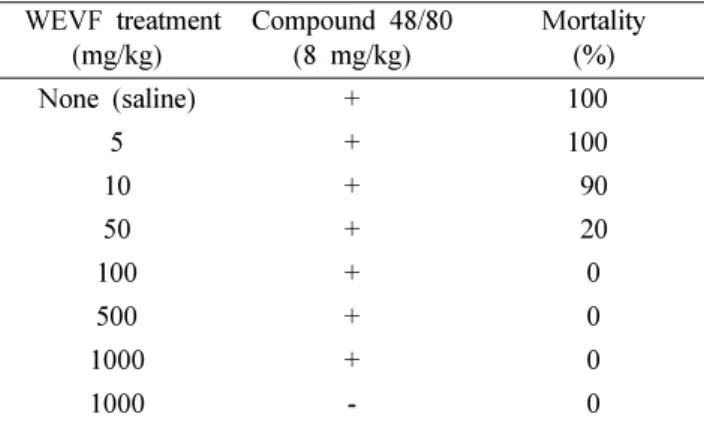
포로부터 화학적 매개물질의 유리를 촉진한다. Table I에서 와 같이 생리 식염수 200 µL를 투여한 대조군은 100% 치 사율을 나타내었다. 그러나 compound 48/80을 투여하기 1 시간 전에 WEVF(5-1000 mg/kg, 체중)를 직장 투여한 후 치 사율을 관찰한 결과 치사율이 농도 의존적으로 감소하였다.
시간의존 실험으로 compound 48/80을 투여하고 5분, 10분 및 20분 후에 WEVF(1000 mg/kg, 체중)를 직장 투여한 결 과 Table II에서와 같이 치사율은 시간 의존적으로 증가하 였다. 이들 효과는 WEVF를 복강으로 투여하였을 때와 비 슷하였다.18) 이 치사율의 실험 결과는 WEVF의 전신적 투 여에 의해 비만세포 매개 전신성 알레르기 반응이 조절될
수 있음을 시사하고 있으며 이러한 작용은 WEVF의 지질 이중막 안정화작용에 의한 것으로 사료된다.
PCA 반응에 대한 WEVF의 효과 − PCA 반응에 미치는 WEVF의 효과를 검토하기 위하여 DNP-HSA와 evans blue 의 혼합액을 투여하기 1시간 전에 WEVF(1-1000 mg/kg)를 직장 투여 하였다. WEVF의 투여에 의해 PCA 반응은 농도 의존적으로 억제되었다(Fig. 1). 이러한 결과는 WEVF가 피 부에서 세포막의 유동성을 안정화시켜 비만세포의 탈과립 을 조절하는 작용으로 알레르기 질환 특히 피부 알레르기 질환의 치료에 도움이 될 수 있음을 시사하고 있다.
세포독성에 대한 WEVF의 영향 − WEVF의 세포독성을 검토하기 위하여 HMC-1 세포에 WEVF를 처리한 후 MTT 법으로 cell viability를 측정하였으며 양성대조군으로 H2O2 를 사용하였다. WEVF(0.1-100 µg/mL)는 세포독성을 나타 Table I. Effect of WEVF on compound 48/80-induced
systemic anaphylaxis WEVF treatment
(mg/kg)
Compound 48/80 (8 mg/kg)
Mortality (%)
None (saline) + 100
5 + 100
10 + 90
50 + 20
100 + 0
500 + 0
1000 + 0
1000 - 0
Groups of mice (n=10/group) were anally pretreated with saline (200 µL) or WEVF. WEVF was given at various doses 1 h before the compound 48/80 injection. The compound 48/80 solution was intraperitoneally given to the group of mice. Mortality (%) within 1 h following compound 48/80 injection was represented as the number of dead mice×100/
total number of experimental mice.
Table II. Time-dependent effect of WEVF on compound 48/
80-induced systemic anaphylaxis WEVF treatment
(mg/kg)
Time (min)
Compound 48/80 (8 mg/kg)
Mortality (%)
None (saline) + 100
1000 5 + 30
10 + 60
20 + 100
Groups of mice (n=10/group) were anally pretreated with saline (200 µL) or WEVF. WEVF (1000 mg/kg) was given at 5 min, 10 min and 20 min after compound 48/80 injection.
The compound 48/80 solution was intraperitoneally given to the group of mice. Mortality (%) within 1 h following compound 48/80 injection was represented as the number of dead mice×100/total number of experimental mice.
Fig 1. Effect of WEVF on PCA. WEVF was anally admin- istered 1 h prior to the challenge with antigen. Each value rep- resents the mean ± SEM of three independent experiments.
*Significantly different from the saline value at p<0.05.
Fig. 2. Effect of WEVF on HMC-1 cell viability. Cells were treated with various concentrations of WEVF (0.1 to 100 µg/
mL) for 24 h. The cell viability was determined using MTT assay. Cell viability was determined by the relative absorbance, compared to control. Each value represents the mean ± SEM of three independent experiments. *Significant difference from PMACI value at p<0.05.
내지 않았다(Fig. 2).
비만세포로부터 히스타민 유리에 미치는 WEVF의 효 과 − 비만세포에 PMACI를 처리하면 비만세포가 활성화 되 면서 세포내 알레르기 유발물질인 히스타민이 유리된다.
HMC-1 세포에서 히스타민의 유리에 미치는 WEVF의 효과 를 검토하기 위하여 PMACI를 처리하기 10분전에 WEVF 를 처리하였으며 양성대조군으로 항알레르기 효과가 검증 된 gallic acid(GA)26)를 사용하였다. WEVF(1-100 µg/mL)는 비만세포에서 PMACI에 의한 히스타민의 유리를 농도 의 존적으로 억제하였다(Fig. 3).
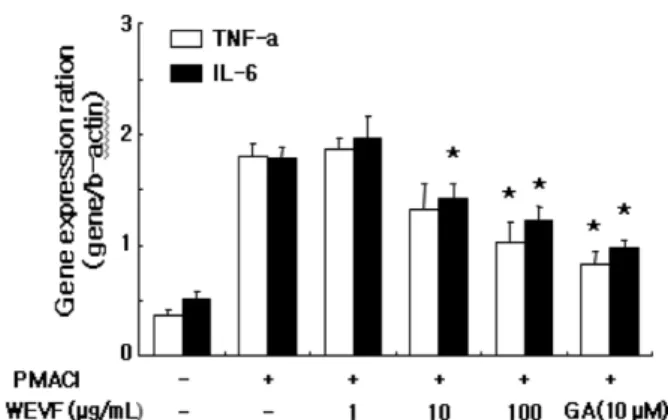
염증유발성 사이토카인의 유전자 발현에 대한 WEVF의 효과 − TNF-α, IL-4, IL-6 및 IL-8 등은 잘 알려진 염증유발 물질이며 PMACI의 자극에 의해 비만세포에서 발현된다.
비만세포 유래 염증유발에 대한 WEVF의 효과를 검토하기 위하여 HMC-1 세포를 PMACI로 자극하기 1시간 전에 WEVF을 처리하였다. WEVF(1-100 µg/mL)는 비만세포에 서 PMACI에 의한 TNF-α와 IL-6의 유전자 발현을 농도 의 존적으로 억제하였다(Fig. 4). 이 결과는 WEVF의 항알레르 기 염증효과는 WEVF가 비만세포로부터 TNF-a와 IL-6를 감소시키는 작용기전에 의한 것임을 시사하고 있다.
세포내 칼슘에 대한 WEVF의 효과 − 비만세포로부터 히 스타민의 유리는 세포내 칼슘농도에 의해 조절 된다.27) WEVF의 히스타민 유리 억제 기전을 검토하기 위하여 비 만세포내 칼슘의 양을 측정하였다. 양성대조군으로 gallic acid와 칼슘 chelator인 1,2-bis(2-aminophenoxy) ethane–
N,N,N,’N’-tetraacetic acid acetoxymethyl ester(BAPTA-AM) (BAPTA)을 사용하였다. WEVF(1-100 µg/mL)는 HMC-1 세 포에서 PMACI에 의한 세포내 칼슘의 증가를 농도 의존적 으로 억제하였다(Fig. 5). 이러한 결과는 WEVF가 비만세포 의 칼슘 농도를 억제하여 히스타민의 유리를 억제는 것으 로 사료된다.
결 론
WEVF의 항알레르기와 항염증효과를 실험한 결과는 다 음과 같다.
1. WEVF는 compound 48/80에 의해 유도된 전신성 알레 르기반응 및 anti-DNP IgE로 유도된 국소성 알레르기반응 을 농도 의존적으로 억제하였다.
2. WEVF는 HMC-1 세포에서 PMACI에 의해 유도된 칼 슘농도의 증가를 억제하는 기전으로 히스타민의 유리를 억 제하였다.
3. WEVF는 PMACI로 자극된 HMC-1 세포에서 TNF-α 와 IL-6의 유전자 발현을 억제하였다.
이러한 결과는 WEVF가 비만세포 매개 알레르기 염증성 질환의 예방 및 치료에 사용 될 수 있음을 시사하고 있다.
Fig. 3. Effect of WEVF on PMACI-induced histamine release.
HMC-1 cells (1×10⁶cells/ml) were preincubated with WEVF at 37oC for 10min prior to incubation with PMACI. Each value represents the mean ± SEM of three independent exper- iments. *Significant difference from PMACI value at p<0.05.
Fig. 4. Effect of WEVF on the gene expression of pro-inflam- matory cytokines in mast cells. HMC-1 cells were pretreated with WEVF for 30 min prior to PMACI stimulation. The gene expression of TNF-α and IL-6 were determined by RT-PCR.
Fig. 5. Effect of WEVF on intracellular calcium levels in mast cells. HMC-1 cells were preincubated for 10 min with WEVF before adding PMACI, and then for another 10 min with PMACI. Each value represents the mean ± SEM of three inde- pendent experiments. *Significant difference from PMACI value at p<0.05.
사 사
본 연구는 우석대학교 학술연구비로 연구되었으며 이에 감사드린다.
인용문헌
1.박종희 (2002) 한약백과도감(상), 232-233, 신일북스, 서울.
2. Zhu, Y. P. (1998) Chinese Materia Medica, Pharmacology and applications. 105-106, Harwood Academic Publishers, Amsterdam.
3. Ono, M., Yamamoto, M., Yanaka, T., Ito, Y. and Nohara, T.
(2001) Ten new labdane-type diterpenes from the fruit of Vitex rotundifolia. Chem. Pharm. Bull. 49: 82-86.
4. Ono, M., Sawamura, H., Ito, Y., Mizuki, K. and Nohara, T.
(2000) Diterpenoids from the fruits of Vitex trifolia. Phy- tochemistry 55: 873-877.
5. Ono, M., Yamamoto, M., Masuoka, C., Ito, Y., Yamashita, M.
and Nohara, T. (1999) Diterpenes from the fruits of Vitex rotundifolia. J. Nat. Prod. 62: 1532-1537.
6. Ono, M., Yanaka, T., Yamamoto, M., Ito, Y. and Nohara, T.
(2002) New diterpenes and norditerpenes from the fruit of Vitex rotundifolia. J. Nat. Prod. 65: 537-541.
7. Ko, W. G., Kang, T. H., Lee, S. J., Kim, N. Y., Kim, Y. C., Sohn, D. H. and Lee, B. H. (2000) Polymethoxyflavonoids from Vitex rotundifolia inhibit roliferation by inducing apo- ptosis in human myeloid leukemia cells. Food Chem. Toxicol.
38: 861-865.
8. Ko, W. G., Kang, T. H., Lee, S. J., Kim, Y. C. and Lee, B. H.
(2001) Rotundifuran, a labdane type diterpene from Vitex rotundifolia, induced apoptosis in human myeloid leukemia cells. Phytother. Res. 15: 535-537.
9. Okuyama, E., Fujimori, S., Yamazaki, M. and Deyama, T.
(1998) Pharmacologically active components of Viticis Fruc- tus (Vitex rotundifolia). II. The components having analgesic effects. Chem. Pharm. Bull. 46: 655-662.
10. Kobayakawa, J., Sato-Nishimori, F., Moriyasu, M. and Mat- sukawa, Y. (2004) G2-M arrest and antimitotic activity medi- ated by casticin, a flavonoid isolated from Viticis Fructus (Vitex rotundifolia Linne fil). Cancer Lett. 10: 59-64.
11. Huang, D., Qing, S., Zeng, G., Wang, Y., Guo, H., Tan, J. and Zhou, Y. (2013) Lipophilic components from Fructus Viticis Negundo and their anti-tumor activities. Fitoterapia 86: 144- 148.
12. Shin, T. Y., Kim, S. H., Lim, J. P., Suh, E. S., Jeong, H. J., Kim, B. D., Park, E. J., Hwang, W. J., Rye, D. G., Baek, S.
H., An, N. H. and Kim, H. M. (2000) Effect of Vitex rotun- difolia on immediate-type allergic reaction. J. Ethnophar- macol. 72: 443-450.
13. Lee, D. H., Kim, S. H., Eun, J. S. and Shin, T. Y. (2006) Mosla dianthera inhibits mast cell-mediated allergic reactions
through the inhibition of histamine release and inflammatory cytokine production. Toxicol. App. Pharmacol. 216: 497-484.
14. Metcalfe, D. D., Kaliner, M. and Donlon, M.A. (1981) The mast cell. Crit. Rev. Immunol. 3: 23-74.
15. Chand, N., Pillar, J., Diamantis, W., Perhach, J. L. and Sophia, R. D. (1983) Inhibition of calcium ionophore (A23187) stimulated histamine release from rat peritoneal mast cells by azelastine: implications for its mode of action.
Eur. J. Pharmacol. 96: 227-233.
16. Takei, M., Umeyama, A., Shoji, N., Arihara, S. and Endo, K.
(1995) Mechanism of inhibition of IgE-dependent histamine release from rat mast cells by penasterol and penasterone. J.
Pharm. Sci. 84: 228-230.
17. Allansmith, M. R., Baird, R. S., Ross, R. N., Barney, N. P. and Bloch, K. J. (1989) Ocular anaphylaxis induced in the rat by topical application of compound 48/80. Dose response and time course study. Acta Ophthalmol. 67: 145-153.
18. Kim, S. H., Kwon, T. K. and Shin, T. Y. (2008) Antiallergic effects of Vitis amurensis on mast cell-mediated allergy model. Exp. Biol. Med. 233: 192-199.
19. Church, M. K and Levi-Schaffer, F. (1997) The human mast cell. J. Allergy Clin. Immunol. 99: 155-160.
20. Galli, S. J., Gordon, J. R. and Wershil, B. K. (1991) Cytokine production by mast cells and basophils. Curr. Opin. Immunol.
3: 865-872.
21. Galli, S. J., Tsai, M. and Piliponsky, A. M. (2008) The devel- opment of allergic inflammation. Nature 454: 445-454.
22. Gurish, M. F., Ghildyal, N., Arm, J., Austen, K. F., Avraham, S., Reynolds, D. S. and Stevens, R. L. (1991) Cytokine mRNA are preferentially increased relative to secretory gran- ule protein mRNA in mouse bone marrow-derived mast cells that have undergone IgE-mediated activation and degranu- lation. J. Immunol. 146: 1527-1533.
23. Plaut, M., Pierce, J. H., Watson, C. J., Hanley-Hyde, J., Nor- don, R. P. and Paul, W. E. (1989) Mast cell lines produce lim- phokines in response to cross-linkage of FceRI or to calcium ionophores. Nature 339: 64-67.
24. Kim, H. H., Choi, P. H., Yoo, J.S., Jeon, H., Chae, B. S., Park, J. S., Kim, S. H. and Shin, T. Y. (2012) Ripe fruit of Rubus coreanus inhibits mast-cell-mediated allergic infalmmation.
Int. J. Mol. Med. 29: 303-310.
25. Shin, T. Y., Oh, J. M., Choi, B. J., Park, W. H., Kim, C. H., Jun, C. D. and Kim, S. H. (2006) Anti-inflammatory effect of Poncirus trifoliata fruit through inhibition of NF-κB acti- vation in mast cells. Toxicol. In Vitro 20: 1071-1076.
26. Kim, S. H., Jun, C. D., Suk, K., Choi, B. J., Lim, H., Park, S., Lee, S. H., Shin, H. Y., Kim, D. K. and Shin, T. Y. (2006) Gallic acid inhibits histamine release and pro-inflammatory cytokine production in mast cell. Toxicol. Sci. 91: 123-131.
27. Beaven, M. A. and Metzger, H. (1993) Signal transduction by Fc receptors: the FceRI case. Immunol. Today 14: 222-226.
(2013. 8. 1 접수; 2013. 8. 6 심사; 2013. 8. 30 게재확정)