• 검색 결과가 없습니다.

A Case Study on Designing a Console Design Review System Considering Operators' Viewing Range and Anthropometric Data

N/A
N/A
Protected

Academic year: 2021

Share "A Case Study on Designing a Console Design Review System Considering Operators' Viewing Range and Anthropometric Data"

Copied!
11
0
0

로드 중.... (전체 텍스트 보기)

전체 글

(1)

JESK http://jesk.or.kr eISSN:2093-8462

A Case Study on Designing a Console Design Review System Considering Operators' Viewing Range and Anthropometric Data

Woo Chang Cha, Eun Gyeong Choi

Kumoh National Institute of Technology, School of Industrial Engineering, Gyeongbuk, 39177

Corresponding Author Woo Chang Cha

Kumoh National Institute of Technology, School of Industrial Engineering, Gyeongbuk, 39177

Mobile : +82-10-7143-8611 Email : [email protected]

Received : January 31, 2017 Revised : March 02, 2017 Accepted : June 09, 2017

Objective: The aim of this study is to introduce an operator console design review system suitable for designing and evaluating consoles based on human factor guidelines for a digitalized main control room in an advanced nuclear power plant which has a requirement for anthropometric data usage.

Background: The system interface of the main control room in a nuclear power plant has been getting digitalized and consists of various consoles with many information displays. Console operators often face human-computer interactive problems due to inappropriate console design stemming from the perceptual constraints of anthropometric data usage.

Method: Computational models with a process of visual perception and variables of anthropometric data are used for designing and evaluating operator consoles suitable for human system interface guidelines, which are used in an advanced nuclear power plant.

Results: From the computational model and simulation application, console dimensions and a designing test module, which would be used for designing suitable consoles with safety concerns in a nuclear power plant, have been introduced.

Conclusion: This case study may influence employing a suitable design concept with various anthropometric data in many areas with safety concerns and may show a feasible solution to designing and evaluating the safety console dimensions.

Application: The results of this study may be used for designing a control room with the human factors requiring a safe working environment.

Keywords: Console, Anthropometry, Visual perception, Interface, HSI guidelines

Copyright@2017 by Ergonomics Society of Korea. All right reserved.

ccThis is an open-access article distributed under the terms of the Creative Commons Attribution Non-Commercial License (http://

creativecommons.org/licenses/by-nc/3.0/), which permits unrestricted non-commercial use, distribution, and reproduction in any medium, provided the original work is properly cited.
1. Introduction

As the main control room interface has been recently digitalized in a nuclear power

plant (NPP), the safety and reliability of the use environment of digital devices

including a console are emphasized more than any other systems. The interface of

NPP's main digital control room consists of various operators' workstation consoles

in addition to a large display panel (LDP) and a safety console. The hierarchy and

shape of the working environment and the flow of movement are major working

environmental factors. The shape design of a control room is a key working factor to

(2)

operators, and thus it is important to identify correlations between physical characteristics and devices' mechanical characteristics in a broad context of human-machine manipulation.

Cognitive load increases due to more information in a hybrid NPP in the digital environment than the analog environment, although physical burden has decreased. Since the possibility of causing human errors is high because of massive amount of operation information even in the case of highly skilled operators, it is critical to convey the relevant information clearly. Concerning the main control room of an existing NPP where the control of operations, such as operation, suspension, emergency, and abnormal operations, is carried out, installed indicators and control devices are over 2,000. Since surveillance using the large display panel (LDP) and control and information indication using operator consoles are conducted, it is critical to design the console shape and layout through which information identification within visual perception range is easy in order to manipulate actual devices.

However, actual design of ergonomic interface considering numerous consoles' shapes and layout is not efficiently carried out due to the lack of a comprehensive system analysis and evaluation system (Ra and Cha, 2013). This study aims to analyze the sensitivity of many independent variables according to recent anthropometric data for console design in order to optimize the operating environment from the cognitive ergonomic perspective. Ultimately, this study aims to introduce a case study on a console design evaluation system currently under development using effective viewing angles helpful to the layout of operators' directing and controlling facilities within the range of operators' information processing capabilities (Cha, 2013).

2. Method

2.1 Background research on viewing angles

Vision is a key sensory organ to the extent that about 90% of the information taken from the surroundings by humans is acquired by human's vision. Humans recognize or perceive information taken through the eyes via information processing. Visual information means information changing through human's vision, and the visual information can be understood with three characteristics: The first is sensible characteristic. When an image is formed on the retina, after light passes through each part of the eye, the sensory receptor and nerve system accept spatial physical energy; namely, light, converting it into neural information.

The second is perceptive characteristic. Human's efficient visual processing area is more than 180° horizontally and 130° vertically, and there is optical illusion in which a subject's shape or form changes according to visual angle. The third is cognitive characteristic.

After visual information arrives at the brain, the visual information, such as shape, color, or motion, is recognized through different channels. Further, knowledge is stored in the form of representing or symbolizing external objects or relationships between objects (Cha, 2016).

Humans have a certain range of field of vision, and it is defined according to visual angle identifying the outline of a subject. The cognitive level differs depending on the distance from a subject and its size. If a subject is at the same vertical side as a human, Table 1 shows human's visual relationship according to the size of a subject.

Human's useful field of view (UFOV), generally known in the ergonomics guidelines, are shown in Table 2, when a human deciphers letters, sees symbols, and distinguishes colors.

2.2 NPP guidelines' application for viewing angles

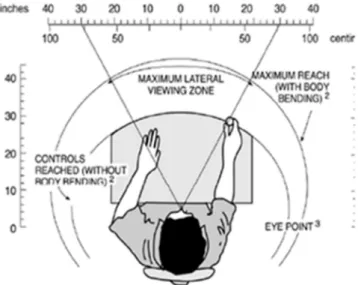
There are three types of guidelines used by applying to a digital NPP with regard to console viewing angle as shown in Figures

1, 2, and 3, and they are offered to actual ergonomic design (KEPCO E&C, 2008, 2016; NRC, 2002).

(3)

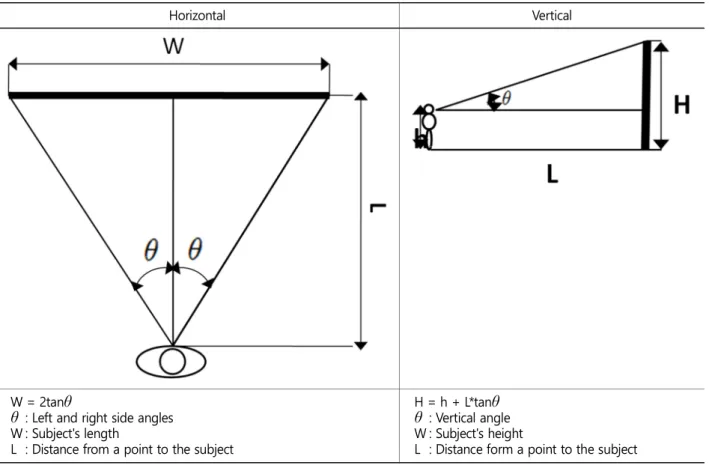
Table 1. Calculations on visual angles

Horizontal Vertical

W = 2tan θ

θ : Left and right side angles W : Subject's length

L : Distance from a point to the subject

H = h + L*tan θ θ : Vertical angle W : Subject's height

L : Distance form a point to the subject

Table 2. Guidelines on visual

Horizontal visual field Vertical visual field

General range

The visual field range through which a subject can be viewed is 1° (left and right, each), when central vertical axis is set up between the left and right eyes.

In the vertical direction, visual field tilts downwards more. At the usual time, the direction of visual field is placed at 10°

downwards.

(4)

2.2.1 Horizontal space standard of the control and display devices of a sit-down console

All the control and information display units used for main jobs of a sit-down console should be placed within the maximum values of viewing range and extended reach of a user in sit-down position (NUREG-0700(Rev.2) 11.1.2-9).

2.2.2 Standard of console VDU's vertical UFOV

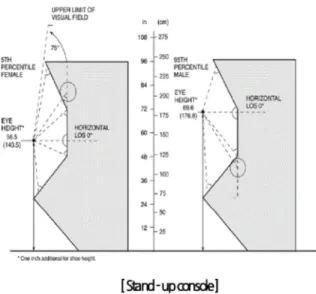
In stand-up and sit-down consoles, all information display units, including an alarm indicator, need to be offered within the 5th percentile of a female's field of view measurement (75° from horizontal field of view), and the angle that the field of view and a visual display unit (VDU) forms needs to be maintained higher than 45° (NUREG-0700(Rev.2) 11.1.2-5).

2.2.3 Actual layout range standard of VDU information

When main information display units were placed in a sit-down console, horizontal layout range was within 35° (left and right, each) centered on line of sight (LOS) by using actual console shape data, with vertical layout range designed to make LOS 40° downwards.

Table 2. Guidelines on visual (Continued)

Horizontal visual field Vertical visual field Range in deciphering letters

Same visual field axis

5~10° (left and right, each)

Centered on visual height horizon

Desirable upward visual field limit is 15°

Range by which a symbol

can be seen 5~30° (left and right, each) Upper limit: 20°

Lower limit: 30°

Range by which colors can

be distinguished. 30~60° (left and right, each)

from the central axis Upper limit: 30°

Lower limit: 40°

Figure 1. Horizontal viewing range on NPP sitting console

(5)

2.3 Anthropometric data for NPP console design

The Korean Agency for Technology and Standards' SizeKorea 7th Anthropometric Data of Koreans, which measured and investigated Koreans' anthropometric data and human shapes (KATS, 2016), were collected by console design factor item in this study for 10 months from March to December 2015. The anthropometric data of operators, aged 25-50 in NPPs required for sit-down console evaluation, were sorted out and arranged by referring to the NUREG guidelines (Table 3).

Figure 2. Vertical viewing range of NPP consoles

Figure 3. VDU layout design

(6)

2.4 Intelligent design review system

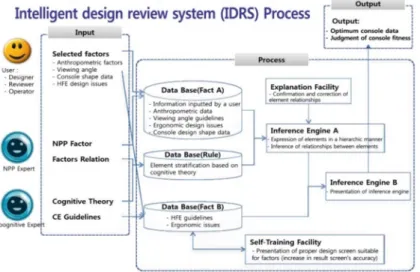
To efficiently carry out console design review and evaluation feedback, an intelligent design review system (IDRS), which is an intelligent decision making system module, was developed in a demonstrative manner (Figure 4).

Table 3. 2015 Korean anthropometric data for console design (unit: cm)

Standing Measured data (cm)

5

th

percentile of adult females 95

th

percentile of adult males

Height 150.2 181.4

Eye height 139.5 169.7

Shoulder height 120.2 147.6

Elbow height 91.2 111.8

Grip reach; forward 59.9 75.4

Viewing distance from the body 7.6 8.6

Popliteal height 34.2 43.9

Sitting height 82.2 96.2

Eye height, sitting 71.5 86.9

Shoulder height, sitting 52.3 64.8

Elbow height, sitting 21.9 30.7

Thigh clearance 12.9 18.0

Buttock-popliteal length 41.2 51.3

Knee height, sitting 44.4 55.4

Grip reach; forward, sitting 59.9 75.4

Figure 4. Intelligent design review system architecture

(7)

IDRS complies with the structure of an intelligent system. When a user (console designer or evaluator) asks a question or in puts the details concerned through the given interface, an inference is made using the details in the database and rules, and the result is conveyed to the user through the interface again. This study implemented an intelligent system by which data can be more easily collected by adding a knowledge acquisition facility, a self-training facility, and an explanation facility to the architecture.

3. Results

3.1 Console design computational model

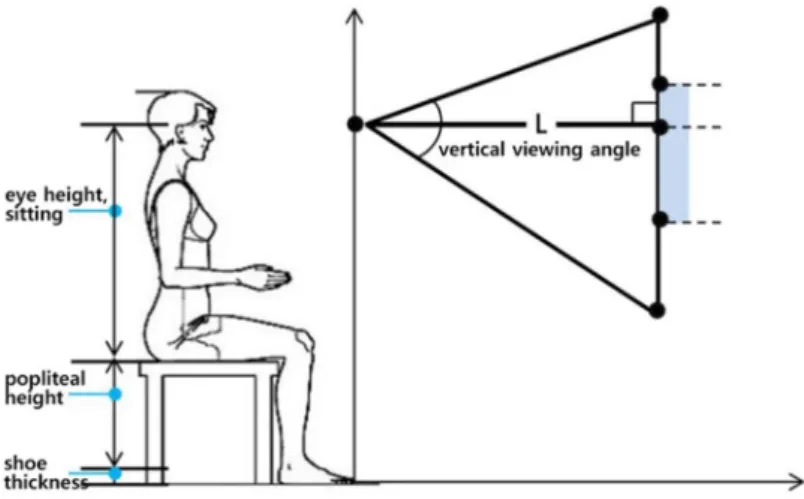
Figure 5 shows the variables and fixed values to be inputted, and also the resulting values when the system is implemented. By fixing VDU's size and the distance, L, between an operator and VDU, according to the design plan of an NPP as they are inputted as variables, each operator's eye height, popliteal height, and shoe thickness are treated as input values. For each independent variable's sensitivity analysis, the SizeKorea 7th Anthropometric Data were used.

When the program is executed, vertical viewing angles are computed according to anthropometric data. If the vertical viewing angle is set as a fixed value by referring to the guidelines, whether a VDU is within the operator's viewing angle or not is displayed as Yes/NO. Therefore it helps to generate an optimum design plan upon designing an NPP, and also an evaluation on whether the design is made well can be carried out.

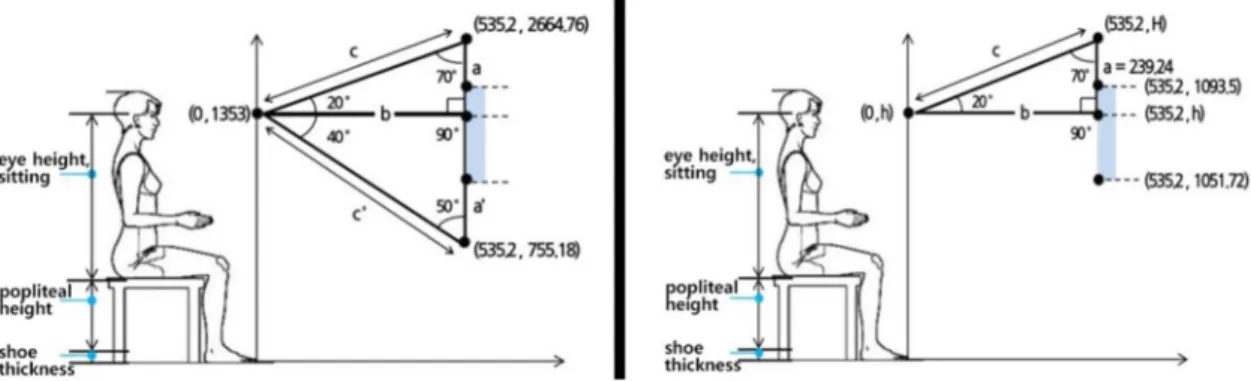
When the main information display units are placed in a sit-down console in the NPP guidelines related with VDU information layout range where NUREC-0700 Rev.2 becomes the basis, the horizontal layout range is 35° (left and right, each), centered on LOS. The vertical layout range is indicated as within 20° upwards and 40° downwards, centered on LOS. Based on this, if calculation is conducted using an example of 5

th

percentile of males through a trigonometrical function and vertical viewing angle formula, the following result values are generated: sit-down console's height, H, is 1093.5mm; distance from VDU is 535.2mm; and distance from floor to eye, h (5

th

percentile of males' eye height, sitting + popliteal height + shoe's thickness), is 1353mm. Also, the maximum height and minimum height of effective viewing angle can be calculated.

Figure 5. Console design with anthropometric data usagerm

(8)

3.2 Suitability analysis with parameters

A sensitivity analysis on whether parameter values affecting console design are suitable for the design and evaluation guidelines was undertaken by substituting the parameter values.

3.2.1 Design sensitivity analysis (male)

Using the SizeKorea 7th Anthropometric Data, when each percentile value of males aged 25-50 was substituted, height (h) from floor to eye height was calculated. According to the result values, Figures 6 and Table 4 show the values calculating the maximum h at 20° upwards, and the minimum h at 40° downwards.

3.2.2 Design sensitivity analysis (female)

Using the SizeKorea 7th Anthropometric Data, height (h) from the floor to eye can be calculated, respectively, by substituting each percentile value of females aged 25-50. According to the result values, Figures 7 and Table 5 show the values calculating the maximum h at 20° upwards, and the minimum h at 40° downwards.

3.3 Computational Model-based System Output

Based on the anthropometric data, guidelines, and console shape data, this study presented the suitability of console design results Table 4. Calculated figures for console design (male)

1

st

percentile 5

th

percentile 25

th

percentile 50

th

percentile 75

th

percentile 95

th

percentile 99

th

percentile

h 1155.5 1195.5 1241 1272 1303 1353 1388.5

H (max.)

=h+a*tan20 1394.74 1434.74 1480.74 1511.24 1542.24 1592.24 1627.74

H (mim.)

=h-a*tan40 676.36 716.36 761.86 792.86 823.86 873.86 909.36

Figure 6. Console design suitability (max., male) and console design suitability (min., male)

(9)

through IDRS' design process embedded with a decision-making inference model as shown in Figure 8.

Table 5. Calculated figures for console design (female) 1

st

percentile 5

th

percentile 25

th

percentile 50

th

percentile 75

th

percentile 95

th

percentile 99

th

percentile

h 1082 1107 1153 1181 1213 1255.5 1293

H (max.)

=h+a*tan20 1321.24 1346.24 1392.24 1420.24 1452.24 1494.74 1532.24

H (min.)

=h-a*tan40 602.86 627.86 673.86 701.86 733.86 776.36 813.86

Figure 7. Console design suitability (max., female) and console design suitability (min., female)

Figure 8. IDRS UI output screen

(10)

4. Conclusion

In a nuclear power plant (NPP), safety is regarded as most important. In a digital hybrid NPP, where the possibility of human errors has become higher due to increase in cognitive load by more information, information identification compared to the past needs to be easy for device manipulation above all. Using the viewing angle-based evaluation support system applicable to the main control room design layout in an NPP through the results of this study, whether a console's visual display units are included within the operator's effective visual field according to NPP guidelines, and whether the given information can be clearly recognized can be evaluated. Therefore, work efficiency improvement can be expected, and there can be effectiveness in terms of ergonomics in the optimum design of a console depending on individual anthropometric data to be solved, or depending on the adequate problem solving measure devised upon problems' occurrence in a console related with the viewing angles of the main control room working environment.

The main control room design of a digitalized NPP is currently conducted and evaluated according to ergonomic guideline standards, which cannot promptly cope with the frequently changing digital environment and up-to-date anthropometric data.

To improve such inefficiencies of design and rule of thumb evaluation, an intelligent console design review system, which is a currently developed design evaluation support system, will make contributions to efficient console design and the evaluation of digital NPPs by continuously embedding updated intelligent modules.

Acknowledgements

This work was funded by grants from Kumoh National Institute of Technology.

References

Cha, W., Cognitive Systems Design , Kaos Book, 2013.

Cha, W., Cognitive Interface , Kaos Book, 2016.

KATS (Korea Agency for Technology and Standard), 7

th

Korean Anthropometric Data Survey Report (http://www.sizekorea.kr), 2016.1.

KEPCO E&C, Technical Report: Environment Design for Shingori 3&4 , 2008.

KEPCO E&C, Technical Report: Environment Design for Shingori 5&6 , 2016.

Nuclear Regulatory Commission, Human System Interface Design Review Guideline (NUREG0700 Rev.2), US Nuclear Regulatory Commission, 2002.

Ra, D. and Cha, W., Development of Design Aiding System for the application of the Cognitive Interface for Information Displays,

Proceeding of the Ergonomics Society of Korea , UNIST, 2013.5.

(11)

Author listings

Woo Chang Cha: [email protected]

Highest degree: PhD, Department of Industrial Engeering, OSU Position title: Professor, Department of Industrial Engeering, KIT Areas of interest: Cognitive System Engineering, HPP modeling

Eun Gyeong Choi: [email protected]

Highest degree: B.S, Department of Engeering Design, KIT

Position title: M.S Candidate, Department of Industrial Engeering, KIT

Areas of interest: Cognitive System Engineering, Ergonomics

수치

Table 1. Calculations on visual angles
Figure 1. Horizontal viewing range on NPP sitting console
Figure 2. Vertical viewing range of NPP consoles
Figure 4. Intelligent design review system architecture
+4

참조

관련 문서

The purpose of this study is to establish and design the characteristics of summer resorts according to the design manual, develop cultural products using

Also, If you're a recognized system of various textbooks on science education and to promote the creative approach will need to review the recognition system

In terms of the mould design, the effects of runner system design and the mould temperature on filling characteristics, the weldline formation, the

This study derives the attributes of 'product design identity' from the consumer's point of view, and verified whether the 'product design identity'

The purpose of the study is to develop a sensor data collection and monitoring system with database using IoT techrology and to apply the ststem to three

 James M. Els, “Strategic management of complex projects: a case study using system dynamics”, System Dynamics Review, Vol. Gordon, “Choosing appropriate

Based on the result of such assessment, this study attempted to establish a basis for establishment of physical epidemiology research evaluation system

일반사용자 2 ADJUSTMENT & STATISTICS 정산 및 통계 관리 시스템 ECS 담당자 3 DAMAGE CONTAINER MANAGEMENT CONTAINER DAMAGE 관리..