• 검색 결과가 없습니다.

Effect on Dynamic Behavior of Group Piles with Changing Thickness of Pile Cap

N/A
N/A
Protected

Academic year: 2021

Share "Effect on Dynamic Behavior of Group Piles with Changing Thickness of Pile Cap"

Copied!
7
0
0

로드 중.... (전체 텍스트 보기)

전체 글

(1)

1) Byeokdong Construction Co., Ltd.

2) Daejon Regional Cunstruction and Management Administration

Effect on Dynamic Behavior of Group Piles with Changing Thickness of Pile Cap

Kusic Jeong

1)

・ Sangro Ahn

2)

・ Seongho Kim

3)

・ Kwangkuk Ahn

Received: May 25

th

, 2018; Revised: June 7

th

, 2018; Accepted: June 29

th

, 2018

ABSTRACT : Instead of a single pile, group piles are usually used for the pile foundation. If the earthquake occurs in the ground where group piles are installed, dynamic behavior of group piles are affected not only by interaction of piles and the ground movement but also by the pile cap. However, in Korea, the pile cap influence is not taken account into the design of group piles. Research on dynamic behavior of group piles has been performed only to verify interaction of piles and the ground and has not considered the pile cap as a factor. In this research, 1g shaking table model tests were performed to verify the thickness of the pile cap affects dynamic behavior of group piles that were installed in the ground where the earthquake would occur. The test results show that, as thickness of the pile cap increased, acceleration and horizontal displacement of the pile cap decreasd while vertical displacement of the pile cap increased. The results also showed that, among the group files tested, acceleration, horizontal displacement, and vertical displacement of the bearing pile are smaller than those of the friction pile.

Keywords : Group piles, Pile cap, Dynamic behavior, Interaction, 1 g shaking table

ISSN 1598-0820 DOI https://doi.org/10.14481/jkges.2018.19.7.5 Journal of the Korean Geo-Environmental Society

19(7): 5~11. (July 2018) http://www.kges.or.kr

1. Introduction

If the earthquake occurs in the ground where foundation structures are constructed, dynamic behavior of the ground, foundation structures, and superstructues will be changed by interaction of foundation structures and the ground.

Many researchers various model tests to identify dynamic behavior of foundation structures and the ground where the earthquake would occur (Chidichimo et al., 2014; Suzuki et al., 2014, Shirato et al., 2008; Ishizaki et al., 2012).

Numerical analysis was also conducted to make a good prediction for model tests (Chau et al., 2009; Taha et al., 2015; Bao et al, 2012).

Among foundation structures, pile foundation, which is deep foundation, is divided into a single pile and a group piles. Usually, a group piles, which are a group of single piles assembled with caps, is used to support superstructures.

If the earthquake occurs in the ground where group piles are installed, dynamic behavior of the group piles will be affected not only by interaction of piles and the ground but also by the pile cap.

However, in Korea, the design guidelines for a group

piles considers only piles and the ground condition while not considering the pile cap influence (Ministry of Land, Infrastructure and Transport, 2009). Research on dynamic behavior of group piles has been performed to verify only interaction of the pile and ground and has not considered the pile cap (Chidichimo et al., 2014; Suzuki et al., 2014, Shirato et al., 2008; Ishizaki et al., 2012; Chau et al., 2009;

Taha et al., 2015; Bao et al., 2012).

In this research, 1 g shaking table model tests were performed to verify the effect of pile-cap thickness on the dynamic behavior of group piles, which are installed in the ground where the earthquake would occur.

2. 1 g shaking table model tests

1 g shaking table model tests were performed with the following test equipment and methods to verify the way thickness of the pile cap affects dynamic behavior of group piles.

2.1 1 g shaking table model test equipment

1 g shaking table model test equipment simulates earth-

(2)

(a) Unit structure (b) Conceptual model box (c) Assembled model box

Fig. 1. Shaking table model test equipment Fig. 2. Model box

(a) Bearing piles (b) Friction piles

Fig. 3. Sketch of group piles Fig. 4. Pile caps

Table 1. Specification of shaking table model test equipment

Item Performance

Dynamic load (tonf) 2

Stroke (mm) ±100

Plate (mm) 1000 ✕1000

Frequency (Hz) 0.001 ∼1000

Maximum acceleration (g) 1

Maximum loading load (tonf) 1.0

Table 2. Physical properties of Jumunjin standard sand

Items Value

Effective grain size, D10 (mm) 0.32 Coefficient of evenness, Cu 1.65 Coefficient of curvature, Cg 1.43

Specific gravity, Gs 2.60

Unified soil classification system (USCS) SP Maximum dry unit weight, (kN/m

3

) 16.6 Minimum dry unit weight, (kN/m

3

) 13.3

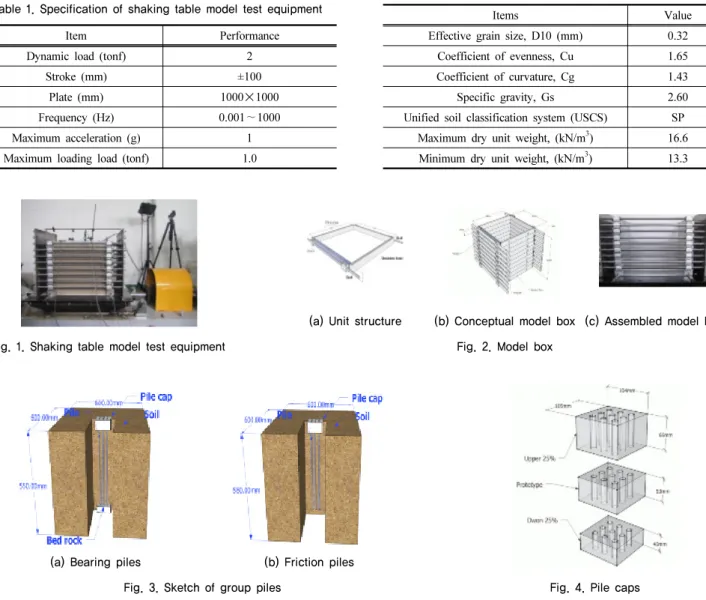
quake shaking by applying cyclic load and earthquake accelera- tion to the plate. A small scale model structure is built onto the plate where cyclic load and earthquake acceleration are applied to measure displacement and acceleration of the model structure and to identify dynamic behavior of the model structure. With test results of dynamic behavior of the model structure, dynamic behavior of the real structure will be predicted according to scaling laws. Configuration and specification of 1 g shaking table model test equipment are shown in Figure 1 and Table 1.

The model box is used to construct the ground on the plate. The model box is made of 10 layers of a unit 600 mm (B) ✕600 mm (L)✕60 mm (H) by using bearings and elastic springs. This structure helps reflection load to be absorbed at the wall of the model box most effectively because earthquake acceleration generated by the plate occurs on the wall of the model box to impact the ground.

2.2 Materials for the ground and group piles Standard sand, which is produced in Jumunjin, Korea, and of which particle size is uniform, is used for the model test.

Physical properties of standard sand are shown in the Table 2. Bearing piles and friction piles, which are scaled down to 1/40 of the original, following scaling laws, as suggested by Iai (1989), are made for model group piles. As shown in Figure 3, Bearing piles are installed bed rock, but friction piles are not installed bed rock.

Two kinds of pile caps, which were either increased or

decreased by 25% of the pile cap as shown in Figure 4,

were made to examine the effect of pile-cap thickness on

dynamic behavior of group piles. Model group piles consist

of hollow pipes and pile cap. Hollow pipes has external 12

mm of diameter and 10 mm of internal diameter, and pile

cap is made of cement mortar (K.S. I. 5105) and used as

(3)

(a) Hachinohe (b) Ofunato Fig. 5. Time history of acceleration

(a) Location of sensor (b) Installation of sensors Fig. 6. Group piles installed in the ground Fig. 7. Sensors of Location and Installation

Table 3. Specification of acceleration

Types of earthquake Earthquake occurrence Magnitude Maximum acceleration (g) Characteristics

Hachinohe Occurred in the Takachin Sea on May 16, 1968 7.8 0.170 Long period

Ofunato Occured in the Miyagi Sea on June 12, 1978 7.4 0.161 Short period

rigid foundation. Hollow pipes and pile cap are connected by rigid joint.

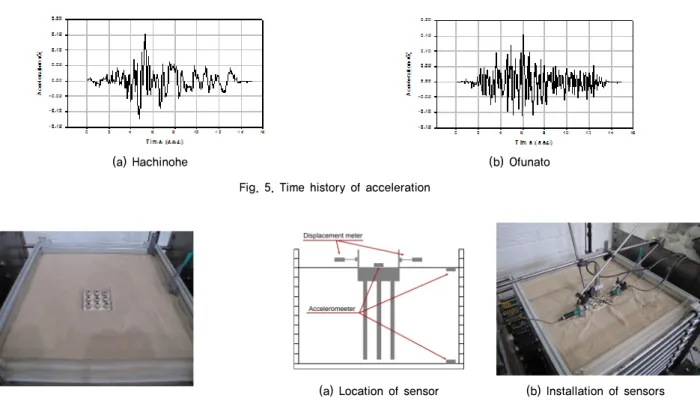
2.3 Acceleration used for the model test Group piles used for the model test are bridge substructures of level 1 earthquake-resistance for which the Korean earthquake- resistant design was taken into account. Earthquake acceleration values were selected as the no-collapse level. So, acceleration of the long period and the short period was applied to the model test as shown in Table 3 and Figure 5.

2.4 Model test methods

The model ground was constructed to verify the effect of pile-cap thickness on the dynamic behavior of group piles that are installed in the ground where the earthquake would occur. Jumunjin standard sand was put into the multi- layered calibration chamber to make unit weight and relative density to be 15.0 kN/m

3

and 57% respectively.

Among group piles installed in the model ground, bearing piles were built into the bottom of the calibration chamber

first and then the ground was constructed while friction piles were put into the holes, which were bored to the already- constructed ground. After installation of group piles, pile caps were fixed to the top of group piles to be integrated.

It was arranged that the top of pile caps corresponded to the surface of the model ground because embedment depth is not indicated in the design guidelines. Figure 6 shows the group piles installed in the model ground.

An accelerometer and a displacement meter (LVDT, the linear variable differential transformer) were arranged to the top of pile caps as shown in Figure 7, in order to verify the way pile-cap thickness affects the dynamic behavior of group piles. Another accelerometer is arranged on the ground surface to compare the acceleration n measured at the pile cap and the acceleration measured at the ground surface. Then, earth- quake acceleration is applied to the model ground to obtain the time history of displacement and acceleration.

Twelve model tests were performed in total as shown

in Table 4 to verify the way pile-cap thickness affects the

dynamic behavior of group piles.

(4)

Table 4. Model test variables

Bearing piles Friction piles

Accele-ration Hachinohe Ofunato Hachinohe Ofunato

Pile cap (mm) 40 52.5 65.5 40 52.5 65.5 40 52.5 65.5 40 52.5 65.5

Test # MBH-1 MBH-2 MBH-3 MBO-1 MBO-2 MBO-3 MFH-1 MFH-2 MFH-2 MF0-1 MF0-2 MF0-3

MBH-1 MBH-2 MBH-3

MBO-1 MBO-2 MBO-3

(a) Bearing piles

MFH-1 MFH-2 MBH-3

MFO-1 MFO-2 MBO-3

(b) Bearing piles

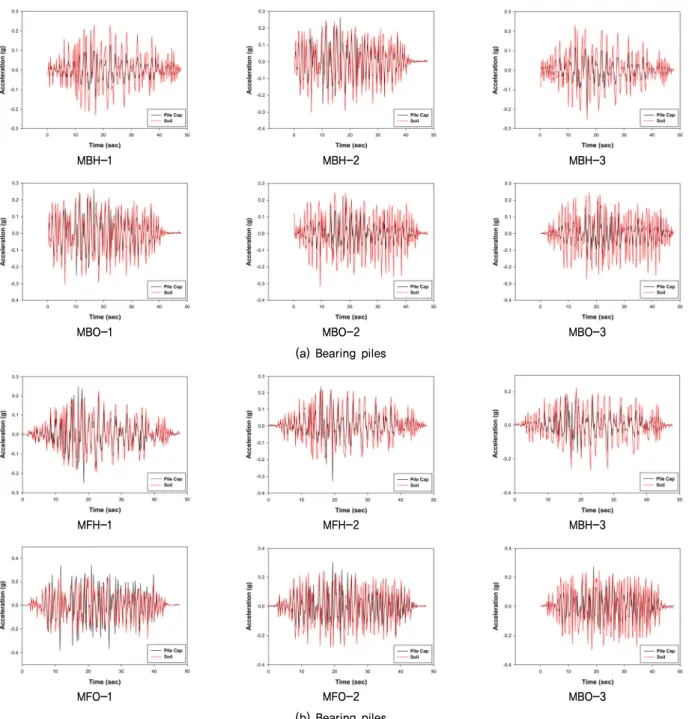
Fig. 8. Spectral acceleration at the top of pile caps and at the ground surface

3. Test result and analysis

1 g shaking table model tests were performed to verify the way pile-cap thickness affects the dynamic behavior of group piles, which were installed in the ground where the earthquake would occur. The test results were converted to

the real condition, following scaling laws, for comparison and analysis.

3.1 Acceleration at the pile caps

Acceleration at the caps of group piles, which were installed

in the ground where the earthquake would occur, is shown

(5)

Table 5. Maximum acceleration at the top of pile caps and at the ground surface

Cap thickness (mm)

Maximum acceleration (g), Max

Test # Long period

Test # Short period

Pile cap Ground Pile cap Ground

Bearing piles

40.00 MBH-1 0.21 0.23 MBO-1 0.27 0.25

52.50 MBH-2 0.19 0.23 MBO-2 0.23 0.24

65.50 MBH-3 0.18 0.23 MBO-3 0.20 0.24

Friction piles

40.00 MFH-1 0.25 0.23 MFO-1 0.34 0.24

52.50 MFH-2 0.24 0.22 MFO-2 0.31 0.24

65.50 MFH-3 0.22 0.22 MFO-3 0.27 0.25

Table 6. Vertical and horizontal displacement of the pile cap

Cap thickness

(mm) Test #

Long period wave

Test #

Short period wave Maximum vertical

displacement (mm)

Maximum horizontal displacement

(mm)

Maximum vertical displacement

(mm)

Maximum horizontal displacement

(mm)

Bearing piles

40.00 MBH-1 1.94 121.94 MBO-1 2.30 144.54

52.50 MBH-2 3.22 99.93 MBO-2 3.47 118.24

65.50 MBH-3 4.96 82.96 MBO-3 7.01 95.37

Friction piles

40.00 MFH-1 28.08 245.90 MFO-1 57.68 428.36

52.50 MFH-2 39.05 203.02 MFO-2 65.14 342.56

65.50 MFH-3 52.06 171.70 MFO-3 73.90 229.39

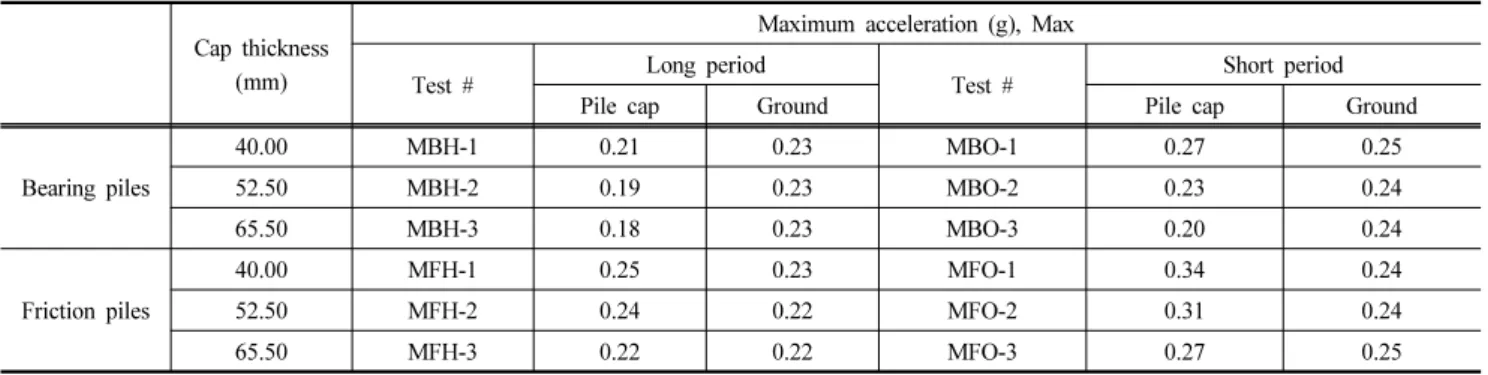
in Figure 8. Its analysis is shown in Table 5. As thickness of the pile cap increased, acceleration at the pile cap decreased by 4%~26% while acceleration at the ground surface showed little change. However, for the bearing piles, acceleration at the pile cap is 8%~22% smaller than acceleration at the ground surface; for the friction piles, acceleration at the pile cap is 8%~42% bigger than acceleration at the ground surface. It is because bearing piles have more resistance to earthquake acceleration, compared with friction piles. In addition, for acceleration at the pile cap, long-period accelera- tion response is 10%~26% bigger than short-period acceleration response. It is because the waveform of short period is closer to that of pile cap materials.

3.2 Displacement at the pile caps

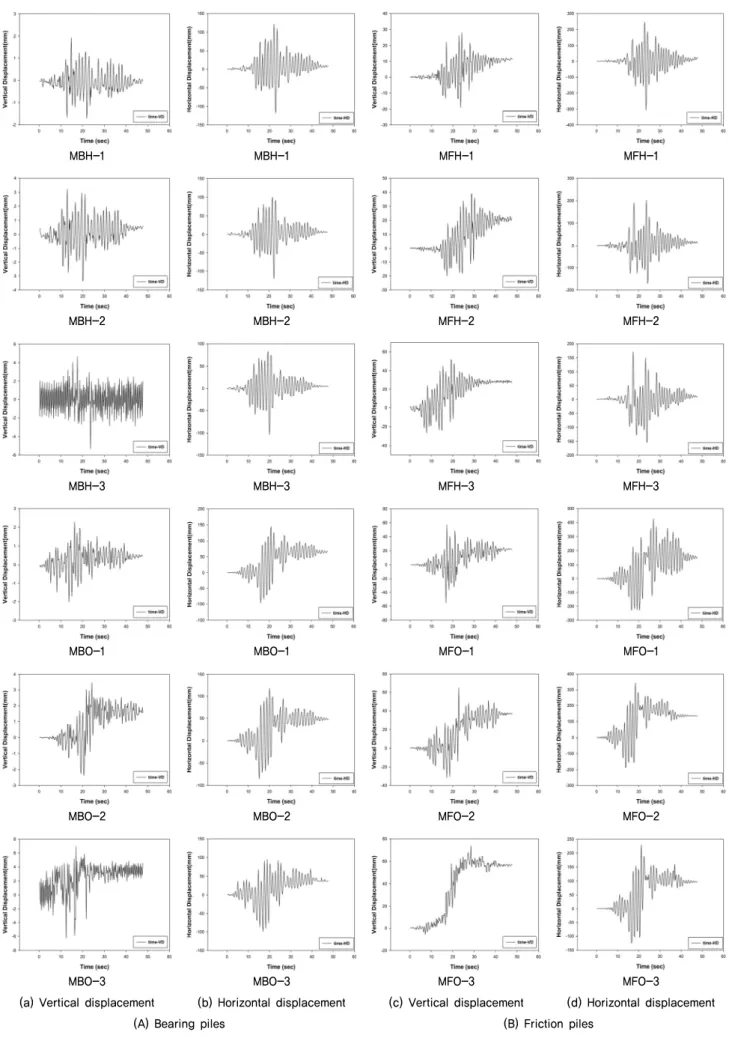
Vertical and horizontal displacement at the cap of group piles, which varied according to earthquake load, are shown in Figure 9. Analysis of the result is shown in Table 6. Vertical and horizontal displacement behavior at the cap of both bearing piles and friction piles were similar. However, as thickness of the pile cap increased, vertical displacement increased by 13%~205% while horizontal displacement decreased by 17%~46%. The increase of vertical displacement is because

the self weight increased as thickness of the pile cap increased;

the decrease of horizontal displacement is because acceleration of the pile cap decreased as thickness of the pile cap increased.

Vertical and horizontal displacement at the pile cap were 7%~51% more subject to short-period acceleration than long- period acceleration. It is because the waveform of short period is closer to that of pile cap materials.

4. Conclusion

1 g shaking table model tests were performed to verify the way thickness of the pile cap affects the dynamic behavior of group piles under earthquake load. The test results are as follows.

(1) As the cap thickness of group piles increased, acceleration at the pile cap decreased while horizontal displacement decreased and vertical displacement increased. This result verified that thickness of the pile cap is a factor to affect dynamic behavior of group piles.

(2) The change of pile-cap thickness will bring about the

change of acceleration and horizontal displacement, which

will affect dynamic behavior of superstructures. So,

(6)

MBH-1 MBH-1 MFH-1 MFH-1

MBH-2 MBH-2 MFH-2 MFH-2

MBH-3 MBH-3 MFH-3 MFH-3

MBO-1 MBO-1 MFO-1 MFO-1

MBO-2 MBO-2 MFO-2 MFO-2

MBO-3 MBO-3 MFO-3 MFO-3

(a) Vertical displacement (b) Horizontal displacement (c) Vertical displacement (d) Horizontal displacement

(A) Bearing piles (B) Friction piles

Fig. 9. Vertical and horizontal displacement of pile caps

(7)

thickness of the pile cap should be considered for the earthquake-resistant design of structures.

(3) Acceleration, horizontal displacement, and vertical displace- ment of bearing piles were bigger than those of friction piles. This result proved that bearing piles are more effectively earth-resistant, compared with friction piles.

References

1. Taha, A., Hesham EI Naggar, M. and Turan, A. (2015), Numerical modeling of the dynamic lateral behavior of geosynthetics- reinforced pile foundation system, soil dynamics and earthquake engineering, elsevier science ltd, Vol. 77, pp. 254~266.

2. Chidichimo, A., Cairo, R., Dente, G., Taylor, C. A. and Mylonakis, G. (2014), 1-g Experimental investigation of bi-layer soil response and kinematic pile bending, soil dynamics and Earthquake Engineering, elsevier science ltd, Vol. 67, pp. 219~232.

3. Iai, S. (1989), Similitude for shaking table tests on soil-structure- fluid model in 1g gravitational field, Soil and Foundations, Japanese Geothechnical Society, Vol. 29, Issue. 1, pp. 105~118 (In Japanese).

4. Ishizaki, S., Nagao, T. and Tokimatsu, K. (2012), Dynamic

centrifuge model test of pile-supported building with semi-rigid head connection in liquefiable soil, International journal of Geotechnical Engineering, Taylor & Francis group, Vol. 6, Issue. 2, pp. 231~238.

5. Korean Agency for Technology and Standards, KS L 5105.

6. Chau, K. T., Shen, C. Y. and Guo, X. (2009), Nonlinear seismic soil-pile-structure interactions : Shaking table tests and FEM analyses, soil dynamics and earthquake engineering, Elsevier Science Ltd, Vol. 29, Issue. 2, pp. 300~310.

7. Ministry of Land, Infrastructure and Transport. (2009), Foundation structure guidline.

8. Shirato, M., Nonomura, Y., Fukui, J. and Nakatani, S. (2008), large-scale shake table experiment and numerical simulation on the nonlinear behavior of pile-groups subjected to large-scale earthquakes, Soils and Foundations, Japanese Geotechnical Society, Vol. 48, No. 3, pp. 375~396.

9. Suzuki, H., Tokimatsu, T. and Tabata, K. (2014), Factors affecting stress distribution of a 3x3 pile group in dry sand based on three-dimensional large shaking table tests, soils and foundations, Soil and foundations, Japanese Geotechnical Society, Vol. 54, No. 4, pp. 699~712.

10. Bao, X., Morikawa, Y., Kondo, Y., Nakamura, K. and Zhang,

F. (2012), Shaking table test on reinforcement effect of partial

ground improvement for grouppile foundation and its numerical

simulation, soil and foundations, Japanese Geotechnical Society,

Vol. 52, Issue. 6, pp. 1043~1061.

수치

Fig. 1. Shaking table model test equipment Fig. 2. Model box
Table 3. Specification of acceleration
Fig. 8. Spectral acceleration at the top of pile caps and at the ground surface
Table 5. Maximum acceleration at the top of pile caps and at the ground surface
+2

참조

관련 문서

Wald-Type Tests for Detecting Breaks in The Trend Function of a Dynamic

The effect of Combined Exercise program on Body composition, Physical fitness and thickness of subcutaneous fat in. Obese

First, after the Group Art Therapy, the scale of hopelessness depression in the test group decreased significantly in comparison with that before the group

The study conducted a study of literature and research, and in literature, the study of cosmetic behavior, nail behavior, self esteem, and

The purpose of this research is to the development and effect of the anthroposophy group art therapy program for improvement of creativity and reduction

– Friction pile( 마찰말뚝 ): driven at a site where soil is not economical or rather possible to rest the bottom end of the pile on the hard stratum, Load is carried by

Piles do not support the load rather acts as a medium to transmit the load from the foundation to the resisting sub-stratum – Friction pile( 마찰말뚝 ): driven at a site where

– Friction pile( 마찰말뚝 ): driven at a site where soil is not economical or rather possible to rest the bottom end of the pile on the hard stratum, Load is carried by