연마 과정에 따른 열중합 의치상 레진의 표면 거칠기 평가
황성식, 임용운
*, 김시철
* **, 한민수
**경동대학교 치기공학과, 단국대학교 치과대학 생체재료학교실*, 혜전대학교 치기공과**
Evaluation of surface roughness of heat-polymerized denture base resin according to the polishing step
Seong-Sig Hwang, Yong-Woon Im*, Si-Chul Kim* **, Min-Soo Han**
Departmentof Dental technology, Kyung-dong University,
Department of Biomaterials Science, College of Dentistry, Dankook University*, Departmentof Dental technology, Hye-jeon College**
Purpose: The objective of this study was to compare the surface roughness according to polishing process in
conventional laboratory techniques used for polishing three different acrylic denture base resins.
Materials and methods: Specimen preparation and surface polishing procedures were conducted to manufacturer’s
recommendation with three heat-polymerized denture base resins. Surface roughness and gloss were measured by a contact type tester and a LED gloss checker using thickness 2 mm and diameter 10 mm. There were five specimens for each acrylic resin material and polishing procedures.Mean average surface roughness (Ra) values of each specimen group were analyzed using a one-way ANOVA analysis of variance and Scheffe’s post hoc test. Surfaces after surface roughness and gloss testing according to each polishing process were evaluated under a stereoscopic microscope.
Results: The highest mean average surface roughness was measured(Ra=2.43±0.47) for surfaces finished with a
denture tungsten carbide bur in Triplex. The lowest surface roughness values (Ra=0.11±0.07) were determined in Vertex polished with a lathe. In addition, all materials revealed that surface roughness determined highly in HP1 and HP2 than other procedures.
All correlation between surface roughness and gloss showed highly with three heat-polymerized resins. Specially, topmost correlation revealed than other material in Triplex. Significant differences in mean average surface roughness were found between polishing process used high speed lathe and low speed hand-piece.
Conclusion: Laboratory polishing used to high speed was found to produce the smoothest surface of heat-
polymerized denture base acrylic resin. Therefore, we recommended that high polishing process need to get smooth surface.
[Abstract]
성 명 한 민 수 전 화 010-5271-7526 E-mail [email protected] Key words :Surface roughness, Heat-curing denture base resin, Polishing step, Gloss, Correlation
http://dx.doi.org/10.14347/kadt.2015.37.4.205
Ⅰ. 서 론
치과용 재료의 개발과 노령인구의 증가, 심미치료에 대 한 관심이 증가되면서 구강 내 상실된 조직을 아크릴 의 치상레진으로 대신하는 총의치 및 국소의치 수복물의 빈 도가 늘고 있다(Kuhar and Funduk, 2005).
치과용 의치상 레진은 크게 열중합레진, 화학적 활성제 를 첨가하여 벤조일페록사이드를 분해하고자 유라디칼을 활성화 시키면서 실온에서 중합반응을 일으키는 상온 중 합레진, 우수한 조직적 합성과 연마가 편리한 유동성 의 치상레진, 강도가 높으며, 수축이 적고 의치상 적합성이 좋은 광중합형 의치상 레진, 특수 제작된 사출성형기의 실린더를 가열하여 주사기 원리에 의해서 레진을 전입하 는 사출성형레진으로 분류 할 수 있다. 특히, 의치상 제작 을 위해 사용되는 의치상 재료로는 다양한 색상에 따른 높은 심미성과 조작성, 물리적 화학적 안정성이 우수한 메틸 메타크릴레이트(methyl methacrylate)계 아크릴릭 레진이 대부분을 차지하고 있다(Vallittu, 1995; Lee et al, 2010).
열중합 의치상 레진은 치과기공 과정에서 열에 의한 중 합 후 레진의 잉여된 부분을 덴쳐버를 사용하여 제거하고 의치상 표면을 매끄럽게 연마한다. 그리고 덴쳐패드, rubber point 등을 사용하여 표면처리 후 고속 회전이 가 능한 연마기(Lathe)에 퍼미스, 루즈(rouge)를 사용하여 광택 연마를 실시한다(Berger et al, 2006; Al-Kheraif, 2014). 이러한 방법은 의치상 레진의 전통적인 기계적 연 마 방법으로 낮은 표면조도와 높은 광택도를 보이기 때문 에 화학적 연마법과 Polishing kit에 의한 연마법 보다 널 리 사용되고 있다(Rahal et al, 2004; Kuhar and Funduk, 2005; Gungor et al, 2014). 하지만, 임상 과 정에서 기계적 연마 과정에서 루즈를 이용한 고광택 최종 연마를 거치지 않고, 술자의 경험도에 따라 덴쳐패드로 연마 후 마무리 하거나, 퍼미스를 이용한 연마 과정에서 마무리하는 경험 의존적 연마를 실시하는 경우도 종종 발 생하고 있다.
의치상 레진을 사용하여 의치를 형성하는 마무리 과정 에서 발생하는 의치상 레진의 표면 거칠기는 음식물 잔사
와 플라그의 부착, 이차우식, 의치상 레진의 착색 등에 매 우 중요한 영향을 미친다(McLundie and Murray, 1974;
Bollen et al, 1997). 따라서 최종 수복물이 높은 심미성 을 얻기 위해서는 최종 연마의 결과가 자연치의 법랑질과 유사하거나 그 이상의 활택도를 얻어야 구강내에서 치태 나 세균의 부착을 억제 할 수 있으며 치은 자극을 줄이고, 표면 착색이 적으며 환자의 불편감을 감소시킬 수 있는 것으로 알려져 있다. 특히, Bollen 등에 따르면 수복물의 표면 거칠기는 0.2 ㎛이하 수준으로 제한하였다(Bollen et al, 1997).
표면 거칠기는 시각적으로 보이는 표면 광택도(gloss)와 상관성이 높다(Kakaboura et al, 2007; Hwang et al, 2014). 기공과정에서 각각의 연마과정에 따른 표면 거칠 기는 최종 수복물의 광택도에 중요한 영향을 미친다. 그 러므로 우수한 심미성과 의치의 수명을 높이기 위해서는 의치 표면이 매끄럽고 부드러우며 광택이 유지되도록 주 의 깊은 마무리 및 연마의 과정이 필수적이다(Bae et al, 2009).
치과기공 과정에서 의치상 레진의 일차적 표면 처리부 터 덴쳐패드, rubber point, pumice, 루즈 등을 이용한 각각의 연마과정에 따른 표면 거칠기 변화를 이해하는 것 은 의치 제작 임상가에게 중요한 정보가 될 것이다.
이에 본 연구에서는 치과기공 과정에서 많이 사용하고 있는 3종의 열중합형 의치상 레진을 선택하여 제조사의 지시에 따라 중합한 후 각각의 연마과정에 따른 표면 거 칠기의 변화를 측정, 평가하여 치과기공 과정에서 최종 연마를 위한 임상적 가이드라인 등 연마 과정의 유용한 정보를 제공하고자 하였다.
Ⅱ. 연구 방법
1. 실험재료
본 연구에서는 임상에서 많이 사용되는 의치상 재료인 3종의 열중합 아크릴레진 Vertex RS, Triplex, Lusiton 199을 사용하였다(Table 1).
2. 시편제작
열중합레진인 Vertex RS, Triplex, Luciton 199의 시 편을 제작하기 위하여 직경 20 ㎜, 두께 2 ㎜의 아크릴 디 스크를 사용하여 금속플라스크에 석고 몰드를 제작하였 다. 제작된 석고 몰드는 레진분리제(ACRO-SEP, GC, Japan) 도포 후 각각의 레진을 제조사 지시대로 혼합한 후 병상(dough stage) 레진을 전입하여 1000 psi로 가압 한 다음 의치상 레진 전용중합기(multicure, Vertex- Dental, Netherlands)를 사용하여 제조사의 지시대로 중 합하였다.
1) Vertex RS
분말과 액을 제조사의 지시대로 30초간 혼합하여 15 min 간 유지 후 병상에서 레진을 주입한 다음 의치상 레 진 전용 중합기에서 100℃에서 20 min 동안 중합하였다.
2) Triplex
분말과 액을 제조사의 지시대로 혼합하여 20 min 간 유 지 후 병상에서 레진을 주입한 다음 의치상 레진 전용 중 합기에서 100℃에서 45 min 동안 중합하였다.
3) Luciton 199
분말과 액을 제조사의 지시대로 15~30초간 혼합하여 병상이 될 때까지 9 min 유지 후 병상에서 레진을 주입 한 다음 의치상 레진 전용 중합기에서 72℃에서 90 min 유지 후 100℃에서 30 min 중합하였다.
3. 의치상 레진의 표면 연마
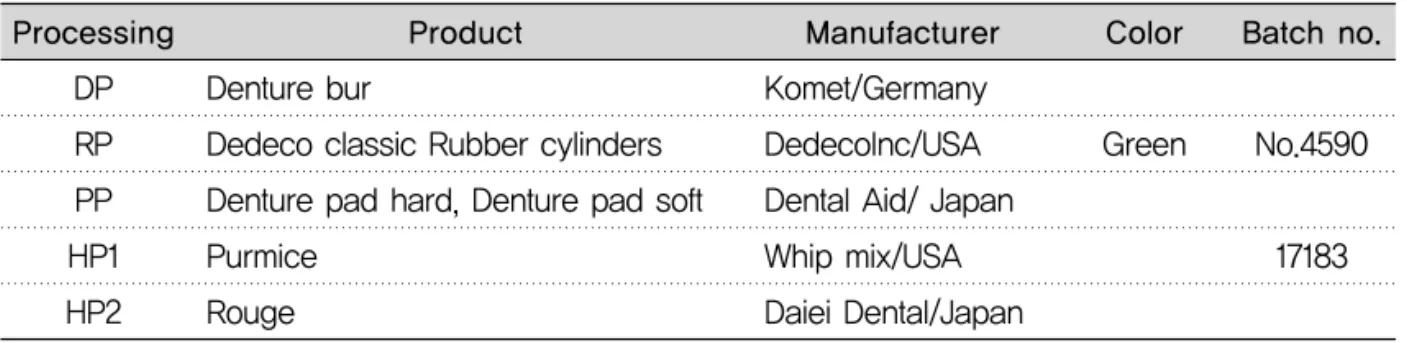
의치상 레진의 기계적 연마를 위해서 각각의 연마 과정 에 따라 사용한 기구들은 <Table 2>에 정리하였다.
1) 의치상 레진의 1차 연마
제조사의 지시대로 제작된 시편(n = 108)은 덴쳐버를 사용하여 1200 rpm으로 양면을 30초간 1차 표면 연마 처리하였다. 1차 연마 처리한 시편은 제조사별로 6개를 대조군(Denture polishing, DP)으로 하였다.
2) 의치상 레진의 2차 연마
1차 표면 처리한 제조사별 6개의 시편을 rubber point (Dedeco, USA)를 사용하여 1200 rpm에서 1분간 연마 (Rubber polishing, RP) 하였고 denture pad hard type과 soft type를 사용하여 1차 표면 처리한 시편을 동 일한 속도로 30초 씩 연마(Pad polishing, PP) 처리하였 다.
3) 고광택 연마
기계적 고광택 연마를 위해서 1차 표면 처리한 시편에 rubber point를 사용하여 연마 후 고속 회전 연마 장비 (Lathe, 26A Red Wing Lathe, USA)를 사용하여 저속 으로 1725 rpm에서 1분간 pumice 연마(High polishing 1, HP1)를 시행하였다. 또한 퍼미스(pumice) 연마 후 3450 rpm에서 고속으로 고광택 rouge 연마재를 사용하 여 1분간 최종 고광택 연마(High polishing 2, HP2)를 시행하였다.
Table 1. Denture base resins used in this study
Powder/Liquid mixing ratio
Product / code Manufacturer
21.5 g / 10 ㎖ 23.4 g / 10 ㎖ 21 g / 10 ㎖ Vertex RS / VE
Triplex / TR Luciton 199 / LU
Vertex, Netherlands Ivoclar, Germany Dentsply, USA
4. 표면 거칠기와 광택도 분석
1) 표면 거칠기 측정제작된 각각의 시편들은 초음파 세척기(Ultrasonic clean, USA)를 사용하여 5분간 증류수에서 세척 후 표면 의 물기를 티슈페이퍼를 사용하여 제거하였다. 표면 거칠 기는 표준 시편으로 접촉식 표면조도 측정기(SJ-400, Mitutoyo, Japan)를 이용하여 이송 속도 0.5 ㎜/s로 4.0
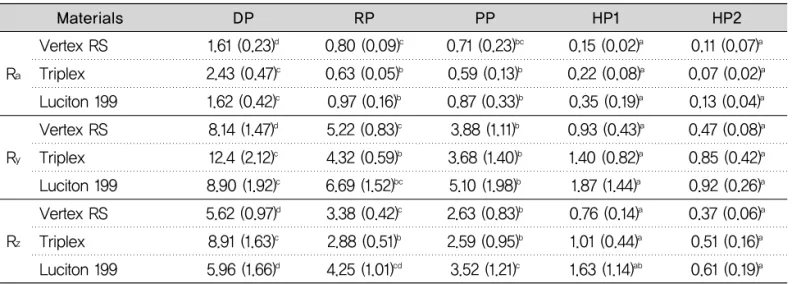
㎜의 거리를 측정하였다. 이때 단면 곡선에서 필터를 통 해 파장을 제거하는 컷오프(Cut-off, λc) 값은 0.8 ㎜로 하였고 각각의 시편 표면에서 서로 다른 부분에 3회 측정 하여 산술 평균 거칠기(Ra), 최대 peak-to-valley 거리 (Ry), 십점 평균 거칠기(Rz)의 평균값을 구하였다.
2) 표면 광택도 측정
시편의 광택도 측정은 의치상 레진의 표면에서 LED 광 원을 사용하는 60°의 광택도 측정기(IG-331, Horiba Ltd, Japan)를 사용하였다. 측정 전 표준 광택판으로 캘 리브레이션을 실시하였고 측정 광택도(GU; gloss unit) 범위는 0-100로 결정된다. 한 시편당 각각 3회 측정하여 평균값을 구하였다.
3) 표면관찰
연마 과정에 따른 각 의치상 레진시 편의 표면 거칠기 측정 후 실체 현미경(SMZ 1500, Nicon, Japan)을 사용 하여 연마된 표면 상태를 50배율에서 관찰하였다.
5. 통계처리
의치상 레진의 표면 거칠기와 광택도의 통계 처리는 각 각의 데이터를 SPSS V 21.0을 이용하여 일원 배치 분산
분석(One-way ANOVA)을 실시하였고, 유의수준 P=0.05에서 scheffe’s로 사후 검정을 하였다. 또한 재료 별 표면 거칠기와 광택도의 상관성은 Excel에서 선형회 귀 분석을 이용하였다.
Ⅲ. 결 과
3종의 열중합 의치상 레진의 연마 과정에 따른 표면 거 칠기 측정 결과는 <Table 3>에 정리하였다. 본 연구에서 사용한 열중합 의치상 레진의 표면 거칠기는 HP1, HP2 연마 과정에서 다른 연마 과정보다 유의하게 낮은 표면 거칠기를 보였다(Ra~0.35μm). 그러나 DP 연마에 의한 표면 거칠기는 모든 의치상 레진에서 유의하게 높은 평균 Ra값을 보였다. 또한, 고속 회전 연마 기구를 이용한 HP1과 HP2는 DP, RP, PP 보다 통계적으로 유의한 차이 를 보였다(P<0.05).
의치상 레진의 표면 평균 60°GU는 <Fig. 1>에 나타내 었다. 전체적으로 HP1, HP2 연마 과정에서 다른 연마 과 정보다 유의하게 높은 광택도를 나타냈다(39-76 GU).
VE 의치상 레진시편의 연마 후 실체 현미경으로 측정한 결과로 HP2의 연마면은 매끄러운 표면 상태를 보였다 (Fig. 3).
표면 조도(Ra)와 60°광택도(GU)의 상관관계는 <Fig.
2>에 나타내었다. 표면 조도와 광택도는 모두 높은 상관 성을 보였다(r2>0.67). 또한 TR에서 가장 높은 상관성를 보였으며(r2>0.79), LU에서 가장 낮았다.
Table 2. Polishing instrument used in this study
Manufacturer Color Batch no.
Processing Product
Komet/Germany DedecoInc/USA Dental Aid/ Japan Whip mix/USA Daiei Dental/Japan
Green No.4590
17183 DP
RP PP HP1 HP2
Denture bur
Dedeco classic Rubber cylinders Denture pad hard, Denture pad soft Purmice
Rouge
a~fDifferent minuscule letters indicate significant difference between material and polishing step.
a~fDifferent minuscule letters indicate significant difference between material and polishing step.
Table 3. Mean value (μm) and standard deviation of roughness parameters of acrylic resins
Fig. 1. Surface roughness according to the polishing step
HP2 HP1
PP RP
DP Materials
1.61 (0.23)d 2.43 (0.47)c 1.62 (0.42)c 8.14 (1.47)d 12.4 (2.12)c 8.90 (1.92)c 5.62 (0.97)d 8.91 (1.63)c 5.96 (1.66)d
0.80 (0.09)c 0.63 (0.05)b 0.97 (0.16)b 5.22 (0.83)c 4.32 (0.59)b 6.69 (1.52)bc 3.38 (0.42)c 2.88 (0.51)b 4.25 (1.01)cd
0.71 (0.23)bc 0.59 (0.13)b 0.87 (0.33)b 3.88 (1.11)b 3.68 (1.40)b 5.10 (1.98)b 2.63 (0.83)b 2.59 (0.95)b 3.52 (1.21)c
0.15 (0.02)a 0.22 (0.08)a 0.35 (0.19)a 0.93 (0.43)a 1.40 (0.82)a 1.87 (1.44)a 0.76 (0.14)a 1.01 (0.44)a 1.63 (1.14)ab
0.11 (0.07)a 0.07 (0.02)a 0.13 (0.04)a 0.47 (0.08)a 0.85 (0.42)a 0.92 (0.26)a 0.37 (0.06)a 0.51 (0.16)a 0.61 (0.19)a Ra
Ry
Rz
Vertex RS Triplex Luciton 199 Vertex RS Triplex Luciton 199 Vertex RS Triplex Luciton 199
Table 4. Surface gloss units of polished specimens
HP2 HP1
PP RP
DP Gloss Materials
4 (1)a 2 (0)a 3 (1)a
6 (1)ab 15 (4)c 5 (0)a
7 (2)ab 9 (2)b 6 (0)a
52 (8)c 39 (8)e 48 (11)c
72 (8)d 76 (3)f 75 (5)d 60
VE TR LU
Fig. 2. Correlation between surface roughness and gloss
Fig. 3. Stereoscopic microscope image according to the polishing process in Vertex RS (×50)
Ⅳ. 고 찰
의치상 재료로 널리 사용되는 PMMA 계열 레진은 제작 과정 중에 사용하는 연마 기구 및 연마재에 의해 다듬고 연마하여 구강내에서 최종 사용하게 된다. 그러나 Weitman과 Eames, Radford, Yamauchi 등은 의치 연 마 기구 및 재료에 의해 형성된 의치상의 표면 거칠기는 박테리아 및 세균이 증식하기에 좋은 환경을 제공하게 되 며, 심미성과 의치 수명도에 영향을 미치는 것으로 보고 하고 있다(Weitman and Eames, 1975; Yamauchi et al, 1990; Bollen et al, 1997; Radford et al, 1998;
Berger et al., 2006; Al-Kheraif, 2014). Abuzar 등과 Kuhar 등은 연구에서 표면 거칠기(Ra)가 0.2㎛를 기준 으로 그 이상이 되면 표면이 거칠고 플라그 침착이 잘 발 생한다고 보고하고 있다(Kuhar and Funduk, 2005;
Abuzar et al, 2010). 또한, Quirynen 등과 Gungor 등 은 플라그의 침착을 줄이기 위해서 수복물의 표면 거칠기 는 0.2㎛ 이하 수준으로 연마하여 사용 할 것을 권고하고 있다(Quirynen et al, 1996; Bollen et al, 1997; Kuhar and Funduk, 2005; Abuzar et al, 2010; Gungor et al, 2014). 따라서 의치상 레진의 표면 연마 과정에 따른 치과용 수복물의 표면 거칠기는 매우 중요한요인이다.
본 연구의 결과에서 HP2 연마 과정은 0.2μm 이하의 값 을 보였으며 다른 연마 과정에서 Ra 값은 모두 0.2μm를 상회하였다. 모든 재료의 HP2 과정에서 표면 거칠기가 0.2μm보다 낮은 결과는 열중합 의치상 레진의 연마 과정 으로 고속 회전 연마기를 이용한 rouge 광택까지 연마해 야 한다는 사실을 보여준다. 반면에, 퍼미스를 이용한 연 마의 과정은 VE를 제외한 TR, LU는 임계조도점을 기준 으로 0.2μm 이상의 표면 거칠기를 나타내었으므로, 재료 사용시 반드시 rouge를 이용한 HP2 과정을 적극 추천한 다. DP 연마에서는 가장 높은 표면 거칠기를 보였다. 이 는 덴쳐버로 잉여된 찌꺼기(fresh)를 짧은 시간에 제거하 는데 유용하지만 최종 거칠기의 변화를 고려할 때 바람직 하지 않을 것으로 생각된다. 아울러 의치상 레진을 전입 하기 전 wax 상태에서의 치상의 최종 형태 및 활택도를 완성하여 덴쳐버의 처리 과정을 최소화 하는 과정이 필요
다른 어떤 연마 과정보다도 최종적으로 고속 회전 연마기 를 이용한 기계적 고광택 연마 과정(HP2)을 수행했을 때 가장 좋은 표면 상태를 얻어 낼 수 있다. 실체 현미경 관 찰에서도 VE의 표면 거칠기는 HP2 연마에서 가장 매끄 럽고 부드러운 것을 확인 할 수 있다 (Fig. 3). 이를 위해 Kuhar 등과 Gungor 등은 고광택 기계적 연마 과정에 서 술자의 기술력과 균일한 압력하에서 연마를 고려한다면 보다 활택한 표면을 얻을 수 있으며, 표면 결함도 줄일 수 있을 것으로 보고 하였다.이는 임상 과정에서 둥근 연마 기구의 사용에 있어서 재료 표면 형성에 영향을 미칠 것 으로 사료되므로 주의를 요한다.
Hannah와 O’Brien 등은 치과용 수복재인 콤포짓트레 진의 표면 거칠기와 광택도는 연마시스템에 따라 영향을 미치는 중요한 요인으로 보고하고 있다(Hannah and Smith, 1973; O'Brien et al, 1984). 또한 Ohara와 Da Costa 등도 치과용 수복 재료에 있어서 연마 시스템에 따 라서 표면 거칠기와 광택도는 상호 밀접한 관련성을 보고 하고 있다(Da Costa et al, 2007; Ohara et al., 2009).
광택도는 표면에서 빛이 반사하는 양에 대한 값으로 재 료 표면에서 나타나는 광학적 현상이다. 표면 입사각에 따라 반사율이 다르며, 표면 마무리 정도에 따라서도 심 미성에 영향을 미치는 광택도는 다르다. Keyf와 Etikan 등은 표면 거칠기와 함께 광택도 측정은 표면의 성질을 이해하는데 중요한 요인이라 하였다(Keyf and Etikan, 2004). 특히, 광택도 측정에 관한 NIST SP 250 - 70은 거의 모든 광택면에 대하여 입사각 60°를 기준으로 측정 하고 있으며, 의치상 레진의 광택도 측정에 적용되어 왔 다(Nadal et al, 2006; Hwang et al, 2014). 따라서 본 연구에서는 표준 광택도인 60°에서 측정 비교 분석하였 다. 그 결과 고광택 연마 과정인 HP2 연마에서 가장 높은 광택도가 나타남을 알 수 있었다. 여러 연구에서와 같이 표면 거칠기(Ra)와 광택도의 상관성을 분석해 본 결과 표 면조도와 60°입사각의 광택도는 비교적 높은 상관성을 보였으며(r2>0.67), TR에서 표면 거칠기와 광택도가 가장 높은 상관성을 보였다(Fig. 2). 따라서 의치 표면의 순차 적인 연마 과정에서 표면 조도는 광택도에 중요한 영향을 미치므로 임상적 허용기준의 매끄러운 표면을 얻기 위한
최근 다양한 의치상 레진과 연마 기구 및 재료가 개발되 어 사용되고 있다. 특히, 프레임이 없는 의치 제작에 사용 되는 Polyamide 계열의 열가소성 의치상 레진과 광중합 레진을 비롯한 다양한 의치상 레진의 표면 거칠기와 광택 도 연구가 필요할 것으로 생각되며, 치과기공 임상에서 연마 과정에 따른 표면 거칠기와 광택도의 상관성은 임상 가들에게 연마 과정의 객관적 정보와 최종 연마를 위한 가이드라인 등 연마 과정의 유용한 정보를 제공하게 될 것으로 기대된다.
Ⅴ. 결 론
본 연구에서 의치 제작을 위한 3종의 열중합 의치상 레 진의 연마 과정에 따른 표면 거칠기와 광택도를 측정하여 아래와 같은 결론을 얻었다.
1. 모든 의치상 레진 재료의 표면 거칠기는 HP1, HP2 연마 과정에서 다른 연마 과정보다 유의하게 낮은 표면 조도(Ra~0.35μm)를 나타냈다(P<0.05). 그러나 DP 연마 에 의한 표면 조도는 모든 의치상 레진에서 유의하게 높 은 평균 Ra값을 보였다(P<0.05).
2. 모든 의치상 레진의 HP2는 치태침착임계조도(Ra
=0.2 μm)보다 낮았다. 또한 HP1에서 TR, LU는 상회하 였다(Ra>0.2 μm).
3. 모든 재료에서 HP1, HP2 연마 과정이 다른 연마 과 정보다 유의하게 높은 광택도를 나타냈다(39-76 GU).
4. 표면 조도와 광택도는 높은 상관성을 보였으며 (r2>0.67), TR에서 가장 높은 상관성(r2>0.79)를 보였다.
REFERENCES
Abuzar MA, Bellur S, Duong N, Kim BB, Lu P, Palfreyman N et al. Evaluating surface
roughness of a polyamide denture base material in comparison with poly (methyl methacrylate). J Oral Sci, 52⑷, 577-581, 2010.
Al-Kheraif AA. The effect of mechanical and chemical polishing techniques on the surface roughness of heat-polymerized and visible light-polymerized acrylic denture base resins.
Saudi Dent J, 26⑵, 56-62, 2014.
Bae JY, Kim SC, Lee HH. Evaluation of surface roughness of dental porcelains by two polishing systems. J Kor Res Soc Dent Mater, 36⑷, 283~292, 2009.
Berger JC, Driscoll CF, Romberg E, Luo Q, Thompson G. Surface roughness of denture base acrylic resins after processing and after polishing. J Prosthodont, 15⑶, 180-186, 2006.
Bollen CM, Lambrechts P, Quirynen M.
Comparison of surface roughness of oral hard materials to the threshold surface roughness for bacterial plaque retention: a review of the literature. Dent Mater, 13⑷, 258-269, 1997.
Da Costa J, Ferracane J, Paravina RD, Mazur RF, RoederL. The effect of different polishing systems on surface roughness and gloss of various resin composites. J Esthet Restor Dent, 19⑷, 214-224, discussion, 225-216, 2007.
Gungor H, Gundogdu M, YesilDuymus Z.
Investigation of the effect of different polishing techniques on the surface roughness of denture base and repair materials. J Prosthet Dent, 112⑸, 1271-1277, 2014.
Hannah CM, Smith GA. The surface finish of composite restorative materials. Br Dent J,
135⑾, 483-488, 1973.
Hwang SS, Im YW, Kim SC, Jun SK, Lee HH.
Influence of polishing methods on surface roughness and gloss of acrylic denture base resins. J Kor Res Soc Dent Mater, 41⑷, 305~310, 2014.
Kakaboura A, Fragouli M, Rahiotis C, Silikas N.
Evaluation of surface characteristics of dental composites using profilometry, scanning electron, atomic force microscopy and gloss-meter. J Mater Sci Mater Med, 18
⑴, 155-163, 2007.
Keyf F, Etikan I. Evaluation of gloss changes of two denture acrylic resin materials in four different beverages. Dent Mater, 20⑶, 244- 251, 2004.
Kuhar M, Funduk N. Effects of polishing techniques on the surface roughness of acrylic denture base resins. J Prosthet Dent, 93⑴, 76-85, 2005.
Lee CJ, Bok SB, Bae JY, Lee HH. Comparative adaptation accuracy of acrylic denture bases evaluated by two different methods. Dent Mater J, 29⑷, 411-417, 2010.
McLundie AC, Murray FD. Comparison of methods used in finishing composite resin-A scanning electron microscope study. J Prosthet Dent, 31⑵, 163-171, 1974.
Nadal ME, Early EA, Thompson EA. Spercular gloss. NIST Special Publication, SP 250-70, 2006.
O’Brien WJ, Johnston WM, Fanian F, Lambert S.
The surface roughness and gloss of composites. J Dent Res, 63⑸, 685-688, 1984.
Ohara N, Koizumi H, Matsumoto Y, Nakayama D, Ogino T, Matsumura H. Surface roughness and gloss of indirect composites etched with
Odontol Scand, 67⑸, 313-320, 2009.
Quirynen M, Bollen CM, Papaioannou W, Eldere J, Steenberghe D. The influence of titanium abutment surface roughness on plaque accumulation and gingivitis: short-term observations. Int J Oral Maxillofac Implants, 11⑵, 169-178, 1996.
Radford DR, Challacombe SJ, Walter JD. Adherence of phenotypically switched Candida albicans to denture base materials. Int J Prosthodont, 11⑴, 75-81, 1998.
Rahal JS, Mesquita MF, Henriques GE, Nobilo MA.
Surface roughness of acrylic resins submitted to mechanical and chemical polishing. J Oral Rehabil, 31⑾, 1075-1079, 2004.
Vallittu PK. A review of methods used to reinforce polymethyl methacrylate resin. J Prosthodont, 4⑶, 183-187, 1995.
Weitman RT, Eames WB. Plaque accumulation on composite surfaces after various finising procedures. J Am Dent Assoc, 91⑴, 101-106, 1975.
Yamauchi M, Yamamoto K, Wakabayashi M, Kawano J. In vitro adherenceof microorganisms to denturebase resin with different surface texture. Dent Mater J, 9⑴, 19-24, 1990.