• 검색 결과가 없습니다.

Cutaneous smooth muscle tumors in 3 dogs

N/A
N/A
Protected

Academic year: 2021

Share "Cutaneous smooth muscle tumors in 3 dogs"

Copied!
4
0
0

로드 중.... (전체 텍스트 보기)

전체 글

(1)

大韓獸醫學會誌(2009) 第49卷 第1號

Korean J Vet Res

(2009) 49(1) : 63~66

63

Cutaneous smooth muscle tumors in 3 dogs

Ji-Youl Jung

1

, Sang-Chul Kang

2

, Dae-Sik Park

3

, Eun-Sung Lee

3

, Jong-Hee Bae

1

, Jae-Hoon Kim

1,*

1

College of Veterinary Medicine, Jeju National University, Jeju 690-756, Korea

2

Preclinical Research Center, Chemon,Yongin 449-826, Korea

3

Saha Animal Hospital, Busan 604-010, Korea

(Accepted: March 11, 2009)

Abstract : Cutaneous leiomyomas (leiomyosarcomas) are smooth muscle tumors that occur single or as multiple lesions. They usually arise from the arrector pili muscles (piloleiomyomas) and less commonly from the muscle of veins (angioleiomyomas). This report describes histologic and immunohistochemical features of one cutaneous piloleiomyoma and two angioleiomyosarcomas. Three 7-12-year-old female dogs were presented with single or double cutaneous nodules. Histologically, the neoplastic masses were composed of densely or loosely arranged interlacing bundles. The neoplastic cells were ovoid to elongate, and had eosinophilic cytoplasms and perinuclear cytoplasmic vacuolation. Nuclei were central to eccentric, cigar shaped, oval to elongate. In two cases, high mitotic index in high power field, multifocal necrosis and local invasion were also noted. Masson’s trichrome and van Gieson staining revealed muscle origin tumors in these cases. Immunohistochemically, the tumor cells were strongly positive for smooth muscle actin. In our best knowledge, this is the first report of cutaneous smooth muscle tumors in dogs in Korea.

Keywords : dog, immunohistochemistry, leiomyoma, leiomyosarcoma, skin

Introduction

Smooth muscle is widely distributed in the body, including the gastrointestinal, respiratory, and genitourinary tracts. Cutaneous leiomyomas (leiomyosarcomas) are uncommon smooth muscle tumors of the skin that occur single or as multiple lesions. They usually arise from the muscle of veins, arrector pili muscles or genital deep dermal smooth muscles. Tumors derived from the musculature of blood vessels are termed angioleiomyomas and angioleiomyosarcomas, and those developing from arrector pili muscles are identified as piloleiomyomas and piloleiomyosarcomas. Smooth muscle tumors located in the skin of the genitalia and nipples are named genital leiomyomas and leiomyosarcomas [7, 8]. Smooth muscle tumors are rare in domestic animals. Cutaneous leiomyomas are infrequently described in dogs and cats, and there is not sufficient data to allow for determination of age, breed, or sex predilec- tions [3].

According to the data from 748 canine cutaneous neoplasms in Korea, the incidence of cutaneous leio-

myoma and leiomyosarcoma was 0.27% and 0.4%, respectively [10]. In another review of 2,616 canine and feline skin tumors from the UK, the incidence of cutaneous leiomyomas was 0.88% and 0.33%, respec- tively [2]. Distinguishing between leiomyosarcoma, rhabdomyosarcoma and fibrosarcoma may be difficult by routine histological methods, but immunohistoche- mical and ultrastructural methods are useful for accurate diagnosis of soft tissue sarcomas [3]. In the present study, we described the histopathologic and immunohi- stochemical features of 3 cutaneous smooth muscle neoplasms in dogs.

Case report

Three subcutaneous biopsies from dogs were submitted to the pathology laboratory at the college of veterinary medicine in Jeju National University. Three cases were composed of a 12-year-old mixed dog with two tumors (1.5 to 2.5 cm in diameter) on the perineal region (case 1), a 7-year-old Shih tzu with a tumor (3.5 × 3 × 2.5 cm) on the right abdominal region around 5th mammary

*Corresponding author: Jae-Hoon Kim

College of Veterinary Medicine, Jeju National University, Jeju 690-756, Korea

[Tel: +82-64-754-3387, Fax: +82-64-702-9920, E-mail: [email protected]]

(2)

64 Ji-Youl Jung, Sang-Chul Kang, Dae-Sik Park, Eun-Sung Lee, Jong-Hee Bae, Jae-Hoon Kim

teat (case 2), and a 9-year-old mixed dog with a tumor (6 × 4 cm) on the left distal area of femur (case 3), respectively. All of three dogs were female.

Submitted masses were trimmed, embedded in paraffin, sectioned at 3

µ

m, and stained with hematoxylin and eosin, Masson’s trichrome, and van Gieson techni- ques. Additional paraffin-embedded sections were available for immunohistochemistry. After mounting on silane coated glass slides, each section was stained by a labeled streptavidin-biotin peroxidase method. For antigen retrieval, sections were incubated with Target Retrieval solution (Dako code S3307). For the differential diagnosis, primary antibody for vimentin (1 : 100, monoclonal mouse anti-vimentin, clone V9; Abcam, UK), S-100 (1 : 1,000, rabbit polyclonal anti-S100;

Dako, Denmark) and

α

-smooth muscle actin (1 : 100,

α

-SMA, monoclonal mouse anti-human smooth muscle actin, clone 1A4; Dako, Denmark) were used.

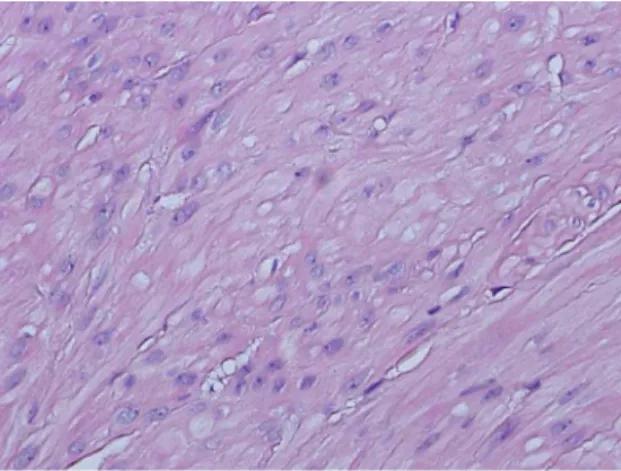
Grossly, cutaneous masses were well circumscribed, solitary, round to oval, and firm. On cut surface, tumor masses were creamy-white in color and moderately firm. Irregular yellowish or red foci were scattered in cases 2 and 3. Histologically, neoplastic masses were composed of interlacing and whorling bundles of spindle cells, and partially surrounded by fibrous connective tissue. In case 1, mass was composed of well differentiated monomorphic spindle cells that were densely arranged in broad interlacing bundles (Fig. 1).

These ovoid to elongate cells had a moderate to large amount of cytoplasm that was perinuclear vacuolated, strongly eosinophilic, and without cross striations. Nuclei were central to eccentric, cigar shaped, oval to elongate (Fig. 2).

In cases 2 and 3, the neoplastic cells with higher cellular density formed closely packed interlacing fascicles.

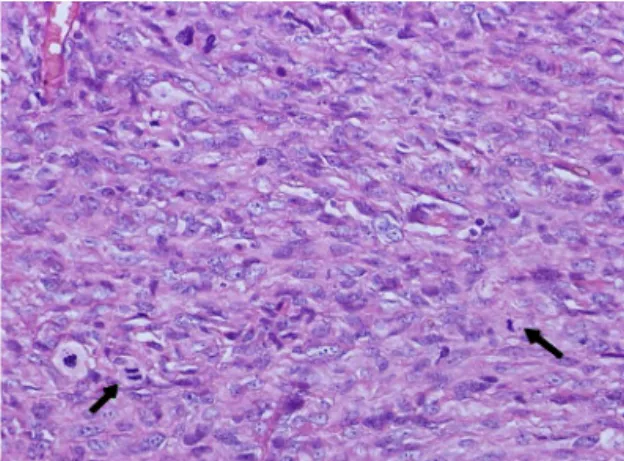
Many cells showed an angiomyomatous pattern of growth, characterized by cells arranged circumferen- tially around vessels. They showed invasive tendency to adjacent tissues. Multifocal necrosis and hemorrhage were presented especially around blood vessels. The neoplastic cells showed marked pleomorphism in shape and size with oval to spindle cells. Bizarre cells and giant cells with multiple or irregular nuclei also presented in poorly differentiated areas. Higher mitotic figures were found ranged from 1 to 3 at high power fields (Figs. 3 and 4). Lymphocytic inflammatory cells were multifocally infiltrated among the tumor cells and around blood vessels. Many small to medium sized vascular channels were occupied in tumor masses. And Fig. 1. Case 1. The tumor cells form interlacing fascicles

that mimic normal smooth muscle. H&E. ×200. Fig. 2. Case 1. Neoplastic cells with abundant cytoplasms and central located elongate nuclei. H&E. ×400.

Fig. 3. Case 2. Multifocal necrosis in the mass, note

bundles of neoplastic spindle cells associated with vascular

channels. H&E. ×100.

(3)

Cutaneous smooth muscle tumors in dogs 65

neoplastic cells blended into or seemed to originate from the blood vessels in these tumors. Neoplastic cells were stained red with Masson’s trichrome and yellow with van Gieson, which revealed muscle origin tumors in these cases. Immunohistochemically, the tumor cells demonstrated strong positive reactions for vimentin and smooth muscle actin, a specific marker for smooth muscle differentiation (Fig. 5), but negative for S-100.

Discussion

Based on the histopathology and immunohistoche- mistry, all three tumors were diagnosed as cutaneous piloleiomyoma (case 1) and angioleiomyosarcomas (case 2 and 3). Because the epidermis was not included in the mass of case 1, we could not find any evidence of connection between tumor mass and arrector pili muscle. The lacking of vascular channels implied that

this mass might be originated from the arrector pili muscle. However in cases 2 and 3, many neoplastic cells showed typical angiomyomatous pattern and some of them blended into the blood vessels. Cutaneous leiomyoma occurs most frequently in ferrets and dogs.

Piloleiomyosarcoma in seven ferrets [11] and solitary dermal leiomyosarcomas in 12 ferrets [9] were described.

In dogs, leiomyomas of arrector pili muscles were described in 5 dogs [3]. Cutaneous tumors of smooth muscle origin are also described in several animal species such as cat, cow, and horse [1, 5, 6].

Light microscopic differentiation of cutaneous leio- myoma and leiomyosarcoma from other connective tissue tumors is difficult. Differential diagnoses for smooth muscle neoplasms include hemangiopericy- toma, fibroma, fibrosarcoma, Schwannoma, malignant peripheral nerve sheath tumor, undifferentiated sarcoma, and malignant fibrous histiocytoma [3]. The histopa- thologic features including the large amounts of acido- philic cytoplasm and a cigar shaped nucleus of the present cases closely resembled with previous study [8]. The results of special staining for Masson’s trichrome and van Gieson staining suggested that tumor cells were myogenous in origin. All tumors reacted strongly positive for both vimentin and

α

-SMA. This result further confirmed a tumor of smooth muscle cell origin.

Antibodies to desmin, muscle specific actin, and SMA have been used to differentiate muscle origin from other mesenchymal origin [3, 8]. Desmin and muscle specific actin, which recognize both skeletal and smooth muscle actins, detect cytoskeletal proteins specific for muscle differentiation, but they do not distinguish among tumors of smooth muscle, cardiac muscle, and skeletal muscle.

α

-SMA is a cytosolic intermediate filament that is involved in the mechanism of contraction and that is a specific marker for smooth muscle differentiation and can distinguish smooth muscle tumors from tumors of skeletal or cardiac muscle. Positive reaction for smooth muscle marker might be an important differential clue for the diagnosis of these tumors. In addition, some references have suggested that

α

-SMA may be a more reliable marker of smooth muscle tumors than desmin in both human and dogs [3, 8].

In human and animal leiomyosarcoma, mitotic activity (2 mitoses per 10 high-power fields) was often used the most useful indicator of tumor malignancy [7, 8].

Fig. 4. Case 3. Nuclear and cellular pleomorphism with high mitotic figures (arrows). H&E. ×400.

Fig. 5. Case 3. Diffuse strong positive for

α

-smooth muscle

actin. IHC. ×200.

(4)

66 Ji-Youl Jung, Sang-Chul Kang, Dae-Sik Park, Eun-Sung Lee, Jong-Hee Bae, Jae-Hoon Kim But other histopathologic criteria such as necrotic foci

in tumor, a high degree of cellularity, pleomorphism, and bizarre giant cells were also helpful [4, 6]. Two cases of present study were considered to be malignant because of multiple areas of necrosis, high mitotic figures, marked cellular pleomorphism, and many atypical giant cells.

According to previous study, cutaneous angioleiom- yosarcomas were located mainly at the extremity of the limbs but were also found eyelid and groin in dogs [8]. This tumor occurred with a high frequency in females (5/6 canine). In our cases, angioleiomyosar- comas were found at right abdominal region around 5th mammary teat and left distal area of femur, middle part of limb, in female dogs.

The prognosis of cutaneous smooth muscle tumors is favorable following complete surgical excision in ferrets [11]. In humans, well-differentiated piloleiom- yosarcomas have a low potential for local recurrence and metastasis. Follow-up information was available for all dogs in this study. Local recurrence or distant metastases were not observed. According to the demand of client, one dog (Case 3) was euthanized six months after surgical excision of the leiomyosarcoma. Although the occurrence rates of the cutaneous smooth muscle tumor in dogs are very low, accurate diagnosis is needed because these tumors allow the possibility of surgical cure.

References

1. Bailey KL, Kinsel MJ, Connell KA. Multiple cutaneous leiomyomas in the perineum of a horse. J Vet Diagn Invest 2003, 15 , 454-456.

2. Bostock DE. Neoplasia of the skin and mammary glands in dogs and cats. In: Kirk RW (ed.). Current Veterinary Therapy. Vol. 6. pp. 493-495, Saunders, Philadelphia, 1977.

3. Cooper BJ, Valentine BA. Tumors of muscle. In:

Meuten DJ (ed.). Tumors in Domestic Animals. 4th ed.

pp.319-363, Iowa State Press, Ames, 2002.

4. Fields JP, Helwig EB. Leiomyosarcoma of the skin and subcutaneous tissue. Cancer 1981, 47 , 156-169.

5. Finnie JW, Leong AS, Milios J. Multiple piloleiom- yomas in a cat. J Comp Pathol 1995, 113 , 201-204.

6. Hanzaike T, Ito I, Ishikawa T, Ishikawa Y, Kadota K. Leiomyosarcoma of soft tissue in a cow. J Comp Pathol 1995, 112 , 237-242.

7. Holst VA, Junkins-Hopkins JM, Elenitsas R.

Cutaneous smooth muscle neoplasms: clinical features, histologic findings, and treatment options. J Am Acad Dermatol 2002, 46 , 477-490.

8. Liu SM, Mikaelian I. Cutaneous smooth muscle tumors in the dog and cat. Vet Pathol 2003, 40 , 685- 9. 692. Mikaelian I, Garner MM. Solitary dermal leiomyosarcomas in 12 ferrets. J Vet Diagn Invest 2002, 14 , 262-265.

10. Pakhrin B, Kang MS, Bae IH, Park MS, Jee H, You MH, Kim JH, Yoon BI, Choi YK, Kim DY.

Retrospective study of canine cutaneous tumors in Korea. J Vet Sci 2007, 8 , 229-236.

11. Rickman BH, Craig LE, Goldschmidt MH.

Piloleiomyosarcoma in seven ferrets. Vet Pathol 2001,

38 , 710-711.

수치

Fig. 3.  Case 2. Multifocal necrosis in the mass, note bundles of neoplastic spindle cells associated with vascular channels
Fig. 4.  Case 3. Nuclear and cellular pleomorphism with high mitotic figures (arrows)

참조

관련 문서

First, the rhythmic gymnastics exercise program improves the skeletal muscle mass of adult women in office workers and reduces body fat percentage,

This study was to do a comparative analysis on kinematic differences and differences in muscle activity between the skilled and the unskilled in windsurfing

In conclusion, Pilates chair exercise is a positive factor in improving skeletal muscle mass among menopausal women's body composition and lower muscles EMG

The third was combination of levator palpebrae, superior rectus, inferior oblique muscle weakness(n=5) and the fourth was the third group plus medial rectus

In the change of functional fitness, muscle strength and endurance, cardiopulmonary endurance, wits, and flexibility showed significantly increased results,

The improvement factors of the performance showed significant increase in muscle strength, muscle endurance, cardiovascular endurance, power, agility and

In the health fitness category of the adult women who underwent instrument pilates exercise, they were statistically significant in muscle strength,

Conclusion: In conclusion, the relaxant effects of neuromuscular blockers on the uterine smooth muscle may be transmitted via nicotinic acetylcholine receptors