• 검색 결과가 없습니다.

THE FILAMENTARY WEB OF STAR FORMATION

N/A
N/A
Protected

Academic year: 2021

Share "THE FILAMENTARY WEB OF STAR FORMATION"

Copied!
7
0
0

로드 중.... (전체 텍스트 보기)

전체 글

(1)

° 2012. The Korean Astronomical Society. All Rights Reserved. c

THE FILAMENTARY WEB OF STAR FORMATION

Glenn J. White

1,2

, Yasuo Doi

3

, Shinya Komugi

4,5

, Mitsunobu Kawada

5

, Satoshi Takita

5

, Ko Arimatsu

5

, Norio Ikeda

5

, Daisuke Kato

5

, Yoshimi Kitamura

5

, Takao Nakagawa

5

, Takafumi Ootsubo

6

, Takahiro Morishima

6

, Makoto Hattori

6

, Masahiro Tanaka

7

, Mireya Etxaluze

1,2,8

, and

Hiroshi Shibai

9

1

Department of Physical Sciences, The Open University, England

2

RALSpace, The Rutherford Appleton Laboratory, Chilton, Didcot, Oxfordshire OX11 0NL, England

3

Department of Earth Science and Astronomy, the University of Tokyo, Tokyo 153-8902, Japan

4

Joint ALMA Observatory, Alonso de Cordova 3107, Vitacura, Santiago 763-0355, Chile

5

Institute of Space and Astronautical Science, Japan Aerospace Exploration Agency, Kanagawa 252-5210, Japan

6

Astronomical Institute, Tohoku University, Sendai 980-8578, Japan

7

Center for Computational Sciences, University of Tsukuba, Ibaraki 305-8577, Japan

8

Centro de Astrobiologa (CSIC/INTA), Instituto Nacional de Tcnica Aeroespacial, Madrid Spain

9
Department of Earth and Space Science, Osaka University, Osaka 560-0043, Japan E-mail: [email protected]

(Received July 08, 2012; Accepted July 25, 2012)

ABSTRACT

Following the first Public Release of the AKARI Point Source catalogues, we have worked on the production of a new far-infrared All-Sky Diffuse mapping product. In this paper we report first results from the All Sky diffuse maps that will shortly be released to the community, based on analysis of data from the Far Infrared Surveyor (65 µm - 160 µm ) instrument. These data are likely to have a strong impact on studies of extended structures, and the diffuse ISM.

Key words: infrared: telescope; conferences: proceedings

1. INTRODUCTION

A major issue in contemporary star formation research is to improve our understanding of the mechanisms in- volved in the formation of stars, and their attendant planetary systems. We provide an update on the sta- tus of the AKARI All Sky Diffuse Mapping project, and present some early results from large-scale images, focussing on the study and characterisation of the Fil- amentary Web linking star-formation throughout our Galaxy, and revealing its association with pre-stellar cores and protostars. We report the first stages of a study that seeks to establish a link between the pre- stellar core mass function and the stellar IMF; to trace and map the formation of stars and clusters along the initially quiescent filaments that thread the ISM; and to determine whether the IMF is determined at the

pre-stellar core formation stage.

The associated diffuse infrared continuum emission is ubiquitously observed across the sky, and is at- tributed to thermal emission from interstellar dust par- ticles. These dust particles are heated by incident stel- lar radiation in the UV, optical and near-infrared spec- tral regions, with a peak at around 1 µm (the interstel- lar radiation field: ISRF; Mathis et al., 1983), and then re-radiating the thermal energy at longer wavelengths in the far-infrared and sub-mm wavelength regions.

2. AKARI FAR-INFRARED DIFFUSE ALL SKY SURVEY

The AKARI space telescope, launched by ISAS/JAXA in 2006 (Murakami et al., 2007), successfully carried out an all sky survey in six bands at mid- and far-infrared

http://pkas.kas.org 201

(2)

202 WHITE ET AL.

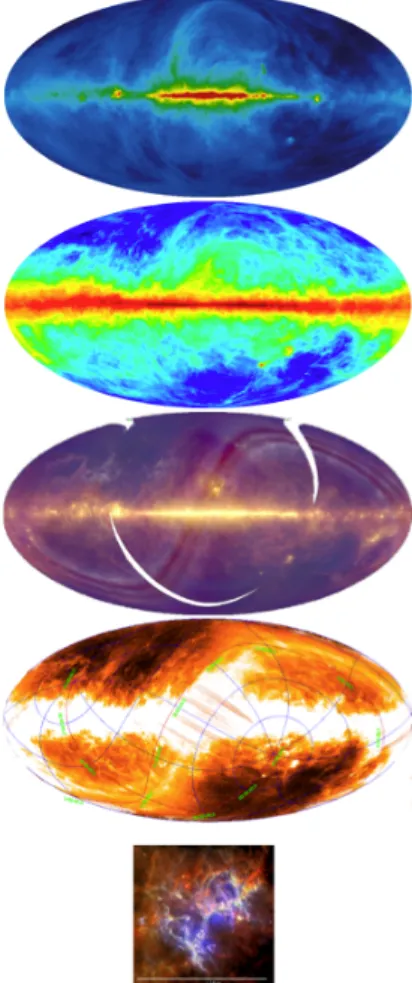
Fig. 1. All sky images, from top to bottom: 408 MHz ra- dio continuum: 21 cm atomic hydrogen line: IRAS 60 µm : AKARI 90 µm all sky diffuse map: Herschel observations of the Eagle Nebula from Hill et al. (2012).

wavelengths, as well as obtaining pointed observations for several large area surveys of the near and far Uni- verse, as well as obtaining many deep pointed observa- tions on specific targets. The satellite was launched in February 2006 and the all-sky survey was carried out between March 2006–August 2007 during the cold op- erational phase before the liquid Helium cryogen was exhausted. AKARI’s mirror had a diameter of 0.685 m and was capable to observe across the 2-180 µm spectral region, with two focal plane instruments (FPIs): the In- fraRed Camera (IRC: Onaka et al., 2007) and the Far- Infrared Surveyor (FIS: Kawada et al., 2007). In this paper we focus on the results of a new processing de- signed to recover the diffuse galactic emission using the Far-Infrared Surveyor instrument data (FIS, Kawada et al., 2007). This ’Diffuse All Sky Survey’ uses four wide-

band photometric filters extending across the 50 – 200 µm range (centred at 65 µm [N60, covering the range 50–80 µm ], 90 µm [WIDE-S, covering 60–110 µm ], 140 µm [WIDE-L, covering 110–180 µm ] and 160 µm [N160, covering 140–180 µm ]). These data form part of the Legacy from which we hope to fly the future SPICA far-IR mission during the next decade (Swinyard et al., 2009), and the basis for ancillary studies with other telescopes (Wada et al., 2008; White et al., 2010, 2012).

The data reduction methodology for the AKARI Dif- fuse All Sky Survey maps will be fully presented by Doi et al. (2012, in preparation). The detector signals were read out by Capacitive Trans-Impedance Ampli- fiers sampled at rates of 25.28 Hz (N60, WIDE-S) and 16.86 Hz (WIDE-L, N160), and need to be corrected for the linearity of the CTIA amplifiers and sensitiv- ity drifts of the detectors. The integrated electrical charge was detected as a ramp, which is reset periodi- cally at intervals of 2 seconds, 1 seconds, or every sam- pling depending upon the sky brightness. A correlated double sampling mode (CDS) was used for very bright regions which would otherwise have saturated the de- tectors. The FIS was equipped with a cold shutter to achieve absolute sensitivity calibration, providing a pe- riodic calibration flash at intervals of about 1 minute to calibrate sensitivity drifts whose time variations were shorter than about 150 minutes. The detected sig- nal was also corrected for glitches resulting from high- energy particle impacts, and changes to the respon- sivity induced by the gradual build up of these hits, which excite charged particles in the detector material.

The glitches were removed from the data-stream using standard de-glitching techniques, whilst the responsiv- ity changes were mitigated by applying an electrical voltage (on the order of 1 V) for 30 seconds to each detector pixel to flush out the charged particles (bias- boosting). The survey data were also influenced from scattered light from bright objects, especially from the moon, with an elongation angle <30

. However, the scattered light from bright planets (Jupiter and Sat- urn) also need to be considered, and affected data were blanked. Additional gain and offset adjustments were made for each set of time-series data to provide first order flat-fielding.

3. LOOPS AND FILAMENTARY STRUCTURES

Loops and shells of diffuse Galactic radio emission have

been known since the 1960s from radio continuum data,

(3)

Fig. 2. [Upper two Figures] AKARI Diffuse All Sky images in the WIDE-S and WIDE-L filters. The Galactic Plane is seen as the S-like feature crossing the map that has been saturated to display the low level high Galactic latitude filamentary emission. The horizontal features seen crossing the Wide-S image show the zodiacal bands in the Solar System. The FWHM or the N60, WIDE-S, WIDE-L and N160 bands are ∼ 32.0

00

, 30.2

00

, 40.9

00

and 38.2

00

respectively. [Lower Figure] Galactic Plane maps in the N60, WIDE-S, WIDE-L and N160 filters.

and were followed a decade later by the detection of large atomic hydrogen, HI shells. In the 1980’s the IRAS mission was able to show similar features in the far-infrared dust emission. Today the AKARI diffuse all-sky survey is providing us with the next generation to the IRAS observations of the large scale structure, whilst the ESA’s Herschel Mission is revealing the com- plexity of these structures for a small number of specific regions. The various surveys are summarised in Figure 1, and the diffuse Galactic emission in Figure 2 [upper], whilst in Figure 2 [lower] we show the same data, but in Galactic coordinates for each of the FIS wavebands.

The Galactic Centre is in the middle of these latter images.

Understanding the physical mechanisms involved in the formation of stars remains a major unsolved prob- lem for contemporary astrophysical research, which requires understanding how the diffuse interstellar

medium (ISM) fragments and evolves to provide the initial conditions for the formation of molecular clouds.

The physics is complex, but almost certainly involves compressible and magnetic turbulent motions in a ther- mally unstable flow. Even though turbulence organises the flow up to scales of tens of parsec (Elmegreen &

Scalo, 2004), important non-linear physical processes take place at the sub-parsec scales, and well suited to AKARI’s spatial resolution.

Analysis of the filamentary features in the ISM Web

can be made by comparing the AKARI observations of

a wide range of high and low-mass star formation re-

gions with recent numerical simulations of supersonic

(magneto)hydrodynamic turbulence. These will pro-

vide a new understanding of these filaments as the nat-

ural consequences of large-scale supersonic flows that

generate complex systems of shocks, and which sub-

sequently fragment into high-density sheets and fila-

(4)

204 WHITE ET AL.

Fig. 3. AKARI All Sky Diffuse images: [left] the WIDE-S image of the Taurus and Perseus star formation regions which form part of the Gould Belt of nearby star forming regions (Ward-Thompson et al., 2007): [right] a large scale WIDE-S image of the diffuse high Galactic latitude cirrus far from the Galactic Plane.

ments. These filaments, typically having widths ∼ 0.1 pc, correspond to dense, post-shock stagnation gas as- sociated with regions of supersonic converging flows, where the kinetic energy of the turbulent motions is efficiently dissipated, and whose stability against grav- itational collapse is determined by the mass per unit length. Key questions we seek to understand include:

• Are cirrus filaments shaped by magnetic effects or other processes?

• Do they trace MHD effects in the self-gravitating ISM?

• Do protostars, or cold cores, preferentially form on the filaments

• Are they the primordial structures required for star formation to occur?

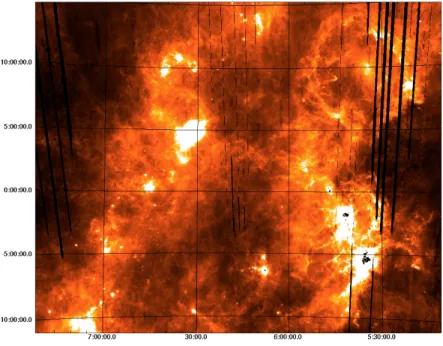
3.1. Individual Regions: Taurus-Perseus and Orion In Figures 3 and 4 we show the preliminary AKARI Diffuse maps of the Taurus and Perseus regions; a sec- tion of the diffuse high Galactic latitude emission; and finally a map of the Orion region.

Taurus is a well-studied region of low mass star for- mation (see Kenyon, Gomez & Whitney (2009) and Davis et al. (2010) for detailed reviews), covering an

area in excess of 100 deg

2

, which require large area maps, such as those of the AKARI Diffuse All Sky map to facilitate comparison. Kenyon & Hartmann (1995) have presented a list of ∼300 Young Stellar Objects (YSOs) in Taurus, derived from multi-wavelength ob- servations and complemented recently with data from the Spitzer Space Telescope (Hartmann et al., 2005;

Luhman et al., 2006). Many of the youngest sources were also detected in the 1.3 mm continuum survey ob- tained by Motte & Andr´ e (2001). The Perseus region is an intermediate star-forming environment consisting of a series of dark clouds with a mass of ∼ 1.7 × 10

4

M

¯

, extending over about 1.5 × 5 degrees on the sky, and adjacent to the Taurus complex. It is associated with Per OB2, the second closest OB association to the Sun, with an age < 15 My, and appears to have blown an ∼ 20 deg diameter shell of atomic hydrogen into the interstellar medium, with the Perseus molecular cloud embedded in its western rim (Curtis et al., 2010).

In Figure 5 we show a comparison between an AKARI Wide-S/WIDE-L/N160 three colour image, and a recent Herschel 250 µm image of the Polaris Flare, which is a high Galactic latitude cirrus cloud, located at a distance < 150 pc. It has significant CO emission, a total gas mass of ∼ 5,500 M

¯

, and some- what colder dust grains than typical diffuse clouds.

As the Polaris flare does not show any sign of star-

formation activity, it is the archetype of the initial

(5)

Fig. 4. Large scale AKARI All Sky Diffuse WIDE-L image of the Orion region. The dark stripes are moon avoidance regions where data are blanked to mitigate scattered moonlight. These will be eliminated in subsequent processing of the All Sky products.

Fig. 5. [Left] AKARI Wide-S/WIDE-L/N160 three colour image of the Polaris Flare; [Right] a recent Herschel 250

µm image from Miville-Deschˆ enes et al.(2010), showing that the AKARI data recovers most of the large scale structures seen

by Herschel, whilst additionally providing coverage of much larger areas.

(6)

206 WHITE ET AL.

Fig. 6. [Upper]: A 30 × 90 degree WIDE-S images of the high Galactic latitude sky. The Andromeda Galaxy, M31, is the bright edge-on elliptical structure just above centre close to the left hand edge of the top figure. [Lower] A filament extraction using the IMARIS software package (with thanks to Dr. Delisa Garcia of www.bitplane.com).

phases of molecular cloud formation (Miville-Deschˆ enes et al., 2010).

To analyse the filamentary structure in the ISM it is necessary to find robust ways to identify filamentary structures in the image planes: e.g. using minimum spanning tree algorithms, gradient techniques, or spe- cific computational algorithms designed to detect fila- mentary or cylindrical objects. We show one example of such a deconvolution using an evaluation version of the commercial software package, IMARIS in Figure 6.

Other filament extraction routines are currently being compared.

4. CONCLUSIONS

The new Diffuse All sky maps show the large scale influence of turbulence on star-formation, revealing a scenario according to which core formation occurs in two main steps: First, large-scale MHD turbulence generates a complex network of filaments in the ISM;

second, the densest filaments fragment into pre-stellar cores through gravitational instability. This picture un- doubtedly is matched by similar Filamentary Webs that thread and shape the properties of other galaxies.

REFERENCES

Curtis, E. I., Richer, J. S., & Buckle, J., 2010, A Submillimetre Survey of the Kinematics of the Perseus Molecular Cloud - I. Data, MNRAS, 401, 455

Davis, C. J., Chrysostomou, A., Hatchell, J., &

Wouterloot, J. G. A., 2010, The JCMT Legacy Survey of the Gould Belt: a First Look at Taurus with HARP, MNRAS, 405, 759

Elmegreen, B. G. & Scalo, J., 2004, Interstellar Tur- bulence I: Observations and Processes, ARAA, 42, 211

Hartmann, L., Megeath, S. T., Allen, L., Luhman, K., et al., 2005, IRAC Observations of Taurus Pre-Main-Sequence Stars, ApJ, 629, 881

Kawada, M., Baba, H., Barthel, P. D., et al., 2007, The Far-Infrared Surveyor (FIS) for AKARI, PASJ, 59, S389

Kenyon, S. J. & Hartmann, L., 1995, Pre-Main- Sequence Evolution in the Taurus-Auriga Molec- ular Cloud, ApJS, 101, 117

Kenyon, S. J., Gomez, M., & Whitney, B. A., 2009, in Handbook of Star Forming Regions Vol.1, ed.

B. Reipurth, ASP Monographs, p.405

Luhman, K. L., Whitney, B. A., Meade, M. R.,

Babler, B. L., et al., 2006, A Survey for New

(7)

Members of Taurus with the Spitzer Space Tele- scope, ApJ, 647, 1180

Miville-Deschˆ enes, M. -A., Martin, P. G., Abergel, A.,

& Bernard, J. -P., 2010, Herschel-SPIRE Obser- vations of the Polaris Flare: Structure of the Dif- fuse Interstellar Medium at the Sub-Parsec Scale, A&A, 518, L104

Motte, F. & Andr´ e, P., 2001, The Circumstellar En- vironment of Low-Mass Protostars: A Millimeter Continuum Mapping Survey, A&A, 365, 440 Murakami, H., Baba, H., & Barthel, P. D., et

al., 2007, The Infrared Astronomical Mission AKARI, PASJ, 59, S369

Onaka, T., Matsuhara, H., & Wada, T., et al., 2007, The Infrared Camera (IRC) for AKARI – Design and Imaging Performance, PASJ, 59, 401 Swinyard, B., Nakagawa, T., Merken, P., & Royer,

P., et al., 2009, The Space Infrared Telescope for Cosmology and Astrophysics: SPICA a Joint Mission between JAXA and ESA, Experimental Astronomy, 23, 193

Wada, T., Matsuhara, H., Oyabu, S., & Takagi, T., 2008, AKARI/IRC Deep Survey in the North Ecliptic Pole Region, PASJ, 60, S517

Ward-Thompson, D., Di Francesco, J., Hatchell, J., Hogerheijde, M. R., et al., 2007, The James Clerk Maxwell Telescope Legacy Survey of Nearby Star- Forming Regions in the Gould Belt, PASP, 119, 855

White, G. J., Pearson, C., Braun, R., & Serjeant, S., et al., 2010, A Deep Survey of The AKARI North Ecliptic Pole Field. I. WSRT 20 cm Radio Survey Description, Observations and Data Reduction, A&A, 517, A54

White, G. J., Hatsukade, B., Pearson, C., Takagi, T.,

et al., 2012, A Deep ATCA 20 cm Radio Survey

of the AKARI Deep Field South near the South

Ecliptic Pole, astro-ph 1207.2262

수치

Fig. 1. All sky images, from top to bottom: 408 MHz ra- ra-dio continuum: 21 cm atomic hydrogen line: IRAS 60 µm : AKARI 90 µm all sky diffuse map: Herschel observations of the Eagle Nebula from Hill et al
Fig. 2. [Upper two Figures] AKARI Diffuse All Sky images in the WIDE-S and WIDE-L filters
Fig. 3. AKARI All Sky Diffuse images: [left] the WIDE-S image of the Taurus and Perseus star formation regions which form part of the Gould Belt of nearby star forming regions (Ward-Thompson et al., 2007): [right] a large scale WIDE-S image of the diffuse
Fig. 4. Large scale AKARI All Sky Diffuse WIDE-L image of the Orion region. The dark stripes are moon avoidance regions where data are blanked to mitigate scattered moonlight

참조

관련 문서

• 이명의 치료에 대한 매커니즘과 디지털 음향 기술에 대한 상업적으로의 급속한 발전으로 인해 치료 옵션은 증가했 지만, 선택 가이드 라인은 거의 없음.. •

 The Dutch physicist Pieter Zeeman showed the spectral lines emitted by atoms in a magnetic field split into multiple energy levels...  With no magnetic field to align them,

그것은 이미지를 문자적 으로 서술하는 문제이며 옐름슬레브Hjelmslev[4]의 용어를 쓰자면 (코노테 이션과 반대되는 의미로서) 공정작용operation의

“ Sheikh Nasser has a written message from HH the Amir, Sheikh Sabah Al-Ahmad Al-Jaber Al-Sabah to the Chinese President, Chi Gen Beng related to enhancing mutual

On his part, CEO of Express Roads Authority, Saud Al-Naqqi said that the heavy rains of the previous day led to clogging parts of the express

Kuwait will celebrate on Sunday the fourth anniversary of the UN honoring and proclamation of His Highness the Amir, Sheikh Sabah Al-Ahmad Al-Jaber Al-Sabah as

Karpowership, part of Turkey’s Karadeniz Energy Group and the first company to build and contract power ships, believes it can offer SA the power it needs very quickly..

The Joseon government designed and promulgated the Taegeukgi as a national flag for diplomatic and political purposes, but it was the independence movement that made it