• 검색 결과가 없습니다.

Structure of an Oncology Information System Based on a Cost-Effective Relational Database for Small Departments of Radiation Oncology

N/A
N/A
Protected

Academic year: 2021

Share "Structure of an Oncology Information System Based on a Cost-Effective Relational Database for Small Departments of Radiation Oncology"

Copied!
7
0
0

로드 중.... (전체 텍스트 보기)

전체 글

(1)

Original Article

Structure of an Oncology Information System Based on a Cost-Effective Relational Database for Small Departments of Radiation Oncology

Hosang Jeon 1 , Dong Woon Kim 1 , Ji Hyeon Joo 1 , Yongkan Ki 2 , Wontaek Kim 2 , Dahl Park 3 , Jiho Nam 3 , Dong Hyeon Kim 3

1 Department of Radiation Oncology and Research Institute for Convergence of Biomedical Science and Technology, Pusan National University Yangsan Hospital, 2 Department of Radiation Oncology, Pusan National University School of Medicine, Yangsan, 3 Department of Radiation Oncology, Pusan National University Hospital, Busan, Korea

Received 19 October 2020 Revised 13 November 2020 Accepted 23 November 2020

Corresponding author Yongkan Ki

([email protected]) Tel: 82-55-360-3450 Fax: 82-55-360-3449

Purpose: Radiation oncology information systems (ROIS) have evolved toward connecting and integrating information between radiation treatment procedures. ROIS can play an important role in utilizing modern radiotherapy techniques that have high complexity and require a large amount of information.

Methods: Using Access TM software, we have developed a relational database that is highly optimized for a radiotherapeutic workflow.

Results: The prescription table was chosen as the core table to which the other tables were connected, and three types of forms-charts, worklists, and calendars- were suggested. A fast and reliable channel for delivering orders and remarks according to changes in the situation was also designed.

Conclusions: We expect our ROIS design to inspire those who need to develop and manage an individual ROIS suitable for their radiation oncology departments at a low cost.

Keywords: Radiation oncology information system, Relational database, Microsoft access

Copyright © 2020 Korean Society of Medical Physics

CC
This is an Open-Access article distributed under the terms of the Creative Commons Attribution Non-Commercial License (http://creativecommons.org/licenses/by- nc/4.0) which permits unrestricted non-commercial use, distribution, and reproduction in any medium, provided the original work is properly cited.

Introduction

Since the awareness of the need for electronic recording and verification of radiotherapy treatments arose over 40 years ago [1-3], radiation oncology information systems (ROIS) have evolved toward connecting and integrating information between different radiation treatment pro- cedures [4]. ROIS can play an important role in utilizing modern radiotherapy techniques that have high complex- ity and involve a large amount of information because it is essential to share such information quickly and efficiently among medical staff. Han et al. [5] reported that the overall

workload associated with radiation treatment procedures such as nursing, simulation, and treatment was reduced by 28.2% through the introduction of an electronic chart sys- tem.

One of the most widely used digital database formats is the relational database (RDB) proposed by Codd [6] in 1970.

Since the RDB can effectively and intuitively manage a large amount of complex data using related tables and support data consistency and concurrency, this method is suitable for ROIS, which requires quick and accurate propagation of frequently updated treatment-related information. Al- though commercial radiotherapy platforms such as Aria TM

Progress in Medical Physics 31(4), December 2020

https://doi.org/10.14316/pmp.2020.31.4.172

eISSN 2508-4453

(2)

(Varian Medical Systems, Palo Alto, CA, USA) or Mosaiq TM (Elekta Oncology Systems, Crawley, UK) already provide most ROIS functionality, their structures or functions can- not be rapidly customized to the needs of individual users, and the number of terminals in these platforms is limited.

Therefore, they have limited capability to respond to the detailed requirements of individual departments.

This study aimed to suggest ROIS with an RDB structure that is effective for small radiation oncology departments using the cost-effective popular database software Access TM (Microsoft, Redmond, WA, USA). Since the feasibility of ROIS developed using this general-purpose software has already been shown by Lim et al. [7], in this study, we focus on an RDB structure that is more sophisticated and opti- mized for radiotherapeutic workflow. The treatment pa- rameters directly related to treatment-beam delivery, such as the monitor unit, gantry angle, and source-to-surface distance, are excluded from our ROIS because they are ef- fectively displayed by existing treatment machine-operating platforms.

Materials and Methods

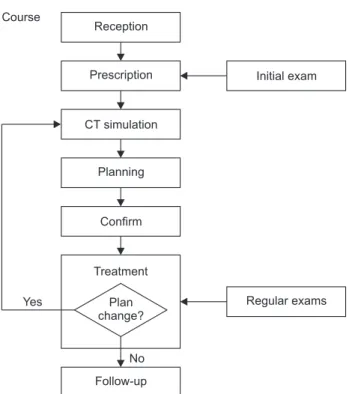
The workflow of our department from the reception of patients to follow-up is presented as an example in Fig. 1.

The workflow was carefully analyzed for the design of our own ROIS structure.

Using Access TM , we created eight relational tables con- taining their own data and designed three types of forms for displaying the queried data. Detailed explanations are provided in the rest of this section. We established three design requirements to build ROIS that were optimized for our departmental workflow as follows.

1. Core table

Because all clinical procedures for radiation treatments should be implemented according to prescriptions, the prescription table was chosen as the core table. Moreover, a single course could be easily matched to a single prescrip- tion. Therefore, we added key information such as clinical status/findings and numerical prescriptions of treatment doses to the prescription table, as shown in Table 1. Five related tables were connected to the prescription table, and the rest were isolated. Fig. 2 presents a diagram describing the overall connections between the related tables.

2. Change in situation

The existing treatment plan may be changed frequently for various reasons, such as weight loss in a patient, modi- fication of target lesions, and machine shutdown. During such situations, appropriate plan changes should be made as necessary to achieve the expected therapeutic effect.

Moreover, these sudden changes should be quickly and accurately conveyed to all staff involved. Therefore, we de- signed order/remark tables to manage unexpected event information. The order table contains order information going from physicians to the other staff members, and the remark table contains information that should be shared between the staff members. When new order/remark con- tent is fed into the ROIS, they are supposed to be immedi- ately displayed on a related worklist to act as an alert.

Initial exam

Regular exams Reception

Prescription

CT simulation

Planning

Confirm

Follow-up Treatment

Plan change?

Yes

No Course

Fig. 1. Overall workflow for radiation treatments. CT, computed

tomography.

(3)

Table 1. Detailed contents contained in each table

Table Content

Patient 1. Personal information (sex, age)

2. Status (active, completed, suspended, canceled, etc.) 3. Face photo link

Prescription 1. Course number

2. Referred information (clinic, physician, letter, etc.)

3. Clinical status (stage, pathology, operation, chemotherapy, radiotherapy history, etc.) 4. Clinical findings (lab, pathology, radiology, etc.)

5. Prescription (physician name, aim, site, total dose/fraction, etc.) 6. Setup photo link

Plan 1. Binary (yes/no) values to indicate whether to complete the target, plan, and confirm 2. Scheduled date and time for computed tomography simulation and treatment 3. Assigned treatment room, machine, and technique names

4. Dose/fraction per plan

Exam 1. Scheduled exam date/time

2. Status (initial, weekly, follow-up, etc.) 3. Comments

Order 1. Recorded date/time

2. Content of order

3. Binary (yes/no) value to indicate whether to implement

Remark 1. Recorded date/time

2. Content of remark

3. Binary (yes/no) value to indicate whether to take care Shutdown 1. Date to shutdown (weekend, holiday, etc.)

User 1. User ID/password/name

2. Working group

Plan

Clinical information

for single plan

Prescription Exam

Clinical information

for single course

Schedules for single

exam Patient

Personal information

Users

User ID and password

for system login

Shutdown

Date list of department shutdown

Order

Short order of physician for single prescription

Remark

Remark of staffs for single prescription

One Many

Fig. 2. Overall connections between the relational tables for radiation oncology information systems (ROIS).

(4)

3. Scheduling task

Treatment scheduling is an inevitable task in radiothera- py departments because radiation treatment adopts a frac-

tionated strategy that treats patients over several days. This is labor-intensive work for which the schedules of the phy- sicians and other staff involved in the examination, com- puted tomography (CT) simulation, planning, and treat- ment rooms must be considered. Therefore, we expect that a high efficiency can be achieved if the coordination and calculation of a patient’s schedule are computerized and automated through the ROIS. In this study, the schedule information for each patient’s examination, CT simulation, and treatment is designed to be entered into the ROIS. The shutdown table contains a list of departmental shutdown dates such as weekends and holidays, such that the pa- tients’ treatment schedule can be automatically calculated in the ROIS.

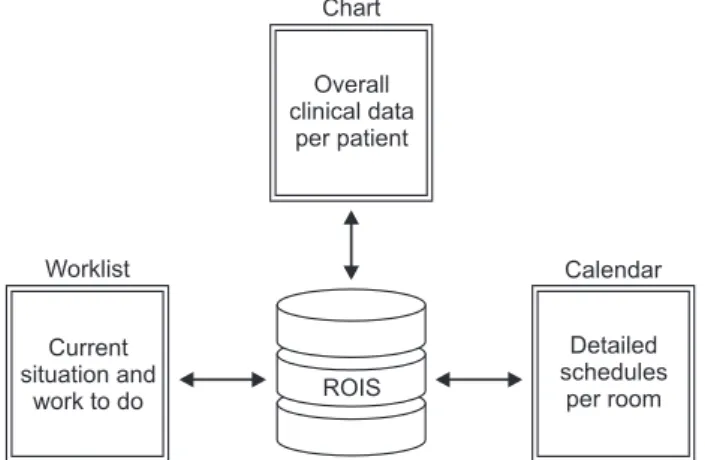
We designed three types of forms, namely, charts, worklists, and calendars, which display the required data for the ROIS (as shown in Fig. 3). The chart contains per- sonal and clinical information for a single patient and

ROIS Current

situation and work to do

Detailed schedules

per room Overall

clinical data per patient

Worklist

Chart

Calendar

Fig. 3. Three kinds of forms for reviewing and editing radiation oncology information systems (ROIS) data.

a c

b

Fig. 4. (a) The main chart of a single patient, (b) the corresponding setup-photo viewer, and (c) the schedule chart for reception staff.

(5)

treatment/exam schedules so that the information for each patient can be obtained at once. Additionally, the chart contains online addresses linked to a facial photo for per- sonal identification, as well as CT simulation photos for checking the patient’s posture, which are stored separately.

The worklist form provides a list of the patient’s information so that each staff member can easily plan what is to be done in each room. As mentioned in the previous paragraph, the latest orders and remarks are also displayed in the form of a worklist. The calendar form is provided for each room, which is similar to the worklist form. The worklist and cal- endar forms can help identify the tasks to be performed in each room.

Results

Fig. 4 shows the two chart forms designed in this study.

One main chart contains most of the clinical data for a single patient, as shown in Fig. 4a, and the other chart is used by the reception staff to schedule examinations, as shown in Fig. 4c. The current clinical status and changes to the patient’s treatment plan can be easily identified in short

order, and remarks are listed at the bottom of the chart. The chart also provides a viewing window to check the patient’s posture during CT simulation, and the history of radiation treatment can be easily reviewed by clicking the corre- sponding course number.

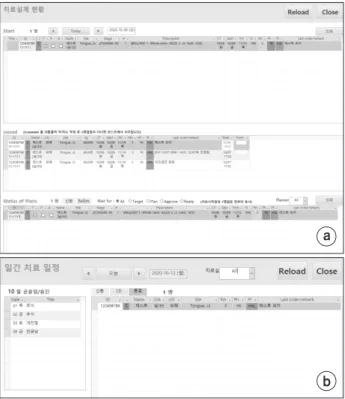
Fig. 5 shows two worklist forms as examples. The worklist form for planners contains three sub-lists for the start of daily treatment, issued orders/remarks, and the current status of planning, as shown in Fig. 5a. The issued list can help planners to respond quickly to the reported situation, and the planners can easily track or conduct the radiation treatment plans of different patients based on the other two lists. The worklist form shown in Fig. 5b provides a daily treatment list for each treatment room, such that therapists can identify their own schedules. We designed five different worklist forms for physicians, planners, reception staff, CT simulation staff, and therapists. Fig. 6 shows two calendar- style forms designed for displaying examination and CT simulation schedules. Since examination or treatment schedules may change frequently, a calendar form effective in managing the schedule information is necessary, espe- cially for the reception staff. We noted that the worklist and calendar forms could offer complementary supports for identifying the task in each room.

In addition to the main functions described above, we in-

a

b

Fig. 5. Two worklist forms for (a) radiation treatment planning rooms and (b) treatment rooms as examples.

a

b

Fig. 6. Calendar-style forms for managing schedules of (a) exams

and (b) computed tomography (CT) simulations.

(6)

troduce a login procedure to manage user-specific authority for clinical data security and develop detailed search and statistics functions through various data-filtering processes.

Discussion

The possibility of communication errors among staff that may lead to clinical accidents has significantly decreased since the introduction of highly computerized ROIS da- tabases. However, there is a possibility of communication errors in non-routine workflow based on sudden changes in the situation; in such cases, a fast and reliable channel for delivering information to related staff is essential. In this study, we developed ROIS that can exactly meet these requirements. All related staff can easily access additional short orders by physicians or sudden changes in the pa- tient’s condition.

The biggest advantage of our ROIS is that it can be fully customized according to the requirements of individual departments, because the difficulty and cost of database development and maintenance using Access TM are signifi- cantly lower than those of the existing database platforms.

Therefore, users can achieve high work efficiency with a highly customized ROIS. For instance, the workload and probability of human errors can be minimized by automatic treatment scheduling (rather than manual writing).

The ROIS presented in this study have some limitations.

First, Access TM has limited data storage (approximately 2 GB) and a small number of connected users. Thus, our ROIS are difficult to use for radiation oncology departments beyond a certain size. Second, we believe that our system cannot be inherently connected or integrated with exist- ing commercial operating systems for radiation treatment.

Instead, it can be used in parallel with systems to maximize work efficiency.

Conclusions

We expect our ROIS design to inspire those who need to develop and manage an individual ROIS suitable for their radiation oncology departments at low cost.

Acknowledgements

This research was supported by the Basic Science Re- search Program through the National Research Foundation of Korea (NRF) funded by the Korean government (MSIT) (2020R1C1C1013300).

Conflicts of Interest

The author has nothing to disclose.

Availability of Data and Materials

All relevant data are within the paper and its Supporting Information files.

Author Contributions

Conceptualization: Yongkan Ki, Wontaek Kim. Data cura- tion: Hosang Jeon, Dong Woon Kim. Formal analysis: Ho- sang Jeon. Funding acquisition: Hosang Jeon. Investigation:

Ji Hyeon Joo, Dong Hyeon Kim. Methodology: Dahl Park.

Project administration: Dong Woon Kim. Resources: Yong- kan Ki, Jiho Nam. Software: Hosang Jeon, Dong Woon Kim.

Supervision: Yongkan Ki, Wontaek Kim. Validation: Hosang Jeon. Visualization: Hosang Jeon. Writing–original draft:

Hosang Jeon. Writing–review & editing: Yongkan Ki.

References

1. Rosenbloom ME, Killick LJ, Bentley RE. Verification and recording of radiotherapy treatments using a small com- puter. Br J Radiol. 1977;50:637-644.

2. Fredrickson DH, Karzmark CJ, Rust DC, Tuschman M.

Experience with computer monitoring, verification and re- cord keeping in radiotherapy procedures using a Clinac-4.

Int J Radiat Oncol Biol Phys. 1979;5:415-418.

3. Morrey D, Smith CW, Belcher RA, Harding T, Sutherland WH. A microcomputer system for prescription, calculation, verification and recording of radiotherapy treatments. Br J Radiol. 1982;55:283-288.

4. Fong de Los Santos LE, Herman MG. Radiation oncology

information systems and clinical practice compatibility:

(7)

workflow evaluation and comprehensive assessment. Pract Radiat Oncol. 2012;2:e155-e164.

5. Han Y, Huh SJ, Ju SG, Ahn YC, Lim DH, Lee JE, et al. Impact of an electronic chart on the staff workload in a radiation oncology department. Jpn J Clin Oncol. 2005;35:470-474.

6. Codd EF. A relational model of data for large shared data banks. Commun ACM. 1970;13:377-387.

7. Lim S, Kim K, Ahn S, Lee SH, Lee R, Cho S. Database for

patient information management in radiation oncology

department. Prog Med Phys. 2018;29:23-28.

수치

Fig. 1. Overall workflow for radiation treatments. CT, computed  tomography.
Fig. 2. Overall connections between the relational tables for radiation oncology information systems (ROIS).
Fig. 3. Three kinds of forms for reviewing and editing radiation  oncology information systems (ROIS) data.
Fig. 4 shows the two chart forms designed in this study.

참조

관련 문서

The data are corrected for temperature error due to solar radiation and the effect of low temperature on the anerod capsule and curvature of the surface of

Purpose: The aim of this study is to identify the relationship between knowledge and awareness of radiation department students and their intent in

Kameoka, “Sentinel lymph node biopsy for breast cancer patients using fluorescence navigation with indocyanine green,” World Journal of Surgical Oncology, Vol..

Development of the Most Appropriate Algorithm for Estimating Personal Dose of Radiation Workers under High Exposure Rate and Non-homogeneous Radiation Field in Nuclear

This research suggests a need for an instructor education program for effective feedback practice and the enhancement of feedback quality in higher education..

It considers the energy use of the different components that are involved in the distribution and viewing of video content: data centres and content delivery networks

After first field tests, we expect electric passenger drones or eVTOL aircraft (short for electric vertical take-off and landing) to start providing commercial mobility

1 John Owen, Justification by Faith Alone, in The Works of John Owen, ed. John Bolt, trans. Scott Clark, "Do This and Live: Christ's Active Obedience as the