A Study on Efficient Animated Character Based on the Hunlock Effect
Ye. Chen
†, Dong Min Cho
††ABSTRACT
Combined with expert interviews and questionnaire investigations, this paper aims at analyzing the different characteristics of the animated characters Spider-Man from Spider-Man: Into the Spider-Verse based on Hunlock Effect, in order to provide appropriate guidance for animation characters designers and limited inspiration for creative practices. First, Spider-Man: Into the Spider-Verse is chosen as the case to analyze 6 Spider-Man with different personalities, who appear at the same time. Then, Spider-Man's characteristics are analyzed through interviews with experts. At last, the key study focuses on the influence of environmental factors on the formation of Spider-Man's roles in the theory of Hunlock Effect, in light of the principle of personality formation in psychology. From the perspective of psychology, interdisciplinary study on animated characters provides scientific and effective support for animation character design, and increases the fascination of animation characters' personalities.
Key words: Hunlock Effect, Animated Character, Environmental Classification
※ Corresponding Author : Dong Min Cho, Address: (54896) 567 Baekje-daero, Deokjin-gu, Jeonju-si, Jeollabuk-do, Korea, TEL : FAX : +82-63-270-3755, E-mail : [email protected]
Receipt date : Apr. 29, 2021, Revision date : Jul. 16, 2021
Approval date : Aug. 17, 2021
††
Dept. of Design & Manufacturing Engineering., Jeon- buk National University
(E-mail : [email protected])
††Dept. of Industrial design., Jeonbuk National University
1. INTRODUCTION
1.1 Background and Objectives
An animated character must conform to the ani- mation plot, and it can draw audiences' attention through its interesting characteristics. Well-de- signed multimedia animated characters can inspire viewers and protect their mental health during COVID-19. Though the plots and characters are fictional, the mental experience gained by audi- ences is real. As a multimedia visual art, the in- tuitiveness and abstraction of animated characters enable the culture to spread between different countries, presenting the designer's worldview and values. The hero theme of Spider-Man opened a new creation of American heroes by using the plot that an ordinary man becomes a superhero after he's been bit by a spider being experimented.
Psychology believes that human behavior is the
result of the interaction between psychological mechanisms and the environment. Through multi- media communication, the animation uses model- ing and background environment to reveal the character's personality. Animated characters orig- inate from some artistic images created by gather- ing, refining, generalizing facts and figures in daily life. They are exquisite designs out of polishing and build-up. Audiences with different age, gender, education background and occupation will have different feelings to animation character's person- ality. The animators of Disney, a famous animation company, always put vivid and distinct person- alities in the first place in the process of character creation. The distinct personality is the most at- tractive part of an animation character, which oc- cupies the main position in audience and leaves a deep impression. This is one of the reasons why Disney animation is the most prominent and has
been popular all the time. Based on Hunlock Effect, this paper analyzes Spider-Man's characteristics in social environment, family environment, and school environment in Spider-Man: Into the Spider- Verse. On the one hand, this analysis is made on the formation of Spider-Man's personalities with expert opinions, indicating the relation between the formation of personality and environmental influ- ence in view of society personality formation theory. On the other hand, this paper states the proportion of which the different personalities of Spider-Man under different environments are fa- vored by audiences, and gives reasons to it.
1.2 Research Content and Methods
The characters appeared in Spider-Man: Into the Spider-Verse are varied and fascinatingly characterized. This research analyzes personalities of 6 different Spider-Man that appeared in Spider- Man: Into the Spider-Verse. The different per- sonalities of Spider-Man have a great impact on the plot and attraction of this animation. Each character has a different story in its own universe, and their personalities are also different. The ani- mation creator designs the character's personality, pouring his ideas and understanding of people into it. Therefore, the animated characters reflect the feelings and emotions of human. Thus, good char- acters can complement the storyline while inter- acting with it, and at the same time, enrich the story content. Nowadays, in the research of anima- tion character design, there are many researches on the personality of different types of animation characters. For example, American psychologists have designed different types of animation charac- ters and invited the audience to carry out the se- lection experiment. South Korea has carried out the research on the personality of animation characters based on different psychological personalities.
Patrick W. Galbraith studied the emotional re- sponse of virtual characters in Japan. While this thesis is to analyze the same type of animation
characters with different personalities in one ani- mation film, which can provide new design refer- ence for the industry.
For the above reasons, this study used the fol- lowing methods:
1) Selecting 6 Spider-Man in Spider-Man: Into the Spider-Verse and analyzing their personalities.
2) Through the society personality formation theory of psychology, analyzing the connection be- tween Spider-Man's personalities and the envi- ronments.
3) Analyzing Spider-Man's personalities based on Hunlock Effect theory.
4) On the basis of the interviews with the ex- perts, extracting key words of Spider -Man's per- sonalities to make personality classification.
5) Based on the audience's satisfaction, the questionnaire of fondness degree upon Spider-Man character is made, and the results of the ques- tionnaire are analyzed.
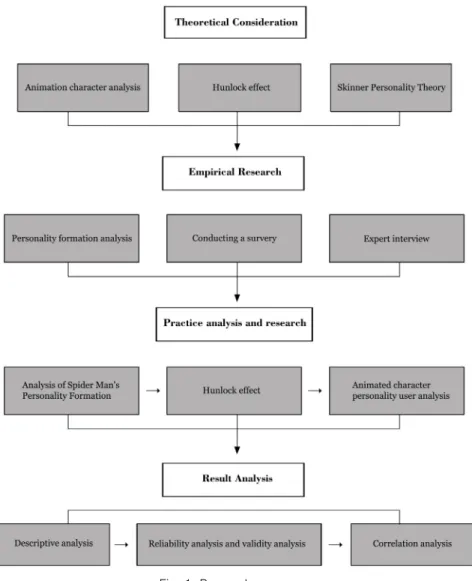
In this study, we follow the process shown in Fig. 1.
2. THEORETICAL INVESTIGATION
2.1 Personality Formation Factors
Stephen Pinker, Professor of Psychology at Massachusetts Institute of Technology has stated that visual organs aim to convey sense of real shape and substance. Character's image building has an extremely important position in animation film production. Psychologist and philosopher William James has said that the strongest human desire is to gain a sense of identity from others.
An animation film cannot touch the inner hearts of the audiences relying on only plot. It must shape the image of characters by endowing them with unique appearance, behavior, language, and dis- tinctive personality. The process of the creation of animation character personalities should be con-
Fig. 1. Research process.
sistent with the development of the film's plot, which is good for audiences' understanding of the animation film.
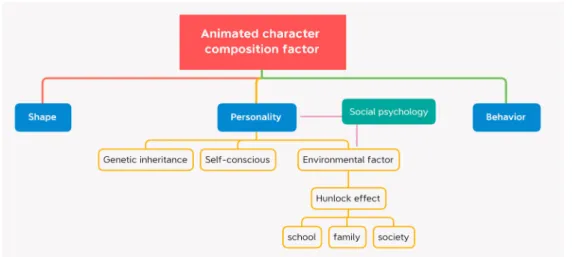
Personality formation factors are divided into environmental factors and ego factors according to psychology. This paper selects environmental fac- tors to analyze animated character's personality formation so as to study animated characters sci- entifically and systematically. Academician Carl Ransom Rogers at American College of Arts and Sciences holds the view that education aims at cul- tivating healthy personality and creating positive growth environment. Stephen Pinker, Professor of
psychology at MIT and Harvard University be- lieves people's differences come from different life experiences, such as family education, growing emergency and so forth. These experiences domi- nate differences between people. Thus, this paper mainly discusses the influence of social environ- ment, family environment, and school environment on the personality formation of animated charac- ters (Fig. 2).
2.2 Hunlock Effect
American psychologist E. B. Hunlock has done a group of psychological experiments. The results
Fig. 2. Analysis on the Formation Factors of Animated Character's Personality.
Fig. 3. Hunlock Effect experiment efficiency table.
are shown in Fig. 3. In his experiments, 126 sub- jects were divided into four groups, and they were asked to complete the same task in four different environments.
The first group is the motivation group in which testers are praised and encouraged after work;
The second group is the reprimand group in which testers are reprimanded after work;
The third group is the ignore group in which testers are not be evaluated and are will only be allowed to listen to the praise and criticism of the other two groups;
The fourth group is the control group. Let the testers be isolated from the first three groups without any evaluation.
The Hunlock Effect efficiency table shows that the four groups that perform the same task in dif-
ferent environments have significant work effi- ciency over time.
1. The motivation group performed the best, while the control group performed the worst.
2. With time, the working efficiency of the moti- vation group has been on the rise.
3. Reprimand Group is not as good as the moti- vation group, but it is making progress. Appro- priate praise is obviously more effective than criti- cism, and criticism is more effective than no evalu- ation.
The Hunlock Effect experimental efficiency ta- ble proves that timely feedback on valuable results and behaviors can increase people's enthusiasm for the same task and explains that human develop- ment is related to the external environment.
There are plenty of efficient and successful cas- es in professional management and education con- cerning about Hunlock Effect. In the art of film, broken-hearted plots are impressive, and healing ones can help people regain their passion for life.
Animation practitioners can create animated char- acter personalities on the basis of Hunlock Effect to make people feel amused and warm, to reduce the audiences' psychological pressure and fatigue, and to help them find positive motivation to face difficulties.
3. EMPIRICAL RESEARCH
3.1 Character Design of Spider-Man
Before the screening of Spider-Man: Into the Spider-Verse, the main trend in commercial 3D animation character design was to pursue a visual sense of reality, and the design of animated char- acter took the sense of reality as goal, in the hope of bringing audience vivid and unique visual effect and immersive animation viewing experience.
In the animation character modelling design, Spider-Man: Into the Spider-Verse provides 6 totally different Spider-Man images. This film was awarded 16 animation awards and high box office.
Every Spider-Man has his or her own distinctive external image and personality. For the detailed analysis method of external modeling, please refer to the paper published in the Spring International Academic Conference of foundation modeling Association in 2020. It was the first time that so many derivative characters exist in one animation film. It is of great study value due to its breaking of previous rule of character creation and its plant- ing of new concept, with which it can enlighten animation practitioners on how to design and dif- ferentiate same-type animated characters in one animation.
3.2 Spider-Man Personality Research Methods 1) Considering prior studies and animation char- acter design principles, the animated character is divided into two elements: modeling design and personality.
2) Based on the psychological personality for- mation theory, the factors affecting the formation of animated characters are divided into genetic factors, environmental factors, and self.
3) This survey invited 10 animation industry ex- perts to collect industry experts’ views on Spider- Man’s character through multiple rounds of inter- views; According to the design characteristics of
the animated character’s character and "Hunlock Effect," the Spider-Man character’s personality were grouped.
4) The user questionnaires were designed based on user satisfaction, animation character design principles, and psychology and social personality formation theory to prove effective decision-mak- ing in the process of animation character design.
5) According to the result of the questionnaire, environmental influences on animated character's personalities are analyzed by using Hunlock Effect.
In order to testify the effectiveness of the study, reliability analysis, effectiveness analysis, and cor- relation analysis are carried out. Finally, the con- clusion is proved using the experimental results of the above empirical studies.
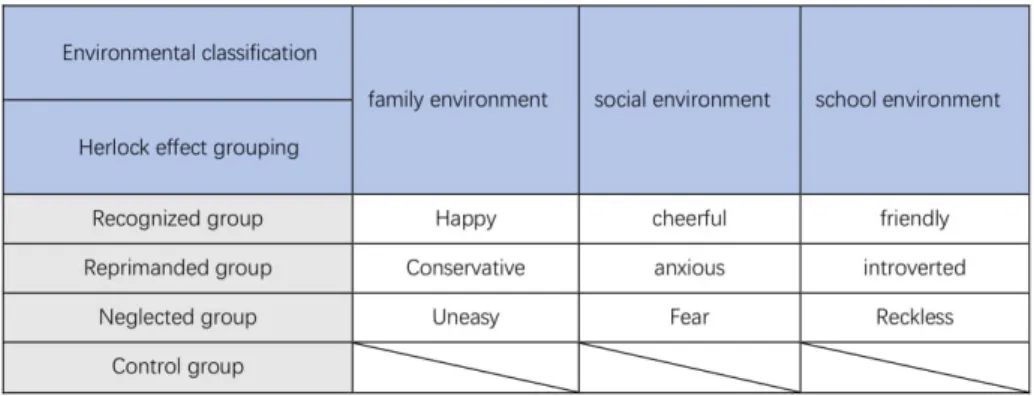
3.3 Personality-classification of Spider-Man According to the interview results of the ex- perts, six Spider-Man were analyzed from the per- spective of personalities by using the Hunlock Effect principle. According to the plot of the ani- mated film and the background design of the six Spider-Man, we can know that Miles Morales and Spider-Woman meet in the same high school, and the plot begins. Therefore, Miles Morales and Spider-Woman are divided into the school envi- ronment group; The role of Peter B, Parker is set as unemployed, divorced, lonely, and decadent. His background is about family, so Peter B, Parker is divided into family groups. As for Peni-Parker and Spider-Man Noir、Spider-Ham, the film empha- sizes their story description of social background, so they are divided into social group. Miles Morales (Fig. 4) and Peter B, Parker(Fig. 5) were taken as the research subjects to analyze the Spider- Man’s personalities in different environments. Through the personality characteristics of the environment to convey the animation character's emotion, the audience can more directly feel the change of the character's emotional characteristics.
Fig. 4. Miles Morales Personality Analysis.
Fig. 5. Peter B, Parker Personality Analysis.
3.4 Hunlock Effect on Spider-Man's Environmental Impact
A conclusion of environment grouping of Spider-Man is drawn as the following based ex- perts’ interviews from the perspective of Hunlock Effect.
1. Miles Morales, the new Spider-Man, becomes brave and responsible after receiving appropriate praise and help, and he grows up significantly- quickly.
2. Peter B, Parker, Spider-Man, loses self-con- fidence and becomes depressed and has a low sense of responsibility after the death of his loved ones, divorce from his wife, investment failure and loneliness. However, after being criticized, he gradually regains his confidence and sense of re- sponsibility and helps Miles Morales become a qualified Spider-Man.
3. Those who gained no praise or criticism in
Spider-Man: Into the Spider-Verse, Spider-Wo- man, Peni-Parker, Spider-Man Noir, and Spider- Ham witness Miles Morales’ growth into Spider- Man. In the end, in order to protect the stability of the city, they fight against the villain, and gain the experience of 6 different Spider-Men fighting together.
4. According to Spider Universe, there are 56 Spider-Men. The 50 other Spider-Man, Which are never mentioned in Spider-Man: Into the Spider- Verse, are fighting regular battles in their own world.
Cinematography can be memorable for its sad storylines and scripts, but healing stories can give people the power of rebirth.
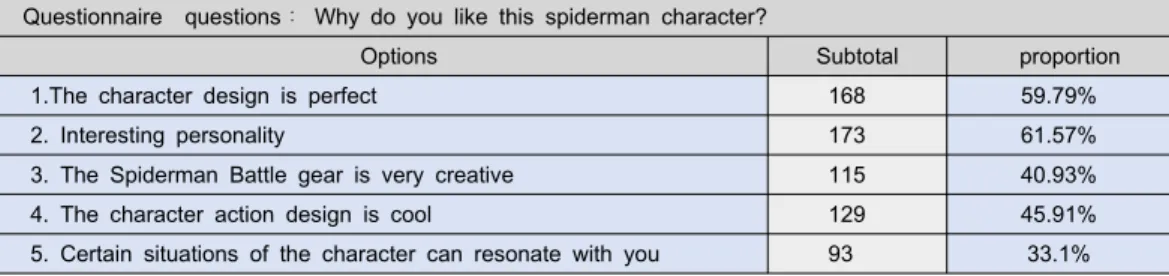
To verify the results of our research on the per- sonalities of animated characters, we conducted a questionnaire survey with 281 randomly-selected viewers who had watched Spider-Man: Into the
Fig. 6. Age Distribution.
Questionnaire questions: Why do you like this spiderman character?
Options Subtotal proportion
1.The character design is perfect 168 59.79%
2. Interesting personality 173 61.57%
3. The Spiderman Battle gear is very creative 115 40.93%
4. The character action design is cool 129 45.91%
5. Certain situations of the character can resonate with you 93 33.1%
Fig. 7. Questionnaire Answer Case.
Spider-Verse.
3.5 Animated Character Personality User Analysis The main subject of this study is the audiences of the animated film.
Empirical research–empirical subjects 1. Animation research invited 10 animation in- dustry experts and conducted multiple rounds of interviews with 10 experts. These expert groups include film directors, storyboard animators, origi- nal artists, animation character designers, scene designers, and animation film technology develop- ers.
2. A total of 281 audiences who have watched Spider-Man: Into the Spider-Verse were randomly selected for the questionnaire survey. The ques- tionnaire was designed based on the user situation analysis, psychological "Social Support Rating Scale" and users' liking of the Spider-Man ani- mated movie.
Spider-Man: Into the Spider-Verse animation film is targeted at all age groups. According to the
research results of developmental psychology and child psychology on children's development, chil- dren from 7-12 years old start to have logical thinking, are able to understand and sympathize with others, learn to put themselves in others' shoes, consider others' feelings and interests and have social awareness. Therefore, we choose the median age of 10 as the lowest point of user age in this study but do not set an upper age limit (Fig.
6).
3.6 Analysis of Users' Preference for Spider-Man with Different Personalities
The results were analyzed through the ques- tionnaire survey, and the acceptance and prefer- ence of six Spiderman animation characters were compared. Combined with the "Hunlock Effect,"
the reasons were analyzed. This analysis provides a more specific reference for the follow-up anima- tion character personality research and analysis.
Of the 281 tested users, 173 (61.57%) say that in Spider-Man: Into the Spider-Verse the charac- ters of Spider-Man are interesting, 168 (59.79%) say the appearance of the Spider-Man are good, 115 (40.93%) say Spider-Man's armors are crea- tive, 129 (40.93%) say the Spider-Man's action de- sign is very attractive, and 93 (33.1%) say that they share the same feeling with the Spider-Man.
According to the questionnaire survey, statistics prove that the various components of the animated character will affect the viewer's viewing experi- ence. The audiences who like the personality of the Spider-Man character accounted for the largest
Table 1. Questionnaire reliability and validity.
Questionnaire reliability analysis
Cronbach's Alpha Number of items
.800 60
Questionnaire validity analysis
Kaiser-Meyer-Olkin metric .908
Bartlett's sphericity test
Approximate chi-square 3352.854
df 153
sig. .000
Table 2. Spider-Men Environment Grouping.
Environment Spider-Man
School Environment Miles Morales、Spider-Woman
Family Environment Peter B,Parker
Society Environment Peni-Parker、Spider -Man Noir、Spider-Ham proportion (Fig. 7).
4. ANALYSIS OF RESEARCH RESULTS
4.1 Questionnaire Analysis
The questionnaire survey is divided into four parts (Fig. 6). Part one includes the audience's gender, age, education background, their attitude towards Spider-Man: Into the Spider-Verse, and whether they want the animated characters to be similar to their reality. Part two of the ques- tionnaire is based on the theory of the Hunlock Effect and social psychology theory. Social Support Rating Scale (SSRS) psychological test is applied.
SSRS has 10 items in 3 dimensions: objective sup- port (i.e., actual support received by the tested user), subjective support (i.e., emotional support of the tested user experience), support utilization de- gree, and the higher the score rate, the better the social support degree. The first part of the scale indicates support from socializing and rate of friends offering help, which shows: None: 24 (8.54
%), 1-2: 95 (33.81%), 3-5: 87 (30.96%), 6 or above:
75 (26.69%). The results of this test will be used to analyze human emotional responses and person- ality traits in different society environments. Part three is Customer Satisfaction (CAST). CAST is the most classic user satisfaction scale for evaluat-
ing a particular event experience. It includes a five- point scale to measure user preferences. The 6 Spider-Man animated characters are evaluated by users of animated movies. Part four is analysis of character background and environment. In order to understand users' emphasis on the story back- ground of animated characters, the matrix scale is used for investigation and evaluation, verification, and extraction.
Firstly, we use SPSS to conduct reliability anal- ysis on the questionnaire. According to Cronbach's α coefficient which measures the reliability of the sample, the α coefficient value is 0.8, indicating that the overall reliability of the research subject is good, and the survey data can be used for effective research. Secondly, KMO and Bartlett tests are carried out to prove that reliable data could be used for the next step of research and analysis. The KMO and Bartlett SPSS analysis result is 0.9 which meets KMO>0.6 and P<0.05. According to the Hurlock Effect and the animated film's plot, the six Spider-Man characters are grouped into envi- ronmental groups (Table 2).
4.2 Analysis Result
After validity analysis and credibility analysis, according to the three environmental factors set by the theory of social personality environment for-
Table 3. Variance Analysis Table.
Dependent Variable Group N Mean F Sig.
School Environment 281 4.10
20.496 .000
Home Environment 281 3.40
Society Environment 281 3.75
Table 4. Analysis of Variance of Environmental Satisfaction.
Dependent Variable: Degree of Satisfaction
(I) Group (J) Group MD (I-J) Std. Error Sig. Multiple
Comparisons
School Environment (1) Home Environment (2) .705 .110 .000 1>2
School Environment (1) Society Environment (3) .342 .110 .002 1>3 Home Environment (2) Society Environment (3) -.363 .110 .001 2<3 mation, and through the user questionnaire, three
different environments of Spider-Man’s person- ality preferences, using variance analysis to study the school environment, family environment, and society environment were set to study the differ- ence among the three groups of environment.
Data analysis results show that in Spider-Man:
Into the Spider-Verse, the character influenced by school environment has the highest average score of satisfaction (4.10), the character influenced by family has the lowest average score of satisfaction (3.40), and the character influenced by society has the middle average score of satisfaction (3.75).
P<0.05 indicates that there exists a significant difference. In this study, P<0.01 indicates a highly significant difference.
4.3 Post Multiple Comparative Analysis
As shown in Table 4, the overall ranking of sat- isfaction of different audience groups on the char- acters of Spider-Man formed under the school en- vironment, family environment and society envi- ronment is: School Environment > Society Envir- onment > Family Environment.
In the three environments, comparing school en- vironment with the family environment, two points are found out. First, in the school environment, we can have a richer emotional experience, such as
friendship, pure love, and getting along with class- mates and teachers. Second, according to the in- formation collected by the questionnaire, audiences all have different levels of school learning experi- ence, so the audiences are more capable to share the same feeling to increase the spiritual inter- action and immersive experience with the animated characters.
Comparing school environment with society en- vironment, the following points are found out.
First, school environment is relatively simpler than socilety environment. Second, both environments have rich emotional experience, but the positive emotional experience in school environment is more than the positive experience in society environment.
Third, the negative emotional experience in society environment is more serious. The audiences are more likely to feel uncomfortable.
Comparing family environment with society en- vironment, the conclusion is as follows. First, be- cause there are few family members of the charac- ters in the film, the emotional communication is relatively single and fixed, while the sociality envi- ronment contains more emotion experience and rounder characters. Second, in Spider-Man: Into the Spider-Verse, four Spider-Man lost their pa- rents, and one lost all their relatives. Such an envi- ronment setting will make some viewers who have
lost their loved ones empathize with their unfor- tunate lives and increase their psychological burden.
5. CONCLUSION
According to social psychology, individual be- havior is influenced by the social environments, such as individual identity, individual status, edu- cation, and behavior mode. Society identity can be divided into personal identity and social identity.
An individual can be aware of the specific social group he belongs to, as well as the emotion and value meaning that group identity brings to him.
6 Spider-Man in Spider-Man: Into the Spider- Verse have different identities, different education, different behavior patterns, and different values, but they share the same goal of maintaining social stability, protecting the world, and reducing harm.
Six personalities are held by one single character, so it is vital to divide the group since each person- ality represents in detail, making it easier for the audience to distinguish their individual identity and thought, behavior pattern, and the capability of saving society. Hunlock Effect can be used to group the environment of all the characters con- veniently and effectively, arrange the background of the characters and improve the design efficiency and set the characters in a scientific way.
According to the user questionnaire, the person- alities of animated characters in the Spider-Man:
Into the Spider-Verse are favored by the audi- ences, which are exhibited together through the external modeling, behavior, and action environ- ment of the animated characters. The personality of the animation character is set according to the animation plot. Not only the composition of the story is widely resonated by the audience, but also an important element of the animation that can bring box office success. Through the interview with 10 experts in animation industry, it can be known that the character's personality reflects the creator's cognition and understanding of society.
If carefully analyze the personality of the charac- ters in animation, one can more scientifically carry out the behavior of the characters in animation. In this way, the actions of the characters are inter- connected, the content of the story is richer, the audience's acceptance is higher, and the audience of different countries can more easily understand the creative intention of the animation creators. In animated films, the personality of animated char- acters is displayed together through the external modeling, behavior, and environment of animated characters. The characters in different environ- ments are different. In the classification of school, family, and society, the animation character per- sonality with interesting and happy adolescence created in a school environment is the most popular. followed by animation character person- ality shaped through family warm environment and relatively simple family beloved relationship.
Because of the variability of the social environ- ment, the emotional experience of some audiences will have uncertainty. Therefore, when animation practitioners need to provide animation characters with a positive emotional experience for the audi- ence, they can first consider shaping the charac- ter's personality based on the school environment, followed by family environment and social envi- ronment. Vivid and interesting animated charac- ters can make the audience remember more deeply, increase the popularity of animated films, and en- courage the audience to face life. The flaw of this thesis is that there are many aspects that affect audience satisfaction for characters while this the- sis only analyzes the characters from the per- spective of characters’ personalities. In the sub- sequent research, analysis of the actions of ani- mated characters will be continued to form a com- plete series of studies on animated characters.
REFERENCE
[ 1 ] A.W. Damerall, “The Visual Working Memory
Demands of Processing Conventional Meta- phoric Language,” American Journal of Psy- chology, Vol. 134, No. 1, pp. 13-29, 2021.
[ 2 ] T. Lee and Y.S. Lee, “Emotional Influence of Attribute Patterns of Movement in Interaction Form,” Archives of Design Research, Vol. 34, No. 1, pp. 69-82, 2021.
[ 3 ] J.J. Li, “Research for The cognitive Properties of Zombie Game Character,” Journal of Korea Multimedia Society, Vol. 24, No. 5, pp. 717- 726, 2021.
[ 4 ] S.K. Kim, “Affective Computing Among Individuals in Deep Learning,” Journal of Korea Multimedia Society, Vol. 7, No. 2, pp.
115-124, 2020.
[ 5 ] A. Ratajska, M.I. Brown, C.F. Chabrisi,
“Attributing Social Meaning to Animated Shapes: A New Experimental Study of App- arent Behavior,” American Journal of Psy- chology, Vol. 133, No. 3, pp. 295-312, 2020.
[ 6 ] S. Jian and S.Y. Mi, “Length-shot language research in animation,” The Korean of Society Science, Vol. 38, No. 1, pp. 83-96, 2020.
[ 7 ] H. Zhe and L.H. Seok, “Study of User Reuse Intention for Gamified Interactive Movies upon Flow Experience,” Journal of Korea Multimedia Society, Vol. 7, No. 4, pp. 281-293, 2020.
[ 8 ] S. Pinker, Enlightenment Now: The Case for Reason, Science, Humanism, and Progress, Duke University Press, London, 2019.
[ 9 ] P.W. Galbraith, Evolutionary Psychology, Otaku and the Struggle for Imagination in Japan, Durham, 2019.
[10] L.S. Jie, “Personality and Behavior Analysis of the Characters in Naruto - With focus on Enneagram Type,” Korean Society of Cartoon and Animation Studies, Vol. 43, No. 1, pp. 23- 46, 2016.
[11] D.M. Buss, Evolutionary Psychology: The New Science of the Mind, East China Normal University Press, Shang Hai, 2007.
Ye. Chen
2014-2017 Master of Nanjing Normal University
2019 Present, Chonbuk National University, Department of Design and Manufacturing Engineering, Ph.D.
Interests: Game Design, Character Design
Dong Min Cho 2009 Present Professor, Department of Industrial Design, Chonbuk University 2008-2009 Full-time Lecturer, Game Education Center, Sogang University
2004-2006 MFA, AAU, San Francisco, USA
Interests: Game Design, Visual Design