• 검색 결과가 없습니다.

REM-Related Sleep-Disordered Breathing

N/A
N/A
Protected

Academic year: 2021

Share "REM-Related Sleep-Disordered Breathing"

Copied!
7
0
0

로드 중.... (전체 텍스트 보기)

전체 글

(1)

REM 수면 관련 수면호흡장애

REM-Related Sleep-Disordered Breathing

신 철 1 ·이 현 주 2

Chol Shin,

1

Hyunjoo Lee

2

ABSTRACT

Sleep is associated with definite changes in respiratory function in normal human beings. During sleep, there is loss of voluntary con- trol of breathing and a decrease in the usual ventilatory response to both low oxygen and high carbon dioxide levels. Especially, rapid eye movement (REM) sleep is a distinct neurophysiological state associated with significant changes in breathing pattern and venti- latory control as compared with both wakefulness and non-rapid eye movement (NREM) sleep. REM sleep is characterized by erratic, shallow breathing with irregularities both in amplitude and frequency owing to marked reduction in intercostal and upper airway muscle activity. These blunted ventilatory responses during sleep are clinically important. They permit marked hypoxemia that occurs during REM sleep in patients with lung or chest wall disease. In addition, sleep-disordered breathing (SDB) is more frequent and longer and hypoventilation is more pronounced during REM sleep. Although apneic episodes are most frequent and severe during REM sleep, most adults spend less than 20 to 25% of total sleep time in REM sleep. It is, therefore, possible for patients to have frequent apneas and hypopneas during REM sleep and still have a normal apnea-hypopnea index if the event-rich REM periods are diluted by event-poor periods of NREM sleep. In this review, we address respiratory physiology according to sleep stage, and the clinical implications of SDB and hypoventilation aggravated during REM sleep. Sleep Medicine and Psychophysiology 2004;11(1):

10-16

Key words: REM sleep·Sleep-disordered breathing·Aphea-hypophea index.

서 론

각성 시 호흡은 수의근의 조절과 산소 및 이산화탄소 농도 와 같은 화학적 자극에 대한 반응으로 조절된다. 이와 달리 수면 중에는 수의근의 조절 능력이 소실 될 뿐만 아니라 저 산소증과 고탄산혈증에 대한 호흡 반응이 전반적으로 감소 한다(1,2). 또한, 상기도 확장근의 이완으로 인하여 수면 시 작 단계에서 기류 저항이 전형적으로 증가한다(3). 그러나,

수면 중 증가하는 호흡 저항에 대한 환기능의 보상 작용은 급속안구운동수면(rapid eye movement sleep;REM 수면) 단계에서 가장 감소하게 된다. 이와 더불어 REM 수면 시 나 타나는 중요한 변화는 횡격막과 안구근을 제외한 골격근의 긴 장이 두드러지게 감소한다는 것이다. 따라서 수면과 관련된 환기장애의 대부분이 REM 수면 단계에서 가장 심각하게 나 타나며(4), 무호흡도 더욱 길고 빈번하게 나타난다(5-7).

뿐만 아니라, 횡격막 기능장애가 두드러진 경우(예를 들면, 마비, 쇠약, 또는 중증 만성폐쇄성폐질환에서 과다팽창), 어 떤 호흡장애이든 특히 REM 수면 중에 치명적인 야간 호흡 저하를 초래할 수 있다. 본 고에서는 수면 단계에 따라 변 하는 호흡생리와 REM 수면 시 나타나는 수면호흡장애에 대 하여 고찰해보고자 한다.

본 론

1. 수면과 호흡 생리

수면 중 신체의 주요 기능들은 비급속안구운동수면(non

••••••••••••••••••••••••••••••••••••••••••••••••••••••••••••••••••••••••••••••••••••••••••••••••••••••••••••••••••••

1고려대학교 의과대학 안산병원 호흡기내과학교실 수면호흡장애센터

Pulmonary Sleep Disorder Center, Department of Pulmonary and Cri- tical Medicine, Korea University College of Medicine, Ansan Hospi- tal, Ansan, Korea

2고려대학교 의과대학 BK21의과학사업단

Brain Korea 21 Project for Biomedical Science, Korea University College of Medicine, Seoul, Korea

Corresponding author: Chol Shin, Pulmonary Sleep Disorder Center, Department of Pulmonary and Critical Care Medicine, Korea University Ansan Hospital, #516 Gojan-1-dong, Danwon-gu, Ansan, 425-707, Korea Tel: 031) 412-5603, Fax: 031) 412-5604

E-mail: [email protected]

(2)

rapid eye movement sleep;NREM 수면)과 REM 수면에 따라 달라진다는 것은 잘 알려진 사실이며, 이는 수면 중 호 흡에 있어서도 그대로 적용된다. 따라서 여기에서는 수면 중 호흡생리에 대하여 NREM과 REM 단계로 나누어 살펴보도 록 하겠다.

1) NREM 수면

일반적으로 NREM 수면은 점진적인 뇌파 활동성의 감소 에 따라 네 단계로 분류하지만, 수면 중 호흡에 관해서는 비 항정상태(unsteady)와 항정상태(steady)로 나누는 것이 더 바람직하다(8). 수면 시작 시에는 서파수면(slow wave sl - eep)으로 바로 도달하지 못하고, 각성과 수면 1, 2단계 사 이에서 몇 분 또는 수 십분 간 맴돌다가 안정된 2단계 수면 에 진입한 후 3, 4 단계 수면에 도달한다. 따라서 비항정상 태 NREM 수면은 각성이 간간히 나타나는 1단계 및 비항 정상태의 짧은 2단계 수면을 의미하며, 항정상태 NREM 수 면은 안정된 2단계 수면 및 3, 4단계의 수면을 뜻한다.

(1) 비항정상태 NREM 수면

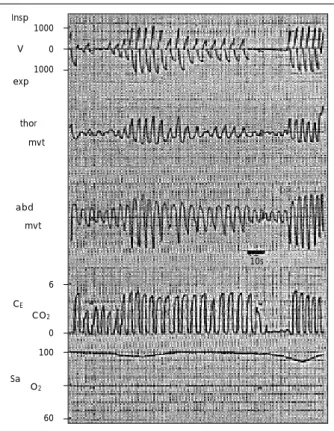
수면의 시작과 졸음 단계에서는 규칙적으로 증감하는 호흡 진폭의 진동을 특징으로 하는 주기변동호흡(periodic brea - thing)이 나타난다(9). 진동은 진폭의 크기가 작은 경우 과 다호흡이나 호흡저하를 유발하며, 크기가 큰 진폭을 보일 때 는 무호흡을 유발할 수 있다. 이처럼 진폭이 변하는 동안, 호흡수에는 거의 변화가 없다(그림 1). 주기변동호흡의 형 태는 무호흡이나 저호흡에 앞서 호흡 진폭의 점진적 감소와 증가를 보이는 체인-스토크형 호흡(Cheyne-Stokes res - piration)이나(10-12), 진폭이 점점 감소하면서 무호흡이 나타난 후에 회복된 첫 번째 또는 두 번째 호흡에서 가장 진 폭이 큰 호흡을 보이는 비오트 호흡(Biot’ s breathing)과 비 슷하다(10).

주기변동호흡은 대개 60~90초 사이의 파장으로(10), 수 면 시작단계에서 10~20분에서 길게는 60분 정도 지속된다 (10-12). 또한 이 현상은 각성과 수면 1, 2단계를 오가는 동안 계속 관찰되며, 안정된 2단계 수면 또는 더 깊은 수면 단계에 도달했을 때 사라진다(10).

(2) 항정상태 NREM 수면

항정상태 NREM 수면 동안 호흡의 진폭과 빈도는 매우 일정하므로(10,12-14), 전 수면 단계 중에서 변화 지수가 가장 작다(10,15)(그림 2). 항정상태 NREM 수면 동안에 는 분당환기량(minute ventilation)이 각성 시에 비하여 0.4~

1.5 l/min 정도 감소하게 된다(9). 이전의 연구들을 살펴보

면, 수면 2단계에서는 각성 시 분당환기량의 13%가 감소하 고, 수면 3, 4단계에서는 약 15% 정도가 감소하여(14), 수 면 단계가 깊어짐에 따라서 환기도 점점 감소하는 것으로 보인다. 그러나 이와 같은 분당환기량의 감소가 일회호흡량 (tidal volume)과 호흡빈도 중 어느 것에 기인한 것인지는 아직 불분명하다.

NREM 수면 시에는 전체 기도 저항이 크게 증가할 뿐만 아니라(16), 폐의 탄성에 변화 없이(17) 후두덮개뒤공간(re - troepiglottic space) 상부의 상기도 저항이 두 배 이상 증가 한다(3,17,18). 저항이 증가하는 부위는 입천장(palatal)과 아래인두(hypopharyngeal) 공간이다(19). 수면 중 상기도 저항의 증가는 상기도근의 근전도 활성의 변화를 동반한다.

즉, 수면 중에는 턱끝혀근(genioglossus muscle), 턱끝목 뿔근(geniohyoid muscle) 및 뒤반지모뿔근(posterior cri - coarytenoid muscle)과 같은 상기도 확장근의 활성이 감소 한다(20,21). 이와 더불어, NREM 수면 시 동반되는 폐용 적의 감소가(22,23) 상기도 저항 증가에 기여하여 결국 수 면 중 환기의 저하를 초래한다.

Insp

V

exp

thor mvt

abd mvt

CE

CO2

Sa O2

1000 1000 1000

1006

1000 1100

1160

10s

Fig. 1. Typical breathing pattern during unsteady NREM sleep. V, ventilatory volumes (ml) obtained from a pneumotachograph attached to a face mask;insp, inspiration;exp, expiration;thor mvt, abd mvt, thoracic and abdominal movements;CE

co2

, CO

2

concentration (percent) in the face mask;SaO

2

, oxygen satura-

tion (percent) (From Krieger J. Breathing during sleep in normal

subjects. Clin Chest Med 1985;6:577-594).

(3)

2) REM 수면

REM 수면 시 호흡의 특징은 불규칙성이다. 호흡 진폭과 빈도가 모두 갑작스럽게 변하며(10,24-28), 때때로 10~

30초의 중추성 무호흡이 나타나기도 하지만(29), 수면 시작 단계에서 보이는 주기변동호흡과는 전혀 다른 양상이다. 불 규칙적인 호흡은 무작위로 관찰되는 것이 아니라 급속 안구 운동과 연관되어 나타난다(10,30,31). 대체로 첫 번째 급 속 안구 운동의 출현 시 호흡진폭의 급작스런 감소가 나타 난 후, REM 수면이 지속됨에 따라 호흡진폭은 점점 증가하 게 된다(30)(그림 3).

이 수면 단계에서 분당환기량은 정도의 차이는 있지만 각 성 시에 비하여 대체로 감소하는 반면, NREM 수면 시와 비교할 때는 결과가 매우 다양하다. 이러한 결과는 일회호흡 량과 호흡수에 있어서도 마찬가지이다. 그러나 이제까지의 연구 결과를 종합적으로 살펴 보면, 정상인에서 REM 수면 시 분당환기량, 일회호흡량 및 호흡수는 NREM 수면 시와 비교해서 크게 다르지 않다(8).

NREM 수면 시에는 흉곽이 호흡에 기여하는 정도가 증가 하는데 비하여, REM 수면 시에는 갈비사이근(intercostal mus - cle) 활성이 뚜렷하게 낮아지므로(32,33) 흉곽이 호흡에 기 여하는 정도가 감소한다. 갈비사이근 근전도 활성의 저하는

척수상부로부터 REM 관련 알파 운동신경세포(alpha moto- neuron)를 억제하는 작용과 더불어, 근육방추섬유(fusimo - tor fiber) 작용이 감소하는 것과 관련이 있는데(34), 횡격 막에는 방추신경분포가 극히 적기 때문에 근전도 활성이 보 존된다(35).

REM 수면 시 상기도저항의 변화에 대해서는 여러 가지 상반된 결과들이 보고되고 있다(3,17,36). REM 수면 단계 에서는 상기도근의 무긴장증이 극대화되기 때문에(37), 이 때 상기도 저항이 가장 클 것이라고 예상되지만, 아직 많은 연구가 이루어지지 못하였다.

REM 수면 시 동맥혈가스분석에 대한 연구는 주로 만성 폐쇄성폐질환자를 대상으로 하는 경우는 많으나, 정상인을 대 상으로 하는 경우는 드물다. Tabachnik 등(24)과 Dolly 등 (33)의 연구에서는 정상인에서 NREM 수면과 REM 수면 중 산소 농도에 변화가 없음을 보고한 반면, Muller 등(38) 은 NREM 수면 보다 REM 수면에서 산소 농도가 더 낮았 다고 하였다. 각성 시와 비교한 REM 수면 시 동맥혈산소포 화도(arterial oxygen saturation;Sao

2

)는 지속적으로 낮 게 유지되고(38), REM 수면 때 일어나는 환기저하 시 일시 적으로 더 낮은 농도를 보인다(30,38).

Insp

V

exp

thor mvt

abd

10s mvt

CE

CO2

Sa O2

1000 1000 1000

1006

1000 1100

1160

Fig. 2. Typical breathing pattern during steady NREM sleep. For abbreviations, see Fig. 1 (From Krieger J. Breathing during sleep in normal subjects. Clin Chest Med 1985;6:577-594).

10s Insp

V

exp

thor mvt

abd mvt

CE

CO2

Sa O2

1000 1000 1000

1006

1000 1100

1160

Fig. 3. Typical breathing pattern during REM sleep. For abbrevia-

tion, see Fig. 1 (From Krieger J. Breathing during sleep in normal

subjects. Clin Chest Med 1985;6:577-594).

(4)

2. 호흡기질환과 수면

수면 중 동맥혈산소분압(arterial oxygen partial pressure;

Po

2

)은 대략 15 mmHg 정도 감소하는데(39), 정상인에서는 이 현상이 거의 문제가 되지 않는 반면, 각성 시 이미 저산소 증이 있는 환자의 경우에는 수면 중 Po

2

이 많게는 27 mmHg 가 낮아지는 심각한 저산소혈증에 빠질 수 있다(40). 15 mmHg 정도의 Po

2

감소는 각성 시 혈색소-산소 해리곡선 에서 평평한 정점을 보이는 정상인에서는 Sao

2

에 거의 영향 을 미치지 않지만, 각성 시 곡선의 기울기가 가파른 저산소 증 환자에서는 Sao

2

가 현저히 떨어진다. 이러한 수면 중 나 타나는 야간 저산소증은 만성폐쇄성폐질환(40-43), 낭성섬 유증(38,44), 횡격막마비(45) 등 여러 가지 질병의 저산 소증 환자에서 보고된 바 있다. 그리고 저산소증은 대개 REM 수면 시 가장 악화된다. 이 같은 현상에 대한 정확한 기전 이 무엇인지는 아직 명확하게 밝혀지지 않았으나, 환기저하 (46-48)와 환기관류불균형(47,49) 모두 수면 시 저산소증 에 관여하는 기전일 가능성이 있다.

REM 수면은 수면호흡장애(sleep-disordered breathing) 가 처음으로 명백하게 나타나는 단계일 뿐만 아니라, 이로 인 해 가스교환에 있어서 가장 심각한 장애가 초래되는 수면 단 계이기 때문에, 임상의사들에게 가장 흥미로운 부분이다. REM 수면은 균일한 상태가 아니며, 긴장성(tonic) REM 수면과 급속 안구 운동을 특징으로 하는 위상성(phasic) REM 수면 의 두 가지 양상을 동시에 보인다. Skatrud 등(48)과 Mill - man 등(50)의 연구들에서는 수면 중 환기저하가 가장 심한 때를 위상성 REM 수면 단계임이 관찰되었다. 젊고 건장한 성인에서도 REM 수면 중 보이는 환기 양상이 매우 다양하 게 나타나는 것은, 전체 수면 중 나타난 위상성 REM 수면 의 빈도와 관련이 있는 것으로 보인다(50).

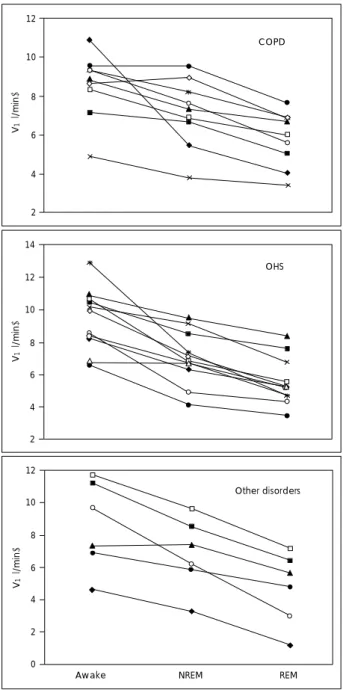
앞서 언급했듯이, 환기저하는 REM 수면 단계에서 가장 뚜 렷하지만 그 기전에 대해서는 명확하지 않다. Wiegand 등 (4)은 만성폐쇄성폐질환 환자에서 흡기저항부하(inspiratory resistive load)를 가하면 각성 시 환기에는 변화가 없는 반 면, NREM과 REM 수면 중에는 환기가 감소함을 보고하였 다. 또한 Ballard 등(51)은 만성폐쇄성폐질환 환자에서 수 면 시작과 동시에 상기도 저항이 증가하고, 이것은 REM 수 면 시 최대가 되는 것을 관찰하였다. 그러나 Becker 등(42) 의 연구에서는 기저질환과 관계없이 야간 저산소증을 보이 는 모든 환자들에서 상기도 저항의 효과를 최소화 하기에 충 분한 압력의(52) 지속성기도양압(continuous positive air - way pressure, CPAP)을 사용했음에도 불구하고, 수면다원 검사를 통해 관찰한 결과, 대상 환자들 모두에게서 각성 시 에 비하여 NREM 수면 시 환기가 감소하였으며, REM 수

면 시 더 심해진 양상을 보였다(그림 4). 따라서 이 연구에 서는 수면 시 상기도 저항의 증가가 NREM과 REM 수면 시 관찰되는 환기저하의 주된 기전이 아닐 가능성을 시사 하 기도 하였다(42).

수면 단계에 따라 호흡근 활성과 흉벽 운동의 현저한 변 화가 일어난다. 정상적으로 NREM 수면 시에는 갈비사이근 활성의 증가로 각성 시에 비하여 흉곽이 환기에 기여하는 정 도가 더 크다(24). 그러나 REM 수면에서는 특징적으로 횡

12

10

08

06

04

02

V1 (l/min)

COPD

14

V1 (l/min) 12

10

08 06 04 02

OHS

12

V1 (l/min)

Awake NREM REM

10

08 06 04 02 00

Other disorders

Fig. 4. Individual changes in minute ventilation (VI) from wake-

fulness to NREM and REM sleep. Individuals were grouped accor-

ding to their primary disease, including obesity hypoventilation syn-

drome (OHS), chronic obstructive pulmonary disease (COPD),

and other primary diseases (From Becker HF, et al. Breathing

during sleep in patients with nocturnal desaturation. Am J Respir

Crit Care Med 1999;159:112-118).

(5)

격막을 제외한 호흡근 활성이 저하된다(24). 갈비사이근 전 기적 활성의 이러한 변화는 흉곽이 환기에 기여하는 정도의 저하와 관련이 있으며, 결과적으로 REM 수면 시에는 환기 를 유지하게 위해서 호흡은 횡격막에 더욱 의지하게 된다.

횡격막 무력증이 있는 환자들에서는 REM 수면으로 유발된 갈비사이근과 호흡보조근 활성의 저하로 인하여 흡기압의 현 저한 저하를 초래하므로 환기에 장애가 생기게 된다. 이전의 연구들에 따르면, 심각한 만성폐쇄성폐질환이 있거나, 전신 신경근육질환이 있는 환자들 모두에서 흉골유돌근(sterno - mastoid muscle)과 목갈비근(scalene muscle)과 같은 호 흡보조근(53)뿐만 아니라 복근(54)이 각성과 NREM 수면 시에 환기를 극대화 하는 데 중요한 역할을 하는 것으로 관 찰되었다. 따라서 환자들에게서 REM 수면 동안 이러한 근 육의 활성이 없어짐으로써 심각한 수준의 환기저하가 나타 날 것이며, 이는 가스교환이상과 관련이 있을 것이다.

3. 수면호흡장애

수면호흡장애는 수면 중 상기도의 부분적인 또는 완전한 허탈이 반복적으로 일어나는 것이 특징이다. 그 결과 기류가 감소되거나 정지되고 이것이 때때로 산화혈색소의 불포화를 유발하며 수면 중 각성을 초래하기도 한다. 수면호흡장애가 있는 환자들에서는 호흡이상이 NREM 수면 중에 나타날 수 도 있으며 REM 수면 중에 나타날 수도 있다. 앞서 언급한 대로, 전형적인 경우 호흡장애는 NREM 수면 보다는 REM 수면 중에 보다 길게 나타나며 더 심한 저산소혈증을 유발 한다(6).

주간졸림증은 환자들이 야간 수면다원검사를 받도록 의뢰 받는 가장 흔한 이유들 중 하나이며(55), 수면호흡장애는 주 간졸림증의 가장 흔한 원인이다. Punjabi 등(56)은 무호흡- 저호흡 지수(apnea-hypopnea index;AHI), 수면분절(sleep fragmentation), 야간 저산소혈증의 중증도 등이 주간졸림증 과 관련 있는 인자들이라고 보고하였다. 그러나, NREM과 REM 수면 중 일어나는 수면호흡장애가 주간졸림증 같은 임 상 증상에 어떻게 다른 영향을 미치는 가에 대해서는 아직 논란의 여지가 있다(57-59).

Kass 등(57)은 주간졸림증을 호소하면서 임상적으로 폐 쇄성수면무호흡증의 기준에 들지 않는, 즉 호흡방해지수(res - piratory disturbance index;RDI)가 10 미만인 환자들을 대상으로 연구한 결과, REM 수면 중 RDI와 평균수면잠복기 (mean sleep latency)가 서로 연관성이 있음을 보고하였다.

비록 무호흡은 REM 수면 시 가장 흔하고, 가장 심하게 나타 나지만(6), 정상 성인의 전체 수면 중 REM 수면은 20~

25%에 불과하다(60). 따라서 REM 수면 때 무호흡의 빈도

가 무호흡이 적은 NREM 수면으로 상쇄되어 결국 RDI 값 은 정상범위에 있지만, 증상 호소는 지속될 수 있다.

또 다른 연구에서 Chervin 등(59)은 NREM과 REM 때 일어나는 AHI(AHIN, AHIR)와 수면잠복기반복검사(multi - ple sleep latency test;MSLT)의 관계를 관찰하고, AHIN 과 MSLT 간에 유의한 상관관계가 있는 반면, AHIR과 MSLT 는 유의한 연관이 없다고 하였다. 또한 Punjabi 등(58)의 연 구에서도 NREM 수면 중 수면호흡장애와 주간졸림증의 연 관관계를 보고한 바 있다. 수면호흡장애는 수면구조에 영향 을 미치는 점을 들어, 저자들(58)은 NREM 수면 중 호흡 장애가 정상적인 REM 수면을 방해하기 때문에 호흡장애가 심해지는 REM 수면의 양이 더욱 줄어들 것이라고 예상하 였다. 따라서 NREM 중에 일어나는 호흡장애가 주간졸림증 과 같은 임상 증상과 더욱 연관성이 있을 것이라고 제시하 였다.

결 론

수면이 환기저하를 유발할 수 있으며 환기저하는 REM 수 면 시 가장 심한 양상을 보인다는 것은 잘 알려져 있는 사 실이나, 그 기전에 대해서는 명확하게 밝혀진 바가 없다. 또 한 NREM과 REM 수면 시 나타나는 수면호흡장애가 임상 증상에 대하여 어떤 식으로 서로 다른 영향을 주는 지에 대 해서도 아직 논란의 여지가 많이 남아있다. REM 수면 시 환기저하는 정상인에게서 문제를 일으키지 않지만, 기저질환 으로 인하여 각성 시 이미 저산소혈증이 있는 환자들에게는 심각한 문제를 야기할 수 있다. 따라서 치료가 잘 되지 않는 저산소혈증 환자들에 대해 각성 시 지표들만으로 환자의 치 료 방향을 설정하는 것 보다는 수면다원검사 결과를 함께 고 려하는 것이 바람직한 방법이다. 또한 보편적인 수면다원검 사 상 정상인 환자들에서 심한 주간졸림증을 호소하는 경우, 수면 단계에 따른 호흡변화를 면밀하게 검토해 보는 것이, 환자들의 증상에 대한 원인을 찾는 데 도움이 될 수 있다.

중심 단어

:REM 수면·수면호흡장애·호흡방해지수.

R EFERENCES

1. Douglas NJ, White DP, Weil JV, Pickett CK, Zwillich CW. Hypercap- nic ventilatory response in sleeping adults. Am Rev Respir Dis 1982;

126:758-762

2. Douglas NJ, White DP, Weil JV, Pickett CK, Martin RJ, Hudgel DW, Zwillich CW. Hypoxic ventilatory response decreases during sleep in normal men. Am Rev Respir Dis 1982;125:286-289

3. Wiegand DA, Latz B, Zwillich CW, Wiegand L. Geniohyoid muscle

activity in normal men during wakefulness and sleep. J Appl Physiol

1990;69:1262-1269

(6)

4. Wiegand L, Zwillich CW, White DP. Sleep and the ventilatory res- ponse to resistive loading in normal men. J Appl Physiol 1988;64:

1186-1195

5. Wiegand L, Zwillich CW, Wiegand D, White DP. Changes in upper airway muscle activation and ventilation during phasic REM sleep in normal men. J Appl Physiol 1991;71:488-497

6. Findley LJ, Wilhoit SC, Suratt PM. Apnea duration and hypoxemia during REM sleep in patients with obstructive sleep apnea. Chest 1985;87:432-436

7. Hendricks JC, Kline LR, Kovalski RJ, O’Brien JA, Morrison AR, Pack AI. The English bulldog: a natural model of sleep-disordered breathing.

J Appl Physiol 1987;63:1344-1350

8. Krieger J. Respiratory physiology: Breathing in normal subjects. In:

Principles and Practice of Sleep Medicine. Third edition ed by Kryger MH, Roth T and Dement WC. Philadelphia, W. B. Saunders;2000.

p.229-241

9. Krieger J. Breathing during sleep in normal subjects. Clin Chest Med 1985;6:577-594

10. Bulow K. Respiration and wakefulness in man. Acta Physiol Scand 1963;59(Suppl 209):1-110

11. Webb P. Periodic breathing during sleep. J Appl Physiol 1974;37:

899-903

12. Rist KE, Daubenspeck JA, McGovern JF. Effects of non-REM sleep upon respiratory drive and the respiratory pump in humans. Respir Physiol 1986;63:241-256

13. Lugaresi E. Snoring. Electroencephalogr Clin Neurophysiol 1975;39:

59-64

14. Skatrud JB, Dempsey JA. Airway resistance and respiratory muscle function in snorers during NREM sleep. J Appl Physiol 1985;59:

328-335

15. Acres JC, Sweatman P, West P, Brownell L, Kryger MH. Breathing during sleep in parents of sudden infant death syndrome victims. Am Rev Respir Dis 1982;125:163-166

16. Lopes JM, Tabachnik E, Muller NL, Levison H, Bryan AC. Total airway resistance and respiratory muscle activity during sleep. J Appl Physiol 1983;54:773-777

17. Hudgel DW, Martin RJ, Johnson B, Hill P. Mechanics of the respira- tory system and breathing pattern during sleep in normal humans. J Appl Physiol 1984;56:133-137

18. Miljeteig H, Hirschberg A, Cole P, Haight JS, Mateika S, Hoffstein V.

Pharyngeal airflow during sleep. Acta Otolaryngol 1995;115:99-105 19. Hudgel DW, Hendricks C. Palate and hypopharynx--sites of inspiratory

narrowing of the upper airway during sleep. Am Rev Respir Dis 1988;138:1542-1547

20. Wiegand DA, Latz B, Zwillich CW, Wiegand L. Upper airway resis- tance and geniohyoid muscle activity in normal men during wakeful- ness and sleep. J Appl Physiol 1990;69:1252-1261

21. Kuna ST, Smickley JS, Insalaco G. Posterior cricoarytenoid muscle activity during wakefulness and sleep in normal adults. J Appl Physiol 1990;68:1746-1754

22. Ballard RD, Irvin CG, Martin RJ, Pak J, Pandey R, White DP. In- fluence of sleep on lung volume in asthmatic patients and normal subjects. J Appl Physiol 1990;68:2034-2041

23. Hudgel DW, Devadatta P. Decrease in functional residual capacity during sleep in normal humans. J Appl Physiol 1984;57:1319-1322 24. Tabachnik E, Muller NL, Bryan AC, Levison H. Changes in ventila-

tion and chest wall mechanics during sleep in normal adolescents. J Appl Physiol 1981;51:557-564

25. Tusiewicz K, Moldofsky H, Bryan AC, Bryan MH. Mechanics of the rib cage and diaphragm during sleep. J Appl Physiol 1977;43:600-602 26. Goodenough DR, Witkin HA, Koulack D, Cohen H. The effects of

stress films on dream affect and on respiration and eye-movement activity during Rapid-Eye-Movement sleep. Psychophysiology 1975;

12:313-320

27. Snyder F, Hobson JA, Morrison DF, Goldfrank F. Changes in Respira- tion, Heart Rate, and Systolic Blood Pressure in Human Sleep. J Appl Physiol 1964;19:417-422

28. Spreng LF, Johnson LC, Lubin A. Autonomic correlates of eye mo- vement bursts during stage REM sleep. Psychophysiology 1968;4:

311-323

29. Guilleminault C. State of the art. Sleep and control of breathing. Chest 1978;73:293, 297-299

30. Aserinsky E. Periodic respiratory pattern occurring in conjunction with eye movements during sleep. Science 1965;150:763-766

31. Gould GA, Gugger M, Molloy J, Tsara V, Shapiro CM, Douglas NJ.

Breathing pattern and eye movement density during REM sleep in humans. Am Rev Respir Dis 1988;138:874-877

32. Lavie P, Fischel N, Zomer J, Eliaschar I. The effects of partial and complete mechanical occlusion of the nasal passages on sleep structure and breathing in sleep. Acta Otolaryngol 1983;95:161-166 33. Dolly FR, Block AJ. Effect of flurazepam on sleep-disordered brea-

thing and nocturnal oxygen desaturation in asymptomatic subjects.

Am J Med 1982;73:239-243

34. Aserinsky E, Kleitman N. Regularly occurring periods of eye motility, and concomitant phenomena, during sleep. Science 1953;118:273-274 35. Parmeggiani PL, Sabattini L. Electromyographic aspects of postural,

respiratory and thermoregulatory mechanisms in sleeping cats. Elec- troencephalogr Clin Neurophysiol 1972;33:1-13

36. Lugaresi E, Cirignotta F, Coccagna G, Piana C. Some epidemiologi- cal data on snoring and cardiocirculatory disturbances. Sleep 1980;3:

221-224

37. Sauerland EK, Orr WC, Hairston LE. EMG patterns of oropharyngeal muscles during respiration in wakefulness and sleep. Electromyogr Clin Neurophysiol 1981;21:307-316

38. Muller NL, Francis PW, Gurwitz D, Levison H, Bryan AC. Mecha- nism of hemoglobin desaturation during rapid-eye-movement sleep in normal subjects and in patients with cystic fibrosis. Am Rev Respir Dis 1980;121:463-469

39. Catterall JR, Douglas NJ, Calverley PM, Shapiro CM, Breainova V, Brash HM, Flenley DC. Transient hypoxemia during sleep in chronic obstructive pulmonary disease is not a sleep apnea syndrome. Am Rev Respir Dis 1983;128:24-29

40. Douglas NJ, Calverley PM, Leggett RJ, Brash HM, Flenley DC, Brezinova V. Transient hypoxaemia during sleep in chronic bronchitis and emphysema. Lancet 1979;1:1-4

41. Koo KW, Sax DS, Snider GL. Arterial blood gases and pH during sleep in chronic obstructive pulmonary disease. Am J Med 1975;58:

663-670

42. Becker HF, Piper AJ, Flynn WE, McNamara SG, Grunstein RR, Peter JH, Sullivan CE. Breathing during sleep in patients with noctur- nal desaturation. Am J Respir Crit Care Med 1999;159:112-118 43. Wynne JW, Block AJ, Hemenway J, Hunt LA, Flick MR. Disordered

breathing and oxygen desaturation during sleep in patients with chro- nic obstructive lung disease (COLD). Am J Med 1979;66:573-579 44. Tepper RS, Skatrud JB, Dempsey JA. Ventilation and oxygenation

changes during sleep in cystic fibrosis. Chest 1983;84:388-393 45. Skatrud J, Iber C, McHugh W, Rasmussen H, Nichols D. Determinants

of hypoventilation during wakefulness and sleep in diaphragmatic paralysis. Am Rev Respir Dis 1980;121:587-593

46. Hudgel DW, Martin RJ, Capehart M, Johnson B, Hill P. Contribution of hypoventilation to sleep oxygen desaturation in chronic obstructive pulmonary disease. J Appl Physiol 1983;55:669-677

47. Fletcher EC, Gray BA, Levin DC. Nonapneic mechanisms of arterial oxygen desaturation during rapid-eye-movement sleep. J Appl Physiol 1983;54:632-639

48. Skatrud JB, Dempsey JA, Iber C, Berssenbrugge A. Correction of CO2

(7)

retention during sleep in patients with chronic obstructive pulmonary diseases. Am Rev Respir Dis 1981;124:260-268

49. Catterall JR, Calverley PM, MacNee W, Warren PM, Shapiro CM, Douglas NJ, Flenley DC. Mechanism of transient nocturnal hypoxe- mia in hypoxic chronic bronchitis and emphysema. J Appl Physiol 1985;59:1698-1703

50. Millman RP, Knight H, Kline LR, Shore ET, Chung DC, Pack AI.

Changes in compartmental ventilation in association with eye move- ments during REM sleep. J Appl Physiol 1988;65:1196-1202 51. Ballard RD, Clover CW, Suh BY. Influence of sleep on respiratory

function in emphysema. Am J Respir Crit Care Med 1995;151:945-951 52. Henke KG, Dempsey JA, Kowitz JM, Skatrud JB. Effects of sleep- induced increases in upper airway resistance on ventilation. J Appl Physiol 1990;69:617-624

53. Johnson MW, Remmers JE. Accessory muscle activity during sleep in chronic obstructive pulmonary disease. J Appl Physiol 1984;57:

1011-1017

54. White JE, Drinnan MJ, Smithson AJ, Griffiths CJ, Gibson GJ. Respi- ratory muscle activity and oxygenation during sleep in patients with muscle weakness. Eur Respir J 1995;8:807-814

55. Coleman RM, Roffwarg HP, Kennedy SJ, Guilleminault C, Cinque J,

Cohn MA, Karacan I, Kupfer DJ, Lemmi H, Miles LE, Orr WC, Phillips ER, Roth T, Sassin JF, Schmidt HS, Weitzman ED, Dement WC. Sleep-wake disorders based on a polysomnographic diagnosis.

A national cooperative study. JAMA 1982;247:997-1003

56. Punjabi NM, O’Hearn DJ, Neubauer DN, Nieto JF, Schwartz AR, Smith PL, Bandeen-Roche K. Modeling hypersomnolence in sleep- disordered breathing. A novel approach using survival analysis. Am J Respir Crit Care Med 1999;159:1703-1709

57. Kass JE, Akers SM, Bartter TC, Pratter MR. Rapid-eye-movement- specific sleep-disordered breathing: a possible cause of excessive day- time sleepiness. Am J Respir Crit Care Med 1996;154:167-169 58. Punjabi NM, Bandeen-Roche K, Marx JJ, Neubauer DN, Smith PL,

Schwartz AR. The association between daytime sleepiness and sleep- disordered breathing in NREM and REM sleep. Sleep 2002;25:307-314 59. Chervin RD, Aldrich MS. The relation between multiple sleep latency test findings and the frequency of apneic events in REM and non- REM sleep. Chest 1998;113:980-984

60. Carskadon MA, Dement WC. Normal human sleep: An overview.

In: Principles and Practice of Sleep Medicine. Third edition ed by Kryger MH, Roth T and Dement WC. Philadelphia, W. B. Saunders;

2000. p.15-25

수치

Fig. 1. Typical breathing pattern during unsteady NREM sleep. V,  ventilatory volumes (ml) obtained from a pneumotachograph  attached to a face mask;insp, inspiration;exp, expiration;thor mvt, abd mvt, thoracic and abdominal movements;CE co2 , CO 2
Fig. 3. Typical breathing pattern during REM sleep. For abbrevia- abbrevia-tion, see Fig
Fig. 4. Individual changes in minute ventilation (VI) from wake- wake-fulness to NREM and REM sleep

참조

관련 문서

Putting these conclusions together, the brain breathing meditation program is effective in improving concentration and learning attitude for children who

Prevalence of sleep-disordered breathing in acute ischemic stroke as determined using a portable sleep apnea monitoring device in Korean subjects.. Obstructive

또한 수면은 NREM(npn-rapid eye movement)수면과 REM(rapid eye movement)수면으로 나뉜다... 연구방법

Cephalometric comparisons of craniofacial and upper airway structure by skeletal subtype and gender in patients with obstructive sleep apnea.. Nasal

Conclusions: This study suggests that psychological health factors such as stress perception, depression and suicidal ideation are related to the quality of sleep

Bandwidth Request with UL Tx Power Report Bandwidth Request and CINR Report Bandwidth Request with UL Sleep

Beck Depression Inventory(BDI), Satisfaction with Life Scale(SLS), health behavior including smoking(Fagerstrom Test for Nicotine Dependence), sleep(Pittsburgh

As a result of multiple regression analysis, the statistically associated factors with burnout were social support, GDS, marital state, self­rated health