• 검색 결과가 없습니다.

A study on physics parameter of proton using Geant4 electromagnetic physics model

N/A
N/A
Protected

Academic year: 2021

Share "A study on physics parameter of proton using Geant4 electromagnetic physics model"

Copied!
2
0
0

로드 중.... (전체 텍스트 보기)

전체 글

(1)

- 122 -

A study on physics parameter of proton using Geant4 electromagnetic physics model

So-Hyun Park , Won-Gyun Jung , Tae-Suk Suh

*

Catholic University of Korea ․ Research Institute of Biomedical Engineering

*

E-mail: [email protected]

keyword : Proton, Geant4, Electromagnetic physics, Kolmogorov-smirnov, verification

Introduction

Geant4 provides packages specialized for modeling electromagnetic physics interactions. In order to have reliable simulations, the accuracy of physics parameter for particle is important and the physics content of the toolkit must be as solid and accurate as possible. It is hence of paramount importance to verification all the models by comparing them with well-established experimental data. This paper presents the results of the verification of Geant4 electromagnetic models with respect to recognized reference data : National Institute of Standards and Technologies (NIST). The aim is to demonstrate the accuracy and reliability of the Geant4 9.2 electromagnetic physics models by concerning the physics parameter of proton.

Materials and Methods

I. The verification was performed both standard and low energy electromagnetic packages [Fig 1]. The reference data adopted in present study were NIST.

II. The geometrical set-up of the simulation consists of a box of selected material : water, bone, adipose tissue, beryllium, aluminum, iron,

germanium, silver, gold, lead and uranium. Proton was generated with random direction at the center of the box, with energy between 1.0 keV and 10 GeV. We simulated the stopping power and CSDA(Continuous Slowing Down Approximation) range by electromagnetic physics models.

III. Comparison between reference data and Geant4 simulation data have been performed by means of kolmogorov-smirnov Goodness-of-fit test, specialized in the comparison of data distributions. The Goodness-of-fit statistical analysis return the p-value of the comparison.

P-values higher than the confidence level α=0.05 set lead to the acceptance of the null hypothesis, stating the equivalence between reference data and Geant4 simulation data.

Fig 1. Construction of Genat4 Electromagnetic physics model.

Results and Discussion

For all the physical quantities considered,

Geant4 is able to reproduce with high accuracy

the reference data with any physical

(2)

- 123 - electromagnetic model. [Table 1] represents the

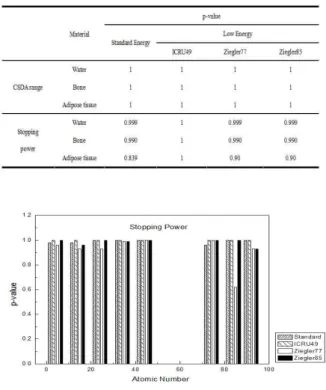
Goodness-of-Fit test results that all the Geant4 electromagnetic packages for water, bone and adipose tissue. All the statistical comparisons led to the acceptance of the null hypothesis, stating that there is not statistical difference between reference data and the Geant4 simulation data.

[Fig 2] and [Fig 3] represent statistical results of stopping power and CSDA range respectively as a function of the atomic number Z of the selected elements. All the p-values obtained are higher than the confidence level set (α=0.05).

Table 1. Goodness-of-Fit test results concerning the CSDA range and stopping power about water, bone and adipose tissue. All the p-value obtained are higher than the confidence level set (α = 0.05).

Fig 2. Goodness-of-Fit test results concerning the stopping power plotted as a function of the atomic number of the selected elements. All the p-value obtained are higher than the confidence level set (α = 0.05).

Fig. 3 Goodness-of-Fit test results concerning the CSDA range plotted as a function of the atomic number of the selected elements. All the p-value obtained are higher than the confidence level set (α = 0.05).

Conclusion

The verification of Geant4 simulation results versus NIST data for MeV proton beams in different media has been performed. Standard package and three models for the low energy package were exercised. Results of simulation exhibited a good agreement with NIST data over the whole energy range. Therefore we could evaluate that the electromagnetic physics of Geant4 is accuracy and reliable physics model for physics parameter of proton. The precision verification of physics models concerning the physics parameter are very important for reliability of simulation.

Because precision tests are especially relevant for critical applications medical physics.

Reference

1. Cirrone P, Cuttone G, Donadio S et al, Precision validation of Geant4 electromagnetic physics, IEEE Nuclear Science Symposium Conference Record 1 : 482-485(2003)

2. Chauvie S, Guatelli S, Ivanchenko V et al,

Geant4 low energy electromagnetic physics, low

American Nuclear Society Topical Meeting in

Monte Carlo, Chattanooga, TN(2005)

수치

Fig 2. Goodness-of-Fit test results concerning the stopping power plotted as a function of the atomic number of the selected elements

참조

관련 문서

this study analysed cast speed and solidification in thermal and flow perspectives and based on the results, conducted a confidence test on the high-speed general purpose

A Study on the Wireless Power Transmission of magnetic resonance using Superconducting

The results of the repeated measures ANOVA of health-related physical fitness suggested that the main effect based on test time had a significant difference

The purpose of this study is to analyze the effects of sports marketing strategy fit on organizational attitude and organizational citizenship behavior

A Study on the Development of Ship’s Ballast Water A Study on the Development of Ship’s Ballast Water A Study on the Development of Ship’s Ballast Water A Study on the

2. The finite element is calculating using tension test of uni-direction 0° and 90°, compression test of uni-direction 0° and 90° and shear test results and, the results

Correlation between Results ofthe Multiple Allergosorbent Test-Chemiluminescent Assay(MAST-CLA) and Clinical Severity of Chronic Urticaria. A study of food allergy

These results of the histologic distribution of lamina propria, adipose tissue, and glandular tissue of the hard palatal mucosa and the topography of the greater palatine