171 This is an Open-Access article distributed under the terms of the Creative Commons Attribution Non-Commercial License (http://
creativecommons.org/licenses/by-nc/3.0) which permits unrestricted non-commercial use, distribution, and reproduction in any medium, provided the original work is properly cited.
†These authors contributed equally to this work.
*To whom correspondence should be addressed.
J. Mushrooms 2019 December, 17(4):171-178 http://dx.doi.org/10.14480/JM.2019.17.4.171 Print ISSN 1738-0294, Online ISSN 2288-8853
© The Korean Society of Mushroom Science
*Co-corresponding author E-mail : [email protected]
Tel : +82-43-261-2293, Fax : +82-43-261-2298 E-mail : [email protected]
Tel : +82-43-261-2524, Fax : +82-43-271-0413 Received September 30, 2019
Revised November 23, 2019 Accepted December 4, 2019
한국의 상업적 양송이 균주의 유전적 다양성 및 집단 구조
이화용1,† · 안혜진2,† · 오연이3 · 장갑열3 · 공원식3 · 류호진1,* · 정종욱2,*
1충북대학교 생물학과
2충북대학교 특용식물학과
3국립원예특작과학원 버섯과
Assessment of genetic diversity and population structure of commercial button mushroom (Agaricus bisporus) strains in Korea
Hwa-Yong Lee1,†, Hye-jin An2,†, Youn-Lee Oh3, Kab-Yeul Jang3, Won-Sik Kong3, Ho-jin Ryu1,*, and Jong-Wook Chung2,*
1Department of Biology, Chungbuk National University, Cheongju 28644, Korea
2Department of Industrial Plant Science and Technology, Chungbuk National University, Cheongju 28644, Korea
3Mushroom Science Division, National Institute of Horticultural and Herbal Science, Eumseong 27709, Korea
ABSTRACT: Agaricus bisporus is a functional food and among the most widely cultivated mushrooms in the world. In this study, we analyzed the genetic diversity and population structure of 23 Korean and 42 foreign A. bisporus cultivars using SSR (Simple sequence repeat) markers. Genetic diversity of A. bisporus cultivars was as follows: number of alleles was approximately 13;
observed and expected heterozygosity were approximately 0.59 and 0.74, respectively; and polymorphic information content value was about 0.71. A. bisporus cultivars were divided into three groups using distance-based analysis. Genetic diversity of Group 2, which consisted of cultivars from various countries, was high. In addition, model-based subpopulations were divided into two, and the genetic diversity of Pop2 (Population 2), which had many cultivars, was high. The results of this study could be used in a breeding program for A. bisporus, such as the development of new genetic resources and securing diversity.
KEYWORDS: Agaricus bisporus, Commercial strains, Genetic diversity, Population structure, SSR
서 론
양송이는 전세계 버섯 생산량의 15%를 차지하고 있으며 (Royse et al, 2017), polyphenols, ergothioneine, vitamins, minerals, polysaccharides의 함유량이 높아 기능성 식품으 로 이용되고 있다(Dubost et al, 2007; Tian et al, 2012).
양송이는 17 세기 초 프랑스에서 처음 재배가 시작되었고 (Sonnenberg et al, 2011), 현재 중국에서 전세계 생산량 의 54%를 생산하며, 미국, 폴란드, 네덜란드, 인도가 그 뒤를 잇고 있다(Royse et al, 2017).
1991년 식물신품종 육종의 권리를 보호하기 위하여 UPOV(International Union for the Protection of New Varieties of Plants) 협약이 수립되었고, 2010년 생물다양 성협약 (Convention on Biological Diversity) 제10차 당 사국 총회에서 유전자원의 접근 및 이익 공유에 관한 나 고야의정서가 채택되었고(Park et al, 2016), 이에 따라
분자마커를 이용한 자원의 보호, 평가가 중요하게 대두되 었다.
양송이는 일반적으로 2극성의 교배양식을 가지고 있으 며(Raper et al, 1972), 담자포자를 형성하는데, 95%는 2 개의 담자포자를 형성하며, 이 중 63%는 이질핵체인 담 자포자를 2개 가지고, 32%는 동질핵체인 담자포자를 2개 가진다. 나머지 5% 중에서 4.5%는 3개의 담자포자를 형 성하며, 단핵포자 1개 또는 동질핵체 2개 가진다. 따라서 양송이는 오직 0.5%의 담자포자만 4개의 단핵포자를 형 성하여(Elliott, 1985), 단핵포자를 이용한 교배육종에 어 려움이 있다(Sonnenberg et al, 2011). 현재 전세계의 다 양한 양송이 품종은 1980년대 초 네덜란드에서 개발된 Horst U1 균주를 모본으로 개발되어(Savoie et al, 2013), 유 전적으로 Horst U1과 매우 유사하고 이로 인해 품종의 유전 적 다양성이 매우 낮은 것으로 알려져 있다(Sonnenberg et al, 2011). 양송이의 품종개발을 위하여 북아메리카, 유럽, 멕시코, 모로코, 자이레, 뉴질랜드, 중국, 호주 등 많은 지 역으로부터 균주들이 수집, 보존되어 있는 것으로 알려져 있으며(Kerrigan et al, 1995; Kerrigan, 1996; Kerrigan, 2004), 한국에서는 미국, 유럽, 호주 등의 종균회사로부터 종균을 수입하여 사용하였으나, 2010년 이후부터 농촌진 흥청(Rural Development Administration)에서 국내 자생 양송이계통과 외국 품종간 동형핵균주를 교잡하여 개발한 품종 ‘새아’를 시작으로 선발된 우수계통과 단포자를 교배 한 ‘새정’, ‘새연’, ‘새도’를 육성하였다(Oh et al, 2013).
유전적 다양성과 집단 구조 분석은 품종개발을 은 위한 잠재적인 유전자원 확보라는 측면에서 중요한 정보를 제 공한다(Xiang et al, 2016). 품종의 개발에서 인간이 목표 로 하는 형질을 쉽게 선발하기 위하여 기존에 일반적으로 재배되고 있는 품종을 생산한 우수 계통을 이용하기도 한 다(Ramanatha Rao and Hodgkin, 2002; Hamrick and Godt, 1989). 이미 개발된 품종을 이용하여 새로운 품종 을 개발할 때, 육종 모본의 유연관계가 좁아질 수 있기 때 문에, 품종들 간의 유전적 다양성 및 유연관계에 대한 정 확한 정보는 육종의 목표를 설정하는데 중요하게 사용될 수 있다 (Choudhary et al, 2013). Restriction fragment length polymorphism(RFLP), random amplified polymorphic DNA(RAPD), amplified fragment length polymorphism (AFLP), inter-simple sequence repeats (ISSRs), sequence characterized regions(SCARs), sequence tag sites(STSs), cleaved amplified polymorphic sequences(CAPS), microsatellites or simple sequence repeats (SSRs), and single nucleotide polymorphisms(SNPs) 등과 같은 분자 유전학적 분석으로 개발된 DNA 마커가 유전적 다양성 및 집단구조와 같은 유연관계 분석에 널리 사용되어왔다 (Zhang et al, 2012). 이중 공우성이며 높은 다형성을 가 지고 있어 재현성이 높은 SSR 마커는 유전적 다양성과 집단구조 분석에 가장 적합한 것으로 알려져 있어(Du et
al, 2012), 벼(Zhang et al, 2011), 기장(Liu et al, 2016), 콩(Wen et al, 2009), 수수(Li et al, 2010), 조(Wang et al, 2012) 등과 같은 식물, 그리고 팽이버섯(Liu et al, 2016), 느타리류(Zhao et al, 2013), 뽕나무버섯류(Prospero et al, 2008) 등의 식용버섯에 이용되었다. 또한, 양송이에 서도 야생균주와 품종간의 유전적 다양성 및 집단구조의 비교를 위하여 SSR 마커를 이용하여 분석이 수행되었다 (Rokni et al, 2016; Fu et al, 2016).
본 연구에서는 양송이 품종의 다양성 확보와 육종소재 의 개발 등을 위하여 한국에서 개발된 23개 품종과 그리 고 42개의 도입 품종을 20개의 SSR 마커를 이용하여 유 전적 다양성과 집단구조를 분석하였다.
재료 및 방법
공시균주 및 균주배양
본 연구에서는 국립원예특작과학원 버섯과에서 보유하 고 있는 한국에서 개발한 23개의 양송이 품종과 42개의 도입품종을 이용하였다(Table 1). 각 양송이 균주들은 CDA(Compost Dextrose Agar)배지를 이용하여 25°C에 서 30일동안 암배양하였다.
DNA 추출 및 SSR 분석
DNA 추출을 위하여 배양된 균사체를 액체질소를 이용 하여 곱게 갈았다. DNA 추출은 GenEX Plant Kit (Geneall, Seoul, Korea)을 이용하였으며, 추출된 DNA는 K5600 Micro-spectrophotometer(Shanghai Biotechnol Co., Shanghai, China)를 이용하여 20 ng/µL로 정량하였다.
연구에서 사용한 SSR 마커는 Lee 등(2018)과 An 등 (2019)이 개발한 마커 중에서 대립형질의 수(Number of alleles, NA)와 다형성지수(polymorphic information content, PIC) 값을 고려하여 상위 20개를 선발하였다(Table 2).
PCR반응액은 총 20 µL로 DNA 2 µL, 5 pmol의 forward 와 reverse primer(Table 2) 각 1 µL, 10 µL의 2X i-Taq Master Mix (Intron biotechnology, Seongnam, Korea) 그 리고 6 µL distilled water로 구성하였다. PCR반응은 95oC에서 3분 그리고 95oC에서 30초, 58oC에서 30초, 72oC에서 30초로 35회 반복하였으며, 마지막으로 72oC에 서 20분간 수행되었다. PCR 증폭 산물의 크기는 size fragment analyzer(Advanced Analytical Technologies, Ankeny, IA, USA)를 이용하여 확인하였다.
데이터 분석
Size fragment analyzer로 분석된 PCR 증폭 산물의 길 이는 PROSize 2.0 software(Advanced Analytical Technologies, Ankeny, IA, USA)로 확인하였다. 확인된 PCR product의 길이를 바탕으로 유전자형 분석 후, PowerMarker V3.25 로 분석된 NA, 관측 이형접합도(observed heterozygosity;
HO), 기대 이형접합도(expected heterozygosit, HE) 및 PIC값으로 유전적 다양성을 분석하였다(Liu and Muse, 2005). CSChord1967에 의해 분석된 유전적 상관관계를 기반으로(Cavalli-Sforza and Edwards, 1967) MEGA 7 프로그램(Kumar et al, 2016)을 사용하여 phylogenetic tree를 구축하고 품종의 유연관계 분석을 위한 군집분석을 수행하였다. 집단의 구조분석은 STRUCTURE 2.3.4의 admixture mode(burn-in 100,000, run length 200,000)로 3회 반복 수행하여 model-based subpopulation을 구분하
였다(Pritchard et al, 2000). 품종들의 집단구조는 LnP(D) 분석을 수행하여 확인하였고, 집단의 수(K)는 1에서 9까 지, 계산한 K(집단)값의 점진적 증가로 인하여 결정이 불분 명한 경우 K를 결정은 Evanno 등(2005)이 제안한 ΔK를 분 석하였다. 또한, 집단의 구조분석을 통한 subpopulation은 CSChord1967의 방법을 통하여(Cavalli-Sforza and Edwards, 1967) 유전적 거리를 구하고 MEGA 7 프로그램으로 (Kumar et al, 2016) unrooted tree를 구축하여 통합 분석 하였다.
Table 1. List of Agaricus bisporus cultivars
Strain Year of collection Origin Strain Year of collection Origin
ASI1329 2010 BRAZIL ASI1224 2003 KOREA
ASI1330 2010 BRAZIL ASI1225 2003 KOREA
ASI1331 2010 BRAZIL ASI1227 2004 KOREA
ASI1199 2000 CHINA ASI1228 2004 KOREA
ASI1303 1995 CHINA ASI1235 2004 KOREA
ASI1310 2006 CHINA ASI1246 2005 KOREA
ASI1131 1988 GERMANY ASI1247 2005 KOREA
ASI1135 1988 GERMANY ASI1248 2005 KOREA
ASI1139 1988 GERMANY ASI1249 2005 KOREA
ASI1048 1969 FRANCE ASI1346 2009 KOREA
ASI1049 1969 FRANCE ASI1651 2016 KOREA
ASI1051 1969 FRANCE ASI1091 1979 Netherlands
ASI1052 1969 FRANCE ASI1321 2009 Netherlands
ASI1053 1969 FRANCE ASI1322 2009 Netherlands
ASI1054 1969 FRANCE ASI1416 2016 Netherlands
ASI1417 2016 FRANCE ASI1031 1967 USA
ASI1419 2016 FRANCE ASI1032 1967 USA
ASI1422 2016 FRANCE ASI1036 1968 USA
ASI1042 1968 United Kingdom ASI1037 1968 USA
ASI1092 1979 United Kingdom ASI1038 1968 USA
ASI1420 2016 United Kingdom ASI1040 1968 USA
ASI1012 1966 KOREA ASI1041 1968 USA
ASI1018 1966 KOREA ASI1074 1978 USA
ASI1021 1966 KOREA ASI1076 1978 USA
ASI1022 1966 KOREA ASI1078 1978 USA
ASI1128 1986 KOREA ASI1079 1978 USA
ASI1190 1998 KOREA ASI1081 1978 USA
ASI1216 2002 KOREA ASI1083 1978 USA
ASI1217 2002 KOREA ASI1084 1976 USA
ASI1219 2003 KOREA ASI1352 2013 USA
ASI1220 2003 KOREA ASI1415 2016 USA
ASI1222 2003 KOREA ASI1418 2016 USA
ASI1223 2003 KOREA
유전적 분화(Genetic differentiation, FST)를 분석하기 위 한 AMOVA 분석은 GenAlEx 6.502을 이용하였다 (Peakall and Smouse, 2012).
결과 및 고찰
20개의 SSR 마커를 이용하여 65개 양송이 품종의 유전 적 다양성을 분석한 결과, NA는 평균 13, 범위는 2(AB- gSSR-1058)에서 40(AB-gSSR-1184), HO는 0.00(AB- gSSR-1058)~0.97(AB-gSSR-0713) 범위에서 평균 0.59, 그리고 HE는 0.28(AB-gSSR-1058)~0.90(AB-gSSR-1184) 의 범위에서 평균 0.74, PIC값은 평균 0.71, 범위는 0.24 (AB-gSSR-1058)~0.89(AB-gSSR-1184) 이었다(Table 2).
Fu 등(2016)이 17개의 SSRs를 이용하여 6개의 미국 품종, 4 개의 중국 품종, 2개의 네덜란드 품종, 영국, 독일, 스페인 의 각 1 품종, 그리고 중국에서 채집한 13개 야생균주를 포함한 28개 양송이 균주를 분석한 보고에 따르면, NA는 5, HO는 0.32, HE는 0.68, PIC은 0.62였고, 한국의 6개 양 송이 균주를 47개 SSR 마커로 분석한 보고에 따르면 NA
는 3, HO는 0.29, HE는 0.40, PIC는 0.34로 확인되었다
(Lee et al, 2018). Foulongne-Oriol 등 (2009)이 A.
bisporus var. bisporus 8개 품종과 17개 야생균주, 2개의 A. bisporus var. burnettii 균주 및 1개의 A. bisporus var.
eurotetrasporus 균주를 이용하여 개발한 SSR 마커의 NA
는 6, HO는 0.35, HE는 0.61이었다. 결과적으로 본 연구에 서는 다른 연구 보다 많은 균주를 분석하여 높은 SSR 마 커 다양성을 확인하였으며, 따라서 본 연구에 사용된 SSR 마커는 기존의 연구에서 사용된 SSR 마커에 비하여 품종의 구분 및 다양성 분석 등에 효율적으로 사용될 수 있을 것으로 생각된다.
군집분석은 20개의 SSR 마커를 이용하여 65개의 양송 이 품종들에 대한 phylogenetic tree를 CSChord1967의 방법으로 구축하여 수행하였다. 본 연구에서는 20개의 SSR마커를 사용하여 65개의 품종들에 대한 원산지를 구 분할 수 없었으나, 3개의 Group으로 구분되었다.
Group 1은 브라질, 네덜란드, 미국, 프랑스 품종이 각 2 개씩 그리고 3개의 한국 품종이 포함되어 있었고, Group 2는 1개의 네덜란드 균주, 독일, 영국 품종이 각 2개, 프랑 스 품종 6개, 한국 품종이 7개, 미국 품종이 9개가 포함되 어 있었다. 마지막으로 Group 3에는 브라질, 프랑스, 영국 Table 2. Primers of 20 SSR markers and genetic diversity for 65 Agaricus bisporus cultivars
Marker Forward primer Reverse primer Motif NA HO HE PIC
AB-gSSR-0182a CATCGAAGCGATATAAGAAAGG TAGTGTTGTTGTATTTCGGCTG (CT)n 16 0.55 0.82 0.79 AB-gSSR-0238a TGATTCGAGATGGAAATTCTTC ATAAGACGGTACGTTCTGATGG (GT)n 12 0.72 0.78 0.75 AB-gSSR-0489a CAATACTCAACGGATTCGACTT CTCATCCTCATCAACAGCATAA (GA)n 13 0.38 0.81 0.78 AB-gSSR-0532a TTTCATGTCGCAAATTGAGTAG ACCCTTAGGCTAGGTACGAATC (ATT)n 16 0.31 0.81 0.79 AB-gSSR-0574a ACACGTATCCGAGTAGAGGAGA AATTGCACAACCTCCAAATAAC (AAG)n 7 0.52 0.54 0.50 AB-gSSR-0584a CTCGTCCTCGAAATAATACTCG ATTTGAGAGGGAAAGTTGAACA (GTT)n 12 0.40 0.69 0.65 AB-gSSR-0603a GCGAAACACATCTAGGAAACAT ACGATGATGAACACGATAATGA (GTT)n 14 0.57 0.79 0.76 AB-gSSR-0611a CTACCCACGCTAGTTACCTTTG TAATTCAACCCTGTCGGTATTC (ATG)n 13 0.52 0.78 0.75 AB-gSSR-0713a AATCATGGTTATTCAGGACTCG CTGGAAGACTGTTATCAGAGGG (AGA)n 16 0.97 0.82 0.80 AB-gSSR-0811b TCCTCTTCAAATTCTCCTTCAA CTGAGGACGATCCTAATAGTGG (ACA)n 17 0.83 0.75 0.72 AB-gSSR-0816b TATTACTGTCATCACGAGCGAC AGAGGATAAGGCCAGAATGAAT (TGT)n 11 0.48 0.68 0.64 AB-gSSR-0837b TTTATCTTAACCCTTACCGCAA AAACCTTCCTTCCGGTAATCTA (ACG)n 11 0.11 0.80 0.77 AB-gSSR-0923b CAGGAAGTGGGTCATCACTATT CGTTATAGTGACATGAGATGGG (CAA)n 17 0.53 0.78 0.75 AB-gSSR-1018b AAGATCAAACCCAGTGAGAATG AGATTTCAGACGAAGATGAGGA (GAA)n 15 0.75 0.79 0.76 AB-gSSR-1057b ATAAGCTTTGGTGGTTGAAGAG AGTCCTTACCATCCTCATTCCT (TGA)n 14 0.65 0.75 0.73 AB-gSSR-1058b TACATGAGGATGACGTGTGTTT GGTAACATGTCCCTATGCTGTT (TGA)n 2 0.00 0.28 0.24 AB-gSSR-1122b ATCCTTAGCAGTTTGCATGTTT TAAAGCAAGTAGTGGGACTGGT (CCA)n 9 0.86 0.71 0.67 AB-gSSR-1142b GACGCAAGAGGAATTAGATGAG TGAATCTTGGCTTTGACTTTCT (GCA)n 13 0.88 0.81 0.79 AB-gSSR-1180b AAGATGCTTCAGAGAGCAGAAC TAGTACGTGAGCAAATTCGTTG (CGA)n 10 0.96 0.77 0.73 AB-gSSR-1184b ATGCTTTAAATCGGAGACAAGA AAGCCCGACTAATATCTCCTTC (CGA)n 24 0.83 0.90 0.89
Mean 13 0.59 0.74 0.71
a, Lee et al., 2018; b, An et al., 2019; NA,number of alleles; HE, expected heterozygosity; HO, observed heterozygosity; PIC, polymorphic infor- mation content.
품종이 각 1개, 네덜란드 품종 2개, 중국 품종이 3개, 6개 의 미국 품종, 13개의 한국 품종이 포함되어 있었다. 브라 질 품종은 Group 1과 3, 독일과 영국의 품종은 Group 2 와 3에만 분포하였다. 모든 Group에 품종이 분포하고 있 는 국가는 프랑스, 미국, 한국 이었다(Fig. 1).
양송이 품종의 집단구조는 집단의 수를 1에서 9로 설정 하였을 때, K가 증가함에 따라 LnP(D)가 점진적으로 증 가하여 Evanno 등(2005) 이 제안한 ΔK를 계산 할 수 있 었다. ΔK가 2일 때 가장 높은 값을 나타내어, 2개의 subpopulation으로 구분되었고 5개의 품종은 두개의 subpopulation이 혼입된 형태였다. 집단의 구조분석 결과, Pop1은 Group 3의 모든 품종과 4개의 admixture 품종이 포함되어 있었으며, Pop2는 Group 1에 10개 품종, Group 2에 26개의 품종 그리고 admixture 1개 품종으로 구성되 어 있었다. Pop1에는 브라질, 독일, 영국의 품종 각 1개, 중국 그리고 네덜란드 품종이 각 2개, 미국의 품종이 5개, 한국의 품종은 12개가 포함되어 있었으며, Pop2에는 브 라질, 독일, 영국, 네덜란드의 품종이 각 2개, 프랑스의 품 종이 7개, 한국의 품종이 10개, 미국의 품종이 11개 포함 되어 있었다(Fig. 1, 2).
양송이 품종의 군집분석과 집단 구조분석 결과, 양송이 품종들은 원산지별로 구분되지 않아, 군집분석의 Group 에서 중국을 제외한 국가들의 품종이 2개 이상의 Group 에 포함되어 있었으며, 집단의 구조 분석에서도 중국과 프랑스를 제외한 국가들에서 양송이 품종이 2개의 subpopulation에 분포하였다. 따라서, 양송이 품종들은 국 가별 다양성이 존재하는 것으로 추정된다. 군집분석에 의 한 Group3의 28개 품종 46%인 중 13개 품종은 한국 품 종이었으며, 이는 23개 전체 한국 품종의 약 56% 인 13 개 품종이며, 중국의 품종 3개는 Group 3에만 분포하였다.
그리고 집단의 구조분석에 의한 Pop1에는 한국의 23품종 중 12품종과 중국의 3품종 중 2품종이 포함되어 있었고, 프랑스의 9개 품종 중 7개 품종, 미국의 17개 품종 중 11
Fig. 1. Phylogenetic tree using CSChord1967 and clustering by distance-based for 65 Agaricus bisporus cultivars using 20 SSR markers. (red line, Pop1; green line, Pop2; black line, admixture).
Fig. 2. Clustering by model-based for 65 Agaricus bisporus cultivars using 20 genomic SSR markers A, Log probability of the data (LnP(D)) for each range from 1 to 9, Δk values calculated as method by Evanno et al. (2005) and population structure based on K = 2; B, unrooted tree. (red line, Pop1;
green line, Pop2; black line, admixture).
개 품종이 Pop2에 포함되어 있었다. 따라서 한국과 중국, 그리고 프랑스와 미국의 품종들이 유전적으로 가까운 것 을 추정할 수 있었으나, 중국의 품종이 적어 차후 추가분 석이 필요할 것으로 사료된다.
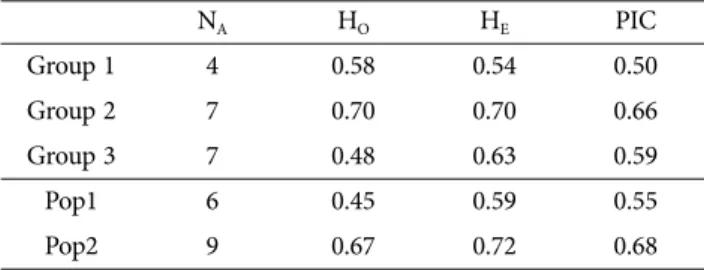
군집분석에 의한 Group간의 유전적 다양성을 비교한 결과, Group간에는 Group 2의 PIC이 0.66으로 Group들 중 가장 높았고, Group 3의 PIC은 0.59로 Group 1(0.50) 보다 높았다. Group중 PIC이 가장 높은 Group 2는 6개 국가의 27개 품종으로 구성되어 있었고, 이보다 다양성이 낮았던 Group 3은 8개 국가의 28개 품종으로 구성되어 있었다(Fig. 1). Group 3은 가장 많은 국가 및 가장 많은 품종으로 구성되어 있었으나, 그중 한국 품종이 13개로 다양성이 Group 2보다 낮은 것으로 추정된다.
구조분석에 의한 Subpopulation의 유전적 다양성은 Pop2에서 PIC이 0.68로 PIC이 0.55인 Pop1 보다 높았다 (Table 3). Pop1과 2는 각각 7개 국가의 품종으로 구성되 어 있으나, Pop2는 36개, Pop1은 24개의 품종으로 구성 되어 있어(Fig. 1) 품종의 수가 많은 Pop2의 다양성이 높 은 것으로 생각된다.
Group간의 품종들의 변이는 품종내의 변이가 67%로
가장 컸으며, 품종간의 변이가 16%, Group간에 기인하는 변이가 16%였다. 또한, subpopulation간에는 subpopulation 간에 기인하는 변이가 14%, 품종간 변이는 20%, 그리고 품종내 변이가 66%로 나타났다(Table 4). FST는 Group간 에 0.161, subpopulation 간에 0.141로 분석되었다. 군집 분석과 집단 구조분석 모두 품종간에 기인하는 변이가 품 종내, Group 및 Subpopulation에 기인한 변이보다 높았다.
새로운 육종목표에 부합되는 품종을 육성하기 위해서는 유전적 변이의 폭을 확대할 필요가 있고 이를 위해서는 많은 유전자원에 대한 정밀한 평가가 중요하다(Cho et al, 2010). 작물의 품종 개발에는 야생종, 재래종, 품종을 이 용한다. 기존 품종을 이용한 품종 개발은 인간이 목표로 하는 형질을 쉽게 선발할 수 있다(Ramanatha Rao and Hodgkin, 2002). 이에 따라, 유전적 침식이 일어나기 때문 에, 품종들 간의 유전적 다양성 및 유연관계에 대한 정보 는 매우 중요하다(Choudhary et al, 2013). 또한, 1991년 UPOV 협약이 수립되었고, 2010년 나고야의정서가 채택 되어 (Park et al, 2016) 품종의 다양성 평가, 자원 구분이 중요해지고 있다. 결과적으로 양송이 품종의 유전적 다양 성과 집단의 구조를 확인한 본 연구는 차후 양송이 품종 개발을 위한 육종소재 개발, 양송이 품종의 다양성 확보 등에 이용될 수 있을 것이다.
적 요
본 연구에서는 한국에서 개발한 23개의 양송이 품종과 42개의 도입품종의 유전적 다양성과 집단 구조를 SSR 마 커를 이용하여 분석하였다. 양송이 품종의 NA는 약 13, HO는 약 0.59, HE는 약 0.74, PIC값은 약 0.71 이었다. 양 송이 품종은 군집분석에 의하여 3개의 Group으로 구분되 었고 다양한 국가의 품종으로 구성된 Group2의 다양성이 높았으며, 구조분석에 의하여 2개의 subpopulation으로 Table 3. Genetic diversity statics of Agaricus bisporus
cultivars based on groups and subpopulations
NA HO HE PIC
Group 1 4 0.58 0.54 0.50
Group 2 7 0.70 0.70 0.66
Group 3 7 0.48 0.63 0.59
Pop1 6 0.45 0.59 0.55
Pop2 9 0.67 0.72 0.68
NA, number of alleles; HE, expected heterozygosity; HO, observed heterozygosity; PIC, polymorphic information content.
Table 4. Analysis of molecular variance (AMOVA) by groups and subpopulations of Agaricus bisporus cultivars
Source df SS MS Est. Var. %
Among groups 2 123.383 61.692 1.329 16%
Among cultivars 62 513.178 8.277 1.354 16%
Within cultivars 65 362.000 5.569 5.569 67%
Total 129 998.562 8.252 100%
FST 0.161
Among subpopulations 1 76.440 76.440 1.174 14%
Among cultivars 58 511.368 8.817 1.663 20%
Within cultivars 60 329.500 5.492 5.492 66%
Total 119 917.308 ? 8.328 100%
FST 0.141
df, degrees of freedom; SS, sum of squares; MS, mean of squares; Est. Var., estimate of variance; %, percentage of total variation; FST, genetic differentiation
구분되었고, 품종의 수가 많은 Pop2의 다양성이 높았다.
한국의 양송이 품종들은 주로 Group 3에 분포하고, subpopulation 간 분포에는 큰 차이를 보이지 않았다. 본 연구의 결과는 양송이의 육종소재의 개발, 다양성 확보 등과 같은 품종의 개발과정에 이용될 수 있을 것이다.
감사의 글
본 연구는 농림축산식품부의 재원으로 농림수산식품기 술기획평가원의 Golden Seed 프로젝트 사업(213007-05- 3-SBJ30)으로 수행되었습니다.
REFERENCES
An H, Jo IH, Oh YL, Jang KY, Kong WS, Sung JK, So YS, Chung JW. 2019. Molecular Characterization of 170 New gDNA-SSR Markers for Genetic Diversity in Button Mushroom (Agaricus bisporus). Mycobiology DOI:10.1080/12298093.2019.1667131 Cavalli-Sforza LL, Edwards AWF. 1967. Phylogenetic analysis
models and estimation procedures. Am J Hum Genet 19: 233- 257.
Cho KH, Heo S, Kim JH, Shin IS, Kim SH, Kim DH, Han SE, Kim HR. 2010. Analysis of genetic diversity of apple cultivars using RAPD and SSR markers. Kor J Breed Sci 42: 525-533.
Choudhary G, Ranjitkumar N, Surapaneni M, Deborah DA, Vipparla A, Anuradha G, Siddiq EA, Vemireddy LR. 2013.
Molecular Genetic Diversity of Major Indian Rice Cultivars over Decadal Periods. PLoS One 21(8): e66197.
Du QZ, Wang BW, Wei ZZ, Zhang DQ, Li BL. 2012. Genetic diversity and population structure of Chinese white poplar (Populus tomentosa) revealed by SSR markers. J Hered 103:
853-862.
Dubost NJ, Ou B, Beelman RB. 2007. Quantification of polyphenols and ergothioneine in cultivated mushrooms and correlation to total antioxidant capacity. Food Chem 105: 727- 735.
Elliott TJ. 1985. Genetics and breeding of species of Agaricus. In P.B. Flegg, D.M. Spencer & D.A. Wood. (ed.), Biology and Technology of the Cultivated Mushroom, Wiley. England.
111-139.
Evanno G. Regnaut S, Goudet J. 2005. Detecting the number of clusters of individuals using the software STRUCTURE: a simulation study. Mol Ecol 14: 2611-2620.
Foulongne-Oriol M, Spataro C, Savoie JM. 2009. Novel microsatellite markers suitable for genetic studies in the white button mushroom Agaricus bisporus. Appl Microbiol Biotechnol 84: 1125-1135.
Fu Y, Wang X, Li D, Liu Y, Song B, Zhang C, Wang Q, Chen M, Zhang Z, Li Y. 2016. Identification of resistance to wet bubble disease and genetic diversity in wild and cultivated strains of Agaricus bisporus. Int J Mol Sci 17: 1568.
Hamrick JL, Godt MJ. 1989. Allozyme diversity in plant species.
In A.H.D. Brown, M.T. Clegg, A.L. Kahler, & B.S. Weir (ed.), Plant Population Genetics, Breeding and Germplasm Resources, Sinauer Associates Inc. England. 43-63.
Kerrigan RW, Carvalho DB, Horgen PA, Anderson JB. 1995.
Indigenous and introduced populations of the cultivated button mushroom, in eastern and western Canada:
implications for population biology, resource management, and conservation of genetic diversity. Can J Bot 73: 1925-1938.
Kerrigan RW. 1996. Characteristics of a large collection of wild edible mushroom germ plasm: the Agaricus resource program. In R.A. Samson (ed.), Proceedings of the Eight International Congress for Culture Collections, Baarn:
Centraalbureau voor Schimmel cultures and The World Federation for Culture Collections. The Netherlands. 302- 308.
Kerrigan RW. 2004. Trait diversity in wild Agaricus bisporus.
Mush Sci 16: 8.
Kumar S, Stecher G, Tamura K. 2016. MEGA7: molecular evolutionary genetics analysis version 7.0 for bigger datasets.
Mol Biol Evol 33: 1870-1874.
Lee HY, Raveendar S, An H, Oh YL, Jang GY, Kong WS, Ryu H, So YS, Chung JW. 2018. Development of Polymorphic Simple Sequence Repeat Markers using High-Throughput Sequencing in Button Mushroom (Agaricus bisporus). Mycobiology 46: 421- 428.
Li RY, Zhang H, Zhou XC, Guan YA, Yao FX, Song GA, Wang JC, Zhang CQ. 2010. Genetic diversity in Chinese sorghum landraces revealed by chloroplast simple sequence repeats.
Genet Resour Crop Evol 57: 1-15.
Liu K. Muse SV. 2005. PowerMarker: an integrated analysis environment for genetic marker analysis. Bioinformatics 21:
2128-2129.
Liu M, Xu Y, He J, Zhang S, Wang Y, Lu P. 2016. Genetic diversity and population structure of broomcorn millet (Panicum miliaceum L.) cultivars and landraces in China based on microsatellite markers. Int J Mol Sci 17: 370.
Liu XB, Feng B, Li J, Yan C, Yang ZL. 2016. Genetic diversity and breeding history of winter mushroom (Flammulina velutipes) in China uncovered by genomic SSR markers. Gene 591: 227- 235.
Oh YL, Jang KY, Jhune CS, Kong WS, Yoo YB, Shin PG, Seo JS.
2013. Quality changes in Agaricus bisporus varieties due to period and temperature during their storage. J Mushroom Sci Prod 11: 137-144.
Park CW, Choi KJ, Soh EH, Koh HJ. 2016. Study on the future development direction of plant variety protection system in Korea. Korean J Breed Sci 48: 11-21.
Peakall R, Smouse PE. 2012. GenAlEx 6.5: genetic analysis in Excel. Population genetic software for teaching and research- an update. Bioinformatics 28: 2537-2539.
Pritchard JK, Stephens M, Donnelly P. 2000. Inference of population structure using multilocus genotype data. Genetics 155: 945-959.
Prospero S, Lung-Excarmant B, Dutech C. 2008. Genetic structure of an expanding Armillaria root rot fungus (Armillaria ostoyae) population in a managed pine forest in southwestern France. Mol Ecol 17: 3366-3378.
Ramanatha Rao V, Hodgkin T. 2002. Genetic diversity and conservation and utilization of plant genetic resources. Plant Cell Tiss Organ Cult 68: 1-19.
Raper CA, Raper JR, Miller RE. 1972. Genetic analysis of the life cycle of Agaricus bisporus. Mycologia 64: 1088-1117.
Rokni N, Goltapeh ME, Shafeinia A, Safaie N. 2016. Evaluation of genetic diversity among some commercial cultivars and
Iranian wild strains of Agaricus bisporus by microsatellite markers. Botany 94: 9-13.
Royse DJ, Baars J, Tan Q. 2017. Current overview of mushroom production in the world. In D.C. Zied, A. Pardo-Giménez (ed.), Edible and medicinal mushrooms: technology and applications, John Wiley & Sons Ltd. USA. 5-13.
Savoie JM, Foulongne-Oriol M, Barroso G, Callac P. 2013.
Genetics and genomics of cultivated mushrooms, application to breeding of agarics. In F. Kempken (ed.), Agricultural Applications, Springer-Verlag. Berlin. Germany. 3-33.
Sonnenberg ASM, Johan JPB, Patrick MH, Brian L, Wei G, Amrah W, Jurriaan JM. 2011. Breeding and strain protection in the button mushroom Agaricus bisporus. In J.M. Savoie, M.
Foulongne-Oriol, M. Largeteau, G. Barroso (ed.), Proceedings of the 7th International Conference on Mushroom Biology and Mushroom Products. France. 7-15.
Tian Y, Zeng H, Xu Z, Zheng B, Lin Y, Gan C, Lo YM. 2012.
Ultrasonic assisted extraction and antioxidant activity of polysaccharides recovered from white button mushroom (Agaricus bisporus). Carbohydr Polym 88: 522-529
Wang C, Jia G, Zhi H, Niu Z, Chai Y, Li W, Wang Y, Li H, Lu P, Zhao B, Diao X. 2012. Genetic diversity and population
structure of Chinese foxtail millet [Setaria italica (L.) Beauv.]
landraces. G3 2: 769-777.
Wen ZX, Ding YL, Zhao TN, Gai JY. 2009, Genetic diversity and peculiarity of annual wild soybean (G. soja Sieb. et Zucc.) from various eco-regions in China. Theor Appl Genet 119:
371-381.
Xiang X, Li C, Li L, Bian Y, Kwan HS, Nong W, Cheung MK, Xiao Y. 2016. Genetic diversity and population structure of Chinese Lentinula edodes revealed by InDel and SSR markers.
Mycol Prog 15: 37.
Zhang P, Li J, Li X, Liu X, Zhao X, Lu Y. 2011. Population structure and genetic diversity in a rice core collection (Oryza sativa L.) investigated with SSR markers. PLoS One 6:
e27565.
Zhang Q, Li J, Zhao Y, Korban SS, Han Y. 2012. Evaluation of genetic diversity in Chinese wild apple species along with apple cultivars using SSR markers. Plant Mol Biol Rep 30:
539-546.
Zhao M, Huang C, Chen Q, Wu X, Qu J, Zhang J. 2013. Genetic variability and population structure of the mushroom Pleurotus eryngii var. tuoliensis. PLoS One 8: e83253.