ⓒThe Korean Society of Mushroom Science J. Mushroom Sci. Prod. 11(3):117-123(2013)
117
Neuritogenic activity of hot water extract from Hericium erinaceus
Hua Li1, Hye-Jung See1, BoKyung Moon2, Young-Bok Yoo3 and Chan Lee1*
1Department of Food Science and Technology, Chung-Ang University, Anseong, Gyeonggi, 456-756, South Korea
2Department of Food and Nutrition, Chung-Ang University, Anseong, Gyeonggi, 456-756, South Korea
3Mushroom Research Division, National Institute of Horticultural & Herbal Science, Rural Development Administration, Bisanro 92, Eumseong, Chungbuk, 369-873, South Korea
(Received August 8, 2013 / Revised September 12, 2013 / Accepted September 16, 2013)
ABSTRACTHot water soluble extract was prepared from Hericium erinaceus and its neuritogenic activity on PC12h cells was analyzed, which is a clone originating from a rat pheochromocytomon. The moisture content of freeze dried hot water extract was 12.08%. The extract was mainly composed of carbohydrate (51.24%) followed by crude protein (24.04%), crude fat (0.26%), dietary fiber (5.09), and ash (12.18%). Fatty acids, glucan and inor- ganic constituents were found as minor components. The neuritogenic activity of hot water extract was evaluated under microscopic observation of neurite outgrowth in PC12h cells and by measuring the neurite length of indu- vidual cell. The extract exhibited strong effect of neurite outgrowth in a dose-dependent manner from 0.01 mg/mL to 1 mg/mL, in which longer neurite outgrowth was observed as the treatment dose increased.
KEYWORDSHericium erinaceus, Hot water extract, Neuritogenic activity, Proximate composition, PC12h cell
Introduction
Hericium erinaceus growing on old or dead broa- dleaf trees is a well-known edible and medicinal mushroom belongs to the Aphyllophorales, Hydnae- cae family in oriental countries. The mushroom was called “Yamabushitake” in Japan or “Houtou” in China and it is taken as a food in Japan and China without harmful effects. H. erinaceus was success- fully cultivated indoors on conifer sawdust in artifi- cial cultivation (Mizuno et al., 1999a).
Various biological functions of H. erinaceus have been investigated in recent years which, related to antimicro- bial effect (Kim et al., 2000), anti-tumor activities (Mizuno, 1996b; Mizuno, 2002), immunomodula- tory effect (Liu et al., 2002), antioxidant properties (Mau et al., 2002), cytotoxic effects (Kuwahara et al., 1992), hypolipidemic effects and promotion of synthesis of nerve growth factor (NGF) (Kawagishi et al., 1994; Lee et al., 2000). The antimicrobial effect of H. erinaceus extracts and standard antibiot- ics was quantitatively assessed by the presence of clear zones indicating strong inhibition, and hazy
(partial) inhibition zones. However, bacteria were found to be more sensitive to the bioactive com- pounds compared to H. erinaceus (Wong et al., 2009).
A number of bioactive molecules, including antitu- mor substances, have been identified in H. erina- ceus. Galactoxyloglucan, xylan and glucoxylan were antitumor and immunostimulating polysaccharides from H. erinaceus (Wasser, 2002). Polysaccharides exert their antitumor effects primarily by activating vari- ous immune system responses in the host, such as complement system activation, macrophage-dependent immune system responses, and upregulation of inter- feron expression. These polysaccharides have vari- ous chemical compositions and belong primarily to the -glucan group (Lee et al., 2009). H. erinaceus is reported not only to have a hypoglycemic effect but also to reduce the elevation rates of serum triglycer- ide and total cholesterol levels when administered.
The treatment of diabetes often involves medication to control blood glucose levels; some of these medi- cations have undesirable side-effects. Thus, H. eri- naceus with hypoglycemic effects can be safely
*Corresponding author: [email protected]
used in the management of diabetes (Wang et al., 2005).
Among previously reported biological function of this mushroom, recent research focused on its neuri- togenic activity due to the existence of hericenone group which stimulate the synthesis of NGF (Nerve growth factor). Hericenones C, D, E, F, G and H and erinacines A, B, C, D, E, F, G, H and I were isolated from the methanol extract of the fruit body and mycelium of H. erinaceus, respectively, all of which promote nerve growth factor(NGF) synthesis in rodent cultured astrocytes. NGF has potent bio- logical activities, such as preventing neuronal death and promoting neurite outgrowth, and is essential to maintain and organize neurons functionally (Obara and Nakahata, 2002). It is assumed that functional deficiency of NGF is related to Alzheimer’s dis- ease and plays a role in the etiology of the disease process (Allen and Dawbarn, 2006; Takei et al., 1989). NGFs are proteins which are unable to cross the blood–brain barrier and easily metabolized by peptidases. Therefore, its application as a medicine for treatment of neurodegenerative disorders will be difficult. Alternatively, research has been carried out on low-molecular weight compounds that promote NGF biosynthesis. Recent research has reported neuritogenic activity from edible and medicinal mushroom, such as Tremella fuciformis (Park et al., 2007).
In this study, we investigated proximate composition of H. erinaceus and its biological function in hot water extract from H. erinaceus. The neuritogenic activity of the extract was investigated using PC12h cells and its nerve growth factor (NGF)-like activ- ity was also calculated.
Materials and Methods
Composition analysis
1) Analysis of the proximate composition
Proximate analysis of H. erinaceus fruiting body and its hot water extract were analyzed to measure content of the crude protein, crude fat, dietary fiber, ash and moisture according to the official AOAC methods.
Moisture was removed by oven dehydration at 105oC for 72 h from sample (1 g). Ash was deter- mined by weighing the incinerated residue obtained at 550oC after 10 h. The dietary fiber content was calculated by combining enzymatic and gravimetric methods. Each of the samples was analyzed using the AOAC TDF method (Prosky et al., 1988) to provide duplicate samples for nitrogen and ash determination. In brief, aliquots of samples (1 g of dry matter) were treated with 100L thermostable
-amylase (3,000 U/mL, Megazyme, Wicklow, Ire- land) for 30 min at 150 rpm in a boiling water bath (95oC) and an purified protease (50 mg/mL, Mega- zyme, Wicklow, Ireland) for 30 min at 150 rpm at 65oC to solubilize protein and amyloglucosidase (3300 U/mL, Megazyme, Wicklow, Ireland) for 30 min at 150 rpm at 65oC to remove glycogen. After a 90% ethanol precipitation, the ethanol-insoluble resi- due recovered by filtration was dried and weighed, and the weight was corrected for ash and residual protein content. Crude fat content of the samples was estimated by exhaustive Soxhlet extraction of a known weight of dried sample with ethyl ether (b.p.
40~60oC) for 8 h (A.O.A.C. 7.045, 1975). Finally, crude protein was determined by a micro-Kjeldahl method, and a conversion factor of 6.25 was used to quantify the nitrogen percentage of the crude pro- tein. The percentage of all the fractions (crude pro- tein, crude fat, moisture and ash) were added together and subtracted from 100 to obtain the total carbohydrate percentage.
2) Analysis of glucans
The total glucan contents were quantified follow- ing enzymatic hydrolysis with exo-1,3--glucanase (200 U/mL, Megazyme, Wicklow, Ireland) and - glucosidase (4 U/mL, Megazyme) by modified AOAC methodology for mushrooms. The -glucan con- tents were determined according to contents of - glucan. The -glucans are solubilised in concentrated potassium hydroxide (2 N) from sample (100 mg).
And then the samples were treated with 0.2 mL of amyloglucosidase (1630 U/mL, Megazyme, Wicklow, Ireland) plus invertase (500 U/mL, Megazyme, Wick- low, Ireland). The samples were incubated at 40°C
for 30 min at 150 rpm. Samples were read on a UV–visible spectrophotometer (Uvikon 933, Milan, Italy) at 510 nm. The percentage of -glucans were subtracted from total glucan contents to -glucan contents.
3) Analysis of fatty acids composition
Sample (1 g) added pyrogallol solution (50 mg/mL) was extracted with diethyl ether/petroleum ether (1:1) on water bath at 80oC at 120 rpm for 1 h. The fatty acids in the extract were simultaneously hydrolyzed and derived to their methyl ester forms with 1 mL of NaOH/methanol at 85oC for 10 min and then a com- plete derivation was added with 1 mL of BF3 (14%) at 85oC for 10 min. And then the sample evaporated to dryness under a stream of nitrogen. Individual samples were passed through an anhydrous Na2SO4
column and redissolved in 3 mL of iso-octane. The derived free fatty acids were separated in An Agilent Technologies 7890N gas chromatograph equipped with a flame ionization detector and a fused silica capillary column (SPTM-2560, 100 m0.25 mm i.d.0.2 m film thickness, Supelco, Bellefonte, PA) with a stationary phase of 5% phenyl methyl silicon. Operating condi- tions were as follows: Helium was the carrier gas (1 mL/min), detector (285oC), injector (225oC), and injected volume (1L).
4) Analysis of inorganic constituents
Inorganic constituents were determined by first destroying the organic matter in the dried sample.
Calcium, sodium, potassium, iron and phosphorus was determined speetrophotometrically (A.O.A.C. 3.064, 1975). Sample (0.5 g) added H2O2 (3 mL) and AgNO3 (5 mL) was roasted in an Microwave at 200oC to determine K, Ca, Na, Fe, and P. After roasting, samples were placed in a beaker and were diluted distilled water (final weight: 15 g). The Na and Ca contents were determined by ame photometer, and Cu, Zn, Mn, and Fe by Inductively Coupled Plasma Spectrometer (OPTIMA 5300 DV, PerkinElmer, U.S.A)
Neuritogenic activity of H. erinaceus hot water extract
1) Preparation of hot water extract from H. erinaceus
The hot water extract of H. erinaceus fruiting body was obtained as follows: freeze-dried mush- room (50 g) was milled into powder using a food mixer, and the mushroom powder was extracted with water 6 hours at 100oC. The extract was centri- fuged at 10000 rpm (using Vision scientific Co.
Ltd., VS-24SMTi) for 40 min at 4oC. Supernatant was collected and filtered twice through No.4 What- man filter paper, and filterate was evaporated at 40oC. And then the extract was freeze-dried for 48 h.
2) Cell culture
PC12h cells, a subclone of PC12 cells isolated by Dr. Hatanaka (Hatanaka, 1981) and kindly donated by Pulmuone Co., Ltd. (Institute of Food & Cul- ture R&D Center, Pulmuone Co., Ltd., Seoul, Korea), were grown in Dulbecco's modified Eagle's medium (DMEM, Gibco) supplemented with 5% (v/
v) horse serum and 5% (v/v) fetal bovine serum in a 100 mm petri dish coated with collagen (Type I, Sigma, U.S.A.) under 10% CO2 at 37oC. PC12h cells undergo certain NGF-responsive cellular events, including neurite outgrowth. PC12h cells are much more sensitive to NGF than PC12 cells (Hatanaka, 1983).
3) Assay for neuritogenic activity in PC12h cells.
Sample preparation: H. erinaceus hot water extract was prepared through 0.22m syringe driven filter (Millex HV, Millipore, France). The concentration of H. erinaceus hot water extract were 0.01 mg/mL, 0.1 mg/mL, 0.5 mg/mL, and 1 mg/mL. Also, the yogurts were centrifugated at 10,000 rpm for 30 min at 4oC into sterile sealed tubes. Supernatant was collected and filtered twice through No.4 Whatman filter paper, and then filterate was freeze-dried for 48hours.
For morphological studies, cells were plated in 6 well plates coated with collagen at a density of 2105cells in 2 mL medium per dish. After 48 h of culture, the medium was replaced with serum-free DMEM/Ham’sF12 (1:1) medium (DMEM/F12,Gibco) supplemented with sodium selenite (30m/L), trans- ferrin (10 mg/mL), insulin (10 mg/mL), progester-
one (256.1g/mL), and hot water extract H.
erinaceus. On the other hand, Nerve growth factor (sigma-Aldrich, St. Louis, USA) 0.1g/mL was used negative control. And positive control was dis- tilled water filtered through 0.22m syringe driven filter (Millex HV, Millipore, France). After 48 h, the neuritogenic activity was evaluated by measuring the length of the longest neurite of individual cells using an image processor system (Leica Qwin, Ger- many) attached to a phase-contrast microscope. One hundred cells in at least 10 random fields in two culture dishes were measured, with the values aver- aged.
Results and Discussions
Composition analysis of H. erinaceus and its hot water extract
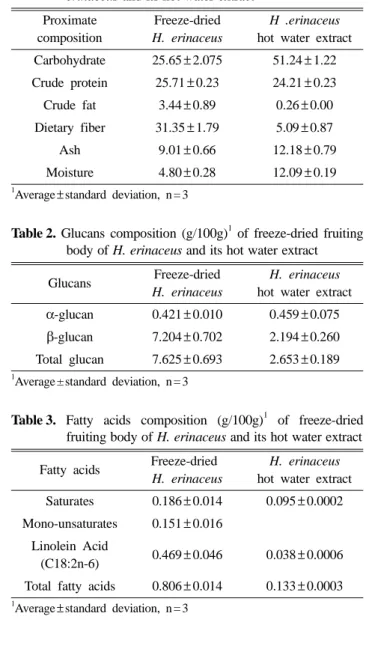
The proximate composition of H. erinaceus and its hot water extract are shown in Table 1. The freeze dried H. erinaceus showed moisture con- tent of 4.80%. The mushroom was mainly com- posed of dietary fiber (31.35%) followed by crude protein (25.71%), carbohydrate (25.65%), ash (9.01%) and crude fat (3.44%). On the other hand, the H. erinaceus hot water extract showed mois- ture content of 12.09%. Main components of H.
erinaceus hot water extact were followed by car- bohydrate (51.24%), crude protein (24.21%), ash (12.18%), dietary fiber (5.09%) and crude fat (0.26%). Considerable differences between freeze dried H. erinaceus and its hot water extract weren’t apparent. Ko et al. (1999) reported the protein content of freeze-dried shiitake mushroom is 18.12%. The protein content of H. erinaceus was high compared to shiitake mushroom and other mushrooms (Kalac, 2009).
The glucan contents of H. erinaceus and its hot water extract are shown in Table 2. Glucan con- tents of this mushroom were 7.62%, -glucan con- tents were 7.20%. Also glucan contents of hot water extract were 2.65% and -glucan contents were 2.19% Great attention has recently been paid to mushroom -glucans, due to their health-positive effects. -glucan research and applications have
been successful, mainly in the east-Asian countries and deal mostly with cultivated mushroom species (Wasser, 2002).
The fatty acids of H. erinaceus and its hot water extract are shown in Table 3. Fatty acids contents (0.806%) of this mushroom were low. Very high proportions were found Linolein acid (C18:2n-6) in freeze-dried H. erinaceus and its hot water extract.
The nutritional value of this mushroom lipid is lim- ited, due to low total lipid contents and the absence of desirable n-3 fatty acids.
Major inorganic constituents of H. erinaceus and its hot water extract are given in Table 4. The inor- ganic constituents in freeze dried H. erinaceus were on the whole slightly lower than its hot water
Table 1. Proximate composition (g/100g)1 of freeze-dried H.
erinaceus and its hot water extract Proximate
composition
Freeze-dried H. erinaceus
H .erinaceus hot water extract Carbohydrate 25.65 2.075 51.24 1.22 Crude protein 25.710.23 24.21 0.23 Crude fat 3.44 0.89 0.260.00 Dietary fiber 31.351.79 5.090.87
Ash 9.01 0.66 12.18 0.79
Moisture 4.80 0.28 12.09 0.19
1Averagestandard deviation, n=3
Table 2. Glucans composition (g/100g)1 of freeze-dried fruiting body of H. erinaceus and its hot water extract
Glucans Freeze-dried H. erinaceus
H. erinaceus hot water extract
-glucan 0.421 0.010 0.4590.075
-glucan 7.204 0.702 2.1940.260 Total glucan 7.625 0.693 2.6530.189
1Average ± standard deviation, n = 3
Table 3. Fatty acids composition (g/100g)1 of freeze-dried fruiting body of H. erinaceus and its hot water extract
Fatty acids Freeze-dried H. erinaceus
H. erinaceus hot water extract Saturates 0.186 0.014 0.095 0.0002 Mono-unsaturates 0.151 0.016
Linolein Acid
(C18:2n-6) 0.469 0.046 0.038 0.0006 Total fatty acids 0.806 0.014 0.133 0.0003
1Averagestandard deviation, n=3
extract, except Iron. Kalac (2009) reported content of major inorganic constituents in mushrooms (Table 5). According to Kalac (2009), H. erinaceus and its hot water extract contain non-specific levels of inor- ganic constituents. But, inorganic constituents of this mushroom are somewhat higher or comparable with the most vegetables.
Neuritogenic activity of H. erinaceus hot water extract
Hot water soluble extract was prepared from H.
erinaceus and its neuritogenic activity on PC12h cells was analyzed, which is a clone originating from a rat pheochromocytomon. NGF has been reported to induce morphological changes in PC12h cells by improving neurite outgrowth (Hatanaka, 1983). NGF was shown to improve the differentiation of PC12h cells (Fig. 1; Table 6).
The average neurite length of cells treated with 0.1g/mL of NGF is 49.01 11.06 m. After treat- ment of PC12h cells with the hot water extract of H. erinaceus at a concentration range of 0.1 and 1g/mL for 48 h, the longest neurite length of each cell was measured (Fig. 1; Table 6). They were significant increase in differentiation com-
pared to the neurite length of the control. The average the longest neurite length of cells treated with 1 mg/mL of H. erinaceus is 76.35 13.85 m.
The hot water extract of H. erinaceus exerts neu-
Table 4. Inorganic constituents composition (mg/100g)1 of freeze- dried fruiting body of Hericium erinaceus and its hot water extract
Inorganic constituents
Freeze-dried H. erinaceus
H. erinaceus hot water extract
Na 1.273 0.041
K 1515.00024.042 1992.500 487.196
Fe 0.669 0.007 0.2320.004
Ca 2.402 0.566 10.936 0.601
P 463.2009.617 572.075 18.773
1Averagestandard deviation, n=3
Table 5. Usual content (mg/100g) of major inorganic constituents in mushrooms
Inorganic constituents Usual content
Na 10 - 40
K 2000 - 4000
Ca 10 - 50
P 500 - 1000
(Pavel Kalac, 2009)
Fig. 1. Neuritogenesis induced by NGF in PC12h cells (*200). Scale bar = 100m (a) Control (negative vehicle); (b) NGF 0.10g/mL. Morphological changes induced hot water extract of H. erinaceus in PC12h cells. Scale bar = 100m. (*200); (c) Hot water extract of H. erinaceus 0.01 mg/mL; (d) Hot water extract of H. erinaceus 0.10 mg/mL; (e) Hot water extract of H.
erinaceus 0.50 mg/mL; (f) Hot water extract of H.
erinaceus 1.00 mg/mL.
Table 6. Effect of H. erinaceus hot water extract on PC12h cells neuritogenesis
Neurite length (ìm)
Control 12.931 2.281
NGF 0.10g/mL 49.013 11.058
Concentration of H. erinaceus hot
water extract
0.01 mg/mL 24.639 4.728 0.10 mg/mL 44.569 6.891 0.50 mg/mL 62.989 7.783 1.00 mg/mL 76.35313.853 Averagestandard deviation, n=100
ronal differentiation activity in PC12h cells by inducing neurite outgrowth at low concentration (0.1 mg/mL) compared to nerve growth factor (0.1g/mL of NGF).
Park et al. (2007) reported that the hot water extract of Tremella fuciformis tends to induce neu- rite outgrowth in PC12h cells. Also Park et al.
(2006) reported the neuritogenic activity of genipin containing fraction from Korean gardenia fruit previ- ously. When PC12h cells were treated with 5g/mL of genipin containing fraction from Korean garde- nia fruit, they observed similar neuritogenic activity compared to 1g/mL of hot water extract of T.
fuciformis. The average neurite length of cells treated with 1g/mL of hot water extract of T. fuci- formis is 77.84 0.92 m.
Conclusion
In this study hot water extract of H. erinaceus fruiting body was prepared and analyzed. As a result of hot water extract analysis, the proximate composition, glucans, fatty acids and inorganic con- stituents were similar to freeze-dried H. erinaceus.
In neuritogenic activity of hot water extract, hot water extract exhibited neurite outgrowth on PC12h cells. Treatment of PC12 cells with NGF induced neuronal differentiation. Also, treatment of PC12h cells with hot water extract did. These results sug- gest the possibility using hot water extract H. erina- ceus derivatives as NGF substitutes. The degree of neurite outgrowth activity differed among the com- pound concentration. In 1 mg/mL hot water extract exhibited the highest neuritogenic effect and the lowest neuritogenic effect is 0.01 mg/mL. It means neuritogenic effect depends on the concentration of hot water extract.
Acknowledgement
This work was supported by the GRRC program of the Gyeonggi province (GRRC-CAU-2013-B01) and the development of mushroom products and related functional resources of the Rural Development Administration (PJ907021102013), Republic of Korea.
Reference
Allen, S. J. and Dawbarn, D. 2006. Clinical relevance of the neurotrophins and their receptors. Clin. Sci. 110 : 175-191.
Hatanaka, H. 1981. Nerve growth factor-mediated stimulation of tyrosine hydroxylase activity in clonal rat pheochromocytoma cell line. Brain Res. 22 : 225-233.
Hatanaka, H. 1983. Nerve growth factor-mediated differentiation of a nerve cell line cultured in a hormone-supplemented serum free medium. Dev. Brain Res. 6 : 243-250.
Kalac, P. 2009. Chemical composition and nutritional value of European species of wild growing mushrooms: A review. Food Chem. 113 : 9-16.
Kawagishi, H., Shimada, A., Shirai, R., Okamoto, K,.
Ojima, F., Sakamoto, H., Ishiguro, Y. and Furukawa, S.
1994. Erinacines A, B and C, strong stimulators of nerve growth factor (NGF)-synthesis, from the mycelia of Hericium erinaceum. Tetrahedron Lett. 35 : 1569-1572.
Kim, D. M., Pyun, C. W., Ko, H. G. and Park, W. M. 2000.
Isolation of antimicrobial substances from Hericium erinaceum. Mycobiology. 28 : 33-38.
Kuwahara, S., Morihino, E., Nemoto, A. and Hiramatsu, A.
1992. Synthesis and absolute configuration of a cytotoxic fatty acid from the mushroom Hericium erinaceum.
Biosci. Biotechnol. and Biochem. 56 : 1417-1419.
Ko, J. W., Lee, W. Y., Lee, J. H., Ha, Y. S. and Choi, Y. H.
1999. Absorption characteristics of dried Shiitake mushrooms powder using different drying methods.
Korean J. Food Sci. Technol. 31(1) : 128-137.
Lee, E. W., Shizuki, K., Hosokawa, S., Suzuki, M., Suganuma, H., Inakuma, T., Li, J., Ohnishi-Kameyama, M., Nagata, T., Furukawa, S. and Kawagishi, H. 2000.
Two novel diterpenoids, erinacines H and I from the mycelia of Hericium erinaceum. Biosci. Biotechnol. and Biochem. 64 : 2402-2405.
Lee, J. S., Kyoung, M. M., Cho, J. Y. and Hong, E. K.
2009. Study of macrophage activation and structural characteristics of purified polysaccharides from the fruiting body of Hericium erinaceum, J Microbiol. and Biotechnol. 19(9) : 951-959.
Liu, C. P., Fang, J. N. and Xiao, X. Q. 2002. Structural characterization and biological activities of SC4, an acidic polysaccharide from Salvia chinensis. Acta Pharm. Sinic.
23(2) : 162-166.
Mizuno, T. 1999a. Bioactive substances in Hericium erinaceus pers and its medicinal utilization. Int. J Med.
Mush. 1 : 105-119.
Mizuno, T. 1999b. The extraction and development of antitumoractive polysaccharides from medicinal mushrooms in Japan. Int. J Med. Mush. 1 : 9-29
Mizuno, T. 2002. Medicinal properties and clinical effects on Agaricus blazei Murr. Int. J Med. Mush. 4
Mau, J. L., Lin, H. C. and Song, S. F. 2002. Antioxidant properties of several specialty mushrooms. Food Res. Int.
35 : 519-526.
Obara. Y. and Nakahata, N. 2002. The signaling pathway of neurotropic factor. Drug News and Perspect. 15 : 290- 298.
Park, K. J., Lee, S. Y., Kim, H. S., Yamazaki, M., Kenzo, C. and Ha, H. C. 2007. The Neuroprotective and Neurotrophic Effects of Tremella fuciformis in PC12h Cells. Mycobiology. 35(1) : 11-15.
Park, K. J., Ha, H. C., Kim, H. S., Chiba, K., Yeo, I. H.
and Lee, S. Y. 2006. The Neuroprotective and Neurotrophic Effects of Korean Gardenia jasminoides Ellis in PC12h cells. Food Sci. Biotechnol. 15 : 735-738.
Prosky, L., Asp, N-G., Schweizer, T. F., DeVires, J. W. and Furda, I. 1988. Determination of insoluble, soluble and total dietary fiber in foods and food products:
interlaboratory study. J. Assoc. Off. Anal. Chem. 71 : 1017-1023.
Takei, N., Tsukui, H. and Hatanaka, H. 1989. Intracellular
storage and evoked release of acetylcholine from postnatal rat basal forebrain cholinergic neurons in culture with nerve growth factor. J Neurochem. 53 : 1405-1410.
Wang, J., Hu, S. H., Wang, J. T., Chen, K. S. and Chia, Y.
C. 2005. Hypoglycemic effect of extract of Hericium erinaceus. J Sci. Food and Agricul. 85 : 641-646.
Wasser, S. P. 2002. Medicinal mushrooms as a source of antitumor and immunomodulating polysaccharides. Applied Microbiol. and Biotechnol. 60 : 258-274.
Wong, K. H., Vikineswary, S., Noorlidah, A., Kuppusamy, U. R. and Murali, N. 2009. Antimicrobial and antioxidant activities of Hericium erinaceus, Food Technol. and Biotechnol. 47(1) : 47-55.