• 검색 결과가 없습니다.

Effects of Transcranial Direct Current Stimulation and Virtual Reality Program Application on the Cognition and Depression of Mild Cognitive Impairment Patients

N/A
N/A
Protected

Academic year: 2021

Share "Effects of Transcranial Direct Current Stimulation and Virtual Reality Program Application on the Cognition and Depression of Mild Cognitive Impairment Patients"

Copied!
10
0
0

로드 중.... (전체 텍스트 보기)

전체 글

(1)

경두개 직류자극과 가상현실프로그램 적용이 경도인지장애 환자의 인지 및 우울에 미치는 영향

김고운

1

김보라

안태규

3

1

더자람감각통합발달센터 연구원,

동주대학교 작업치료과 교수,

3

마산대학교 작업치료과 교수

Effects of Transcranial Direct Current Stimulation and Virtual Reality Program Application on the Cognition and Depression of Mild Cognitive Impairment Patients

Ko-Un Kim, OT, Ph.D

1

Bo-Ra Kim, OT, Ph.D

Tae-Gyu An, OT, Ph.D

3

1

Thejalam Sensory Integration Development Research Institute, Researcher

2ǂ

Dept. of Occupational Therapy, Dongju University, Professor

3

Dept. of Occupational Therapy, Masan University, Professor

Abstract

Purpose : The purpose of this study is to investigate the effects of transcranial direct current stimulation and virtual reality program application on cognition and depression of patients with mild cognitive impairment, and to find an intervention method that can enhance active participation of patients with mild cognitive impairment.

Methods : In this study, 50 mild cognitive impairment patients were divided into a treatment group (25 patients) and a control group (25 patients). The treatment group was applied with a transcranial direct current stimulation and a virtual reality program, while the control group received a placebo transcranial direct current stimulation and a virtual reality program. Both groups received five 50-minute sessions per week (one session per day) for six weeks (total of 30 sessions). NCSE was used to evaluate the cognitive functions of the patients before and after treatment intervention. Moreover, K-BDI was conducted to examine the depression of the patients.

Results : As a result of the transcranial direct current stimulation and a virtual reality program intervention, the cognitive function of both treatment and control group significantly (p<.05) improved, and the depression of both treatment and control group significantly (p<.05) decreased. Moreover, the changes in cognitive functions and depression were significant between the two groups¸ treatment and control group (p<.05).

Conclusion : The results of the study showed that the application of the transcranial direct current stimulation and virtual reality program significantly improved the cognitive function of mild cognitive impairment patients and decreased the depression of them.

Therefore, it could be concluded that the transcranial direct current stimulation and virtual reality program was an intervention method which positively affects the cognitive function and depression of mild cognitive impairment patients.

Key Words : cognitive function, depression, mild cognitive impairment, tDCS, virtual reality program

ǂ

교신저자 : 김보라, [email protected]

1)

논문접수일 : 2021년 7월 12일 | 수정일 : 2021년 7월 22일 | 게재승인일 : 2021년 8월 13일

(2)

Ⅰ . 서 론

우리나라는 급속한 고령화로 인해 2018년에 65세 이 상 노인인구비율이 14.3 % ‘고령화사회(aging society)’에 돌입하게 되었고, 2025년에는 노인인구비율이 20 %를 넘는 ‘초고령사회(super-aged society)’로 접어들 것으로 예상된다(Statistics, 2020). 이로 인해 만성 노인질환은 점 점 늘어나는 추세이며 이중 대표적인 노인 질환인 치매 의 유병률은 점점 증가하고 있으며 이에 따라 치매의 전 단계인 경도인지장애(mild cognitive impairment; MCI) 비 율 역시 증가하고 있다(Central Dementia Center, 2019).

최근 우리나라 65세 이상 노인인구 중 경도인지장애 환 자는 약 167만 명이고 유병률은 22.58 %로 노인 약 5명 중 1명이 경도인지장애 환자로 추정된다(Central Dementia Center, 2019).

경도인지장애의 진단기준은 환자나 보호자에 의한 기 억력 문제 호소, 신경심리학적 평가에서 동일 연령 및 교육수준을 고려하였을 때 1.5 표준편차 이하로 저하된 기억력 장애, 전반적으로 정상적인 인지기능 유지, 일상 생활에 지장이 없는 경우, 치매 진단기준에 부합하지 않 을 것 등의 5가지 조건을 만족하는 경우를 경도인지장애 로 진단하고 있다(Petersen, 2014). 경도인지장애의 대표 적인 증상은 인지기능의 손상을 들 수 있다. 인지기능의 경우 정상 노인에 비해 주의기능을 제외한 기초지능, 집 행기능, 작업기억, 시공간기능과 언어기능 등에서 유의 한 차이를 보였고 치매 노인과 비교했을 때 경도인지장 애 노인의 경우 언어기능, 기억기능 등에서 유의미하게 높은 수행능력을 보인다고 하였다(Lim, 2015). 또한 경도 인지장애가 장기기억을 제외한 모든 기억 영역에서 정 상 노인보다 유의하게 손상되었다고 보고하였다(Yun 등, 2005).

또한 경도인지장애 노인들은 인지기능 저하와 함께 정서적 증상들이 동반되며 그중 우울증을 앓고 있는 비 율은 20.1~44.3 %로 가장 높다(Panza 등, 2010). 우울증으 로 인한 신경화학적 변화는 해마(hippocampus)와 앞쪽띠 다발피질(anterior cingulate cortex)의 기능이 저하되며 인 지기능도 함께 저하된다(Bremne 등, 2004). 인지기능과 우울은 밀접한 관련이 있으며 우울 증상이 심한 경우 이

마엽 실행기능의 저하가 뚜렷하고 주의력과 억제능력, 작업기억력, 시공간기능 등의 인지 기능의 저하가 동반 되며 이는 우울증이 동반되는 경우 광범위한 영역의 인 지 저하를 가중하는 것으로 해석할 수 있다(Chui 등, 2011).

경도인지장애 환자에 대한 조기 중재는 중증치매로의 이환률을 감소시키고 인지기능의 유지 및 향상을 위해 중요하다(Ham 등, 2018). 경도인지장애 환자의 인지기능 향상에 대한 적극적 중재는 사회적 돌봄을 줄이고, 환자 의 주관적인 삶의 질을 향상시킴으로 우울감을 감소시 킬 수 있다는 점에서 전문가의 적절한 개입이 필요하다.

최근 경도인지장애 환자의 인지기능 증진을 위한 방 법 중의 하나는 경두개 직류자극(transcranial direct current stimulation)을 들 수 있다. 경두개 직류자극이란 뇌에 비침습적으로 전기 자극을 제공하여 뇌 세포의 흥 분성 및 억제성 변화를 통해 뇌의 각 부분별 기능 손상 으로 인한 회복을 줄 수 있는 대표적인 방법이다(Nitsche 등, 2003; Paulus & Yang, 2000). 경두개 직류자극은 두피 에 부착된 두 개의 전극을 통해 미세한 전기 자극이 뇌 피질에 지속적으로 적용되는 것으로써 전극의 위치와 극성에 따라 효과의 차이가 있는데 양극(anode)의 자극 은 뇌피질의 흥분성을 증가시키는 반면 음극(cathode)의 자극은 흥분성을 감소시킨다(Nitsche 등, 2003). 다양한 연구에서 뇌 활동의 통제를 통해 행동 및 정보처리 우울 증 등에 대한 효과성이 보고되었고, 경도인지장애 환자 를 대상으로 한 연구에서는 공간지각능력, 기억력 등이 증진되었다고 보고하였다.(An & Gwon, 2019; Park 등, 2019; Meinzer 등, 2013).

또한 가상현실프로그램의 경우 여러 가지 과제를 수 행하고 현실과 유사한 상황에 다양한 기능의 습득이 가 능하여 재활치료에 널리 사용되고 있다. 이는 실제와 유 사한 환경에서 대상자 스스로 과제를 수행하고 기능에 따라 다양하게 난이도를 조절할 수 있어 동기유발과 참 여도가 높아지는 장점을 가지고 있다(Grealy 등, 1999).

이러한 가상현실프로그램을 경도인지장애 환자에게 적 용하였을 때 균형 및 낙상 관련 체력의 증진, 인지기능 의 증진 등의 인지기능 증진뿐만 아니라 신체적인 기능 의 증진에도 효과가 있다고 보고되고 있다(Hwang &

Park, 2018; Kim, 2019). 또한 치매환자에게 가상현실프

(3)

로그램을 적용하였을 때 우울 및 삶의 질에 긍정적인 영 향을 미쳤다는 연구가 보고되고 있다(Park & Sin, 2016).

하지만 경도인지장애 환자에게 가상현실을 적용하였을 때 우울과 같은 정서적 요소에 미치는 영향에 대한 연구 가 미흡하며 경도인지장애 환자에게 경두개 직류자극과 가상현실을 함께 적용하여 인지기능 및 우울에 미치는 영향에 대한 연구 또한 미흡한 실정이다. 이에 본 연구 에서는 경도인지장애 환자를 대상으로 경두개 직류자극 과 가상현실프로그램을 동시에 적용하여 인지기능 및 우울에 어떠한 변화가 일어났는지 알아보고자 한다.

Ⅱ. 연구방법

1. 연구 대상 및 기간

본 연구는 2019년 01월부터 2019년 12월까지 1년 동안 부산광역시에 소재한 재활병원에서 경도인지장애로 진 단받고 외래를 통해 재활치료를 받고 있는 경도인지장 애 환자를 대상으로 하였다. 연구 대상자 선별기준에 부 합하고 본 연구의 목적과 방법을 이해하고 연구 참여에 동의한 50명을 선정하여 경두개 직류자극과 가상현실재 활프로그램을 적용하는 실험군 25명과 허위로 경두개 직류자극과 가상현실재활프로그램을 적용하는 대조군 25명으로 나누었다. 중재프로그램은 주 5회, 1일 50분씩 6주간 총 30회기의 중재를 적용하였고, 중재 전𐤟후 NCSE와 K-BDI를 이용하여 인지기능과 우울을 평가하 였다. 연구 대상자의 선별 기준은 다음과 같다.

1) 연구 진행 기간인 6주 동안 입원 및 외래로 연구에

참여 가능한 자

2) Petersen(1999)이 제시한 경도인지장애의 준거에 적 합한 자

3) 한국판 몬트리올 인지평가(Korean version of montreal cognitive assessment; K-MoCA)가 22점 이하인 자 4) 한국형 간이 정신상태 판별검사(Korean version of

mini-mental state examination; MMSE-K)에서 20~23 점(치매 의심)을 받은 자로 의사소통이 가능한 자 5) 치매임상평가척도(clinical dementia rating; CDR)점

수 0.5점을 받은 자로 의사소통이 가능한 자 6) 두 개 내 금속물질 삽입하지 않은 자

7) 본인이나 가족으로부터 연구 참여에 대한 동의를 얻은 자

2. 실험도구 및 측정방법

1) 가상현실프로그램

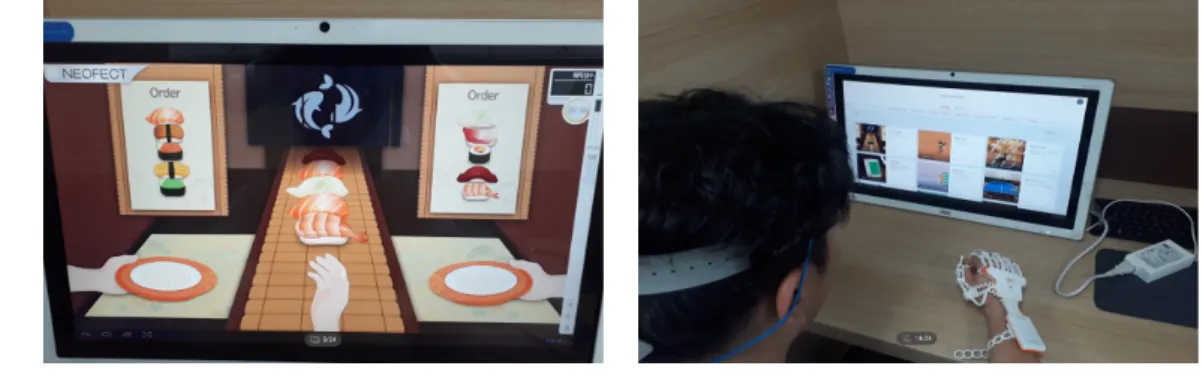
가상현실재활훈련은 실험군과 대조군에서 각각 30분 간 시행하였다 . 가상현실재활프로그램은 라파엘 스마트 글러브(RAPAEL Smart Glove, Neofect, Korea)를 이용하 여 실시하였다. 본 도구는 일상생활에서 사용하는 과제 를 반복적으로 제시하여 실시간으로 시각 및 청각의 피 드백을 제공하며, 수행기록의 저장, 대상자의 능력에 따 른 난이도 조절이 가능한 도구이다. 각 과제들은 운동 기능 훈련 프로그램인 단순훈련, 기능 및 인지기능 훈련 프로그램으로 구성되어 있다. 과제 수행 시 시․청각 피드 백을 제공하고 훈련이 종료되면 훈련성과를 정량화하여 대상자의 능력에 따라 난이도를 조절하는 맞춤형 훈련 도구이다.

Fig 1. Rapael smart glove

(4)

본 연구에서는 치매환자의 인지기능 증진에 효과적으 로 밝혀진 An 등(2018)의 연구에서 사용한 프로그램 중

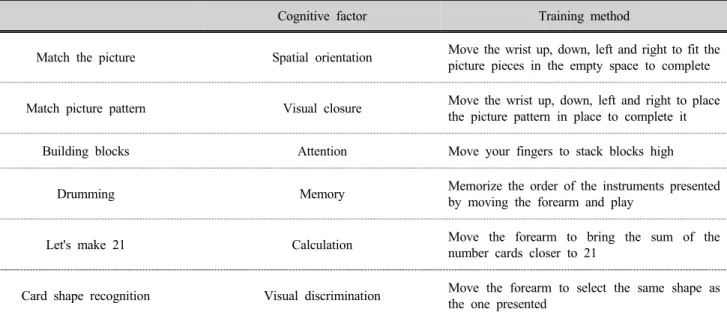
대상자의 인지 능력을 고려하여 총 6가지 프로그램을 사 용하였다(Table 1)(Fig 1).

Cognitive factor Training method

Match the picture Spatial orientation Move the wrist up, down, left and right to fit the picture pieces in the empty space to complete

Match picture pattern Visual closure Move the wrist up, down, left and right to place the picture pattern in place to complete it

Building blocks Attention Move your fingers to stack blocks high

Drumming Memory Memorize the order of the instruments presented

by moving the forearm and play

Let's make 21 Calculation Move the forearm to bring the sum of the number cards closer to 21

Card shape recognition Visual discrimination Move the forearm to select the same shape as the one presented

Table 1. Cognitive training program of rapael smart glove

2) 경두개 직류자극

본 연구에서 사용한 경두개 직류자극은 식염수를 흡 수하는 스펀지 전극(4×6 ㎝)을 두피에 부착하여 흐르도 록 하였고, 전기는 건전지를 이용하여 직류를 발생시키 는 Phoresor® PM 850(Phoresor® II Auto Model No. PM 850, IOMED Inc. USA)으로 FDA 인증을 받고 상품화된 제품을 사용하였다.

본 연구의 전극의 위치는 Boroojerdi 등(2001)의 연구 에서 이마앞엽에 적용시 인지기능의 향상을 보였다는 연구를 근거로 양극은 왼쪽 등쪽가쪽이마앞엽(DLPFC;

dorsal lateral prefrontal cortex)에 부착하였고, 음극은 오 른쪽 등쪽가쪽이마앞엽(DLPFC; dorsal lateral prefrontal cortex)에 스트랩을 감아서 자극 부위에 고정되도록 하였 다. 실험군에서 20분간 경두개 직류자극을 적용하였고, 동일한 연구 상황 조성을 위해 대조군은 동일 부위에 경 두개 직류자극을 부착하되, 자극을 중단하였다. 실험군 의 자극 변수인 강도와 기간은 Iyer 등(2005)의 연구에서 입증된 안정성에 의거하여 1 ㎃로 20분간 적용하였다.

3) 신경행동학적 인지상태검사(neurobehavioral cognitive status examination; NCSE)

Kiernan 등(1987)이 개발한 인지 상태 검사 도구로 Park 등(1994)에 의해 번역되었다.

인지기능의 전반적 기능인 의식수준(level of

consciousness), 지남력(orientation), 집중력(attention), 언어

(language)의 3가지의 일반적 항목과 언어(language), 구

성능력(constructions), 기억력(memory), 계산력

(calculation), 추리력(reasoning)의 5가지 주 기능 항목을

독립적으로 검사하여 언어는 유창성 , 이해, 반복 및 사물

의 이름 말하기 항목으로, 사고력 항목은 유사성과 판단

력 항목으로 세분화되어 있다. 의식수준과 언어유창성

항목을 제외한 10개 항목을 점수화한다. 소요시간은

15~20분 정도로 짧은 시간에 인지 능력을 판별할 수 있

으며 검사자 간 신뢰도는 상관계수가 .90 이상이며 검사

-재검사의 신뢰도는 상관계수가 .88〜1.00이다(Jung 등,

1999). 본 연구에서는 Park 등(1994)의 제안에 따라 민감

도와 특이도를 높이기 위해서 만 60세 이상의 노인 군에

게는 기억력 항목에 2점, 구성능력 항목에 1점을 가산하

(5)

였다.

4) 백 우울증 척도 한국판(Korean version of beck depression inventory; K-BDI)

백 우울 척도는 Beck 등(1961)이 성인의 우울 증상 정 도를 측정하기 위해 제작한 것으로 전 세계적으로 널리 사용되고 있는 우울을 평가하는 평가도구이다. 우울감의 인지적, 정서적, 동기적, 신체적 증상 영역을 포함하는 총 21문항으로 구성되어 있으며 증상의 정도를 표현하 는 구체적인 문장에 응답하게 하는 자기 보고식 척도로 각 문항 당 0점부터 3점까지 4점 척도로 구성되어 있다.

점수가 높을수록 우울의 정도가 심각하다. 9점 이하는 정상, 10~15점은 경도의 우울, 16~23점은 중증도 우울, 24~63점은 매우 심각한 우울 증상이다. 본 도구의 내적 일관성 신뢰도는 0.83으로 높은 신뢰도를 가진다.

3. 자료분석

본 연구에서 수집된 자료는 SPSS version 22.0을 이용 하여 분석하였다. 대상자의 일반적인 특성은 기술통계의

방법인 평균과 표준편차를 이용하였다. 중재 시행 전 집 단 간 동질성 검증을 위해 카이제곱 검정(chi-squared test)을 이용하였다. 본 연구에서 사용한 경두개 직류자 극과 가상현실재활프로그램이 경도인지장애 환자의 인 지기능 및 우울에 미치는 영향을 알아보기 위해 중재 전·후의 비교를 대응표본 t검정(paired t-test)을 실시하였 고, 중재 전과 후의 변화량을 알아보기 위해 독립표본 t 검정(independent two-sample t-test)을 실시하였다. 모든 결과의 통계학적 유의수준은 .05로 하였다.

Ⅲ . 결 과

1. 연구 대상자의 일반적 특성

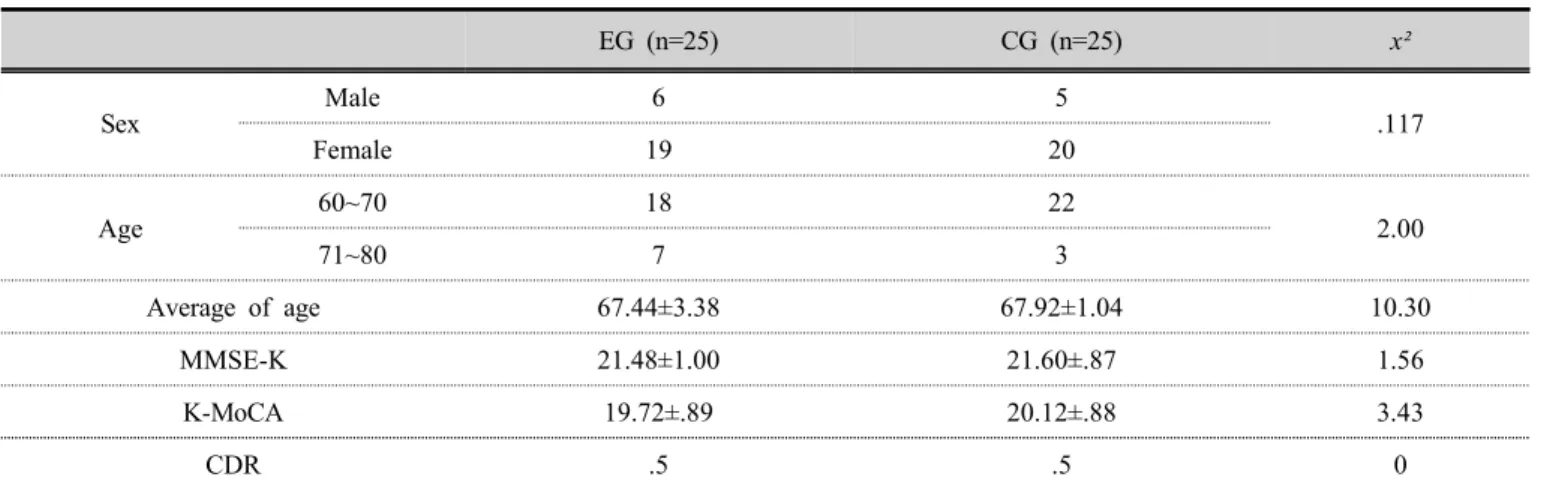
연구 대상자의 일반적 특성은 Table 2와 같다. 중재 전 실험군과 대조군 사이의 일반적 특성에 대한 동질성 검 증을 실시한 결과 통계학적으로 유의한 차이가 나타나 지 않았다.

EG (n=25) CG (n=25)

Sex Male 6 5

Female 19 20 .117

Age 60~70 18 22

71~80 7 3 2.00

Average of age 67.44±3.38 67.92±1.04 10.30

MMSE-K 21.48±1.00 21.60±.87 1.56

K-MoCA 19.72±.89 20.12±.88 3.43

CDR .5 .5 0

CDR; clinical dementia rating, MMSE-K; Korean version of mini-mental state examination, K-MoCA Korean version of montreal cognitive assessment

Table 2. General characteristics of the subject (n=50)

2. 중재 전·후 실험군의 인지 기능, 우울의 비교

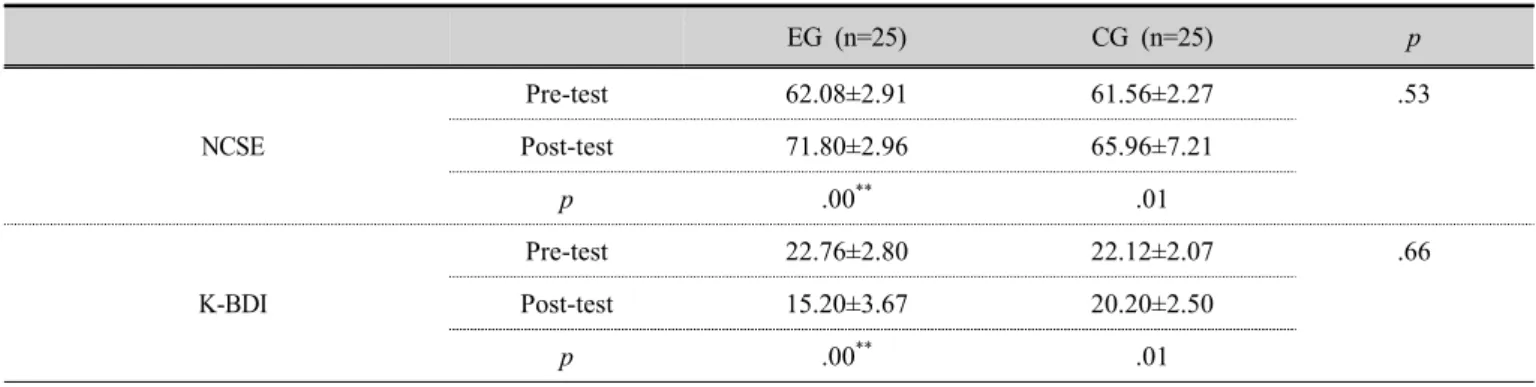
중재 전·후 변화량을 비교한 결과 중재 전과 후의 인

지 기능, 우울은 통계학적으로 유의한 차이를 보였다

(p<.05)(Table 3).

(6)

EG (n=25) CG (n=25) p

NCSE

Pre-test 62.08±2.91 61.56±2.27 .53

Post-test 71.80±2.96 65.96±7.21

p .00

**

.01

K-BDI

Pre-test 22.76±2.80 22.12±2.07 .66

Post-test 15.20±3.67 20.20±2.50

p .00

**

.01

*

p<.05,

**

p<.01

Table 3. Comparison of cognitive function and depression between groups before and after intervention

3. 중재 후 두 군 간의 인지 기능, 우울의 변화량 비교

중재 후 변화량을 실험군과 대조군의 인지 기능, 우울

을 비교한 결과 두 집단 간의 인지 기능의 변화량과 우 울의 변화량은 유의한 차이를 나타냈다(p<.05)(Table 4).

EG (n=25) CG (n=25) p

NCSE 13.12±3.69 4.40±7.43 .00

**

K-BDI -7.56±4.90 -1.92±3.59 .00

**

*

p<.05,

**

p<.01

Table 4. Comparison of cognitive function and depression between groups

Ⅳ . 고 찰

본 연구는 경두개 직류자극 및 가상현실 프로그램 적 용이 경도인지장애 환자의 인지 및 우울에 미치는 영향 을 알아보고, 경도인지장애 환자의 능동적인 참여를 증 진시킬 수 있는 중재방법을 알아보고자 하였다. 본 연구 의 연구 대상자는 총 50명으로 각각 25명씩 실험군과 대 조군으로 무작위배정을 하였다. 실험군에서는 경두개 직 류자극과 가상현실프로그램을 병행하여 적용하였으며, 대조군에서는 허위로 경두개 직류자극과 가상현실프로 그램을 적용하였다. 중재가간은 두군 모두에게 동일하게 주 5회, 1일 30분씩 6주간 총 30회기의 중재를 적용하였 다.

실험군에게 적용한 방법인 경두개 직류자극은 비침습 적인 방법으로 수술과 같은 외과적 수술 없이 뇌를 자극

하는 방법으로 뇌의 활성화를 조절하여 신경가소성의 변화를 이끌어내는 방법 중의 하나이다. 비침습적 뇌자 극방법은 뇌기능장애환자나 신경계 손상환자의 뇌기능 활성화에 영향을 준다고 알려져 있다. 경두개 직류자극 의 경우 신경계통의 구조적 변화를 초래하여 경도인지 장애 환자에게 적용하였을 때 삽화적 기억(episodic memory)을 포함하는 인지기능과 낙상 관련된 신체적 요 소 등의 증진을 나타내었다(Das 등, 2019; Kim, 2019).

실험군과 대조군 동시에 적용한 가상현실 프로그램은 Neopect사에서 개발한 RAPAEL Smart Glove로 총 11개 의 프로그램으로 구성되어 있으며 이 중 본 연구목적에 적합한 총 6개의 프로그램만을 선택하여 중재 프로그램 을 구성하였다.

중재 전과 후의 인지기능의 변화를 알아보기 위해

NCSE를 실시하였고, 우울을 알아보기 위해 백 우울증

(7)

척도 한국판(Korean version of beck depression inventory;

K-BDI)을 사용하였고, 인지기능의 변화를 알아보기 위 해 NCSE 평가를 실시하였다. 그 결과 실험군과 대조군 모두 중재 전과 후에 통계학적으로 유의한 차이가 나타 났으며, 그룹 간의 변화량 차이에서도 인지기능과 우울 이 통계학적으로 유의한 차이가 나타났다. 따라서 경도 인지장애 환자의 인지기능을 증진시키고자 할 때 가상 현실 프로그램만을 적용하는 것보다 경두개 직류자극을 함께 사용하는 것이 효과적이라는 것을 알 수 있다. 이 러한 결과는 Lawrence 등(2018)의 연구 결과와 유사하게 파킨슨으로 진단받은 경도인지장애를 가진 환자에게 12 주간 인지훈련프로그램과 더불어 왼쪽의 등쪽가쪽이마 앞엽겉질(dorsal lateral prefrontal cortex; DLPFC) 부위에 경두개 직류자극을 적용한 연구에서 경두개 직류자극만 실시한 그룹, 일반 인지 훈련을 실시한 그룹을 비교했을 때 인지기능의 하위 요소인 집행기능, 주의집중력, 단기 기억, 기억력에서 유의한 증진을 나타내었다. 이러한 연 구 결과는 본 연구에 경도인지장애 환자에게 왼쪽의 DLPFC에 전극을 부착하였을 때 얻게 된 것인데 이는 DLPFC가 파킨슨 환자뿐만 아니라 경도인지장애 환자에 게도 인지기능 증진에 효과적이라는 것을 알 수 있다.

Das 등(2019)의 연구에서도 경도인지장애 환자에게 양극 의 전극을 왼쪽아래이마이랑(left inferior frontal gyrus;

LIFG)에 부착하고, 인지훈련프로그램을 적용한 실험군 에서 대조군에 비해 인지기능이 유의하게 증진하였다는 연구 결과와도 일치한다. 이전의 연구들과 본 연구의 결 과를 통해 경두개 직류자극과 동시에 가상현실프로그램 을 적용하는 것은 경도인지장애 환자에게 뇌의 활성도 의 변화와 더불어 즐거움을 주는 활동이며, 이는 인지기 능의 증진에 긍정적인 효과가 있는 것이라는 것을 알 수 있다.

또한 우울의 변화를 알아보기 위해 백 우울증 척도 한 국판을 사용하였을 때 실험군과 대조군 모두 중재 전후 의 우울이 감소하였고, 실험군과 대조군의 점수변화량을 비교한 결과 두 군간의 유의한 차이를 나타내어 실험군 에서의 우울이 더 많이 감소하였다는 것을 의미한다. 이 러한 연구 결과는 Fregni 등(2006)의 연구결과에서 10명 의 주요 우울 증상을 가진 환자 10명을 대상으로 DLPFC 에 적용하였을 때, 허위로 tDCS를 적용한 그룹과 비교하

여 인지기능 증진과 함께 우울 또한 감소하였다는 것과 일치한다. 위와 같은 선행연구는 DLPFC의 영역이 인지 기능과 감정 변화에 관련 있는 메커니즘과 관련성을 확 인할 수 있었다(Fregni 등, 2006). Segrave 등(2014)의 연 구결과에서도 주요 우울 장애 환자에게 27명에게 인지 조절 훈련 프로그램과 동시에 DLPFC에 tDCS를 적용하 였을 때, 인지기능 증진과 함께 우울 또한 감소하였다.

이러한 연구결과 인지와 우울과 같은 정서 변화는 DLPFC의 활성화에 밀접한 관련이 있는 부분으로 DLPFC의 자극은 우울의 감소와 함께 인지 기능의 증진 에 긍정적인 효과를 가진다는 것을 알 수 있었고, 건강 한 성인에게서도 같은 결과를 나타내었다(Martin 등, 2013). 본 연구에서도 뇌의 활성화와 더불어 가상현실프 로그램을 적용하는 것이 경도인지장애 환자에게 흥미라 는 동기를 자극하고 성취감과 활동성을 이끌어냄을 통 해 우울을 개선하는데 효과적이라는 것을 확인할 수 있 었다 .

Kim과 Hong(2018)의 연구 결과에서 가상현실 프로그 램을 적용하였을 때 치매 환자의 인지기능의 증진되었 고 우울이 감소하였다고 보고하였다. 이와 같은 연구 결 과는 가상현실 프로그램의 경우 인지저하를 가지고 있 는 치매환자뿐만 아니라 경도인지장애 환자에게서도 긍 정적인 영향을 가진다는 본 연구의 결과와 일치한다고 볼 수 있다. 이와 같은 가상현실프로그램의 경우 치매와 같은 인지 손상 환자에게 손상된 인지를 유지 및 향상에 효과적이고 각 개인별 특성과 능력에 따라 다양하게 적 용할 수 있는 장점을 가지고 있다고 볼 수 있다(Park &

Sin 2016). 또한 36명의 경도인지장애 환자에게 실험군에 서는 가상현실 인지 훈련을 실시하고 대조군에서는 음 악치료를 실시하였을 때, 실험군에서 인지기능 중의 하 나인 기억력과 실행기능이 대조군에 비해 더 많은 효과 를 나타내었고, 우울감도 감소하였다(Optale 등, 2010).

그러므로 경두개 직류전기 자극 및 가상현실 프로그램 은 경도인지장애 환자의 인지기능 증진과 우울이 감소 함에 따라 즐겁고 흥미로운 활동으로 대상자들의 참여 를 증진시켜 인지기능의 향상 및 우울이 감소하였다는 본 연구를 뒷받침한다.

본 연구의 제한점은 대상자 수의 제한으로 내용의 일

반화가 어렵고 각 중재 회기 마다 어떠한 변화를 가지고

(8)

있는지 측정하기 어렵기 때문에 6주로 중재 기간이 제한 된다는 점이다. 하지만, 본 연구에서는 경도인지장애 환 자에서 경두개 직류자극와 가상현실프로그램의 효과를 증명하고, 경도인지장애 환자의 인지기능과 우울의 감소 에 효과가 있는 중재 방법 중의 하나로 경두개 직류자극 과 가상현실프로그램을 제시하였다는 것에 의의가 있다.

추후 다양한 질환과 대상자 수를 늘리고 각 회기별로 결 과를 측정하여 어떠한 시기에 가장 효과가 있는지에 대 한 연구와 추적 관찰을 통한 중재 효과의 지속성에 대한 연구가 필요할 것이다.

Ⅴ . 결 론

본 연구는 경두개 직류자극과 가상현실을 이용한 치 료 프로그램이 경도인지장애 환자의 인지기능과 우울에 미치는 영향을 알아보았다. 이를 통해 경도인지장애 환 자의 뇌에 신경학적 변화와 더불어 동기유발과 능동적 인 참여를 유도할 수 있는 중재 방법을 제시하고 경도인 지장애 환자의 인지기능의 증진과 우울의 감소에 효과 적인 중재 프로그램을 제시하고자 하였다. 연구결과 경 두개 직류자극과 가상현실프로그램은 경도인지장애 환 자의 인지기능의 증진과 우울의 감소에 효과적이라는 것을 확인 할 수 있었다. 이는 경도인지장애 환자의 인 지기능의 증진과 우울의 감소를 목적으로 경두개 직류 자극과 가상현실프로그램이 사용될 수 있음을 나타낸다.

추후 대상자 수의 증진과 함께 다양한 변수들과 인지기 능의 변화 단계에 따른 연구가 진행되어야 할 것이며, 경도인지장애 환자를 위한 다양하고 체계적인 치료접근 방법이 다각적으로 모색되어야 할 것이라고 사료된다.

참고문헌

An TG, Gwon HC(2019). The effect of transcranial direct-current stimulation on cognitive function and depression in stroke patient’s through a computerized cognitive rehabilitation program. J Korean Med Rehabil,

7(3), 33-40. https://doi.org/10.15268/ksim.2019.7.3.033.

An TG, Gwon HC, Kim H, et al(2018). Effect of transcranial direct current stimulation on upper extremity function and depression in stroke patients with virtual reality rehabilitation program. J Humani Soc Sci, 9(5), 43-56. https://doi.org/10.22143/hss21.9.5.4.

Beck AT, Ward CH, Mendelson M, et al(1961). An inventory for measuring depression. Arch Gen Psychiatry, 4(6), 561-571. https://doi.org/10.1001/

archpsyc.1961.01710120031004.

Boroojerdi B, Phipps M, Kopylev L, et al(2001). Enhancing analogic reasoning with rTMS over the left prefrontal cortex. Neurology, 56(4), 526-528. https://doi.org/

10.1212/WNL.56.4.526.

Bremner JD, Vythilingam M, Vermetten E, et al(2004).

Deficits in hippocampal and anterior cingulate functioning during verbal declarative memory encoding in midlife major depression. Am J Psychiatry, 161(4), 637-645.

Chui W, Cheung E, Lam L(2011). Neuropsychological profiles and short-term outcome in late-onset depression.

Int J Geriatr Psychiatry, 26(5), 458-465. https://doi.org/

10.1176/appi.ajp.161.4.637.

Das N, Spence JS, Aslan S, et al (2019). Cognitive training and transcranial direct current stimulation in mild cognitive impairment: a randomized pilot trial. Front Neurosci, 13, Printed Online.

https://doi.org/10.3389/fnins.2019.00307.

Fregni F, Boggio PS, Nitsche MA, et al(2006a). Treatment of major depression with transcranial direct current stimulation. Bipolar Disord, 8(2), 203-204. https:

//doi.org/10.1111/j.1399-5618.2006.00291.x.

Fregni F, Boggio PS, Nitsche MA, et al(2006b). Cognitive effects of repeated sessions of transcranial direct current stimulation in patients with depression. Depress Anxiety, 23(8), 482-484. https://doi.org/10.1002/da.

20201.

Grealy MA, Johnson DA, Rushton SK(1999). Improving

cognitive function after brain injury: the use of exercise

(9)

and virtual reality. Arch Phys Med Rehabil, 80(6), 661-667. https://doi.org/10.1016/S0003-9993(99)90169-7.

Hahn HM, Yum TH(1986). A standardization study of Beck depression inventory in Korea. J Korean Neuropsychiatr Assoc, 25(1), 487-502.

Ham MJ, Kim SK, Yu DH(2018). The effects of a multimodal interventional program on cognitive function, instrumental activities of daily living in patients with mild Alzheimer's disease. KSOT, 26(1), 91-102. https://doi.org/10.14519/jksot.2018.26.1.07.

Hwang JH, Park MS(2018). Effect of a dual-task virtual reality program for seniors with mild cognitive impairment. Korean J Clin Lab Sci, 50(4), 492-500.

https://doi.org/10.15324/kjcls.2018.50.4.492.

Iyer MB, Mattu U, Grafman J, et al(2005). Safety and cognitive effect of frontal DC brain polarization in healthy individuals. Neurology, 64(5), 872-875.

https://doi.org/10.1212/01.WNL.0000152986.07469.E9.

Jung WM, Choi HS, Park GJ(1999). Neurobehavioral cognitive status examination(NCSE) in brain-injured patients. KSOT, 7(1), 1-16.

Kiernan RJ, Mueller J, Langston JW, et al(1987). The neurobehavioral cognitive status examination: a brief but differentiated approach to cognitive assessment. Ann Intern Med, 107(4), 481-485. https://doi.org/10.7326/

0003-4819-107-4-481.

Kim KU(2019). Effects of transcranial direct current stimulation and virtual reality rehabilitation program on balance, fall efficacy, and fall-related fitness in people with mild cognitive impairment. J Humanit Soc Sci, 10(5), 1337-1348. https://doi.org/10.22143/hss21.10.5.95.

Kim YM, Hong HJ(2018). The effects of wholeness program using virtual reality(VR) on cognitive function, depression, and activities of daily living for the elderly with demented. Korean J Phys Educ, 57(2), 387-397.

https://doi.org/10.23949/kjpe.2018.03.57.2.27.

Lawrence BJ, Gasson N, Johnson AR, et al(2018).

Cognitive training and transcranial direct current stimulation for mild cognitive impairment in Parkinson’s

disease: a randomized controlled trial. Parkinsons Dis, 2018, Printed Online. https://doi.org/10.1155/2018/

4318475.

Lim WS(2015). Cognitive differences between normal, mild cognitive impairment, and Alzheimer's disease in the elderly. Graduate school of Daegu University, Republic of Korea, Master’s thesis.

Meinzer M, Lindenberg R, Antonenko D, et al(2013).

Anodal transcranial direct current stimulation temporarily reverses age-associated cognitive decline and functional brain activity changes. J Neurosci, 33(30), 12470-12478. https://doi.org/10.1523/JNEUROSCI.

5743-12.2013.

Martin DM, Liu R, Alonzo A, et al(2013). Can transcranial direct current stimulation enhance outcomes from cognitive training?. a randomized controlled trial in healthy participants. Int J Neuropsychopharmacol, 16(9), 1927-1936. https://doi.org/10.1017/S1461145713000539.

Neofect(2016). RAPAEL smart solution manual. Seongnam, Neofect.

Nitsche MA, Schauenburg A, Lang N, et al(2003).

Facilitation of implicit motor learning by weak transcranial direct current stimulation of the primary motor cortex in the human. J Cogn Neurosci, 15(4), 619-626. https://doi.org/10.1162/089892903321662994.

Optale G, Urgesi C, Busato V, et al(2010). Controlling memory impairment in elderly adults using virtual reality memory training: a randomized controlled pilot study. Neurorehabil Neural Repair, 24(4), 348-357.

https://doi.org/10.1177/1545968309353328.

Panza F, Frisardi V, Capurso CDA, et al(2010). Late-life depression, mild cognitive impairment and dementia:

possible continuum?. Am J Geriatr Psychiatry, 18(2), 98-116. https://doi.org/10.1097/JGP.0b013e3181b0fa13.

Park IH, Lee KG, Kim CY(1994). A study for clinical application of neurobehavioral cognitive status examination(NCSE). J Korean Neuropsychiatr Assoc, 33(6), 1329-1342.

Park SH, Sin JI(2016). The effect of virtual reality using a

(10)

therapeutic program on depression and the quality of life in dementia. JCD, 18(1), 13-19.

Park, J, Oh Y, Chung K, et al(2019). Effect of home-based transcranial direct current stimulation (tDCS) on cognitive function in patients with mild cognitive impairment: a study protocol for a randomized, double-blind, cross-over study. Trials, 20(1), Printed Online. https://doi.org/10.1186/s13063-019-3360-1.

Paulus PB, Yang HC(2000). Idea generation in groups: a basis for creativity in organizations. Organ Behav Hum Decis Process, 82(1), 76-87. https://doi.org/10.1006/

obhd.2000.2888.

Petersen RC, Caracciolo B, Brayne C, et al(2014).

Mildcognitive impairment: a concept in evolution. J Int Med, 275(3), 214-228. https://doi.org/10.1111/joim.

12190.

Petersen RC, Smith GE, Waring SC, et al(1999). Mild cognitive impairment: clinical characterization and outcome. Arch Neurol, 56(3), 303-308. https://doi.org/

10.1001/archneur.56.3.303.

Segrave RA, Arnold S, Hoy K, et al(2014). Concurrent cognitive control training augments the antidepressant efficacy of tDCS: a pilot study. Brain Stimul, 7(2), 325-331. https://doi.org/10.1016/j.brs.2013.12.008.

Statistics Korea(2020). Cause of death statistics.

Yun JH, An IS, Kim DG, et al(2005). Neuropsychological evaluation of mild cognitive impairment: comparison of no cognitive impairment and early Alzheimer`s disease.

Korean J Clin Psychol Annu Conf, 6, 408-409.

Central Dementia Center. Korean dementia observatory, 2019. Available at https://www.nid.or.kr/info/

dataroom_view.aspx?bid=209/ Accessed April 1, 2020.

수치

Fig 1. Rapael smart glove
Table 1. Cognitive training program of rapael smart glove
Table 2. General characteristics of the subject  (n=50)
Table 3. Comparison of cognitive function and depression between groups before and after intervention

참조

관련 문서

The purpose of this study is to evaluate the effects of heat treatment on the load-deflection properties and transitional temperature range(TTR) of

The purpose of this thesis is to examine the effects of the Marriage Encounter program(ME program) on marital problem solving behavior.. The overall goal of

The purpose of this study was to investigate the effects of a disability awareness program on improving the attitudes of regular elementary school

The purpose of this study is to analyze the effects of word- recording on learning vocabulary, reading and listening of English. control groups to answer

The purpose of this study is to investigate the effects on elementary school students' academic English improvement, interest, and self-confidence through the

The purpose of this study is to verify whether The mediating effects of planned happenstance skills on the relationship between perceived social support

The purpose of this study is to analyze the effects of sports marketing strategy fit on organizational attitude and organizational citizenship behavior

The purpose and necessity of this study was to investigate the effect of the 8-week GX complex exercise program on the stress index, blood lipid and APG