Effect of 1-MCP Treatment on the Early-season Asian Pear Cultivar ‘Wonhwang’ in Response to Different Temperature Conditions during Simulated Exportation
Ug-Yong Lee
1, Jin-Ho Choi
1, Ju-Hyun Lee
1, Kwang-Suk Oh
2, and Jong-Pil Chun
2*1
Pear Research Institute, National Institute of Horticultural & Herbal Science, Naju 58216, Korea
2
Dept. of Horticulture, Chungnam National University, 99 Daehak-ro, Daejeon 34134, Korea
*Corresponding author: [email protected]
We evaluated fruit quality and the incidence of physiological disorders in the Asian pear( Pyrus
pyrifolia Nakai) cultivar ‘Wonhwang’ in response to 1-methylcyclopropene (1-MCP, 1.0
µL·L
-1) treatment and different temperature conditions to determine its appropriate shelf-life period. Postharvest treatment with 1-MCP had a positive effect on ‘Wonhwang’ pears at all storage temperatures (18, 25, and 30°C) with regard to flesh firmness. Marketable fruits (>20 N) were only attainted using 1-MCP-treated fruit after 21 days of storage. A high incidence of physiological disorders and fruit decay was detected in fruits stored at 30°C, whereas a low incidence of physiological disorders including core browning, flesh browning, mealiness, and water soaking was detected in fruits treated with 1-MCP. Ethylene production and respiration rates increased with increasing temperature treatment. We detected high respiration rates in control fruits, reaching approximately two times higher than that of 1-MCP-treated fruits regardless of storage temperature. These results indicate that the efficacy of 1-MCP treatment on Asian pear depends on the storage temperature. Therefore, 1-MCP treatment should help maintain the quality of Asian pear fruits stored in high-temperature regions during the export process.
OPEN ACCESS Received:
Revised:
Accepted:
June 5, 2017 July 6, 2017 July 10, 2017
Abstract
Additional key words: ethylene, firmness, respiration, physiological disorders, skin color HORTICULTURAL SCIENCE and TECHNOLOGY
35(5):568-576, 2017 URL: http://www.kjhst.org pISSN : 1226-8763 eISSN : 2465-8588
This is an Open-Access article distributed under the terms of the Creative Commons Attribution NonCommercial License which permits unrestricted non-commercial use, distribution, and reproduction in any medium, provided the original work is properly cited.
Copyrightⓒ2017 Korean Society for Horticultural Science.
This research was supported by Chungnam National University (2016-1719-01).
Introduction
Among the many fresh agricultural products from Korea , the amount of pear (Pyrus pyrifolia Nakai )
fruit exports reached 22 , 706 tons in 2015 , representing the largest percentage of exported fresh fruit ( 16 %),
a value that is steadily increasing every year ( Statistics Korea , 2016 ). Korean pear is exported to
approximately 20 countries worldwide , with 44 . 7 % (~ 10 , 160 tons ) and 41 . 7 % (~ 9 , 471 tons ) exported to
Taiwan and the United States , respectively . Recently , various efforts have focused on expanding the
export market of Asian pear to regions such as Southeast Asia and various European countries ( K - stat ,
2015 ). Among exported cultivars , ‘ Niitaka ’ ( mid - season cultivar ) constitutes the largest portion , but
recently , the export volume of domestic cultivated cultivars such as ‘ Wonhwang ’ ( early - season ), ‘ Hwangkeumbae ’ ( early - to mid - season ), and ‘ Chuhwangbae ’ ( late - season ) pear has been gradually increasing .
‘ Wonhwang ’ pear has the largest cultivation area among the cultivars developed in Korea and represents the second most abundant cultivar in the pear export market . However , it has recently become quite difficult to export Asian pear due to the occurrence of physiological disorders including internal browning , flesh soaking , and skin blackening during distribution in the destination countries , especially in high - temperature regions . In Taiwan , a major Korean pear export destination , the average temperature in major cities is 28 . 5°C in August , 27 . 8°C in September , and 26 . 1°C in October . Moreover , depending on the region , there is a high temperature difference from the lowest temperature ( 20 . 8°C ) to the highest ( 35 . 6°C ) during the distribution period ( CWB , 2015 ). Therefore , if the fruits are exposed to high temperatures during distribution in local areas , these temperatures might cause problems such as reduced fruit quality , leading to fruit disposal due to the occurrence of internal disorders ( Lee et al ., 2011 ).
On the other hand , treatment with 1 - methylcyclopropene ( 1 - MCP ) is an effective way to improve post - harvest storage life of various fruit species including Chinese and Korean pear ( Dong et al ., 2015 ; Jiang and Joyce , 2002 ; Moon et al ., 2008 ; Watkins , 2006 ). In this study , we compared the changes in fruit quality and the incidence of physiological disorders in ‘ Wonhwang ’ pears stored at various temperatures after 1 - MCP treatment . The results of this study will contribute to the expansion of the export market and the marketability of Korean pear fruits .
Materials and Methods
Plant Material and 1-MCP Treatment
This study was carried out using 10 - year - old ‘ Wonhwang ’ pear trees (Pyrus pyrifolia Nakai ) planted at the National Institute of Horticultural Science , Naju , Korea . Fruits were harvested on the 125th day after bloom ( August 27 , 2015 ). After harvesting , the fruits were pre - conditioned for 1 day at room temperature ( 25°C ).
Subsequently , 1 - methylcyclopropene ( 1 - MCP ) treatment was performed by sealing the fruits in a plastic box with PE film ( 0 . 1 mm ) and vaporizing them with 1 . 0 µL · L
-1of 1 - MCP ( SmartFresh
TM, AgroFresh Inc ., USA ) at 25 ° C for 12 hrs . A small fan was installed in the treatment box to circulate the air during treatment ( Choi and Bae , 2007 ). After 1 - MCP treatment , the fruits were packed in 5 kg paperboard cartons for export . The change in fruit quality and the incidence of physiological disorders were examined for 28 days at 7 - day intervals in samples stored at 18 , 25 , or 30 ° C and 80 % RH .
Fruit Quality and Physiological Disorder Assessment
The flesh firmness of the fruits was measured at two points on the equator of the fruit after removing skin with an 8 mm tip
using a rheometer ( TMS - Pro , Food Technology Corp ., USA ). The maximum pressure was measured from a 5 mm sample at a
crosshead speed of 100 mm
.min
-1. Fruit juice samples for soluble solids and titratable acidity measurements were prepared by
cutting the flesh of the fruit equatorial plane to a thickness of 10 mm . The soluble solids content was measured using a digital
refractometer ( PR - 32a , ATAGO , Japan ). To determine titratable acidity , 5 mL of juice was diluted in 35 mL of distilled water ,
neutralized to pH 8 . 3 with 0 . 1 N NaOH , and converted into malic acid . Skin color difference values L *, a *, and b * were measured
at the fruit equatorial plane using a chroma meter ( CR - 410 , Minolta , Japan ), and the hue angle was calculated .
Ethylene production and the respiration rate of the fruits were measured using three replicates per treatment : two fruits were placed in a 3 . 4 L plastic jar , followed by incubation at 25 ° C for 2 hours . A 1 mL sample of the gas inside the sealed jar was collected with a syringe and analyzed with a gas chromatograph ( YL 6100 - GC , Younglin , Korea ) equipped with FID and TCD ( Tamura et al ., 2003 ). The fruits were visually examined for the occurrence of physiological disorders including core browning , internal browning , mealiness , and water soaking . The incidence of disorder was scored based on the damaged area of the cut surface ( 0 : no occurrence , 1 : < 20 %, 2 : < 40 %, 3 : < 60 %, 4 : < 80 %, 5 : > 80 %).
Statistical analysis was performed by Duncan ’ s multiple range test ( 5 % level ) using the SPSS program ( Version 20 . 0 , SPSS , Inc ., Chicago , IL , USA ).
Results and Discussion
After 1 - MCP treatment , which has been shown to inhibit ethylene activity ( Blankenship and Dole , 2003 ), we investigated the change in quality of Asian pear cultivar ‘ Wonhwang ’ fruits stored at different temperatures . Weight loss tended to increase with increasing storage period , especially at higher temperatures , which is similar to previous reports on Asian pears ( Kim et al ., 2011 ; Lee et al ., 2011 ). There was no significant difference between the 1 - MCP treatment and untreated control groups during the 21 - day storage periods ( Table 1 ). Under 25 ° C storage , the firmness of untreated fruits rapidly decreased to 28 . 5 N after 14 days , 17 . 0 N after 21 days , and 9 . 6 N after 28 days . By contrast , the firmness of fruits under 1 - MCP treatment remained high ( at 29 . 1 N ) after 28 days of storage . At 30 ° C , untreated fruits rapidly softened to 15 . 2 N after 21 days of storage , and quality analysis became impossible due to fruit decay after 28 days of storage . By contrast , the flesh firmness of 1 - MCP - treated fruits remained in the edible state ( 22 . 8 N ) even after 21 days of storage . The firmness of fruits stored at 18 ° C was not significantly different between the control and 1 - MCP - treated groups , with values remaining high ( 37 . 3 N and 38 . 1 N , respectively ) after 28 days of storage ( Table 1 ). The efficacy of 1 - MCP treatment on pear fruits varies depending on the concentration ( Mahajan et al ., 2010 ), the cultivar and harvest time ( Lee et al ., 2012 , 2014b ), and the distribution period ( Moon et al ., 2008 ). Our results suggest that the effect of 1 - MCP treatment on flesh firmness in Asian pear fruits also varies depending on the storage temperature . Soluble solids and acid content did not significantly differ based on the storage temperature and duration , and 1 - MCP treatment did not affect the overall quality ( Table 1 ) .
We also investigated the differences in the skin color of fruits during storage . The L * value tended to decrease with increasing storage period regardless of temperature condition . However , the L * value remained somewhat higher in 1 - MCP - treated fruit at 30 ° C . At 18 ° C storage temperature , there was little difference in L * value between treatments . The a * value , which indicates the increase in green color ( negative values ) and red color ( positive values ), generally increases during fruit maturation in Asian pear ( Oh et al ., 2010 ). The a * value was higher in fruits stored at 30 ° C than at 18 ° C , with a greater increase in control fruits than in fruits treated with 1 - MCP ( Table 2 ). The b * value , which reflects the expression of skin yellowness , showed a similar tendency to the a * value . The hue angle tends to decrease gradually as the shelf life of the Asian pear progresses ( Lee et al ., 2014b ) and can therefore be used as an index of ripening in pear fruit . In the current study , we also found that as the storage period increased , the hue angle exhibited a significantly greater decrease at 30 ° C than at 18 ° C and that 1 - MCP treatment significantly inhibited the decrease in hue angle ( Table 2 ).
One of the major factors contributing to the deterioration of Asian pear fruit during the storage and distribution period is the
occurrence of physiological disorders . In particular , internal disorders are difficult to distinguish based on the fruits ’ appearance ,
which causes substantial problems such as consumer recall after distribution . The incidence of disorders varies depending on the transport temperature during the fruit exporting process ( Oh et al ., 2010 ). In the current study , the physiological disorders that occurred during the 28 days of storage in ‘ Wonhwang ’ pear included flesh browning , core browning , and mealiness . The occurrence of flesh browning was low at 18 ° C regardless of treatment with 1 - MCP . After 28 days of storage at 25 ° C , flesh browning in untreated fruit occurred at a rate of 2 . 4 , while that under 1 - MCP treated showed a low incidence rate of 1 . 0 ( Fig . 1 ) . The rate of core browning increased as the storage period increased , but this rate was lower at 18 ° C and under 1 - MCP Table 1. Effect of postharvest 1-MCP (1.0 µL·L
-1) treatment and storage temperature on fruit quality indices during 28 days of storage in
‘Wonhwang’ pear Temperature
(°C) 1-MCP
zPeriod
(days)
Fruit quality indices Weight loss
(%) Firmness
(N) TSS
(
oBrix) Acidity
(%)
18
- 7 1.7 d
y38.0 a 11.7 a 0.24 a
- 14 2.6 c 39.6 a 11.8 a 0.23 a
- 21 3.5 b 39.7 a 11.6 a 0.24 a
- 28 4.8 a 37.3 a 11.8 a 0.22 a
+ 7 1.6 d 39.7 a 11.6 a 0.25 a
+ 14 2.6 c 40.4 a 12.2 ab 0.24 a
+ 21 3.5 b 37.9 a 12.4 a 0.25 a
+ 28 4.7 a 38.1 a 12.1 b 0.24 a
25
- 7 2.6 d 38.9 a 12.3 a 0.22 a
- 14 4.4 c 28.5 b 12.4 a 0.22 a
- 21 6.4 b 17.0 c 12.5 a 0.26 a
- 28 9.0 a 9.6 c 12.7 a 0.13 b
+ 7 2.6 d 39.7 a 12.0 b 0.25 a
+ 14 4.5 c 37.6 a 12.2 ab 0.22 ab
+ 21 5.8 b 37.5 a 12.6 a 0.24 a
+ 28 8.2 a 29.1 b 12.6 a 0.20 b
30
- 7 2.5 c 38.7 a 11.7 a 0.22 a
- 14 4.9 b 15.6 b 12.0 a 0.18 b
- 21 7.2 a 15.2 b 11.3 a 0.18 b
- 28 -
x- - -
+ 7 2.3 d 38.8 a 12.1 b 0.21 a
+ 14 4.1 c 37.0 a 11.8 b 0.23 a
+ 21 6.7 b 22.8 a 12.6 a 0.21 a
+ 28 9.0 a 14.3 c 11.7 b 0.14 b
ANOVA
wTemperature (A) *** *** *** ***
1-MCP (B) *** *** ** ***
Shelf-life (C) *** *** * ***
A × B ** *** *** NS
A × C *** *** NS ***
B × C NS *** *** *
A × B × C NS *** NS *
z
1-MCP treatment at a level of 1.0 μL·L
-1for 12 hours at room temperature.
y
For each temperature and treatment, values with different letters in the same column are significantly different by Duncan's multiple range test at the 5% level.
x
Experimental results were missing due to quality deterioration and decay of fruits.
w
NS, *, **, *** indicate non-significant, and significant difference at p < 0.05, p < 0.01 or p < 0.001, respectively.
treatment regardless of temperature compared to the control . At 18 ° C , the rate of core browning in untreated fruit was 0 . 7 on the 28th day of storage and that under 1 - MCP treatment was 0 . 3 ; these rates are relatively low compared to those at higher temperatures . On the other hand , at 25 ° C , this value was 1 . 8 at 14 days and 4 . 2 at 21 days of storage , and more than 80 % of the core area was brown . In 1 - MCP - treated fruit , core browning began to occur at 14 days of storage and remained significantly lower ( at 1 . 4 ) after 28 days compared to the untreated control . At 30 ° C , in untreated fruits , core browning began to occur after 7 days of storage and rapidly increased ( to 4 . 5 ) after 14 days . However , core browning was significantly inhibited in 1 - MCP - Table 2. Effects of postharvest 1-MCP (1.0 μL·L
-1) treatment and storage temperature on skin color difference during 28 days of storage in
‘Wonhwang’ pear Temperature
(°C) 1-MCP
zPeriod
(days) Color difference
L* a* b* H
o18
- 7 64.88 a
y10.79 c 41.14 ab 75.34 a
- 14 64.40 a 10.81 c 41.04 b 75.31 a
- 21 65.02 a 12.80 b 41.16 ab 72.74 b
- 28 64.74 a 14.36 a 41.75 a 71.01 c
+ 7 63.53 b 9.54 c 40.44 b 76.78 a
+ 14 64.61 a 11.20 b 40.94 ab 74.70 b
+ 21 64.42 ab 13.12 a 41.22 a 72.36 c
+ 28 64.50 ab 13.84 a 41.06 a 71.39 c
25
- 7 64.22 a 10.50 b 40.59 a 75.55 a
- 14 64.15 a 12.93 a 41.06 a 72.53 b
- 21 63.57 a 13.48 a 40.30 a 71.51 bc
- 28 62.31 b 13.11 a 38.51 b 71.24 c
+ 7 63.51 bc 9.18 c 40.34 b 77.25 a
+ 14 64.88 a 11.80 b 41.18 a 74.03 b
+ 21 63.94 b 13.65 a 41.31 a 71.73 c
+ 28 62.71 c 14.48 a 40.37 b 70.28 d
30
- 7 62.93 a 9.74 b 40.08 a 76.40 a
- 14 60.12 a 13.10 a 37.25 a 70.45 b
- 21 47.08 b 10.74 b 22.20 b 62.50 c
- 28 -
x- - -
+ 7 63.63 a 9.90 c 40.29 a 76.26 a
+ 14 63.63 a 11.52 b 40.72 a 74.28 b
+ 21 61.93 b 13.72 a 40.05 a 70.75 c
+ 28 41.96 c 9.49 c 15.85 b 58.66 d
ANOVA
wTemperature (A) *** *** *** ***
1-MCP (B) *** NS *** ***
Shelf-life (C) *** *** *** ***
A × B *** * *** ***
A × C *** *** *** ***
B × C *** *** *** **
A × B × C *** *** *** ***
z
1-MCP treatment at a level of 1.0 μL·L
-1for 12 hours at room temperature.
y
For each temperature and treatment, values with different letters in the same column are significantly different by Duncan's multiple range test at the 5% level.
x
Experimental results were missing due to quality deterioration and decay of fruits.
w
NS, *, **, *** indicate non-significant and significant difference at p < 0.05, p < 0.01 or p < 0.001, respectively.
treated fruits , with a value of 2 . 9 at 14 days of storage ( Fig . 1 ).
Mealiness has a great influence on the texture of fruit . The incidence of mealiness in fruit treated with 1 - MCP was extremely low at 21 days of storage at 25 ° C , but the untreated fruits were inedible due to the rapid increase in mealiness during the same period . At 30 ° C , 1 - MCP treatment prolonged the edible period of the fruit for 7 days compared to the control ( Fig . 1 ). Overall , the effect of 1 - MCP treatment on early - season ‘ Wonhwang ’ Asian pear was not obvious when the storage temperature was as low as 18 ° C , but this treatment was very effective in reducing the incidence of physiological disorders at temperatures above 25 ° C ( Fig . 1 ) .
The occurrence of physiological disorders in Asian pear is related to the control of ethylene production and the respiration rate ( Chen et al ., 2010 ; Lee et al ., 2014a ; Lee et al ., 2016 ). Therefore , in this study , we investigated the changes in ethylene production and respiration rate in fruit during various periods of storage at different temperatures . Ethylene production increased with increasing storage temperature ( Fig . 2 ), as previously reported ( Kitamura et al ., 1981 ). Ethylene production did not significantly differ between untreated and 1 - MCP - treated fruits stored at all storage temperatures ( Fig . 2 ). These results are
Days after distribution Days after distribution Days after distribution
7 14 21 28 7 14 21 28 7 14 21 28
Core browning (Index, 0-5)
01 2 3 6 5 4 7
0 1 2 3 6 5 4 7
0 1 2 3 6 5 4 7 Control
1-MCP
Control 1-MCP
Control 1-MCP
7 14 21 28 7 14 21 28 7 14 21 28
Flesh browning (Index, 0-5)
01 2 3 4 6 5 7
0 1 2 3 4 6 5 7
0 1 2 3 4 6 5
18°C 25°C
730°C
7 14 21 28 7 14 21 28 7 14 21 28
Mealiness (Index, 0-5)
0 1 2 3 4 6 5 7
0 1 2 3 4 6 5 7
0 1 2 3 4 6 5 7
Fig. 1. Effects of postharvest 1-MCP (1.0 μL·L
-1) treatment and storage temperature on the incidence of flesh browning, core browning, and
mealiness during 28 days of storage in ‘Wonhwang’ pear. Symbols represents the mean± standard error (n=18) for each treatment.
similar to the findings for ‘ Akemizu ’ pear , in which the only difference detected was the timing of peak ethylene production based on storage time ( Li and Wang , 2009 ). The maximum ethylene production level of ‘ Wonhwang ’ pear was 1 . 5 μL · kg
-1· h
-1, which is equivalent to the “moderate” range of the ethylene - generating group of Japanese pears classified by Itai et al . ( 2003 ). In some Japanese pear cultivars , climacteric and non - climacteric types co - exist ( Kitamura et al ., 1981 ), and harvest season is closely related to maximum ethylene production during fruit ripening ( Itai et al ., 2003 ), suggesting that ‘ Wonhwang ’ pear , which is an early - season cultivar and a moderate ethylene producer , may be climacteric .
Treatment with 1 - MCP significantly inhibited the respiration rates of fruits stored at 25 ° C and 30 ° C compared with the untreated control . In 1 - MCP - treated fruits stored at 25 ° C , the respiration rate at 15 days of storage was 5 . 8 mL · kg
-1· h
-1, which was half that of the control . At 30 ° C , the respiration rate of 1 - MCP - treated fruits was 7 . 2 mL · kg
-1· h
-1on the 10th day of storage , which was 1 / 3 that of the untreated control ( Fig . 2 ) . These results suggest that the respiration rate of Asian pear fruit is significantly affected by temperature , which is similar to the finding that the respiration rate changes according to temperature in fruits such as tomatoes ( Getinet et al ., 2008 ), apples ( Fagundes et al ., 2013 ), and other Asian pears ( Hong et al ., 2004 ; Lee et al ., 2016 ).
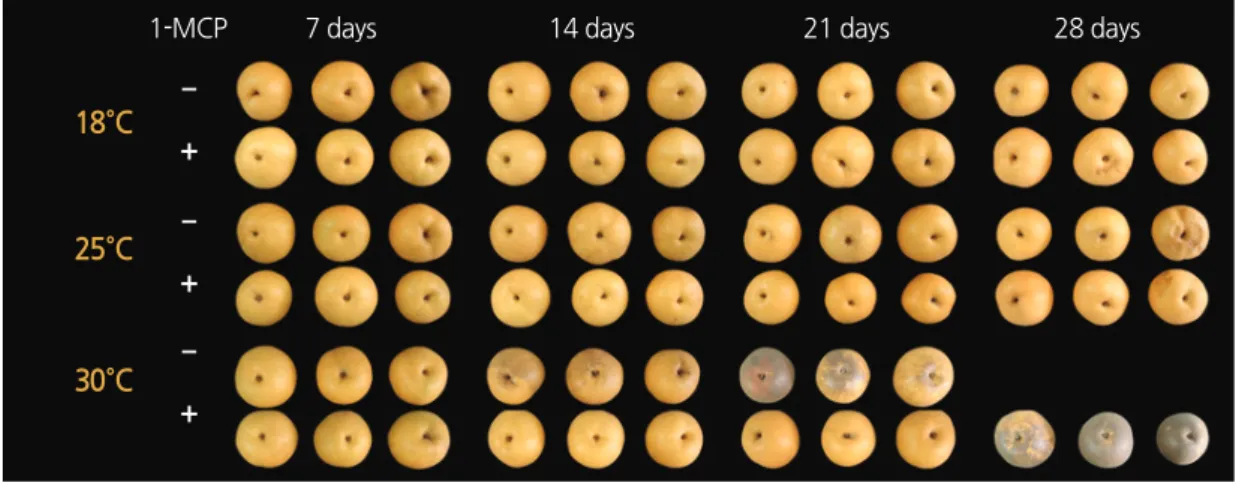
There was no significant difference in external appearance value between 1 - MCP - treated fruits and the untreated control when stored at 18 ° C . On the other hand , at 30 ° C , water - soaking and skin browning occurred beginning at 14 days in untreated fruits , and it was impossible to analyze fruit appearance due to the decay of the fruit at 28 days . However , 1 - MCP treatment had significant effects on the maintenance of fruit quality and the reduction in physiological disorders , especially at high temperatures , due to the delayed occurrence of skin discoloration , which did not occur until 21 days of storage ( Fig . 3 ) . Therefore , we strongly recommend applying 1 - MCP treatment to maintain fruit quality and appearance in Asian pear cultivar ‘ Wonhwang ’, which could successfully be used to enhance the exportation process to high - temperature distribution areas such as Southeast Asia .
Fig. 2. Effects of postharvest 1-MCP (1.0 μL·L
-1) treatment and storage temperature on ethylene production (top) and respiration rate (bottom) during 25 days of storage in ‘Wonhwang’ pear. Symbols represents the mean± standard error (n=18) for each treatment.
Respirationrate (mL·kg
-1·hr
-1)
0 0 0
1 1 1
5 5 5
2 2 2
15 15 15
30 30 30
25 25 25
0 5 10 15 20 25 0 5 10 15 20 25 0 5 10 15 20 25
Days after distribution Days after distribution Days after distribution
E th yle n e p rod uc ti o n ( μL· kg
-1·h r
-1)
0 5 0 5 0 5
Control 1-MCP
Control 1-MCP
Control 1-MCP
10 15 20 25 10 15 20 25 10 15 20 25
0 0 0
1 1 1
2 2 2
3 3 3