This is an Open Access article distributed under the terms of the Creative Commons Attribution License (http://creativecommons.org/licenses/by/4.0) which permits unrestricted use, distribution, and reproduction in any medium, provided the original work is properly cited.
Copyright © 2021 Korean Society of Women Health Nursing
Factors affecting unmet healthcare needs of low-income
overweight and obese women in Korea: analysis of the Korean National Health and Nutrition Examination Survey 2017
Ju-Hee Nho, Sook Kyoung Park
College of Nursing, Jeonbuk Research Institute of Nursing Science, Jeonbuk National University, Jeonju, Korea
Purpose: The purpose of this study was to explore unmet healthcare needs among low-income overweight and obese women and to identify the factors affecting unmet healthcare needs.
Methods: The study was a secondary analysis of data from the 2017 Korea National Health and Nutrition Examination Survey. A final sample of 388 out of 8,127 participants was analyzed using complex descriptive statistics, the chi-square test, the independent t-test, and logistic regression.
Results: The mean age of the participants was 66.51±1.05 years. Unmet healthcare needs were ex- perienced by 19.4% of low-income overweight and obese women. Women with depression, stress, and poor self-reported health status were significantly more likely than their counterparts to experi- ence unmet healthcare needs. Poor self-reported health status was confirmed to be related to unmet health needs in low-income overweight and obese women (odds ratio, 2.65; p=.011).
Conclusion: The study provides the novel insight that the unmet healthcare needs of low-income overweight and obese women were influenced by self-reported health status. Healthcare providers should make efforts to develop strategies to reduce unmet healthcare needs among low-income overweight and obese women, who constitute a vulnerable population.
Keywords: Health services needs and demand; Income; Obesity; Overweight; Women
Introduction
The prevalence of obesity among adults over the age of 19 in Ko- rea (hereafter, Korea) increased by 2.5% points from 31.9% in 2009 to 33.4% in 2015 and further increased to 34.4% in 2019.
Classified by income level, the prevalence of obesity among mid- dle and upper-income earners was 33.7%, whereas it was 34.5%
among middle and lower-income earners and 35.6% among low- er-income earners. Disparities were also seen according to the residential area, as the prevalence of obesity was 33.6% among those living in urban areas and 38.3% for residents of rural areas, which have lower income levels; overall, the prevalence of obesi- ty was higher among those living in rural settings [1]. Among pISSN 2287-1640 · eISSN 2093-7695
Korean J Women Health Nurs 2021;27(2):93-103 https://doi.org/10.4069/kjwhn.2021.05.06
Received: February 17, 2021 Revised: April 8, 2001 Accepted: May 6, 2021 Corresponding author:
Sook Kyoung Park College of Nursing, Jeonbuk Research Institute of Nursing Science, Jeonbuk National University, 567 Baekje-daero, Deokjin-gu, Jeonju 54896, Korea E-mail: [email protected]
women in particular, an interaction was observed between the effects of income and residential area. The overall obesity rate of higher-income women was 7% points higher than that of low- er-income women, but this disparity was wider (9.3% points) among those living in rural areas. Furthermore, the obesity rate among women with a low level of education was 6.3% points higher than that among women with a high level of education [1]. These observations indicate that obesity in Korean women is associated with low socioeconomic status, as has also been ob- served in other developed countries.
As expressed by the saying that “obesity is a disease” [2], obesi-
ty is associated with endometrial cancer and breast cancer in ad-
dition to chronic diseases commonly encountered in adulthood,
such as diabetes and hypertension [3]. Furthermore, 25% of obese women experienced depression [4]. Obesity increases the risk of anovulation, menstrual irregularities, polycystic ovarian syndrome, and impaired endometrial receptivity and implanta- tion, and obese women were found to be more than three times more likely to become infertile than normal-weight women [3].
Of particular note, it has been reported that low-income women ate larger quantities of food with a high glycemic index and lipid content [5]. Compounded by a lack of conditions for exercise and high treatment costs making medical access less accessible, low-income women are more likely to become obese [6]. It has been found that among low-income women, those with obesity had a lower quality of life than normal-weight women, and their health status was perceived somewhat negatively [7]. Attention is needed to alleviate the health inequalities caused by income and gender gaps.
Unmet healthcare needs refer to a situation where adequate prevention, alleviation, and treatment of a disease or disability cannot be provided due to a lack of medical services [8]. The presence of unmet healthcare needs increases disease severity and increases the likelihood of complications and mortality [9].
In particular, unmet healthcare needs due to socioeconomic problems have a negative effect on psychological factors; for ex- ample, they increase social isolation and depression by causing relative deprivation [10]. Social isolation and depression, in turn, cause suicidal thoughts [11] and significantly lower individuals’
quality of life. Unmet healthcare needs were found to be associat- ed with low income, low education level, chronic illness, living alone, and limited activities [12,13]. Low income has also been found to be related to poor health status as well as unmet health- care needs [14,15]. In a study of Korean adults based on data from the Korean Health Panel, it was reported that economic reasons had a mediating effect of 14.7% to 32.9% of unmet healthcare needs [16]. Of note, income had a stronger effect on
unmet healthcare needs among women than among men [17].
As described above, overweight and obese women in low-in- come groups have specific health care needs, so it is necessary to understand the status of their unmet healthcare needs and the factors affecting them. With increasing interest in unmet health- care needs, factors related to unsatisfactory medical care for adults, married migrant women, the elderly, and single-person households have been studied [12-18]. However, research has yet to explore the status of unmet healthcare needs and related factors among low-income women who are overweight and obese in Korea, underscoring the need for efforts to improve health by identifying and improving the factors associated with the health inequalities that these women experience.
Anderson’s behavioral model was developed for the identifica- tion and evaluation of factors related to medical service use, and it is a useful model for identifying social and personal determi- nants of medical service use [19]. Anderson’s behavioral model has been used not only to analyze medical service use behavior but also to identify systematic factors influencing unmet health- care needs in research aiming to achieve equitable access to med- ical service use [18,20]. Therefore, in this study, the classification in Anderson’s behavioral model (predisposing, enabling, and need factors) was used to explore the factors influencing unmet healthcare needs. Predisposing factors are characteristics that an individual already has before the occurrence of medical needs, and include demographic factors such as age, sex, and education.
Enabling factors include economic and sociological factors such as income level, employment, family resources, and insurance as factors that enable medical services to be used, and need factors are related to the level of an individual’s disability or disease, in- cluding overall health status and symptoms [19].
As previously discussed, low-income women who are over- weight and obese experience a variety of health problems. There- fore, this study identified aspects of their individual, demograph-
Summary statement
• What is already known about this topic?
Low-income overweight and obese women are a physically, psychologically, and socially vulnerable population.
• What this paper adds
Need factors were significant in predicting unmet healthcare needs in contrast to predisposing or enabling factors. The unmet health- care needs of low-income overweight and obese women are influenced by self-reported health status.
• Implications for practice, education, and/or policy
Strategies to enhance self-reported health status can be used by healthcare providers in probing for unmet healthcare needs
among low-income overweight and obese women.
ic, social, and economic vulnerabilities and unmet healthcare needs. In light of the need to determine the factors that affect un- met healthcare needs, the present study, based on Anderson’s be- havioral model, aimed to identify the factors influencing unmet healthcare needs among low-income women who are overweight and obese. It is expected that these findings will inform a person- al and socioeconomic approach to improve the health of these women in the future.
Objectives
The purpose of this study was to obtain insights into the unmet healthcare needs of low-income women who are overweight and obese in Korea, and to identify the factors influencing unmet healthcare needs based on Anderson’s behavioral model of medi- cal care. The specific aims were as follows:
First, to investigate the status of unmet healthcare needs for low-income women who are overweight and obese.
Second, to identify differences in unmet healthcare needs ac- cording to predisposing factors, enabling factors, and need fac- tors of low-income women who are overweight and obese.
Third, to analyze factors influencing unmet healthcare needs of low-income women who are overweight and obese.
Methods
Ethics statement: This study was exempted by the Institution- al Review Board (IRB) of Jeonbuk National University (2020- 08-018), as this was secondary analysis of existing data and the data were handled anonymously.
Study design
This study was conducted to obtain insights into the characteris- tics of unmet healthcare needs and factors influencing those needs among overweight and obese low-income women. This secondary analysis used health survey data from the seventh Ko- rea National Health and Nutrition Examination Survey (KN- HANES) (2017) and analyzed the data based on Anderson’s be- havioral model of medical care. This study was described in ac- cordance with the Strengthening the Reporting of Observational Studies in Epidemiology (STROBE) guidelines (https://www.
strobe-statement.org/index.php?id= strobe-home).
Data sources
This study used data from the seventh wave of the KNHANES, which is conducted annually, with the approval of the Research Ethics Review Committee from the Korea Centers for Disease
Control and Prevention. Only the 2017 KNHANES contained a survey on whether participants had experienced “depression for 2 weeks in a row”; therefore, this study used data from 2017.
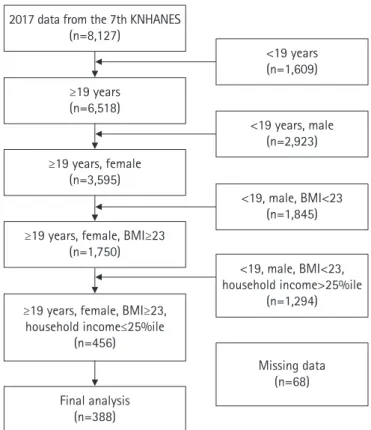
From the total number of participants in the 2017 data from the 7th KNHANES, 6,518 adult women aged 19 years or older were extracted. Using a body mass index of 23 kg/m
2as the cutoff [21], there were 456 overweight or obese women whose house- hold income was in the lowest quartile. Sixty-eight participants were excluded if there was no information or answers of “don’t know” for relevant variables (marital status, 1; education, 38;
economic activity, 38; type of health insurance, 18; whether they subscribed to private insurance, 5; diabetes diagnosis, 1; tubercu- losis diagnosis, 32; cancer diagnosis, 32; aerobic physical activity, 41; whether they have felt depressed for at least 2 weeks, 14; per- ceived stress, 14; and subjective health status, 31). In total, data from 388 respondents were extracted and analyzed (Figure 1).
Study variables Unmet healthcare needs
Medical use data from the KNHANES were used to assess un- met healthcare needs, which were defined as an answer of “yes” to the item asking, “did you ever need treatment (examination or
2017 data from the 7th KNHANES (n=8,127)
<19 years (n=1,609)
<19 years, male (n=2,923)
<19, male, BMI<23 (n=1,845)
<19, male, BMI<23, household income>25%ile
(n=1,294)
Missing data (n=68)
≥19 years (n=6,518)
≥19 years, female (n=3,595)
≥19 years, female, BMI≥23 (n=1,750)
≥19 years, female, BMI≥23, household income≤25%ile
(n=456)
Final analysis (n=388)
Figure 1. Flowchart of the study population.
BMI: Body mass index (kg/m
2); KNHANES: Korea National Health
and Nutrition Examination Survey.
treatment) in a hospital (excluding dentistry) in the last year?”
Low income
Low-income status was defined based on the household income quartile, which is a basic variable in the KNHANES. Household income was classified into lower, middle-low, middle-high, and upper quartiles, and those who fell into the lower quartile were defined as low income.
Predisposing factors
The predisposing factors included age, marital status, education level, and the number of family members living together. Age was classified into under 60 years, 60 to 79 years, and 70 years or old- er, and marital status was divided into married, bereaved, di- vorced, and single. Education level was classified as elementary school or lower, middle school, high school, and college or high- er. In addition, the number of family members living together was reclassified to divide respondents into those who lived alone and those who lived with at least one other family member.
Enabling factors
Enabling factors were classified into employment, health insur- ance type, and private insurance coverage. Employment status was classified in terms of presence or absence, and the types of health insurance were classified as self-employed, employee, and dependent. Private insurance coverage was classified as “yes” or
“no.”
Need factors
Need factors included hypertension, diabetes, and cancer, which are representative chronic diseases suggested by the Centers for Disease Control and Prevention [22], as well as tuberculosis, which has been identified as a relevant factor among socioeco- nomically vulnerable groups [23]. Aerobic physical activity, de- pression, stress, and perceived health status were analyzed. The presence of chronic diseases (hypertension, diabetes, tuberculo- sis, and cancer) was confirmed by doctors. Participants were classified as engaging or not engaging in aerobic physical activity, based on whether they took part in 2 hours and 30 minutes of moderate-intensity physical activity or 1 hour and 15 minutes of high-intensity physical activity per week, or a mixture of moder- ate and high-intensity physical activities (high-intensity of 1 minute= moderate-intensity of 2 minutes). Depression was clas- sified as present or absent based on answers of “yes” and “no,” re- spectively, for the item asking whether participants had experi- enced feeling depressed for 2 weeks or more. According to previ- ous studies [13,18], responses on perceived stress were dichoto-
mized as “no” (responses of feeling less stress, feeling a little stress, or barely feeling stress in everyday life) or “yes” (feeling a lot of stress or feeling very much stress in everyday life). Per- ceived health status was classified as “very bad,” “bad,” “average,”
“good,” or “very good”; these responses were merged into “poor”
(very bad or bad), “moderate,” and “good” (good or very good).
Data collection
This study was based on 2017 data from the seventh KNHANES.
The KNHANES gathers information on the health level, health behavior, and food and nutrition intake of the Korean people, and involves a household member survey, a health survey, a medical examination, and a nutrition survey. The household member sur- vey identifies the current status of households in a selected area and selects households to participate in the KNHANES. The health survey is divided into a household survey, a health inter- view survey, and a health behavior survey, and is conducted through an interview and a self-response survey. In addition, the medical examination includes physical measurements, blood pressure and pulse measurements, and blood and urine tests, and the nutritional survey gathers information on dietary behavior and food intake. The data are collected following a protocol devel- oped by the Korea Centers for Disease Control and Prevention (now known as the Korea Disease Control and Prevention Agen- cy) and analyzed according to the guidelines for use.
Data analysis
Data analysis was conducted using IBM SPSS ver. 26.0 (IBM Corp., Armonk, NY, USA). According to the analysis guideline, the complex-sample design elements were reflected and analyzed with appropriate consideration of the sample.
1) The general characteristics of the respondents and the status of unmet healthcare needs were analyzed by a composite sample frequency analysis.
2) The differences in unmet healthcare needs according to the characteristics of the respondents were analyzed by the com- plex-sample t-test and the complex-sample Rao-Scott chi- square test.
3) Complex-sample multiple logistic regression analysis was per- formed for the factors influencing unmet healthcare needs.
Results
General characteristics of the respondents
There were a total of 388 respondents in this study, with an aver-
age age of 66.51± 1.05 years. The majority (51.9%) were over 70
years of age. The most common marital status was married
(47.7%), the most common education level was an elementary school (67.8%), and the average number of family members liv- ing together was 2.04± 0.07, while 33.5% of participants lived alone. Slightly more than two-thirds of the respondents (67.7%) were not employed, while 49.4% had employee-based national health insurance coverage and 59.1% of them did not have pri- vate insurance.
Table 1. General characteristics of respondents (N=388)
Factor Variable Categories n
†%
†(SE)
Predisposing factors Age (year) Mean± SE, 66.51± 1.05
< 60 68 23.5 (3.2)
60–69 106 24.7 (2.7)
≥ 70 214 51.9 (2.9)
Marital status Married 182 47.7 (3.0)
Bereaved 160 38.6 (2.8)
Divorced 35 9.4 (1.6)
Single 11 4.4 (1.5)
Education level ≤ Elementary school 282 67.8 (3.2)
Middle school 39 10.3 (1.6)
High school 50 17.1 (2.8)
≥ College 17 4.8 (1.2)
Family members in the residence (n) Mean± SE, 2.04± 0.07
Alone 160 33.5 (2.9)
≥ 2 228 66.5 (2.9)
Enabling factors Employment Yes 120 32.3 (3.0)
No 268 67.7 (3.0)
Health insurance Self-employed 117 33.2 (3.0)
Employee 193 49.4 (3.1)
Dependent 78 17.4 (2.7)
Private insurance Yes 145 40.9 (2.8)
No 243 59.1 (2.8)
Need factors Chronic disease
Hypertension Yes 229 52.2 (2.9)
No 159 47.8 (2.9)
Diabetes mellitus Yes 89 21.5 (2.4)
No 299 78.5 (2.4)
Tuberculosis Yes 15 3.5 (0.9)
No 373 96.5 (0.9)
Cancer Yes 33 8.3 (1.6)
No 355 91.7 (1.6)
Aerobic physical activity Yes 87 24.4 (2.7)
No 301 75.6 (2.7)
Depression Yes 119 30.4 (2.9)
No 269 69.6 (2.9)
Stress Yes 127 34.3 (2.5)
No 261 65.7 (2.5)
Perceived health status Poor 180 42.9 (3.1)
Moderate 176 49.2 (3.1)
Good 32 7.9 (1.5)
†
Unweighted count (frequency), weighted %.
Table 2. Unmet healthcare needs in respondents (N=388)
Variable Categories n
†%
†(SE)
Unmet medical needs Yes 74 19.4 (2.6)
No 314 80.6 (2.6)
†
Unweighted count (frequency), weighted %.
Table 3. Unmet healthcare needs according to general characteristics (N=388)
Factor Variable Categories
Unmet healthcare needs
F
‡or t (p) n
†/% (SE)
Yes No
Predisposing factors Age (year) Mean± SE, 68.29± 1.33 Mean± SE, 66.08± 1.25 –1.20 (.232)
< 60 14/17.6 (5.1) 54/82.4 (5.1) 0.96 (.385)
60–69 26/25.8(6.3) 80/74.2 (6.3)
≥ 70 34/17.2 (3.2) 180/82.8 (3.2)
Marital status Married 38/21.4 (3.9) 144/78.6(3.9) 1.17 (.319)
Bereaved 30/20.7 (4.2) 130/79.3 (4.2)
Divorced 4/8.7 (4.9) 31/91.3 (4.9)
Single 2/9.5 (7.3) 9/90.5 (7.3)
Education level ≤ Elementary school 57/22.5 (3.1) 225/77.5 (3.1) 1.94 (.131)
Middle school 6/14.8 (6.1) 33/85.2 (6.1)
High school 9/13.4 (4.6) 41/86.6 (4.6)
≥ College 2/6.9 (4.9) 15/93.1 (6.9)
Number of family members in the
residence Mean± SE, 2.33± 0.23 Mean± SE, 1.97± 0.07 –1.47 (.144)
Alone 30/18.7 (3.7) 130/81.3 (3.7) 0.05 (.824)
≥ 2 44/19.8 (3.4) 184/80.2 (3.4)
Enabling factors Employment Yes 21/18.2 (4.1) 99/81.8 (4.1) 0.16 (.687)
No 53/20.0 (3.0) 215/80.0 (3.0)
Health insurance Self-employed 22/21.2 (4.6) 95/78.8 (4.6) 0.21 (.811)
Employee 34/18.3 (3.0) 159/81.7 (3.0)
Dependents 18/19.4 (47) 60/80.6 (4.7)
Private insurance Yes 28/20.6 (4.5) 117/79.4 (4.5) 0.15 (.701)
No 46/18.6 (3.0) 197/81.4 (3.0)
Need factors Chronic disease
Hypertension Yes 43/20.1 (3.1) 186/79.9 (3.1) 0.09 (.760)
No 31/18.7 (3.7) 128/81.3 (3.7)
Diabetes mellitus Yes 12/11.9 (3.6) 77/88.1 (3.6) 3.44 (.066)
No 62/21.5 (3.2) 237/78.5 (3.2)
Tuberculosis Yes 6/34.4 (12.3) 9/65.6 (12.3) 2.06 (.155)
No 68/18.9 (2.7) 305/81.1 (2.7)
Cancer Yes 5/13.3 (5.9) 28/86.7 (5.9) 0.83 (.344)
No 69/20.0 (2.8) 286/80.0 (2.8)
Aerobic physical activity Yes 18/18.5 (4.6) 69/81.5 (4.6) 0.06 (.803)
No 56/19.7 (2.9) 245/80.3 (2.9)
Depression Yes 33/26.3 (4.8) 86/73.7 (4.8) 4.27 (.041)
No 41/16.4 (2.8) 228/83.6 (2.8)
Stress Yes 34/26.0 (4.4) 93/74.0 (4.4) 5.93 (.017)
No 40/16.0 (2.6) 221/84.0 (2.6)
Perceived health status Poor 49/28.7 (3.9) 131/71.3 (3.9) 6.92 (.001)
Moderate 21/12.6 (3.2) 155/87.4 (3.2)
Good 4/11.4 (5.6) 28/88.6 (5.6)
†