• 검색 결과가 없습니다.

Life long course of children with autism spectrum disorders

N/A
N/A
Protected

Academic year: 2021

Share "Life long course of children with autism spectrum disorders"

Copied!
9
0
0

로드 중.... (전체 텍스트 보기)

전체 글

(1)

WHAT IS AUTISM SPECTRUM DISORDER?

Autism, first described in 1943, is a complex devel- opmental disorder characterized by severe impair- ment in reciprocal social interaction and communica- tion and by a pattern of repetitive or stereotyped be- havior.

1-2

The Diagnostic and Statistical Manual of Mental Disorders, Fourth Edition, Text Revision (DSM-IV,TR) includes autistic disorder in the broad- er category of pervasive developmental disorders, along with pervasive developmental disorder, not otherwise specified (PDD-NOS), Asperger’ s disorder, Rett’ s disorder, and childhood disintegrative disor- der.

1

Autistic disorder, PDD-NOS, and Asperger’ s disor- der are often collectively referred to as the autism spectrum disorders (ASDs), while the term autism is used interchangeably with the DSM-IV, TR term autistic disorder. The term ASDs reflects the notion that these conditions are related and may be difficult to differentiate with current diagnostic tools.

3

Pervasive developmental disorder, not otherwise specified is a somewhat ill-defined diagnosis of exclu- sion reserved for children with problems similar to those seen in autistic disorder but insufficient to meet the criteria for autistic disorder in number, severity, or age at onset.

1,3

The diagnostic criteria for autism require the pres- ence of 6 symptoms from 3 categories: impaired reci- procal social interaction (at least 2 symptoms), im-

paired communication, and restricted, repetitive, or stereotyped behaviors (Table 1). These criteria reflect the central role of deficits in social behavior in chil- dren with ASDs.

1,4

One of the earliest and most im- portant indicators of autism is the failure to develop joint attention,

5

which refers to the child’ s ability to share interests, pleasurable experiences, or requests by using gestures or verbal communication in combi- nation with eye contact with another person.

EPIDEMIOLOGY

There is widespread public concern about the ap- parent increase in autism, based on prevalence stud- ies during the last 20 years.

6

Studies from the 1980s and early 1990s reported a prevalence of 4 to 10 per 10,000 children, whereas recent studies have report- ed prevalences of 30 to 50 per 10,000 children.

6

Studies that rely on administrative data for children who receive special education services have reported significant increases in prevalence from 1992 to 2001.

7

A recent study in a single US county demon- strated an apparent increase in the incidence of re- search-identified autism among individuals 21 years of age or younger, from 5.5 per 100,000 in the 1980- 1983 period to 44.9 per 100,000 in the 1995-1997 period.

8

The advantage this incidence study had over previous prevalence studies was in its reporting rates of newly identified cases in the same community over many years with the use of consistent DSM-IV, TR- based research criteria for case identification. The timing of this apparent increase coincided with the introduction of broader diagnostic criteria, increased avail ability of educational services, and increased awareness of autism. These findings were not consis-

◆ 종 설

Life long course of children with autism spectrum disorders

Dongsoo Suh

Seoul Metropolitan Children’s Hospital Child Psychiatry Department

교신저자 : 서 동 수

137-180 서울시 서초구 헌릉로 260 서울특별시립 어린이병원 소아∙청소년정신과 Tel: 02-570-8170

E-mail: [email protected]
(2)

awareness of autism. These findings were not consis- tent with the hypotheses that immunization policy or the vaccine preservative thimerosal have contributed to this epidemiologic phenomenon.

8

A study from the United Kingdom also concluded that the observed in- crease in the rate of diagnosis of pervasive develop- mental disorder is likely the result of better case as- certainment rather than a true increase in autism.

9

Early identification of autism is important because early intervention services may be more effective in children with autism than in children with other de- velopmental disabilities.

10

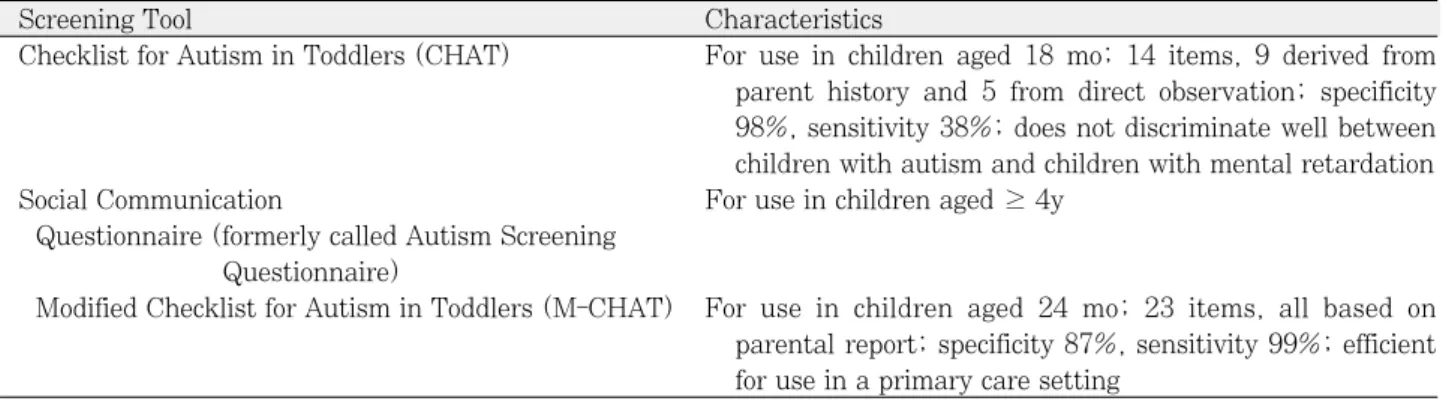
A 2-level approach to autism screening and diagnosis is recommended. In children who fail routine developmental screening, specific screening for autism should be performed (Table 2).

11-14

In children who fail specific autism

Table 1. Diagnostic Criteria for Autistic Disorder*

A. A total of ≥ 6 items from the following criteria 1, 2, and 3, with at least 2 from criterion 1 and 1 each from criteria 2 and 3 1. Qualitative impairment in social interaction as manifested by at least 2 of the following:

a. Marked impairment in the use of multiple nonverbal behaviors such as eye-to-eye gaze, facial expression, body posture, and gestures to regulate social interaction

b. Failure to develop peer relationship appropriate to developmental level

c. Lack of spontaneous seeking to share enjoyment, interests, or achievements with other people (eg, lack of showing, bringing, or pointing out objects of interest)

d. Lack of social or emotional reciprocity

2. Qualitative impairment in communication as manifested by at least 1 of the following:

a. Delay in or total lack of development of spoken language (not accompanied by an attempt to compensate through alternative modes of communication such as gesture or mime)

b. In individual with adequate speech, marked impairment in the ability to initiate or sustain a conversation c. Stereotyped and repetitive use of language or idiosyncratic language

d. Lack of varied, spontaneous make-believe play or social imitative play appropriate to developmental level 3. Restricted, repetitive, and stereotyped patterns of behavior, interests, and activities as manifested by at least 1 of

the following:

a. Encompassing preoccupation with 1 or more stereotyped and restricted patterns of interest that is abnormal either in intensity or focus

b. Apparently inflexible adherence to apecific, nonfunctional routines or rituals

c. Stereotyped and repetitive motor mannerisms (eg, hand or finger flapping or twisting, or complex whole-body movements)

d. Persistent preoccupation with parts of objects

B. Delay or abnormal functioning in at least 1 of the following areas, with onset before age 3 years:

1. Social interaction

2. Language as used in social communication 3. Symbolic or imaginative play

C. Disturbance not better accounted for by Rett’ s disorder or childhood disintegrative disorder

*Reprinted with permission from the Diagnostic and Statistical Manual of Mental Disorders, Fourth Edition, Text Revision.

3

Table 2. Autism-Specific Screening Tools

Screening Tool Characteristics

Checklist for Autism in Toddlers (CHAT) For use in children aged 18 mo; 14 items, 9 derived from parent history and 5 from direct observation; specificity 98%, sensitivity 38%; does not discriminate well between children with autism and children with mental retardation

Social Communication For use in children aged ≥ 4y

Questionnaire (formerly called Autism Screening Questionnaire)

Modified Checklist for Autism in Toddlers (M-CHAT) For use in children aged 24 mo; 23 items, all based on

parental report; specificity 87%, sensitivity 99%; efficient

for use in a primary care setting

(3)

screening, referral for a formal evaluation by an ex- perienced clinician is recommended. Referral is also recommended for any child who does not babble or point or use other gestures by the age of 12 months, who uses no single words by 16 months or no sponta- neous (nonecholalic) 2-word phrases by 24 months, or who experiences any loss of any language or social skills at any age.

15

Deficits in joint attention differentiate infants with autism from those with mental retardation or typical development.

16

These behaviors include deficits in the following areas: eye contact, orientation to name be- ing called, pointing, and showing. In the toddler age group, a lack of pretend play and imitation, deficits in nonverbal communication, and disproportionate language delays differentiate autism from other de- velopmental disorders.

15

Although repetitive behav- iors, stereotypic motor mannerisms, atypical sensory responses, and behavioral outbursts are generally ob- served in children with autism, these behaviors do not consistently differentiate autism from other de- velopmental disorders at early ages.

15

DIAGNOSING ASD

A comprehensive, multidisciplinary assessment is required to evaluate a child for an ASD and to differ- entiate ASDs from other developmental disorders.

15,17

Since there are no definitive diagnostic tests, a clini- cal diagnosis by an expert, based on DSM-IV, TR cri- teria, remains the gold standard of ASD diagnosis.

17

The DSM-IV, TR criteria consist of a list of behaviors that are not described in detail, leaving considerable latitude for clinical judgment.

1

Children who have been evaluated exclusively by school or early inter- vention staff should not be considered to have under- gone a thorough diagnostic assessment. An ASD des- ignation for special education purposes may be ob- tained without a clinical diagnosis of an ASD.

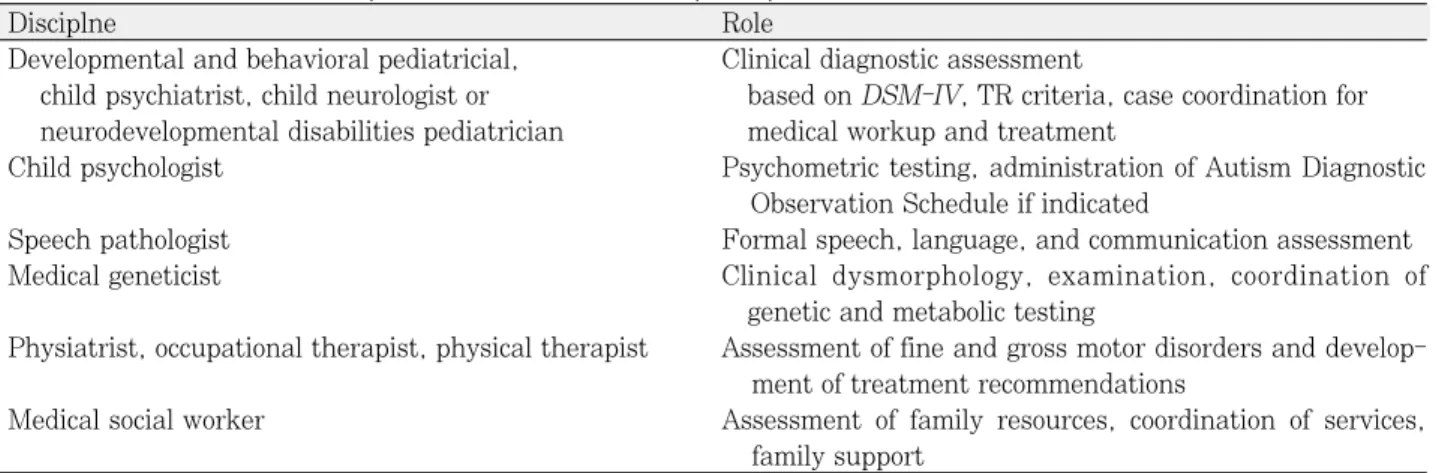
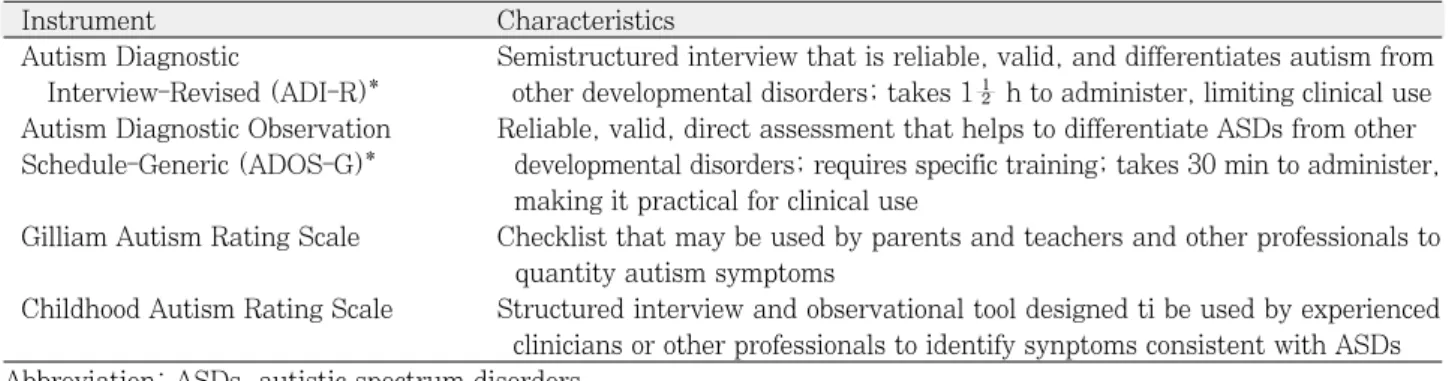
Furthermore, children with autism or PDD-NOS of- ten have severe cognitive, communicative, and be- havioral problems that can only be assessed by a team of professionals (Table 3). The clinical diagnosis of an ASD is facilitated by the use of rating scales and direct assessment tools specifically developed for this purpose (Table 4).

18-23

Approximately 60% to 75% of children with autis- tic disorder or PDD-NOS have cognitive skills in the mentally retarded range (standard scores < 70 on for- mal cognitive tests). Fewer children with PDD-NOS are likely to function in the mentally retarded range.

Children with autism or PDD-NOS often demon- strate relative strength in visual problem-solving skills and relative weakness in language-based cogni- tive skills; this discrepant cognitive profile may be reflected in a significant discrepancy between verbal and performance IQ scores.

17

Formal cognitive assess- ment should be completed using instruments that have been demonstrated to be appropriate (Table 5).

Similarly, formal speech and language assessment is essential because communication deficits of varying severity are always present in children with ASD.

Table 3. Professionals Who May Be Included in Multidisciplinary Assessment for Autism

Disciplne Role

Developmental and behavioral pediatricial, Clinical diagnostic assessment

child psychiatrist, child neurologist or based on DSM-IV, TR criteria, case coordination for neurodevelopmental disabilities pediatrician medical workup and treatment

Child psychologist Psychometric testing, administration of Autism Diagnostic

Observation Schedule if indicated

Speech pathologist Formal speech, language, and communication assessment

Medical geneticist Clinical dysmorphology, examination, coordination of

genetic and metabolic testing

Physiatrist, occupational therapist, physical therapist Assessment of fine and gross motor disorders and develop- ment of treatment recommendations

Medical social worker Assessment of family resources, coordination of services, family support

Abbreviation: DSM-IV, TR, Diagnostic and Statistical Manual of Mental Disorders, Fourth Edition, Text Revision.

(4)

Children with ASD may have specific deficits in the social use of language, often referred to as pragmatic language.

1

For example, a child may be able to recite long segments of dialogue from a favorite video yet not be able to use a 3-word sentence to ask for some- thing to eat. Problems with pragmatic language are often identified only by a careful history or direct ob- servation of the child in his or her natural environ- ment.

Social-adaptive behavioral assessments should in- clude assessment of functional skills such as sleep- ing, eating, and toileting and problem behaviors such as aggression, oppositionality, and self-injury. This assessment is facilitated by the use of formal ques- tionnaires and rating scales including, among others, the Vineland Adaptive Behavior Scales and the Scales of Independent Behavior.

24

Formal assess- ments of fine and gross motor skills may be incorpo- rated into the evaluation as indicated. Parent re-

sources should be carefully assessed to enable the team to understand the context of the child’ s devel- opmental problems and to ensure that plans are made to provide appropriate support to the family.

EDUCATIONAL AND BEHAVIORAL INTERVENTIONS

Child psychiatrist have an important role in help- ing to guide families toward intervention approaches that have been empirically demonstrated as effective.

25

In the Internet era, families have access to virtual- ly limitless information about treatments and inter- ventions for autism. Since family resources of time, energy, and finances are limited, it is essential to en- sure that these resources are directed toward inter- ventions that offer the best hope for improved out- come.

Decades-worth of scientific research provide clear and convincing support for the technique referred to as Applied Behavior Analysis (ABA).

25

This technique uses the principles of operant conditioning to teach specific social, communicative, and behavioral skills to children with ASD. It involves teaching new be- haviors by explicit reinforcement of these behaviors;

problem behaviors are often addressed by carefully analyzing triggers or antecedents of the problem be- havior in order to change the factors in the environ- ment that are contributing to the problem behavior.

Applied Behavior Analysis also uses careful collection of data to demonstrate the efficacy of treatment in the individual child; the data are used to assess Table 5. Cognitive Assessment Tools

Bayley Scales of Infant Development Mullen Scale of Early Learning Differential Abilities Scales Stanford-Binet IV

Wechsler Scales of Intelligence for Children, Fourth Edition

Leiter International Performance Scale-Revised*

Merrill-Palmer Scale*

*May be more appropriate for use in nonverbal children.

Table 4. Autism-Specific Diagnostic Tools

Instrument Characteristics

Autism Diagnostic Semistructured interview that is reliable, valid, and differentiates autism from Interview-Revised (ADI-R)* other developmental disorders; takes 1½ h to administer, limiting clinical use Autism Diagnostic Observation Reliable, valid, direct assessment that helps to differentiate ASDs from other Schedule-Generic (ADOS-G)* developmental disorders; requires specific training; takes 30 min to administer,

making it practical for clinical use

Gilliam Autism Rating Scale Checklist that may be used by parents and teachers and other professionals to quantity autism symptoms

Childhood Autism Rating Scale Structured interview and observational tool designed ti be used by experienced clinicians or other professionals to identify synptoms consistent with ASDs Abbreviation: ASDs, autistic spectrum disorders.

*Neither the ADI-R nor the ADOS-G is sufficient to enable a diagnosis of autism. The diagnosis depends on assessment

by an experienced clinician.

(5)

progress and to continually modify the intervention as the child progresses toward specific learning objectives.

Interest in ABA as a primary, comprehensive treatment approach in children with ASD was sparked by the research of Lovaas,

26

who reported that 9 (47%) of 19 young children with autism who received intensive, early ABA (40 hours per week for

≥ 2 years) had outcomes that were in distinguish- able from their normally developing peers.

Subsequent studies have led many experts in the field to conclude that intensive ABA is an effective intervention but that it is unlikely that 50% of chil- dren who receive early, intensive ABA will achieve completely normal developmental outcomes. Practice guidelines have used these and other research find- ings to formulate recommendations on the key fea- tures of appropriate intervention for children with autism.

25

Characteristics of effective intervention are believed to include a minimum of 20 hours per week of carefully organized services initiate data nearly age (preferably younger than 4 years) and involving di- rect adult attention in individual or very small group instruction. Recent studies have concluded that in- tensity of intervention is important (ie, a minimum of 20 hours per week) and that ABA is superior to other intervention strategies.

27

Another intervention model with a long history and well-defined instructional methods is TEACCH (Treatment and Education of Autistic and Related Communication Handicapped Children).

28

The TEACCH approach takes advantage of relative strengths in visual information processing, character- istic of many children with ASD, using strategies such as visual schedules, clearly structured and orga- nized classrooms, and highly structured learning ac- tivities that are broken down into manageable, visu- ally organized steps. Published reports demonstrate improvement in behaviors and functional skills and parent satisfaction with the TEACCH approach.

However, there appear to be no direct studies of treatment outcomes attributable to TEACCH inter- ventions.

While other intervention strategies are often rec- ommended, there do not appear to be approaches that have the empirical support of ABA or the long

history and well-developed curricula of TEACCH.

The weight of currently available scientific evidence, however, indicates that ABA should be viewed as the optimal, comprehensive treatment approach in young children with ASD.

Child psychiatrist should also be aware of sensory integration therapy because this approach is often used in special education programs. Interest in sen- sory integration is related to the observation that children with ASD often exhibit unusual sensory re- sponses, such as hypersensitivity to certain noises.

Techniques used in this therapy include “brushing”of the skin, “swinging”to stimulate vestibular respons- es, and deep-pressure massage applied in an effort to calm the child.

17

There is no available empirical sup- port for sensory integration therapy, and it should, therefore, neither be routinely recommended nor viewed as a primary intervention strategy in children with ASD.

Many other unproved nonmedical therapies have been recommended for use in children with autism.

There is no evidence to support the use of facilitated communication, auditory integration training.

MEDICAL INTERVENTIONS FOR CHILDREN WITH ASD

Although psychopharmacologic therapies have been studied for more than 50 years, there are no Food and Drug Administration-approved indications for the treatment of autism with any agent and there is no medication available for treatment of the core deficits in communication and social interaction.

29

In addition, when used to treat similar target behaviors, psychotropic medications tend to be less effective and result in more adverse effects when used in children with autism compared with children with out autism because of similar target behavioral symptoms.

However, there is an evidence base for prescribing

risperidone to assist in managing tantrums, aggres-

sion, and self-injurious and stereotypic behaviors and

for prescribing methylphenidate to manage inatten-

tive, impulsive, and hyperactive behaviors in children

with autism.

30

To date, there is insufficient evidence

to support the use of selective serotonin reuptake in-

hibitors, α 2-adrenergic agonists, or mood stabilizers,

(6)

despite reports of their effectiveness in managing tar- get behavioral symptoms in some children with autism in short-term open-label trials with small sample sizes. Psychotropic medications should never be used in isolation but used only in conjunction with behavioral, educational, and rehabilitative therapies.

If psychotropic medications are used, initial dosage should be low, with gradual increases in dosage until optimal positive effects, without significant adverse effects, are achieved.

UNPROVED OR INEFFECTIVE TREATMENTS IN CHILDREN WITH ASD

Traditional medicine does not offer a cure for autism. As a result, unproved complementary and al- ternative treatments are often provided to children with autism by parents who are seeking effective bio- medical interventions.

31

Patients with chronic condi- tions with unclear pathophysiologic features, fluctu- ating courses, highly subjective symptoms, and few effective evidence-based treatments are most vulner- able to the placebo effect.

32

Such is clearly the case in autism, and unproved explanations of causation and unproved therapies abound.

One example is the controversy about whether the mercury-containing compound thimerosal, which has been included in certain vaccines to protect multiple- dose vials from bacterial and fungal contamination, is related to the increased prevalence of autism.

33

However, no children with autism have been reported to have an abnormal body burden of mercury or an excess of mercury in hair, urine, or blood. Neither the clinical signs and symptoms of mercury-induced neurologic damage nor the neuropathologic changes associated with mercury exposure parallel the clinical signs and symptoms of autism. Population-based studies have also shown that the risk of autism in children given thimerosal-containing vaccines is no different from that in children given thimerosal-free vaccines. Further, since thimerosal was removed from childhood vaccines in Denmark in 1992, the in- cidence of autism in that country has continued to rise.

34

Despite this overwhelming scientific evidence, some children with autism are receiving treatment with chelating agents. However, even if exposure to

mercury or other heavy metals was causative of autism, chelation therapy has not been found to im- prove the neuro developmental sequelae of heavy metal toxicity. Also, children being treated with chelating agents are at risk of renal and hepatic toxic adverse effects.

There have been concerns about the potential role of the measles-mumps-rubella (MMR) vaccine in the causation of autism, based on findings that have been partially retracted.

35

This theory hypothesizes that the MMR vaccine produces enterocolitis, causing

“leaky gut,”which then leads to increased absorption of peptides with bioactive properties of endogenous opioids that produce the symptoms of autism.

31

However, large-scale epidemiologic studies have failed to show an association between the MMR vac- cine and autism. Furthermore, a dramatically in- creased incidence of autism has been associated with the withdrawal of the MMR vaccine in Japan.

36

Despite strong evidence against an association be- tween either thimerosal or MMR vaccines and autism, fear generated by these scientifically dis- proved theories may be leading more parents to de- cline to have their children immunized.

The leaky gut hypothesis has also led to unproved claims that variants of celiac disease, yeast over growth, and immunologic abnormalities can cause autism.

31

Many children with autism have been given very restrictive gluten-andcasein-free diets because of unfounded fears that opioid like peptides derived from gluten and case in are absorbed through their leaky guts and can be detected in their urine.

However, children with autism have not been found to have an increased rate of celiac disease and do not have excessive amounts of opioid like compounds in their urine.

It has been hypothesized that autism is an autoim- mune disorder; however, treatment with intravenous immunoglobulin has not proved effective.

37

The pan- creatic hormone secretin has also been proposed as a treatment of autism. However, more than a dozen published, peer-reviewed, randomized, double-blind, placebo-controlled trials have failed to show secret in to be effective in treating the symptoms of autism.

Other medical therapies that have been recommend-

ed but that do not have sufficient evidence to support

(7)

their effectiveness or safety include vitamin and min- eral supplements (vitamin B

6

and magnesium, vita- min C, vitamin B

12

, and folic acid), amino acid and peptide supplements (dimethylglycine and carno- sine), and ω-3 long-chain polyunsaturated fatty acids.

Clinicians should counsel parents of children with autism to be sure that any treatment they may con- sider is supported by evidence from randomized, dou- ble-blind, placebo-controlled clinical trials published in the peer-reviewed medical literature. Families should be informed about potential health risks asso- ciated with unproved therapies. Finally, parents should be reminded that such treatments may take time, effort, and financial resources away from effec- tive, evidence-based interventions.

FAMILY AND CAREGIVER SUPPORT

Families that include a child with one of the ASDs experience considerable stress as they are confronted with extraordinary demands on their time, energy, and financial resources. It is essential to offer clear explanations of diagnostic findings and treatment recommendations and to guide families toward effec- tive treatment approaches. This requires the com- bined effort of experts in the ASD field working col- laboratively with primary care clinicians.

COURSE AND PROGNOSIS

As with other children, significant changes occur over the course of development. However, sometimes not all the required diagnostic features are exhibited until age 3 years; many children with autism do not show clear repetitive behavior at the age of 2 years.

By around 3 to 4 years of age, preschool children with autism do exhibit the more classic syndrome picture. Delays in case detection unfortunately re- main relatively frequent, but greater awareness and better screening and diagnostic instruments have for- tunately facilitated early identification of the condi- tion. By school age, many children with autism be- come more responsive socially, develop some response to joint attention (become able to follow a point), and, in some cases, become more socially directed to

familiar people. Language skills and simple gestures may improve considerably, although other skills may be quite deviant. Self-stimulatory and other problem- atic behaviors, such as self-abuse, also become more common and may more difficult to manage. In ado- lescence, a few persons with autism make marked developmental gains; another subgroup shows very problematic deterioration in behavior.

Numerous methodologically sound follow-up stud- ies of autism have been conducted. With earlier in- tervention more adults are able to function indepen- dently and self sufficiently, although many continue to require high levels of support. As adults, a majori- ty of persons with autism exhibit significant limita- tions in the ability to care for basic personal needs, whereas about one-third of these patients achieve some level of personal and occupational indepen- dence, with a smaller number of persons becoming able to live fully independently. The two most impor- tant predictors of adult outcome are level of intellec- tual functioning and communicative competence, even though theses do not guarantee a positive out- come. Persons with IQs in the moderately and se- verely retarded range and with greater deficits in adaptive skills are more likely to have worse out- comes as adults as are those with very limited ex- pressive language. However, an important trend has been observed: In post-1980 studies, the percentage of persons with better outcomes has significantly in- creased, whereas the percentage of persons with the poorest outcomes (e.g., living in long-stay institu- tions) has markedly decreased. This observation ap- parently reflects, to some degree, improved outcome as a result of earlier identification. However, curative claims made by proponents of unestablished forms of intervention on the basis of anecdotal or very small studies are unwarranted, and, at this time autism is generally likely to continue to be a lifelong disorder, with an increasing number of children having better outcomes.

Follow-up studies have illustrated some intriguing

aspects of autism that remain poorly understood. For

example, it is clear that persons with autism are at

higher risk of seizures throughout childhood and par-

ticularly in adolescence, a pattern quite unlike that

of the normal population, in whom the risk of seizure

(8)

deceases with age. A few persons with autism exhibit a pattern of behavioral deterioration during adoles- cence, whereas another small group appears to im- prove during this period.

REFERENCES

1. American Psychiatric Association. Diagnostic and Statistical Manual of Mental Disorders, Fourth Edition, Text Revision. Washington, DC:

American Psychiatric Association; 2000.

2. Kanner L. Autistic disturbances of affective con- tact. Nervous Child 2:217-250, 1943.

3. Lord C, Risi S. Frameworks and methods in di- agnosing autism spectrum disorders. Ment Retard Dev Disabil Res Rev 4:90-96, 1998.

4. Wing L, Gould J. Severe impairments of social interaction and associated abnormalities in chil- dren: epidemiology and classification. J Autism Dev Disord 9:11-29, 1979.

5. Volkmar F, Chawarska K, Klin A. Autism in in- fancy and early childhood. Annu Rev Psychol 56:315-336, 2005.

6. Wing L, Potter D. The epidemiology of autistic spectrum disorders: is the prevalence rising?

Mental Retard Dev Dis Res Rev 8:151-161, 2002.

7. Newschaffer CJ, Falb MD, Gurney JG. National autism prevalence trends from United States special education data. Pediatrics 115:e277- e282, 2005.

8. Barbaresi WJ, Katusic SK, Colligan RC, Weaver AL, Jacobsen SJ. The incidence of autism in Olmsted County, Minnesota, 1976-1997: results from a population-based study. Arch Pediatr Adolesc Med 159:37-44, 2005.

9. Smeeth L, Cook C, Fombonne PE, et al. Rate of first recorded diagnosis of autism and other per- vasive developmental disorders in United Kingdom general practice, 1988 to 2001. BMC Med 2:39, 2004.

10. Lipkin PH, Schertz M. An assessment of the effi- cacy of early intervention programs. In: Capute AJ, Accardo PJ, eds. Developmental Disabilities in Infancy and Childhood. 2nd ed. Baltimore, Md: Brookes Publishing Co 525-547, 1996.

11. Baron-Cohen S, Allen J, Gillberg C. Can autism be detected at 18 months? The needle, the haystack, and the CHAT. Br J Psychiatry 161:839-843, 1992.

12. Baron-Cohen S, Wheelwright S, Cox A, et al.

Early identification of autism by the Checklist for Autism in Toddlers (CHAT). J R Soc Med 93:521-525, 2000.

13. Berument SK, Rutter M, Lord C, Pickles A, Bailey A. Autism screening questionnaire: diag- nostic validity. Br J Psychiatry 175:444-451, 1999.

14. Rutter M, Bailey A, Lord C. SCQ: Social Communication Questionnaire. Los Angeles, Calif: Western Psychological Services; 2003.

15. Filipek PA, Accardo PJ, Baranek GT, et al. The screening and diagnosis of autistic spectrum dis- orders [published correction appears in J Autism Dev Disord. 2000;30:81]. J Autism Dev Disord.

1999;29:439-484.

16. Osterling J, Dawson G. Early recognition of chil- dren with autism: a study of first birthday home videotapes. J Autism Dev Disord 24:247-257, 1994.

17. Lord C, McGee JP, eds, for the Committee on Educational Interventions for Children with Autism, Division of Behavioral and Social Sciences and Education, National Research Council. Educating Children With Autism.

Washington,DC: National Academy Press;2001.

18. Lord C, Rutter M, Le Couteur A. Autism Diagnostic Interview-Revised: a revised version of a diagnostic interview for caregivers of individ- uals with possible pervasive developmental disor- ders. J Autism Dev Disord 24:659-685, 1994.

19. Klinger LG, Renner P. Performance-based mea- sures in autism: implications for diagnosis, early detection, and identification of cognitive profiles.

J Clin Child Psychol 29:479-492, 2000.

20. Lord C, Pickles A, McLennan J, et al.

Diagnosing autism: analyses of data from the Autism Diagnostic Interview. J Autism Dev Disord 27:501-517, 1997.

21. Lord C, Risi S, Lambrecht L, et al. The Autism

Diagnostic Observation Schedule-Generic: a

standard measure of social and communication

(9)

deficits associated with the spectrum of autism. J Autism Dev Disord 30:205-223, 2000.

22. Gilliam J. Gilliam Autism Rating Scale (GARS).

Austin, Tex: PRO-ED, Inc; 1995.

23. Schopler E, Reichler R, Rochen-Renner B. The Childhood Autism Rating Scale (CARS). Los Angeles, Calif: Western Psychological Services;

1988.

24. Sparrow S, Balla D, Cicchetti D. Vineland Adaptive Behavior Scales, Expanded Edition.

Circle Pines, Minn: American Guidance Service;

1984.

25. Rogers SJ. Empirically supported comprehensive treatments for young children with autism. J Clin Child Psychol 27:168-179, 1998.

26. Lovaas OI. Behavioral treatment and normal ed- ucational and intellectual functioning in young autistic children. J Consult Clin Psychol 55:3-9, 1987.

27. Howard JS, Sparkman CR, Cohen HG, Green G, Stanislaw H. A comparison of intensive behavior analytic and eclectic treatments for young chil- dren with autism. Res Dev Disabil 26:359-383, 2005.

28. Mesibov G, Shea V, Schopler E. The TEACCH Approach to Autism Spectrum Disorders. New York, NY:Springer; 2005.

29. Aman MG, Novotny S, Samango-Sprouse C, et al. Outcome measures for clinical drug trials in autism. CNS Spectr 9:36-47, 2004.

30. McCracken JT, McGough J, Shah B, et al;

Research Units on Pediatric psychopharmacology Autism Network. Risperidone in children with autism and serious behavioral problems. N Engl J Med 347:314-321, 2002.

31. Hyman SL, Levy SE. Autistic spectrum disor- ders: when traditional medicine is not enough.

Contemp Pediatr 17:101-116, 2000.

32. Kaptchuk TJ, Eisenberg DM. The persuasive ap- peal of alternative medicine. Ann Intern Med 129:1061-1065, 1998.

33. Bernard S, Enayati A, Redwood L, Roger H, Binstock T. Autism: a novel form of mercury poi- soning. Med Hypotheses 56:462-471, 2001.

34. Madsen KM, Lauritsen MB, Pedersen CB, et al.

Thimerosal and the occurrence of autism: nega- tive ecological evidence from Danish population- based data. Pediatrics 112:604-606, 2003.

35. Wakefield AJ, Murch SH, Anthony A. Ileal lym- phoid nodular hyperplasia, nonspecific colitis, and pervasive developmental disorder. Lancet 351:637-641, 1998.

36. Honda H, Shimizu Y, Rutter M. No effect of MMR withdrawal on the incidence of autism: a total population study. J Child Psychol Psychiatry 46:572-579, 2005.

37. DelGiudice-Asch G, Simon L, Schmeidler J,

Cunningham-Rundles C, Hollander E. A pilot

open clinical trial of intravenous immunoglobulin

in childhood autism. J Autism Dev Disord

29:157-160, 1999.

수치

Table 1. Diagnostic Criteria for Autistic Disorder*
Table 3. Professionals Who May Be Included in Multidisciplinary Assessment for Autism
Table 4. Autism-Specific Diagnostic Tools

참조

관련 문서

Purpose: In this meta-analysis, relevant case-control and cohort studies were pooled to evaluate the asso ciation between preeclampsia and the risk of autism spectrum

Diagnostic and Statistical Man- ual of Mental Disorders (DSM-5®). Prevalence of autism spectrum disorders in a total population sample. Randomized, controlled trial of an

A study on effect of power card strategy on the problem behaviors of a preschooler with autistic spectrum disorder (Master's thesis). Dankook University, Yongin. Effects of

The two most important psychiatric classification systems are the Diagnostic and Statistical Manual of Mental Disorders text revision (DSM-IV-TR) developed by American

Diagnostic and Statistical Man- ual of Mental Disorders (DSM-5®). Prevalence of autism spectrum disorders in a total population sample. Randomized, controlled trial of an

Paroxysmal discharges on EEG in young autistic patients are fre- quent in frontal regions. Incidence and behavioral correlates of epileptiform abnormalities in autism

In our study, an 18-year-old boy diagnosed with Tourette’s disorder based on Diagnostic and Statistical Manual of Mental Disorders, fourth edition presented with the following

The purpose of our study was to determine the prevalence of overweight among a clinical population of children diag- nosed with autism spectrum