• 검색 결과가 없습니다.

Effects of estrogen on food intake, serum leptin levels and leptin mRNA expression in adipose tissue of female rats

N/A
N/A
Protected

Academic year: 2022

Share "Effects of estrogen on food intake, serum leptin levels and leptin mRNA expression in adipose tissue of female rats"

Copied!
6
0
0

로드 중.... (전체 텍스트 보기)

전체 글

(1)

http://dx.doi.org/10.5625/lar.2013.29.3.168

Effects of estrogen on food intake, serum leptin levels and leptin mRNA expression in adipose tissue of female rats

Wirasak Fungfuang

1,5

, Misao Terada

2

, Noriyuki Komatsu

3

, Changjong Moon

4

, Toru R. Saito

1

*

1

Behavioral Neuroscience Laboratory, Graduate School of Veterinary Medicine, Nippon Veterinary and Life Science University, Musashino, Tokyo, Japan

2

Department of Laboratory Animal Science, Dokkyo University School of Medicine, Mibu, Tochigi, Japan

3

Civil International Corporation, Ueno, Taito, Japan

4

Department of Veterinary Anatomy, College of Veterinary Medicine, Chonnam National University, Gwangju, Korea

5
Department of Zoology, Faculty of Science, Kasetsart University, Bangkok, Thailand

The integration of metabolism and reproduction involves complex interactions of hypothalamic neuropeptides with metabolic hormones, fuels, and sex steroids. Of these, estrogen influences food intake, body weight, and the accumulation and distribution of adipose tissue. In this study, the effects of estrogen on food intake, serum leptin levels, and leptin mRNA expression were evaluated in ovariectomized rats. Seven-week-old female Wistar-Imamichi rats were ovariectomized and divided into three treatment groups: group 1 (the control group) received sesame oil, group 2 was given 17β-estradiol benzoate, and group 3 received 17 β-estradiol benzoate plus progesterone. The body weight and food consumption of each rat were determined daily. Serum leptin levels and leptin mRNA expression were measured by ELISA and quantitative RT-PCR, respectively. Food consumption in the control group was significantly higher (P<0.05) than that in groups 2 and 3, although body weight did not significantly differ among the three groups. The serum leptin concentration and leptin mRNA expression were significantly higher (P<0.05) in groups 2 and 3 than in group 1, but no significant difference existed between groups 2 and 3. In conclusion, estrogen influenced food intake via the modulation of leptin signaling pathway in ovariectomized rats.

Key words: Estradiol, food intake, leptin, ovariectomized rats

Received 31 May 2013; Revised version received 29 July 2013; Accepted 20 August 2013

Leptin, the obese ( ob) gene product, is an adipocyte- derived hormone [1,2] that regulates body weight and metabolism [3] by influencing food intake and increasing energy expenditure [4,5]. Plasma leptin concentrations are directly related to the amount of body fat in rats [6].

Sex steroid hormones are involved in the metabolism, accumulation, and distribution of adipose tissue [7]. For example, estrogen has effects on food intake and body weight, which are similar to those of leptin: it causes a transient reduction in food intake and a moderate reduction in body weight in ovariectomized female mice [8]. Recent data indicate that women have higher levels

of circulating leptin than men [9,10], suggesting that sex steroid hormones exert major effects on leptin production in humans and rats [2,11]. In an animal study, Tanaka et al. [12] indicated that the serum leptin level changed significantly during the estrous cycle and peaked at the proestrous stage. A previous report [13] showed that food intake in female rats was significantly lower at the proestrous stage, compared with other stages, whereas serum leptin levels and leptin mRNA expression were significantly higher at the proestrous stage. Fluctuations in the serum leptin level in ovariectomized rats were eliminated by estrogen replacement [7]. Given that

*Corresponding author: Toru R. Saito, Behavioral Neuroscience Section, Graduate School of Veterinary Medicine, Nippon Veterinary and Life Science University, 1-7-1 Kyonan-cho, Musashino-shi, Tokyo 180-8602, Japan

Tel: +81-422-31-4571; Fax: +81-422-31-4571; E-mail: [email protected]

This is an Open Access article distributed under the terms of the Creative Commons Attribution Non-Commercial License (http://creativecommons.org/licenses/

by-nc/3.0) which permits unrestricted non-commercial use, distribution, and reproduction in any medium, provided the original work is properly cited.

(2)

finding, estrogen was hypothesized to be involved in the mechanism by which leptin regulates feeding behavior and adiposity in female rats.

The present study was undertaken to evaluate the effects of estrogen on food intake, body weight, serum leptin levels and leptin mRNA expression in ovariectomized rats.

Materials and Methods

Animals and housing conditions

Six-week-old female Wistar-Imamichi rats were housed in individual cages and kept at 24±2

o

C in a light- controlled room (12:12 h light:dark cycle; lights on 07:00 to 19:00) and were given free access to water and laboratory chow (Oriental MF; Oriental Yeast Co., Ltd., Tokyo, Japan). At the onset of the experiment, the rats weighed 170-180 g.

All animal procedures were approved by the Institutional Animal Care and Use Committee of Nippon Veterinary and Life Science University (Tokyo, Japan) and carried out in accordance with the Guide for the Care and Use of Laboratory Animals of the National Institutes of Health. All efforts were undertaken according to the “3R principles” of the directive to reduce the number of animals used in this study and to optimize the experimental protocols to acquire the maximum amount of data from each tested animal.

Experimental design

At seven weeks of age, the rats were ovariectomized under sodium pentobarbital (40 mg/kg) anesthesia. Five days after surgery, the rats were divided into three groups of six rats each. The control group (group 1) was given a daily subcutaneous injection of sesame oil (0.1 mL/rat) on days 10-13 postsurgery. The remaining groups (groups 2 and 3) were injected with 2 µg of 17β- estradiol benzoate (Sigma-Aldrich, St. Louis, MO, USA) dissolved in 0.1 mL of sesame oil on days 10-12 postsurgery; half of the rats were injected with 0.5 mg of progesterone (Sigma-Aldrich) dissolved in 0.1 mL of sesame oil on day 13. Thus, the rats in group 3 (17 β- estradiol benzoate+progesterone) were expected to behave like females in the proestrous stage of the estrous cycle as compared with group 2 (17 β-estradiol benzoate only). Drug administration was done at 11:00 every day.

All rats were anesthetized with sodium pentobarbital on day 14 postsurgery. Individual blood samples were

collected from the vena cava caudalis using a syringe between 09:00 and 10:00 and centrifuged at 2,200 g for 15 min at 4

o

C. The serum samples were kept frozen at

−35

o

C until the leptin assay. Peri-uterine adipose tissue was dissected, frozen immediately in liquid nitrogen, and stored at −80

o

C until RNA extraction.

Measurement of body weight and food consumption Body weight and food consumption were monitored daily by weighting at 11:00; a visual check was made for any diet dropped on the floor of the cage. The food intake of each rat was measured by weighing the remaining chow.

Measurement of leptin

Leptin concentrations in serum (5 µL) were determined using the Rat Leptin ELISA kit (Morinaga Institute of Biological Science Inc., Yokohama, Japan). The assay sensitivity was 200 pg/mL. The inter- and intra-assay coefficients of variation were less than 10%.

Leptin mRNA expression

For the analysis of leptin mRNA expression, visceral

abdominal fat was dissected, frozen immediately in

liquid nitrogen, and stored at −80

o

C until RNA

extraction. Total RNA was isolated using an RNeasy

Lipid Tissue Midi Kit (Qiagen, Gaithersburg, MD,

USA) according to the manufacturer’s instructions. The

RNA samples were quantified spectrophotometrically

(ND-1000 [V3.12], NanoDrop, Houston, TX, USA), and

the integrity was confirmed using a 1.5% agarose gel

containing 2.2 M formaldehyde. Total RNA from each

sample was transcribed into first-strand cDNA using

SuperScript™ III Reverse Transcriptase (Invitrogen,

Carlsbad, CA, USA) in a final volume of 20 µL; 1 µg of

the RNA sample was mixed with 1 µL of 20 µM oligo

dT Primer in DNase- and RNase-free water. The

samples were then incubated at 65

o

C for 10 min and

placed on ice. Next, 4 µL of 5× first-stand buffer, 2 µL

of 0.1 M dithiothreitol, and 4 µL of 10 mM 2-

deoxynucleoside 5-triphosphate mixed solution was

added. The samples were preincubated at 42

o

C for

2 min, and then 0.5 µL of SuperScript

TM

III Reverse

Transcriptase was added. The samples were then

incubated at 42

o

C for 1 h, 30 µL of TE buffer (Tris-

hydrochloride buffer, pH 8.0, containing 1.0 mM EDTA)

was added, and the samples were heated at 65

o

C for

10 min to inactivate the reverse transcriptase.

(3)

Real-time RT-PCR was performed using a leptin (Gene Bank Accession No.: NM_013076) specific forward primer (5'-GACCAGACCCTGGCAGTCTA- 3') and reverse primer (5'-CTCAGCATTCAGGGCTAA GG-3') to amplify the product. The samples were normalized using the housekeeping gene glyceraldehyde 3-phosphate dehydrogenase (GAPDH) (Gene Bank Accession No. : NM_017008) using a forward primer (5'-TGTCAGCAATGCATCCTGCA-3') and reverse primer (5'-CCGTTCAGCTCTGGGATGAC-3'). Amplified products’ size for leptin and GAPDH cDNAs are 280 bp and 240 bp, respectively. Real-time RT-PCR was performed in a final reaction volume of 25 µL using Platinum SYBR Green qPCR Supermix-UDG (Invitrogen).

Each real-time RT-PCR contained 12.5 µL of Platinum SYBR Green qPCR Supermix-UDG, 10 µM each primer, and an RNA template. Real-time RT-PCR was carried out in duplicate for each sample using an ABI 7500 Real-time RT-PCR System (Applied Biosystems, Foster City, CA, USA) with the following parameters:

one cycle at 50

o

C for 2 min (UDG incubation), 95

o

C for 2 min, and 40 cycles at 95

o

C for 15 s and 60

o

C for 30 s.

Melting curve analyses were performed for each series to confirm the specificity of the amplified products. To confirm the absence of a genomic DNA signal, amplification without reverse transcriptase was performed.

Standard curves were prepared for the tested and housekeeping genes. All expression data were normalized by dividing the amount of GAPDH used for the target gene by the amount used for the control.

Statistical analysis

All data are expressed as the mean±SEM. Statistically significant differences were evaluated by an ANOVA and Tukey’s test to examine the effects among subject variables. Differences were considered significant at P<0.05.

Results

Food intake and body weight

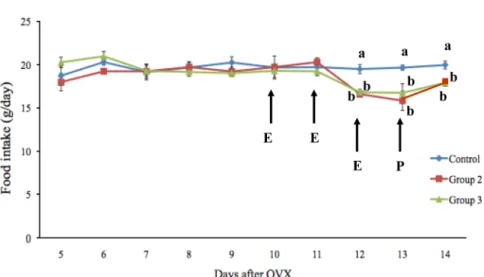
Data related to food intake and body weight are presented in Figures 1 and 2. Notably, the food intake of the rats did not differ among the three groups before treatment, whereas groups 2 and 3 had a significantly lower food intake than group 1 following estrogen treatment. The mean food intake in groups 1, 2, and 3 was 19.51±0.51, 16.61±0.35, and 16.83±0.34 g/day,

respectively, on day 12 and 19.67±0.31, 15.86±1.13, and 16.75±1.06 g/day, respectively, on day 13. The mean food intake on day 14 in group 3 (17.93±0.40 g/

day) was significantly lower ( P<0.05) than that in group 1 (19.99±0.46 g/day). After estrogen treatment, the rate of food intake in groups 2 and 3 decreased by 14.86%

and 13.73%, respectively, compared with group 1. The mean body weights of the rats were not significantly different among the three groups.

Serum leptin concentration and leptin mRNA expression

Figure 3 shows the serum leptin levels in groups 1, 2, and 3. The serum leptin levels in group 1 (473.40±97.19 pg/mL) were significantly lower ( P<0.05) than those in groups 2 and 3 (653.20±31.55 and 687.20±65.18 pg/

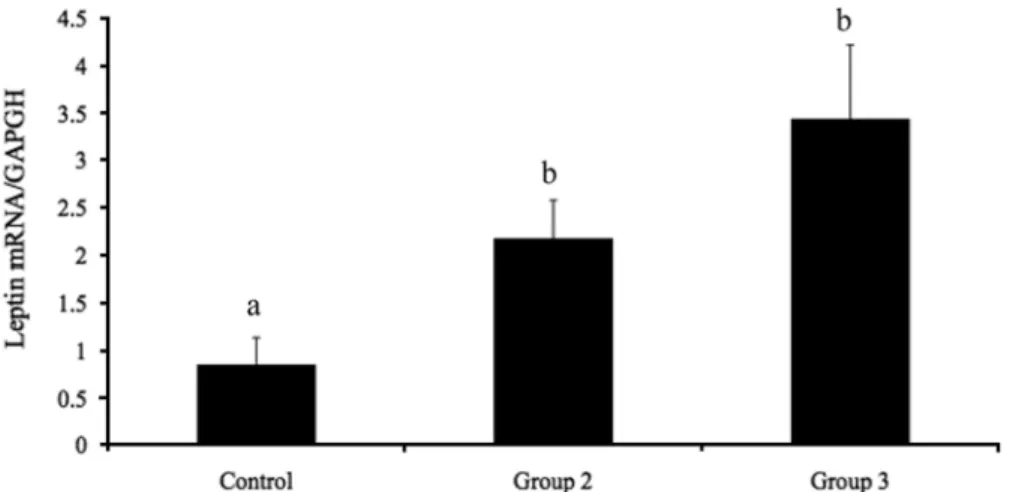
mL, respectively). No significant difference in leptin was observed between groups 2 and 3. The expression of leptin mRNA in adipose tissue is presented in Figure 4.

Leptin mRNA expression was significantly lower in group 1 (0.85±0.29; P<0.05) than in groups 2 and 3 (2.17±0.40 and 3.44±0.78, respectively). No significant differences in leptin mRNA expression were detected between groups 2 and 3. These data show that estrogen stimulates leptin mRNA expression and leptin secretion from adipose tissue.

Discussion

Sex steroid hormones are involved in the metabolism, accumulation, and distribution of adipose tissue [7].

Estrogen is a potent anorectic agent shown to reduce food intake and body weight. As expected, following the injection of estrogen and progesterone, the food intake in groups 2 and 3 decreased significantly compared with group 1, while no change in body weight was observed among the three groups. These findings indicate that estrogen administration completely reversed the high food intake in groups 2 and 3, and that progesterone administration seemed to have no effect on the anorectic effect of estrogen. The anorectic effect of estrogen was previously shown to have a delayed onset in ovariectomized rats: a decrease in food intake did not occur until 24-48 h after injection [14].

Estrogen has been demonstrated to influence feeding

behavior by acting via estrogen receptor (ER α) in

hypothalamic nuclei: the ventral medial nucleus, arcuate

nucleus (ARC), medial preoptic area, and paraventricular

(4)

nucleus are all considered to be important in feeding behavior [15,16]. Liang et al. [17] indicated that ERβ was involved in the anorectic action of estrogen, and a separate report confirmed that the activation of central estrogen receptors was necessary for the anorectic effect of the hormone [18]. Estrogen has been proposed to act directly and indirectly through orexigenic peptides, including neuropeptide Y (NPY), ghrelin, and melanin- concentrating hormone, or anorexigenic neuropeptides such as insulin, serotonin, cholecystokinin, and leptin [19,20]. Leptin receptor (Leprb) expression in the ARC is reportedly co-localized with estrogen receptor and estrogen was stated to regulate the expression of Leprb mRNA in the ARC, suggesting a closely coupled interaction between these peripheral signals in the regulation of energy homeostasis [16,21].

Several studies have reported that estrogen may also

elevate the circulating leptin concentration in humans and rats [12,22], and that the reduction in leptin expression in white adipose tissue in ovariectomized rats can be reversed by estrogen administration [15,23].

Together, these results demonstrate increased serum leptin concentrations and leptin mRNA expression due to high levels of estrogen in both cyclic female rats and estrogen-treated ovariectomized rats. Furthermore, the above results are in agreement with those of previous reports [12,24-27] showing that estrogen increased the serum leptin concentration and leptin mRNA expression in adipose tissue both in vitro and in vivo. However, Clegg et al. [27] indicated that estrogen administration had no effect on serum leptin concentrations and that estrogen increased leptin sensitivity in the brain. Their results also showed that the effect of administering estrogen or estrogen plus progesterone was not significantly

Figure 1. Effects of estrogen and progesterone on food intake in ovariectomized rats. Data are presented as means±SEM.

*P<0.05, vs Groups 2 and 3.

Figure 2. Effects of estrogen and progesterone on body weight in ovariectomized rats.

(5)

different in terms of the serum leptin level and leptin mRNA expression [27].

The mechanisms underlying the regulation of leptin concentrations by estrogen have been studied. O’Neil et al. [28] demonstrated that estrogen enhanced leptin promoter activity in JEG-3 cells, suggesting that estrogen regulates LEP gene expression via promoter activation, while Gambino et al. [26] showed that estrogen induced leptin expression in trophoblast cells through genomic and extragenomic actions via estrogen receptor1 and MAPK and PI3K signaling. Yi et al. [29] indicated that ER α induced leptin expression, whereas ERβ inhibited its expression, in 3T3-L1 adipocytes and that the ratio of ER α to ERβ expression in 3T3-L1 adipocytes may be an important potential regulatory factor in leptin expression.

Further analysis of the regulatory role of estrogen in adipose tissue is needed to confirm our findings and to

define the mechanism involved.

In conclusion, our results indicate that estrogen influences the food intake of ovariectomized rats via positive effects on leptin mRNA expression and the serum leptin concentration. Additional studies are needed to clarify the mechanism underlying the regulation of ob gene expression by estrogen.

Acknowledgments

The authors thank Dr. N. Nakao, Department of Animal Physiology, Nippon Veterinary and Life Science University, for his valuable advice. This study was supported in part by grants-in-aid for Scientific Research from the Ministry of Education, Culture, Sports, Science and Technology, Japan (to TRS), and the Nippon Medical School Foundation (to WF).

Figure 3. Effects of estrogen (EB) and progesterone (P) on serum leptin levels in ovariectomized rats (OVX) . Data are presented as means±SEM. The different characters indicate significant differences (P<0.05).

Figure 4. Effects of estrogen (EB) and progesterone (P) on serum leptin levels in ovariectomized rats (OVX). Data are presented

as means±SEM. The different characters indicate significant differences (P<0.05).

(6)

References

1. Zhang Y, Proenca R, Maffei M, Barone M, Leopold L, Friedman JM. Positional cloning of the mouse obese gene and its human homologue. Nature 1994; 372(6505): 425-432.

2. Watanobe H, Suda T. A detailed study on the role of sex steroid milieu in determining plasma leptin concentrations in adult male and female rats. Biochem Biophys Res Commun 1999; 259(1):

56-59.

3. Mohamed WF, Alsuwaigh BR, Alsuhaimi EA. Effect of gonadal sex steroid on serum leptin level of both adult male and female rat.

Sci J King Faisal Univ (Basic Appl Sci) 2004; 5: 239-247.

4. Stephens TW, Basinski M, Bristow PK, Bue-Valleskey JM, Burgett SG, Craft L, Hale J, Hoffmann J, Hsiung HM, Kriauciunas A, Mackellar W, Rosteck JR PR, Schoner B, Smith D, Tinsley FC, Zhang XY, Heiman M. The role of neuropeptide Y in the antiobesity action of the obese gene product. Nature 1995;

377(6549): 530-532.

5. Halaas JL, Gajiwala KS, Maffei M, Cohen SL, Chait BT, Rabinowitz D, Lallone RL, Burley SK, Friedman JM. Weight- reducing effects of the plasma protein encoded by the obese gene.

Science 1995; 269(5223): 543-546.

6. Rocha M, Grueso E, Puerta M. The anorectic effect of oestradiol does not involve changes in plasma and cerebrospinal fluid leptin concentrations in the rat. J Endocrinology 2001; 171(2): 349-354.

7. Mayes JS, Watson GH. Direct effects of sex steroid hormones on adipose tissues and obesity. Obes Rev 2004; 5(4): 197-216.

8. Pelleymounter MA, Baker MB, McCaleb M. Does estradiol mediate leptin's effects on adiposity and body weight? Am J Physiol 1999; 276: 955-963.

9. Saad MF, Damani S, Gingerich RL, Riad-Gabriel MG, Khan A, Boyadjian R, Jinagouda SD, el-Tawil K, Rude RK, Kamdar V.

Sexual dimorphism in plasma leptin concentration. J Clin Endoclinol Metab 1997; 82(2): 579-584.

10. Demerath EW, Towne B, Wisemandle W, Blangero J, Chumlea WC, Siervogel RM. Serum leptin concentration, body composition, and gonadal hormones during puberty. Int J Obes Metab Disord 1999; 23(7): 678-685.

11. Pinilla L, Seoane LM, Gonzalez L, Carro E, Aguilar E, Casanueva FF, Dieguez C. Regulation of serum leptin levels by gonadal function in rats. Eur J Endocrinol 1999; 140(5): 468-473.

12. Tanaka M, Nakaya S, Kumai T, Watanabe M, Tateishi T, Shimizu H, Kobayashi S. Effects of estrogen on serum leptin levels and leptin mRNA expression in adipose tissue in rats. Horm Res 2001;

56(3-4): 98-104.

13. Fungfuang W, Nakada T, Nakao N, Terada M, Yokosuka M, Gizurarson S, Hau J, Moon C, Saito TR. Serum leptin concentrations, leptin mRNA expression, and food intake during the estrous cycle in rats. Lab Anim Res 2013; 29(1): 1-6.

14. Eckel LA. Estradiol: a rhythmic, inhibitory, indirect control of meal size. Physiol Behav 2004; 82(1): 35-41.

15. Yoneda N, Saito S, Kimura M, Yamada M, Iida M, Murakami T, Irahara M, Shima K, Aono T. The influence of ovariectomy on ob gene expression in rats. Horm Metab Res 1998; 30(5): 263-265.

16. Brown LM, Gent L, Davis K, Clegg DJ. Metabolic impact of sex hormones on obesity. Brain Res 2010; 1350: 77-85.

17. Liang YQ, Akishita M, Kim S, Ako J, Hashimoto M, Iijima K, Ohike Y, Watanabe T, Sudoh N, Toba K, Yoshizumi M, Ouchi Y.

Estrogen receptor beta is involved in the anorectic action of estrogen. Int J Obes Relat Metab Disord 2002; 26: 1103-1109.

18. Rivera HM, Eckel LA. Activation of central, but not peripheral, estrogen receptors is necessary for estradiol's anorexigenic effect in ovariectomized rats. Endocrinology 2010; 151(12): 5680-5688.

19. Brown LM, Clegg DJ. Central effects of estradiol in the regulation of food intake, body weight, and adiposity. J Steroid Biochem Mol Biol 2010; 122(1-3): 65-73.

20. Okamoto S, Shimizu M, Mizuno A, Higuchi T. Estrogens inhibit food intake in CCK-1 receptor-deficient rats. J Physiol Sci 2010;

60(4): 267-271.

21. Bennett PA, Lindell K, Wilson C, Carlsson LM, Carlsson B, Robinson IC. Cyclical variations in the abundance of leptin receptors, but not in circulating leptin, correlate with NPY expression during the oestrous cycle. Neuroendocrinology 1999;

69(6): 417-423.

22. Shimizu H, Shimomura Y, Nakanishi Y, Futawatari T, Ohtani K, Sato N, Mori M. Estrogen increases in vivo leptin production in rats and human subjects. J Endocrinol 1997; 154(2): 285-292.

23. Henson MC, Castracane VD. Leptin in pregnancy: an update. Biol Reprod 2006; 74(2): 218-229.

24. Kristensen K, Pedersen SB, Richelsen B. Regulation of leptin by steroid hormones in rat adipose tissue. Biochem Biophys Res Commun 1999; 259(3): 624-630.

25. Alonso A, Fernández R, Moreno M, Ordóñez P, Díaz F, González C. Leptin and its receptor are controlled by 17beta-estradiol in peripheral tissues of ovariectomized rats. Exp Biol Med (Maywood) 2007; 232(4): 542-549.

26. Gambino YP, Maymó JL, Pérez-Pérez A, Dueñas JL, Sánchez- Margalet V, Calvo JC, Varone CL. 17Beta-estradiol enhances leptin expression in human placental cells through genomic and nongenomic actions. Biol Reprod 2010; 83(1): 42-51.

27. Clegg DJ, Brown LM, Woods SC, Benoit SC. Gonadal hormones determine sensitivity to central leptin and insulin. Diabetes 2006;

55(4): 978-987.

28. O'Neil JS, Burow ME, Green AE, McLachlan JA, Henson MC.

Effects of estrogen on leptin gene promoter activation in MCF-7 breast cancer and JEG-3 choriocarcinoma cells: selective regulation via estrogen receptors alpha and beta. Mol Cell Endocrinol 2001; 176(1-2): 67-75.

29. Yi KW, Shin JH, Seo HS, Lee JK, Oh MJ, Kim T, Saw HS, Kim

SH, Hur JY. Role of estrogen receptor-alpha and -beta in

regulating leptin expression in 3T3-L1 adipocytes. Obesity (Silver

Spring) 2008; 16(11): 2393-2399.

수치

Figure 1. Effects of estrogen and progesterone on food intake in ovariectomized rats. Data are presented as means±SEM.
Figure 4. Effects of estrogen (EB) and progesterone (P) on serum leptin levels in ovariectomized rats (OVX)

참조

관련 문서

The aim of this study was to determine the serum levels of the prohormone form of hepcidin, pro-hepcidin, and its relations with iron status and its

In the present study, consistent to that report, up-regulation of VEGF mRNA was observed in the colon cancer cell with the acquired resistance to 5-FU and this

This study was conducted to investigate the effects of a 12-week swimming exercise program on body composition, blood lipids and inflammatory indicators in

The present study, according to the sports instructor introduction of satisfaction and to perform sustained exercise classes.. Effects on the purpose of this

Effect of mulberry leaf powder containing the lactic acid bacteria on body weight gain, food intake and food efficiency ratio in a constipation model

Effects of various concentrations of Scutellaria baicalensis (SB) extract in the diets on growth, body composition, serum chemistry and challenge test of far eastern

Anderson, M. The influence of exercise on serum enzyme levels in the horse. Haematological and biochemical changes in horses competing in a 3 day

This study supports that flavonoids present in PCE has anti-adipogenic and anti- diabetic effects by activating AMPK and normalizing the expression of