INTRODUCTION
According to the Causes of Death Statistics of Korea, published
in 2016, deaths related to cancer accounted for 27.8% of the to- tal mortality rate, which was the highest among the 10 leading causes of death. The number of cancer cases and deaths has been steadily increasing every year, with the cancer death rate increasing by 1.4% in the previous year.1 Pancreatobiliary can- cer is one of the 10 most common cancers in Korea, account- ing for 2.7% of all cancer cases in 2014. In contrast to the im- proving survival rates for major cancers, including stomach and breast cancers, the survival rate for pancreatobiliary cancer has shown minimal increases, and the 5-year survival rate remains less than 10%.2
Pancreatobiliary cancer shows poor prognosis, and many patients experience difficulty having a positive outlook toward treatment, which subsequently leads to serious psychological distress. Studies examining the prevalence of depression in can- cer patients have shown that pancreatobiliary cancer is most
Preliminary Findings on the Effectiveness
of Meaning-Centered Psychotherapy in Patients with Pancreatobiliary Cancer
Jin Sun Ryu
1, Sun Woo Choi
1, Sung Su Yun
2, Bon Hoon Koo
3, In Seok Choi
4, Seung Jun Kim
5, Joon Seong Park
6, Jeong-Ho Seok
1, and Dong-Sup Yoon
6Departments of 1Psychiatry and 6Surgery, Yonsei University College of Medicine, Seoul;
Departments of 2Surgery and 3Psychiatry, Yeungnam University College of Medicine, Daegu;
Departments of 4Surgery and 5Psychiatry, Konyang University College of Medicine, Daejeon, Korea.
Purpose: This study investigated the effectiveness of meaning-centered psychotherapy (MCP), which is known to be a helpful psychotherapeutic intervention in distressing conditions, for patients with pancreatobiliary cancer.
Materials and Methods: We recruited 37 patients with pancreatobiliary cancer from three university general hospitals and as- sessed their psychological characteristics. Patients who reported clinically significant emotional distress were recommended to undergo MCP. Patients who consented to MCP were provided four sessions of the therapy. Patient psychological characteristics were assessed again 2 months after MCP. For statistical comparison, outcome variables included anxiety, depression, mental ad- justment to cancer, and quality of life (QoL), as well as the degree of stress and physical symptoms.
Results: Sixteen patients completed the MCP and the final assessment 2 months later. In the initial assessment, the patients re- ceiving MCP showed higher levels of anxiety and depression than those not receiving MCP, and QoL was also lower in terms of role function, emotional function, social function, and global QoL. At the 2-month follow-up, the MCP group showed a significant improvement in anxiety (p=0.007), depression (p=0.010), and anxious preoccupation (p<0.001). In addition, QoL significantly im- proved in the MCP group, while there was no significant change in the non-MCP group.
Conclusion: In this study, MCP showed potential therapeutic benefits against emotional distress in patients with pancreatobili- ary cancer, improving their QoL.
Key Words: Psychotherapy, pancreatobiliary cancer, distress, quality of life
pISSN: 0513-5796 · eISSN: 1976-2437
Received: May 24, 2018 Revised: September 5, 2018 Accepted: September 6, 2018
Co-corresponding authors: Jeong-Ho Seok, MD, PhD, Department of Psychiatry, Yonsei University College of Medicine, 50-1 Yonsei-ro, Seodaemun-gu, Seoul 03722, Korea.
Tel: 82-2-2019-3343, Fax: 82-2-3462-4304, E-mail: [email protected] and Dong-Sup Yoon, MD, PhD, Department of Surgery, Yonsei University College of Med- icine, 50-1 Yonsei-ro, Seodaemun-gu, Seoul 03722, Korea.
Tel: 82-2-2228-2131, Fax: 82-2-3462-5994, E-mail: [email protected]
•The authors have no financial conflicts of interest.
© Copyright: Yonsei University College of Medicine 2018
This is an Open Access article distributed under the terms of the Creative Com- mons Attribution Non-Commercial License (https://creativecommons.org/licenses/
by-nc/4.0) which permits unrestricted non-commercial use, distribution, and repro- duction in any medium, provided the original work is properly cited.
Yonsei Med J 2018 Nov;59(9):1107-1114 https://doi.org/10.3349/ymj.2018.59.9.1107
highly associated with depression (33–50%), followed by oro- pharyngeal cancer (22–57%), lung cancer (11–44%), and breast cancer (1.4–46%), with the subjective quality of life (QoL) of the patients with pancreatobiliary cancer being the lowest.3,4 Due to such psychological distress, many patients with pan- creatobiliary cancer experience anxiety and depression after being diagnosed, and develop a negative outlook on life. These patients are also less willing to undergo treatment and fre- quently discontinue curative treatment.5 Thus, a multidisci- plinary approach that includes psychiatric care in addition to cancer therapy is essential for the treatment of patients with pancreatobiliary cancer.
In recent years, a number of studies have focused on the psy- chological aspects of patients with advanced cancer and have reported the importance of a patient’s sense of meaning in life and spiritual well-being. Accordingly, the need for psycholog- ical care through psychiatric intervention is being increasingly acknowledged.6,7 Due to serious psychological distress, patients with advanced cancer experience a number of psychological symptoms, including depression, anxiety, insomnia, anhedo- nia, and personal devaluation, and some patients even experi- ence a loss of meaning of life and a desire for hastened death.8,9 One of the psychotherapeutic interventions for patients with advanced cancer is meaning-centered psychotherapy (MCP).
It was first conceptualized by Viktor E. Frankl and has been further developed by a number of other researchers for use in individual or group psychotherapy;10,11 MCP has been shown to help patients increase a sense of meaning in one’s life dur- ing distressing conditions and provide hope to patients with cancer even if they are not cured. Studies have shown that MCP is effective in enhancing QoL and spiritual well-being, as well as reducing depression and desire for death in patients with advanced cancer.12,13 The present study aimed to investigate the effectiveness of MCP for patients with pancreatobiliary cancer who reported clinically significant psychological distress.
MATERIALS AND METHODS
Recruitment of study participants and ethics approval A total of 37 patients with pancreatobiliary cancer were recruit- ed from outpatient clinics at three university general hospitals from December 2015 to October 2017: Gangnam Severance Hospital, Yonsei University College of Medicine; Yeungnam University College of Medicine; and Konyang University Col- lege of Medicine. The recruited patients (aged ≥20 years) were scheduled to undergo surgery or receive treatment after being diagnosed with pancreatobiliary cancer. The patients did not exhibit cognitive impairment, understood the purpose of the study, and provided consent to participate in the study. For initial assessment, self-report questionnaires were adminis- tered to the patients by registered nurses at each of the three hospitals. Based on the initial assessment, patients who met
one of the following criteria were recommended to participate in MCP: 1) a score of 8 or higher on both the anxiety and de- pression subscales of the Hospital Anxiety and Depression Scale (HADS), 2) a score of 4 or more on the distress thermom- eter, or 3) a score of 18 or more in the helpless-hopeless sub- scale of the Mini-Mental Adjustment to Cancer Scale (MAC).
MCP was provided to the patients who met the above criteria and wished to participate in this study. Patients who refused to participate in MCP or did not meet the inclusion criteria for MCP group were assigned to the non-MCP group. The ques- tionnaires were administered again 2 months after completing MCP during a follow-up evaluation of the patients’ psycho- logical characteristics. Demographic data of the patients were collected during the initial assessment, and electronic medi- cal records were used to examine the patients’ medical data, in- cluding pancreatobiliary cancer stages. This study was reviewed and approved by the Institutional Review Boards of the Gang- nam Severance Hospital (Approval No. 3-2015-0269) including all participating institutions.
Meaning-centered psychotherapy
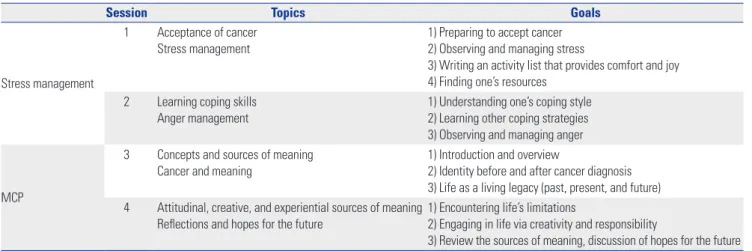
A psychiatrist or a clinical psychologist who had received training in MCP conducted the MCP sessions. The patients in the present study received MCP individually because sched- uling for a group intervention was often difficult due to the patients’ health conditions and cancer therapy schedules. All patients underwent surgery before the start of MCP and re- ceived MCP during chemotherapy, except for one patient who had not received any other treatment after surgery. Most pa- tients received MCP on the day of their outpatient visit, and each patient participated in four sessions of MCP. The content of the sessions was divided into stress management and MCP.
The sessions addressed the topics of accepting cancer and stress management, reviewing the concept of meaning of life and re- discovering it despite the limitations related to cancer (Table 1). Each session lasted approximately 1 hour. At the end of each session, the patients were provided related reading ma- terial or homework and were instructed to read or try them before the next session.
Assessment scales
The following assessment scales were used in the study: the HADS, for the assessment of depression and anxiety;14 the MAC, for the assessment of psychological and behavioral re- sponses to cancer;15 the European Organization for Research and Treatment of Cancer (EORTC) quality of life questionnaire core 30 (QLQ-C30), for the assessment of global quality of life;
the EORTC pancreatic cancer-specific module (QLQ-PAN26), for the assessment of QoL specific to patients with pancreato- biliary cancer;16,17 and Social Readjustment Rating Scale (SRRS), for the quantification of psychosocial adjustments to as- sess personal stress levels from various stressors.18 The National Comprehensive Cancer Network distress thermometer (DS-
DT) was included in the initial assessment to evaluate the pa- tients’ gross distress levels.19 The MAC used in this study is a minimized version of the widely used Mental Adjustment to Cancer scale. It contains 29 items using a four-point Likert scale, which includes the following five adjustment styles:
fighting spirit (FS), helpless-hopeless (HH), anxious preoccu- pation (AP), fatalism (FA), and cognitive avoidance (CA). Ac- cording to previous studies on standardization of the Korean version of MAC, FA and FS are associated with positive atti- tudes, while others are associated with negative attitudes. The QLQ-C30 and QLQ-PAN26 comprise 30 and 26 items, respec- tively. In the present study, the functional scales [physical func- tion (PF), role function (RF), cognitive function (CF), emotional function (EF), social function (SF)] and QoL scale were assessed using the QLQ-C30. Symptom scales (pancreatic pain, diges- tive, altered bowel habit, body image, satisfaction with health care, and sexual functioning) were assessed using the QLQ- PAN26. The QoL scale employs a seven-point linear scale, with scores ranging from 1 to 7, and the other items are evaluated on a four-point Likert scale. The raw scores for each item were transformed to scores ranging from 0 to 100 according to the EORTC Scoring guidebook.20 Higher scores in the functional scales and QoL scale indicate better QoL, while lower scores in the symptoms scales indicate better QoL.
Statistical analysis
The sociodemographic characteristics and questionnaire scores for psychiatric assessment of the MCP and non-MCP groups were analyzed. The Kolmogorov-Smirnov test was used to test for normality, and Fisher’s exact test and Mann-Whitney U test were used to assess homogeneity between the groups.
Paired t-test and Wilcoxon signed rank test were used to com- pare the questionnaire scores at the initial and follow-up as- sessments of the MCP and non-MCP groups. Changes in scores were analyzed using independent t-test and Mann-Whitney test. Analysis of covariance (ANCOVA) was conducted to sta- tistically control for differences in initial assessment scores be-
tween the MCP and non-MCP groups for more accurate anal- ysis. All statistical tests were two-tailed, and p values less than 0.05 were considered statistically significant. All data were an- alyzed using SPSS ver. 22.0 (IBM Corp., Armonk, NY, USA).
RESULTS
General characteristics and initial assessments Of the 37 patients who completed the initial assessment, 24 re- ceived MCP (Table 2). The mean ages of the MCP (63.13±10.28 years) and non-MCP (67.08±10.93 years) groups were not sig- nificantly different (p=0.287). In the MCP group, 15 (62.5%) patients were men and nine (37.5%) were women. The pro- portion of married individuals was high (79.2%). The mean Table 1. Weekly Topics and Goals of MCP
Session Topics Goals
Stress management
1 Acceptance of cancer Stress management
1) Preparing to accept cancer 2) Observing and managing stress
3) Writing an activity list that provides comfort and joy 4) Finding one’s resources
2 Learning coping skills
Anger management 1) Understanding one’s coping style
2) Learning other coping strategies 3) Observing and managing anger
MCP
3 Concepts and sources of meaning
Cancer and meaning 1) Introduction and overview
2) Identity before and after cancer diagnosis 3) Life as a living legacy (past, present, and future) 4 Attitudinal, creative, and experiential sources of meaning
Reflections and hopes for the future 1) Encountering life’s limitations
2) Engaging in life via creativity and responsibility
3) Review the sources of meaning, discussion of hopes for the future MCP, meaning-centered psychotherapy.
Table 2. Patient Demographic Data
Variable MCP (n=24) Non-MCP (n=13) p value
Age (yr) 63.13±10.28 67.08±10.93 0.287
Gender 0.850
Male 15 (62.5) 8 (61.5)
Female 9 (37.5) 5 (38.5)
Marital status 0.558
Married 19 (79.2) 11 (84.6)
Unmarried 0 (0.0) 0 (0.0)
Divorced 2 (8.3) 0 (0.0)
Widowed 3 (12.5) 2 (15.4)
Education (yr) 9.39±4.52 10.08±5.07 0.678
TNM stage 0.140
I 6 (25.0) 5 (38.5)
II 15 (62.5) 5 (38.5)
III 1 (4.2) 2 (15.4)
IV 2 (8.3) 1 (7.7)
Time from the cancer diagnosis
to the initial assessment (day) 30.36±68.53 53.36±69.91 0.374 MCP, meaning-centered psychotherapy; TNM, tumor, node, metastasis.
Data are presented as a mean±standard deviation or number (%).
years of education in the MCP group was 9.39 (±4.52) years.
The number of patients with tumor, node, metastasis (TNM) stages I and II was higher than the number of patients with TNM stages III and IV for both groups. The time from the can- cer diagnosis to the initial assessment was 30.36 (±68.53) days in the MCP group and 53.36 (±69.91) days in the non-MCP group, which were not significantly different (p=0.374). Among the patients, two in the non-MCP group were receiving psychi- atric medication, SSRI and mood stabilizer with antipsychotics, respectively.
In the initial assessment, the patients in the MCP group showed significantly higher levels of distress (DS-DT, p<0.001), anxiety (HAD-A, p<0.001), and depression (HAD-D, p<0.001) than those in the non-MCP group. The scores of helpless-hope- less (MAC-HH, p=0.001) and anxious preoccupation (MAC- AP, p<0.001) items of the MAC scale were also significantly higher in the MCP group than in the non-MCP group. More- over, the patients in the MCP group, in general, scored lower on the social and emotional functional scales of the QLQ-C30, and the overall QoL scale scores were significantly different between the two groups (p<0.001) (Table 3).
Effectiveness of MCP
Of the 24 patients who received MCP, 16 completed the ques- tionnaire during the follow-up 2 months after the completion of MCP. Thirteen patients in the non-MCP group completed the questionnaire again 2 months after the initial assessment (Table 4). The patients in the MCP group showed significant improvements in the HADS-A (p=0.014), HADS-D (p=0.014), and MAC-AP (p=0.002) scores at the final assessment. In ad- dition, cognitive function (QLQ-C30-CF, p=0.037), social func- tion (QLQ-C30-SF, p=0.043), and global QoL (QLQ-C30-QoL, p=0.021) for patients in the MCP group were also significantly improved at the final assessment. Although there were no clinically significant changes in the scores between the initial and final assessments for the non-MCP group, a trend of in- creasing distress was observed, based on the MAC-AP (p=0.031) and emotional function (QLQ-C30-EF, p=0.010) scores.
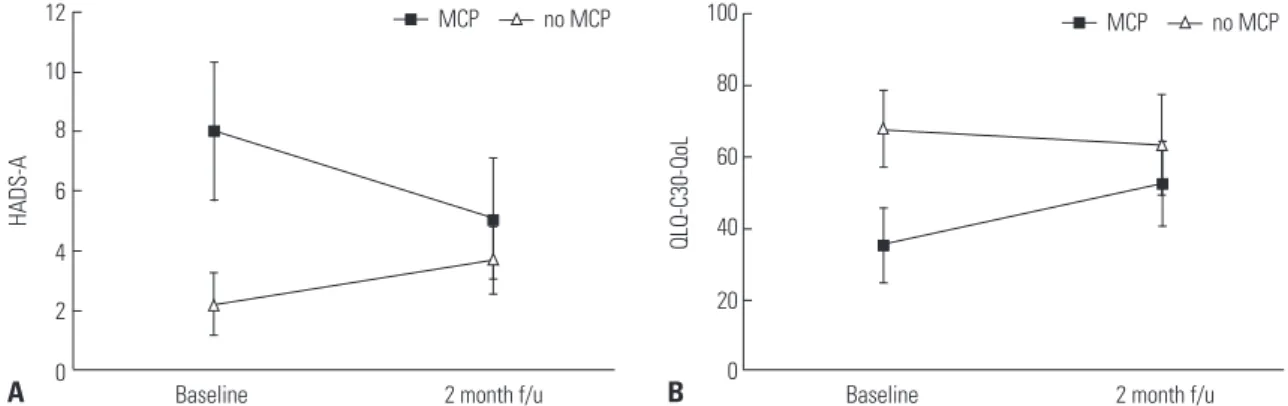
Changes in HADS-A (p=0.007) and HADS-D (p=0.010) scores between the initial and final assessments were significantly different between the MCP and non-MCP groups. Changes in MAC-AP score were also significantly different between the two groups (p<0.001). Moreover, the two groups showed sig- nificantly different changes in the scores for EF (p=0.009), SF (p=0.022), and global QoL (p=0.017) subscales of the QLQ- C30 (Fig. 1).
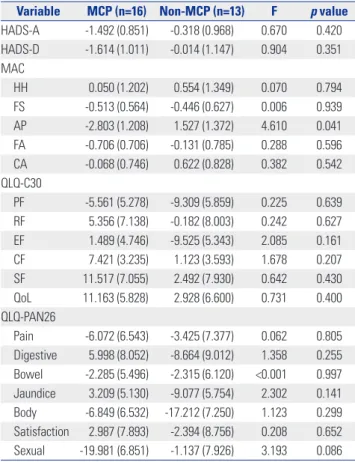
As the patients who received MCP scored significantly high- er on several items assessing emotional distress and lower QoL at the initial assessment, the effects of these differences in the initial assessment were considered to affect the analysis of the therapeutic effect of MCP. In order to control for this, AN- COVA was conducted with initial assessment scores of each scale showing a difference at baseline (e.g., HADS-A, HADS-D,
HH, AP, RF, EF, SF, QoL, Pain, Jaundice) as the covariate of each scale to analyze changes in scores between the initial and follow-up assessments of the two groups (Table 5). FS, FA of MAC and all items of QLQ-C30 suggest improvement when showing positive changes, whereas HADS-A, HADS-D, HH, AP, CA of MAC, and all items of QLQ-PAN26 reflect improve- ment when showing negative changes. This analysis showed that change in the anxious preoccupation (MAC-AP, p=0.041) Table 3. Comparison of Baseline Emotional Distress and QoL between MCP and Control Groups
Variable MCP (n=24) Non-MCP (n=13) p value
DS-DT 6.09±2.52 2.46±2.47 <0.001
HADS-A 8.71±4.58 2.23±1.92 <0.001
HADS-D 9.33±3.69 4.23±2.35 <0.001
MAC
HH 15.71±4.23 11.23±2.65 0.001
FS 12.04±1.97 11.23±2.08 0.249
AP 22.83±5.07 15.23±3.49 <0.001
FA 15.00±2.02 13.46±2.82 0.063
CA 10.63±2.37 10.62±2.57 0.991
QLQ-C30
PF 72.22±17.83 78.46±20.39 0.340
RF 56.94±36.09 83.33±20.41 0.026
EF 63.89±20.88 91.03±12.48 <0.001
CF 72.92±21.88 83.33±11.79 0.194
SF 54.86±30.88 88.46±15.79 0.001
QoL 34.72±25.14 67.95±19.79 <0.001
QLQ-PAN26
Pain 43.06±29.66 12.82±13.87 0.002
Digestive 40.28±30.66 21.79±24.89 0.071
Bowel 35.42±30.42 16.67±18.00 0.050
Jaundice 27.08±21.32 12.94±11.54 0.042
Body 43.06±35.75 34.62±24.96 0.455
Satisfaction 55.56±27.66 57.69±32.36 0.834
Sexual 21.74±31.15 33.33±29.30 0.294
SRRS
6m 73.00±84.36 27.92±30.34 0.159
7–12m 39.96±53.94 12.15±32.43 0.189
Sum 104.45±101.96 40.38±38.19 0.067
MCP, meaning-centered psychotherapy; DS-DT, National Comprehensive Cancer Network distress thermometer; HADS-A, Hospital Anxiety and De- pression Scale, Anxiety subscale; HADS-D, HADS, Depression subscale;
MAC, Mini-Mental Adjustment to Cancer Scale; HH, helpless-hopeless; FS, fighting spirit; AP, anxious preoccupation; FA, fatality; CA, cognitive avoid- ance; QLQ-C30, European Organization for Research and Treatment of Cancer quality of life questionnaire core 30; PF, physical function; RF, role function; EF, emotional function; CF, cognitive function; SF, social function; QoL, global quali- ty of life; QLQ-PAN26, European Organization for Research and Treatment of Cancer quality of life questionnaire pancreatic cancer-specific module; Pain, pancreatic pain; Bowel, altered bowel habit; Body, body image; Satisfaction, satisfaction with health care; Sexual, sexual functioning; SRRS, Social Readjust- ment Rating Scale; 6m, within 6 months life change unit; 7–12m, 7–12 months life change unit; Sum, life change unit summation.
Data are presented as a mean±standard deviation.
subscale of MAC alone was significantly different between the MCP and non-MCP groups. In other words, the anxious preoc- cupation tendency in the MCP group showed significant posi- tive changes, compared with the non-MCP group, when the dif- ferences at the initial assessment were controlled.
DISCUSSION
Patients with cancer experience a number of psychiatric symp- toms, including depression, anxiety, and insomnia, in addition to physical symptoms.21 Pancreatobiliary cancer is one of the malignancies with the worst prognosis, so there is an even great-
Fig. 1. Comparison of changes from baseline to 2 months after MCP. The MCP and non-MCP groups showed significantly different changes between the initial and final assessments in the scores of (A) HADS-A (p=0.007) and (B) QLQ-C30-QoL (p=0.017). MCP, meaning-centered psychotherapy; HADS-A, Hospital Anxiety and Depression Scale, Anxiety subscale; QLQ-C30-QoL, European Organization for Research and Treatment of Cancer quality of life questionnaire core 30, global quality of life subscale; f/u, follow-up.
Table 4. Changes in Scores for Psychological Assessment of MCP and Control Groups
Variable MCP (n=16) Non-MCP (n=13)
p value*
Baseline 2 mo f/u t p value Baseline 2 mo f/u t p value
HADS-A 8.00±4.70 5.06±4.14 2.785 0.014 2.23±1.92 3.69±2.06 -1.977 0.071 0.007
HADS-D 8.44±3.33 5.69±3.24 2.779 0.014 4.23±2.35 5.62±4.29 -1.251 0.235 0.010
MAC
HH 14.81±4.25 13.56±4.40 0.852 0.408 11.23±2.65 13.38±4.66 -1.689 0.117 0.099
FS 12.19±2.26 11.44±2.19 1.205 0.247 11.23±2.09 11.08±2.63 0.221 0.829 0.528
AP 22.25±5.65 17.94±5.08 3.692 0.002 15.23±3.49 18.62±4.72 -2.436 0.031 <0.001
FA 14.63±2.09 13.81±3.53 1.019 0.324 13.46±2.82 13.46±3.12 0.001 1.000 0.440
CA 10.38±2.68 10.38±3.46 0.001 1.000 10.61±2.57 11.15±2.54 -0.656 0.524 0.671
QLQ-C30
PF 74.38±18.83 69.17±27.64 1.140 0.272 78.46±20.39 68.72±23.79 1.456 0.169 0.568
RF 54.17±38.25 66.67±33.88 -1.307 0.211 83.33±20.41 74.36±25.11 1.534 0.151 0.082
EF 70.31±22.35 76.04±19.21 -1.102 0.288 91.03±12.48 76.28±21.20 3.055 0.010 0.009
CF 78.13±20.83 86.46±15.18 -2.739 0.037 83.33±11.79 83.33±18.00 0.001 0.713 0.131
SF 62.50±30.12 83.33±28.54 -2.207 0.043 88.46±15.79 79.49±23.72 1.289 0.222 0.022
QoL 35.42±26.61 52.60±24.29 -2.567 0.021 67.95±19.79 63.46±25.81 0.959 0.357 0.017
QLQ-PAN26
Pain 40.10±28.42 27.08±24.63 1.756 0.099 12.82±13.87 17.95±27.18 -0.780 0.450 0.085
Digestive 46.88±33.45 44.79±32.04 0.246 0.809 21.79±24.89 23.08±30.84 -0.113 0.912 0.811
Bowel 28.13±24.13 19.79±20.38 0.984 0.341 16.67±18.00 21.79±22.86 -0.574 0.576 0.286
Jaundice 26.04±23.55 18.75±20.97 0.861 0.403 7.69±12.94 11.54±18.49 -0.492 0.632 0.352
Body 40.63±38.47 31.25±29.11 0.855 0.406 34.62±24.96 20.51±20.59 1.442 0.175 0.756
Satisfaction 57.29±31.60 60.42±33.82 -0.299 0.769 57.69±32.36 55.13±29.17 0.253 0.805 0.703
Sexual 22.92±34.36 7.29±14.87 1.678 0.112 33.33±29.30 26.39±37.24 0.519 0.614 0.587
MCP, meaning-centered psychotherapy; HADS-A, Hospital Anxiety and Depression Scale, Anxiety subscale; HADS-D, HADS, Depression subscale; MAC, Mini-Mental Adjustment to Cancer Scale; HH, helpless-hopeless; FS, fighting spirit; AP, anxious preoccupation; FA, fatality; CA, cognitive avoidance; QLQ-C30, European Organiza- tion for Research and Treatment of Cancer quality of life questionnaire core 30; PF, physical function; RF, role function; EF, emotional function; CF, cognitive function; SF, social function; QoL, global quality of life; QLQ-PAN26, European Organization for Research and Treatment of Cancer quality of life questionnaire pancreatic cancer-spe- cific module; Pain, pancreatic pain; Bowel, altered bowel habit; Body, body image; Satisfaction, satisfaction with health care; Sexual, sexual functioning.
Data are presented as a mean±standard deviation.
*p value from independent T-test comparing the differences of initial assessment and 2 months later between the MCP and non-MCP group.
100
80
60
40
20
0 12
10 8 6 4 2 0
QLQ-C30-QoL
HADS-A
Baseline 2 month f/u
MCP no MCP MCP no MCP
Baseline 2 month f/u
A B
er need for a psychiatric approach for these patients.3 One of the psychotherapeutic intervention that helps patients cope with the distress is MCP. There have been no reports of MCP being conducted in patients with advanced cancer in Korea.
Thus, the present study aimed to evaluate the effectiveness and applicability of MCP in patients with pancreatobiliary cancer.
We examined emotional distress and QoL before MCP and 2 months after its completion. The MCP group showed significant improvements in depression, anxiety, and anxious preoccupa- tion related to mental adjustment to cancer, global QoL, cog- nitive function, and social function, although the group had scored relatively poorly for emotional distress and QoL at the initial assessment. In contrast, no clinically significant changes
in emotional distress and QoL were found between the initial and follow-up assessments in the non-MCP group. Although not statistically significant, a trend of increasing distress, based on the MAC-AP and QLQ-C30-EF scores, was observed in the non-MCP group. These results suggest that patients with ad- vanced cancer, who experience clinically significant emotional distress and decreasing QoL, need an appropriate psychoso- cial intervention. In addition, the MCP group showed signifi- cantly higher scores in the initial assessment of QLQ-PAN26 pain, jaundice. Higher anxiety and distress scores in the MCP group may be induced by severe physical symptoms. In addi- tion, although not statistically significant, it is possible that MCP was assessed in severe physical symptoms because the time from cancer diagnosis to initial assessment was shorter than non-MCP. The important finding is that QLQ-PAN26, an evaluation item related to physical symptoms, did not show any significant improvement in any, while there was improve- ment in EF score. The results suggest that the therapeutic effects of MCP may primarily involve relieving psychological symp- toms, which can change the cognitive approach process and improve emotional state even if actual physical symptoms are similar.
MCP is a psychotherapeutic intervention that helps patients cope with distress by enhancing meaning of life and spiritual well-being. So far, few psychological interventions have been developed, with psychological care more often being focused on providing psychoeducational or supportive interventions.13 These interventions have rarely considered meaning of life and spiritual well-being an important issue. MCP is based on the writings of Viktor Frankl, a psychiatrist and holocaust survivor, and he suggested that people desire to find meaning in their existence even as they approach the end of life.11,22,23 This dif- ference in the perspective of psychological care for cancer pa- tients may cause MCP to be effective in patients with advanced cancer experiencing anxiety and pain related to the issue of
“impending death.”12,13
The result of ANCOVA for assessing MCP effectiveness showed that only MAC-AP was significantly improved in pa- tients after receiving MCP. MAC-AP is characterized by con- stant preoccupation with cancer and feelings of anxiety, fear, and devastation.24 Previous studies have shown that a higher score on AP domain was associated with both anxiety and de- pression, and has a negative impact on well-being, irrespective of phase of illness.25,26 In this study, we attempted not only to get a meaning of life from different perspectives through MCP, but also to understand the causes of anxiety and to learn how to control anxiety effectively through stress management. These attempts seem to have worked together to improve cancer-re- lated anxiety. Other variables, except MAC-AP, did not show a significant difference in ANCOVA. This may be attributed to the fact that only the patients who reported clinically signifi- cant distress in the initial assessment were selected for the MCP group.
Table 5. Results for Changes in Scores for Psychological Assessment in MCP and Control Groups by ANCOVA
Variable MCP (n=16) Non-MCP (n=13) F p value HADS-A -1.492 (0.851) -0.318 (0.968) 0.670 0.420 HADS-D -1.614 (1.011) -0.014 (1.147) 0.904 0.351 MAC
HH 0.050 (1.202) 0.554 (1.349) 0.070 0.794
FS -0.513 (0.564) -0.446 (0.627) 0.006 0.939 AP -2.803 (1.208) 1.527 (1.372) 4.610 0.041 FA -0.706 (0.706) -0.131 (0.785) 0.288 0.596 CA -0.068 (0.746) 0.622 (0.828) 0.382 0.542 QLQ-C30
PF -5.561 (5.278) -9.309 (5.859) 0.225 0.639 RF 5.356 (7.138) -0.182 (8.003) 0.242 0.627 EF 1.489 (4.746) -9.525 (5.343) 2.085 0.161
CF 7.421 (3.235) 1.123 (3.593) 1.678 0.207
SF 11.517 (7.055) 2.492 (7.930) 0.642 0.430 QoL 11.163 (5.828) 2.928 (6.600) 0.731 0.400 QLQ-PAN26
Pain -6.072 (6.543) -3.425 (7.377) 0.062 0.805 Digestive 5.998 (8.052) -8.664 (9.012) 1.358 0.255 Bowel -2.285 (5.496) -2.315 (6.120) <0.001 0.997 Jaundice 3.209 (5.130) -9.077 (5.754) 2.302 0.141 Body -6.849 (6.532) -17.212 (7.250) 1.123 0.299 Satisfaction 2.987 (7.893) -2.394 (8.756) 0.208 0.652 Sexual -19.981 (6.851) -1.137 (7.926) 3.193 0.086 ANCOVA, analysis of covariance; MCP, meaning-centered psychotherapy;
HADS-A, Hospital Anxiety and Depression Scale, Anxiety subscale; HADS-D, HADS, Depression subscale; MAC, Mini-Mental Adjustment to Cancer Scale;
HH, helpless-hopeless; FS, fighting spirit; AP, anxious preoccupation; FA, fatal- ity; CA, cognitive avoidance; QLQ-C30, European Organization for Research and Treatment of Cancer quality of life questionnaire core 30; PF, physical function;
RF, role function; EF, emotional function; CF, cognitive function; SF, social function;
QoL, global quality of life; QLQ-PAN26, European Organization for Research and Treatment of Cancer quality of life questionnaire pancreatic cancer-specific module; Pain, pancreatic pain; Bowel, altered bowel habit; Body, body image;
Satisfaction, satisfaction with health care; Sexual, sexual functioning.
Data are presented as an estimated marginal mean (standard error of the mean). Score changes with negative values in the HADS-A, HADS-D, MAC-HH, AP, and CA and positive values in the MAC-FS, FA, and QLQ-C30 items repre- sent improvement.
Approximately 66% of the participants completed all ses- sions of MCP, which is much higher than the completion rate of the grouped format of MCP reported by previous studies.13 Generally, MCP is provided in a group format. In the present study, however, patients missed or were unable to complete their sessions due to difficulties of scheduling or illness-relat- ed problems. This suggests the need for a more flexible and personalized therapy for patients with advanced cancer. In our study, MCP was provided individually, and in many cases, patients were able to receive MCP after their outpatient visit to the surgery department. It is expected that this form of thera- py will have positive effects on treatment compliance in clini- cal practice. A previous study on MCP, however, showed that patients who received the individual format of MCP no longer showed improvement 2 months after its completion, whereas patients who received the grouped format showed continued improvement when they were followed up after more than 2 months.12 Our study demonstrated the effectiveness of MCP up to 2 months after its completion, and further investigation in a long-term follow-up study may provide a better understanding of the patterns of MCP effectiveness.
This study has several limitations. Firstly, the subjects were limited to patients with pancreatobiliary cancer, and the results may not be generalizable to all patients with cancer. Moreover, the small sample size of the MCP group lowers the statistical power. As mentioned above, ANCOVA showed significant ther- apeutic effect in terms of MAC-AP scores alone, whereas the t- test showed otherwise. More statistically significant results may be expected when larger sample sizes of MCP and con- trol groups with clinically significant emotional distress are compared to assess therapeutic effects. In addition, although the patients of this study were recruited from three hospitals, the number of patients that the psychologists at each hospital were assigned to was not equal because different numbers of patients were recruited at each hospital. The therapist may in- fluence the therapeutic effect and patient satisfaction. To mini- mize the effect related with differences between therapists, we initiated this study after each therapist had had sufficient time to discuss the MCP program during the study preparation step. The MCP group was reassessed two months after the completion of the MCP, while the non-MCP group was reas- sessed two months after the baseline. Therefore, there is a dif- ference in the evaluation interval for each group, and these fac- tors may have affected the outcome. Lastly, the MCP was only recommended to the patients who showed clinically significant levels of depression, anxiety, and distress in this study, and the results of the current study do not provide evidence for the ef- fectiveness of MCP in patients without clinically significant psychiatric symptoms.
Despite these limitations, our study showed that MCP helps patients with advanced cancer regain their sense of meaning in life and may reduce emotional distress, including depression and anxiety, and increase QoL. Our study is the first to attempt
MCP intervention in patients with pancreatobiliary cancer in Korea. The need to treat the psychiatric symptoms of patients with cancer is clear, and further studies and clinical trials may establish MCP as an important therapeutic tool for treating pa- tients with advanced cancer.
ACKNOWLEDGEMENTS
This project was supported by research funds from the Korean Society of Surgical Oncology (2015). A part of this study has been presented as a poster in the 2018 Annual Spring Meeting of the Korean Neuropsychiatric Association held in Seoul on April 19-20, 2018.
ORCID
Jeong-Ho Seok https://orcid.org/0000-0002-9402-7591 Dong-Sup Yoon https://orcid.org/0000-0001-6444-9606
REFERENCES
1. Statistics Korea. Death rates (2016) in Korea [Accessed 2017 Decem- ber 3]. Available at: http://kostat.go.kr/portal/korea/kor_nw/2/6/2/
index.board?bmode=read&bSeq=&aSeq=363268&pageNo=1&ro wNum=10&navCount=10&currPg=&sTarget=title&sTxt=.
2. Korea Central Cancer Registry. Annual report of cancer statistics in Korea in 2014 [Accessed 2017 December 3]. Available at: http://
ncc.re.kr/cancerStatsView.ncc?bbsnum=417&searchKey=total&s earchValue=&pageNum=1.
3. Jia L, Jiang SM, Shang YY, Huang YX, Li YJ, Xie DR, et al. Investiga- tion of the incidence of pancreatic cancer-related depression and its relationship with the quality of life of patients. Digestion 2010;
82:4-9.
4. Tavoli A, Mohagheghi MA, Montazeri A, Roshan R, Tavoli Z, Omid- vari S. Anxiety and depression in patients with gastrointestinal can- cer: does knowledge of cancer diagnosis matter? BMC Gastroen- terol 2007;7:28.
5. Song SY. Recent trends in pancreatic cancer chemotherapy. Kore- an J Pancreas Biliary Tract 2004;9:92-101.
6. Sinclair S, Pereira J, Raffin S. A thematic review of the spirituality literature within palliative care. J Palliat Med 2006;9:464-79.
7. Chochinov HM, Cann BJ. Interventions to enhance the spiritual aspects of dying. J Palliat Med 2005;8 Suppl 1:S103-15.
8. Kelly B, Burnett P, Pelusi D, Badger S, Varghese F, Robertson M.
Factors associated with the wish to hasten death: a study of patients with terminal illness. Psychol Med 2003;33:75-81.
9. Ransom S, Sacco WP, Weitzner MA, Azzarello LM, McMillan SC.
Interpersonal factors predict increased desire for hastened death in late-stage cancer patients. Ann Behav Med 2006;31:63-9.
10. Breitbart W. Reframing hope: meaning-centered care for patients near the end of life. Interview by Karen S. Heller. J Palliat Med 2003;
6:979-88.
11. Frankl VE. Man’s search for meaning. New York (NY): Simon &
Schuster, Inc.;1985.
12. Breitbart W, Poppito S, Rosenfeld B, Vickers AJ, Li Y, Abbey J, et al.
Pilot randomized controlled trial of individual meaning-centered psychotherapy for patients with advanced cancer. J Clin Oncol 2012;30:1304-9.
13. Breitbart W, Rosenfeld B, Gibson C, Pessin H, Poppito S, Nelson C,
et al. Meaning-centered group psychotherapy for patients with ad- vanced cancer: a pilot randomized controlled trial. Psychooncolo- gy 2010;19:21-8.
14. Zigmond AS, Snaith RP. The hospital anxiety and depression scale. Acta Psychiatr Scand 1983;67:361-70.
15. Greer S, Watson M. Mental adjustment to cancer: its measure- ment and prognostic importance. Cancer Surv 1987;6:439-53.
16. Aaronson NK, Ahmedzai S, Bergman B, Bullinger M, Cull A, Duez NJ, et al. The European Organization for Research and Treatment of Cancer QLQ-C30: a quality-of-life instrument for use in interna- tional clinical trials in oncology. J Natl Cancer Inst 1993;85:365-76.
17. Fitzsimmons D, Johnson CD, George S, Payne S, Sandberg AA, Bassi C, et al. Development of a disease specific quality of life (QoL) ques- tionnaire module to supplement the EORTC core cancer QoL ques- tionnaire, the QLQ-C30 in patients with pancreatic cancer. EORTC Study Group on Quality of Life. Eur J Cancer 1999;35:939-41.
18. Holmes TH, Rahe RH. The social readjustment rating scale. J Psy- chosom Res 1967;11:213-8.
19. National Comprehensive Cancer Network. Distress management.
Clinical practice guidelines. J Natl Compr Canc Netw 2003;1:344-74.
20. Fayers PM, Aaronson NK, Bjordal K, Groenvold M, Curran D, Bot- tomley A; the EORTC Quality of Life Group. The EORTC QLQ-C30
Scoring Manual. 3rd ed. Brussels: European Organisation for Re- search and Treatment of Cancer;2001.
21. Kim SY, Kim JM, Kim SW, Shin IS, Yoon JS, Shim HJ. Management of depression in terminally ill cancer patients. Korean J Psycho- pharmacol 2010;21:51–61.
22. Frankl VE. Man’s search for ultimate meaning. Cambridge (MA):
Perseus Publishing; 2000.
23. Frankl VE. The will to meaning: foundations and applications of logotherapy. New York: Penguin Books; 1988.
24. Kang JI, Chung HC, Kim SJ, Choi HJ, Ahn JB, Jeung HC, et al. Stan- dardization of the Korean version of Mini-Mental Adjustment to Cancer (K-Mini-MAC) scale: factor structure, reliability and valid- ity. Psychooncology 2008;17:592-7.
25. Johansson M, Rydén A, Finizia C. Mental adjustment to cancer and its relation to anxiety, depression, HRQL and survival in pa- tients with laryngeal cancer-a longitudinal study. BMC Cancer 2011;
11:283.
26. Grassi L, Travado L, Moncayo FL, Sabato S, Rossi E; SEPOS Group.
Psychosocial morbidity and its correlates in cancer patients of the Mediterranean area: findings from the Southern European Psy- cho-Oncology Study. J Affect Disord 2004;83:243-8.