https://doi.org/10.7585/kjps.2018.22.3.199 Open Access
199
시설재배 수박 중 carbendazim 및 tetraconazole의 경시적 잔류량 변화
노현호·이재윤
1·박효경
2·정혜림
2·이정우
2·조승현
2·경기성
2*
농촌진흥청 국립농업과학원 농산물안전성부,
1(주)농협케미컬 연구소,
2충북대학교 농업생명환경대학 환경생명화학과
Dissipation of Carbendazim and Tetraconazole Residues in Water Melon Under Green House Condition
Hyun Ho Noh, Jae Yun Lee
1, Hyo Kyoung Park
2, Hye Rim Jeong
2, Jung Woo Lee
2, Seung Hyeon Jo
2and Kee sung Kyung
2*
Department of Agro-food Safety and Crop protection, National Institute of Agricultural Science, Rural Development Administration, Wanju 55365, Korea
1
Research Institute, Residue Research Team, Nonghyeop Chemical, Okcheon 29008, Korea
2
Department of Environmental and Biological Chemistry, College of Agriculture, Life and Environmental Sciences, Chungbuk National University, Cheongju 28644, Korea
(Received on July 24, 2018. Revised on September 12, 2018. Accepted on September 13, 2018)
Abstract This study was carried out to survey dissipation of carbendazim and tetraconazole residues in water melon time-coursely and to analyze growth dilution effect during cultivation period. The test pesticides were sprayed onto the water melon at two fields and then collected from 0 day, day after last spray, to 10 day. Limits of detection (LODs) of carbendazim and tetraconazole were 0.005 mg/kg at the all pesticides and recoveries of carbendazim and tetraconazole ranged from 73.6 to 83.7 and from 89.0 to 96.8 in water melon, respectively. Average residues of carbendazim in water melon collected from field I and II were 0.262 and 0.244 mg/kg in 0 day and 0.055 and 0.049 mg/kg in 10 day, respectively. In case of tetraconazole residues were 0.087 and 0.067 mg/kg at the field I and II in 0 day samples, respectively, and 0.014 and 0.009 mg/kg in 10 day samples. Those decreased pesticide residue from 0 day to 10 day, time-coursely. Growth dilution effects of residual pesticides in water melon were lower than cucumber and squash. Biological half-lives of carbendazim and tetraconazole found to be 5.0-5.8 and 3.4-4.8 day, respectively.
Key words Water melon, carbendazim, tetraconazole, pesticide residue
서 론
농산물 중 잔류농약은 살포한 농약이 수확하여 유통되는 시점에 농산물 중 잔류하고 있는 농약으로 과일의 경우 세 척과 박피의 과정을 거치면서 대부분의 잔류농약이 제거됨 에도 불구하고 많은 소비자들은 “농약 검출”이라는 단어만 으로 불안해하고 관행 농산물에 대한 불신을 갖고 있으며,
“ 유기농 농산물”은 맹목적으로 신뢰하고 있는 실정이다. 이 러한 불신을 해소하기 위하여 우리나라 각계부처에서는 과 학적인 근거로 농산물 중 잔류농약에 대한 안전성을 확보하
기 위한 연구를 진행하고 있으며, 잔류허용기준(maximum residue limit, MRL) 과 농약의 안전사용기준(pre-harvest interval, PHI)을 설정하는 등의 노력을 기울이고 있다(Lee et al., 2008). 이러한 근거로 농산물 중 잔류농약을 제한하 고 있으며, 적절한 양의 농약 사용으로 농산물 중 잔류농약 의 검출량이 MRL을 초과하지 않도록 관리하고 있다.
MRL 을 초과한 농산물의 경우 폐기, 용도전환 및 출하연 기 등의 행정적 처분으로 인하여 농민의 피해가 속출하고 있으며(Lee et al., 2013), 기출하된 농산물의 경우 회수가 어렵기 때문에 2차 피해가 발생할 여지가 있다(Park et al., 2011; Lee et al., 2012). 따라서 출하전 농산물 중 농약의 잔 류량을 예측하여 농약 사용량을 조절하고 출하시기의 잔류
*Corresponding author E-mail: [email protected]
ORIGINAL ARTICLES
량이 MRL을 초과하지 않도록 관리하는 것이 매우 중요하 다(Kim et al., 2013). 따라서 식품의약품안전처에서는 생산 단계 농산물의 MRL을 설정하여 출하전 농산물 중 잔류농 약을 관리하고 있다(Park et al., 2005).
Benzimidazole 계 살균제인 carbendazim과 triazole계 살균 제 tetraconazole은 수박의 탄저병과 흰가루병을 치료 및 예 방하는 침투성 농약으로 광분해, 가수분해 등에 안정한 농 약이다. Carbendazim과 tetraconazole은 각각 46과 20개 식 품에 MRL이 설정되어 있으며, 수박에는 각각 1.0과 0.2 mg/kg 으로 설정되어 있다.
또한 수박은 우리나라 국민 연평균 섭취량이 20 kg에 육 박하는 대표적인 여름 과일로 전세계적으로 수박을 가장 많 이 생산하는 국가에 속하며, 국내 수박 생산량의 82.6%가 시설재배를 통하여 생산되고 있다(Kim et al., 2014).
따라서 이 연구는 수박 중 carbendazim과 tetraconazole의 경시적 잔류량 변화를 구명하고 이를 근거로 감소곡선을 도 출한 후 생물학적 반감기를 산출하며, 작물 생장에 의한 농 약의 희석효과를 분석하기 위하여 수행되었다.
재료 및 방법
시험작물 및 시험농약
시험작물은 수박(삼복)이었으며, 시험농약은 benzimidazole 계 살균제 carbendazim (12% 수화제, 한국삼공(주))과 triazole 계 살균제 tetraconazole (12.5% 유탁제, 바이엘크롭 사이언스)이었다. 시험농약은 각각 1,000배와 2,000배 희석 하여 경엽살포 하였으며, 수박에 대한 안전사용기준(pre- harvest interval, PHI) 과 잔류허용기준(maximum residue limit, MRL) 을 Table 1에 제시하였다.
포장시험 및 시료 전처리
시험포장은 충북 청주시와 음성군의 시설재배 수박 포장 을 임차하여 사용하였으며, 처리구는 20 m
2씩 3반복 배치하 였다. 또한 교차살포의 오염을 방지하기 위하여 반복간 시 험구간 완충대를 배치하였으며, 약제는 안전사용기준의 추 천살포 농도로 1회 살포하였다. 시료는 약제살포 당일부터 10 일차까지 경시적으로 채취하였으며, 가급적 동일한 크기 와 무게인 시료를 채취하였다. 시험기간 중 기상변화를 관
찰하기 위하여 자동 온습도 측정기를 설치하여 한시간 간격 으로 기록하였으며, 채취한 시료의 무게를 측정하여 시험기 간 중의 수박 무게변화를 조사하였다. 또한 잔류농약을 분 석하기 위하여 수확한 시료를 8등분하여 수박의 꼭지부분과 반대쪽 대각선 부분의 수박을 취하여 마쇄한 후 분석전까지 -20
oC 의 냉동고에 보관하였으며, 잔류농약 분석은 자체 개 발된 분석법을 이용하였다.
잔류농약 분석
Carbendazim시료 50 g을 300 mL tall beaker에 넣고 100 mL의 methanol 을 넣어 10,000 rpm에서 3분간 균질화하고 Celite545를 통 과시켜 흡인여과한 후 50 mL의 methanol로 용기 및 잔사를 씻어 앞의 여과액과 합하였다. 여과액을 100 mL의 포화식 염수와 300 mL의 증류수가 들어있는 1 L 분액 여두에 옮기 고 1 N HCl 10 mL를 첨가하여 pH를 2 이하로 조정하고 100 mL의 dichloromethane을 가한 후 Recipro shaker를 이 용하여 270 rpm에서 10분간 진탕하는 방법으로 분배하였다.
Dichloromethane 분배액을 버리고 남은 물층에 1 N NaOH 5.5 mL 를 첨가하여 pH를 8 이상으로 조정하고 70 mL의 dichloromethane 을 가한 후 Recipro shaker를 이용하여 270 rpm 에서 10분간 진탕하는 방법으로 2회 분배하였다.
Dichloromethane 분배액을 무수 황산나트륨으로 탈수하여 35
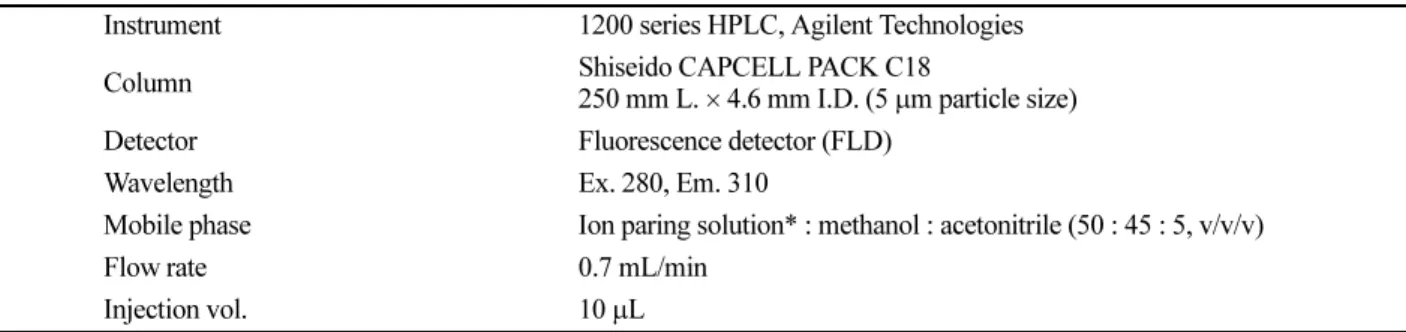
oC 에서 감압 농축한 후 5 mL의 분석장비의 이동상 혼합 용매로 재용해하여 Table 2의 방법으로 HPLC-FLD로 기기 분석하였다.
Tetraconazole
시료 50 g을 300 mL tall beaker에 넣고 100 mL의 acetone 을 넣어 10,000 rpm에서 3분간 균질화하고 Celite545를 통 과시켜 흡인여과한 후 50 mL의 acetone으로 용기 및 잔사 를 씻어 앞의 여과액과 합하였다. 여과액을 100 mL의 포화 식염수와 300 mL의 증류수가 들어있는 1 L 분액 여두에 옮 기고 50 mL의 dichloromethane:n-hexane (80 : 20, v/v) 혼합 용매를 가한 후 Recipro shaker를 이용하여 270 rpm에서 10 분간 진탕하는 방법으로 2회 분배하였다. Dichloromethane : n-hexane (80 : 20, v/v) 혼합용매 분배액을 무수 황산나트륨 으로 탈수하여 35
oC 에서 감압 농축한 후 5 mL의 acetone에
Table 1. Pre-harvest intervals of the commercial product of carbendazim and tetraconazole and their MRLs in water melon
Pesticide A.I.
a)Formulation Dilution rate
Pre-harvest interval
MRL
d)(mg/kg) Last application day
before harvest
Maximum application time
Carbendazim 50% WP
b)1,000 7 4 1.0
Tetraconazole 10% WG
c)1,000 3 3 0.2
a)Active ingredient, b)Wettable powder, c)Water dispersible granule, d)Maximum residue limit
재용해한 후 Table 3의 방법을 이용하여 GLC-NPD로 분석 하였다.
회수율 및 저장 안정성 시험
검출한계의 10배와 50배 수준으로 무처리 시료에 표준용 액을 처리한 후 상기 분석방법으로 분석하여 회수율을 산출 하는 방법으로 분석법을 검증하였으며, 분석법의 적합성은 농촌진흥청 고시와 비교하여 판단하였다. 또한 시료 보관 중 시험농약의 안정성을 확인하기 위하여 검출한계의 50배 수준으로 무처리 시료에 표준용액을 처리한 후 시료와 동일 한 조건에서 보관한 후 시료 분석시 동일한 방법으로 분석 하여 회수율을 산출하였다.
수박 중 농약의 희석효과 분석
시료 채취 일자별 수박 증체에 따른 잔류량(growth dilution effect, A) 을 식 (1)을 이용하여 산출하였으며, 무게 변화로 인한 잔류농약의 희석효과를 배제한 농약의 잔류량 (B) 을 식 (2)를 이용하여 산출하였다(Hong et al., 2011;
Cho et al., 2013; Na et al., 2013; Park et al., 2012; Kim et al., 2009).
B = 0 일차 잔류량 − (일자별 dilution effect − 일자별 잔류량) (2)
결과 및 고찰
검출한계 및 회수율 시험
수박 중 carbendazim과 tetraconazole의 검출한계는 모두 0.005 mg/kg 이었으며, 검출한계와 회수율 시험 결과를 Table 4에 제시하였다. 수박 중 carbendazim의 회수율은 73.6-83.7%이었으며, tetraconazole의 경우 89.0-96.8%이었 다. 농촌진흥청에서는 70-120% 범위의 회수율을 권장하고 있으며, 이를 감안하면 이 연구의 분석법은 적합한 것으로 판단되었다.
수박 재배기간 중 잔류량 변화
포장 I 0일차 수박 중 carbendazim의 평균 잔류량은 0.262 mg/kg 이었으며, 10일차의 평균 잔류량은 0.055 mg/kg 으로 경시적으로 감소하였다. 포장 II의 경우 0일차 수박의 평균 잔류량은 0.244 mg/kg이었으며, 10일차의 평균 잔류량 은 0.049 mg/kg으로 포장 I의 잔류량이 높았지만 감소하는 경향은 일치하였다. 포장 I과 II 0일차 수박 중 tetraconazole 의 평균 잔류량은 각각 0.087과 0.069 mg/kg이었으며, 수확 예정일인 10일차의 평균 잔류량은 각각 0.014와 0.009 mg/
kg이었다. Tetraconazole 역시 carbendazim과 같이 경시적으 로 잔류량이 감소하였으며, 포장 I의 잔류량이 높은 경향이 었다. Table 5에 제시한 바와 같이 수박의 무게는 포장 II가 포장 I보다 무거웠기 때문에 상대적으로 포장 I의 잔류량이 높은 것으로 판단되었다. 또한 포장 I과 II 수박 중 car- bendazim의 소실율은 각각 79.0과 79.9%이었으며, tetraco-
A = 0일차 잔류량 × 0일차 무게
수확 일자별 무게 (1)
Table 2. Conditions for the analysis of carbendazim in water melon
Instrument 1200 series HPLC, Agilent Technologies
Column Shiseido CAPCELL PACK C18
250 mm L. × 4.6 mm I.D. (5 µm particle size) Detector Fluorescence detector (FLD)
Wavelength Ex. 280, Em. 310
Mobile phase Ion paring solution* : methanol : acetonitrile (50 : 45 : 5, v/v/v)
Flow rate 0.7 mL/min
Injection vol. 10 µL
*1-Decanesulfonic acid sodium salt 1 g, phosphoric acid 7 mL, triethylamine 10 mL/ water 1 L
Table 3. Conditions for the analysis of tetraconazole in water melon
Instrument 7890A GC, Agilent Technologies
Column DB-17, 30 m L. × 0.25 mm I.D. (0.25 µm film thickness) Detector Nitrogen phosphorus detector
Temperature Oven: 180
oC → 10
oC / min → 260
oC (2 min) Inlet : 250
oC Detector : 270
oC
Split mode Splitless for tetraconazole
Flow rate 1 mL/min
Injection vol. 1 µL
nazole의 경우 각각 83.9와 87.0%로 포장간의 차이는 없었 으며, 약제 살포 당일부터 수박 중 시험농약의 잔류량은 MRL 미만으로 검출되었다.
Utture et al. (2011) 은 포도에 carbendazim을 기준량과 배 량 살포한 후 잔류농약을 분석하였으며, 기준량과 배량 처 리구의 약제 살포 당일 잔류량은 각각 1.767과 3.536 mg/kg 이었다고 보고하였다. 또한 기준량과 배량 처리구 모두 경 시적으로 잔류량이 감소하여 약제살포 3일후 초기 잔류량의 66% 가 감소하였으며, 약제살포 30일 후에는 10%만 잔류하 였다고 보고하였다. Khalfallah et al. (1998)은 오이에 tetra- conazole 을 기준량과 배량 살포 한 후 0일차부터 15일차까 지 경시적으로 잔류량 변화를 조사한 결과 기준량과 배량 모두 잔류량이 감소하였다는 보고와 같이 본 연구에서도 유 사한 결과를 보였다. 또한 Table 5에 제시한 바와 같이 수박 이 재배기간 동안 생장하면서 농약이 희석되어 잔류량이 낮 아진 것으로 판단되었다(Lee et al., 2013).
수박 증체에 따른 농약의 희석효과
작물 중 잔류농약의 양은 미생물 분해, 광분해, 가수분해 등 여러 인자에 의해 감소하지만 작물 중 농약의 잔류량은 작물의 비대생장에 의한 감소가 주된 요인이다. 작물의 비 대성장 인자를 배제한 수박 중 농약의 잔류량은 Fig. 1, 2, 3 및 4에 제시한 바와 같이 감소하는 경향이었지만 오이, 토 마토 등 급격한 생장을 보이는 작물의 희석 효과만큼 크지 는 않은 것으로 판단되었다(Kim et al., 2009). Carbendazim 는 50
oC 이하에서 2년이상 안정하고 20,000 lux에서 7일 동 안 안정하며, 알칼리와 산 등에도 안정하기 때문에 growth
dilution effect가 농약 감소의 주된 원인이라고 판단되었다.
Tetraconazole은 0일차 잔류량을 제외하고 작물 비대성장을 고려한 잔류량은 10일차까지 유사한 경향이었는데 이것은 물과 태양광에 안정하고 산과 알칼리 수용액에도 안정한 특 성 때문인 것으로 판단되었다. Khalfallah et al. (1998)은 오 이에 살포한 tetraconazole은 0일차 대비 15일차 잔류량이 Table 4. Limit of detection (LOD) and average recoveries of the test pesticides in water melon
Pesticide Field Fortification (mg/kg) Recovery ± SD
a)(%) CV
b)(%) LOD
c)(mg/kg)
Carbendazim
I 0.05 82.3 ± 0.4 0.5
0.005
0.25 82.8 ± 1.1 1.3
II 0.05 76.1 ± 2.3 3.1
0.25 77.7 ± 0.2 0.3
Tetraconazole
I 0.05 90.3 ± 1.1 1.3
0.25 94.3 ± 0.5 0.5
II 0.05 92.2 ± 2.6 2.8
0.25 94.8 ± 1.8 1.9
a)Standard deviation, b)Coefficient variation, c)Limit of detection
Table 5. Weight of water melon at the sampling date
Field
Weight (n=5, kg) Day after last application
0 1 2 3 5 7 10
I 5.74 ± 0.95 5.90 ± 0.87 6.10 ± 1.01 7.01 ± 0.53 7.01 ± 0.60 6.51 ± 0.94 7.29 ± 1.09 II 8.48 ± 1.11 8.60 ± 0.95 8.82 ± 1.00 9.09 ± 0.87 8.71 ± 0.66 9.13 ± 1.02 9.73 ± 0.49
Fig. 1. Dilution effect for the dissipation of carbendazim during cultivation period in water melon from field I.
Fig. 2. Dilution effect for the dissipation of carbendazim during
cultivation period in water melon from field II.
기준량 처리구는 약 75.6% 감소하였으며, 배량 처리구의 경 우 81.1%가 감소하였는데 이것은 작물 생육에 의한 희석효 과가 가장 크게 기인한 것이라고 보고하였다.
수박 중 농약의 반감기
포장 I과 II 수박 중 carbendazim의 1차 반감기는 Table 6 에 제시한 바와 같이 각각 5.0과 5.8일이었으며, 2차와 3차 반감기는 각각 10.0, 11.5와 15.0, 17.3일이었다. Tetraconazole 의 수박 중 1차 반감기는 4.8(포장 I)과 3.4(포장 II)일이었 으며, 2차 반감기는 9.5(포장 I)와 6.9(포장 II)일 이었다. 또 한 3차 반감기는 포장 I과 II 각각 14.3과 10.3일로 나타났 으며, 포장간 큰 차이는 없는 것으로 판단되었다. 김 et al.
(2008)은 상추 중 carbendazim의 반감기는 품종에 따라 상 이하지만 2.56-4.20일이었다고 보고하였으며, Seo (2005)는 carbendazim 기준량 살포 처리구의 상추 중 반감기는 3.7이 었으며, 배량의 경우 3.5일이었다고 보고하였다. 또한 Amer et al. (2007) 은 토마토 중 tetraconazole의 반감기는 6.5일이 었다고 보고하였다.
감사의 글
본 연구는 2013년도 식품의약품안전처의 연구개발비(과제 번호:20130630809-00)로 수행되었으며, 이에 감사드립니다.
Literature cited