Veterinary Science
†The first two authors contributed equally to this work.
*Corresponding author
Tel: +82-64-754-3363; Fax: +82-64-756-3354
E-mail: [email protected]
Increased phosphorylation of caveolin-1 in the spinal cord of irradiated rats
Heechul Kim
1,2,3,†, Changjong Moon
4,†, Jeongtae Kim
1, Meejung Ahn
1,2,3, Jin Won Hyun
2,5, Jae Woo Park
2,6, Sung-Ho Kim
4, Seungjoon Kim
2, Taekyun Shin
1,2,3,*
1
Department of Veterinary Medicine, College of Applied Life Sciences,
2Applied Radiological Science Research Institute,
3
Research Institute for Subtropical Agriculture and Biotechnology,
5Department of Biochemistry, College of Medicine, and
6
Department of Nuclear and Energy Engineering, College of Engineering, Cheju National University, Jeju 690-756, Korea
4
Department of Veterinary Anatomy, College of Veterinary Medicine, Chonnam National University, Gwangju 500-757, Korea
Phosphorylation of caveolin-1 occurs during cell activa- tion by various stimuli. In this study, the involvement of caveolin-1 in an irradiation injured spinal cord was exam- ined by analyzing the phosphorylation of caveolin-1 in the spinal cord of rats after irradiation with a single dose of 15 Gray from a
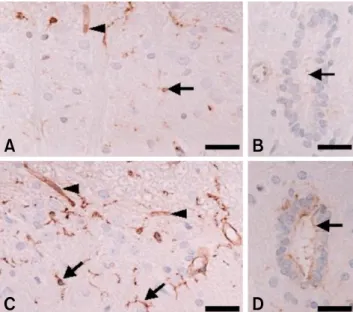
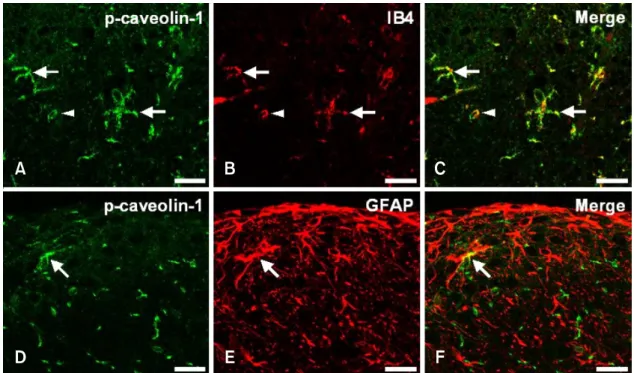
60Co γ-ray source at 24 h post-irradiation (PI). A Western blot analysis showed that the phosphory- lated form of caveolin-1 (p-caveolin-1) was expressed con- stitutively in the normal spinal cords and was significantly higher in the spinal cord of irradiated rats at 24 h PI. The increased expression of ED1, which is a marker of acti- vated microglia/macrophages, was matched with that of p-caveolin-1. In the irradiated spinal cords, there was a higher level of p-caveolin-1 immunoreactivity in the iso- lectin B4-positive microglial, ependymal, and vascular en- dothelial cells, in which p-caveolin-1 was weakly and con- stitutively expressed in the normal control spinal cords.
These results suggest that total body irradiation induces activation of microglial cells in the spinal cord through the phosphorylation of caveolin-1.
Key words: caveolin-1, irradiation, microglia, phosphorylation, spinal cord
Introduction
Caveolin is a transmembrane adapter molecule that recog- nizes glycosylphosphatidyl inositol-linked proteins and in- teracts with downstream cytoplasmic signaling molecules, such as Src-family tyrosine kinases and heterotrimeric G
proteins [8,11]. Caveolin is phosphorylated under certain activation conditions, specifically, at Tyr-14, Ser-88, and other residues in v-Src-transformed cells leading to the flattening, aggregation, and fusion of caveolae and cav- eolae-derived vesicles [8]. Moreover, the phosphorylation of caveolin affects the cell shape, which is an important finding in the activation and migration of inflammatory cells. It was previously reported that the phosphorylation of caveolin-1 occurs with experimental autoimmune ence- phalomyelitis, particularly in activated microglia or mac- rophages in the spinal cord [6]. Here, we hypothesize that the phosphorylation of caveolin-1 is an important event for cell activation in central nervous system (CNS) in- flammation and possibly irradiation.
Radiation is widely used to treat common central nervous system cancers, particularly glioblastoma multiforme, with or without chemotherapy [1,3] as well as for suppor- tive treatment of a spinal cord injury in animal models [15].
Even though radiation is used for cancer treatment, various side effects can occur, such as glial cell activation, dis- ruption of the blood brain barrier, and white matter ne- crosis in the CNS [1,3,7,14]. Previous studies suggest that irradiation activates the microglia and eventually induces astrogliosis. Furthermore, a variety of cell activation events, including the increased level of p38 phosphor- ylation, NF-κB activation, and inflammatory mediators, occur in microglia during irradiation [5]. Little is however known about the cellular responses to irradiation, in partic- ular, the changes to lipid raft proteins such as caveolin-1.
The aim of this study is to localize the expression, and ex-
amine the changes in the phosphorylation of caveolin-1
(p-caveolin-1) in the spinal cord of rats after irradiation.