J Korean Med Obes Res 2013;13(2):51-57
한방비만학회지 제13권 제2호, 2013
JKOMOR
Review Article
비만에 작용하는 주요 본초의 항비만 효과 분석
송미영ㆍ김호준
동국대학교 한의과대학 한방재활의학과교실
Analysis of Main Single Medicinal Herbs for Anti-Obesity
Miyoung Song, Hojun Kim
Department of Oriental Rehabilitation Medicine, College of Oriental Medicine, Dongguk University
Received: November 11, 2013 Revised: November 23, 2013 Accepted: November 26, 2013
Objectives: This study was conducted to analyze anti-obesity effects of the main single medicinal herbs which have effects on obesity or metabolic syndrome.
Methods: We selected the 8 main single medicinal herbs, and then 3 databases were searched using search words “obesity”, and “each scientific name of selected 8 main herbs”.
Results and Conclusions: Only Ephedra sinica and Panax ginseng were analyzed through 3 methods, in vitro, animal studies and randomized controlled trial (RCT)s, Ephedra sinica was shown weight loss effects in RCTs, but Panax ginseng couldn’t. Other 6 selected medicinal herbs were not verified in RCTs, all had anti-obesity effects in high fat fed mice (or rats) and the others except for Radix notoginseng and Radix puerariae had inhibitory effects on lipid accumulation in 3T3-L1 cells.
Key Words: Single medicinal herb, Obesity, Metabolic Syndrome X Correspondence to: Miyoung Song
Department of Oriental Rehabilitation Medicine, College of Oriental Medicine, Dongguk University, 123 Dongdae-ro, Gyeongju 780-714, Korea
Tel: +82-54-770-1256 Fax: +82-54-770-1200 E-mail: [email protected] Copyright © 2013 by The Society of Korean Medicine for Obesity Research
서 론
2011년 국민건강영양조사에 따르면 우리나라 성인 인구 중 비만 유병률은 31.9%로 꾸준히 상승하고 있으며, 비만 으로 인한 고혈압, 당뇨병 등 관련 질환의 유병률 역시 상승 하면서 비만은 사회적으로 큰 문제가 되고 있다1).
비만치료를 위해 사용되는 약물 다수가 지방변, 오심, 구 토, 두통, 불면증, 위장장애 등의 부작용이 발생할 수 있다고 보고된 바 있으며2), 특히 많이 사용되어 왔던 sibutramine의 경우는 최근 뇌졸중이나 심근경색과 같은 심혈관 질환의 발 생 가능성을 높이는 부작용이 밝혀져 국내 판매가 금지되었 다3). 이러한 상황에서 한방 약물 치료에 대한 수요 및 관심 은 꾸준히 높으며, 비만에 적용 가능한 한약 소재 발굴에 대 한 연구도 활발히 이뤄지고 있다.
이에 따라 비만 치료에 사용되는 한약에 대한 기존 연구
들을 분석, 고찰하는 연구도 필요하다. 관련 연구가 국내외 에서 이미 수 편이 발표된 바 있는데, 국내에서 발표된 연구 로는 복합 약물 처방 및 마황을 중심으로 한 연구가 있으며4), 국외에서 발표된 연구로는 복합 약물 처방의 무작위 대조 임상 시험 연구만을 대상으로 한 연구5) 및 대사증후군6) 또 는 비만 관련 한약의 분석 연구7) 등이 있었다. 그러나 이들 연구는 대부분 한약 복합 처방 위주로 이뤄져 있어 개별 본 초에 대한 항비만 효과 분석은 부족한 상황이며, 이마저 국 내에서는 거의 사용하지 않는 약재 또는 식품이 다수 포함 된 연구들이어서 국내 한의학의 실정에서는 실효성이 부족 한 점이 있었다. 이에 저자는 항비만 및 대사증후군 개선 효 과가 밝혀진 주요 본초 중 국내에서 주로 처방되는 약물을 중심으로 기존 연구에서 밝혀진 이들의 항비만 효과들을 분 석해 보았다.
본 론
1. 연구방법
1) 조사 약물 선정 기준 및 자료 검색 방법
조사 대상 약물을 미리 선정하지 않고, herb, herbal medicine, plant medicinal 및 obesity를 검색어로 예비 검 색을 실시한 결과, key word에 herb가 등록되어 있지 않은 경우가 많은 등의 이유로 약효가 알려진 비만 관련 주요 약 재임에도 불구하고 검색되지 않는 경우가 다수 있었다. 이 에 문헌 검색의 정확성 및 유효성을 높이기 위해 대사증후 군 또는 항비만 효과가 밝혀진 주요 단미를 문헌 고찰을 통 해 우선 선정한 후 해당 약물명을 직접 검색어로 입력하여 검색하는 방식을 택하였다.
이에 따라 Yin 등6)의 연구에서 대사증후군 치료 효과 약 물로 언급된 22개 약물(알로에, 육계, 산사, 산수유, 여정자, 구기자, 영지, 건강, 감초, 삼칠근, 길경, 호박, 황기, 대황, 갈근, 지황, 단삼, 황정, 옥죽, 용버들, 결명자 및 녹차) 중 항 비만 효과에 대한 연구 없이 항당뇨, 항고지혈 효과를 중심 으로 연구가 이뤄진 약물(육계, 여정자, 영지, 건강, 감초, 황기, 대황, 지황, 옥죽, 용버들, 결명자 및 단삼)과 식품이 거나 한방에서 거의 처방하지 않는 약물(알로에, 호박, 녹 차)을 제외한 산사, 산수유, 구기자, 삼칠근, 갈근, 단삼, 황 정의 6개 약물을 조사 약물로 선정하였다. 또한 Hasani- Ranjbar 등7)의 연구에서 항비만 효과가 우수하다고 언급된 4종의 약물(마황, 인삼, 라자, 여주) 중 국내에서 거의 처방 되지 않거나 식품에 속하는 것(라자, 여주)을 제외한 마황, 인삼 총 2개 약물을 함께 선정하여 총 8종의 약물에 대해서 문헌 검색을 하였다.
해외 자료 검색은 미국국립의학도서관(National Library of Medicine) Medline Database인 PubMed를 이용하였으 며, 사용한 검색어는 개별 약물의 ‘학명’과 ‘Obesity’를 배합 하여 검색하였다. 또한 국내 자료 검색은 ‘학술연구정보서 비스(RISS4U)’와 ‘한국학술정보원(KISS)’을 통해 검색하였 다. 논문 선정 기준은 생체 외 실험(in vitro), 동물실험 및 인체를 대상으로 한 무작위 대조 임상시험(randomized controlled trial, RCT)으로 하였으며, 대상 약물 외에 다른 약물 또는 성분을 복합 투여한 경우는 제외하였다.
결 과
1. 논문 선별
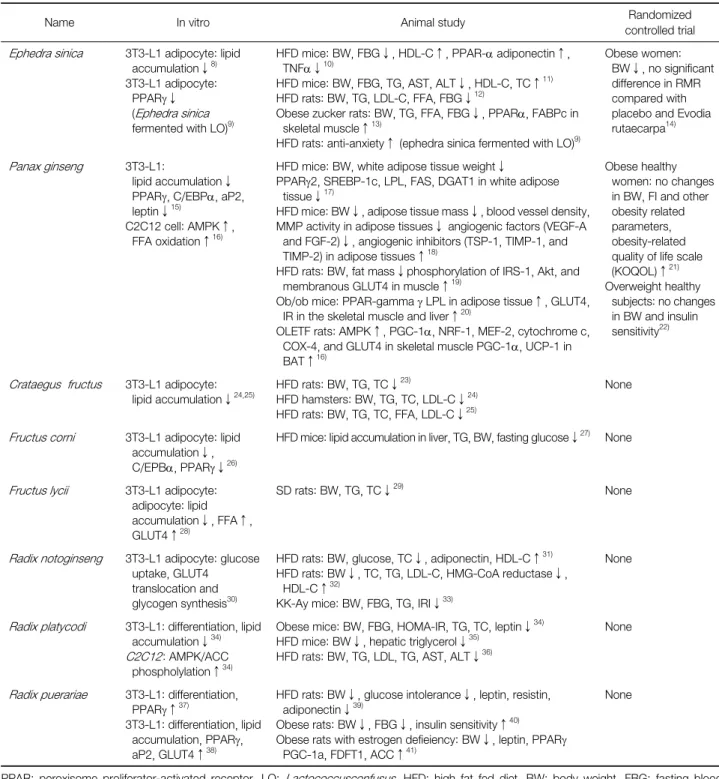
연구 검색 기준에 맞추어 분석 대상으로 최종 선정된 연 구는 34편이었으며, 이 중 in vitro 연구는 12편, 동물 실험 은 24편이었으며, RCT 연구는 3편이었다(중복계산됨) (Table 1)8-41).
2. 본초별 항비만 효과
1) 마황
3T3-L1 지방세포 분화 실험에서 마황의 지방세포 축적 억제 효과를 확인할 수 있었으며8), 발효 마황의 효과를 실 험한 연구도 있었는데, Bifidobacterium longum, Lacto- bacilluscasei, Lactococcusconfusus (LO)의 3종의 유산균 으로 각각 발효된 마황을 분화 유도된 3T3-L1 세포에 처리 했을 때, LO로 발효된 마황이 지방 분화에 관여하는 전사인자 인 peroxisome proliferator-activated receptor (PPAR) γ mRNA를 가장 많이 억제시키는 것으로 나타났다9). 동물실 험에서는 고지방사료 섭취로 유도된 비만쥐에 마황을 투여 한 결과 body weight (BW), triglyceride (TG), low density lipoprotein cholesterol, free fatty acid, fasting blood glucose (FBG)의 감소, high density lipoprotein cholesterol의 증가 및 aspartate aminotransferase, alanine aminotransferase 의 감소가 나타났다10-13). 또한 골격근 내에서 지방산 산화 와 관련된 PPARα, fatty acid binding protein c의 유전자 발현을 증가시키는 것으로 나타나 지방산 산화를 증가시 켜13) 골격근 내 지방산 산화 증가를 통한 인슐린 감수성 증 가에 영향을 줄 것으로 생각된다. 한편, 앞서 언급된 Shin9) 의 연구에서 비만쥐에 LO로 발효된 마황을 8주간 투여했 을 때, 고지방 사료 섭취(high fat fed diet, HFD) 대조군에 비해서 HFD+마황, HFD+LO 발효 마황 투여군의 체중증 가 억제 효과가 나타났으나, 마황군과 LO 마황군 사이에는 유의한 차이가 없었다. 그러나 항불안 억제 실험에서는 LO 마황군은 불안 증세를 나타내지 않아 발효 마황이 마황의 교감신경 자극에 의한 부작용을 상대적으로 줄이는 것으로 나타났다. 마황 단독으로 수행된 RCT 연구는 1편이었으며, 저열량 식이를 병행하면서 8주간 투여 시 마황군이 대조군
Table 1. Anti-obesity Effects of 8 Selected Single Medicinal Herbs
Name In vitro Animal study Randomized
controlled trial Ephedra sinica 3T3-L1 adipocyte: lipid
accumulation↓8) 3T3-L1 adipocyte:
PPARγ↓
(Ephedra sinica fermented with LO)9)
HFD mice: BW, FBG↓, HDL-C↑, PPAR-α adiponectin↑, TNFα↓10)
HFD mice: BW, FBG, TG, AST, ALT↓, HDL-C, TC↑11) HFD rats: BW, TG, LDL-C, FFA, FBG↓12)
Obese zucker rats: BW, TG, FFA, FBG↓, PPARα, FABPc in skeletal muscle↑13)
HFD rats: anti-anxiety↑ (ephedra sinica fermented with LO)9)
Obese women:
BW↓, no significant difference in RMR compared with placebo and Evodia rutaecarpa14)
Panax ginseng 3T3-L1:
lipid accumulation↓
PPARγ, C/EBPα, aP2, leptin↓15)
C2C12 cell: AMPK↑, FFA oxidation↑16)
HFD mice: BW, white adipose tissue weight↓
PPARγ2, SREBP-1c, LPL, FAS, DGAT1 in white adipose tissue↓17)
HFD mice: BW↓, adipose tissue mass↓, blood vessel density, MMP activity in adipose tissues↓ angiogenic factors (VEGF-A
and FGF-2)↓, angiogenic inhibitors (TSP-1, TIMP-1, and TIMP-2) in adipose tissues↑18)
HFD rats: BW, fat mass↓phosphorylation of IRS-1, Akt, and membranous GLUT4 in muscle↑19)
Ob/ob mice: PPAR-gamma γ LPL in adipose tissue↑, GLUT4, IR in the skeletal muscle and liver↑20)
OLETF rats: AMPK↑, PGC-1α, NRF-1, MEF-2, cytochrome c, COX-4, and GLUT4 in skeletal muscle PGC-1α, UCP-1 in BAT↑16)
Obese healthy women: no changes in BW, FI and other obesity related parameters, obesity-related quality of life scale (KOQOL)↑21) Overweight healthy
subjects: no changes in BW and insulin sensitivity22)
Crataegus fructus 3T3-L1 adipocyte:
lipid accumulation↓24,25)
HFD rats: BW, TG, TC↓23)
HFD hamsters: BW, TG, TC, LDL-C↓24) HFD rats: BW, TG, TC, FFA, LDL-C↓25)
None
Fructus corni 3T3-L1 adipocyte: lipid accumulation↓, C/EPBα, PPARγ↓26)
HFD mice: lipid accumulation in liver, TG, BW, fasting glucose↓27) None
Fructus lycii 3T3-L1 adipocyte:
adipocyte: lipid accumulation↓, FFA↑, GLUT4↑28)
SD rats: BW, TG, TC↓29) None
Radix notoginseng 3T3-L1 adipocyte: glucose uptake, GLUT4
translocation and glycogen synthesis30)
HFD rats: BW, glucose, TC↓, adiponectin, HDL-C↑31) HFD rats: BW↓, TC, TG, LDL-C, HMG-CoA reductase↓,
HDL-C↑32)
KK-Ay mice: BW, FBG, TG, IRI↓33)
None
Radix platycodi 3T3-L1: differentiation, lipid accumulation↓34) C2C12: AMPK/ACC
phospholylation↑34)
Obese mice: BW, FBG, HOMA-IR, TG, TC, leptin↓34) HFD mice: BW↓, hepatic triglycerol↓35)
HFD rats: BW, TG, LDL, TG, AST, ALT↓36)
None
Radix puerariae 3T3-L1: differentiation, PPARγ↑37)
3T3-L1: differentiation, lipid accumulation, PPARγ, aP2, GLUT4↑38)
HFD rats: BW↓, glucose intolerance↓, leptin, resistin, adiponectin↓39)
Obese rats: BW↓, FBG↓, insulin sensitivity↑40)
Obese rats with estrogen defieiency: BW↓, leptin, PPARγ PGC-1a, FDFT1, ACC↑41)
None
PPAR: peroxisome proliferator-activated receptor, LO: Lactococcusconfusus, HFD: high fat fed diet, BW: body weight, FBG: fasting blood glucose, HDL-C: high density lipoprotein cholesterol, TNFα: tumor necrosis factor-alpha, TG: triglyceride, AST: aspartate aminotransferase, ALT:
alanine aminotransferase, TC: total cholesterol, LDL-C: low density lipoprotein cholesterol, FFA: free fatty acid, FABP: fatty acid binding protein, RMR: resting metabolic rate, C/EBP: CCAAT/enhancer-binding protein (C/EBP), aP: adipocyte protein, FI: food intake, AMPK: adenosine monophosphate-activated protein kinase, MMP: matrix metalloproteinases, VEGF: vascular endothelial growth factor, FGF: fibroblast growth factors, TSP: thrombospondin, TIMP: tissue inhibitor of metalloproteinases, KOQOL: Korean version of obesity-related quality of life, SREBP: sterol regulatory element-binding protein, LPL: lipoprotein lipase, DGAT: diglyceride acyltransferase, IRS: insulin receptor substrate, Akt: protein kinase B, GLUT: glucose transporter, OLETF: Otsuka Long-Evans Tokushima fatty rats, PGC: peroxisome proliferator-activated receptor gamma coactivator, NRF: nuclear respiratory factor, MEF: myocyte enhancing factor, COX: cyclo-oxygenase, UCP: uncoupling protein, BAT: brown adipose tissue, SD: Sprague Dawley, IRI: insulin resistance index, ACC: acetyl CoA carboxylase, HMG-CoA: 3-hydroxy-3-methylglutaryl coenzyme A.
및 오수유 복용군에 비해서 체중 감량이 가장 많았으나, 기 초대사율에는 세 군 모두 유의한 차이가 없는 것으로 나타 났다14).
2) 인삼
3T3-L1 지방세포 분화 실험에서 홍삼의 지방세포 축적 억제 효과를 확인할 수 있었으며, 지방세포 특이 유전자인 PPARγ, CCAAT/enhancer-binding protein α, adipocyte protein 2와 leptin의 발현을 억제하는 것으로 나타났다15). 또한 C2C12 골격근 세포에서는 혈당 조절 및 에너지 대사 와 관련된 adenosine monophosphate-activated protein kinase (AMPK)의 활성을 올리며, 지방산 산화를 촉진시키 는 것으로 나타났다16). 비만쥐를 대상으로 한 동물실험에서 는 BW, 지방조직 무게 감소를 확인할 수 있었으며, 지방조 직에서 지방분화와 관련된 요소인 PPARγ2, sterol regu- latory element-binding protein-1c, lipoprotein lipase, fatty acid synthase 및 diglyceride acyltransferase 1의 발현 을 억제시켜, 지방 생성을 억제시킴을 확인할 수 있었다17). 또한 인삼이 혈관 생성을 억제시키는 작용을 하는 것에 착 안하여 이뤄진 연구에서 지방 조직에서의 혈관 분포가 감소 하고, 혈관생성억제 인자들의 증가 및 혈관생성인자들의 감 소가 나타나서, 지방세포에서의 혈관 생성을 억제하여 지방 생성을 줄이는 작용을 하는 것으로 생각되었다18). 또한 비 만쥐의 골격근 조직에서는 인슐린 민감도와 관련된 인자인 insulin receptor substrate (IRS)-1, protein kinase B (Akt), glucose transporter (GLUT)4의 상승이 관찰되어 인슐린 저항성 감소에 작용하였으며19,20), 비만형 당뇨쥐 (Otsuka Long-Evans Tokushima fatty rats)의 골격근 조 직과 갈색지방조직에서 미토콘드리아 생합성과 관련된 인 자인 peroxisome proliferator-activated receptor gamma coactivator (PGC)-1α, nuclear respiratory factor (NRF)-1, myocyte enhancing factor-2의 상승이 나타나서 미토콘드 리아 생합성 증가를 통한 대사율 증가 또는 인슐린 저항성 감소에도 기여할 것으로 나타났다16). 인체를 대상으로 한 연구에서는 body mass index (BMI) 25 이상의 비만 여성 을 대상으로 홍삼을 8주간 투여 시 대조군에 비해서 체중, BMI, 허리둘레, 음식섭취량 및 비만관련 혈액 성분의 차이 는 없었으나, 비만관련 삶의 질 척도(obesity-related quality
of life scale)에서 대조군에 비해서 유의한 변화가 나타났 다. 이에 저자는 홍삼이 체중, 혈액학적 변화 등 비만에 대 한 직접적인 작용보다는 삶의 질 등 비만관련 2차적인 문제 들의 해결에 보다 효과적이라고 밝혔다21). 또한 건강한 과 체중인을 대상으로 12주간 복용 시 체중감량 및 인슐린 민 감도 향상 효과가 나타나지 않았다22).
3) 기타 약물
3T3-L1 지방세포 분화 실험에서 지방 합성을 억제하는 것으로 나타난 약물은 산사23,24), 산수유26), 구기자27), 길경34) 이었으며, 반대로 갈근은 지방 분화를 활성화시키는 것으로 나타났으며37,38), 삼칠근의 지방세포 분화억제 관련 연구는 찾을 수가 없었다. 또한 C2C12 골격근 세포에서 길경은 AMPK를 활성화시키는 것으로 나타났다34).
비만쥐 동물모델에서는 산사23-35), 산수유27), 구기자29), 삼칠근31-33), 길경34-36) 및 갈근39-41)의 체중증가 억제와 TG, total cholesterol의 억제 효과 등이 나타났다. 또한 삼 칠근은 지질 합성 호르몬인 3-hydroxy-3-methylglutaryl coenzyme A (HMG-CoA) reductase와 FBG, IRI를 감소
시켰다32,33). 산수유의 경우 주성분인 anthocyanins, ursolic
acid 분리 추출하여 비만쥐에 8주간 투여한 결과 간에서의 지방 축적을 감소시키고, TG, BW, FBG를 감소시키는 것 으로 나타났다27). 갈근은 난소제거로 estrogen 결핍으로 비 만이 유발된 쥐에서 항비만 효과를 나타냈다41).
한편, 마황, 인삼을 제외한 상기 약물의 단독 투여 RCT 연구는 찾을 수가 없었다.
고찰 및 결론
본 연구에서 분석한 8종의 본초 중 in vitro, 동물실험 및 RCT 연구가 모두 이뤄진 약물은 마황, 인삼의 2종에 불과 했다. 그 중 마황은 Hwang 등4)의 연구에서 국내에서 비만 치료에 가장 많이 사용되는 본초로 알려져 있으며, 기존 연 구에서 in vitro 실험에서 지방세포의 분화억제 효과8)와 비 만형 동물모델에서 체중조절, 지질대사 조절 및 골격근 내 지방산 산화 증가를 통한 인슐린 저항성 감소 효과를 나
타내었다9-13). 마황의 주성분인 ephedrine은 α-, β1-,
β2-agonism에 의해서 교감신경을 자극하여서 열발생 효과
를 내는 것으로 알려져 있다42). 또한 중추신경계에 작용하 여 norepinephrine 분비를 증가시켜서 식욕억제, 피로감소, 운동능력 증가 등의 효과를 나타낸다43). 체중 감량 효과에 있어 마황의 효능, 안전성 검증을 위한 RCT 연구가 많이 이뤄졌으나, 대부분이 상승 효과를 일으키는 caffeine 등을 병용 투여했거나, 마황의 주요 성분인 ephedrine을 이용한 연구여서 본 연구의 선정 논문에 해당되지 않는 경우가 대 부분이었다. 항비만 관련 마황 및 ephedrine의 효과 분석을 위한 RCT 연구 분석은 이미 타 연구에서 수행된 바 있는 데, 마황 및 ephedrine의 복용은 중등도의 단기간 체중감소 효과를 나타내며, 대조군에 비해 1개월에 0.9 kg의 체중 감 량 효과를 나타내는 것44)으로 밝혀져 마황의 체중 감량, 항 비만 효과는 타 본초에 비해 우수하게 검증되어 있다. 그러 나 마황의 안전성은 주의해야할 부분으로 마황의 부작용으 로 정신신경계, 자율신경계, 위장관계 문제 혹은 빈맥이 나 타날 수 있다44). Shin9)의 연구에서 발효 마황이 발효하지 않은 마황에 비해 항불안 효과를 나타낸 것으로 보고되었는 데, 이에 발효 마황이 교감신경 자극으로 인한 부작용을 줄 여줄 것으로 기대되며 추후 활발한 연구가 필요하다.
인삼의 주성분은 ginsenosides로 Rb1, Rb2, Re, Rd와 Rg1 등으로 나눠지는데45) 대사증후군 관련 인삼 및 홍삼의 작용은 혈당조절, 인슐린 민감도 증가, 지질대사 개선, 체중 감량 및 에너지 대사 증가 등이 밝혀져 있다6). 인삼 역시 마 황과 함께 타 약물에 비해 다양하게 항비만 효과가 실험된 약물로, in vitro 실험에서는 지방 세포에서의 지방축적 억 제, 지방 분화 관련 전사인자의 발현 억제 효과가 나타났으 며15), 골격근 세포에서의 지방산 산화 증가, AMPK 활성화 를 통한 인슐린 저항성 개선 효과가 나타났다16). 비만형 동 물 모델에서도 이를 뒷받침하는 결과들이 발표되었는데, 체 중감소, 지방조직의 무게 감소, 지방조직에서 지방 분화 관 련 전사인자의 발현 억제 효과가 나타났고17), 골격근 조직 에서 인슐린 민감성과 관련 있는 IRS-1, Akt와 GLUT4의 상승이 나타나서19,20) 인슐린 저항성 개선에 작용하는 것으 로 나타났다. 또한 골격근 조직 및 갈색지방조직에서 미토 콘드리아 생합성 또는 열발생과 관련된 PGC-1α, NRF-1, MEF-2 또는 uncoupling protein-1의 발현 증가가 나타나 서 미토콘드리아 기능 개선을 통한 인슐린 저항성 개선 및 대사율 항상 효과도 기대된다16). 이러한 in vivo, 동물실험
결과에 비해서 건강한 과체중 또는 비만인을 대상으로 한 RCT 연구에서는 유의한 체중감량 효과가 나타나지 않았 다. 한편, 체중 관련 없이 2형 당뇨병에 대한 RCT 연구에서 는 12주간 인삼복용 시 혈당 및 인슐린 조절 효과가 보고된 바 있다46).
그 외 약물 중 3T3-L1 adipocyte를 이용한 in vitro 실험 에서 지방세포의 분화억제, 지방합성 억제 효과가 나타난 약물은 산사23,24), 산수유26), 구기자28) 및 길경34)이었다. 그 러나 갈근은 반대로 지방 분화를 촉진시키며, 지방 분화 및 인슐린 작용과 관련된 PPARγ, GLUT4를 상승시키는 것으 로 나타나서37-41), 지방 분화 증가를 통한 인슐린 저항성 및 혈당 강화 효과가 더욱 두드러지는 약물인 것으로 보인다.
또한 삼칠근은 지방 분화 관련 실험 내용을 찾을 수는 없었 지만 지방세포에서 glucose uptake를 상승시키는 것으로 나타나30), 지방분화를 촉진시킬 것으로 예상된다. 한편, Hong26)은 비만 및 대사증후군 관련 효과가 기대되는 약물 30종(산수유, 반하, 백작약, 진피, 오미자, 백출, 상지, 하수 오, 황금, 차조기, 산사, 황기, 길경, 희첨, 의이인, 홍화, 마 황, 택사, 대황, 적소두, 상심자, 감초, 솔잎, 시옆, 인진, 상 엽, 비파옆, 상백피, 죽엽 및 결명자)을 선별하여 3T3-L1 지방세포에서 지방 합성 억제 정도를 비교한 연구를 발표하 였는데, 산수유, 백출, 대황이 가장 높은 지방분화 억제 효 과를 나타냈으며, 반대로 솔잎, 상엽, 상심자는 지방분화를 촉진시키는 것으로 나타났다.
비만쥐를 이용한 동물 실험에서는 산사 등 6종의 약물 모두 체중감소, 지질대사개선, 혈당 감소 효과를 나타났다. 이 중 삼 칠근은 콜레스테롤 합성에 관여하는 효소인 HMG-CoA reductase를 억제시켜서 지질 대사에 직접 작용하는 것으로 나타났는데32,33), 삼칠근의 주성분인 saponin (ginsenosides Rb1, Rg1, Rd, notoginsenoside R1 등)이 비만, 대사증후 군 개선 효과의 핵심 성분으로 알려져 있다47). 또한 갈근은 난소제거로 비만이 유발된 쥐에서 항비만 효과를 나타냈는 데, 이는 estrogen receptor β에 대한 agonist로서 작용을 하 여 phytoestrogen으로서 기능을 하기 때문48)인 것으로 보 인다.
기존의 연구에서 비만 및 대사증후군 개선에 주된 작용 을 하는 것으로 밝혀진 8종의 약물의 항비만 효과를 분석을 한 결과, 관련 효능 및 작용이 가장 많이 밝혀진 약물은 마
황, 인삼이었으며, 마황은 RCT 연구에서 그 효과가 가장 잘 입증된 약물이며, 인삼은 in vitro와 동물실험에서 효능 및 기전이 밝혀졌지만, RCT 연구에는 뚜렷한 항비만 효과 를 나타내지 못했다. 또한 그 외 산사, 산수유, 구기자, 삼칠 근, 길경 및 갈근은 개별 본초로는 RCT 연구가 이뤄지지 않 았거나, 마황, 인삼에 비해서는 효능, 기전 연구가 부족했다.
본 연구는 국내에서 주로 사용하는 본초의 항비만 효과 를 분석하기 위한 연구였으나, 검색의 범위를 구체화 하기 위해 사전 조사를 통해 조사 약물을 미리 선정하였으나, 오 히려 이로 인해 체계적 문헌고찰(systematic review)의 형 식을 갖추지 못하고, 검색상의 오류를 범할 수 있는 한계를 가지고 있다. 이에 본 연구 결과를 바탕으로 추후 후속 연구 를 통해 보다 본초의 항비만 효과에 대한 보다 체계적인 문 헌 고찰이 이루어져야겠다.
References
1. KNHANES. Health behaviors and chronic disease statistics, 2010. Available from: http://knhanes.cdc.go.kr/knhanes/sub04/
sub04_03.do?pageNo=1&classType=7.
2. Soon JY. Pharmacological treatment of obesity. J Korean Soc Endocrinol. 2008 ; 23 : 223-33.
3. KFDA. Available from: http://www.kfda.go.kr/antidrug/index.
do?nMenuCode.
4. Hwang MJ, Shin HD, Song MY. Literature review of herbal medicines on treatment of obesity since 2000 - mainly about ephedra herba. J Korean Med Obes Res. 2007 ; 7 : 39-54.
5. Park JH, Lee MJ, Song MY, Bose S, Shin BC, Kim HJ. Efficacy and safety of mixed oriental herbal medicines for treating human obesity: a systematic review of randomized clinical trials. J Med Food. 2012 ; 15(7) : 589-97.
6. Yin J, Zhang H, Ye J. Traditional chinese medicine in treatment of metabolic syndrome. Endocr Metab Immune Disord Drug Targets. 2008 ; 8(2) : 99-111.
7. Hasani-Ranjbar S, Nayebi N, Larijani B, Abdollahi M. A systematic review of the efficacy and safety of herbal medicines used in the treatment of obesity. World J Gastroenterol. 2009 ; 15(25) : 3073-85.
8. Kim SB. The effects of proliferation and differentiation on adipocyte 3T3-L1 by prescriptions and herbs of Tae-yang In and Tae-um In. Doctor's degree. Seoul: Kyung Hee University. 1998.
9. Shin YJ. The effects of fermentated Mahuang(Ephedra sinica) on obese fats fed by high fat diet. Doctor's degree. Gyeongju:
Dongguk University. 2009.
10. Song MK, Um JY, Jang HJ, Lee BC. Beneficial effect of dietary Ephedra sinica on obesity and glucose intolerance in high-fat diet-fed mice. Exp Ther Med. 2012 ; 3(4) : 707-12.
11. Song MK. The effects of Ephedrae herba on obese type 2 diabetes mouse model induced by high fat, high carbonate diet. Master's degree. Seoul: Kyung Hee University. 2009.
12. Kim YJ. The effects of Ephedra sinica on lipid of blood serum and epididymis fat cells in the rats. Master's degree, Gyeongju:
Dongguk University. 2006.
13. Lee YJ. The efficiency of Ephedrae herba on the obese zucker rats' lipid of blood serum and fatty acid metabolism of skeletal muscles. Master's degree. Gyeongju: Dongguk University. 2005.
14. Kim HJ, Park JM, Kim JA, Ko BP. Effect of herbal Ephedra sinica and Evodia rutaecarpa on body composition and resting metabolic rate: a randomized, double-blind clinical trial in Korean premenopausal women. J Acupunct Meridian Stud.
2008 ; 1(2) : 128-38.
15. Oh J, Lee H, Park D, Ahn J, Shin SS, Yoon M. Ginseng and its active components ginsenosides inhibit adipogenesis in 3T3-L1 cells by regulating MMP-2 and MMP-9. Evid Based Com- plement Alternat Med. 2012 ; 2012 : 1-14.
16. Lee HJ, Lee YH, Park SK, Kang ES, Kim HJ, Lee YC, et al.
Korean red ginseng (Panax ginseng) improves insulin sensitivity and attenuates the development of diabetes in Otsuka Long-Evans Tokushima fatty rats. Metabolism. 2009 ; 58(8) : 1170-7.
17. Lee YS, Cha BY, Yamaguchi K, Choi SS, Yonezawa T, Teruya T, et al. Effects of Korean white ginseng extracts on obesity in high-fat diet-induced obese mice. Cytotechnology. 2010 ; 62(4) : 367-76.
18. Lee H, Park D, Yoon M. Korean red ginseng (Panax ginseng) prevents obesity by inhibiting angiogenesis in high fat diet- induced obese C57BL/6J mice. Food Chem Toxicol. 2013 ; 53 : 402-8.
19. Lee SH, Lee HJ, Lee YH, Lee BW, Cha BS, Kang ES, et al.
Korean red ginseng (Panax ginseng) improves insulin sensitivity in high fat fed Sprague-Dawley rats. Phytother Res. 2012 ; 26(1) : 142-7.
20. Mollah ML, Kim GS, Moon HK, Chung SK, Cheon YP, Kim JK, et al. Antiobesity effects of wild ginseng (Panax ginseng C.A. Meyer) mediated by PPAR-gamma, GLUT4 and LPL in ob/ob mice. Phytother Res. 2009 ; 23(2) : 220-5.
21. Kwon DH, Bose S, Song MY, Lee MJ, Lim CY, Kwon BS, et al.
Efficacy of Korean red ginseng by single nucleotide poly- morphism in obese women: randomized, double-blind, placebo-controlled trial. J Ginseng Res. 2012 ; 36(2) : 176-89.
22. Cho YH, Ahn SC, Lee SY, Jeong DW, Choi EJ, Kim YJ, et al.
Effect of Korean red ginseng on insulin sensitivity in non- diabetic healthy overweight and obese adults. Asia Pac J Clin
Nutr. 2013 ; 22(3) : 365-71.
23. Gal SW, Choi YJ, Cho SJ. Anti-obesity effect of crataegus fructus extract from Chinese cultivation. J Life Sci. 2011 ; 21(11) : 1686-91.
24. Kuo DH, Yeh CH, Shieh PC, Cheng KC, Chen FA, Cheng JT.
Effect of shanzha, a Chinese herbal product, on obesity and dyslipidemia in hamsters receiving high-fat diet. J Ethno- pharmacol. 2009; 124(3) : 544-50.
25. Bas SS, Yoon HD, Shin OC, Shin YJ, Park CS, Park JH, et al.
The effects of Artemisiae capillaris, Ponciri fructus and Cartaegi fructus in obese rats induced by high fat diet. Korean J Herbology. 2006 ; 21(3) : 55-67.
26. Hong CR. Inhibitory effect of Cori fructus ethanolic extracts on adipogenesis in 3T3-L1 preadipocytes. Master's degree. Incheon:
Inha University. 2009.
27. Jayaprakasam B, Olson LK, Schutzki RE, Tai MH, Nair MG.
Amelioration of obesity and glucose intolerance in high-fat-fed C57BL/6 mice by anthocyanins and ursolic acid in Cornelian cherry (Cornus mas). J Agric Food Chem. 2006 ; 54(1) : 243-8.
28. Hwang EY, Hong JH, Choi JH, Lee EJ, Lee IS. Study on anti-obesity and hypoglycemic effects of Lycium chinense mill extracts. J Korean Soc Food Sci Nutr. 2009 ; 11(38) : 1528-34.
29. Song YS, Effects of Bangkihwangkitang, Bangkihwangkitang with Lycii fructus and Lycii fructus on the weight of obese rats.
Wonkwanghanihak. 1992 ; 2(1) : 102-20.
30. Kim JJ, Xiao H, Tan Y, Wang ZZ, Paul Seale J, Qu X. The effects and mechanism of saponins of Panax notoginseng on glucose metabolism in 3T3-L1 cells. Am J Chin Med. 2009 ; 37(6) : 1179-89.
31. Lee DH. The effects of Panax notoginseng on high fat and high carbohydrate diet-induced obese diabetic mouse model. Doctor's degree, Naju: Dongshin University. 2012.
32. Xia W, Sun C, Zhao Y, Wu L. Hypolipidemic and antioxidant activities of sanchi (radix notoginseng) in rats fed with a high fat diet. Phytomedicine. 2011 ; 18(6) : 516-20.
33. Yang CY, Xie ZG, Cheng WB, Jiang X, Chen ZH. Effects of Panax notoginseng saponins on anti-hyperglycemic, anti-obese and prevention from kidney pathological changes in KK-Ay mice. Zhong Yao Cai. 2009 ; 32(10) : 1571-6.
34. Lee CE, Hur HJ, Hwang JT, Sung MJ, Yang HJ, Kim HJ, et al.
Long-term consumption of Platycodi radix ameliorates obesity and Insulin Resistance via the Activation of AMPK Pathways.
Evid Based Complement Alternat Med. 2012 ; 2012 : 759143.
35. Han LK, Xu BJ, Kimura Y, Zheng Yn, Okuda H. Platycodi radix affects lipid metabolism in mice with high fat diet-induced obesity. J Nutr. 2000 ; 130(11) : 2760-4.
36. Byun BH, Seo BI. Effect of Platycodi radix powder on enzyme activities of obese rats serum fed high fat diet. Korean J Herbology. 2003 ; 18(4) : 135-9.
37. Xu ME, Xiao SZ, Sun YH, Zheng XX, Ou-Yang Y, Guan C.
The study of anti-metabolic syndrome effect of puerarin in vitro.
Life Sci. 2005 ; 77(25) : 3183-96.
38. Lee OH, Seo DH, Park CS, Kim YC. Puerarin enhances adipocyte differentiation, adiponectin expression, and antioxi- dant response in 3T3-L1 cells. Biofactors. 2010 ; 36(6) : 459-67.
39. Zhang W, Liu CQ, Wang PW, Sun SY, Su WJ, Zhang HJ, et al.
Puerarin improves insulin resistance and modulates adipokine expression in rats fed a high-fat diet. Eur J Pharmacol. 2010 ; 649(1-3) : 398-402.
40. Prasain JK, Peng N, Rajbhandari R, Wyss JM. The Chinese Pueraria root extract (Pueraria lobata) ameliorates impaired glucose and lipid metabolism in obese mice. Phytomedicine.
2012 ; 20(1) : 17-23.
41. Shin HJ, Yoo JE, Jung EH, Yoo DY. Effects of Pueraria iobata body weight and gene expression in obese rats muscle with estrogen defieiency. J Orient Gynecol. 2012 ; 25(3) : 71-84.
42. Shannon JR, Gottesdiener K, Jordan J, Chen K, Flattery S, Larson PJ, et al. Acute effect of ephedrine on 24-h energy balance. Clin Sci (Lond). 1999 ; 96(5) : 483-91.
43. Magkos F, Kavouras SA. Caffeine and ephedrine: physiological, metabolic and performance-enhancing effects. Sports Med. 2004 ; 34(13) : 871-89.
44. Shekelle PG, Hardy ML, Morton SC, Maglione M, Mojica WA, Suttorp MJ, et al. Efficacy and safety of ephedra and ephedrine for weight loss and athletic performance: a meta-analysis.
JAMA. 2003 ; 289(12) : 1537-45.
45. Kim DH. Chemical diversity of Panax ginseng, Panax quinquifolium and Panax notoginseng. J Ginseng Res. 2012 ; 6(1) : 1-15.
46. Vuksan, V, Sung MK, Sievenpiper JL, Stavro PM, Jenkins AL, Di Buono M, et al. Korean red ginseng (Panax ginseng) improves glucose and insulin regulation in well-controlled, type 2 diabetes: Results of a randomized, double-blind, placebo- controlled study of efficacy and safety. Nutr Metab Cardiovasc Dis. 2006 ; 18(1) : 45-56.
47. Uzayisenga R, Ayeka PA, Wang Y. Anti-diabetic potential of Panax notoginseng saponins (PNS): a review. Phytother Res.
2013. [Epub ahead of print]
48. Zheng G, Zhang X, Zheng J, Meng Q, Zheng D. Estrogen-like effects of puerarin and total isoflavones from Pueraria lobata.
Zhong Yao Cai. 2002 ; 25(8) : 566-8.