INTRODUCTION
Upper gastrointestinal hemorrhage is the most common complication of peptic ulcers. In approximately 20% of pa- tients, ulcer-related hemorrhage occurs without preceding symptoms (1). Bleeding persists or recurs in a subgroup of these patients, which contributes to an overall mortality rate of 6-10%. This rate has remained remarkably stable over the past 20-30 yr (2), despite the tremendous advances in support- ive care techniques such as blood-banking, intensive care units, and endoscopy (3-9).
Gastric hemorrhage may occur for many reasons, such as eroded vessels in an active ulcer, portal hypertension, or mul- tiple gastric erosions. It has been assumed that this feature does not occur in all peptic ulcer cases (10). Many independent risk factors for ulcer hemorrhage have been described, such as high- er age, use of nonsteroidal anti-inflammatory drugs (NSAIDs), and a history of prior peptic ulcers (11, 12). However, there is no satisfactory explanation of the pathogenesis of ulcer bleed- ing: Helicobacter pylori (HP) has not been shown to be an inde- pendent risk factor for ulcer hemorrhage (13), gastric acid hy-
persecretion is not necessary for hemorrhage in patients with peptic ulcers, and no significant differences in secretory para- meters (e.g., baseline, peak, or meal-stimulated acid outputs, and parietal cell sensitivity) have been noted among ulcer patients with and without bleeding (14). Therefore, further studies are needed to determine the exact mechanism of ulcer hemorrhage.
Many reports have indicated that the fibrinolytic system plays a significant role in gastric bleeding (15-18), but most of these have focused on a specific parameter of the fibrinolyt- ic system adjacent to the ulcer. The fibrinolysis, which is medi- ated mainly by the tissue plasminogen activator (t-PA) and plasminogen activator inhibitor type 1 (PAI-1), is a reparative process that occurs in response to hemostatic plug or throm- bus formation (19). The fibrin that is formed during hemosta- sis must be removed when normal tissue structure and func- tion is restored. Thus, a fibrin clot that forms quickly in a torn blood vessel to stop hemorrhage is remodeled and then re- moved to restore normal blood flow. The fibrinolytic system is the principal effecter of clot removal and controls the enzy- matic degradation of fibrin. Its action is coordinated through the interaction of activators, zymogens, enzymes, and inhibitors
Hong-Soo Kim, Kyu-Yoon Hwang*, Il-Kwon Chung, Sang-Heum Park, Moon-Ho Lee, Sun-Joo Kim, Sae-Yong Hong
Departments of Internal Medicine and *Preventive Medicine, Soonchunhyang University Chunan Hospital, Soonchunhyang University, Chonan, Korea
Address for correspondence Sae-Yong Hong, M.D.
Department of Internal Medicine, Soonchunhyang University Chunan Hospital, 23-20 Bongmyung- dong, Chonan 330-100, Korea
Tel : +82-41-570-2121, Fax : +82-41-574-5762 E-mail : [email protected]
58
Tissue Plasminogen Activator and Plasminogen Activator Inhibitor Type 1 Gene Polymorphism in Patients with Gastric Ulcer
Complicated with Bleeding
Tissue plasminogen activator (t-PA) and plasminogen activator inhibitor type 1 (PAI- 1) may be involved in the pathogenesis of peptic ulcers through suppression of fib- rinolysis. This study was designed to investigate associations of t-PA and PAI-1 genes with clinical features of the patients with bleeding gastric ulcers. Eighty-four patients with peptic ulcers and 100 controls were studied between January 1998 and April 2000. We used polymerase chain reaction and endonuclease digestion to genotype for 4G/5G polymorphism in the promoter region of the PAI-1 gene and the Alu-repeat insertion/deletion (I/D) polymorphism in intron h of the t-PA gene. Various clinical fea- tures, including lesion site, bleeding event, recurrence of ulcer, and rebleeding, were assessed using a multiple logistic regression model. The genotype distributions of both the t-PA and PAI-1 genes did not differ between the patient and control groups.
The occurrence of the I/D or D/D genotype of t-PA was significantly higher in cases of duodenal ulcer (adjusted OR=4.39, 95% CI=1.12-17.21). When a dominant effect (i.e., 4G/4G or 4G/5G versus 5G/5G) of the 4G allele was assumed, the PAI-1 4G/
4G genotype was independently associated with rebleeding after hemostasis (adjust- ed OR=5.07, 95% CI=1.03-24.87). Our data suggest that t-PA gene polymorphism is associated with duodenal ulcers, and that the PAI-1 gene may be a risk factor lead- ing to recurrent bleeding after initial hemostasis.
Key Words : Tissue Plasminogen Activator; Plasminogen Activator Inhibitor 1; Peptic Ulcer; Fibrinolysis;
Hemostasis
Received : 4 September 2002 Accepted : 1 November 2002
to provide local activation at the site of fibrin deposition.
Various methods have been used to evaluate systemic fibri- nolytic activity, such as monitoring the euglobulin fibrinolyt- ic activity, chromogenic bioassay, enzyme-linked immunosor- bent assay, and radioimmunoassay for t-PA and PAI-1. How- ever, there are several reasons why these methods do not pro- vide an accurate measure of the patient’s physiologic fibrinolyt- ic activity: (a) physiologic fibrinolysis does not occur in the circulating blood but at the fibrin and/or thrombus site, so any method that measures fibrinolytic activity in a sample of cir- culating blood does not reflect fibrin-associated fibrinolysis;
(b) the release of t-PA from endothelial cells can be modified by many factors such as exercise, venous occlusion, mental stress, sympathetic stimulation, and prostaglandin (20); and (c) variations in blood levels of PAI-1 are resulted from changes in the rate of PAI-1 gene expression in the tissue rather than from the release of stored PAI-1 in the cells (19). With these factors kept in mind, it seems likely that the fibrinolytic activ- ity measured at the gene level may provide a better assessment of fibrinolysis.
There is recent evidence that 4G/5G polymorphism in the promoter region of the PAI-1 gene is related to circulating PAI-1 levels (21-24). In vitro experiments have shown that both alleles of the 4G/5G polymorphism contain a binding site for a transcription activator, and that the 5G allele also contains a binding site for a transcription repressor that partial- ly overlaps with the activator binding site (21, 25). Therefore, the 4G allele of the PAI-1 gene is associated with increased basal gene transcription. The 4G/4G genotype of PAI-1 has been shown to be associated with ischemic heart disease (24, 26) and myocardial infarction (MI) (21, 27).
Similarly, the insertion/insertion (I/I) genotype of Alu-repeat insertion/deletion (I/D) polymorphism in the t-PA gene has been shown to be associated with the plasma PAI-1 antigen in patients with MI (28). Since t-PA and PAI-1 levels are posi- tively correlated, the Alu-repeat I/D polymorphism could be a marker of a functional mutation in the t-PA gene that reg- ulates the interaction between t-PA and PAI-1. The Alu-repeat insertion may also be closely linked to a mutation at or near the t-PA gene that produces a functional effect, and an Alu- repeat I/D event can alter mRNA stability and splicing (29).
Although Alu-repeat I/D polymorphism in the t-PA gene is not associated with either t-PA plasma levels (28) or the basal synthesis rate of t-PA in endothelial cells (30), Alu-repeat I/D polymorphism in the t-PA gene may be a candidate marker for thrombosis and hemostasis (31).
The major pathogenic mechanisms for peptic ulcer are acid, HP, and NSAIDs (1). Of these factors, only NSAIDs appear to be an important risk factor for the development of bleed- ing (32-34). In order to avoid any influence of this factor in our study, we excluded any patient who had a history of NSAID within 3 months of the study.
Intramucosal proteolysis has been considered to be an aggres- sive factor in the development of peptic ulcers, and it has been
shown that there is a significantly higher level of protease activ- ity at the ulcer edge and from the antral mucosa of patients with an active duodenal ulcer (15-17). HP can induce peptic ulceration through direct production of several proteases capa- ble of damaging the gastroduodenal mucosa (34, 35). It is well known that plasmin, the end product of the fibrinolytic sys- tem, converts latent collagenase to an active form. The main- tenance of an adequate mucosal blood flow by adequate fib- rinolysis is another essential protective factor (28, 29), and t- PA may be a key enzyme in this process. Nonetheless, the role of the fibrinolytic system on the development of peptic ulcers and/or ulcer bleeding is controversial.
Taking these observations into consideration, we hypoth- esized that the t-PA and PAI-1 genes are factors leading to peptic ulcer and hemorrhage. In order to determine whether our hypothesis was correct, we analyzed I/D type polymor- phism in intron h of the t-PA gene and 4G/5G polymorphism in the promoter of the PAI-1 gene in patients with gastric ul- cers with or without ulcer bleeding.
MATERIALS AND METHODS Study subjects
Between January 1998 and April 2000, diagnostic and/or therapeutic endoscopy was performed in 84 patients with ac- tive peptic ulcers. The control group comprised 100 subjects who presented consecutively for multiphasic health check-up at Soonchunhyang University Chunan Hospital. Individuals with an NSAID-induced ulcer, underlying systemic disease, or bleeding tendency were excluded from the study.
The study design was approved by the Ethics Committee of Soonchunhyang University Chunan Hospital. Informed consent was obtained from all subjects.
We used historical information and endoscopic examinations to evaluate the lesion site for the presence of bleeding, recur- rency, and HP infection. We performed several tests for HP infection, including a rapid urease test (CLO test; Ballard, Dr- aper, Australia) that was observed for up to 24 hr, histological examination of an endoscopic biopsy, 13C-labeled urea breath test (UBT), and serologic examination for the presence of imm- unoglobulin G antibody to HP (Radim, Pomezia, Italy). We determined the presence of HP infection in patients when two or more of the above tests produced positive results. Rebleed- ing was defined as the persistence or redevelopment of overt bleeding (hematemesis, melena, or hematochezia) or a reduc- tion in hemoglobin of more than 1.5 g/dL within 5 days of initial hemostasis.
Blood sampling and DNA isolation
Blood samples were obtained from the antecubital vein be- tween 7 a.m. and 9 a.m. after a fast and a 20 min rest. For DNA
analysis, blood was collected in K-EDTA vacuum tubes, and stored at -70℃. DNA was isolated using a commercial ge- nomic DNA purification kit (QIAamp; QIAGEN, Valencia, CA, U.S.A.). Serum was separated from whole blood and used for biochemical assays.
Determination of genotypes
Allele-specific polymerase chain reaction (PCR) was per- formed according to Falk’s assay (32) with some modifications.
The PAI-1 4G/5G polymorphism was determined for each subject using two 17-mer allele-specific primers: 5′-GTCT- GGACACGTGGGGG-3′for insertion 5G allele and 5′-G- TCTGGACACGTGGGGA-3′for deletion 4G allele, in com- bination with the common downstream primer 5′-TGC- AGCCAGCCACGACGTGATTGTCTA-3′. The PCR ampli- fied 140-bp DNA fragments with the 5G-specific primer only, whereas in the 4G/4G genotype only 139-bp DNA fragments with the 4G-specific primer, and in heterozygotes both 140- and 139-bp DNA fragments were amplified. As a positive control for the PCR, a 256-bp DNA fragment was generated using a fourth primer, 5′-AAGCTTTTACCATGGTAACC- CCTGGT-3′, located upstream of the polymorphic region in combination with the downstream primer. Each DNA ampli- fication was performed in a total volume of 25 L using 150- 200 ng of genomic DNA. The reaction mixture contained 50 mM Tris-HCl buffer (pH 9.0), 1.5 mM MgCl2, 0.2 mM of each deoxyribonucleoside triphosphate, and 0.6 M of each primer, except for the upstream control primers which were 0.12 M and 1.0 U of DNA polymerase. The mixture was subjected to 35 155-sec-long cycles of 94℃for 35 sec, 65℃ for 45 sec, and 72℃for 75 sec. The PCR products were sep- arated by 2% agarose gel electrophoresis, stained with ethid- ium bromide, and viewed under UV light.
An I/D polymorphism resulting from the presence or absence of an Alu repeat in intron h of the t-PA gene was identified in all subjects. Briefly, 25-50 ng of each genomic DNA sample was amplified by PCR in 25- L reaction volumes. Upstream (5′-TCCGTAACAGGACACCTCA-3′) and downstream (5′- ACCGTGGCTTCAGTCATGGA-3′) primers were chosen as previously described (31). Briefly, 50 ng of DNA was ampli- fied in a 25 L reaction containing 45 mM Tris-HCl (pH 8.0), 11 mM ammonium sulfate, 4.5 mM MgCl2, 6.7 mM 2-mer- captoethanol, 4.4 M K-EDTA (pH 8.0), 1 mM each of dNTP, 100 g/mL bovine serum albumin, 0.01% gelatin, 10 pmol of each primer, and 1 unit of Taq polymerase. The reaction was initially heated to 94℃for 5 min, which was followed by 30 3-min-long cycles of 94℃for 1 min, 58℃for 1 min, and 72℃for 1 min. Amplified products (I allele=967 base pairs, D allele=655 base pairs) were resolved on 1.5% agarose gels and visualized by ethidium bromide fluorescence. Samples were classified according to three genotypes: I/I, D/D, and I/D.
The classification was determined independently by two indi- viduals who had no knowledge of the case or control status.
The PCR direct sequencing was carried out from randomly selected samples to confirm the accuracy of allele-specific oligonucleotide genotyping.
Statistical analysis
Differences in baseline characteristics among three groups were evaluated by analysis of variance (ANOVA) and 2tests for continuous and categorized variables, respectively. The ob- served numbers of each PAI-1 genotype and each t-PA geno- type were compared with those expected for a population in Hardy-Weinberg equilibrium using a 2test. Associations of PAI-1 and t-PA genotypes with the presence of peptic ulcers were estimated using odds ratio (OR) and 95% confidence interval (CI) measures. Both dominant and recessive models were constructed to test the associations. Multiple logistic regression was applied to evaluate the independent associa- tion of the PAI-1 4G/5G polymorphism and t-PA I/D poly- morphism with peptic ulcer, whilst controlling for possible confounding factors. Gene-gene interaction between PAI-1 and t-PA on peptic ulcer parameters was also assessed. Sta- tistical analysis was performed using SPSS for Windows V 10.0 (SPSS Inc., Chicago, U.S.A.). P values less than 0.05 were considered to be statistically significant.
RESULTS Profile of patients
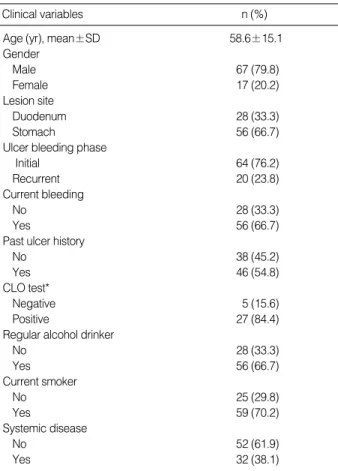
The clinical profiles of the patients are given in Table 1.
Genotypes for PAI-1 and t-PA were available in 84 patients with peptic ulcer and 100 and 98 of the controls, respective- ly. The mean (SD) age of the patients was 58.6 yr (15.1 yr), and 67 (79.8%) of them were male. The peptic ulcer was gas- tric in 56 cases and duodenal in 28 cases; its phase was cate- gorized as initial in 64 cases and recurrent in 20 cases. Clin- ical bleeding was observed in 56 cases (66.7%). Of 32 patients subjected to the CLO test, 84.4% were positive. Fifty-six (66.7
%) of the patients regularly drank alcohol, and 59 (70.2%) were cigarette smokers.
The clinical outcomes are presented in Table 2. Sixty patients required blood transfusion and 4 patients needed surgical oper- ation for hemostasis. Rebleeding was observed in 9 patients.
The mean (SD) duration of hospital treatment was 14.1 (8.8) days.
Gene polymorphisms of t-PA and PAI-1
The distribution of t-PA genotypes in 84 patients with a peptic ulcer was: 32 (38.1%) D/D, 30 (35.7%) I/D, and 22 (26.2%) I/I. This distribution was not significantly different from that of 98 control subjects (p=0.180): 25 (25.5%) D/D, 40 (40.8%) I/D, and 33 (33.7%) I/I (Table 3). No significant
difference in frequency of the I allele was observed between control subjects (0.54) and peptic ulcer patients (0.63) (p=
0.193).
The distribution of PAI-1 genotypes in the patients was: 26 (31.0%) 4G/4G, 42 (50.0%) 4G/5G, and 16 (19.1%) 5G/5G.
This distribution was not significantly different from that of the 100 control subjects: 21 (21.0%) 4G/4G, 53 (53.0%) 4G/
5G, and 26 (26.0%) 5G/5G (p=0.245, Table 3).
Relations of gene polymorphism with ulcer site and rebleeding
Using a multiple logistic regression model in which a reces- sive effect (I/I vs. I/D or D/D) of the I allele was assumed, the I/I genotype of t-PA was found to be related to the presence of peptic ulcers. The occurrence of the I/D or D/D genotypes of t-PA was significantly higher in duodenal ulcers (adjusted OR=4.39, p=0.034). However, PAI-1 was not related to ulcer site in both dominant and recessive models (Table 4).
When a dominant effect (4G/4G or 4G/5G versus 5G/5G) of the 4G allele was assumed, the PAI-1 4G/4G genotype was
*CLO test was performed in 32 patients.
Clinical variables n (%)
Age (yr), mean±SD 58.6±15.1
Gender
Male 67 (79.8)
Female 17 (20.2)
Lesion site
Duodenum 28 (33.3)
Stomach 56 (66.7)
Ulcer bleeding phase
Initial 64 (76.2)
Recurrent 20 (23.8)
Current bleeding
No 28 (33.3)
Yes 56 (66.7)
Past ulcer history
No 38 (45.2)
Yes 46 (54.8)
CLO test*
Negative 5 (15.6)
Positive 27 (84.4)
Regular alcohol drinker
No 28 (33.3)
Yes 56 (66.7)
Current smoker
No 25 (29.8)
Yes 59 (70.2)
Systemic disease
No 52 (61.9)
Yes 32 (38.1)
Table 1.Clinical profiles of 84 patients with active peptic ulcer
Clinical variables n (%)
Blood transfusion
No 24 (28.6)
Yes 60 (71.4)
Treatment
Endoscopy 80 (95.3)
Surgery 4 ( 4.7)
Rebleeding
No 75 (89.3)
Yes 9 (10.7)
Hospitalization duration (days), mean (SD) 14.1 (8.8) Table 2.Therapeutic and prognostic profiles of 84 patients with
active peptic ulcer Gene
Adjusted
Model OR* 95% CI p value
t-PA Dominant
no vs rebleeding 1.83 0.41-8.25 0.429 Recessive
no vs rebleeding 3.95 0.40-38.66 0.237 PAI-1 Dominant
no vs rebleeding 5.07 1.03-24.87 0.045 Recessive
no vs rebleeding 0.97 0.20-4.58 0.966 Table 5. Associations between gene polymorphisms and rebleeding
Genetic polymorphisms
Patients n (%)
Controls
n (%) p-value
t-PA 0.180
II 22 (26.2) 33 (33.7)
ID 30 (35.7) 40 (40.8)
DD 32 (38.1) 25 (25.5)
PAI-1 0.245
4G/4G 26 (31.1) 21 (21.0)
4G/5G 42 (50.0) 53 (53.0)
5G/5G 16 (19.1) 26 (26.0)
Table 3.Distributions of genetic polymorphisms of t-PA and PAI-1 in patients and controls
*adjusted for age, gender, bleeding during endoscopy, ulcer site, alco- hol consumption, and smoking.
Gene Adjusted
Model OR* 95% CI p value
t-PA Dominant
stomach vs duodenum 2.05 0.75-5.56 0.161 Recessive
stomach vs duodenum 4.39 1.12-17.21 0.034 PAI-1 Dominant
stomach vs duodenum 0.85 0.24-2.97 0.799 Recessive
stomach vs duodenum 1.16 0.41-3.26 0.783 Table 4.Associations between gene polymorphisms and site of ulcer
*adjusted for age, gender, alcohol consumption, and smoking.
significantly and independently related to rebleeding after ini- tial hemostasis (adjusted OR=5.07, p=0.045). However, nei- ther the recessive model of PAI-1 nor recessive or dominant model of t-PA was related to rebleeding (Table 5).
The interactions between PAI-1 and t-PA were calculated in both dominant and recessive models and evaluated for gene- gene interaction on ulcer sites and rebleeding as well as other clinical parameters in a further analysis. However, no signif- icant interactions were observed (data not shown).
DISCUSSION
In the present study, the occurrence of the I/D or D/D geno- types of t-PA was higher in duodenal ulcers, and the PAI-1 4G/4G genotype was associated with rebleeding of a peptic ulcer. These results suggest that the t-PA and PAI-1 system plays a role in both ulcer formation and ulcer bleeding.
In our study, when age, gender, alcohol consumption, and smoking habits were controlled, there was an association be- tween the I/D or D/D genotype of t-PA and the presence of a duodenal ulcer. This result suggests that the t-PA gene is an independent factor in the pathogenesis of duodenal ulcers.
The so-called peptic ulcer disease encompasses both gastric and duodenal ulcers (1). Duodenal and gastric ulcers share many common features in terms of pathogenesis, diagnosis, and treatment, but several factors distinguish the two. Gastric ulcers tend to occur later in life than duodenal lesions. More than half of gastric ulcers occur in males, and they are less com- mon than duodenal ulcers. As for duodenal ulcers, the major- ity of gastric ulcers can be attributed to either HP-or NSAID- induced mucosal damage. Gastric ulcers that occur in the prepyloric area or those associated with a duodenal ulcer are similar to duodenal ulcers in terms of pathogenesis (1). The exact mechanism of the formation of a peptic ulcer is beyond the scope of this study. However, our results have shown that the effects of the t-PA gene on peptic ulcer formation depends upon whether the ulcer occurs in the stomach or in the duo- denum.
The other question relating to our results is the significance of the I/D and D/D genotypes of t-PA. Alu-repeat I/D poly- morphism in the t-PA gene was not associated with either t- PA plasma levels (28) or the basal synthesis rate of t-PA in en- dothelial cells (30). Therefore, it is hard to explain why stim- ulated fibrinolysis is implicated in the pathogenesis of a duo- denal ulcer. However, the I/I genotype of Alu-repeat I/D poly- morphism in the t-PA gene shows an association with plasma PAI-1 antigen in patients with MI (28). Since t-PA and PAI- 1 levels are positively correlated, the Alu-repeat I/D polymor- phism could be a marker of a functional mutation in the t-PA gene that regulates the interaction between t-PA and PAI-1.
In this regard, Alu-repeat I/D polymorphism in the t-PA gene may be a candidate marker for thrombosis and hemostasis (31).
Further studies are needed to clarify the property of the I/D
or D/D genotypes of t-PA during duodenal ulcer formation.
Contrary to our expectations, the PAI-1 4G/4G genotype was an independent risk factor for rebleeding. It is known that an increased PAI-1 concentration induces decreased plasmin formation and leads to an accumulation of fibrin. The 4G allele and the 4G/4G genotype of PAI-1 have been reported to be associated with increased basal gene transcription, and conse- quently have been regarded as thrombogenic factors (21, 24, 26, 27). With this kept in mind, our results are suggestive of some other role of PAI-1 in the process of rebleeding, except the effect on fibrinolytic activity.
PAI-1 is synthesized by endothelial cells and hepatocytes, and is present mainly in platelets and plasma. But some PAI- 1 is also present in the subendothelial extracellular matrix, where its function may be inhibition of local proteolysis. PAI- 1 activity induces changes in remodeling of the vessel wall through activation of metalloproteinases, growth factors, and degradation of the extracellular matrix (26, 27). In addition to its antiprotease activity, PAI-1 participates in the cellular adhesion and migration processes (36). Taken the well-known function of PAI-1 to inhibit local proteolysis into consideration, our results suggest that disturbed vessel wall remodeling may be involved in the rebleeding of peptic ulcers.
In the normal physiological state, the activities of coagula- tion and fibrinolysis are balanced. However, increased activity of either coagulation or fibrinolysis can overwhelm the other, to the extent of producing a clinical problem. Therefore, in- creased fibrinolysis and/or decreased coagulation may be in- volved in the pathogenesis of ulcer hemorrhage. However, we believe that the role of t-PA and PAI-1 in peptic ulcer bleed- ing differs between current-bleeding and rebleeding situations.
Furthermore, it seems likely that peptic ulcer rebleeding is due in large part to the properties of PAI-1, which disturbs remodeling of injured vessel after initial bleeding.
In conclusion, our data suggest that t-PA gene polymor- phism may be associated with duodenal ulcers, and that the PAI-1 gene may be a risk factor leading to recurrent bleeding after initial hemostasis.
REFERENCES
1. Valle JD. Peptic ulcer disease and related disorders. In: Braunwald E, et al., ed. Harrison’s Principles of Internal Medicine. New York: Mc- Graw- Hill, 2001: 1649-61.
2. Bogoch A. Bleeding from the alimentary tract. In: Haubrich WS, Schaffner F, eds. Bockus Gastroenterology. Philadelphia: W.B. Saun- ders, 1995: 61-6.
3. Buffoli F, Graffeo M, Nicosia F, Gentile C, Cesari P, Rolfi F, Paterli- ni A. Peptic ulcer bleeding: comparison of two hemostatic procedures.
Am J Gastroenterol 2001; 96: 89-94.
4. Bombardier C, Laine L, Reicin A, Shapiro D, Burgos-Vargas R, Davis B, Day R, Ferraz MB, Hawkey CJ, Hochberg MC, Kvien TK, Schnitzer TJ. Comparison of upper gastrointestinal toxicity of rofe-
coxib and naproxen in patients with rheumatoid arthritis. N Engl J Med 2000; 343: 1520-8.
5. Lai KC, Hui WM, Wong WM, Wong BC, Hu WH, Ching CK, Lam SK. Treatment of Helicobacter pylori in patients with duodenal ulcer hemorrhage - a long-term randomized, controlled study. Am J Gastroenterol 2000; 95: 2225-32.
6. Lau JY, Sung JJ, Lee KK, Yung MY, Wong SK, Wu JC, Chan FK, Ng EK, You JH, Lee CW, Chan AC, Chung SC. Effect of intra- venous omeprazole on recurrent bleeding after endoscopic treatment of bleeding peptic ulcers. N Engl J Med 2000; 343: 310-6.
7. Sonnenberg A, Olson CA, Zhang J. The effect of antibiotic therapy on bleeding from duodenal ulcer. Am J Gastroenterol 1999; 94: 950-4.
8. Lau JY, Sung JJ, Lam YH, Chan AC, Ng EK, Lee DW, Chan FK, Suen RC, Chung SC. Endoscopic retreatment compared with surgery in patients with recurrent bleeding after initial endoscopic control of bleed- ing ulcers. N Engl J Med 1999; 340: 751-6.
9. Chung IK, Ham JS, Kim HS, Park SH, Lee MH, Kim SJ. Comparison of the hemostatic efficacy of the endoscopic hemoclip method with hypertonic saline-epinephrine injection and a combination of the two for the management of bleeding peptic ulcers. Gastrointest Endosc 1999; 49: 13-8.
10. Swain CP, Storey DW, Bown SG, Heath J, Mills TN, Salmon PR, No- rthfield TC, Kirkham JS, O’Sullivan JP. Nature of the bleeding vessel in recurrently bleeding ulcers. Gastroenterology 1986; 90: 595-608.
11. Garcia Rodriguez LA, Jick H. The risk of upper gastrointestinal bleed- ing and/or perforation associated with individual non-steroidal anti- inflammatory drugs. Lancet 1994; 343: 769-72.
12. Kurata J, Abbey D. The effect of chronic aspirin use on duodenal and gastric ulcer. J Clin Gastroenterol 1990; 12: 260-6.
13. Walsh JH, Peterson WL. The treatment of Helicobacter pylori infec- tion in the management of peptic ulcer disease. N Engl J Med 1995;
333: 984-9.
14. Kovas TOG, Jensen DM. Complication of peptic ulcer disease. In:
DiMarino AJ, Benjamin SB, eds. Gastrointestinal disease: an endoscop- ic approach. Massachusetts: Blackwell Science, 1997; 475-94.
15. Herszenyi L, Plebani M, Carraro P, De Paoli M, Cardin R, Di Mario F, Kusstatscher S, Naccarato R, Farinati F. Impaired fibrinolysis and increased protease levels in gastric and duodenal mucosa of patients with active duodenal ulcer. Am J Gastroenterol 1997; 92: 843-7.
16. Wodzinski MA, Bardhan KD, Reilly JT, Cooper P, Preston FE. Reduc- ed tissue type plasminogen activator activity of the gastroduodenal mucosa in peptic ulcer disease. Gut 1993; 34: 1310-4.
17. Stenberg B, Bylock A, Risberg B. Local fibrinolytic activity and its structural basis in experimental gastric ulcers. Eur J Clin Invest 1983;
13: 297-300.
18. Stenberg B, Karlsson L, Alpsten M, Risberg B. Reduction of gastric haemorrhage by fibrinolysis inhibition-an experimental study in rats.
Thromb Haemost 1983; 49: 106-8.
19. Loskutoff DJ. Regulation of PAI-1 gene expression. Fibrinolysis 1991;
5: 197-206.
20. Hong SY, Yang DH, Shin HK. Effect of nerve block on t-PA release by venous occlusion. Fibrinolysis 1992; 6: 131-5.
21. Eriksson P, Kallin B, van′t Hooft FM, Bavenholm P, Hamsten A.
Allele-specific increase in basal transcription of the plasminogen-acti-
vator inhibitor 1 gene is associated with myocardial infarction. Proc Natl Acad Sci USA 1995; 92: 1851-5.
22. Zoller B, Garcia de Frutos P, Dahlback B. A common 4G allele in the promoter of the plasminogen activator inhibitor-1 gene as a risk factor for pulmonary embolism and arterial thrombosis in hereditary protein S deficiency. Thromb Haemost 1998; 79: 802-7.
23. Stegnar M, Uhrin P, Peternel P, Mavri A, Salobir-Pajnic B, Stare J, Binder BR. The 4G/5G sequence polymorphism in the promoter of plasminogen activator inhibitor-1 (PAI-1) gene: relationship to plas- ma PAI-1 level in venous thromboembolism. Thromb Haemost 1998;
79: 975-9.
24. Grancha S, Estelles A, Tormo G, Falco C, Gilabert J, Espana F, Cano A, Segui R, Aznar J. Plasminogen activator inhibitor-1 promoter 4G/
5G genotype and increased PAI-1 circulating levels in postmenopausal women with coronary artery disease. Thromb Haemost 1999; 81: 516- 21.
25. Dawson SJ, Wiman B, Hamsten A, Green F, Humphries S, Henney AM. The two allele sequences of a common polymorphism in the pro- moter of the plasminogen activator inhibitor-1 (PAI-1) gene respond differently to interleukin-1 in HepG2 cells. J Biol Chem 1993; 268:
10739-45.
26. Gardemann A, Lohre J, Katz N, Tillmanns H, Hehrlein FW, Haber- bosch W. The 4G4G genotype of the plasminogen activator inhibitor 4G/5G gene polymorphism is associated with coronary atherosclero- sis in patients at high risk of this disease. Thromb Haemost 1999; 82:
1121-6.
27. Ioviello L, Burzotta F, Di Castelnuovo A, Zito F, Marchioli R, Donati MB. The 4G/5G polymorphism of PAI-1 promoter gene and the risk of myocardial infarction: a meta-analysis. Thromb Haemost 1998; 80:
1029-30.
28. Iocoviello L, Di Castelnuovo A, De Knijff P, D’Orazio A, Amore C, Arboretti R, Kluft C, Donati MB. Polymorphisms in the coagulation factor VII gene and the risk of myocardial infarction. N Engl J Med 1998; 338: 79-85.
29. Makalewski W, Mitchell GA, Labuda D. Alu sequence in the coding regions of mRNA: a source of protein variability. Trends Genet 1994;
10: 188-93.
30. van den Eijnden-Schrauwen Y, Lakenberg N, Emeis JJ, de Knijff P.
Alu-repeat polymorphism in the tissue-type plasminogen activator (tPA) gene does not affect basal endothelial tPA synthesis. Thromb Haemost 1995; 74: 1202.
31. van der Bom JG, de Knijff P, Haverkate F, Bots ML, Meijer P, de Jong PT, Hofman A, Kluft C, Grobbee DE. Tissue plasminogen activator and risk of myocardial infarction: the Rotterdam study. Circulation 1997; 95: 2623-7.
32. Silverstein FE, Faich G, Goldstein JL, Simon LS, Pincus T, Whelton A, Makuch R, Eisen G, Agrawal NM, Stenson WF, Burr AM, Zhao WW, Kent JD, Lefkowith JB, Verburg KM, Geis GS. Gastrointesti- nal toxicity with celecoxib vs nonsteroidal anti-inflammatory drugs for osteoarthritis and rheumatoid arthritis: the CLASS study: a ran- domized controlled trial. Celecoxib Long-term Arthritis Safety Study.
JAMA 2000; 284: 1247-55.
33. Koch M, Dezi A, Tarquini M, Capurso L. Prevention of non-steroidal anti-inflammatory drug-induced gastrointestinal mucosal injury: risk
. . . .
′
factors for serious complications. Dig Liver Dis 2000; 32: 138-51.
34. Graham DY. Campylobacter pylori and peptic ulcer disease. Gas- troenterology 1989; 96: 615-25.
35. Piotrowski J, Czajkowski A, Yotsumoto F, Slomiany A, Slomiany BL.
Sulglycotide effect of the proteolytic and lipolytic activities of Heli- cobacter pylori toward gastric mucus. Am J Gastroenterol 1994; 89:
232-6.
36. Ye S, Green FR, Scarabin PY, Nicaud V, Bara L, Dawson SJ, Hum- phries SE, Evans A, Luc G, Cambou JP, et al. The 4G/5G genetic polymorphism in the promoter of the plasminogen activator inhibitor- 1 (PAI-1) gene is associated with differences in plasma PAI-1 activity but not with risk of myocardial infarction in the ECTIM study. Thromb Haemost 1995; 74: 837-41.