INTRODUCTION
Tinnitus refers to the ‘auditory perception’ that is heard in the ears or head without the external auditory stimulus, and its symptoms are characterized by the sensation of buzzing, ringing, clicking, pulsations, and other noises. However, it is not a kind of hallucination of psychiatric illness. As a result of the studies, its prevalence has been variously reported from 2 to 32% (1-3), and the prevalence in Korea has been report- ed to be 10.5% (4). Coles (2) stated that many of the tinnitus patients are accustomed to tinnitus, but 1-2% of the general population has reported severe discomforts. When tinnitus is severe, it can be experienced as extremely disturbing and disruptive to everyday activities such as difficulties in concen- trating on work, conversing with other people and sleeping (1, 3-5). It also increases the possibility of experiencing emo- tional discomforts such as depression and anxiety (3, 6-10).
According to some studies, over 70% of all tinnitus patients complain of emotional distress (3, 11). Therefore, it is consid- ered important that therapists try to treat patients’ annoyance caused by tinnitus, especially emotional discomfort.
In order to reduce annoyance caused by tinnitus, the first possible device is to treat the clinical features of tinnitus such as loudness, pitch, and so on. However, studies show that after
psychological treatment, there was a significant reduction in discomfort while no significant alteration was found in the subjective loudness (12). Moreover, Lindberg et al. (13) sup- ported that the loudness of tinnitus is not a determinant factor for the degree of distress caused by tinnitus and there is no correlation between pitch, intensity, or constancy of tinnitus and severity of tinnitus (14). The results of these studies demon- strated that the severity of tinnitus related to the secondary distress from tinnitus and auditory features is not a determi- nant factor for many distress caused by tinnitus (15). There- fore, there should be attempts to identify the determinant factors that affect the reduction of emotional annoyance from tinnitus. From this perspective, the researchers have come to pay close attention to the cognitive characteristics of tinnitus patients. Namely, despite the similar stress from tinnitus, individuals with vulnerability may have a higher chance of experiencing emotional distress. Vulnerability is likely to be a factor of the personality trait as over-sensitivity about their body sensation and cognitive vulnerability such as dysfunc- tional thought can act as an individual’s intrinsic vulnerability as well. Sweetow (16, 17) has reported that cognitive reactions to tinnitus act as the most important factor that decides whe- ther habituation can be achieved. Other studies have also reported that those with dysfunctional thought receive more
So-Young Lee, Ji-Hae Kim, Sung-Hwa Hong*, Dong-Soo Lee
Department of Psychiatry, Department of Otolaryngology-Head and Neck Surgery*, Samsung Medical Center, Sungkyunkwan University School of Medicine, Seoul, Korea
Received : 31 December 2003 Accepted : 25 June 2004
Address for correspondence Ji-Hae Kim, M.D.
Department of Psychiatry, Samsung Medical Center, Sungkyunkwan University School of Medicine, 50 Ilwon-dong, Kangnam-gu, Seoul 135-710, Korea Tel : +82.2-3410-0931, Fax : +82.2-3410-0070 E-mail : [email protected]
*This was presented in a poster session at APA (American Psychological Association) 111th Annual Convention on August 8th, 2003.
864
Roles of Cognitive Characteristics in Tinnitus Patients
To investigate the cognitive characteristics that affect the emotional and functional distress caused by tinnitus and to decide and test the model to explain their relations, 167 patients with tinnitus, who visited Samsung Medical Center, Seoul, Korea bet- ween March 2001 and May 2002 were recruited. To examine their features related to tinnitus, the following scales were administered; Tinnitus-related basic question- naire including dysfunctional beliefs, Tinnitus Handicap Inventory, State-Trait Anxi- ety Inventory, Anxious Thought and Tendencies, Self-Consciousness Scale, and modified ‘catastrophic thought’ from Coping Strategies Questionnaire. The results showed that the duration of experiencing tinnitus was 4.7±±7.1 yr, those who com- plained of hearing one sound were the most common (45.5%), and hearing sounds similarly described to whistling were the most common (22.5%). Also, there were significant correlations among tinnitus features, cognitive characteristics, and dis- tresses from tinnitus. As a result of testing the model, Normed fit index, Incremental fit index, Tucker-Lewis index, and Comparative fit index were over .90, indicating that it is a good model, and Root mean square error of approximation showed a rea- sonable fit. Also, the direct effects of the trait or severity of tinnitus on distress did not appear to be significant, thus it appeared to be affecting indirectly through the cognitive characteristics. This result shows that cognitive interventions can be impor- tant for the psychological adaptations of tinnitus patients.
Key Words :Tinnitus; Cognition; Depression; Anxiety; Psychology
psychological distress (1). Summing up, emotional discom- forts and annoyance from tinnitus can be related to cognitive characteristics rather than auditory features such as pitch and loudness. Also, a recent meta-analysis provided support for the use of Cognitive Behavioral Therapy (CBT), in particular, for decreasing the annoyance caused by tinnitus (18). CBT which was originally developed and evaluated with depressive and anxiety disorders, postulates a) maladaptive thoughts such as catastrophic or dysfunctional beliefs which affects patients’ emotional discomforts, and b) if their cognition will be changed, reducing their emotional problem. Based on these postulations and results of these studies, cognitive character- istics are supposed to be important factors for psychological adaptation of tinnitus patients. Therefore, investigating the cognitive characteristics of tinnitus patients seems inevitable for their treatment.
This study was conducted to examine the clinical and cog- nitive characteristics of tinnitus patients, which may affect psychological distress that are specific to tinnitus patients, and to inspect the model with which to explain their causali- ties. The following hypotheses were tested: a) that the sever- ity of tinnitus, personality trait, and cognitive characteristics would effect the distress caused by tinnitus, and b) that cog- nitive characteristics would mediate between the severity of tinnitus and distress from tinnitus, and between personality traits and distress from tinnitus.
MATERIALS AND METHODS Subjects
The subjects for this study were 167 patients with tinnitus, who visited Samsung Medical Center, Seoul, Korea between March 2001 and May 2002, and all patients were asked to complete a questionnaire on their clinical features of tinnitus and psychological symptoms including cognitive character- istics. We did not discriminate between object and subject tinnitus, because this study focused on their subjective dis- tress by tinnitus. The subjects included 96 male patients, and 59 female patients (missing value of 12), with an average age of 51.05±14.02 and 53.98±11.32 yr for men and women, respectively. Explanation for the questionnaire was adminis- tered and consent was obtained from the subjects.
Measures
To examine the patients’ clinical features of tinnitus as well as cognitive and emotional characteristics, the following scales were administered. They were all self-reported measures.
Tinnitus-related basic questionnaire: Tinnitus-related basic questionnaire was used to investigate patients’ tinnitus fea- tures and dysfunctional beliefs. It contains questions on dura- tion, subjective loudness, pitch, sound features, number of
tinnitus, and so on. Dysfunctional beliefs refer to some sort of catastrophic thoughts about tinnitus and its results. It con- sists of 12 items, and its internal consistency (Cronbach’s ) was .81 for this study.
Tinnitus Handicap Inventory (THI): Newman et al. (19) de- veloped THI to assess distress due to tinnitus. It consists of 25 items and is composed of three subscales: functional, emo- tional, and catastrophic subscale. Kim et al. (20) translated THI into Korean and standardized it to suit Koreans.
State-Trait Anxiety Inventory (STAI): To assess anxiety symp- toms, Spielberger et al.’s STAI (21) was used. It is composed of state and trait anxiety subscale, and each subscale has 20 items. Kim (22) translated STAI into Korean and studied its Korean reliability and validity.
Anxious Thought and Tendencies (AT&T): To assess anxious thoughts and tendencies, Uhlenhuth et al.’s AT&T (23) was used. It consists of 15 items. It examines how often patients think their life events as negative and catastrophic. In Korea, Lim and Kim (24) translated AT&T into Korean and standard- ized it.
Self-Consciousness Scale (SCS): To assess self-focused atten- tion, Fenigstein et al.’s SCS (25) was used. It consists of 23 items and is composed of three subscales: private self-conscious- ness, public self-conscious, and social anxiety. Kim and Oh (26) translated SCS into Korean in their study, and in this study, we used their form.
Coping Strategies Questionnaire (CSQ): The original scale was designed for patients with low back pain, thus in this study, it was modified to suit tinnitus patients. A certified clinical psychologist translated CSQ into Korean, and a bilin- gual person examined that translation. It insists of 48 items and is composed of 7 subscales: diverting attention, reinter- preting pain sensation, coping self statements, ignoring sen- sations, praying and hoping, catastrophizing, and increase in behavioral activities. Only ‘catastrophic thought’ was analyzed in this study.
A hypothesized model was selected and inspected, in order to understand the causal relationship among functional and emotional distress experienced by tinnitus patients, severity of tinnitus, personality trait, and cognitive characteristics.
First, the duration of experiencing tinnitus, the subjective loudness of tinnitus, and the number of times tinnitus is expe- rienced in a day were evaluated as variables for the degree of severity, and the factors related to the anxious tendency and self-consciousness as the personality trait variables. Also, cata- strophic interpretation and dysfunctional beliefs related to tin- nitus were classified as variables that measured cognitive char- acteristics, and functional and emotional distresses were clas- sified as variables that measured distresses caused by tinnitus.
Statistical analysis
In order to understand the tinnitus clinical features that tinnitus patient experience, we conducted frequency and cor-
relation analyses on the duration of tinnitus, type of tinnitus, location of tinnitus, and the subjectively sensed loudness of tinnitus. Furthermore, we hypothesized the model which explains their causalities among the above variables, distress from tinnitus, and cognitive characteristics, and tested the fit of the causal model. SPSS 10.0 for WINDOWS was used for the frequency and correlation analyses, and AMOS 4.0 for the test model.
After the nineties, structural equation modeling (SEM) goes beyond traditional statistical approaches such as Exploratory Factor Analysis and regression to explore complex relation- ships because it not only enables us to find the correlation, but also enables us to confirm relationships, and even gain additional insight into the causal nature and strength of those relationships. In other words, SEM is a multivariate analysis technique that encompasses and extends standard methods, including regression, factor analysis, simultaneous equations, and analysis of variance. Also, 1) SEM produces more accu- rate models than linear regression because SEM corrects for measurement error and correlation among the predictors; 2) it is easy to build a mediator variable; and 3) it is possible to evaluate the statistics of the theoretical model (27). To decide the hypothesized model is fit for the data, fit indices should be used; Normed fit index (NFI), Incremental fit index (IFI), Tucker-Lewis index (TLI), and Comparative fit index (CFI), and Root mean square error of approximation (RMSEA). NFI, IFI, TLI, and CFI index usually range from 0.0 to 1.0. As they are close to 1.0 they can be interpreted as a good model.
Generally, if they are over 0.90 then the fit of the model is seen as good. And, as RMSEA is close to 0.0 they can be inter- preted as a good model; close fit as under 0.05, reasonable fit as under 0.08, mediocre fit as under 0.1, and unacceptable fit as over 0.1.
Analysis of Moment Structure (AMOS) software makes this structural equation modeling easy. AMOS implements the general approach to data analysis known as structural equation modeling, analysis of covariance structures, or causal model- ing. Therefore, this approach includes as special cases many
well-known conventional techniques, including the general linear model and common factor analysis. In this study, we used AMOS software to evaluate the fit of the hypothesized model, and NFI, IFI, TLI, CFI, and RMSEA have been cal- culated.
RESULTS Features of tinnitus
The duration of experiencing tinnitus was 4.7±7.1 yr, and those who complained of one sound were the most common with 45.5%. Sounds similarly described to tinnitus included whistling (22.5%) and chirping of cicadas (12%) being the most common, and mostly ‘buzzing (36%)’, ‘hissing (16.2%)’, and ‘gushing (14.4%)’ sounds. The locations of tinnitus were 25.7% in the right, 34.1% in the left, 29.3% in both ears, and 10.8% in the head, while the subjective tinnitus pitches included 43.1% high-pitched, 43.1% medium-pitched, and 13.2% low-pitched.
Correlations among features of tinnitus, cognitive charac- teristics, and distresses from tinnitus
Correlation analysis demonstrated that there were moder- ate correlations among tinnitus features (subjective loudness
Duration Loudness Hour/day Conscious Anxious Anxiety Beliefs Catastro Emotion
Duration 1.000
Loudness .133 1.000
Hour/day .226� .488� 1.000
Conscious .046 .037 -.018 1.000
Anxious .110 .240� .134 .440� 1.000
Anxiety .072 .300� .120 .359� .756� 1.000
Beliefs .174* .360� .326� .105 .441� .389� 1.000
Catastro .273� .341� .356� .167* .509� .474� .639� 1.000
Emotion .096 .434� .356� .269� .605� .672� .563� .719� 1.000
Function .200* .459� .435� .207� .536� .545� .603� .707� .848�
Table 1.Correlations among features of tinnitus, cognitive characteristics (catastrophic), and distresses from tinnitus (n=167)
*; p<0.05; �; p<0.01.
Conscious, self-consciousness; Anxious, anxious tendencies; Anxiety, trait anxiety; Beliefs, dysfunctional beliefs; Catastro, catastrophic thoughts; Emo- tion, emotional distresses due to tinnitus; Function, functional distresses due to tinnitus.
If NFI, Normed fit index; IFI, Incremental fit index; TLI, Tucker-Lewis index;
CFI, Comparative fit index>0.9, it can be interpreted as a good model;
if RMSEA, Root mean square error of approximation< 0.05, then close fit; if RMSEA<0.08, then reasonabale fit; if RMSEA<0.10, then mediocre fit; if RMSEA>0.10, then unacceptable fit.
Fit indices NFI IFI TLI CFI RMSEA
Estimated values .984 .992 .986 .992 .076
Table 2.Goodness-of-fit indices for the model of distresses from tinnitus
of tinnitus and hours per day), cognitive characteristics (dys- functional beliefs and catastrophic thoughts about tinnitus itself and its results), and emotional and functional distress due to tinnitus except for the duration of experiencing tin- nitus (Table 1).
These results only showed that they had simple correlations themselves, however did not explain the causal relationships and fitness of those relationships.
Assessment of the model for cognitive characteristics affecting distresses of tinnitus patients
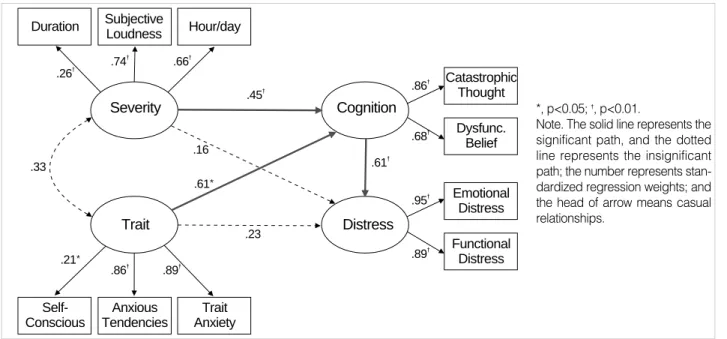
As described above, SEM not only enables us to find the correlation, but also enables us to confirm relationships, and even gain additional insight into the causal nature and strength of those relationships. The result of the calculation of the model fit was over 0.90, which is the generally acceptable standard (28). It can be seen as a good model, seeing as the NFI, IFI, TLI, and CFI were close to 1.0, thus suggesting that the hypothesized model is good (Table 2). RMSEA, which is known as the strictest standard was 0.076 and it was the
‘reasonable fit’, being less 0.08 (29). It can be seen as a valid model (Fig. 1).
That model explains that the severity of tinnitus and per- sonality trait affect distresses from tinnitus via cognitive char- acteristics like catastrophic thoughts and dysfunctional beliefs, but having no significant direct effect. Cognitive character- istics mediate between the severity of tinnitus and distresses from tinnitus and between personality traits of patients and distresses caused by tinnitus.
This result indicates that cognitive characteristics such as catastrophic interpretation and dysfunctional beliefs about
tinnitus are important factors for the treatment and psycho- logical adaptation of tinnitus patients.
DISCUSSION
The results of previous studies showed that many patients with tinnitus suffered from emotional distresses, especially depression (3, 6-11). Therefore, it is necessary to consider what causes patients’ emotional discomfort. If it comes from tinni- tus itself, the therapist should try to reduce clinical features of tinnitus such as loudness. On the other hand, if it is due to other features such as cognition or personality, the therapist should try to search for an adequate treatment for mitigating psychological distresses. If we can find some features which explain patients’ distresses from tinnitus, it will help their psychological adaptation.
Taking into consideration that previous results demonstrat- ed that the loudness of tinnitus was not a dominant factor (13), this study was designed to investigate the cognitive char- acteristics that affect emotional and functional distresses from tinnitus, to test the causal relations among the clinical features of tinnitus itself, the postulated personality trait, and the cog- nitive characteristics affecting distresses. For this investigation, the model was hypothesized and its fit indices were inspected.
The results showed that the model showed reasonable fit- ness and it was evaluated as a valid model. The model sug- gested that the direct effects of the trait or severity of tinni- tus on distresses from tinnitus did not seem to be significant, and it appeared to be affecting indirectly through cognitive characteristics such as catastrophic interpretation and dysfunc- tional beliefs about tinnitus and its results. This result indi-
Subjective Loudness
Catastrophic Thought
Dysfunc.
Belief
Emotional Distress
Functional Distress
Anxious Tendencies
Trait
.21* .86�
.74� .66� .26�
.33
.23 .61*
.16
.89�
.45�
.61� .86�
.68�
.95�
.89�
Severity
Distress Cognition
Trait Anxiety Self-
Conscious
Duration Hour/day
*, p<0.05; �, p<0.01.
Note. The solid line represents the significant path, and the dotted line represents the insignificant path; the number represents stan- dardized regression weights; and the head of arrow means casual relationships.
Fig. 1. The model for distresses from tinnitus.
cates that cognitive characteristics mediate between severity and distresses from tinnitus, and play an important role for the psychological adaptation of patients suffering from tin- nitus. That is, although patients suffer from tinnitus for a relatively short period or have less loud tinnitus, if they have catastrophic thoughts such as ‘they cannot escape from their tinnitus’, ‘tinnitus is a terrible disease’, or ‘they have no con- trol over their tinnitus’, they may have more emotional and functional distresses-become more anxious or depressed.
On the basis of examining such results, extra interventions are considered in addition to treating the clinical features of tinnitus in order to help the psychological adaptation of tin- nitus patients. It appears to be useful to deal with cognitive characteristics such as vulnerability in patients with tinnitus.
This result shows that cognitive interventions can be helpful for physical symptoms and important for the psychological adaptations of tinnitus patients. This is consistent with the result of Lee et al.’s study (30) that dysfunctional belief medi- ates or moderates the loudness of tinnitus for emotional dis- tress. In addition, Scott et al. (31) suggested that the most important predictors of discomforts from tinnitus and adap- tation to tinnitus were cognitions such as controllability. In this context, Tinnitus Retraining Therapy was performed;
recently Cognitive Behavioral Therapy (CBT) is applicable to tinnitus patients (32). Anderson (32) stated that the cogni- tive and emotional aspects of tinnitus were targeted in the CBT approach to treatment, and CBT could be effective in alleviating the distress caused by tinnitus. Also, Jeong et al.
(33) suggested that alternative therapies such as CBT besides traditional therapies were desirable. As a result of a recent study (34), even CBT by means of the Internet resulted in significant reduction of tinnitus-related distress, depression, and diary ratings of annoyance. It must be taken into account that psychological treatment such as CBT for tinnitus is aimed at reducing annoyance rather than eliminating the tinnitus itself (18).
Although these results are valuable for treatment, the results of this study should be interpreted carefully since there are only a few previous studies related to the cognitive aspects of tinnitus. Therefore, we suggest further studies be conduct- ed to replicate these results, namely to show that cognitive characteristics play an important role for the psychological adaptation of tinnitus patients, and the follow up effects of cognitive intervention for tinnitus patients.
One of the drawbacks of this study was that auditory eval- uation such as tinnitogram was not administered because we focused on the subjective severity of tinnitus. Thus, further studies should be conducted to examine the relations between the results of tinnitogram and cognition or distresses from tinnitus. Nevertheless, previous studies have shown that audi- tory features were not determinant factors for many distresses caused by tinnitus and the annoyance from tinnitus could be related to cognitive characteristics rather than auditory fea- tures such as pitch and loudness of tinnitus (14, 31).
In conclusion, cognitive characteristics such as catastrophic thoughts in relation with tinnitus play an important role in distresses caused by tinnitus; cognitive characteristics medi- ate between the severity of tinnitus and distresses from tin- nitus, and between personality traits of patients and annoy- ances from tinnitus. Thus, cognitive interventions such as CBT are useful for psychological adaptation. However, there is a need to further develop and evaluate these results.
REFERENCES
1. Budd RJ, Pugh R. Tinnitus coping style and its relationship to tinnitus severity and emotional distress. J Psychosom Res 1996; 41: 327-35.
2. Coles RR. Epidemiology of tinnitus: prevalence. J Laryngol Otol 1984; 9: 7-15.
3. Halford JB, Anderson SD. Anxiety and depression in tinnitus suffer- ers. J Psychosom Res 1991; 35: 383-90.
4. Koo JW, Lee WC, Kim HY, Choi BC, Oh MH, Park YP. Prevalence of tinnitus and hearing thresholds of a non-noise-exposed population with and without tinnitus. Korean J Occup Environ Med 1999; 11:
323-31.
5. Veen ED, Jacobs JB, Bensing JM. Assessment of distress associated with tinnitus. J Laryngol Otol 1998; 112: 258-63.
6. Hiller W, Goebel G. Psychiatric disorders and their degree of severity in patients with severe tinnitus and pain syndromes. In: Aran JM, Dauman R, editors, Tinnitus 91. Bordeaux France; Proceedings of the Forth International Tinnitus Seminar, 1991: 441-4.
7. Katon W, Sullivan MD, Russo J, Dobie R, Sakai C. Depressive symp- toms and measures of disability: a prospective study. J Affect Disord 1993; 27: 245-54.
8. Reich GE, Baker LJ. Personality characteristics of tinnitus patients.
J Laryngol Otol 1984; 9: 228-32.
9. Rizzardo R, Savastano M, Maron MB, Mangialaio M, Salvadori L.
Psychological distress in patients with tinnitus. J Otolaryngol 1998;
27: 21-5.
10. Stephens RD, Hallam RS. The crown-crisp experiential index in pa- tients complaining of tinnitus. Br J Audiol 1985; 19: 151-8.
11. Tyler RS, Baker LJ. Difficulties experienced by tinnitus sufferers. J Speech Hear Disord 1983; 48: 150-4.
12. Lindberg P, Scott B, Melin L, Lyttkens L. Long-term effect of psycho- logical treatment of tinnitus. Scand Audiol 1987; 16: 167-72.
13. Lindberg P, Scott B, Melin L, Lyttkens L. Behavioural therapy in the clinical management of tinnitus. Br J Audiol 1988; 22: 265-72.
14. Meikle MB, Vernon J, Johnson RM. The perceived severity of tinni- tus; some observations concerning a large population of tinnitus clin- ic patients. Otolaryngol Head Neck Surg 1984; 92: 689-96.
15. Sullivan MD, Katon W, Dobie R, Sakai C, Russo J, Harrop-Griffiths J. Disabling tinnitus: association with affective disorder. Gen Hosp Psychiatry 1988; 10: 285-91.
16. Sweetow RW. Cognitive behavioral modification in tinnitus manage- ment. Hear Instr 1984; 35: 14-9.
17. Sweetow RW. Cognitive aspects of tinnitus patient management. Ear Hear 1986; 7: 390-6.
18. Andersson G, Lyttkens L. A meta-analytic review of psychological treatments for tinnitus. Br J Audiol 1999; 33: 201-10.
19. Newman CW, Jacobson GP, Spitzer JP. Development of the Tinnitus Handicap Inventory. Arch Otolaryngol Head Neck Surg 1996; 122:
143-8.
20. Kim JH, Lee SY, Kim CH, Lim SL, Shin JN, Chung WH, Yu BH, Hong SH. Reliability and validity of a Korean adaptation of the Tin- nitus Handicap Inventory, Korean J Otholaryngol 2002; 45: 328-34.
21. Spielberger CD, Gorsuch RL, Lushene RE. Manual for the state-trait anxiety inventory. Pal. Alto, CA: Consulting Psychologist Press, 1970.
22. Kim JT. Relationship between trait anxiety and sociality. Masters Thesis. Korea University, 1978.
23. Uhlenhuth EH, McCarty T, Paine S, Warner T. The revised Anxious Thoughts and Tendencies (AT&T) scale: a general measure of anx- iety-prone cognitive style. J Affect Disord 1999; 52: 51-8.
24. Lim SL, Kim JH. Evaluation of catastrophizing and clinical applica- tion: a standardization study of Korean Anxious Thoughts and Ten- dencies Scale. Korean J Clin Psychol 2002; 21: 189-206.
25. Fenigstein A, Scheier MF, Buss AH. Public and private self-conscious- ness: assessment and theory. J Consult Clin Psychol 1975; 43: 522-7.
26. Kim EJ, Oh KJ. Cognitive and behavioral factors associated with persistence of depressive symptoms: 3 months’ follow-up study. Korean J Clin Psychol 1994; 13: 1-19.
27. Hong S. The criteria for selecting appropriate fit indices in structural equation modeling and their rat ionales. Korean J Clin Psychol 2000;
19: 151-77.
28. Bentler PM, Bonett DG. Significance tests and goodness of fit in the analysis of covariance structure. Psychol Bull 1980; 88: 588-606.
29. Browne MH, Cudeck R. Alternative ways of assessing model fit. In:
Bollen KA, Long JS, editors, Testing structural equation models. New- bury Park: California Sage, 1993; 136-62.
30. Lee SY, Lim SL, Hong SH, Lee DS, Kim JH. Dysfunctional beliefs of tinnitus patients who suffer from depression. Korean J Clin Psychol 2003; 22: 709-23.
31. Scott B, Lindberg P, Melin L, Lyttkens L. Predictors of tinnitus dis- comfort, adaptation and subjective loudness. Br J Audiol 1990; 24:
51-62.
32. Andersson G. The role of psychology in managing tinnitus: a cognitive behavioral approach. Semin Hear 2001; 22: 65-76.
33. Jeong SH, Kang SH, Lee ZN, Kang BJ, Rim HD. Review of psychi- atric approaches to tinnitus. J Korean Soc Biol ther Psychiatry 1997;
3: 250-7.
34. Andersson G, Stromgren T, Strom L, Lyttkens L. Randomized con- trolled trial of internet-based cognitive behavior therapy for distress associated with tinnitus. Psychosom Med 2002; 64: 810-6.