494
©The Korean Society of Food Science and Technology
원료삼의 증삼 및 건조 조건별 홍삼의 품질 및 기능성
김교연·신진기·이수원·윤성란·정헌식1·정용진2·최명숙3·이치무4·문광덕·권중호*
경북대학교 식품공학과, 1경북대학교 식품생물산업연구소, 2계명대학교 식품가공학과, 3경북대학교 식품영양학과, 4풍기인삼농협
Quality and Functional Properties of Red Ginseng Prepared
with Different Steaming Time and Drying Methods
Kyo-Youn Kim, Jin-Ki Shin, Su-Won Lee, Sung-Ran Yoon, Hun-Sik Chung1, Yong-Jin Jeong2,
Myung-Sook Choi3, Chi-Moo Lee4, Kwang-Deog Moon, and Joong-Ho Kwon*
Department of Food Science & Technology, Kyungpook National University
1Food and Bio-industry Institute, Kyungpook National University 2Department of Food Science & Technology, Keimyung University 3Department of Food Science & Nutrition, Kyungpook National University
4Punggi Ginseng Nonghyup
Abstract The quality and functional properties of red ginseng in relation to steaming and drying conditions were evaluated. Fresh ginseng (5-year roots), cultivated in the Punggi region, were steamed for 2.5, 3.5, or 4.5 hr, and then dried by hot-air (60-65oC/24 hr and 40oC/3-4 d), freezing (−80oC/56 hr), and infrared (900 W/62oC/68 hr). Hunter’s yellowness (b-value) and
browning indexes (420 nm) of the samples were higher in the rootlets than in the main roots. Furthermore, these same index values were found to be high in the order of 3.5, 4.5, and 2.5 hr and infrared, hot-air, and freezing for steaming and subsequent drying, respectively. Analysis of soluble solids, total phenolics, total flavonoids, acidic polysaccharides, and electron donating abilities of the steamed and dried samples showed that 3.5 hr of steaming with infrared drying was optimal. However, crude saponin contents were not influenced by steaming and drying conditions. The contents of ginsenoside-Rg1,
-Re, -Rf, and -Rb2, which were the major components in the samples, were reduced with steaming time, while the amounts
of -Rg3 and -Rh2 increased, reaching the highest levels at 3.5 and 4.5 hr in the main roots and rootlets, respectively. The
contents of -Rg3 and -Rh2 were similar in both the freeze-dried and hot-air dried samples.
Key words: red ginseng, steaming, drying, functional properties, ginsenoside
서 론 인삼은 식물 분류학상으로 두릅나무과(Araliaceae)의 인삼속 (Panax)에속하며 주로뿌리를 약재로이용한다. 여기서 ‘Panax’ 란어원은 희랍어로 Pan(all)과 Axos(cure)의복합어로만병을치 료한다는 뜻이다. 인삼의 성분은 약 60%의 탄수화물, 8-15%의 조단백질, 1-3%의조지방, 4-6%의회분, 3-7%의조사포닌, 그외 미량성분들로구성되어 있다(1). 인삼의유효성분인사포닌성분의화학적구조가구명된이후 부터본격적으로인삼의화학성분에대한연구가수행되어다당 체성분, 폴리아세칠렌계성분, 페놀계화합물, 정유성분, 펩티드, 알칼로이드, 비타민 등의성분분석 결과가 보고되었다. 또한인 삼의비사포닌 성분에서도 약효가있다고 밝혀져이에 대한다 각적인 연구가진행되고 있다(1). 지금까지 알려진 인삼의 약리 작용 및임상효과로는 중추신경 억제및 흥분작용, 단백질 및 핵산생합성촉진작용, 조혈작용, 동맥경화예방, 혈당강하 작 용, 항피로 및항스트레스 작용등이 있는데(1,2), 이와같은 작 용은 대개인삼사포닌의작용에기인하는것으로이해되고있다. 인삼제품은 크게수삼, 백삼, 홍삼으로구분한다. 수삼은가공 하지 않은 상태의 인삼을 말하며, 백삼은 4년근이상의 수삼을 원료로하여표피를제거하거나제거하지않고그대로건조하여 수분함량이 15% 이하가되도록가공한원형유지제품으로유백 색, 난백색이나 담황색을띤다. 백삼의 제조에는 태양열에의한 천일건조 또는 40-50oC의 열풍건조가 이용되기 때문에 amylase, invertase 등의활성이잔존한다. 홍삼은수삼을세척, 증자, 건조 및정형등의과정을거쳐수분함량이 14% 이하가되도록가공 하는데, 제조가공처리에 의해저장성이향상되고 사포닌의변형, 아미노산의 변화, 갈변화 등의화학적인변화가일어나서담적갈 색, 담황갈색, 다갈색또는농다갈색의색상을가진단단한형태 의제품이된다(2). 이러한홍삼의특징은원료의산지와재배년 수는물론이고 제조방법에의해크게영향을받는데, 이에대한 연구는부족한실정이다. 따라서본연구에서는 5년근경북풍기산수삼으로만든홍삼 의품질향상을위한제조방법개선을위하여증자시간과건조방 법이홍삼의품질및기능성성분에미치는영향을검토하였다.
*Corresponding author: Joong-Ho Kwon, Department of Food Sci-ence & Technology, Kyungpook National University, Daegu 702-701, Korea
Tel: 82-53-950-5775 Fax: 82-53-950-6772 E-mail: [email protected]
재료 및 방법 재료 경북풍기지역에서 생산된 2005년산 5년근수삼을 홍삼제조 용원료로사용하였다. 아래에서 언급한증자와건조조건에따 라제조한홍삼을본근과지근으로나누고분쇄(100 mesh 이하) 하여분석용시료로사용하였다. 증자, 건조 및 추출 조건 증자 조건으로 증자시간을 2.5, 3.5, 4.5시간으로 각각 구분 하여 열풍건조(60-65oC, 24시간 및 40oC, 3-4일)하고 품질특성 을 비교 평가하였다. 여기서 증자시간 3.5시간과 열풍건조 조 건은 현재상업적으로 이용되고 있는 조건범위이다. 건조 조건 은 3.5시간 증자한 시료를 대상으로 열풍건조(60-65oC, 24시간 및 40oC, 3-4일), 동결건조(−80oC, 56시간) 및 원적외선건조(900 W, 62oC, 68시간)로 구분하여 건조조건별 품질특성을 비교 평 가하였다. 추출물은 증자 및건조 조건별 홍삼시료 분말 1 g에 50% 에탄올 50 mL를 가하여 실온(20oC)에서 24시간 shaking (150 rpm)한후 Whatman No. 41 여과지로 여과하여 실험용 추 출물을 제조하였다. 색도 및 갈변도 측정
분말과 50% 에탄올추출물의색도는 Hunter lab. optical sensor
(D25, Reston, VA, USA)로 Hunter color parameter(L, a, b, ∆E) 를측정하였다. 이때표준 백판의 L, a, b 값은 각각 90.6, 0.4,
3.3이었다. 시료의 갈변도는 50% 에탄올 추출물을가지고
spec-trophotometer(UV-1601, Shimadzu, Tokyo, Japan)을 이용하여
420 nm에서흡광도를측정하였다(3). 화학성분 및 기능성 측정 가용성고형분 함량은상기와 같이제조한 50% 에탄올 추출 액 2 mL를미리항량을구한 칭량접시에취하여 105oC에서증발 건조시킨후그무게를측정하였으며, 추출물조제에사용된원 료량에 대한백분율로서 나타내었다(4). 총페놀성 화합물의 함 량측정은 Folin-Denis법(5)을일부변형하여사용하였다. 즉, 50% 에탈올추출물 1 mL에 Folin시약 1 mL을혼합하여실온에서 3분 간정치한뒤 10% Na2CO3용액 1 mL을가하여혼합한 후실온 에서 1시간정치한다음 700 nm에서흡광도를측정하였다. 표준 곡선의 작성은 caffeic acid를 1-50µg/mL의 농도로조제하여 작 성하였다. 총플라보노이드함량은 50% 에탄올추출물시료 0.5
mL를시험관에각각분취하여 ethyl alcohol 1.5 mL, 10%
alumin-ium nitrate 0.1 mL, 1 M potassalumin-ium acetate 0.1 mL와 증류수 2.8
mL을 가하여 충분히 교반한 후 실온에서 40분간 방치한 다음 410 nm에서 흡광도를 측정하였다(6). 표준곡선은 hesperidin을 0-100 mg%의농도로조제하여작성하였다. 산성다당체함량은 carbazole-sulfuric acid 방법(7)으로 측정하였 다. 즉, 50% 에탄올추출액 0.5 mL에 carbazole 0.25 mL와 conc-H2SO4 3 mL를넣은후 80oC에서 5분간반응시킨다음실온에서 15분간방치한것을 525 nm에서흡광도를측정하였다. 전자공여 능은 Blois(8)의방법을변형하여측정하였다. 즉, 50% ethanol 추 출액 0.5mL에 α,α'-diphenyl-β-picrylhydrazyl(DPPH) 12mg에 100% 에탄올 100 mL를가하여 녹인후 517 nm에서흡광도가 1.0이될 때까지 50% 에탄올을가하여조제한 DPPH 용액을 5 mL 가하 여교반한후 흡광도를측정하였다. 전자공여능(%)은 100−[(시 료첨가구의흡광도/무첨가구의 흡광도)×100]으로계산하였다. 아질산염소거능은 Kato 등(9)의방법으로측정하였다. 즉, 50% 에탄올추출물 1 mL에 1 mM NaNO2용액 1 mL을가한후 0.1 N HCl(pH 1.2), 0.2 M 구연산완충액(pH 3.0, 4.2, 6.0)을사용하여 반응용액의 pH를각각 1.2, 3.0, 4.2, 6.0 으로조정한후각반응 용액을 10 mL로정용하였다. 각반응 용액을 37oC에서 1시간 동 안반응시킨후 1 mL을취하여 2% 초산용액 5 mL을첨가한다 음 griess 용액을 0.4 mL 가하여혼합한 후실온에서 15분간 방 치한 후 520 nm에서 흡광도를 측정하였다. 아질산염 소거능(%) 은 (1− 무첨가구의 흡광도/시료첨가구의 흡광도)×100으로계산 하였다. 조사포닌 및 ginsenoside 분석 홍삼분말 5 g에 80% methanol 50 mL를 가하여 100 W에서
microwave를 3분간조사한 후 추출액을 여과(Whatman No. 41) 하였다(4). 이러한추출과정을 3회반복실시하여추출액을합하 고 55oC에서감압농축한다음 잔여물을증류수를이용해 50 mL 로정용하였다. 이것을 분액깔대기에 넣어 diethyl ether(50 mL) 가용성성분들을제거한다음 남은수층에는수포화부탄올을가 해 (30 mL씩 3회) n-butanol 층으로이행된 saponin을 1/2로나누 어 55oC에서농축시켜 crude saponin으로정량하였다(10). 나머지 1/2은 농축 후 methanol 1 mL로 용해한 후 0.45µm membrane
filler로 여과하여 high performance liquid chromatograph(Jasco
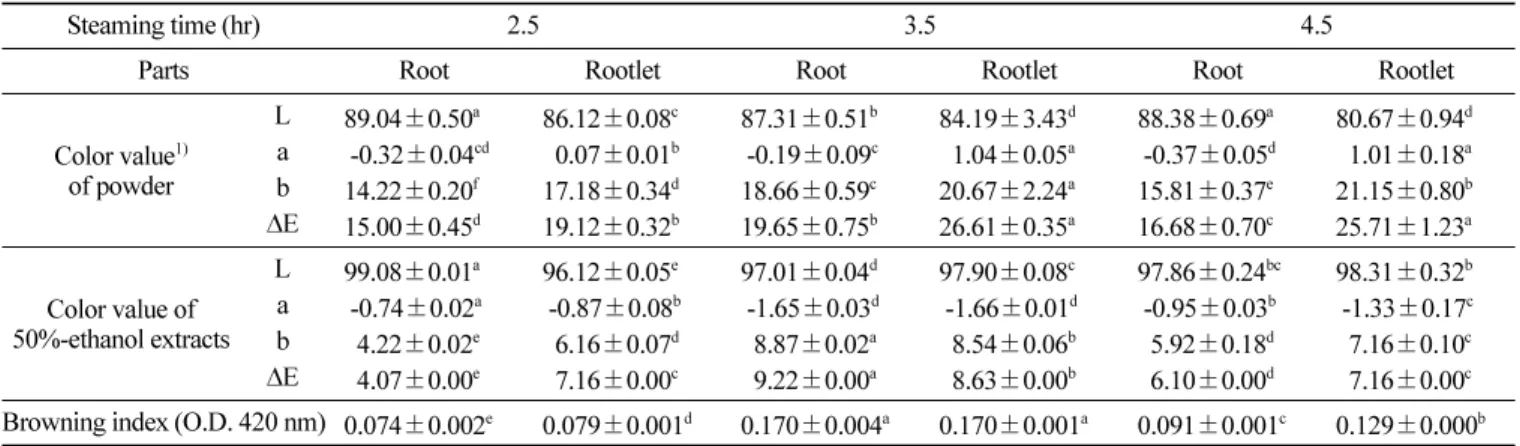
PU-980, Tokyo, Japan)로 ginsenoside를분리정량하였다(10). 이때 의분석조건으로컬럼은 Merck chromolith, 검출기는 UV(203 nm), 이동상은 10% methanol + 80% acetonitrile, 이동상 유량속도는 2.5 mL/min 및시료주입량은 20µL이었다. 통계 처리 모든측정은 시료당 3회반복 실시하였고, 측정결과는 SAS에 의한분산분석과 Duncan의다중검정으로 통계적유의성을검정 하였다(11). 결과 및 고찰 증자 및 건조 조건에 따른 색도 및 갈변도 증자시간을 달리하여 제조한 홍삼의 기계적색도와 갈변도를 측정한 결과는 Table 1에나타내었다. 증자시간에 따른홍삼 분 말및 50% 에탄올추출액의색도는홍삼본체에비해지근에서 높은 황색도(b값) 및갈변도(420 nm)를보인 반면, 낮은 명도(L 값)를나타내었다. 증자시간에따른경향에서는 3.5시간, 4.5시간, 2.5시간의순으로높은황색도와전반적인색차(∆E)를보였을뿐 아니라갈변도에있어서도가장높은값을보였다. 이는 Yoon 등 (3)의보고에서수삼원료의증자처리에서갈색도는가열온도와가 열시간이증가할수록증가하는보고와다소상이한결과를보였다. 건조방법에 따른홍삼의 기계적색도와 갈변도를측정한 결 과는 Table 2에나타내었다. 건조방법에따른 시료부위별색도 는원적외선처리된 50% 에탄올추출물을제외하고는지근이본 근에 비해유의적으로 높은황색도와 전반적인 색차크기를 보 였다(Table 2). 그러나 추출물의 갈변도에서는 건조방법에 따라 시료부위별 차이가일관성을보이지않았다. 건조방법별분말의 황색도는 열풍건조나 동결건조에 비해원적외선 건조 시료에서 높은 값을보였으며, 전반적 색차에서도 동일한 양상이었다. 그 러나에탄올 추출물의황색도와 갈변도는원적외선건조, 열풍건 조, 동결건조의순으로유의적으로높은값을나타내었다(p< 0.01). 이같은결과는동결건조나열풍건조에비해 원적외선건조가증
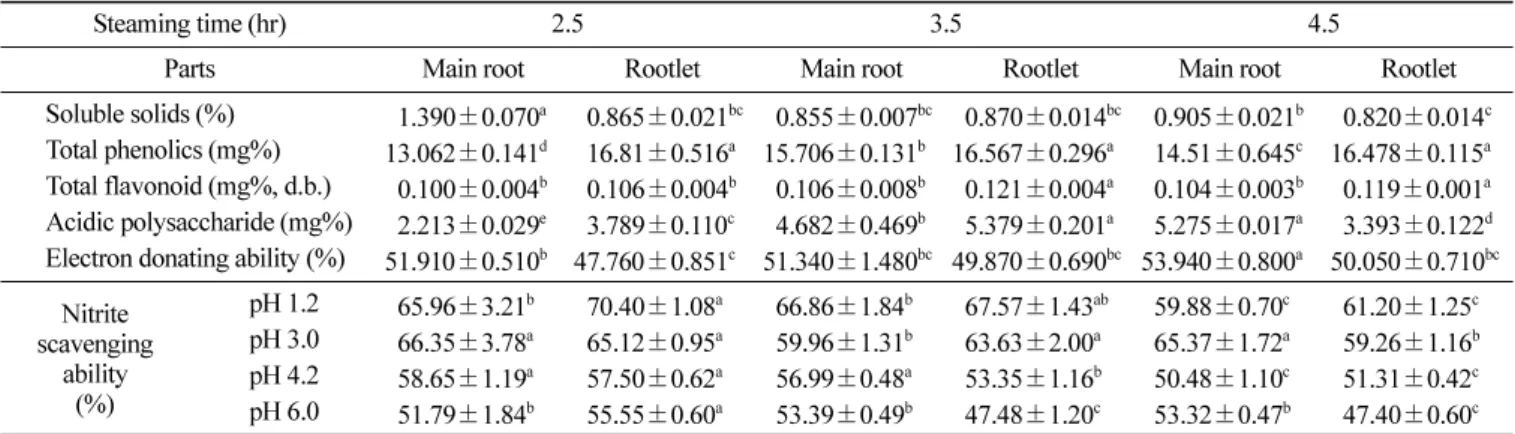
자된수삼시료의 갈변반응에 더큰영향을 미치는것으로 판단 되었다. 증자 및 건조 조건에 따른 화학성분 및 기능성 증자시간을달리하여제조한홍삼의화학성분및기능성으로 서가용성고형분, 총페놀, 총플라보노이드, 산성다당체, 항산 화성, 아질산염 소거능등을 분석한결과는 Table 3에나타내었 다. 가용성고형분은홍삼본근의경우 2.5시간에서가장높은값 을, 지근의 경우 4.5시간에서 가장 낮은 값을 각각 보였으나 (p< 0.01), 그외는증자시간에따른유의적인차이는없었다. Park 등(12)은홍삼의경우가열온도가 증가할수록 가용성고형분함 량이감소하는 것으로보고한바있다. 총페놀과총플라보노이 드함량은각각증자 3.5, 4.5, 2.5시간의순으로높은값을보였 다. 시료의전자공여능은 증자시간 2.5시간에비해 3.5, 4.5시간 에서높게나타났으며, 산성다당체는본체는 4.5시간, 지근은 3.5 시간 증자시료에서 가장 높은 값을보였다. Do 등(7)은 인삼의 다당체는홍삼제조중증자에의해가용화되기쉬운상태로되 어더많이추출되는것으로보고되었지만, 본연구에서는시료 의부위에따라 최적증자시간이다름을확인하였다. 또한 pH 조 건을 달리하여아질산염 소거능을측정한결과, 증자시료의 아질 산염 소거능은 pH 1.2와 3.0에서 높은값을 보였다. 그리고 모든 pH에서유사하게 3.5시간 이상의장시간 증삼은 아질산염소거 능의감소를초래하는 것으로확인되었으며, 이같은현상은 본 삼에 비해지근에서뚜렷하였다. 따라서원료수삼의증자 시간은 3.5시간범위가양호한것으로나타났다. 건조조건을달리하여제조한홍삼의화학성분및기능성을측 정한 결과는 Table 4에나타내었다. 가용성고형분의 함량은 본 삼(0.560-0.740%)이지삼(0.535-0.850%)에비해낮은값을보였으 며 열풍건조, 원적외선건조, 동결건조의 순으로높은 함량을 나 타내었다. 이는 Yoon 등(3)의가열처리를하지 않은인삼이 가열 처리한인삼보다낮은 가용성고형분함량을보였다는결과와일 치하였다. 시료의총페놀, 총플라보노이드및산성다당체함량 은본근에비해지근에서 각각높은함량을보였다. 건조방법에 서는 열풍건조시료에서 총페놀과 산성다당체 함량이타건조
Table 1. Color values and browning index of red ginseng prepared with different steaming time
Steaming time (hr) 2.5 3.5 4.5
Parts Root Rootlet Root Rootlet Root Rootlet Color value1) of powder L 089.04±0.50a 086.12±0.08c 087.31±0.51b 084.19±3.43d 088.38±0.69a 080.67±0.94d a 0.-0.32±0.04cd 000.07±0.01b 0.-0.19±0.09c 001.04±0.05a 0.-0.37±0.05d 001.01±0.18a b 014.22±0.20f 017.18±0.34d 018.66±0.59c 020.67±2.24a 015.81±0.37e 021.15±0.80b ∆E 015.00±0.45d 019.12±0.32b 019.65±0.75b 026.61±0.35a 016.68±0.70c 025.71±1.23a Color value of 50%-ethanol extracts L 099.08±0.01a 096.12±0.05e 097.01±0.04d 097.90±0.08c 097.86±0.24bc 098.31±0.32b a 0.-0.74±0.02a 0.-0.87±0.08b 0.-1.65±0.03d 0.-1.66±0.01d 0.-0.95±0.03b 0.-1.33±0.17c b 004.22±0.02e 006.16±0.07d 008.87±0.02a 008.54±0.06b 005.92±0.18d 007.16±0.10c ∆E 004.07±0.00e 007.16±0.00c 009.22±0.00a 008.63±0.00b 006.10±0.00d 007.16±0.00c
Browning index (O.D. 420 nm)00.074±0.002e 00.079±0.001d 00.170±0.004a 00.170±0.001a 00.091±0.001c 00.129±0.000b
1)L: Degree of lightness (white +100↔ 0 black). a: Degree of redness (red +100↔ -80 green).
b: Degree of yellowness (yellow +70↔ -80 blue). ∆E: Overall color difference ( ).
a-dMeans ± SD (n = 3) within the same row with different superscript letters are significantly different at p< 0.01. Table 2. Color values and browning index of red ginseng with different drying methods
Drying methods Commercial hot-air drying Freeze drying Far-infrared drying Parts Root Rootlet Root Rootlet Root Rootlet Color value1) of powder L 087.05±1.06a 082.82±0.19d 084.89±0.42b 083.20±0.74cd 084.83±0.13b 084.02±0.54bc a 0.-0.15±0.08c 000.53±0.08a 0.-0.02±0.04c 000.32±0.14b 000.52±0.04a 000.44±0.11ab b 018.62±0.20c 020.93±0.24b 018.57±0.39c 021.77±0.72a 020.26±0.27b 020.11±0.66b ∆E 019.77±0.64d 024.12±0.31a 020.98±0.57c 024.55±1.02a 022.38±0.30b 022.73±0.85b Color value of 50%-ethanol extracts L 098.00±0.06b 097.66±0.30b 097.75±0.35b 096.88±0.28 c 095.24±0.16d 098.44±0.08a a .0-1.72±0.02b 0.-1.86±0.03c 0.-0.62±0.03a 0.-0.65±0.01a 0.-2.54±0.04d 0.-1.72±0.03b b 008.87±0.08c 009.15±0.06b 004.96±0.13f 008.14±0.11e 013.68±0.02a 008.71±0.06d ∆E 008.93±0.00c 009.32±0.00b 005.25±0.00f 008.46±0.00e 014.42±0.00a 008.67±0.00d
Browning index (O.D. 420 nm)00.204±0.002b 00.192±0.002c 00.104±0.001f 00.160±0.001e 00.363±0.002a 00.184±0.001d
1)L: Degree of whiteness (white +100↔ 0 black). a: Degree of redness (red +100↔ -80 green).
b: Degree of yellowness (yellow +70↔ -80 blue). ∆E: Overall color difference ( ).
a-dMeans ± SD (n = 3) within the same row with different superscript letters are significantly different at p< 0.01.
∆L2+∆a2+∆b2
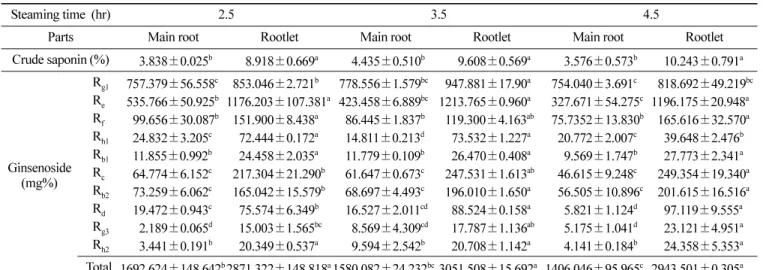
방법에비해유의적으로 낮은반면, 총플라보노이드 함량과전 자공여능은동결건조 시료에서가장낮은값을보였다(p< 0.01). 그러나 전반적인 경향에서는 건조방법에 따라 기능성의 변화는 크지않았다. Noh 등(13)은양배추의총페놀성화합물의함량은 건조의영향보다는추출용매나추출시간등의영향을받는다고 보고한바있다. 시료의아질산염소거능은 pH 3.0에서가장높 은값을보였으나건조방법별로는뚜렷한차이를보이지않았다. 이상의결과에서건조방법에따른홍삼시료의화학성분과기능 성은동결건조나 열풍건조에 비해 원적외선 건조시료에서 다소 양호한결과를보여주었다(Table 4). 증자 및 건조 조건에 따른 사포닌 및 ginsenoside 증자시간을달리하여제조한홍삼의조사포닌및 ginsenoside 함량을측정한 결과는 Table 5에나타내었다. 본근과 지근의비 교에서조사포닌 함량은각각 3.58-4.44%와 8.92-10.24%로지근 이본근에 비해높은것으로 확인되었다. 이는인삼의 사포닌성 분은표피부에 많이존재하므로 표피의 면적이넓은 지근이높 다고판단된다. 그러나시료의 조사포닌함량은증자시간에따라 유의적인변화를보이지않았다. Ginsenoside 패턴및함량을보 면모든시료에서 ginsenoside-Rg1, Re, Rf, Rb2등의 순으로높은 함량을차지하였으나, 이들의함량은 증자시간이길어질수록 감 소하는경향이었다. 그러나 항암성등기능성(1-3)이주목받고있 는 -Rg3 및 -Rh2의함량은 증자시간이길어질수록유의적으로증 가하였는데, 본근은 3.5시간, 지근은 4.5시간증자시료에서각각 가장높은함량을보여주었다(p< 0.01). 본시료는 diol 계열(Rb1, Rc, Rb2, Rd)에비해 triol 계열의 ginsenoside 함량이더높게나 타났다. 이는 Ryu(14)의보고에서와같이증자삼에서 triol계사포 닌의 종류와함량의증가는 diol계사포닌의 malonyl-ginsenoside 가증자에의해 malonyl기의분해로사포닌의구조적변화를일 으켰기때문이다. 건조조건을 달리하여 제조한홍삼의 조사포닌 함량및 ginse-noside 함량을 측정한 결과는 Table 6과 같다. 조사포닌 함량은 본근(3.61-5.42%)보다 지근(8.56-8.84%)의 함량이 높게 나타났으 며, 건조방법별차이는보이지않았다. 주요 ginsenoside의건조방 법에 따른 함량 차이를 보면, 열풍건조시료에서는 함량이 가장 많은 ginsenoside-Rg1만이 가장높은 함량을 보였고, 동결건조시 료에서는 -Re, -Rb2, -Rf, -Rg3, -Rh2 등이가장높은값을보였다. 한편 원적외선건조시료에서는 -Rh1, -Rc 및 -Rd의 함량이 가장 높았다. 이상의 결과에서 볼때증자된 시료의 건조방법을 gin-senoside 관점에서고려한다면동결건조방법(2,824 mg%)이열풍건 조(2,669 mg%)나 원적외선건조(2,667 mg%)에 비해 가장 타당한 것으로판단되었다. 그러나홍삼제조과정에서생성된 ginsenoside-Rg3 및 Rh2(1,13,14)의함량은동결건조와 열풍건조간에유의적 인 차이가 없지만, ginsenoside-Rg1을 제외한 나머지 ginsenoside 함량에서는 동결건조시료가상당히높은함량을보였다.
Table 3. Soluble solids, total phenolics, total flavonoid, acidic polysaccharide, electron donating ability, and nitrite scavenging ability of red ginseng prepared with different steaming time
Steaming time (hr) 2.5 3.5 4.5
Parts Main root Rootlet Main root Rootlet Main root Rootlet Soluble solids (%) 01.390±0.070a 00.865±0.021bc 00.855±0.007bc 00.870±0.014bc 00.905±0.021b 00.820±0.014c
Total phenolics (mg%) 13.062±0.141d 016.81±0.516a 15.706±0.131b 16.567±0.296a 014.51±0.645c 16.478±0.115a
Total flavonoid (mg%, d.b.) 00.100±0.004b 00.106±0.004b 00.106±0.008b 00.121±0.004a 00.104±0.003b 00.119±0.001a
Acidic polysaccharide (mg%) 02.213±0.029e 03.789±0.110c 04.682±0.469b 05.379±0.201a 05.275±0.017a 03.393±0.122d
Electron donating ability (%) 51.910±0.510b 47.760±0.851c 51.340±1.480bc 49.870±0.690bc 53.940±0.800a 50.050±0.710bc
Nitrite scavenging ability (%) pH 1.2 065.96±3.21b 070.40±1.08a 066.86±1.84b 067.57±1.43ab 059.88±0.70c 061.20±1.25c pH 3.0 066.35±3.78a 065.12±0.95a 059.96±1.31b 063.63±2.00a 065.37±1.72a 059.26±1.16b pH 4.2 058.65±1.19a 057.50±0.62a 056.99±0.48a 053.35±1.16b 050.48±1.10c 051.31±0.42c pH 6.0 051.79±1.84b 055.55±0.60a 053.39±0.49b 047.48±1.20c 053.32±0.47b 047.40±0.60c
a-e)Means ± SD (n = 3) within the same row with different superscript letters are significantly different at p< 0.01.
Table 4. Soluble solids, total phenolics, total flavonoid, acidic polysaccharide, electron donating ability, and nitrite scavenging ability of red ginseng with different drying methods
Drying methods Commercial hot-air drying Freeze drying Far-infrared drying Parts Main root Rootlet Main root Rootlet Main root Rootlet Soluble solids (%) 00.740±0.042a 00.815±0.021a 00.560±0.014b 00.535±0.035b 00.595±0.106b 00.850±0.424a
Total phenolics (mg%) 08.661±0.227e 10.082±0.150d 11.401±0.064b 11.833±0.225a 11.167±0.100b 10.766±0.150c
Total flavonoid (mg%) 00.141±0.004ab 00.142±0.003ab 00.101±0.003c 00.133±0.003b 00.153±0.004a 00.144±0.005a
Acidic polysaccharide (mg%) 02.501±0.077d 03.685±0.218abc 03.342±0.103c 04.034±0.344a 03.619±0.158bc 03.931±0.185ab
Electron donating ability (%) 47.640±1.780a 49.900±0.290a 37.640±1.360b 30.280±0.950c 49.420±0.580a 38.350±0.860b
Nitrite scavenging ability (%) pH 1.2 58.034±2.51b 61.980±1.46a 54.409±2.78c 49.874±1.25d 52.900±2.25cd 58.591±1.43ab pH 3.0 60.250±1.94bc 62.066±1.88b 55.808±2.37de 65.904±2.54a 53.425±1.16e 58.328±0.21cd pH 4.2 50.930±0.73a 51.192±1.22a 47.146±1.23b 50.619±0.71a 46.247±0.49b 46.961±0.49b pH 6.0 40.939±0.64c 45.396±0.50a 45.065±0.69ab 45.800±0.89a 46.742±1.50a 43.666±0.86b
요 약 경북풍기산 원료삼의 증자 및건조 조건별 홍삼의 품질 및 기능성을 알아보기 위해 5년 근을대상으로 증자 조건(2.5, 3.5, 4.5시간)과건조조건(열풍건조: 60-65oC/24시간, 40oC/3-4일, 동결 건조: −80oC/56시간, 원적외선건조: 900 W/62oC/68시간) 별로이 화학적특성과 ginsenoside 함량을비교분석하였다. 시료의황색 도와갈변도는지근이본근에비해 높은수치를 보였으며, 증자 시간 3.5, 4.5, 2.5시간의순으로그리고, 원적외선건조, 열풍건조, 동결건조의순으로 높은수치를보였다. 증자및건조시료의가 용성고형분, 총페놀, 총플라보노이드, 산성다당체, 전자공여능 등의특성은 3.5시간증자와 원적외선건조가가장양호한결과 를보였다. 조사포닌함량은증자시간 및건조방법에 영향을받 지않았다. 함량이 높은 ginsenoside-Rg1, -Re, -Rf, -Rb2 등은증 자시간이길어질수록 감소하였으나 -Rg3및 -Rh2의함량은유의 적으로 증가하여 본근은 3.5시간, 지근은 4.5시간 증자시료에서 가장 높은 함량을 보였다(p< 0.01). 증자 시료의 건조방법을 ginsenoside 관점에서 고려한다면 동결건조방법(2,824 mg%)이열 풍건조(2,669 mg%)나원적외선건조(2,667 mg%)에비해가장타당 한 것으로판단되며, ginsenoside-Rg3 및 Rh2의함량은 동결건조 와열풍건조간에유의적인차이가없었다. 감사의 글 본논문은농림기술개발사업에의해 수행된연구결과이며, 지 원에감사드립니다. 문 헌
1. KG & TRI. New Korean Ginseng. Korea Ginseng & Tabacco Research Institute. Daejeon, Korea. pp. 13-260 (1996)
2. Park CK, Kwak YS, Hwang MS, Kim SC, Do JH. Trends and prospect of ginseng products in market health functional food. Food Sci. Ind. 40: 30-45 (2007)
3. Yoon SR, Lee MH, Park JH, Lee IS, Kwon JH, Lee GD. Changes in physicochemical compounds with heating treatment of ginseng. J. Korean Soc. Food Sci. Nutr. 34: 1572-1578 (2005) 4. Kwon JH, Bélanger JMR, Paré JRJ. Optimization of
microwave-assisted extraction (MAP) for ginseng components by response surface methodology. J. Agr. Food Chem. 51: 1807-1810 (2003) 5. Amerine MA, Ough CS. Method for analysis of musts and wine.
Table 5. Crude saponin and ginsenoside of red ginseng prepared with different steaming time
Steaming time (hr) 2.5 3.5 4.5
Parts Main root Rootlet Main root Rootlet Main root Rootlet Crude saponin (%) 0003.838±0.025b 0008.918±0.669a 0004.435±0.510b 0009.608±0.569a 0003.576±0.573b 0010.243±0.791a Ginsenoside (mg%) Rg1 0757.379±56.558c 0853.046±2.721b 0778.556±1.579bc 0947.881±17.90a 0754.040±3.691c 0818.692±49.219bc Re 0535.766±50.925b 1176.203±107.381a0423.458±6.889bc 1213.765±0.960a 0327.671±54.275c 1196.175±20.948a Rf 0099.656±30.087b 0151.900±8.438a 0086.445±1.837b 0119.300±4.163ab 075.7352±13.830b 0165.616±32.570a Rh1 0024.832±3.205c 0072.444±0.172a 0014.811±0.213d 0073.532±1.227a 0020.772±2.007c 0039.648±2.476b Rb1 0011.855±0.992b 0024.458±2.035a 0011.779±0.109b 0026.470±0.408a 0009.569±1.747b 0027.773±2.341a Rc 0064.774±6.152c 0217.304±21.290b 0061.647±0.673c 0247.531±1.613ab 0046.615±9.248c 0249.354±19.340a Rb2 0073.259±6.062c 0165.042±15.579b 0068.697±4.493c 0196.010±1.650a 0056.505±10.896c 0201.615±16.516a Rd 0019.472±0.943c 0075.574±6.349b 0016.527±2.011cd 0088.524±0.158a 0005.821±1.124d 0097.119±9.555a Rg3 0002.189±0.065d 0015.003±1.565bc 0008.569±4.309cd 0017.787±1.136ab 0005.175±1.041d 0023.121±4.951a Rh2 0003.441±0.191b 0020.349±0.537a 0009.594±2.542b 0020.708±1.142a 0004.141±0.184b 0024.358±5.353a Total 1692.624±148.642b2871.322±148.818a1580.082±24.232bc3051.508±15.692a 1406.046±95.965c 2943.501±0.305a
a-c)Means ± SD (n = 3) within the same row with different superscript letters are significantly different at p< 0.01. Table 6. Crude saponin and ginsenoside of red ginseng prepared with different drying methods
Drying methods Commercial hot-air drying Freeze drying Far-infrared drying Parts Main root Rootlet Main root Rootlet Main root Rootlet Crude saponin (%) 0003.610±0.489b 0008.839±0.539a 0004.683±0.438b 0008.643±0.283a 0005.416±1.763b 0008.556±0.593a Ginsenoside (mg%) Rg1 0667.586±28.855a 0689.373±5.932a 0520.570±0.213b 0669.706±67.454a 0562.400±1.535b 0694.118±112.703a Re 0380.578±19.479c 1030.086±6.175b 0525.854±148.801c1679.965±10.494a 0361.528±844.537c0844.538±112.703b Rf 0070.985±9.196c 0134.620±1.183a 0082.328±4.931bc 0089.751±1.541bc 0079.100±20.590bc0113.069±26.301ab Rh1 0009.229±2.782e 0011.396±0.770e 0030.791±2.154d 0091.311±2.176a 0037.509±1.639c 0044.811±0.183b Rb1 0009.769±0.871d 0023.206±0.207a 0012.459±0.799cd 0016.660±0.622bc 0012.724±4.665cd 0020.235±2.851ab Rc 0051.637±5.412d 0219.463±0.354a 0074.507±7.139cd 0150.874±1.772b 0077.335±20.017c 0206.050±9.739a Rb2 0061.718±5.888c 0170.606±0.622a 0081.897±5.358c 0114.976±0.881b 0077.335±17.327c 0151.130±20.123a Rd 0006.458±0.697d 0081.633±1.504a 0024.714±3.267c 0051.304±1.503b 0048.380±3.880b 0074.308±11.575a Rg3 0012.589±1.046bc 0018.967±2.136a 0013.625±2.058b 0016.492±0.859ab 0007.549±3.651c 0008.310±0.530c Rh2 0008.799±1.343c 0017.949±0.842a 0009.778±1.930c 0014.364±0.845b 0005.513±1.730d 0008.986±0.809c Total 2669.323±149.137c4860.453±16.911b 2824.804±346.712c5971.115±165.270a2667.287±55.833c 4411.235±332.452b
Wiley & Sons, New York, NY, USA. pp. 176-180 (1980)
6. Lee JM, Son ES, Oh SS, Han DS. Contents of total flavonoid and biological activities of edible plants. Korean J. Diet. Culture 16: 504-515 (2001)
7. Do JH, Lee HO, Lee SK, Jang JK. Colorimetic determination of acidic polysaccharide of red ginseng on lipolitic action of toxo-hormone-L form panax ginseng, its extraction condition and sta-bility. Korean J. Ginseng Sci. 17: 139-144 (1993)
8. Blios MS. Antioxidant determinations by the use of a stable free radical. Nature 181: 1199-1203 (1958)
9. Kato H, Lee IE, Chuyen NV, Kim SB, Hayase F. Inhibition of nitrosamine formation by nondialyzable melanoidens. Agr. Biol. Chem. Tokyo 51: 1333-1338 (1987)
10. Lee CR, Whang WK, Shin CG, Lee HS, Han ST, Im BO, Ko
SK. Comparison of composition and contents in fresh ginseng roots cultivated in Korea, Japan, and China at various ages. Korean J. Food Sci. Technol. 36: 847-850 (2004)
11. SAS Institute, Inc. SAS User’s Guide. Statistical Analysis Sys-tems Institute, Cary, NC, USA (2003).
12. Park MH, Kim KC, Kim JS. Changes in the physicochemical properties of ginseng by roasting. Korean J. Ginseng Sci. 17: 228-231 (1993)
13. Noh JE, Choi YK, Kim HK, Kwon JH. Pre-establishment of microwave-assisted extraction condition for antioxidative extracts from cabbage. Korean J. Food Preserv. 12: 62-67 (2005)
14. Ryu GH. Present status of red ginseng products and its manufac-turing process. Food Ind. Nutr. 8: 38-42 (2003)