Time Trend and Age-Period-Cohort Effects on Acute Myocardial Infarction Mortality in Korean Adults from 1988 to 2007
We examined time trend and age-period-cohort effects on acute myocardial infarction (AMI) mortality in Korean adults from 1988 to 2007. Annual AMI mortality data and population statistics from 1988 to 2007 were obtained from the STATISTICS KOREA website. Age adjusted mortality for four 5-yr calendar periods (1988-1992 to 2003-2007) was calculated by direct standardization using the Year 2000 WHO world standard population. A log-linear Poisson regression model was used to estimate age, period, and cohort effects on AMI mortality. In both genders, age-adjusted AMI mortality increased from period one (1988-1992) to period three (1998-2002) but decreased in period four (2003-2007). An exponential age effect was noted in both genders. The rate ratio of the cohort effect increased up to the 1943 birth cohort and decreased gradually thereafter, and the rate ratio of the period effect increased up to period three (1998-2002) and decreased thereafter. Our results suggest that AMI mortality in Korean adults has decreased since the period 1998-2002 and age, period, and cohort effects have influenced on AMI mortality.
Key Words: Myocardial infarction; Mortality; Trends Hyung-Joon Jhun1, Ho Kim2,
and Sung-Il Cho3
1Center for Interventional Pain Management, Daejeon Woori Hospital, Daejeon; Departments of
2Biostatistics and 3Epidemiology, School of Public Health, Seoul National University, Seoul, Korea Received: 4 December 2010
Accepted: 17 March 2011 Address for Correspondence:
Sung-Il Cho, MD
Department of Epidemiology, School of Public Health, Seoul National University, 599 Gwanak-ro, Gwanak-gu, Seoul 151-742, Korea
Tel: +82.2-880-2717, Fax: +82.2-743-8240 E-mail: [email protected]
DOI: 10.3346/jkms.2011.26.5.637 • J Korean Med Sci 2011; 26: 637-641
INTRODUCTION
Ischemic heart disease, including acute myocardial infarction (AMI), is one of the most common causes of morbidity and mortality in developed countries (1). Korea has experienced marked economic growth over the past 40 yr, with an 80-fold increase in the per capita gross national income from US $250 in 1970 to US $20,000 in 2007 (2). Along with economic growth, Korean lifestyle and dietary patterns have become westernized.
Recently, heart disease was the third highest cause of mortality in Korean men and women; the mortality rates were 43.1 and 43.6, respectively, per 100,000 in 2008 (3).
An analysis of time trends is necessary to understand the natural history of a disease and establish public health policies.
A nationwide multicenter registry of AMI in Korea, the Korea Acute Myocardial Infarction Registry, was established in Novem- ber 2005, and studies that have evaluated clinical characteris- tics and treatment outcomes of AMI patients in Korea have been reported (4, 5). Hong et al. (6) analyzed data from the Korean National Health Insurance Database and reported time trends in the incidence of AMI in Korea from 1997 to 2007. Although these studies showed the recent epidemiology of AMI in Korea, they dealt only with relatively recent data and could not reveal long-term trends in AMI in Korea. Furthermore, no reported study has evaluated the nationwide time trend of AMI mortality in Korea.
Age, period, and birth cohort are important time-related vari- ables in epidemiology, and age-period-cohort (A-P-C) analysis has been used to analyze time trends of disease in populations (7, 8). Age effects are associated with different age groups, peri- od effects affect all ages simultaneously over time, and cohort effects involve changes among groups born in the same year.
Age effects reflect biological changes and are important in the development of chronic diseases. Period and cohort effects re- flect environmental changes. In particular, cohort effects repre- sent early exposure to environmental factors that have different health risks in different cohorts (9). Thus, in this study, we ex- amined time trend and age-period-cohort effects on AMI mor- tality in Korean adults from 1988 to 2007.
MATERIALS AND METHODS
The Statistics Korea provides annual data on cause-specific mor- tality and mid-year population estimates on the Korean Statisti- cal Information Service website at http://www.kosis.kr. These data are presented in five-year age groups (20-24, 25-29, ‥‥, 80 and higher). We used these data to calculate age-specific mor- tality by gender for 12 five-year age groups (20-24 to 75-79 yr) and four 5-yr calendar periods (1988-1992 to 2003-2007). We excluded the group of people aged 80 yr and older because a wide range of birth years was represented in that group and it was difficult to determine birth cohorts. Using the age and cal-
endar period classification, 15 overlapping 10-yr birth cohorts were identified and defined according to the central year of a birth cohort (1913, 1918, ‥‥, 1978, 1983).
To evaluate nationwide time trends in AMI mortality in Kore- an adults, the age-adjusted mortality for each period was calcu- lated by direct standardization using the Year 2000 World Health Organization (WHO) world standard population (10).
Poisson regression analysis was used to estimate age, period, and cohort effects on AMI mortality in Korean adults. This log- linear model uses a logarithmic link function between the out- come (y) variable, which was counts of AMI mortality cases with offset by the count of the denominator population, and the pre- dictor (x) variables: age, period, and cohort. The model was con- structed as y = μ + αiAge + βjPeriod + γkCohort + εijk, where y rep- resents the natural logarithm of counts of AMI mortality cases, μ is the intercept term, αi is the effect of age i, βj is the effect of period j, γk is the effect of cohort k, and εijk is an error term.. A-P- C analysis has an intrinsic problem in that a linear dependency exists among the age, calendar period, and birth cohort variables (C = P-A). However, a modeling approach to overcome this prob- lem using constraints of parameters has been proposed (11, 12).
Thus, the present study set age group seven (50-54 yr old), peri- od three (1998-2002) and birth cohorts eight and nine (1948 and 1953) as the constraints of the A-P-C model. The PROC GENMOD procedure in the SAS statistical package (ver. 9.1.3; SAS Institute, Inc., Cary, NC, USA) was used to conduct A-P-C analysis. The results of the A-P-C analysis are expressed as rate ratios of age, period, and cohort effects in graphical form (13).
RESULTS
AMI mortality rates in Korean men were different among age groups during the study period. Those of Korean men aged 20- 34 yr decreased steadily during the study period. Those of Kore- an men aged 35-39 yr increased from period one (1988-1992) to period two (1993-1997), but decreased thereafter. Those of Kore- an men aged 40-74 yr increased from period one to period three (1998-2002), but decreased in period four (2003-2007). Those of Korean men aged 75-79 yr increased steadily during the study period. Consequently, age-adjusted AMI mortality in Korean men increased from 17.62 per 100,000 in period one to 30.86 in period three, but decreased to 28.50 in period four. AMI mortal- ity rates in Korean women during the study period also differed among age groups. Those of Korean women aged 20-39 yr de- creased steadily during the study period. Those of Korean wom- en aged 40-44 yr increased from period one to period two, but decreased thereafter. Those of Korean women aged 45-74 yr in- creased from period one to period three, but decreased in peri- od four. Those of Korean women aged 75-79 yr increased steadi- ly during the study period. Consequently, age-adjusted AMI mor- tality in Korean women increased from 7.73 per 100,000 in pe-
riod one to 13.61 in period three, then decreased to 12.66 in pe- riod four (Table 1).
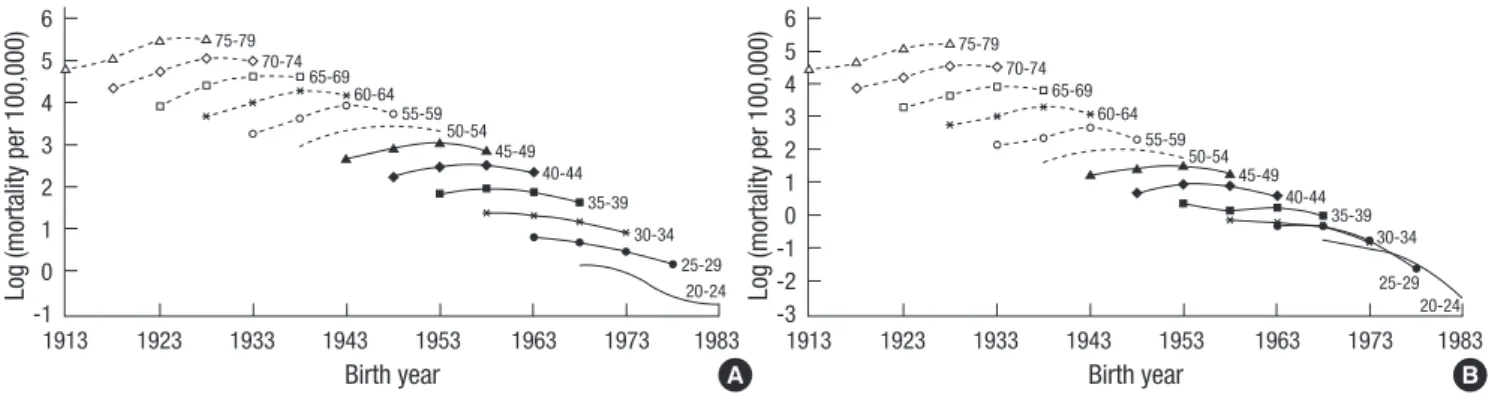
Fig. 1 shows age-specific mortality rates for AMI in Korean men and women with a natural logarithmic scale against birth year during the study period. In both men and women, age-spe- cific mortality rates in younger cohorts decreased during the period; however, those in older cohorts increased consecutive- ly, but mostly decreased in the last time period.
Fig. 2 shows estimates of age, period, and cohort effects on AMI mortality in Korean men and women with 95% confidence intervals (CI) derived from the A-P-C Poisson regression model.
An exponential age effect was noted in both genders. The rate ratio of the age effect in men increased exponentially from 0.08 (95% CI, 0.06-0.11) in the 20-24 yr-old group to 11.05 (95% CI, 9.01-13.55) in the 75-79 yr-old group compared with the 50-54 yr-old group (Fig. 2A). The rate ratio of the age effect in women increased exponentially from 0.16 (95% CI, 0.09-0.28) in the 20- 24 yr-old group to 33.59 (95% CI, 21.65-52.11) in the 75-79 yr-old group compared with the 50-54 yr-old group (Fig. 2C). The rate ratio of the cohort effect increased up to the 1943 birth cohort Table 1. Acute myocardial infarction mortality per 100,000 in Korean adults from 1988 to 2007 by gender and age group
Gender Age (yr) Calendar period
1988-1992 1993-1997 1998-2002 2003-2007
Male 20-24 1.15 0.95 0.53 0.45
25-29 2.25 1.95 1.57 1.17
30-34 3.99 3.76 3.18 2.46
35-39 6.27 7.02 6.48 5.08
40-44 9.58 11.93 12.29 10.32
45-49 14.52 18.60 21.01 17.37
50-54 19.46 28.03 30.80 27.98
55-59 26.18 37.75 51.16 41.97
60-64 39.36 54.50 71.60 64.48
65-69 50.29 81.92 101.81 100.46
70-74 76.81 114.02 155.15 146.24
75-79 120.82 157.50 241.42 248.45
Age- adjusted mortality*
17.62 24.30 30.86 28.50
Female 20-24 0.46 0.35 0.22 0.08
25-29 0.70 0.69 0.44 0.19
30-34 0.85 0.77 0.68 0.42
35-39 1.37 1.13 1.22 0.94
40-44 1.90 2.49 2.34 1.72
45-49 3.36 4.06 4.42 3.44
50-54 4.99 6.82 7.21 5.62
55-59 8.60 10.38 14.29 9.58
60-64 15.45 20.34 27.00 21.91
65-69 26.00 38.64 49.81 44.84
70-74 48.22 66.39 94.54 89.97
75-79 84.53 102.09 162.89 182.61
Age- adjusted mortality*
7.73 10.00 13.61 12.66
*Age-adjusted mortality was calculated by direct standardization using the Year 2000 WHO world standard population.
and decreased gradually thereafter in both men and women.
The rate ratio of the period effect increased up to the period 1998-2002 and decreased thereafter in both men and women (Fig. 2B, D).
DISCUSSION
We analyzed annual data on AMI mortality in Korean men and women from 1988 to 2007, obtained from the Statistics Korea website. Our results suggest that AMI mortality in Korean adults
Fig. 1. Age-specific mortality rates for acute myocardial infarction in Korean men (A) and women (B) on a natural logarithmic scale against birth year from 1988 to 2007.
Log (mortality per 100,000) Log (mortality per 100,000)
Birth year Birth year
75-79 75-79
70-74 70-74
55-59
55-59 65-69
65-69 50-54
50-54 40-44
40-44
30-34 30-34
60-64
60-64 45-49
45-49 35-39
35-39
25-29
25-29 20-24
20-24
1913 1923 1933 1943 1953 1963 1973 1983 1913 1923 1933 1943 1953 1963 1973 1983
6 5 4 3 2 1 0 -1
6 5 4 3 2 1 0 -1 -2 -3
A B
Fig. 2. Estimates (solid line) of age, birth cohort, and period effects on acute myocardial infarction mortality in Korean men (A, B) and women (C, D) with 95% confidence intervals (dashed line). Age effects are expressed as rate ratios relative to age 50-54 yr, cohort effects are expressed as rate ratios relative to the 1948 and 1953 birth cohorts, and period effects are expressed as rate ratios relative to the period 1998-2002.
Rate ratio
Age (yr)
Male Male
20 30 40 50 60 70 80
14 12 10 8 6 4 2
0 A
Rate ratio
Cohort (yr) Period (yr)
1913 1923 1933 1943 1953 1963 1973 1983 1988 1993 1998 2003 2008 1.2
1.0 0.8 0.6 0.4 0.2
0.0 B
Female Female
Rate ratio
Cohort (yr) Period (yr)
1913 1923 1933 1943 1953 1963 1973 1983 1988 1993 1998 2003 2008 1.4
1.2 1.0 0.8 0.6 0.4 0.2
0.0 D
Rate ratio
Age (yr)
20 30 40 50 60 70 80
55
44
33
22
11
0 C
has decreased since the period 1998-2002 and age, period, and cohort effects have influenced on AMI mortality.
The AMI mortality trend increased in the late 1980s and 1990s in men and women. However, a decreasing trend was observed in the 2000s. Our finding of a decreasing trend in AMI mortality among Korean adults must be confirmed by other studies be- fore it can be concluded that the downward trend will continue.
A rapid increase in mortality rates of ischemic heart disease was observed at the beginning of the twentieth century; however, a marked decrease in AMI mortality has been reported in most
Western countries over recent decades (14, 15). A decline in mor- tality from ischemic heart disease since 1970 has been reported in Japan (16). A decreasing trend of AMI mortality beginning in the early 1990s was reported in Hong Kong (17). Considering previous experiences of mortality from AMI or ischemic heart disease in most Western countries, Japan, and Hong Kong, a fur- ther decrease in AMI mortality is likely to be expected in Korean adults.
A study on the incidence of AMI in Korea from 1997 to 2007 based on data from the Korean National Health Insurance Da- tabase reported that the incidence of AMI increased from 43.5 per 100,000 in 1997 to 91.8 per 100,000 in 2007; however, the fa- tality rate of incident AMI cases decreased from 14.1% in 1997 to 10.8% in 2007. Although the incidence of AMI increased from 1997 to 2007, a change in growth pattern during the period was reported. A sharp increase of AMI incidence was noted from 1997 to 2002, but a relatively slow growth of AMI incidence was noted after 2002 (6). We think these results are consistent with ours. Decreased AMI mortality in period four (2003-2007) com- pared with that in period three (1998-2002) may be explained by slow growth of AMI incidence and decreased case fatality of AMI in period four. Increased awareness of AMI among doctors and the general public and improved care in coronary care units in recent decades likely contributed to the reduction in the case fatality rate of AMI in Korean adults between 2003 and 2007. The changes in incidence pattern and fatality of AMI between peri- ods may explain the period effect on AMI mortality in Korean adults.
It is well-known that incidence and mortality of AMI increase with age. Furthermore, age influences management of patients with AMI. In the clinical setting, elderly patients with AMI are likely to be treated less vigorously than younger patients. How- ever, studies have revealed that the prognosis of AMI is substan- tially affected by the development of left-ventricular failure and clinical indices rather than age. Thus, vigorous treatment is rec- ommended for elderly patients as well as younger patients (18, 19).
Koreans born after 1950 benefited from economic growth over the past 40 yr compared with those born before 1950. Fur- thermore, they benefited from the expanded medical coverage that accompanied that economic growth. We believe these fac- tors could explain the downward trend in AMI mortality in men and women born after 1950.
Although a trend towards a reduction in AMI mortality has been observed recently in Korean adults, the age-adjusted AMI mortality in period four was higher than that in period one. Thus, further efforts to reduce AMI mortality in Korean adults are need- ed. In particular, people in the older age groups and those born between 1940 and 1950 require interventions to reduce their likelihood of death from AMI.
REFERENCES
1. American Heart Association. Statistical Fact Sheet — Populations: 2009 Update. Available at http://www.americanheart.org/downloadable/
heart/1236204012112INTL.pdf [accessed on 1 Mar 2011].
2. The Bank of Korea. Economic statistics system. Available at http://ecos.
bok.or.kr/ [accessed on 1 Mar 2011].
3. Statistics Korea. Mortality statistics and causes of death in Korea, 2008.
Available at http://www.nso.go.kr/nso2006/k04___0000/k04b__0000/
k04ba_0000/k04ba_0000.html?method=view&board_id=144&seq=
85&num=85 [accessed on 1 Mar 2011].
4. Li YJ, Rha SW, Chen KY, Jin Z, Minami Y, Wang L, Dang Q, Poddar KL, Ramasamy S, Park JY, Oh DJ, Jeong MH; Korea Acute Myocardial In- farction Registry Investigators. Clinical characteristics and mid-term outcomes of acute myocardial infarction patients with prior cerebrovas- cular disease in an Asian population: lessons from the Korea Acute Myocardial Infarction Registry. Clin Exp Pharmacol Physiol 2010; 37:
581-6.
5. Sim DS, Jeong MH, Kang JC. Current management of acute myocardial infarction: experience from the Korea Acute Myocardial Infarction Reg- istry. J Cardiol 2010; 56: 1-7.
6. Hong JS, Kang HC, Lee SH, Kim J. Long-term trend in the incidence of acute myocardial infarction in Korea: 1997-2007. Korean Circ J 2009; 39:
467-76.
7. Robertson C, Boyle P. Age-period-cohort analysis of chronic disease rates.
I: Modelling approach. Stat Med 1998; 17: 1305-23.
8. Choi Y, Kim Y, Hong YC, Park SK, Yoo KY. Temporal changes of lung can- cer mortality in Korea. J Korean Med Sci 2007; 22: 524-8.
9. Kwon JW, Song YM, Park H, Sung J, Kim H, Cho SI. Effects of age, time pe- riod, and birth cohort on the prevalence of diabetes and obesity in Korean men. Diabetes Care 2008; 31: 255-60.
10. Ahmad OB, Boschi-Pinto C, Lopez AD, Murray CJ, Lozano R, Inoue M.
Age standardization of rates: a new WHO standard. Available at http://
www.who.int/healthinfo/paper31.pdf [accessed on 1 Mar 2011].
11. Holford TR. The estimation of age, period and cohort effects for vital rates.
Biometrics 1983; 39: 311-24.
12. Holford TR. Understanding the effects of age, period and cohort on inci- dence and mortality rates. Annu Rev Public Health 1991; 12: 425-57.
13. Carstensen B. Age-Period-Cohort models: Statistical inference in the Lex- is diagram. Available at http://staff.pubhealth.ku.dk/~bxc/Lexis/Lexis.
pdf [accessed on 1 Mar 2011].
14. Roger VL, Jacobsen SJ, Weston SA, Bailey KR, Kottke TE, Frye RL. Trends in heart disease deaths in Olmsted County, Minnesota, 1979-1994. Mayo Clin Proc 1999; 74: 651-7.
15. Gerber Y, Jacobsen SJ, Frye RL, Weston SA, Killian JM, Roger VL. Secu- lar trends in deaths from cardiovascular diseases: a 25-year community study. Circulation 2006; 113: 2285-92.
16. Ma E, Iso H, Takahashi H, Yamagishi K, Tanigawa T. Age-Period-Cohort analysis of mortality due to ischemic heart disease in Japan, 1955 to 2000.
Circ J 2008; 72: 966-72.
17. Yu IT, Li W, Wong TW. Effects of age, period and cohort on acute myo- cardial infarction mortality in Hong Kong. Int J Cardiol 2004; 97: 63-8.
18. White HD, Barbash GI, Califf RM, Simes RJ, Granger CB, Weaver WD, Kleiman NS, Aylward PE, Gore JM, Vahanian A, Lee KL, Ross AM, Topol EJ. Age and outcome with contemporary thrombolytic therapy. Results
from the GUSTO-I trial. Global Utilization of Streptokinase and TPA for Occluded coronary arteries trial. Circulation 1996; 94: 1826-33.
19. Barakat K, Wilkinson P, Deaner A, Fluck D, Ranjadayalan K, Timmis A.
How should age affect management of acute myocardial infarction? A prospective cohort study. Lancet 1999; 353: 955-9.
AUTHOR SUMMARY
Time Trend and Age-Period-Cohort Effects on Acute Myocardial Infarction Mortality in Korean Adults from 1988 to 2007
Hyung-Joon Jhun, Ho Kim, and Sung-Il Cho
We examined time trend and age-period-birth cohort effects on acute myocardial infarction (AMI) mortality in Korean adults from 1988 to 2007. We analyzed the data from the STATISTICS KOREA website. In both genders, AMI mortality increased from 1988 to 2002, but a decreasing trend was noted after 2003. An exponential age effect was noted in both genders. In relation to birth year, AMI mortality risk was highest in those who were born around 1943 and decreased gradually thereafter. With regard to period, AMI mortality risk was highest during 1998-2002 and decreased thereafter.