268
www.e-enm.orgEndocrinol Metab 2018;33:268-272 https://doi.org/10.3803/EnM.2018.33.2.268 pISSN 2093-596X · eISSN 2093-5978
Original Article
The Status and Distinct Characteristics of Endocrine
Diseases in North Korean Articles Published between 2006 and 2015
Kyeong Jin Kim1, Shin Ha2,3, Yo Han Lee4, Jung Hyun Noh5, Sin Gon Kim1,6
1Division of Endocrinology and Metabolism, Department of Internal Medicine, Korea University College of Medicine;
2Department of Public Health, Graduate School, Korea University; 3Services Department, Medical Library, Korea University, Seoul; 4Department of Preventive Medicine, Konyang University College of Medicine, Daejeon; 5Department of Internal Medicine, Inje University Ilsan Paik Hospital, Inje University College of Medicine, Goyang; 6Department of Healthcare and Medicine for Unified Korea, Korea University College of Medicine, Seoul, Korea
Background: Past decades of division have led to substantial differences in medical environments between South and North Korea.
However, little is known about North Korea’s medical status and research field, especially regarding endocrinology. In this study, we report the characteristics of North Korea’s articles regarding endocrine-related diseases.
Methods: Among the nine medical journals, articles published in Internal Medicine between 2006 and 2015 were reviewed. A total of 2,092 articles were included; among them, 96 articles were associated with endocrinology. We analyzed these articles according to the disease categories they focused on and evaluated their features.
Results: Articles related to diabetes mellitus accounted for 55.2% (n=53) and those to thyroid disease accounted for 28.1% (n=27).
Other disease categories, including adrenal gland (n=1), pituitary gland (n=1), and osteoporosis (n=3), comprised minor portions.
Regarding diabetes mellitus, more than half the articles (n=33) focused on treatment and complications. Experimental studies were conducted with old hypoglycemic drugs or natural substances for the treatment of hyperglycemia. Regarding thyroid disease, articles related to hyperthyroidism were the most common (51.9%, n=14), followed by thyroid nodule/cancer (18.5%, n=5). Unique article features were short length, no figures, and less than five references.
Conclusion: North Korea’s endocrinology articles mainly focused on diabetes mellitus and thyroid disease. Persistent studies have been carried out in North Korea with dedication despite the poor medical environment. We hope that this study will be the beginning of mutual medical exchange and collaboration between North and South Korea.
Keywords: Democratic People’s Republic of Korea; Biomedical research; Endocrinology
INTRODUCTION
As tension over the Korean peninsula has been escalating be-
cause of North Korea’s continual nuclear weapon tests, the mu- tual exchanges between South and North Korea have virtually been disconnected. To make matters worse, economic sanctions
Received: 15 March 2018, Revised: 29 March 2018, Accepted: 5 April 2018 Corresponding author: Sin Gon Kim
Division of Endocrinology and Metabolism, Department of Internal Medicine, Korea University Anam Hospital, Korea University College of Medicine, 73 Inchon-ro, Seongbuk-gu, Seoul 02841, Korea
Tel: +82-2-920-5890, Fax: +82-2-953-9355, E-mail: [email protected]
Copyright © 2018 Korean Endocrine Society
This is an Open Access article distributed under the terms of the Creative Com- mons Attribution Non-Commercial License (http://creativecommons.org/
licenses/by-nc/4.0/) which permits unrestricted non-commercial use, distribu- tion, and reproduction in any medium, provided the original work is properly cited.
Copyright © 2018 Korean Endocrine Society www.e-enm.org
269
of the United States against North Korea have profoundly iso- lated North Korea from the world [1,2]. However, it is worth noting that North Korea is still suffering from poverty and needs humanitarian assistance from international communities [3,4].
These humanitarian reliefs to North Koreans, especially for med- ical care, should continue regardless of political circumstances [5].
Although understanding disease status and medical systems in North Korea is essential for proper support, there are few re- ports related to this [2,6]. Most of these reports were released by international communities or non-governmental organizations and mainly focused on mortality due to malnutrition and com- municable diseases, such as tuberculosis and malaria [7-9]. How- ever, recent reports from the World Health Organization have revealed that the prevalence and mortality of non-communica- ble diseases (NCDs) of North Korea, including hypertension and cardiovascular disease, were similar or even higher compar- ing to developed countries, and proposed the prevention and control of NCDs as the primary cooperation strategic agenda [10,11]. NCDs can induce more serious long-term problems af- ter the unification of South and North Korea [12]. Previous re- search regarding medical conditions and disease status in North Korea has been weak due to restricted data access and limited information that was not primarily based from North Korea’s medical documents.
To the best of our knowledge, this is the first report about the status and characteristics of North Korean’s endocrine diseases, which are NCDs, using recent medical articles published in North Korea between 2006 and 2015.
METHODS
Selection of North Korean articles
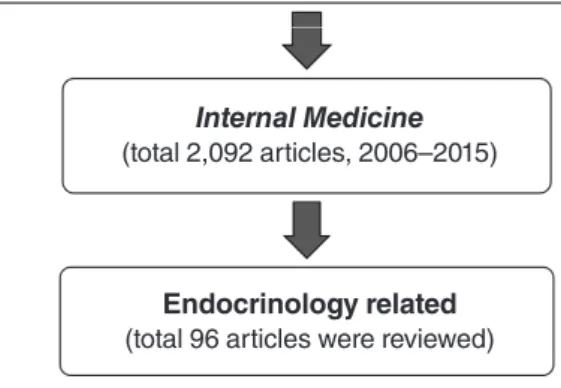
Nine medical journals could be accessed through the Ministry of Unification’s Information Center on North Korea by the mid- dle of 2016 (https://unibook.unikorea.go.kr). We focused our at- tention on the journal Internal Medicine. Internal Medicine is assumed to have been established since 1979 (four issues pub- lished each year; 146 in total), with a compilation of approxi- mately 40 to 60 articles per issue. For our study, we analyzed 2,092 articles published between 2006 and 2015. Among them, 110 endocrine-related articles were extracted and 14 articles were excluded due to ambiguous disease categories. Finally, 96 articles were extracted by two endocrinologists (S.G.K. and K.
J.K.). The detailed procedure of the study selection is summa- rized in Fig. 1. More specific details on study design and gener- al features of all-embracing internal medical journals have been published elsewhere [13]. Informed consent was not obtained specifically because this study was a retrospective analysis based on the North Korean Articles published in North Korea.
Determination of endocrine disease
We divided all endocrine-related articles into six groups: diabe- tes mellitus, metabolic syndrome, thyroid disease, osteoporosis, adrenal & pituitary disease, and unspecified group. Treatises on diabetes mellitus were categorized into four groups (pathophys- iology, diagnosis, treatment, and complications) according to the contents of the article instead of disease classification. Re- garding thyroid disease-related articles, they were divided into hyperthyroidism, hypothyroidism, thyroid nodule/cancer and unclassified according to disease categories. We did not further
Fig. 1. A flowchart of endocrine-related article selection.
FIGURE LEGENDS
Fig. 1. A flowchart of endocrine-related article selection.
Fig. 2. Distribution of articles according to manuscript format.
Nine types of journals
Internal Medicine (total 2,092 articles, 2006–2015)
Endocrinology related (total 96 articles were reviewed)
2 (2%) 13 (13%)
38 (40%)
43 (45%) 17 animal studies were included
Intervention study
Reviews Case report
Observational study
: Internal Medicine, Medicine of the Joseon Dynasty, Preventive Medicine, Surgery, Medical Science, Basic Medicine, Pediatrics/Obstetrics and Gynecology, Oral/Otorhinolaryngology/Ophthalmology, Joseon Pharmacy
270
www.e-enm.org Copyright © 2018 Korean Endocrine Societyanalyze metabolic syndrome-, osteoporosis-, and adrenal/pitu- itary-related articles because of the insufficient number.
RESULTS
Among the 96 articles, diabetes mellitus comprised 55.2% (n=53), followed by thyroid disease (n=27, 28.1%), metabolic syndrome (n=3, 3.1%), osteoporosis (n=3, 3.1%), adrenal and pituitary disease (n=2, 2.1%), and unspecified group (n=8, 8.4%). Fig. 2 indicates the classification of various types of papers into four types: intervention study, observational study, review, and case report. Among them, intervention studies including 17 animal intervention studies accounted for 45%, followed by observa- tional studies (40%), reviews (13%), and case reports (2%).
Representative papers about diabetes and thyroid disease were adduced to show general form and characteristics (Appendix 1).
Most articles consisted of one or two pages and initial citations of the teaching from supreme leaders. The original research ar- ticles comprised introduction, methods, results, and discussion sections, similar to those in other general articles. The method descriptions were short and concise compared to the results and discussion sections. There were usually less than five references and no figures included.
Most diabetes-related papers dealt with type 2 diabetes, while
type 1 diabetes was succinctly described only in review articles.
Fig. 3 shows detailed categories of diabetes-related articles; more than half of the 53 papers were related to complications and treat- ment (complications, n=17, 32.1%; treatment, n=16, 30.2%).
In treatment sections, most articles focused on evaluating the ef- ficacy of oral hypoglycemic agents, from sulfonylurea to North Korea’s herbal medicine.
Regarding thyroid disease, hyperthyroidism accounted for 51.9% among 27 thyroid disease-related articles, whereas only two papers were associated with hypothyroidism. Five papers were related to thyroid nodules and cancer; three of them were about the diagnosis of thyroid nodules, and two about treatments like iodide-alcohol ablation and thyroxine supplementation ther- apies.
Regarding osteoporosis, two articles were associated with treatment, including exercise and alendronate, and one was a re- view article about osteoporosis. There were only two papers fo- cused on adrenal and pituitary glands, which covered adrenal gland tumors and corticotropin-releasing hormone activity. Un- classified groups included those that addressed overall endo- crine function, such as endocrine-related hormonal changes in patients with tuberculosis.
DISCUSSION
In this study, we inceptively reported unique characteristics and endocrinology disease status of North Korea through North Korean articles. Endocrine-related treatises were the fourth most common papers, following by those related to gastroenter- ology, cardiology, and pulmonology in all of Internal Medicine.
At least three to a maximum of 18 endocrine-related articles have been published every year between 2006 and 2015. Diabe- tes and thyroid disease were the most common theme, and a few studies were associated with osteoporosis and adrenal/pituitary glands. Based on the number of published papers (96 articles), we can deduce that endocrine diseases, which are NCDs, have been studied actively as much as communicable diseases, such as certain infectious/parasitic diseases (126 articles), suggesting that the prevalence of endocrine-related diseases, especially dia- betes mellitus and thyroid disease, is not low.
World Health Organization published data about the mortality and burden of disease in North Korea in 2014; the most com- mon cause of death was cardiovascular disease and NCDs, in- cluding diabetes, were estimated to account for 79% of total deaths [10]. We have also noticed that North Korean medical researchers realized the severity of chronic disease and attempt- Fig. 3. Distribution of topics related to diabetes mellitus.
Complications
Others 17
3
5
11 2
3 11 3 5 16
8
12 8
Macrovascular Microvascular Retinopathy Nephropathy Neuropathy
Others Insulin Metformin Sulfonylureas
Herbal medicine
Topic category Treatment
Diagnosis
Pathophysiology
ed to identify more effective treatments for their cases. Espe- cially for diabetes, glibenclamide, an old sulfonylurea drug, was actively studied for its efficacy and side effects in the treatment of hyperglycemia. However, recently released oral hypoglyce- mic agents, such as dipeptidyl peptidase-4 inhibitors, and even insulin analogs, such as insulin glargine, were mostly covered in review articles. Instead of new diabetes drugs, they investi- gated the hypoglycemic effects of traditional herbal medicines found in North Korea and this suggests that they could not easi- ly access insulin as well as new diabetic drugs due to import re- strictions. Insulin treatment is critical for type 1 diabetes, and there should be greater assistance available to patients for their basic living. In addition, glucose levels measured using glucom- eters, but not glycated hemoglobin levels, were usually used as a glycemic index, indicating that access to chemical equipment is very limited in North Korea.
Regarding thyroid diseases, hyperthyroidism was the most common theme. Most of the papers related to diagnosis and treat- ment. For diagnosis, they introduced unique modalities, like in- frared scans or CO2 gas monitoring tests, to detect hyperthyroid- ism, which is not usually used worldwide. Different from recent trends, propylthiouracil was mostly mentioned in treatment sec- tions, describing its effects and side effects in detail. In contrast to hyperthyroidism, there were only two papers about hypothy- roidism. However, North Korea is geologically prone to iodine deficiency owing to its predominantly mountainous terrain [14].
In North Korea, a salt iodization program has been supported by the United Nations International Children’s Emergency Fund (UNICEF) for more than 10 years; however, the amount of io- dized salt remains limited due to issues related to the purchase of potassium iodate and the production capacity of salt factories [14]. Thus, we should consider that hypothyroidism due to io- dine deficiency might be a major concern among endocrine dis- orders in North Korea.
Our previous study showed that 386 North Korean refugees had severe vitamin D deficiencies and no one had sufficient vi- tamin D levels above 30 ng/mL [15]. Our preliminary study also showed that the prevalence of osteoporosis was much higher in postmenopausal women among North Korean refugees compared to among South Koreans [16]. Therefore, we assumed that vita- min D deficiency and osteoporosis are more severe health prob- lems in North Korea. Osteoporosis is a major cause of fractures, inducing morbidity and mortality in old-aged men, as well as in postmenopausal women [17,18]. However, there were only three articles published in 10 years, suggesting that proper diagnosis and treatment for osteoporosis have not been achieved in North
Korea.
This study has several limitations. First, the precise situation of North Korea’s endocrine-related diseases cannot be complete- ly reflected by articles published in North Korea. Second, there was a lack of information on recent endocrine-related diseases because nearly 60% of the 96 articles were published between 2006 and 2009. Despite these limitations, 96 papers, which were published in authoritative journals in North Korea, even to some extent, were relevant to North Korea’s endocrine disease status and features. Third, there is a probability that disease classifica- tion may have reflected the subjective views of researchers. To minimize this limitation, two endocrinologists reviewed all 96 articles respectively and coordinated the discordances.
In summary, this is the first study dealing with North Korea’s endocrine diseases based on the articles published in North Ko- rea between 2006 and 2015. Through these papers, we could peek into the medical status of North Korea, especially regard- ing endocrinology. Diabetes and thyroid disease, which are NCDs, have been actively investigated compared to osteoporosis and adrenal and pituitary diseases. Researchers in North Korea have already struggled and endeavored to identify more appropriate diagnoses and treatments for patients with endocrine-related diseases. We need to pay attention to endocrine disorders, as well as malnutrition and infectious diseases. We hope that this study will be the cornerstone of exchange and cooperation in medical research filed between South and North Korea.
CONFLICTS OF INTEREST
No potential conflict of interest relevant to this article was re- ported.
ACKNOWLEDGMENTS
This work was jointly supported by the Association of Health- care for Korean Unification and the Department of Healthcare and Medicine for Unified Korea, Korea University College of Medicine.
AUTHOR CONTRIBUTIONS
Acquisition, analysis, or interpretation of data: K.J.K., S.H. Con- ception or design: Y.H.L. Drafting the work or revising: J.H.N.
Final approval of the manuscript: S.G.K.
272
www.e-enm.org Copyright © 2018 Korean Endocrine SocietyORCID
Shin Ha https://orcid.org/0000-0002-1454-731X Yo Han Lee https://orcid.org/0000-0002-9631-9969 Jung Hyun Noh https://orcid.org/0000-0002-7964-0515 Sin Gon Kim https://orcid.org/0000-0002-7430-3675
REFERENCES
1. Financial Tracking Service. Korea, Democratic People’s Republic of 2017 [Internet]. Geneva: Financial Tracking Service; 2017 [cited 2018 Apr 11]. Available from: https://
fts.unocha.org/countries/118/summary/2017.
2. Park JJ, Park KB, Shafik N. Nuclear war and public health:
rebalancing priorities and global health leadership. Lancet 2017;390:1733-4.
3. Hug L, Sharrow D, You D. Levels & trends in child mortali- ty: report 2017. Estimates developed by the UN Inter-agency Group for Child Mortality Estimation [Internet]. New York:
United Nations Children’s Fund; c2017 [cited 2018 Apr 11].
Available from: https://www.popline.org/node/671957.
4. McCurry J. No end in sight for North Korea’s malnutrition crisis. Lancet 2012;379:602.
5. Horton R. Offline: North Korea. The case for health diplo- macy. Lancet 2017;390:1016.
6. Kim OJ. An analysis of a North Korean medical journal: In- Min-Bo-Gun (People’s Health) in 1950s. Uisahak 2002;11:
165-85.
7. World Health Organization. Global tuberculosis report 2017 [Internet]. Geneva: World Health Organization; 2017 [cited 2018 Apr 11]. Available from: http://www.who.int/tb/
publications/global_report/en/.
8. World Health Organization. World malaria report [Internet].
Geneva: World Health Organization; 2015 [cited 2018 Apr 11]. Available from: http://www.who.int/malaria/publications/
world-malaria-report-2015/report/en/.
9. Perry S, Linton H, Schoolnik G. Tuberculosis in North Ko- rea. Science 2011;331:263.
10. World Health Organization. Noncommunicable diseases country profiles 2014 [Internet]. Geneva: World Health Or- ganization; 2014 [cited 2018 Apr 11]. Available from: http://
www.who.int/nmh/publications/ncd-profiles-2014/en/.
11. World Health Organization. Country cooperation strategy [Internet]. Geneva: World Health Organization; 2016 [cit- ed 2018 Apr 11]. Available from: http://apps.who.int/iris/
bitstream/10665/137159/1/ccsbrief_prk_en.pdf.
12. Lee YH, Yoon SJ, Kim YA, Yeom JW, Oh IH. Overview of the burden of diseases in North Korea. J Prev Med Public Health 2013;46:111-7.
13. Kim SG, Kim KJ, Ha S, Kim YH. A peek into the Galapa- gos of the medical research field. Lancet 2016;388:2989-90.
14. Yadav K. Iodine deficiency in the Democratic People’s Re- public of Korea [Internet]. Ottawa: International Council for the Control of Iodine Deficiency Disorders; 2012 [cited 2018 Apr 11]. Available from: http://www.iccidd.org/newsletter/
idd_nov12_korea.pdf.
15. Kim KJ, Kim YJ, Kim SH, An JH, Yoo HJ, Kim HY, et al.
Vitamin D status and associated metabolic risk factors among North Korean refugees in South Korea: a cross-sec- tional study. BMJ Open 2015;5:e009140.
16. Kim KJ, Kim KJ, An JH, Kim NH, Yoo HJ, Kim HY, et al.
Prevalence of osteoporosis in North Korean refugees in South Korea: a case-control study. Proceedings of the 5th Seoul International Congress of Endocrinology and Metabo- lism; 2017 Apr 27-30; Seoul, Korea.
17. Sattui SE, Saag KG. Fracture mortality: associations with epidemiology and osteoporosis treatment. Nat Rev Endocri- nol 2014;10:592-602.
18. Walsh JS, Eastell R. Osteoporosis in men. Nat Rev Endocri- nol 2013;9:637-45.