Received on November 10, 2014. Revised on December 24, 2014. Accepted on December 29, 2014.
CC This is an open access article distributed under the terms of the Creative Commons Attribution Non-Commercial License (http://creativecommons.org/licenses/by-nc/3.0) which permits unrestricted non-commercial use, distribu- tion, and reproduction in any medium, provided the original work is properly cited.
*Corresponding Author. John Hwa Lee, College of Veterinary Medicine and Bio-Safety Research Institute, Chonbuk National University, Jeonju, Korea. Tel: 82-63-270-2553; Fax: 82-63-270-3780; E-mail: [email protected]
Abbreviations: DPC, days post challenge; PPI, post prime immunization; SE, Salmonella Enteritidis; ST, Salmonella Typhimurium; SG, Salmonella Gallinarum
Protection Against Salmonella Typhimurium, Salmonella Gallinarum, and Salmonella Enteritidis Infection in Layer Chickens Conferred by a Live Attenuated Salmonella Typhimurium Strain
John Hwa Lee*
College of Veterinary Medicine and Bio-Safety Research Institute, Chonbuk National University, Jeonju 561-756, Korea
In the present study, we investigated the protection con- ferred by a live attenuated Salmonella enterica serovar Typhimurium (ST) strain against Salmonella Typhimurium, Salmonella Gallinarum (SG), and Salmonella Enteritidis (SE) infection in layer chickens. Birds were orally primed with the attenuated ST strain at 7 days of age and then boosted at 4 weeks post prime immunization (PPI). Sequential mon- itoring of plasma IgG and mucosal secretory IgA (sIgA) levels revealed that inoculation with ST induced a significant anti- body response to antigens against ST, SE, and SG.
Moreover, significant lymphoproliferative responses to the 3 Salmonella serovars were observed in the immunized group.
We also investigated protection against virulent ST, SE, and SG strain challenge. Upon virulent SG challenge, the immu- nized group showed significantly reduced mortality com- pared to the non-immunized group. The reduced persistence of the virulent ST and SE challenge strains in the liver, spleen, and cecal tissues of the immunized group suggests that immunization with the attenuated ST strain may not only protect against ST infection but can also confer cross pro- tection against SE and SG infection.
[Immune Network 2015;15(1):27-36]
Keywords: Salmonella, Vaccine, Cross immunity, Protection, Chickens
INTRODUCTION
Foodborne Salmonella infections in humans, occurring through the consumption of contaminated poultry meat and eggs, are a major public health concern. Therefore, the con- trol of Salmonella within poultry breeding and rearing farms is an urgent issue (1). Intense international trade of animals and products of animal origin facilitates the spread of these bacteria (2), making salmonellosis an international public health concern that is responsible for serious economic losses to the poultry industry and governments worldwide (3,4). A variety of Salmonella strains are known to cause extra- intestinal infections in poultry (5), and the major species that cause infections in chickens include Salmonella Typhimurium (ST), Salmonella Enteritidis (SE), and Salmonella Gallinarum (SG). These serotypes can infect humans and are the main causes of food contamination (6). Although these infections do not cause severe symptoms in poultry, the eggs and meat of infected animals can become a reservoir for infection of human consumers. These asymptomatic bird carriers play a major role in Salmonella propagation and in food con- tamination (6). ST and SE infect chickens via the fecal-oral route, colonize the alimentary tract, invade internal organs such as the liver and spleen, and finally spread to the re- productive tract (7). SE bacteria can be transmitted to the
eggs, which can be transmitted to humans through con- sumption of these contaminated eggs, which is a major public health issue (8). In contrast, SG infection is host specific and causes fowl typhoid (FT), an acute disease that leads to septi- cemia in poultry (9). Even though SG has adapted to its avian host and rarely induces food poisoning in humans, FT out- breaks cause severe economic loses worldwide (10).
Vaccination is one of the best prophylaxes against diseases caused by infectious agents, which prevents infection via in- duction of innate and/or adaptive immune responses (11,12).
There have been several attempts to prevent salmonellosis by vaccination (6,10,13-20), and in some studies, cross protective responses were shown to enhance pathogen clearance in an antigen non-specific way (12). More recently, cross-protective immunity among different Salmonella serovars has been re- ported in both animals and humans (21-23). Therefore, it ap- pears that a vaccine constructed against one intracellular pathogen might provide cross-protective immunity against other similar infectious agents (24-27).
In recent years, the usage of genetically modified ST strains as immunization agents has gained remarkable popularity, as these attenuated ST strains have no ill effects (28-30) and may provide some protection against other related serovars (28).
In one study, an attenuated ST vaccine strain was shown to offer protection against SE virulent challenge in chickens (31).
One report also demonstrated the protection efficacy of SG vaccines against virulent SE infections in laying hens (32,33).
In our previous studies, we constructed a live attenuated ST strain (34). As several other studies previously explored the cross-protection conferred by Salmonella vaccines against re- lated serovars (31-33,35), immunization with this ST strain may confer protection against salmonellosis.
With these previous studies in mind, we first evaluated the safety of the live attenuated ST strain in chickens by monitor- ing fecal excretion and observing their general condition after administration. Next, we evaluated whether ST administration conferred protection against virulent ST, SE, and SG infections in layer chickens. Finally, the humoral and cellular immune responses against ST, SE, and SG antigens were evaluated.
MATERIALS AND METHODS
Bacterial strains and growth conditions
A live attenuated ST strain (JOL912) was constructed by as described previously (34). Wild-type SG (JOL422) and ST (JOL401) strains were obtained from the National Veterinary
Research and Quarantine Service (Anyang, 430-016, Kyunggi 425-100, Republic of Korea). A wild-type SE strain (JOL1982) was obtained from Kyungpook National University (Daegu, Republic of Korea). All strains were grown at 37oC in Luria-Bertani media (Difco, Sparks, MD, USA). PBS (pH 7.0) was used to resuspend the vaccine and challenge strains.
Immunization and challenge experiment
The animal experiments were approved by the Chonbuk National University Animal Ethics Committee (CBU 2011-0017) and were performed in accordance with the guidelines of the Korean Council on Animal Care. One-day-old Brown Nick layer chicks were used for all the experiments and were pro- vided with water and antibiotic-free feed ad libitum. The birds were divided into 2 groups (n=60/group), designated as group A (non-vaccinated controls) and group B (primed and boosted immunization via the oral route). At 7 days of age, the birds in group B (n=60) were primed with 1×10⁷ cfu of the attenuated ST strain in 100 μl of PBS. The booster dose was administered at 4 weeks post prime immunization (PPI). Three weeks after booster administration (7 weeks post PPI), the birds (n=20/group of each serovar) were exposed to oral inoculations of wild-type virulent SG, SE, and ST strains. For the virulent SG challenge (n=20/group), the chicks were inoculated via the oral route with 100 μL of PBS containing 1×10⁶ cfu of JOL422. The oral inoculations of the virulent ST and SE strains used contained 1×10⁹ cfu.
Safety evaluation of the attenuated ST strain in chickens
To investigate the safety of the attenuated ST strain, the gen- eral condition of the birds was monitored daily for 2 weeks after immunization. The parameters evaluated included ano- rexia, depression, diarrhea, and mortality (29). Further, the presence of the delivered ST strain in fecal pellets was moni- tored at 3, 7, 10, and 14 days post-immunization. Animals were placed individually into clean empty buckets, allowed to defecate, and the feces were collected and weighed. The fecal material was homogenized in buffered peptone water (Becton Dickinson and Company) by mechanical disruption with a sterile wooden stick. To recover the bacteria, fecal samples were processed as described previously [18]. The positive samples were counted, and the number of positive cases for each group, with samples containing typical Salmonella colonies, was confirmed by PCR using an ST-spe- cific primer set (36).
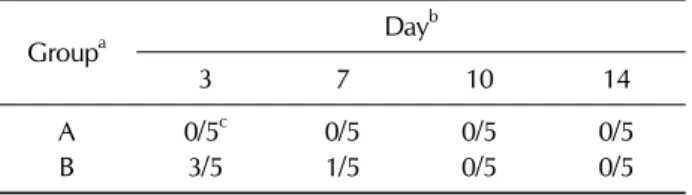
Table I. Bacterial isolation from feces after immunization with the ST strain
Groupa Dayb
3 7 10 14
A 0/5c 0/5 0/5 0/5
B 3/5 1/5 0/5 0/5
aThe groups were designated as group A, non-immunized and group B, immunized. bThe days post prime immunization. The bacterial recovery from feces was carried out at day 3,7, 10 and 14 post prime immunization. cNumber of positive samples after enrichment culture
Observations of mortality, gross lesions, and bacterial recovery after SG, ST, and SE virulent challenge After SG challenge, the mortality rate was assessed daily for 14 days. After the apparent recovery of all surviving animals, the birds were sacrificed 14 days post challenge (dpc) and were examined for macroscopic lesions and the presence of the challenge strain in internal organs such as the liver and spleen. The splenic and hepatic gross lesion exams and the challenge strain recovery were performed as previously de- scribed (18-20,37). To determine the presence of the ST and SE challenge strains in internal organs such as the liver, spleen, and caecum, 4 birds per group were randomly selected and sacrificed at 1, 4, 7, 11, and 14 dpc. PCR using specific primers (36) was performed using colonies recovered on BGA that were typical for the inoculated Salmonella strains.
Immune responses
Antibody responses: To examine the antibody responses, samples were collected from 5 birds per group every week after the prime and booster doses of the vaccine were administered. The levels of plasma IgG and intestinal secre- tory IgA (sIgA) against the outer membrane proteins (OMP) of ST, SE, and SG were determined by using the Chicken IgG and IgA ELISA Quantitation kits (Bethyl Laboratories, TX, USA) according to the manufacturer’s instructions. Plasma IgG and intestinal wash samples were taken until 7 weeks PPI. To obtain plasma, peripheral blood samples were sepa- rated by centrifugation. Intestinal wash samples were col- lected as described previously (19,38).
Cellular response: At 3 and 7 weeks ppi, peripheral lym- phocytes were separated from 5 randomly selected chickens per group using the gentle swirl technique (39). The lympho- cytes were processed, and the proliferation assay was per- formed as previously described (18-20).
Statistical analyses
All statistical analyses were performed with SPSS 16.0 (SPSS Inc., Chicago, IL, USA). Student’s t-test was used to analyze the statistical significance of differences in mortality, immune responses, gross lesion scores, and bacterial recovery among the vaccinated and unvaccinated groups. Data are presented as mean±standard deviation, and the differences were con- sidered significant at p-values less than 0.05.
RESULTS
Safety evaluation of the attenuated ST
The general condition of the inoculated birds was observed for 2 weeks post inoculation. There was no evidence of mor- tality after oral inoculation. The animals were apparently healthy and did not show any signs of anorexia, depression, or diarrhea during the entire experimental period. Bacterial recovery from fecal shedding was assessed 3, 7, and 10 days PPI. Homogenized fecal samples from 5 chickens in the in- oculated group were plated on BGA for direct colony count- ing, and no colonies were observed in the samples (Table I).
However, bacterial colonies were recovered by the enrich- ment culture method. Bacteria were recovered from 3 of 5 inoculated birds at 3 days PPI, whereas bacteria were recov- ered from only 1 bird at 7 days PPI (Table I). No bacteria were recovered from feces at 10 and 14 days PPI and booster immunization.
Protection against SG challenge
Cross protection against virulent SG challenge was examined after prime-booster immunization with the attenuated ST strain. Upon challenge with the virulent SG strain, the immu- nized group (group A) showed significantly less acute mortal- ity (4/20) than the non-immunized group (group B; 11/20).
All surviving birds in group A showed anorexia, depression, and greenish-colored diarrhea, whereas the surviving birds in group B did not exhibit these symptoms. In addition, group B birds showed a milder average lesion score (0.1) than the group A birds (1.18). The presence of the challenge strain in hepatic and splenic tissues was examined by direct colony counting of homogenized tissues on BGA and from enrich-
Table II. Mortality, gross lesion and bacterial recovery in the chickens challenged with a wild type Salmonella Gallinarum
Groupa
Challengeb
Mortality (%)
Gross lesion Bacterial recoverye
Liver Spleen Liver Spleen
Count Positive No. Count Positive No.
A 11/20 (55)c 1.1±0.9d 1.1±1.0 0.4±0.5f 4/9g 0.3±0.5 3/9
B 4/20 (20)* 0.1±0.4** 0.2±0.5** 0.0±0.0** 0/16* 0.0±0.0d* 0/16*
aEach group contained 20 chicks. The groups were designated as group A, non-immunized and group B, immunized. bThe SG infection was performed by oral inoculation at the 7th week post prime immunization. cThe number of dead birds was expressed as mortality.
dGroup lesion score (Mean±Standard deviation). eThe bacterial recovery from liver and spleen was carried out at the 14th day after challenge strain inoculation. fThe bacterial count was determined and expressed as mean±Standard deviation Log10 cfu/g. gNumber of positive chicken after enrichment culture. All values were considered to be significant if p≤0.05 or 0.01.*p<0.05, **p<0.01
Table III. Bacterial recovery in chickens after a virulent Salmonella Typhimurium and Salmonella Enteritidis challenge
Strain Groupa Organ
Bacterial recovery post challengeb
Day 1 Day 4 Day 7 Day 11 Day 14
Count Positive
No. Count Positive
No. Count Positive
No. Count Positive
No. Count Positive No.
Salmonella
Typhimurium A Liver 0.5±0.5c 2/4d 0.5±0.5 2/4 0.5±0.5 2/4 0.2±0.5 1/4 0.0±0.0 0/4
Spleen 0.5±0.5 2/4 0.6±0.9 2/4 1.2±1.2 3/4 0.7±0.5 3/4 0.2±0.5 1/4
Caecum 2.5±1.7 3/4 1.4±1.6 3/4 1.0±0.8 3/4 0.8±1.0 1/4 0.2±0.5 1/4
B Liver 0.0±0.0 0/4 0.5±0.5 2/4 0.2±0.5 1/4 0.0±0.0 0/4 0.0±0.0 0/4
Spleen 0.0±0.0 0/4 0.9±1.8 1/4 0.2±0.5 1/4 0.0±0.0 0/4 0.0±0.0 0/4
Caecum 0.6±1.2 1/4 0.0±0.0 0/4 0.0±0.0 0/4 0.0±0.0 0/4 0.0±0.0 0/4
Salmonella
Enteritidis A Liver 0.0±0.0 0/4 0.5±0.5 2/4 0.5±0.5 2/4 0.5±0.5 2/4 0.2±0.5 1/4
Spleen 0.0±0.0 0/4 0.2±0.5 1/4 0.6±0.7 2/4 0.5±0.5 2/4 0.2±0.5 1/4
Caecum 0.9±1.2 2/4 0.8±1.1 2/4 0.9±1.1 1/4 0.2±0.5 1/4 0.0±0.0 0/4
B Liver 0.0±0.0 0/4 0.0±0.0 0/4 0.0±0.0 0/4 0.0±0.0 0/4 0.0±0.0 0/4
Spleen 0.0±0.0 0/4 0.2±0.5 1/4 0.2±0.5 1/4 0.2±0.5 1/4 0.0±0.0 0/4
Caecum 0.0±0.0 0/4 0.0±0.0 0/4 0.0±0.0 0/4 0.0±0.0 0/4 0.0±0.0 0/4
aEach group contained 20 chicks. The groups were designated as group A, non-immunized and group B, immunized. bThe bacterial recovery from liver, spleen and caecum was carried out on day 1,4,7,11 and 14 post Salmonella Typhimurium and Salmonella Enteritidis challenge strain inoculation. cThe bacterial count was determined and expressed as mean±Standard deviation Log10 cfu/g. dNumber of positive chicken after enrichment culture. All values were considered to be significant if p≤0.05 or 0.01.*p<0.05, **p<0.01 ment cultures. No colonies were observed on plates containing
samples of direct cultures of homogenized liver and spleen tis- sues from group B (immunized) chickens (Table II). However, the challenge strain was recovered from the livers (4/9) and spleens (3/9) of group A (non-immunized) chickens.
Evaluation of protection against virulent ST challenge The protection efficiency of the attenuated ST strain against virulent ST challenge was investigated. No acute mortality
was observed after oral inoculation with the virulent ST strain. Examination of bacterial persistence in hepatic, splen- ic, and cecal tissues revealed consistently higher bacterial counts from chickens in group A than from chickens in group B from day 1 to day 14 post infection (Table III). Consistent bacterial recovery from liver tissues on days 1, 7, and 11 was observed in group A animals, which was higher than that de- tected in group B animals, whereas no significant differences were found on day 14 post-infection (Table III). Bacterial per-
Figure 1. Antigen-specific IgG plasma levels detected by indirect ELISA. Plasma IgG levels (ng/ml) against the OMP antigens of (A) Salmonella Typhimurium (ST), (B) Salmonella Enteritidis (SE), and (C) Salmonella Gallinarum (SG) were monitored for 7 weeks post-prime immunization (PPI) with a live attenuated Salmonella Typhimurium (ST) strain. The values are expressed as mean±SEM. Antibody levels were considered significant if the p-value was less than 0.05. *p<0.05, **p<0.01 The arrow (↑) indicates the time point at which the booster was administered (4 weeks PPI). (♦) group A, the non-immunized control group and (■) group B, the ST-immunized group.
sistence in the spleen tissues of group A animals was higher on days 1 and 4 than that recovered from group B chickens, and this persistence further increased on days 7 and 11, with the highest bacterial counts on day 7, whereas bacteria were only recovered from 1 of 4 group B chickens at days 4 and 7 (Table III). The bacterial counts in the cecal tissues of group A animals were significantly higher on days 1, 4, 7, 11, and 14. Bacteria were only recovered from 1 bird in group B on day 1.
Protection against virulent SE challenge
To evaluate cross protection against SE infection, birds were sacrificed at 1, 4, 7, 11, and 14 days after SE challenge. The liver tissues of group A birds showed consistent bacterial per- sistence from days 4 to 14 post infection, with significantly higher bacterial counts than those in group B birds, which did not show bacterial persistence in liver tissues (Table III).
Higher bacterial counts were detected in the spleen tissues of group A birds at day 7 post infection, which was sub- sequently reduced on day 14. Although bacterial persistence was not observed in the cecal tissues of group B birds, bacte- rial persistence was detected in group A chickens on days 1, 4, 7, and 11.
Humoral responses
The plasma concentration of IgGs against ST, SE, and SG anti- gens was measured. As shown in Fig. 1, the plasma IgG con- centrations against ST-, SG-, and SE-specific antigens were significantly higher in group B than in group A. The IgG re- sponse to ST antigens was significantly higher beginning at 1 week PPI. The response remained consistently high in sub- sequent weeks; it was further elevated after the booster was administered at 4 weeks PPI, and it then plateaued at 6 weeks PPI (Fig. 1A). Similarly, the IgG levels against SE antigen
Figure 2. Intestinal IgA response to ST-, SE-, and SG-specific antigens. The intestinal levels of IgA against the OMP antigens of ST (A), SE (B), and SG (C) were measured in intestinal washings for 7 weeks PPI. The IgA antibody levels are expressed as mean±SEM.
Differences in the antibody levels were considered significant if p the value was less than 0.05. *p<0.05,
**p<0.01. The arrow (↑) indicates the time point at which the booster was administered (at 4 weeks PPI). (♦) group A, the non-immunized control group and (■) group B, the ST-immunized group.
were significantly higher at 3 weeks PPI, and were further elevated at 6 weeks PPI, which was 2 weeks after the booster was administered (Fig. 1B). The IgG response to the SG anti- gen increased significantly beginning at 2 weeks PPI, and sig- nificantly higher values were detected 5 weeks PPI (Fig. 1C).
The sIgA response against the ST antigen was significantly induced in group B birds, with a plateau at 2 weeks PPI (Fig. 2A), and sIgA levels remained significantly higher until 7 weeks PPI. The sIgA levels against the SE antigen reached a peak at 3 weeks PPI, and further increased after booster administration (Fig. 2B). The IgA responses against the SG antigen were higher at 2 weeks PPI and then declined at 3 and 4 weeks (Fig. 2C). However, the IgG response increased significantly after booster administration and remained sig- nificantly higher until 7 weeks PPI (Fig. 2C).
Cellular response
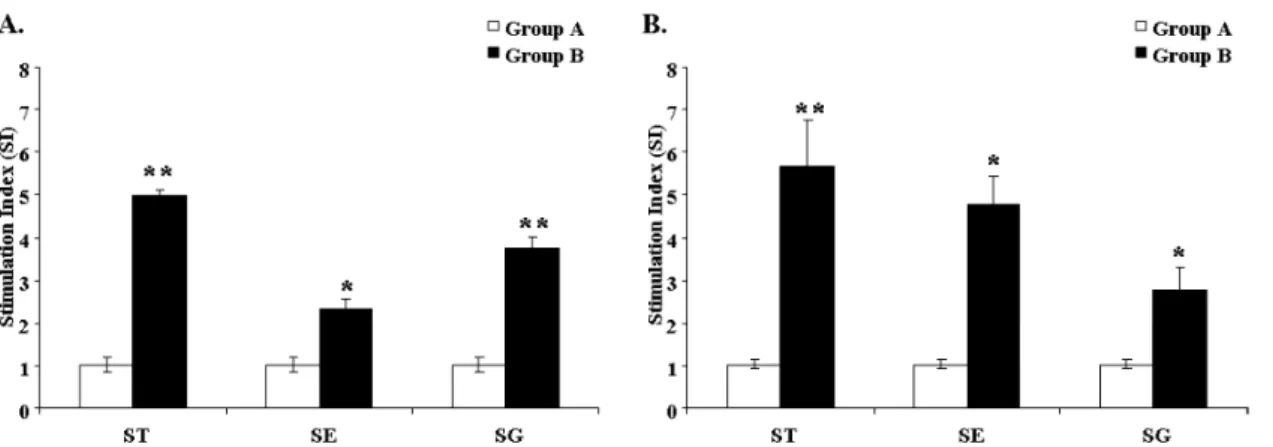
To elucidate the cellular immune responses to ST, SE, and SG antigens following ST immunization, a peripheral lympho- cyte proliferation assay was performed at 3 and 7 weeks PPI.
Group B showed significant proliferative responses against ST-, SE-, and SG-specific antigens. Post prime vaccination, the stimulation indices against the ST, SE, and SG antigens for group B were 4.9, 2.3, and 3.7, respectively (Fig. 3A). Like- wise, after booster administration, the stimulation indices against ST, SE, and SG antigens for group B were 5.6, 4.7, and 2.7, respectively (Fig. 3B).
DISCUSSION
A high incidence of livestock diseases due to infection with a wide array of Salmonella serovars and contamination of de-
Figure 3. Antigen-specific lymphocyte stimulation responses were measured in ST-immunized and non-immunized chickens. Lymphocyte stimulation responses against ST, SE, and SG antigens were analyzed at 3 weeks ppi (A) and 3 weeks post booster immunization (B). The stimulation index of the lymphocyte sample from the chickens is shown. *p<0.05, **p<0.01. Group A, the non-immunized control group;
group B, the ST-immunized group.
rived food products are associated with significant livestock production losses and public health risks, respectively (40,41).
The present study demonstrated the cross-protective efficacy of a live attenuated ST strain (29,30) against three major Salmonella serovars in chickens. Vaccination using genet- ically-manipulated Salmonella strains is emerging as a popular strategy for effective control and prevention of Salmonella in- fections in commercial livestock production systems (11).
However, the release of genetically modified microorganisms into the environment is associated with significant safety con- cerns (10,14,42,43). Although ST infection is common in chickens, it does not cause severe diseases in poultry (7).
Therefore, attenuated ST strains have been successfully used to express foreign antigens and they have been suggested as safe strains (28). The results of this study indicated that oral inoculation of the attenuated ST strain (△lon, △cpxR, △ asd-A16) neither induces acute mortality nor yields any ad- verse effect in the vaccinated birds. In our previous study, we carried out an extensive safety evaluation of this lon, cpxR and asd-A16-deleted ST strain in chickens and reported its safe use as a delivery system to prevent colibacillosis (29).
In addition, observations made in the present study showed that the strain was excreted in the feces of only a few vacci- nated birds and that booster administration did not increase bacterial excretion in the feces. Only low level fecal excretion was observed during the monitoring period, which suggests that oral administration of the attenuated ST strain may be environmentally safe.
It has also been postulated that use of an attenuated ST
strain may confer cross protection against related serovars (28).
This would provide an alternative use for the attenuated ST strain as a delivery system for immunizations. Although the protection afforded to immunized hosts by vaccination is gen- erally highly specific, recently, vaccines have been developed that confer cross protection to multiple strains of the same species (28). Here, we further investigated the protections conferred by the attenuated ST strain against challenge with virulent ST, SG, and SE strains. Our results demonstrated that prime-boosted oral immunization of layer chickens with the live attenuated ST strain conferred protection against chal- lenge with virulent ST, SG, and SE strains. Immunization with the ST strain significantly reduced the mortality and bacterial load in internal organs induced by SG virulent challenge (Table I), demonstrating the protective effect of the strain against SG infection. The only currently available SG vaccine has residual virulence in chickens. Therefore, the observation that immunization with the attenuated ST strain offers pro- tection against SG virulent challenge is very important, and this ST strain may offer an alternative approach to prevent fowl typhoid in chickens. After SE and ST challenge, no acute mortality was observed. Bacterial recovery from internal organs of chickens immunized with the attenuated ST strain revealed its protective effects against ST and SE infections. Immunization with the ST strain significantly reduced the persistence of the ST and SE strains in the immunized host (Table III).
To gain insight into the underlying protective mechanisms, we monitored the immune response pattern in sequential weeks. The data showed that inoculation with the attenuated
ST strain induced antibodies against ST, SG, and SE antigens.
The systemic IgG response against the Salmonella antigens was significantly higher after the booster was administered (Fig. 1), whereas the mucosal sIgA response was higher after the prime immunization. Plasma IgG levels against the ST and SE antigens were significantly higher at 6 weeks PPI, whereas significantly higher IgG levels against the SG antigens were observed at 5 weeks PPI, suggesting that administration of the booster elevated IgG levels against the SG antigen earlier than those against the ST antigen. In contrast, sIgA levels against the ST and SG antigens reached a plateau at 2 weeks PPI, whereas sIgA levels against the SE antigen increased sig- nificantly at 3 weeks PPI, which indicates that the sIgA re- sponse to the ST and SG antigens was induced earlier than the response to the SE antigen. Overall, these findings suggest that immunization with the attenuated ST strain not only in- duced a significant humoral immune response against the ST antigen but also offered cross-immunity to SE and SG antigens. However, the immune responses against the differ- ent Salmonella antigens observed in the present study require additional conformational studies. In addition, we also inves- tigated cell-mediated immune responses against these anti- gens in the immunized and non-immunized groups using the lymphocyte proliferation assay, which is widely used for this purpose (44,45). Immunization with the attenuated ST strain induced significant lymphocyte stimulation to the ST, SE, and SG antigens. These significant lymphoproliferative responses observed in the immunized group are suggestive of T-cell mediated immune responses. The lymphocyte proliferation observed in response to the SE and SG antigens is interesting and suggests that immunization with the ST strain also confers cross immunity at the cellular level.
In conclusion, vaccination with an attenuated ST strain not only prevented ST infection after virulent challenge but also provided additional cross-protective immunity against in- fections with SE and SG serovars.
ACKNOWLEDGEMENTS
This work was supported by Mid-career Researcher Program through National Research Foundation (NRF) grant funded by the Ministry of Education, Science and Technology (MEST) (No. 2012-R1A2A4A01002318), Republic of Korea.
CONFLICTS OF INTEREST
The authors have no financial conflict of interest.
REFERENCES
1. Silva, E. N., and A. Duarte. 2002. Salmonella Enteritidis in poultry: retrospective in Brazil. Braz.J. Poult. Sci. 4: 85-100.
2. Forshell, L. P., and M. Wierup. 2006. Salmonella con- tamination: a significant challenge to the global marketing of animal food products. Rev. Sci. Tech. 25: 541-554.
3. Duguid, J. P., and R. A. North. 1991. Eggs and Salmonella food-poisoning: an evaluation. J. Med. Microbiol. 34: 65-72.
4. Rodrigue, D. C., R. V. Tauxe, and B. Rowe. 1990.
International increase in Salmonella enteritidis: a new pan- demic? Epidemiol. Infect. 105: 21-27.
5. Poppe C. 2000. Salmonella Infections in the Domestic Fowl In: Wray C, Wray A, editors. Salmonella in domestic animals, Wallingford: CABI Publishing; p. 107-132.
6. Carvajal, B. G., U. Methner, J. Pieper, and A. Berndt. 2008.
Effects of Salmonella enterica serovar Enteritidis on cellular recruitment and cytokine gene expression in caecum of vacci- nated chickens. Vaccine 26: 5423-5433.
7. Chappell, L., P. Kaiser, P. Barrow, M. A. Jones, C. Johnston, and P. Wigley. 2009. The immunobiology of avian systemic salmonellosis. Vet. Immunol. Immunopathol. 128: 53-59.
8. Velge, P., A. Cloeckaert, and P. Barrow. 2005. Emergence of Salmonella epidemics: the problems related to Salmonella enterica serotype Enteritidis and multiple antibiotic resistance in other major serotypes. Vet. Res. 36: 267-288.
9. McGruder, E. D., P. M. Ray, G. I. Tellez, M. H. Kogut, D.
E. Corrier, J. R. DeLoach, and B. M. Hargis. 1993. Salmonella enteritidis immune leukocyte-stimulated soluble factors: ef- fects on increased resistance to Salmonella organ invasion in day-old Leghorn chicks. Poult. Sci. 72: 2264-2271.
10. Wigley, P., S. Hulme, C. Powers, R. Beal, A. Smith, and P.
Barrow. 2005. Oral infection with the Salmonella enterica se- rovar Gallinarum 9R attenuated live vaccine as a model to characterise immunity to fowl typhoid in the chicken. BMC.
Vet. Res. 1: 2.
11. Girard, M. P., D. Steele, C. L. Chaignat, and M. P. Kieny.
2006. A review of vaccine research and development: human enteric infections. Vaccine 24: 2732-2750.
12. Sieve, A. N., K. D. Meeks, S. Bodhankar, S. Lee, J. K. Kolls, J. W. Simecka, and R. E. Berg. 2009. A novel IL-17-dependent mechanism of cross protection: respiratory infection with my- coplasma protects against a secondary listeria infection. Eur.
J. Immunol. 39: 426-438.
13. Calenge, F., P. Kaiser, A. Vignal, and C. Beaumont. 2010.
Genetic control of resistance to salmonellosis and to Salmonella carrier-state in fowl: a review. Genet. Sel. Evol. 42: 11.
14. Gantois, I., R. Ducatelle, L. Timbermont, F. Boyen, L. Bohez, F. Haesebrouck, F. Pasmans, and I. F. van. 2006. Oral immu- nisation of laying hens with the live vaccine strains of TAD Salmonella vac E and TAD Salmonella vac T reduces internal egg contamination with Salmonella Enteritidis. Vaccine 24:
6250-6255.
15. Pathangey, L., J. J. Kohler, R. Isoda, and T. A. Brown. 2009.
Effect of expression level on immune responses to recombi- nant oral Salmonellaenterica serovar Typhimurium vaccines.
Vaccine 27: 2707-2711.
16. Tan, S., C. L. Gyles, and B. N. Wilkie. 1997. Evaluation of an aroA mutant Salmonellatyphimurium vaccine in chickens using modified semisolid Rappaport Vassiliadis medium to monitor faecal shedding. Vet. Microbiol. 54: 247-254.
17. Tellez, G. I., M. H. Kogut, and B. M. Hargis. 1993. Immuno- prophylaxis of Salmonella enteritidis infection by lympho- kines in Leghorn chicks. Avian Dis. 37: 1062-1070.
18. Chaudhari, A. A., S. W. Kim, K. Matsuda, and J. H. Lee.
2011. Safety evaluation and immunogenicity of arabinose- based conditional lethal Salmonella Gallinarum mutant unable to survive ex vivo as a vaccine candidate for protection against fowl typhoid. Avian Dis. 55: 165-171.
19. Matsuda, K., A. A. Chaudhari, and J. H. Lee. 2011.
Evaluation of safety and protection efficacy on cpxR and lon deleted mutant of Salmonella Gallinarum as a live vaccine candidate for fowl typhoid. Vaccine 29: 668-674.
20. Nandre, R. M., K. Matsuda, A. A. Chaudhari, B. Kim, and J. H. Lee. 2012. A genetically engineered derivative of Salmonella Enteritidis as a novel live vaccine candidate for salmonellosis in chickens. Res. Vet. Sci. 93: 596-603.
21. Matulova, M., H. Havlickova, F. Sisak, V. Babak, and I.
Rychlik. 2013. SPI1 defective mutants of Salmonellaenterica induce cross-protective immunity in chickens against chal- lenge with serovars Typhimurium and Enteritidis. Vaccine 31:
3156-3162.
22. Wahid, R., R. Simon, S. J. Zafar, M. M. Levine, and M. B.
Sztein. 2012. Live oral typhoid vaccine Ty21a induces cross-reactive humoral immune responses against Salmonella enterica serovar Paratyphi A and S. Paratyphi B in humans.
Clin. Vaccine Immunol. 19: 825-834.
23. Mohler, V. L., D. M. Heithoff, M. J. Mahan, K. H. Walker, M. A. Hornitzky, L. W. Shum, K. J. Makin, and J. K. House.
2008. Cross-protective immunity conferred by a DNA adenine methylase deficient Salmonellaenterica serovar Typhimurium vaccine in calves challenged with Salmonella serovar Newport. Vaccine 26: 1751-1758.
24. Ansaldi, F., S. Bacilieri, P. Durando, L. Sticchi, L. Valle, E.
Montomoli, G. Icardi, R. Gasparini, and P. Crovari. 2008.
Cross-protection by MF59-adjuvanted influenza vaccine: neu- tralizing and haemagglutination-inhibiting antibody activity against A(H3N2) drifted influenza viruses. Vaccine 26:
1525-1529.
25. Beal, R. K., P. Wigley, C. Powers, P. A. Barrow, and A. L.
Smith. 2006. Cross-reactive cellular and humoral immune re- sponses to Salmonella enterica serovars Typhimurium and Enteritidis are associated with protection to heterologous re-challenge. Vet. Immunol. Immunopathol. 114: 84-93.
26. Carrat, F., and A. Flahault. 2007. Influenza vaccine: the chal- lenge of antigenic drift. Vaccine 25: 6852-6862.
27. Chacana, P. A., and H. R. Terzolo. 2006. Protection con- ferred by a live Salmonella Enteritidis vaccine against fowl ty- phoid in laying hens. Avian Dis. 50: 280-283.
28. Roland, K., R. Curtiss, III, and D. Sizemore. 1999. Construc- tion and evaluation of a delta cya delta crp Salmonellatyphi-
murium strain expressing avian pathogenic Escherichia coli O78 LPS as a vaccine to prevent airsacculitis in chickens.
Avian Dis. 43: 429-441.
29. Chaudhari, A. A., and J. H. Lee. 2013. Evaluation of the ad- juvant effect of Salmonella-based Escherichia coli heat-labile toxin B subunits on the efficacy of a live Salmonella-delivered avian pathogenic Escherichia coli vaccine. Avian Pathol. 42:
365-372.
30. Chaudhari, A. A., K. Matsuda, and J. H. Lee. 2013. Construc- tion of an attenuated Salmonella delivery system harboring genes encoding various virulence factors of avian pathogenic Escherichia coli and its potential as a candidate vaccine for chicken colibacillosis. Avian Dis. 57: 88-96.
31. Dueger, E. L., J. K. House, D. M. Heithoff, and M. J. Mahan.
2001. Salmonella DNA adenine methylase mutants elicit pro- tective immune responses to homologous and heterologous serovars in chickens. Infect. Immun. 69: 7950-7954.
32. Barrow, P. A., M. A. Lovell, and A. Berchieri. 1990. Immuni- sation of laying hens against Salmonellaenteritidis with live attenuated vaccines. Vet. Rec. 126: 241-242.
33. Nassar, T. J., H. M. al-Nakhli, and Z. H. al-Ogaily. 1994. Use of live and inactivated Salmonella enteritidis phage type 4 vaccines to immunise laying hens against experimental infection. Rev. Sci. Tech. 13: 855-867.
34. Kim, S. W., K. H. Moon, H. S. Baik, H. Y. Kang, S. K. Kim, J. D. Bahk, J. Hur, and J. H. Lee. 2009. Changes of physio- logical and biochemical properties of Salmonellaenterica se- rovar Typhimurium by deletion of cpxR and lon genes using allelic exchange method. J. Microbiol. Methods 79: 314-320.
35. Lindberg, A. A., T. Segall, A. Weintraub, and B. A. Stocker.
1993. Antibody response and protection against challenge in mice vaccinated intraperitoneally with a live aroA O4-O9 hy- brid Salmonelladublin strain. Infect. Immun. 61: 1211-1221.
36. Alvarez, J., M. Sota, A. B. Vivanco, I. Perales, R. Cisterna, A. Rementeria, and J. Garaizar. 2004. Development of a mul- tiplex PCR technique for detection and epidemiological typing of Salmonella in human clinical samples. J. Clin. Microbiol.
42: 1734-1738.
37. Betancor, L., F. Schelotto, M. Fernandez, M. Pereira, A. Rial, and J. A. Chabalgoity. 2005. An attenuated Salmonella Enteritidis strain derivative of the main genotype circulating in Uruguay is an effective vaccine for chickens. Vet.
Microbiol. 107: 81-89.
38. Porter, R. E., Jr. and P. S. Holt. 1992. Use of a pilocarpine- based lavage procedure to study secretory immunoglobulin concentration in the alimentary tract of White Leghorn chickens. Avian Dis. 36: 529-536.
39. Gogal, R. M., Jr., S. A. Ahmed, and C. T. Larsen. 1997.
Analysis of avian lymphocyte proliferation by a new, simple, nonradioactive assay (lympho-pro). Avian Dis. 41: 714-725.
40. Centers for Disease Control and Prevention (CDC). 1996.
Outbreak of Salmonella serotype Typhimurium associated with eating ground beef-- Wisconsin. JAMA 275: 353-354.
41. Roels, T. H., P. A. Frazak, J. J. Kazmierczak, W. R. Mackenzie, M. E. Proctor, T. A. Kurzynski, and J. P. Davis. 1997.
Incomplete sanitation of a meat grinder and ingestion of raw ground beef: contributing factors to a large outbreak of Salmonella Typhimurium infection. Epidemiol. Infect. 119:
127-134.
42. Abd El Ghany M., A. Jansen, S. Clare, L. Hall, D. Pickard, R. A. Kingsley, and G. Dougan. 2007. Candidate live, attenu- ated Salmonellaenterica serotype Typhimurium vaccines with reduced fecal shedding are immunogenic and effective oral vaccines. Infect. Immun. 75: 1835-1842.
43. Kotton, C. N., and E. L. Hohmann. 2004. Enteric pathogens as vaccine vectors for foreign antigen delivery. Infect.
Immun. 72: 5535-5547.
44. Park, J. H., H. W. Sung, B. I. Yoon, and H. M. Kwon. 2009.
Protection of chicken against very virulent IBDV provided by in ovo priming with DNA vaccine and boosting with killed vaccine and the adjuvant effects of plasmid-encoded chicken interleukin-2 and interferon-gamma. J. Vet. Sci. 10: 131-139.
45. Rana, N., and R. C. Kulshreshtha. 2006. Cell-mediated and humoral immune responses to a virulent plasmid-cured mu- tant strain of Salmonellaenterica serotype gallinarum in broil- er chickens. Vet. Microbiol. 115: 156-162.