Efficacy of various cleaning solutions on saliva-contaminated zirconia for improved resin bonding
Da-Hye Kim1, Jun-Sik Son2, Seong-Hwa Jeong3, Young-Kyung Kim4, Kyo-Han Kim5, Tae-Yub Kwon5*
1Department of Medical & Biological Engineering, Graduate School, Kyungpook National University, Daegu, Republic of Korea
2Korea Textile Development Institute, Daegu, Republic of Korea
3Faculty of Health Science, Daegu Haany University, Gyeongsan, Republic of Korea
4Department of Conservative Dentistry, School of Dentistry, Kyungpook National University, Daegu, Republic of Korea
5Department of Dental Biomaterials, School of Dentistry, Kyungpook National University, Daegu, Republic of Korea
PURPOSE. This study aimed to investigate the efficacy of cleaning solutions on saliva-contaminated zirconia in comparison to air-abrasion in terms of resin bonding. MATERIALS AND METHODS. For saliva-contaminated air- abraded zirconia, seven cleaning methods)–no contamination (NC), water-spray rinsing (WS), additional air- abrasion (AA), and cleaning with four solutions (Ivoclean [IC]; 1.0 wt% sodium dodecyl sulfate [SDS], 1.0 wt%
hydrogen peroxide [HP], and 1.0 wt% sodium hypochlorite [SHC])–were tested. The zirconia surfaces for each group were characterized using various analytical techniques. Three bonded resin (Panavia F 2.0) cylinders (bonding area: 4.5 mm2) were made on one zirconia disk specimen using the Ultradent jig method [four disks (12 cylinders)/group; a total of 28 disks]. After 5,000 thermocycling, all specimens were subjected to a shear bond strength test with a crosshead speed of 1.0 mm/minute. The fractured surfaces were observed using an optical and scanning electron microscope (SEM). RESULTS. Contact angle measurements showed that groups NC, AA, IC, and SHC had hydrophilic surfaces. The X-ray photoelectron spectroscopy (XPS) analysis showed similar elemental distributions between group AA and groups IC and SHC. Groups IC and SHC showed
statistically similar bond strengths to groups NC and AA (P>.05), but not groups SDS and HP (P<.05). For groups WS, SDS, and HP, blister-like bubble formations were observed on the surfaces under SEM. CONCLUSION.
Within the limitations of this in vitro study, some of the cleaning solutions (IC or SHC) were effective in removing saliva contamination and enhancing the resin bond strength. [J Adv Prosthodont 2015;7:85-92]
KEY WORDS: Zirconia; Saliva; Cleaning agent; Dental bonding
INTRODUCTION
Recently, yttria partially stabilized tetragonal zirconia (Y-TZP) has come into wide clinical use mainly due to its high fracture strength.1,2 Although zirconia ceramic restora- tions may be luted using conventional luting cements,2 bonding with resin to the ceramic would be advantageous for many clinical applications.3 Wegner and Kern3 demon- strated that a durable bond to zirconia was achieved by applying resin luting cements containing 10-methacryloy- loxydecyl dihydrogenphosphate (10-MDP) to an air-abrad- ed zirconia surface.
Resin-ceramic bonding might be compromised in clini- cal situations when compared with clean laboratory situa- tions.1 After the try-in of all-ceramic restoration, the ceram- ic surface might be contaminated by saliva, blood, or sili-
Corresponding author:
Tae-Yub Kwon
Department of Dental Biomaterials, School of Dentistry, Kyungpook National University, 188-1 Samduk-dong 2-ga, Jung-gu, Daegu 700-412, Republic of Korea
Tel. 82 53 660 6891: e-mail, [email protected]
Received November 26, 2014 / Last Revision February 23, 2015 / Accepted March 16, 2015
© 2015 The Korean Academy of Prosthodontics
This is an Open Access article distributed under the terms of the Creative Commons Attribution Non-Commercial License (http://creativecommons.
org/licenses/by-nc/3.0) which permits unrestricted non-commercial use, distribution, and reproduction in any medium, provided the original work is properly cited.
This research was supported by Basic Science Research Program through the National Research Foundation of Korea (NRF) funded by the Ministry of Education (2013R1A1A2061732).
cone fit-indicators.4 Among them, saliva contamination is reportedly the main cause of decreased resin bond strength.1,5 Some previous studies demonstrated that saliva contamination significantly affected the strength and dura- bility of resin bonds to zirconia and that air-abrasion was the most useful cleaning method.1,4-6
Recently, a commercial cleaning solution (Ivoclean, Ivoclar Vivadent, Schaan, Liechtenstein) has been intro- duced to the dental market. The manufacturer claims that a simple application of the solution, followed by water rins- ing and air-drying, effectively cleans the saliva-contaminated bonding surfaces of various dental restorations including zirconia ceramic. However, little research has been carried out with respect to the cleaning efficacy of such cleaning solutions on saliva-contaminated zirconia in terms of resin- zirconia bonding.
In this in vitro study, we tested the cleaning efficacy of four (one commercial and three experimental) cleaning solutions in enhancing resin-zirconia bonding following simulation of try-in with saliva exposure and compared it to that of air-abrasion. The hypothesis tested was that the cleaning solutions are less effective than air-abrasion in removing saliva contaminants from zirconia surfaces with respect to zirconia bonding with a 10-MDP-containing res- in cement.
MATERIALS AND METHODS
Saliva was collected from one non-smoking male who had refrained from eating and drinking 1.5 hours before the col- lection procedure, in accordance with the Institutional
Review Board of Kyungpook National University Hospital (BMRI 74005-452) and with the informed consent of the donor.1,6 All experiments were performed with fresh saliva.1 Ivoclean (IC, lot #: R78201), which contains zirconium oxide, water, polyethylene glycol, sodium hydroxide, pig- ments, and additives, was tested. Sodium dodecyl sulfate (SDS), hydrogen peroxide (HP, H2O2), and sodium hypo- chlorite (SHC, NaOCl) were purchased from Bio-Rad (Richmond, CA, USA; lot #: L1610301) or Duksan Pure Chemicals (Seoul, Korea; lot #: lC8EB41 and 032516, respectively) and diluted with distilled water into 1.0 wt%
solutions. The solution codes were likewise used for desig- nating each group in this study.
Zirconia (Lava, 3M ESPE, Seefeld, Germany) disk spec- imens (20 mm diameter and 1.5 mm thickness) were fabri- cated according to the manufacturer’s instructions. Initially, one surface of all specimens was polished with 600 grit sili- con carbide (SiC) paper, air-abraded with 50 μm Al2O3 at 0.25 MPa for 15 seconds at a distance of 10 mm,4 ultrasoni- cally cleaned in isopropyl alcohol for 3 minutes, rinsed with water, and finally air-dried.2,7 The specimens were classified into seven study groups. Except for the control group (group NC, no saliva contamination), all specimens were immersed in saliva for 1 minute and rinsed with water-spray for 15 seconds and air-dried for another 15 seconds.4 In group WS, no further cleaning was performed. In group AA, specimens were air-abraded, ultrasonicated, rinsed, and air-dried as described above. In group IC, a microbrush was used to apply IC, which was allowed to react for 20 sec- onds, followed by rinsing with water-spraying for 15 sec- onds and air-drying for another 15 seconds, according to
Fig. 1. Design of this study. All specimens were water-rinsed and finally air-dried prior to further procedures.
the manufacturer’s recommendation. In groups SDS, HP, and SHC, the corresponding solutions were applied, respec- tively, rinsed, and air-dried in the same way as for group IC.
The study design for surface analysis and shear bond strength testing is illustrated in Fig. 1.
To assess the cleanability of the surfaces for each study group,8 water contact angle (CA) measurements were per- formed. Since roughness may also alter the CA values, sur- face roughness measurements were performed prior to CA analysis.9,10 The surface roughness Ra of each specimen was measured using a profilometer (Surftest SV-400, Mitutoyo Corp., Kawasaki, Japan) at a stylus speed of 0.1 mm/sec- ond, a cutoff of 0.8 mm, and a range of 600 μm.2 The Ra of each specimen was determined as the average of five readings (n=5/group). The CA measurements were per- formed using a CA goniometer (OCA 15 plus, Data Physics Instrument GmbH, Filderstadt, Germany) in a tempera- ture-controlled room at 23 ± 1ºC with relative humidity at 50 ± 5%.11 Using the dynamic sessile drop method, the advancing CA of water was measured after settling 6 μL droplets on the material surface, the receding one then being measured after sucking 2 μL from the droplet into the syringe (n=5/group).9,12,13 The CA hysteresis (H) was calculated using the equation8: H = cosΘr - cosΘa, in which Θr and Θa are the receding and advancing water CAs, respectively.14 The degree of correlation between the cosΘa and the H was determined by the Pearson correlation coef- ficient.
To determine the effectiveness of the cleaning methods, specimens of the seven test groups were examined with X-ray photoelectron spectroscopy (XPS).1,6,7 All measure- ments were performed using an XPS system (PHI Quantera SXM, ULVAC-PHI Inc., Tokyo, Japan) with an X-ray source providing Al Kα X-rays and kinetic energy of 1486.6 eV.1 The emission angle of the photoelectrons was kept constant at 45°. A 180° hemispherical analyzer with 32 channel detectors was used for detection of the photoelec- trons.7 A wide scan survey spectrum (0-1100 eV) was obtained to examine the surface composition of the speci- mens under ultra high vacuum at 10-7 Pa.7 High resolution scans of the carbon (C1s), oxygen (O1s), zirconium (Zr3d), nitrogen (N1s), and aluminum (Al2p) peaks were obtained.1,5 Ratios of C/O, C/Zr, O/Zr, N/Zr, and Al/Zr were calculated.
For shear bond strength testing, a total of 28 zirconia disks were prepared and embedded in round silicone rub- ber molds using an acrylic resin. The uncovered (to be bonded) surfaces were treated according the study design (Fig. 1) and isolated using a bonding jig (Ultradent Products Inc., South Jordan, UT, USA).9,15 Freshly-mixed Panavia F 2.0 (Kuraray Noritake Dental Inc., Okayama, Japan; lot #:
00586D (A paste), 00114D (B paste, light shade)) was applied to the surface by packing the material into cylindri- cal-shaped plastic matrices with an internal diameter of 2.38 mm and then irradiated for 20 seconds using a halogen curing light (Elipar TriLight, 3M ESPE; output intensi- ty=750 mW/cm2).9 In this manner, three bonded resin cyl-
inders were made on one zirconia disk specimen and a total of 12 resin cylinders (i.e., four disk specimens) prepared for each group. Prior to debonding, all bonded specimens were stored in water at 37ºC for 24 hours and then thermocycled 5000 times between 5ºC and 55ºC water baths with a dwell time of 30 seconds and a transfer time of 5 seconds between each bath.16
The specimens were perpendicularly engaged at their bonded resin cylinder bases with a round-notched custom shear blade in a universal testing machine (Model 3343, Instron Inc., Canton, MA, USA) at a crosshead speed of 1.0 mm/minute until bonding failure occurred.9,15 Bond strengths (MPa) were calculated from the peak load of fail- ure (N) divided by the bonded surface area. Following debonding, all fractured interfaces were examined under an optical microscope (SMZ800, Nikon Corp., Tokyo, Japan) at 10× magnification to determine the failure mode: A, adhesive failure at the zirconia-resin interface; C, cohesive failure within resin; and M, a combination of these failure modes (mixed failure). In addition, a scanning electron microscope (SEM, JSM-6700F, Jeol, Japan) operating at 5 kV was used to observe the debonded zirconia surfaces.
The Shapiro-Wilks normality test and Levene’s variance homogeneity test were applied to the surface roughness and bond strength data. The surface roughness data, which met both the normality and variance homogeneity assumptions, were analyzed using one-way ANOVA. As the bond strength data were normally distributed but showed inho- mogeneity of variances between groups, they underwent a log10 transformation to meet homogeneity of variance prior to analysis (Leven’s test, P=.135).14 Shear bond strength comparisons between the seven test groups were conducted using one-way ANOVA followed by the Bonferroni post hoc test. The analyses were done under an assumption of inde- pendence among the three resin cylinders bonded to each zirconia disk specimen (ST 1).17 In addition, a simple ran- dom effect in mixed model ANOVA was conducted to allow correlation between the resin cylinders (ST 2).17 Statistical analyses were carried out using SPSS 17.0 for Windows (SPSS Inc., Chicago, IL, USA). Differences were considered statistically significant at P≤.05 (marginally sig- nificant at P≤.1, highly significant at P≤.01, and extremely significant at P<.001).18 In addition, a post hoc power analysis was carried out to examine the power of the bond strength data using G*Power 3.1.7 software.
RESULTS
Table 1 summarizes the surface roughness values of the zir- conia specimens. One-way ANOVA revealed no significant differences among the seven groups tested (P=.683), indi- cating that the additional air-abrasion cleaning (group AA) did not significantly increase the Ra value of the primary air-abrasion (group NC).
Fig. 2 shows the results of the Pearson correlation anal- ysis between the cosine values of the advancing CAs (cosΘa) and the contact angle hysteresis (H). Groups NC,
AA, IC, and SHC showed higher cosΘa values, whereas groups WS, SDS, and HP yielded lower values. A significant strong negative correlation was found between the parame- ters (r=-.866, P=.012).
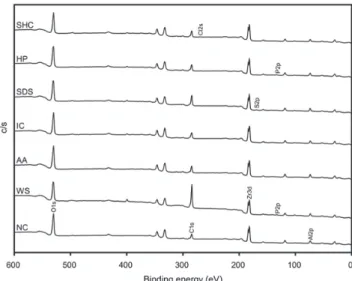
The results of the XPS analysis are shown in Fig. 3 and Table 2. The peak intensity ratios of C/O and C/Zr were the highest in group WS (2.1 and 11.6, respectively). The ratios were reduced after air-abrasion (group AA), being comparable to those of group NC. The four cleaning solu- tion groups showed C/O and C/Zr ratios that were similar to group AA—except for group SDS, which exhibited notably higher ratios. The N element was not detected only in groups NC and AA. In group WS and HP, the phospho- rus (P) element was also detected (0.5 and 0.9 at%, respec- tively). In group SDS, 0.7 at% sulfur (S) element was also detected. On the other hand, group SHC showed 0.5 at%
chlorine (Cl).
Table 1. Ra surface roughness (μm) of the zirconia specimens (mean ± SD, n=5)
Groups Ra
NC (control) 0.16 ± 0.02
WS (water-spray) 0.17 ± 0.02
AA (air-abrasion) 0.17 ± 0.02
IC (Ivoclean) 0.17 ± 0.01
SDS (sodium dodecyl sulfate) 0.17 ± 0.02
HP (H2O2) 0.17 ± 0.03
SHC (NaOCl) 0.16 ± 0.01
There were no significant differences among the test groups (one-way ANOVA, P=.683).
Fig. 2. Pearson’s correlations between the cosΘa and the contact angle hysteresis (H). r indicates the Pearson’s correlation coefficient. AA: air-abrasion; HP: H2O2; IC:
Ivoclean; NC: control; SDS: sodium dodecyl sulfate;
SHC: NaOCl; WS: water-spray.
Fig. 3. Wide-scan XPS spectra for the test groups. AA:
air-abrasion; HP: H2O2; IC: Ivoclean; NC: control; SDS:
sodium dodecyl sulfate; SHC: NaOCl; WS: water-spray.
Al: aluminum; C: carbon; Cl: chlorine; O: oxygen; P:
phosphorus; S: sulfur; Zr: zirconium. The peaks between 600 and 0 eV are shown.
Table 2. Ratios of carbon (C), oxygen (O), nitrogen (N), and aluminum (Al) elements
Groups C/O C/Zr O/Zr N/Zr Al/Zr
NC (control) 0.5 2.7 5.4 - 1.2
WS (water-spray) 2.1 11.6 5.6 0.7 1.1
AA (air-abrasion) 0.6 3.4 5.9 - 1.4
IC (Ivoclean) 0.6 3.1 5.0 0.2 1.0
SDS (sodium dodecyl sulfate) 0.9 5.6 5.9 0.3 1.3
HP (H2O2) 0.6 3.5 5.7 0.2 1.2
SHC (NaOCl) 0.7 3.2 4.8 0.2 0.9
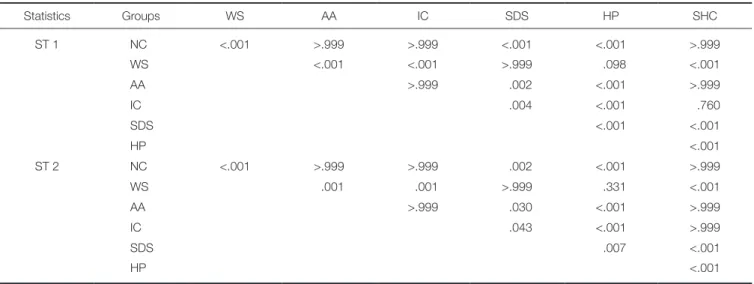
Table 3 summarizes the shear bond strength and failure mode results. Each P value from post hoc comparison Bonferroni’s test is presented in Table 4. Group SHC showed the highest shear bond strength value (10.9 ± 1.7 MPa). Groups NC, AA, IC exhibited statistically similar bond strength values to that of group SHC. In contrast, groups SDS, WS, and HP showed significantly lower bond strengths than the aforementioned four groups (i.e., groups SHC, NC, AA, and IC). For groups SHC, NC, AA, and IC, mixed failures outnumbered adhesive failures. For groups SDS and HP, the higher frequency of adhesive failures observed when compared to mixed failures. For group WS, all failures were adhesive.
Table 3. Shear bond strength (MPa) of the test groups and type of failure mode
Groups
Shear bond
strength Failure modes
Mean ± SD A M
SHC (NaOCl) 10.9 ± 1.7a* 4† 8
NC (control) 10.4 ± 2.1a 5 7
AA (air-abrasion) 9.5 ± 2.4a 6 6
IC (Ivoclean) 9.1 ± 1.3a 5 7
SDS (sodium dodecyl sulfate) 6.7 ± 1.6b 8 4
WS (water-spray) 5.7 ± 1.2bc 12 0
HP (H2O2) 4.4 ± 0.8c 10 2
* Means with same lowercase letters are not statistically different at P>.05. The P values are shown in Table 4.
† Number of resin cylinders. A: adhesive failure at the zirconia-resin interface; M:
a combination of adhesive failure at the interface and cohesive failure within resin.
Table 4. The P values of the shear bond strength data from post hoc comparison Bonferroni’s test
Statistics Groups WS AA IC SDS HP SHC
ST 1 NC <.001 >.999 >.999 <.001 <.001 >.999
WS <.001 <.001 >.999 .098 <.001
AA >.999 .002 <.001 >.999
IC .004 <.001 .760
SDS <.001 <.001
HP <.001
ST 2 NC <.001 >.999 >.999 .002 <.001 >.999
WS .001 .001 >.999 .331 <.001
AA >.999 .030 <.001 >.999
IC .043 <.001 >.999
SDS .007 <.001
HP <.001
ST 1: the analyses were done under the assumption of independence among the three resin cylinders bonded to each zirconia disk specimen. ST 2: a simple random effect in mixed model ANOVA was conducted to allow correlation between the resin cylinders. Means were log10 (MPa) transformed prior to analysis. AA: air-abrasion;
HP: H2O2; IC: Ivoclean; NC: control; SDS: sodium dodecyl sulfate; SHC: NaOCl; WS: water-spray.
Fig. 4 shows representative SEM images of zirconia sur- faces after debonding. Groups NC, AA, IC, and SHC show the typical air-abraded zirconia surfaces. For groups WS, SDS, and HP, blister-like bubble formations on the air- abraded surfaces were observed.
DISCUSSION
According to the manufacturer, IC contains sodium hydroxide and is meant for extraoral use only. The three substances used to prepare the cleaning solutions also have potentially adverse intraoral effects when present in high concentrations and with prolonged exposure. Clinically rel- evant concentrations of SDS are 0.015-1.5%, and tooth- pastes usually contain 1-3% of SDS as the detergent.19 Home mouth rinses and dentifrices contain low concentra- tions (1% or less) of HP.20 Although 5.25% SHC is a com- mon tissue solvent, 1% SHC solution has effective tissue- dissolving capability.21 Considering the potential use of such cleaning solutions for intraoral repair procedures with restorative composite resin, three experimental zirconia- cleaning solutions with relatively low concentration (1.0 wt%) were prepared and tested (Fig. 1).
Non-covalent adsorption of salivary proteins, simulated by saliva immersion in this study, occurs on zirconia surface after try-in.1 Only water-spray rinsing of the specimens after saliva contamination significantly lowered the bond strength value, compared to the control (Table 3). The additional air-abrasion after contamination effectively removed saliva contamination without significantly increas- ing the Ra value (Table 2) and restored the bond strength significantly to the same level as that in the control, in accordance with some previous studies.1,4-6 In this study, moreover, some of the cleaning solutions (IC or SHC) were
found to be also effective in removing saliva contamination and in enhancing the resin bond strengths. Thus, the null hypothesis that the cleaning solutions are less effective than air-abrasion in terms of resin bond strength was rejected.
Surface hydrophobicity/hydrophilicity can be deter- mined by CA measurement.22 It is known that surface roughness also alters the CA values of the surface.9 In this study, the influence of surface roughness on the CA values can be excluded because the Ra values among the seven test groups were not significantly different (Table 1).9,10 Although zirconia is rather hydrophobic and has a low sur- face free energy,23 air-abrasion creates high surface energy and promotes microretention.24 Thus, air-abraded zirconia surfaces without saliva contamination may be considered relatively hydrophilic.According to the CA measurements (Fig. 2), groups NC, AA, IC, and SHC, which produced higher bond strength values (Table 3 and Table 4), showed lower advancing CA values (39.7-52.2°) and therefore indi- cated more hydrophilic surfaces. On the contrary, groups WS, SDS, and HP, which exhibited lower bond strength val- ues, yielded lower CA values (62.9-65.2°) and indicated more hydrophobic surfaces. Thus, more hydrophilic zirco- nia surfaces indicate more effective cleaning; whereas more hydrophobic surfaces indicate less-effective cleaning.8 In addition, since chemical heterogeneity can also cause CA hysteresis,9 greater surface inhomogeneity due to less-effec- tive cleaning of saliva-contaminated zirconia surfaces may induce greater CA hysteresis.8 Thus, a significantly strong negative correlation between the cosΘa and the CA hyster- esis (Fig. 2) indicates that CA hysteresis is also relevant in assessing the cleanness of rough surfaces.8 Nonetheless, CA measurements alone are not sufficient to characterize sur-
face chemical changes on zirconia before and after clean- ing.22 Therefore, XPS was also used to identify the chemical elements on the surfaces. The depth and spatial resolutions for XPS are 1-25 nm and 8-150 μm, respectively.25 Since the subtended zirconia surface signal was detectable (Fig. 3), the thickness of the contamination layer was less than 10 nm.7
In dental practice, SHC solution has been widely used as an endodontic irrigant due to its effective antimicrobial and tissue-dissolving capabilities.26 It is also known that residual SHC may interfere with resin polymerization due to oxygen generation.27 Among the experimental cleaning solutions, however, 1% SHC solution was the most effec- tive in removing the saliva contaminants from the zirconia surface (Table 3). XPS analysis also showed a lower O/Zr ratio for the zirconia surface cleaned with SHC than that cleaned with HP. SEM observation of the debonded sur- face revealed little bubble formation at the interface (Fig.
4G). These findings may indicate that SHC effectively cleaned the surface; water-spray rinsing then removed most of the residual SHC on the zirconia surface.
The results for group AA confirms again that air-abra- sion is a useful cleaning method of saliva-contaminated zir- conia.1,4-6 In clinical practice, however, the more complex surface geometry of zirconia-based restorations may make it difficult to remove contamination using air-abrasion.1 In such cases, a microbrush would be more convenient for applying cleaning solutions such as SHC to the inner sur- faces of the restorations.
According to the manufacturer (Ivoclar Vivadent Scientific Documentation, 2011), the alkaline suspension of zirconi- um oxide particles in IC removes salivary phosphate con- Fig. 4. Representative SEM images of zirconia surfaces after debonding (original magnification: 4000×). A: NC (control);
B: WS (water-spray); C: AA (air-abrasion); D: IC (Ivoclean); E: SDS (sodium dodecyl sulfate); F: HP (H2O2); and G: SHC (NaOCl). For groups WS, SDS, and HP (images B, E, and F), some blister-like bubble formations are indicated by pointers.
A B C
D E F G
taminants by adsorption. Although 0.5% P element was detected in group WS, no P element was detected in group IC (Fig. 3). It appears that the application of IC effectively removed various contaminants (including salivary phos- phate) from the surface and provided a clean surface for improved resin bonding (Table 3).
SDS is an anionic surfactant commonly used in the removal of proteins.28 However, group SDS showed a sig- nificantly lower bond strength than groups NC and AA (Tables 3 and 4). As stated above, groups WS, SDS, and HP showed similar higher water CAs (i.e., rather hydrophobic surfaces) (Fig. 2).29 Nonetheless, the CA hysteresis of group SDS was greater than that of group HP and similar to that of group WS. Similarly, XPS analysis showed a higher C/Zr ratio in group SDS than in group HP (5.6 vs. 3.5). These findings indicate less complete removal of carbon by 1%
SDS solution when compared with 1% HP. Moreover, small bubbles remained on the SDS-treated and water-washed zirconia surface (Fig. 4E). Thus, the solution seems ineffec- tive in cleaning the saliva-contaminated zirconia surface.
For group WS, the N element was detected on the zir- conia surface (Table 2). After cleaning with the solutions, the N/Zr ratio was reduced but N remained on the zirconia surfaces. Nitrogen was not detected only in groups NC and AA, in which the surfaces were air-abraded. Groups IC and SHC showed lower cosΘa values and higher CA hystereses than group AA (Fig. 2). These findings might imply the superior cleaning potential of saliva-contaminated zirconia surface by air-abrasion than by the application of IC or 1%
SHC, although no significant differences in shear bond strength were found among the three cleaning methods (Table 3). Further research is still needed to clarify whether the cleaning solutions are superior to air-abrasion in terms of long-term clinical bond strength.
HP is one of the principal reactive products of oxygen metabolism and often used as a bleach or cleaning agent.
Although CA measurements and XPS analysis indicated a relatively effective cleaning efficacy of 1% HP, group HP exhibited the lowest bond strength value among the seven test groups. This may be due to the more extensive bubble formations on the zirconia surface after cleaning with HP (Fig. 4F).
In microtensile bond strength testing, each tooth can be considered a statistical unit because the variation within the tooth may be larger than the inter-tooth variation.30.31 In this study, a zirconia disk, which is expected to show less heterogeneity as opposed to tooth material, was used,31 three resin cylinders being bonded on one zirconia sur- face.22 In post hoc power analysis, a power of about 0.80 is regarded as acceptable for most purposes.32 For the bond strength data in this study, the power values were 1.00. In our linear mixed model, responses from a subject are thought to be the sum (linear) of fixed and random effects, the latter contributing only to the covariance structure of the data. Although the fixed effect was the primary interest in our study, it was necessary to adjust for the covariance.
Thus, the statistical analyses for the shear bond strength
data were done in two ways after transformation: under the assumption that the data are independent (ST 1) and that the data on one zirconia are correlated (ST 2).17 When the preset threshold value of alpha was set to 0.05, the statisti- cal results in the pairwise comparisons were not affected by the methods of statistical analysis (i.e., STs 1 or 2).
Nevertheless, the P values in some of the pairwise compari- sons differed between the two methods. In particular, the bond strength of group SDS was “highly” significantly low- er than those of groups AA and IC according to ST 1. The value of group HP was “marginally” significantly lower than that of group WS according to ST 1, but not signifi- cantly different from each other, according to ST 2.
Although a zirconia ceramic is expected to show less het- erogeneity as opposed to tooth material, it may thus be nec- essary to adjust for the covariance structure of the data.
During the try-in of zirconia restorations, the surfaces to be bonded may be additionally contaminated by blood or silicone indicators, which might also compromise resin bonding.1,4,6 These contaminants were not included in the present study and further experiments are needed to deter- mine whether the cleaning solutions tested are also effective for such contamination. The cleaning efficacy of 1% SHC solution on other prosthetic restoration surfaces should also be studied. In addition, the safety of SHC should be assessed for intraoral use.
CONCLUSION
The findings of this study confirm that saliva contamina- tion significantly reduces resin shear bond strength to zir- conia and that air-abrasion is a useful cleaning method.
However, a simple application of IC or 1% SHC effectively removed the saliva contaminants and provided a clean sur- face. The resin bond strength results were supported by water CA measurements and chemical identification of the zirconia surface with XPS. However, long-term clinical studies are still required to clarify the efficacy of the clean- ing solutions in improving resin bonding of saliva-contami- nated zirconia.
ORCID
Kyo-Han Kim http://orcid.org/0000-0002-0762-9608 Tae-Yub Kwon http://orcid.org/0000-0002-9998-3099 REFERENCES
1. Yang B, Scharnberg M, Wolfart S, Quaas AC, Ludwig K, Adelung R, Kern M. Influence of contamination on bonding to zirconia ceramic. J Biomed Mater Res B Appl Biomater 2007;81:283-90.
2. Kim MJ, Kim YK, Kim KH, Kwon TY. Shear bond strengths of various luting cements to zirconia ceramic: surface chemi- cal aspects. J Dent 2011;39:795-803.
3. Wegner SM, Kern M. Long-term resin bond strength to zir- conia ceramic. J Adhes Dent 2000;2:139-47.
4. Quaas AC, Yang B, Kern M. Panavia F 2.0 bonding to con- taminated zirconia ceramic after different cleaning proce- dures. Dent Mater 2007;23:506-12.
5. Yang B, Lange-Jansen HC, Scharnberg M, Wolfart S, Ludwig K, Adelung R, Kern M. Influence of saliva contamination on zirconia ceramic bonding. Dent Mater 2008;24:508-13.
6. Yang B, Wolfart S, Scharnberg M, Ludwig K, Adelung R, Kern M. Influence of contamination on zirconia ceramic bonding. J Dent Res 2007;86:749-53.
7. Phark JH, Duarte S Jr, Kahn H, Blatz MB, Sadan A. Influence of contamination and cleaning on bond strength to modified zirconia. Dent Mater 2009;25:1541-50.
8. Boulange-Petermann L, Joud JC, Baroux B. Wettability pa- rameters controlling the surface cleanability of stainless steel.
In: Mittal KL, ed. Contact angle, wettability and adhesion.
Leiden; VSP; 2008. p. 139-51.
9. Kim YK, Son JS, Kim KH, Kwon TY. Influence of surface energy parameters of dental self-adhesive resin cements on bond strength to dentin. J Adhesion Sci Technol 2013;27:
1778-89.
10. Kim YK, Min BK, Son JS, Kim KH, Kwon TY. Influence of different drying methods on microtensile bond strength of self-adhesive resin cements to dentin. Acta Odontol Scand 2014;72:954-62.
11. Takimoto M, Ishii R, Iino M, Shimizu Y, Tsujimoto A, Takamizawa T, Ando S, Miyazaki M. Influence of temporary cement contamination on the surface free energy and dentine bond strength of self-adhesive cements. J Dent 2012;40:131- 8.
12. Chibowski E, Hołysz L, Terpilowski K, Jurak M. Investi- gation of super-hydrophobic effect of PMMA layers with different fillers deposited on glass support. Colloids Surf A:
Physicochem Eng Asp 2006;291:181-90.
13. Hołysz L, Mirosław M, Terpiłowski K, Szcześ A. Influence of relative humidity on the wettability of silicon wafer sur- faces. Ann UMCS Chem 2008;63:223-39.
14. Phark JH1, Duarte S Jr, Blatz M, Sadan A. An in vitro evalua- tion of the long-term resin bond to a new densely sintered high-purity zirconium-oxide ceramic surface. J Prosthet Dent 2009;101:29-38.
15. Hagge MS, Lindemuth JS. Shear bond strength of an autopo- lymerizing core buildup composite bonded to dentin with 9 dentin adhesive systems. J Prosthet Dent 2001;86:620-3.
16. Yun JY, Ha SR, Lee JB, Kim SH. Effect of sandblasting and various metal primers on the shear bond strength of resin ce- ment to Y-TZP ceramic. Dent Mater 2010;26:650-8.
17. Sattabanasuk V, Vachiramon V, Qian F, Armstrong SR.
Resin-dentin bond strength as related to different surface preparation methods. J Dent 2007;35:467-75.
18. McClean MD, Rinehart RD, Ngo L, Eisen EA, Kelsey KT, Wiencke JK, Herrick RF. Urinary 1-hydroxypyrene and poly- cyclic aromatic hydrocarbon exposure among asphalt paving workers. Ann Occup Hyg 2004;48:565-78.
19. Neppelberg E, Costea DE, Vintermyr OK, Johannessen AC.
Dual effects of sodium lauryl sulphate on human oral epithe- lial structure. Exp Dermatol 2007;16:574-9.
20. Walsh LJ. Safety issues relating to the use of hydrogen perox-
ide in dentistry. Aust Dent J 2000;45:257-69; quiz 289.
21. Baumgartner JC, Cuenin PR. Efficacy of several concentra- tions of sodium hypochlorite for root canal irrigation. J Endod 1992;18:605-12.
22. Chen L, Suh BI, Brown D, Chen X. Bonding of primed zir- conia ceramics: evidence of chemical bonding and improved bond strengths. Am J Dent 2012;25:103-8.
23. Piascik JR, Swift EJ, Braswell K, Stoner BR. Surface fluorina- tion of zirconia: adhesive bond strength comparison to com- mercial primers. Dent Mater 2012;28:604-8.
24. Matinlinna JP, Heikkinen T, Ozcan M, Lassila LV, Vallittu PK. Evaluation of resin adhesion to zirconia ceramic using some organosilanes. Dent Mater 2006;22:824-31.
25. Ratner BD. Characterization of biomaterial surfaces.
Cardiovasc Pathol 1993;2:87-100.
26. Spencer HR, Ike V, Brennan PA. Review: the use of sodium hypochlorite in endodontics-potential complications and their management. Br Dent J 2007;202:555-9.
27. Del Carpio-Perochena AE, Bramante CM, Duarte MA, Cavenago BC, Villas-Boas MH, Graeff MS, Bernardineli N, de Andrade FB, Ordinola-Zapata R. Biofilm dissolution and cleaning ability of different irrigant solutions on intraorally infected dentin. J Endod 2011;37:1134-8.
28. Liu G, Craig VS. Improved cleaning of hydrophilic protein- coated surfaces using the combination of Nanobubbles and SDS. ACS Appl Mater Interfaces 2009;1:481-7.
29. Arkles B, Pan Y, Kim YM. The role of polarity in the struc- ture of silanes employed in surface modification. In: Mittal KL, editor. Silanes and other coupling agents. Leiden; CRC Press; 2009. p. 51-64.
30. Vanderlei A, Passos SP, Özcan M, Bottino MA, Valandro LF.
Durability of adhesion between feldspathic ceramic and resin cements: effect of adhesive resin, polymerization mode of resin cement, and aging. J Prosthodont 2013;22:196-202.
31. Roulet JF. Statistics: nuisance - tool - necessity? J Adhes Dent 2013;15:203.
32. De Lucas M, Janss GFE, Whitfield DP, Ferrer M. Collision fatality of raptors in wind farms does not depend on raptor abundance. J Appl Ecol 2008;45:1695-703.