The use of base metal alloys in fixed prosthodontics has created a necessity to construct one-piece metal castings for multiple unit fixed partial dentures. This approach arises as a result of the difficulty in achieving a strong dependable pre or post solder joint(1, 4).
Previous studies on the fit of base metal alloy casting have indicated an apparent universal problem of poor surface texture, and castings commonly being short at margins or tight fitting(5,
6). Other investigators using a modified investing technique have found Ni-Cr castings were routinely oversize(7).
It follows that investing techniques must be strictly controlled, each alloy evaluated for specific shape of casting using an investment having high and reproducible expansion characteristics.
Since there is an obvious need for more basic research into these problems, a study was designed to provide a method of assessing the dimensional changes occurring at the marginal area of a multiple unit fixed partial denture. In this study the distance between specific precast(wax stage)and post-cast points on abutment crown margins were recorded as the expansion of the investment was altered.
MATERIALS AND METHODS
The model-Typodont teeth(maxillary Ist bicuspid and maxillary 2nd molar) were reduced for representative porcelain veneer crown preparations having a buccal shoulder and proximal and lingual chamfer finish lines. At four points on the proximal margins of each preparation a groove was made to allow the positioning of indexing pins for subsequent measurements. The two teeth intervening were removed to provide an edentulous ridge area. This simulated four-unit bridge was impressioned with polysulfide rubber(9) and a silver electroplated cast was produced. The abutment dies were indexed with dowel pins and made removable from the master cast.
WAX PATTERNS~The abutment dies were initially dipped into molten wax(10) to provide a wax coping of 0.3㎜. Subsequently, a 1㎜. band of this wax was removed from the margin and this area was refilled with Maves green wax(11) and carved to end at the finish line. Two premolded wax pontics(12) were positioned into the edentulous area with a lingual indexing jig and wax connectors were added between each abutment pattern and pontic secton resulting in a one-piece four-unit waxed span. As the wax unit
- 대한 치과 보철학회지 Vol. 20 No. 1, 1982 -
FIT OF ONE-PIECE CAST FIXED PARTIAL DENTURES
Davis A. Garlapo, D. D. S.,※※Sun-Hyung Lee, D. D. S.,PhD.,※※※※ Chin Koo Choung, D. D. S.,※※※※※※and Soren E. Sorensen, D. D. S., M. S.※※※※※※※※
State University of New York at Buffalo, School of Dentistry, Buffalo, New York
※ Associate Professor, Department of Fixed Prosthodontics.
※※ Visiting Assistant Professor, Department of Fixed Prosthodontics.
※※※ Assistant Professor, Department of Fixed Prosthodontics.
※※※※ Professor and chairman, Department of Dental Materials.
seated on the master cast the major sprue luted to the linegual cusp area.
A silicone mold was employed to produce a custom sprue. On each abutment pattern four indexing needles(13) were inserted into the wax at the indented points on the die margin along with one needle inserted at the middle of the proximal- occlusal line angle. These needles were all 5.0㎜.
long and extened into the wax to touch the axial wall of the die. They were sealed to the external surface of the patterns with sticky wax. The four- unit waxed span with indexing needles was then separated from the master cast and wax was removed internally in the pattern sufficient to visually expose the tip of each needle.
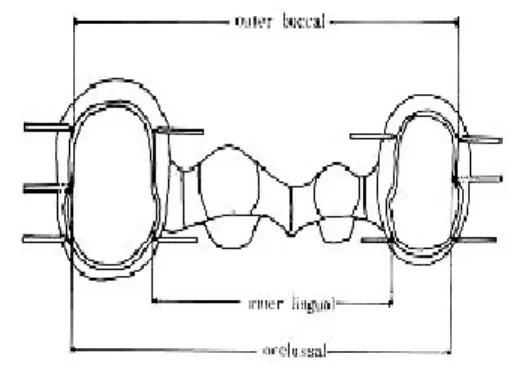
MEASUREMENT OF PATTERNS~Subsequent to completion of each four-unit wax pattern, the wax specimen with indexing needles and attached sprue was placed onto a positioning jig in an inverted position. This assembly permitted recordings to be made of the distances between the corresponding indexing points using a traveling microscope(14)(Fig.1., 2). The time elapsed in making these recordings was controlled to minimize spatial changes caused by distortion of the wax patterns. Each measurement was recorded to the nearest 0.005㎜. Subsequently, the major sprue was luted to a sprue base, ovoid in shape(38㎜.x50㎜.). A length of Kaoliner(15)(40
㎜.x120㎜.)was wrapped around the sprue base
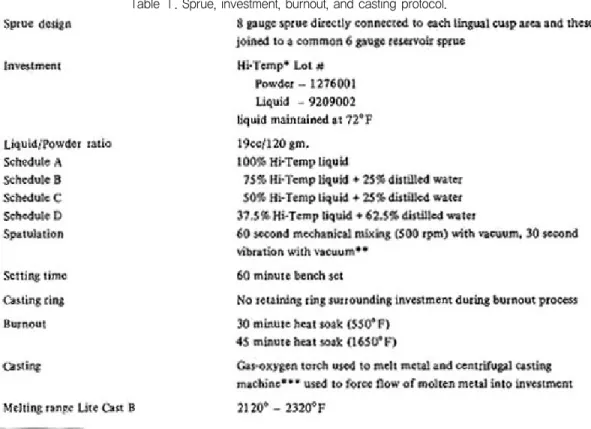
Table Ⅰ. Sprue, investment, burnout, and casting protocol.
and outside of this a layer of boxing wax(16) was adapted with the free ends luted together. This cylinder of Kaoliner and boxing wax served as a retaining ring during the investment procedures.
Hi-Temp investment was mixed in the proportion recommended by the manufacturer(Table Ⅰ) and varied only in concentration of liquid as indicated in table Ⅰ. Before filling the ring, the investment was painted to fill the internal aspects of the abutment patterns.
INVESTING BURN OUT-CASTING~The setting time of investment, burnout schedule and casting procedure for each of the patterns were standardized and carried out as described in table
Ⅰ. Five pennyweight of nickel-chrome alloy with beryllium,(17) containing at best 50% new metal, was used for the casting of each specimen. Each casting was bench cooled to room temperature before devestment. Remaining investment was removed in a solution of stone and plaster remover(18) in conjunction with ultrasonic vibration.
Each completed four-unit casting was suspended on the positioning jig and the traveling microscope used to measure distances between the indexing points which corresponded to those previously used for measurement in the waxed specimens. Again, two measurements were made for the inside, two for the external, and one for the occlusal span distance.
RESULTS
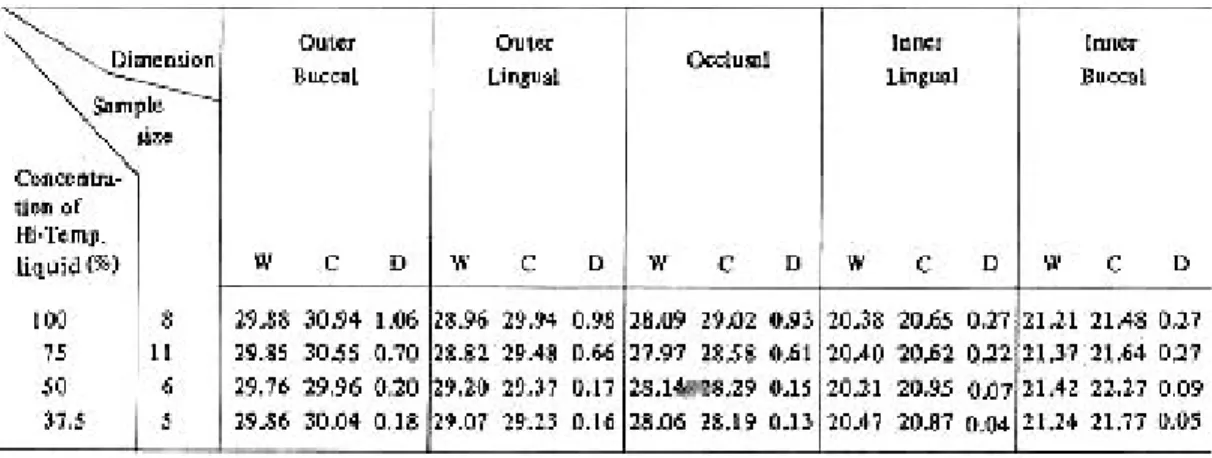
Thirty fixed partial dentures simulating a four- tooth span were made and the only variable introduced into the protocol was a dilution of the Hi-Temp investment liguid. Table Ⅱ shows the colloidal silica concentration versus casting oversize in percent within each group. All specimens had an increased linear dimensional change after casting, which was effectively reduced with each successive dilution of liquid until the 50% concentration was reached. Further liquid dilution to a 37.5% concentration did not significantly reduce the dimensional change;
however, it did create a marked increase in surface roughness. The relative change in outside and inside dimensions to concentration of colloidal silica liquid is illustrated in table Ⅱ. The Schaffe’s test was used to compare differences between sample means.
DISCUSSION
The failure to produce adequate investment expansion for a base metal cast span was not substantiated by this testing methodology. In fact, the concern as interpreted from the data is the need to limit excessive expansion such that one can expect a four-unit cast fixed partial denture to simultaneously seat onto two abutment preparations. Table Ⅲ clearly illustrates the greater dimensional increase realized across external index points than across internal index Fig. 1 : Gingival view of four-unit bridge with indexing
needles
Fig. 2 : Buccal view of four-unit bridge with indexing needles(O : occlusal, C : cervical)
points. The explanation for the observed differences in inside vs. external oversize(%) may be due to some degree of restricted setting expansion exerted by the inside wax span assembly. The external being less restricted and significantly higher.
The occlusal indexing points were placed so that the dimensional change occurring between them could be recorded and related to those of the outside gingival indexing points(Fig. 2.). In this manner a measure of the vertical warpage across the four-unit span could be appreciated. This comparison of actual dimensional change between the occlusal and gingival outside indexing
points(Table Ⅲ)does not indicate significant vertical warpage for the length of the span measured.
A subjective evaluation of the results was made by attempting to seat representative sample one- piece castings from each of the four concentrations of investment liquid onto the master cast. The sample castings from the 100%
and 75% liguid concentrations seated onto the master cast only within 1㎜ of the margin. The sample castings for 50% and 37.5% liquid concentrations provided complete seating after very minimal relief of the internal axial walls.
Table Ⅲ. Mean percentage of expansion and standard deviation as a function of liquid concentration Table Ⅱ. Mean bridge lengths in mm. for the wax(W) and cast(C) stages and their difference(D) as a function of
investment liquid concentration.
CONCLUSIONS
1. The investment expansion possible with Hi-Temp investment exceeds the requirements necessary to compensate for cast metal shrinkage of a base metal alloy(Lite-Cast B) across o four unit span.
2. It is possible to significantly alter the expansion of Hi-Temp investment by diluting the concentration of the Hi-Temp liquid with distilled water.
3. The problem in fabricating a fixed partial denture cast as one-piece may well be in negating any expansion occurring between the inner facing proximal walls while simultaneously providing for expansion between the outer facing proximal walls.
4. It is possible to cast a four-unit fixed partial denture with a base metal alloy(Lite-Cast B) without producing significant vertical warpage across the span.
5. A test method to quantify the casting accuracy of multiple unit fixed partial dentures was developed.
REFERENCES
1) �善炯 : 陶材燒付前裝鑄造冠用卑�屬合�間의 납착에 관한 硏究, JKDA, Vol. 15;969-974, 1977.
2) Schiffer, R. : Soldering technique for high fusing gold in the porcelain, J Prosthet Dent 22:495- 499, 1969.
3) Pruden Ⅱ, W. H. : Soldered connections with porcelain fused to gold, J Prosthet Dent 22:679-, 1969.
4) Draddy, R. E. : Chrom-cobalt alloy pontics for fixed partial dentures, J Prosthet Dent 25:638- 641, 1971.
5) Bauer, R. W. and Eden, G. T. : NADL survey of casting alloys in commercial dental laboratories, J Dent Res 56(special issue B)B214, 1977.
6) Bauer, R. W. : Survey on the use of casting alloys in commercial dental laboratories Part Ⅱ:
ceramic alloys, Nat Assoc Dent Lab J 24:8-15,
1977.
7) Eden, G. T., Franklin, O.M., Powell, J. M., Ohta, Y., and Dickson, G. : Fit of porcelain fused-to- metal crown and bridge castings, J Dent Res 58:2360-2368, 1979.
8) Fusayama, T. : Synthetic study on precision dental casting, Bul Tokyo Med Dent Univ 11:165- 205, 1964.
= 초 록 =
One-Piece cast법에 의한 가공의치의 적합성에 관한 연구
뉴우욕 주립대학교 치과대학 보철학 교실
데이비스 에이 칼라포, 이선형, 정진구, 쏘렌 이 쏘렌슨
귀금속 가격 앙등은 치과보철치료에 있어서 비귀금속 합금의 이용을 촉진 시키고 있다.
가공의치 제작에 비귀금속합금을 이용할 경우에는 납 착상태에 대한 신빙성 문제로 인하여 one-piece cast법 이 널리 사용되고 있으나 이에 의하여 제작된 가공의치 의 적합도에 관하여는 논의가 분분하다.
고로 저자는 one-piece cast법에 의한 비귀금속 가공 의치에 있어서 경화수축에 따른 거리변화를 계측현미경 을 이용하여 연구한 결과 다음과 같은 결론을 얻었다.
1. 4개 치아를 포함하는 가공의치 제작에 있어서 Hi- Temp매몰재는 비귀금속(Lite-Cast B)의 수축을 보상하 고도 남음이 있다.
2. Hi-Temp에 사용되는 液을 증류수로 희석할 경우 그 농도 조절에 의하여 Hi-Temp 매몰재의 팽창을 크게 변화시킬 수 있다.
3. one-piece cast법에 의한 가공의치 제작의 문제점 은 두 지대치의 서로 바라보고 있는 인접면간의 거리는 증가됨이 없이 외측 인접면간의 거리만 다소 증가되어야 한다는 것이다.
4. 비귀금속합금을 이용하여 수직적인 큰 변형없이 4 개 치아가 포함되는 가공의치를 제작할 수 있다.
5. 수개 치아를 포함하는 가공의치의 주조 정확도를 계측할 수 있는 새로운 방법을 창안하였다.