Optimal Culture Conditions for the Production of a Novel Extracellular Alkaline Lipase from
Yarrowia lipolyticaNRRL Y-2178
Geon-Ho Lee, Jae-Han Bae, Min-Jung Suh and Hak-Ryul Kim*
Department of Animal Science and Biotechnology, Kyungpook National University, Daegu 702-701, Korea
Received April 17, 2007; Accepted June 4
Lipases are industrially useful versatile enzymes that catalyze numerous different reactions.
Among lipases functioning under extreme conditions, alkaline lipase is useful in detergent industry.
Lipase from yeast strain Yarrowia lipolytica NRRL Y-2178 was most active under alkaline condition, and initial medium pH for most lipase production was also alkaline [Lee et al., 2007, J
Microbiol Biotechnol, 17(6)]. High lipase production was achieved using Y. lipolytica NRRL Y-2178.
Optimal incubation time for lipase production at 25oC was 72 h. Optimal temperature, when incubated for 72 h, was 27.5oC. Lipase production but not cell growth was very sensitive to concentrations of glucose and glycerol as efficient carbon sources, showing optimal concentrations of 1.0 and 1.5% (w/v), respectively. Lipase production was highly stimulated by Ca2+, K+, and Na+, but was inhibited by Co2+, Cu2+, Mn2+, Na+, and Fe2+. Maximum lipase production at 0.1 mM Ca2+
for 72 h incubation at 27.5oC was 649 units/mL.
Key words: alkaline lipase, Yarrowia lipolytica
Lipases (triacylglycerol acylhydrolases, E.C. 3.1.1.3.) are versatile enzymes that catalyze the hydrolysis of triglycerides under natural conditions. Because lipases can catalyze numerous different reactions including transesterification and chiral synthesis of esters, they have been widely used for industrial applications, including food, chemical, pharmaceutical, and detergent industries [Harwood, 1989]. Lipases are found widely in animals, plants, and microbes. Although early interest in lipases was directed mostly toward pancreatic lipase [Sarda and Desnuelle, 1958], other mammalian lipases such as lipoprotein lipase have also been thoroughly studied [Eckel, 1989]. Recently, microbial lipases have gained special industrial attentions due to their versatility and availability, as well as lower production cost as compared to the mammalian enzymes. Several microorganisms are known as good producers of extracellular lipases [Ratledge and Tan, 1990].
Although microbial lipases have been utilized in many industrial applications, there are still high interests in developing new enzymes with commercially useful properties, such as high activities under extreme conditions.
Specifically, alkaline lipases are useful in detergent
industry because triglycerides in stains on fabrics are difficult to remove due to their very low saponification capability compared to fatty acids. Studies on alkaline lipase from Pseudomonas species [Kanwar et al., 2002;
Karadzic et al., 2006], Bacillus species [Castro-Ochoa et al., 2005], and some fungal species [Essamri et al., 1998;
Gulati et al., 1999; Gupta et al., 2006] have been reported.
The National Center for Agricultural Utilization Research (NCAUR, Peoria, IL, USA) conducted a large-scale screening for lipase activity using selected cultures from the Agricultural Research Service (ARS) Culture Collection (Peoria, IL, USA) and characterized 25 highly active yeast lipases with respect to their positional specificity against triglyceride [Hou, 1997]. We expanded our research more specifically with respect to high production and novel characteristics of lipases from these selected lipase-producing yeast strains, and were the first to report a novel alkaline lipase from Yarrowia lipolytica NRRL Y-2178 [Lee et al., 2007]. Results showed the optimal initial pH of the medium for lipase production and optimal pH for lipase activity were 9.0 and 8.0, respectively. Interestingly, similar Y. lipolytica strains with different origin represented different optimal pH values for production and activity of lipase. Y. lipolytica 681 from the culture collection of the Tropical Medicine Institute of Sao Paulo, Brazil showed optimal initial pH for lipase production was in the range of 3.0-4.5, whereas
*Corresponding author
Phone: +82-53-950-5754; Fax: +82-53-950-6750 E-mail: [email protected]
optimal pH for activity was 6.0 [Corzo and Revah, 1999].
Optimal pH for the production and activity of lipase from a mutant strain of Y. lipolytica isolated from soil was 7.0 and 8.0, respectively [Tan et al., 2003; Yu et al., 2007].
Extracellular lipase from the lipase over-producing mutant of Y. lipolytica CBS6303 showed optimal activity at pH 6.0 [Fickers et al., 2006]. Another genetically modified Y. lipolytica strain overproducing LIP2 lipase showed maximum specific activity at pH 6.0 [Aloulou et
al., 2006]. All these results confirmed that lipase from Y.
lipolytica NRRL Y-2178 was a novel alkaline lipase. In this study, we conducted optimization of the environmental conditions for the production of a novel extracellular alkaline lipase from Y. lipolytica NRRL Y-2178.
Materials and Methods
Microorganism and chemicals.Y. lipolyica NRRL Y- 2178 was kindly provided by Dr. Hou of National Center for Agricultural Utilization Research (Peoria, IL, USA).
The stock culture was maintained in a cryogenic vial containing 0.4 mL glycerol and 0.6 mL YM medium (1%
glucose, 0.3% yeast extract, 0.3% malt extract, 0.5%
peptone; w/v) in a deep freezer at −70oC prior to use. All chemicals were purchased from Sigma Chemical Co. (St Louis, MO, USA), unless mentioned otherwise.
Culture conditions and lipase production. Seed culture was prepared by thawing the frozen stock culture in a 37oC water bath, followed by inoculation and sequential transfer using 50 mL YM media in 100-mL flasks. Culture was incubated for 48 h with reciprocal shaking at 150 rpm and 25oC. For the main culture used for the production of lipase, a portion (2%, v/v) of the seed culture was inoculated into a 250-mL conical flask containing 100 mL lipase producing medium (YM medium plus 1% soybean oil; v/v) and incubated for the time specified in a reciprocal shaking incubator. YM medium was used as a basal medium, and the medium composition was modified as needed for the optimization of culture conditions.
Determination of cell growth. One milliliter of the culture from the flasks was collected and centrifuged (5,000×g for 10 min at 4oC). The cells were washed twice by resuspending in the same volume of distilled water, and the absorbance was measured at 610 nm using a spectrophotometer (Jasco V-530, Tokyo, Japan). Dry cell weight (DCW) was calculated from the absorbance value using the standard curve.
Determination of lipase activity. Lipase activity was estimated using the spectrophotometric method [Vorderwiilbecke et al., 1992] with p-nitrophenylbutyrate (p-NPB) as the substrate. Assay mixture was composed
of 0.1 mL enzyme sample and 0.9 mL working substrate solution. Substrate solution was prepared by ten times dilution of 10 mM p-NPB dissolved in 100% cold ethanol with 0.05 M sodium-phosphate buffer (pH 7.0). After immediate transfer of the assay mixture into the spectrophotometer cells, increase in absorbance at 37oC was measured at 410 nm for 360 s against an enzyme-free control. One unit of the enzyme activity was defined as the amount of enzyme that liberates 1 nmol of p-nitrophenol from p-NPB per minute. The values presented in each experiment of this study were the averages of duplicate tests, unless specified otherwise.
Results and Discussion
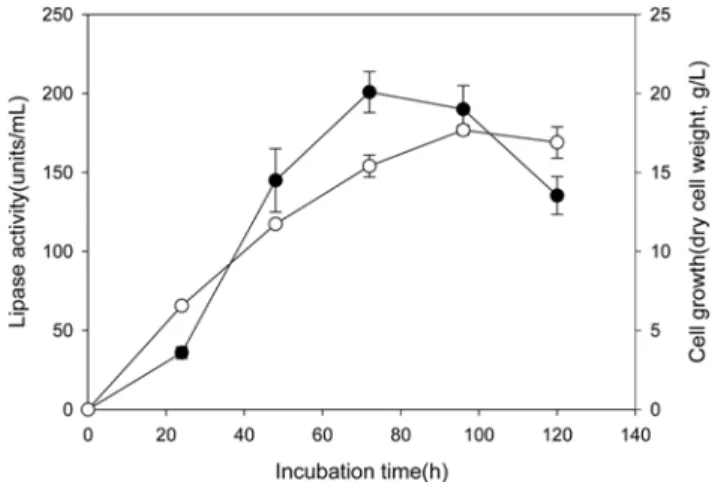
Time-dependent lipase production. Time course studies of lipase production and cell growth were performed in YM media containing 1% soybean oil, and the lipase activities were recorded periodically at 24-h intervals.
The highest lipase production of 200 units/mL was observed after 72 h incubation at 25oC, corresponding to the late exponential phase of the cell growth (Fig. 1).
Based on this result, further environmental optimization processes were performed by 72 h incubation.
Effects of incubation temperature on lipase production.
Temperature is one of the most important environmental factors affecting the enzyme production and cell growth.
Incubation temperatures ranging from 20 to 35oC were tested for their effects on the lipase production (Fig. 2).
When incubated for 72 h at a given temperature, lipase production reached optimal of 537 units/mL, at 27.5oC, although Y. lipolytica NRRL Y-2178 was capable of producing lipase in the range of 20 to 30oC. Cell growth
Fig. 1. Time-dependent lipase production by Y. lipolyt- ica NRRL Y-2178. Lipase activity (closed circle) and cell growth (open circle) were determined in 24-h intervals for 5 days. Soybean oil (1%) was added as lipase inducer. See Materials and Methods section for detailed experimental conditions.
was not significantly influenced up to 30oC. However, both lipase production and cell growth were inhibited at 35oC.
Effects of media volume on lipase production. Under the given shaking speed, volume of the media in the flask affect the mixing of the media component and the contact between oil substrate and microbial cells. In this regard, we determined the effect of the media volume on the production of lipase at the range of 50 to 150 mL with oil substrate concentration of 1% (v/v) in a 250-mL flask.
Lipase activity per unit volume greatly increased up to 100 mL and retained about 92% of the maximum value at 125 mL, followed by a remarkable declining at 150 mL (Table 1). However, total lipase production was higher at 125 mL than at 100 mL. Cell growth per unit media volume was inversely proportional to the media volume.
All these results indicated that certain ratio of media volume over flask volume was required for optimal lipase production. Proper ratio of the media volume over flask volume could be important, because it could provide sufficient contact between microbial cells and the oil
substrate, which was important for the efficient induction of the microbial lipase by the oil substrate.
Effects of carbon sources on lipase production. We previously reported that glucose and glycerol among eight different carbon sources tested were the most suitable for lipase production by Y. lipolytica NRRL Y- 2178 [Lee et al., 2007]. Based on this result, we determined optimal concentrations of glucose and glycerol in the range of 0.1 to 2.0% (w/v) for lipase production and cell growth. Lipase production was very sensitive to the concentration of glucose (Fig. 3). Lipase production increased sharply up to 1.0% and decreased significantly thereafter, showing that 1.0% glucose was optimal for lipase production from Y. lipolytica NRRL Y- 2178. Cell growth was not affected significantly by glucose concentration. Lipase production with varied concentration of glycerol increased up to 1.5% of glycerol, then decreased thereafter, an indication that optimal concentration of glycerol for lipase production by Y. lipolytica NRRL Y- 2178 is 1.5% (Fig. 4). As shown in the case of glucose, Fig. 2. Effect of incubation temperature on the produc-
tion of lipase by Y. lipolytica NRRL Y-2178. Black and gray bars indicate lipase activity and cell growth, respec- tively. See Materials and Methods section for other experi- mental conditions.
Table 1. Effects of media volume on the production of lipase by Y. lipolytica NRRL Y-2178 Media volumea
(mL) Lipase activity
(units/mL) Total lipase activity
(units) Cell growth
(DCWb, g/L) Total cell growth (DCWb, g)
50 1.38 ± 0.3 00,69.0 18.9 ± 0.4 0.95
75 109.5 ± 8.00 8,212.5 15.5 ± 0.1 1.16
100 235.8 ± 2.00 23,580.00 14.1 ± 0.2 1.41
125 217.5 ± 5.50 27,187.50 12.5 ± 0.2 1.56
150 55.6 ± 1.5 8,340.0 9.8 ± 0.1 1.47
aAll media were contained in 250-mL flasks
bDCW: dry cell weight
Fig. 3. Effect of glucose concentration on the produc- tion of lipase by Y. lipolytica NRRL Y-2178. Different concentrations of glucose was used as single carbon source in YM medium supplemented with 1% soybean oil.
Closed and open circles indicate lipase activity and cell growth, respectively. See Materials and Methods section for other experimental conditions.
glycerol concentration did not affect the cell growth significantly. However, maximum lipase production with glycerol (350 units/mL) was much higher than that with glucose (249 units/mL), indicating that glycerol was the most efficient carbon source for lipase production by Y.
lipolytica NRRL Y-2178 than glucose under the optimized condition.
Lin et al. (2006) reported that glycerol was the strongest stimulating factor among the ordinary carbon sources they used for lipase production from a fungal species Antrodia cinnamomea, in good agreement with the results of this study. However, contradictory effects of glycerol on lipase production from other microbial sources have also been published. In the case of Y. lipolytica 681, lipase activity was not observed in the culture medium containing glycerol, although glycerol, even at high concentration, did not significantly inhibit the activity of lipase when glycerol was added to the enzyme reaction medium [Corzo and Revah, 1999]. They explained that, because glycerol was an end product of the hydrolysis of triglycerols, it might repress the lipase production.
Unexpectedly, in this study, glycerol was used as an efficient stimulating carbon source for lipase production by Y. lipolytica NRRL Y-2178. This discrepancy should be further studied.
Effects of metal ions on lipase production. Because metal ions are known to influence lipase synthesis, activity, and secretion mechanism, nine metal ions in the form of chloride salt (1 mM) were evaluated for their effects on lipase production by Y. lipolytica NRRL Y- 2178 (Table 2). Lipase production was highly stimulated
by Ca2+, K+, and Na+, but was inhibited by Co2+, Cu2+, Mn2+, Na+, and Fe2+ as compared to the control (standard medium). Stimulation of lipase production by K+ was of interest, since the cell growth was significantly inhibited.
Calcium ions have been reported to form complexes with ionized fatty acids, changing their solubility and behavior at interfaces, resulting in the activation of lipase [Gulomova et al., 1993]. Inhibition by Fe2+ significantly affected the lipase production by 98%, whereas had no effect on the cell growth, up to 74% of the control.
Inhibition by Co2+ was most significant against both lipase production and cell growth by 99.6 and 98%, respectively. Significant inhibitions of lipase production and cell growth by Co2+ in this study were quite different from those of other report in that CoCl2 didn’t exert any negative effect on the activity of the purified lipase of a fungal species [Hiol et al., 1999]. There were some reports about varied effects of metal ions on the production of lipase from different organisms [Castro- Ochoa et al., 2005; Hiol et al., 1999; Lin et al., 2006; Yu et al., 2007].
As sodium and calcium ions were determined as efficient metal ions for the production of lipase from Y.
lipolytica NRRL Y-2178, we determined the effect of their concentrations on the production of lipase by Y.
lipolytica NRRL Y-2178. Concentration of calcium ion was very sensitive for lipase production but not for cell growth (Fig. 5). Lipase production increased up to 0.1 mM of calcium ions and then decreased significantly indicating that Y. lipolytica NRRL Y-2178 required certain concentration of calcium ion for optimal production of lipase. Maximum lipase production at 0.1 mM was 649 units/mL, more than twice the value of the control. Lipase Fig. 4. Effect of glycerol concentration on the produc-
tion of lipase by Y. lipolytica NRRL Y-2178. Different concentrations of glycerol was used as single carbon source in YM medium supplemented with 1% soybean oil.
Closed and open circles indicate lipase activity and cell growth, respectively. See Materials and Methods section for other experimental conditions.
Table 2. Effects of metal ions on the production of lipase by Y. lipolytica NRRL Y-2178
Metal ions
(1 mM)a Lipase production
(units/mL) Cell growth (g/L, DCWb) Ca2+ 477.2 ± 24.10 14.5 ± 0.80
Co2+ 1.5 ± 0.3 0.34 ± 0.10
Cu2+ 273.5 ± 2.000 9.9 ± 0.5 Mn2+ 139.9 ± 19.00 13.8 ± 1.50 Mg2+ 321.6 ± 10.00 16.5 ± 1.30 Zn2+ 269.9 ± 22.10 11.1 ± 0.20 K+ 438.0 ± 10.10 0.55 ± 0.05 Na+ 535.4 ± 28.20 16.4 ± 0.20
Fe2+ 8.9 ± 1.1 11.8 ± 0.20
Controlc 380.3 ± 25.30 15.9 ± 0.30
aEach metal ion in chloride salt was added to YM medium.
bDCW: dried cell weight.
cControl: YM medium
production using different concentrations of sodium ion also changed, showing optimal production at 1 mM sodium ion (Fig. 6). However, the cell growth was not influenced significantly by sodium ion concentration.
Maximum lipase production with sodium ion at 1 mM was about 60% of that with calcium ion at 0.1 mM. These results indicated that calcium ion was more efficient for lipase production by Y. lipolytica NRRL Y-2178 than sodium ion under the optimized condition.
In conclusion, we determined some necessary environmental
and nutritional conditions for the optimal production of a novel extracellular alkaline lipase from Y. lipolytica
NRRL Y-2178. Optimal incubation time at 25oC for lipase production was 72 h, and optimal temperature, when incubated for 72h, was 27.5oC. Optimal concentration of glucose and glycerol as efficient carbon sources were 1.0 and 1.5% (w/v), respectively. Lipase production was highly stimulated by Ca2+, K+, and Na+, but was inhibited by Co2+, Cu2+, Mn2+, Na+, and Fe2+. Maximum lipase production at 0.1 mM of Ca2+ with 72 h incubation at 27.5oC was 649 units/mL. Further study should be focused on the fine purification and characterization of this lipase.
Acknowledgments. This work was supported by the Korea Research Foundation Grant funded by the Korean Government (MOEHRD) (KRF-2005-003-F00026).
References
Aloulou A, Rodriguez JA, Puccinelli D, Mouz N, Leclaire J, Leblond Y, and Carriere F (2007) Purification and biochemical characterization of the LIP2 lipase from Yarrowia lipolytica.Biochim Biophys Acta Mol Cell Biol Lipids1771, 228-237.
Castro-Ochoa LD, Rodriguez-Gomez C, Valerio-Alfaro G, and Ros RO (2005) Screening, purification and characterization of the thermoalkalophilic lipase produced by Bacillus thermoleovorans CCR11. Enzyme Microb Technol37, 648-654.
Corzo G and Revah S (1999) Production and characteristics of the lipase from Yarrowia lipolytica 681. Bioresource Technol70, 173-180.
Eckel RH (1989) Lipoprotein lipase. A multifunctional enzyme relevant to common metabolic diseases. N Engl J Med320, 1060-1068.
Essamri M, Deyris V, and Comeau L (1998) Optimization of lipase production by Rhizopus oryzae and study on the stability of lipase activity in organic solvents. J Biotechnol 60, 97-103.
Fickers P, Ongena M, Destain J, Weekers F, and Thonart P (2006) Production and down-stream processing of an extracellular lipase from the yeast Yarrowia lipolytica. Enzyme Microb Technol38, 756-759.
Gulati R, Saxena RK, Gupta R, Yadav RP, and Davidson WS (1999) Parametric optimisation of Aspergillus terreus lipase production and its potential in ester synthesis. Process Biochem35, 459-464 .
Gulomova K, Ziomek E, Schrag JD, Davranov K, and Cygler M (1993) Purification and characterization of a Penicillium sp. Lipase which discriminates against diglycerides. Lipids31, 379-384.
Gupta N, Sahai V, and Gupta R (2007) Alkaline lipase from a novel strain Burkholderia multivorans: Statistical medium optimization and production in a bioreactor.
Process Biochem42, 518-526.
Fig. 5. Effect of calcium ion concentration on the pro- duction of lipase by Y. lipolytica NRRL Y-2178. Differ- ent concentrations of calcium ion in the chloride salt was added as single metal ion source in YM medium supple- mented with 1% soybean oil. Black and gray bars indi- cate lipase activity and cell growth, respectively. See Materials and Methods section for other experimental con- ditions.
Fig. 6. Effect of sodium ion concentration on the pro- duction of lipase by Y. lipolytica NRRL Y-2178. Differ- ent concentrations of sodium ion in the chloride salt was added as single metal ion source in YM medium supple- mented with 1% soybean oil. Black and gray bars indi- cate lipase activity and cell growth, respectively. See Materials and Methods section for other experimental con- ditions.
Harwood J (1989) The versatility of lipases for industrial uses. Trends Biochem Sci14, 125-126.
Hiol A, Jonzo MD, Druet D, and Comeau L (1999) Production, purification and characterization of an extracelluar lipase from Mucor hiemalis f. hiemalis. Enzyme Microb Technol25, 80-87.
Hou CT (1997) Characterization of new yeast lipases. J Am Oil Chem Soc74, 1391-1394.
Kanwar L, Gogoi BK, and Goswami P (2002) Production of a Pseudomonas lipase in n-alkane substrate and its isolation using an improved ammonium sulfate precipitation technique. Bioresource Technol84, 207-211.
Karadzic I, Masui A, Zivkovic LI, and Fujiwara N (2006) Purification and characterization of an alkaline lipase from Pseudomonas aeruginosa isolated from putrid mineral cutting oil as component of metalworking fluid.
J Biosc Bioeng102, 82-89.
Lee GH, Bae JH, Suh MJ, Kim IH, Hou CT, and Kim HR (2007) New finding and optimal production of a novel extracellular alkaline lipase from Yarrowia lipolytica NRRL Y-2178. J Microbiol Biotechnol (in press).
Lin ES, Wang CC, and Sung SC (2006) Cultivating conditions influence lipase production by the edible Basidiomycete Antrodia cinnamomea in submerged culture. Enzyme Microb Technol39, 98-102.
Ratledge C and Tan KH (1990) Oils and fats: production degradation and utilization by yeasts. In Yeasts, Biotechnology and Biocatalysis, Verachter H and Mot D (eds.) pp 223-253. Marcel Dekker, New York.
Sarda L and Desnuelle P (1958) Action de la Lipase pancreatique Sur Les Esters en Emulsion. Biochim Biophys Acta30, 513-521.
Tan T, Zhang M, Wang B, Ying C, and Deng L (2003) Screening of high lipase producing Candida sp. and production of lipase by fermentation. Process Biochem
39, 459-465.
Vorderwiilbecke T, Kieslich K, and Erdmann H (1992) Comparison of lipases by different assays. Enzyme Microb Technol14, 631-639.
Yu M, Qin S, and Tan T (2007) Purification and characterization of the extracellular lipase Lip2 from Yarrowia lipolytica.Process Biochem42, 384-391.