Ⅰ. 서 론
골유착성 임프란트가 무치악의 고정성 보철물에 의한 수복에 성공함1-3)에 따라 부분 무치악에 적용되 고 단일치아의 결손증례에도 도입된 이래4-5)보다 심 미적이고 기능적인 임프란트 수복을 위하여 여러 방 법들이 고안되고 개발되어져왔다5-9). 단일치아결손 의 임프란트 수복시 요구되는 조건으로는 심미성, 회전에 대한 저항성(counter-rotation), 생체에 대한 적합성(biocompatibility), 단순성(simplicity), 청 소의 용이성(accessibility), 수정의 다양성(vari- ability), 수리의 가능성(retrievability)등9-11)이 있 다.
단일치아결손의 임프란트 수복방법은 임프란트 본 체(body,fixture)에 보철물이 직접 연결되는 형태인 UCLA형 abutment11-15)와 같이 abutment와 gold cylinder가 일체화된 비분할 abutment (non-seg- mented abutment)를 사용하는 직접 수복법(direct restoration)과 임프란트 본체와 보철물사이에 중간 abutment (intermediary abutment)를 사용하는 간 접 수복법(indirect restoration)으로 구분할 수 있다.
간접 수복법의 abutment는 다시 최종상부구조를 고정하는 방법에 따라 시멘트 합착형(cementation type)의 abutment와 나사 유지형 abutment (screw retained abutment)로 분류된다16-18).
한편 나사유지방식은 짧은 abutment에서도 나사 에 의해서 유지력을 얻을수 있고, 임프란트의 상부 구조에 조임나사의 풀림(screw loosening)이나 파절
등의 문제가 생겼을 경우에도 언제나 수리 및 교체 가 가능한 retrievability10,18)가 있는 반면, abut- ment와 임프란트 크라운을 연결시 시멘트공간에 의 한 오차보상을 할 수 없으므로 고도의 보철물 적합 도가 요구되고 기능시에 나사풀림(screw loosen- ing)의 가능성이 있으며19-22) 심미성과 단순성 그리고 회전 방지의 면에서 시멘트 합착방식보다 불리한 조 건에 있다23-24).
나사의 풀림은 단일 임프란트 수복물의 부적합 및 나사의 파절 등으로 골유착에 좋지않은 결과를 가져 올 수 있는데25), Jemt등(1991)24)의 보고에 의하면 장 착후 처음 1년동안 나사유지형 임프란트 치관의 26%에서, 하악(10.5%)보다는 상악(31%)에서 훨씬 높은 빈도로 관찰되었다.
시멘트 합착 방식은 임프란트 상부의 크라운 구조 의 단순성 및 abutment와 임프란트 크라운간의 오 차를 시멘트 공간으로 보상할 수 있고, 기능시 회전 력에 대한 높은 저항성을 갖는다26). 그러나 임프란트 크라운을 나사 유지형의 abutment에 인산아연 시멘 트, 글라스 아이오노머 시멘트 또는 레진 시멘트등 과 같은 영구적 시멘트로 일단 시멘트 합착한 후에 는 합착된 임프란트 크라운을 손상시키지 않고는 상 부구조와 임프란트 본체의 분리가 불가능하여 retrievability의 면에서 열세하고, 경화후 시멘트가 치은연하에 남아 제거가 어려운 점등의 문제점이 있 다10,27).
두가지 방법의 장점만을 이용할 목적으로 Jemt는 분리되어 있는 완성된 보철물과 single tooth abut- 대한치과보철학회지:Vol. 37, No. 3, 1999
콤비네이션 임프란트 크라운(Combination Implant Crown)을 이용한 단일치아의 임프란트 보철수복증례
대림성모병원 치과부 보철과
김래경*∙송언희∙최병갑∙김현철∙안현정
ment를 적절한 시멘트로 접착한 후 이들을 abut- ment screw로 임프란트와 고정한 증례를 보고하였 으나 나사의 고정을 위한 큰 진입구(access hole)를 형성하여 기능적인 교합면의 크기가 감소되고 심미 성이 저하되는 단점이 있었다5). 본원에서는 이와 유 사한 Calcitek Integral Omniloc System과 spline sys- tem의 fixed abutment을 이용한 콤비네이션 임프란 트 크라운(Combination Implant Crown)의 경우, 보 다 작은 진입구의 형성으로 기능적이고 심미적인 시 술로 단일치아 결손의 임프란트 보철수복을 시행함 에 있어 다소의 지견을 얻었기에 이를 보고하는 바 이다.
Ⅱ. 임상 증례
<증례 1>
좌, 우 구치부의 저작시의 동통을 주소로 내원한 59세 남성 환자로 내원 당시 #35와#37을 지대치 로한 금관브릿지로 수복되어 있었고 대합치는 건강 한 자연치였다. 보철물의 제거후 #37은 분지부 병 변으로 인하여 치근분리술을 시행하였으며 치아결 손부위인 #36은 직경 5.0mm, 길이 10mm의 HA- coated Spline cylinder implant body를 식립하였다.
식립 4개월후 2차 수술을 시행하고 2주후 임프란트 주변 연조직이 충분히 치유된 후 6.5mm flare의 인 상용 포스트를 임프란트 본체(body,fixture)에 장착하 였다. 실리콘 고무 인상재(Extrude, Kerr)를 이용하 여 최종인상을 채득하고, 통법에 의해 임프란트 본
체 아나로그를 연결한 후 연성 치은 모형제(soft gingival modeling material)를 abutment와 임프란 트 본체 아나로그 주변에 주입함으로써 기공작업시 임프란트 abutment의 착탈을 용이하게 하였다.
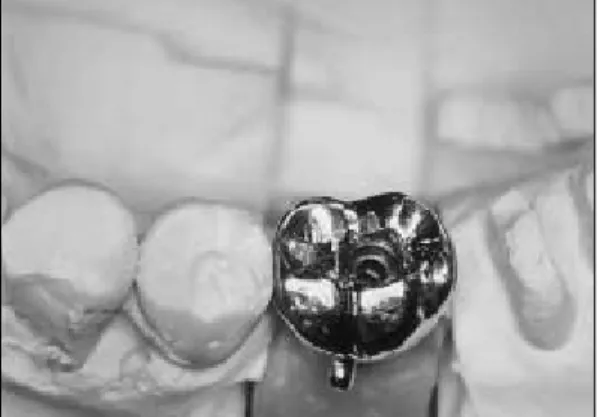
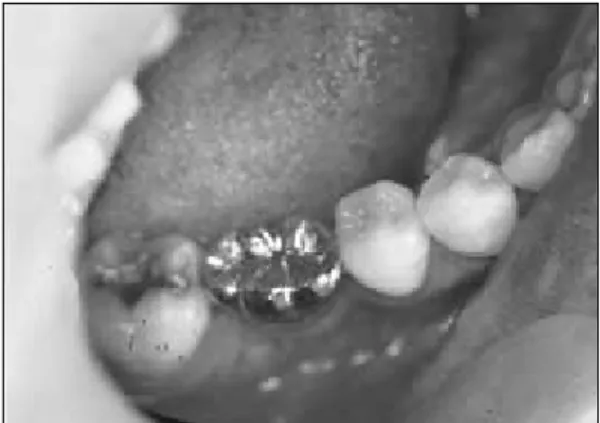
6.5mm flare, 4mm cuff의 fixed abutment를 hex dri- ver를 이용하여 임프란트 본체 아나로그에 설치하고 상하악 모형을 교합기에 부착하였다. 교두감합위 (intercuspal position)에서 최종수복물을 완성하기에 충분한 공간이 존재하는지 검사하고 필요한 양만 교 합면을 삭제한 후 abutment의 측벽이 약해지지 않도 록 cuff line하방으로는 삭제되지 않게 주의하여 변연 부 형성을 하였다. 통법에 의해 wax-up과 주조를 시 행하고 교합면으로부터 조임나사에 도달하기 위한 진입구의 형태를 수정한 후 구강내 시적하여 치간 및 교합접촉을 조정하였다. 구강외에서 글라스아이 오노머 시멘트를 이용하여 임프란트 크라운을 abut- ment에 부착한 후(Fig. 1) 진입구(access hole)를 통 하여 조임나사(fastening screw)를 조여 임프란트 본 체에 나사고정하였다. 교합검사후 진입구에 면구를 넣고 그위의 공간은 composite resin으로 밀봉하였다 (Fig. 2).
<증례 2>
#46의 금관의 탈락을 주소로 내원한 26세 여성 환자로 동일 지대치의 심한 치은 연하 우식증으로 수복이 불가능하여 발치를 시행하였다. 대합치는 금 관이 장착된 상태이고 발치 3개월 후 직경 4.0mm, 길이 15mm의 Integral Omniloc Implant body를 식
Fig. 1. retrievable crown is shown before cementa- tion to the abutment
Fig. 2. occlusal view of final restoration in model
립하고 2차 수술 후 4mm cuff의 abutment를 선택한 후 치은 연하 0.5mm에 변연형성을 하였다. 이후 통 법에 의해 임프란트 크라운을 제작하고 구강외에서 글라스아이오노머 시멘트를 이용하여 임프란트 크 라운을 abutment에 합착하였다. 본 증례의 경우 hex driver만 들어갈 수 있을 정도로 진입구의 크기 를 최소화함으로써 보다 기능적인 교합면을 형성할 수 있었다(Fig. 3, 4).
<증례 3>
44세의 남자환자로 타 의료기관에서 #47의 근관
치료를 시행한 후 방치한 결과 치근부의 수직파절을 주소로 내원하여 발치하였다. 대합치는 건강한 자연 치로 발치 약 4개월 후 직경 5mm, 길이 10mm의 Spline cylinder implant body를 식립하고 약 3개월 후 2차 수술을 시행하였다. 주변 연조직의 치유후에 6.5mm flare, 2mm cuff의 abutment를 사용하여 통 법에 의해 최종적인 임프란트 크라운을 제작하고 (Fig. 5, 6), 구강외에서 superbond 레진 시멘트를 사 용하여 임프란트 크라운을 abutment에 합착하였 다. 본 증례에서는 Spline의 fixed abutment를 사용 하여 증례 2에서와 같이 진입구의 크기를 최소화할 수 있었다.
Fig. 3. screw access hole only for allowing access to floating screw
Fig. 4. access cavity of cemented restoration is closed with resin
Fig. 5. occlusal view of restoratioon seated in mas- ter cast
Fig. 6. buccal view of finished restoration
Ⅲ. 총괄 및 고안
단일치아 결손의 임프란트 수복시에 임프란트 크 라운을 abutment에 시멘트로 합착하고 다시 이것을 나사에 의해 임프란트 본체(body, fixture)에 연결하 는 콤비네이션 임프란트 크라운은 시멘트나 나사만 을 단독으로 사용하는 연결 및 유지방식에 비해 많 은 장점들을 가지고 있다.
콤비네이션 임프란트 크라운은 분리되어 있는 완 성된 보철물과 single tooth abutment를 적절한 시멘 트로 접착한 후 이들을 abutment screw로 임프란트 와 고정하는 Jemt(1986)5)의 방법과 유사하나 McGlumphy등(1992)10)은 Integral Omniloc Implant System을 이용하여 조임나사를 위한 진입구를 hex driver가 들어가는 정도로 작게 제작하여 본 방법의 다수의 장점을 보고하였다.
Fig. 7과 Fig. 8은 각각 증례 1과 증례 2의 임프란 트 크라운의 진입구를 하방에서 본 장면으로 증례 1 은 진입구를 크게 형성하여 통상의 나사유지방식의 진입구와 유사한 크기로 교합면의 문제점을 계속 가 지고 있었으며, 증례 2는 McGlumphy 등의 증례와 같이 작은 진입구를 형성하여 교합면이 보다 기능적 이고 심미적인 수복을 시행할 수 있었다.
또한 경과관찰중 임프란트 본체에 고정된 나사의 조정으로 수복물의 retrievability가 가능한 장점을 가 지고 있다고 생각한다.
콤비네이션 임프란트 크라운을 적용한 Integral Omniloc Implant System은 조임나사가 abutment 내부에서 자유로이 움직일 수 있는 공간이 부여 된 상태로 캡슐화(encapsulating)되어 조임나사를 abutment의 외부로 제거할 수 없는 제한성이 있어 단일 치아 수복에만 사용가능하며 진입구를 hex
Fig. 8. inferior photo of access hole in case 2.
Fig. 7. inferior photo of access hole in case 1.
Fig. 9. fixed abutment which contain a floating screw in abutment housing
Fig. 10. fractured abutment which preparation below cuff line resulted in
driver가 들어 갈 수 있는 최소한의 크기로 형성할 수 있었다(Fig. 3). 캡슐화되어 있지않은 다른 분할형의 임프란트 시스템은 조임나사의 제한성이 없으므로 multiple unit에도 적용할 수 있으나 abutment간의 path가 평행하거나 abutment의 수직공간이 충분 하여 unscrewing을 위한 상방 space(교합간 거리)가 부여되는 경우에 한정되어 사용할 수 있다고 생각한 다.
콤비네이션 임프란트 크라운을 제작시 시멘트 사 용의 경우 abutment 상부 조임나사의 머리부위에 시 멘트가 들어가지 않도록 주의하여 시멘트합착을 시 행해야한다(Fig. 9).
Abutment에 임프란트 크라운을 합착하는 방법은 구강내외 어디에서든지 할 수 있으나 합착의 정확도 를 검사할 수 있고, 여분의 시멘트의 제거가 용이하 므로 구강 외에서 합착하는 방법이 추천된다10). 임프 란트 크라운 제작을 위한 abutment형성 과정시 주의 할 사항으로 구강 내에서 임프란트 본체(body,fix- ture)와 연결되어 있는 상태에서 abutment를 삭제하 지 않도록 하여 열의 발생 및 열 전도를 방지하고, 기능시 abutment의 파절 방지를 위하여 축벽(axial wall) 부위의 과다한 삭제와 cuff line하방으로의 삭제 를 하지 않도록 주의해야한다10). Fig. 10은 cuff line 하방으로 abutment를 삭제 하여 abutment가 파절된 증례를 나타내고 있다.
콤비네이션 임프란트 크라운은 임프란트 보철 수 복 완료후 필요시 언제든지 임프란트 본체에서 abutment를 분리할 수 있고, 영구적인 시멘트로 합 착한 경우에도 약 1,000�F에서 처리하여18)임프란트 크라운과 abutment를 제거하여 수리(retrievability) 가 가능하고, emergence profile의 수정을 할 수 있으 며 임프란트 주위의 연조직의 평가 및 치은연하 치 석의 제거가 용이하다10).
수제( )의 abutment (custom-cast abutment) 나 주조 가능한 플라스틱 패턴의 UCLA abutment 같이 제작하는 방식은 임프란트 본체와 abutment간 의 적합도가 저하되어 임프란트 상부구조의 미세운 동에 의한 조임나사의 풀림 현상이 일어나기 쉬운 반면19) 콤비네이션 임프란트 크라운은 밀링처리된 상태 그대로의 abutment에 임프란트 크라운이 시멘 트합착되므로 적합도의 향상을 기대할 수 있다. 또 한 abutment와 임프란트 크라운간에 시멘트로 합착
시킴으로써 나사 유지시 발생하는 settling현상의 발 생을 방지하고 힘의 분산에 도움을 주어 나사의 풀 림현상을 줄일 수 있을 것으로 사료된다.
통상적인 콤비네이션 임프란트 크라운의 제작의 금기증은 abutment의 수직공간이 불충분하여 임프 란트 크라운의 유지에 필요한 abutment의 길이가 짧 은경우로, 이 경우에는 UCLA 형 abutment와 같이 abutment와 임프란트 크라운 일체형의 나사유지 abutment (non-segmented screw-retained abut- ment)로 수복하는 것이 바람직하다9).
Ⅳ. 결 론
콤비네이션 임프란트 크라운은 단일치아 임프란트 수복시 필요한 요구조건인 단순성, 심미성 및 기능 시 회전에 대한 저항성, 수리(retrievability)가 가능 하여 경제성의 장점을 가지며 abutment와 임프란트 크라운을 연결시 시멘트 공간에 의한 오차를 보상할 수 있어 보철물 적합도가 우수하다.
즉, 시멘트합착방식(cement fixed type)과 나사유 지방식(screw retained type)의 장점을 겸비하였 다.
콤비네이션 임프란트 크라운은 분할형의 임프란트 시스템으로 임프란트 수복의 경우에는 Integral Omniloc과 Spline이외의 다른 시스템에서도 적용이 가능하다.
앞으로 콤비네이션 임프란트 크라운의 장기적인 예후에 대한 보고 및 보다 많은 임상적 연구가 이루 어져야 할 것으로 사료된다.
참 고 문 헌
1. Adell R, Lekholm U, Rockler B, et al : A 15 year study of osseointegrated implants in the treatement of the edentulous jaw. Int. J. Oral Surgery. 1981:10:387-416.
2. Kent John N., Block M.S., Finger I.M. et al : Biointegrated hydroxyapatite-coated den- tal implants: 5 year clinical observations. J.
Am. Dent. Assoc. 1990:121:138-144.
3. Kirsch A, Mentag PJ : IMZ endosseous two phase implant system: complete oral
rehabilitation treatment concept.. Oral Implant. 1986:12:576-589.
4. M.Nader Sharifi, Iok-Chao pang, John chai : Alternative Restorative Technique of ceraone single- tooth abutment: A Technical Note. Int.
Journal Oral and Maxillofacial Implants.
1994:9:235-238.
5. T.Jemt : Modified single and short- span restorations supported by osseointegrated fixtures in the partially edentulous iaw. J.
Prosthet. Dent. 1986:Vol 55:243-246.
6. Donald Spitzer, et al : Acheving ideal esthet- ics in osseointegrated Prostheses. Part
Ⅱ. The single unit. The International Journal of Periodontics and Restorative Dentistry 1992:12(6):500-507.
7. Braden Stauts : The anterior single-tooth implant restoration. J. of the California Dental Association. 1992, 20(11):35-40.
8. Pierre Boudrias : The implant-supported single-tooth restoration: Preoperative eval- uation and clinical procedure. Dental Clinics of North America. 1993:37(3):497-511.
9. George Perri, Steven Lewis, John Beumer III, et al : single tooth implants. A comparison of UCLA and Nobelpharma single tooth implant supported restorations system. J. of the California Dental Association. 1989:vol 17:No3:30-33.
10. McGlumphy EA, Papazoglou E., Riley R.L.
: The combination implant crown: A cement and screw retained restoration.Compend Continue Educ Dent. 1992:13:34-41.
11. Steven G.Lewis, John Beumer III, George R Perri, et al : single tooth implant supported restoration. Int. Journal Oral and Maxillofacial Implants: 1988:3:25-30.
12. Lewis S., Beumer III.J., Hornberg W. : The
“UCLA”abutment. Int. Journal Oral and Maxillofacial Implants. 1988:3:183-189.
13. Steven G.Lewis, D.Liamas, S.Avera : UCLA abutment: A four-year review.J. Prosthet.
Dent. 1992:67:509-515.
14. 조인호 : 치과 임프란트 시술에 관한 해외 최신 지견(Ⅱ). 대한치과의사협회지 1991:29(12) :949-955.
15. Fumitaka Takeshita et al : Various design of ceramometal crown for implant restorations.
Quintessence international. 1997:28(2):117- 120.
16. 신상완 : 단일치아 임프란트 수복 술식 ; 임프란 트의 선택, 식립과 보철과 유지. 의치학사 1998:
234-257.
17. 조인호 : 치과 임플랜트 지대나사의 풀림 현상 에 관한 연구: 대한치과보철학회지. 1996:33:1- 11.
18. Steven Lewis : Anterior single-tooth implant restorations. The International Journal of Periodontics & Restorative Dentistry 1995:15(1):31-41.
19. Keith Beaty : Esthetics and Osseoint- egration. Int Journal Oral and Maxillofacial Implants.1994: supplement 9:48-63.
20. William R.Laney, Torsten Jemt, David Harris, et al : osseointegrated implants for sin- gle tooth replacement: progressive report from a multicenter prospective study after 3 years. Int Journal Oral and Maxillofacial Implants. 1994:9:49-54.
21. Lars Jorneus, Torsten Jemt, Lennart Carlsson : Loads and designs of screw joints for single crowns supported by osseointegrated implants.
Int Journal Oral and Maxillofacial Implants.
1992:7:353-359.
22. Bo Rangert, Torsten Jemt, Lars Jorneus:
Forces and moments on Branemark implants.
Int Journal Oral and Maxillofacial Implants.
1989:4:241-247.
23. Misch,C.E. : contemporary implant den- tistry, Mosby-Year Bock, Inc, St.Louis, 1993:3-19.
24. Torsten Jemt, William R.Laney, David Harris, et al : osseointegrated implants for sin- gle tooth replacement: A 1 year report from
a multicenter prospective study. Int. Journal Oral and Maxillofacial Implants. 1991:6:29- 36.
25. Eann A.Patterson, Mi Mech E.Richard B.Johns. : Theoretical analysis of fatique life of fixture screws in osseointegrated dental implants. Int. Journal Oral and Maxillofacial Implants. 1992:7:26
26. Chiche GI, Pinault A : considerations for fab- rication of implant-supported post. restora- tions Int. J. Prosthet. 1991:4:37-44.
27. Yehuda Ganar, Baruch Indig, Martin Gross : Retrievable cemented options on implant- supported angled abutments: A case report.
Quintessence int. 1996:27(10):679-684.
The purpose of this article is to present the clinical and laboratory procedures for single tooth restoration using “Combination Implant Crown”. It is cemented on implant abutment and that abutment is screw-retained over implant body.
This type of implant restorations has the advantages of cement-retained restoration while being antirotational and retrievable. And, more esthetic and functional result can be achieved by min- imizing the size of access hole.
The results were as follows :
1. Preparation of abutment below the cuff line should be avoided
2. Axial reduction of implant abutment should not be excessive because it may weaken the abut- ment
3. More esthetical and functional occlusal surface was achieved with a minimal access hole which is slightly larger than the diameter of hex driver to enable future total retrievability.
4. Combination Implant Crown has the advantages of both the cement-retained and screw-retained type implant restoration.
5. Cementation between implant crown and abutment reduces screw loosening through even force distribution
SINGLE TOOTH IMPLANT RESTORATION USING COMBINATION IMPLANT CROWN : A CASE REPORT
Rae-Gyoung Kim*, Eon-Hee Song, Byeong-Gap Choi, Hyoun-Chull Kim, Hyun-Jeong Ahn Department of Prosthodontics, Faculty of Dentistry, Daerim Saint Mary’s Hospital ABSTRACT
Key words : Access hole, Cement-retained, Combination Implant Crown, Retrievability